
A Course to survive
Marina`s Classes.
• Grammar is the study of the rules governing
the use of a given natural language, and, as
such, is a field of linguistics.
• Traditionally, grammar included
morphology and syntax.
• In modern linguistics these
subfields are complemented
by phonetics, phonology, semantics,
and pragmatics.
• In Linguistics Syntax are the rules of a
language that show how the words of
that language are to be arranged to
make a sentence of that language.
So…
• It is the study of how words are
combined together to form
sentences.
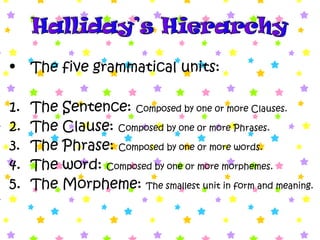
• The five grammatical units:
1. The Sentence: Composed by one 0r more Clauses.
2. The Clause: Composed by one 0r more Phrases.
3. The Phrase: Composed by one 0r more words.
4. The word: Composed by one 0r more morphemes.
5. The Morpheme: The smallest unit in form and meaning.
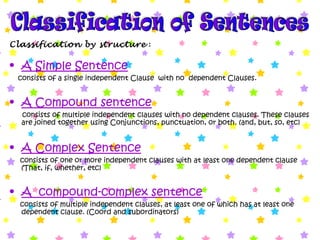
Classification by structure :
• A Simple Sentence
consists of a single independent Clause with no dependent Clauses.
• A Compound sentence
consists of multiple independent clauses with no dependent clauses. These clauses
are joined together using Conjunctions, punctuation, or both. (and, but, so, etc)
• A Complex Sentence
consists of one or more independent clauses with at least one dependent clause
(That, if, whether, etc)
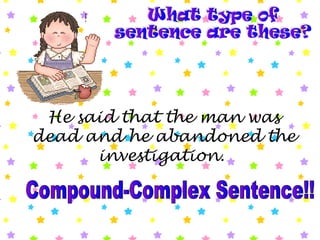
• A compound-complex sentence
consists of multiple independent clauses, at least one of which has at least one
dependent clause. (Coord and subordinators)
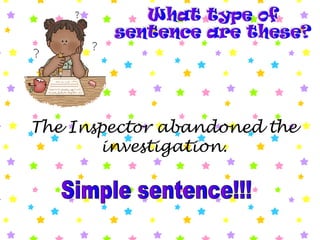
The Inspector abandoned the
investigation.
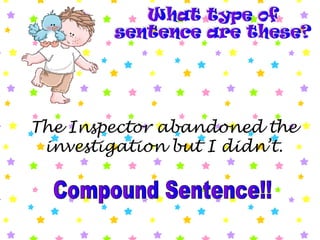
The Inspector abandoned the
investigation but I didn’t.
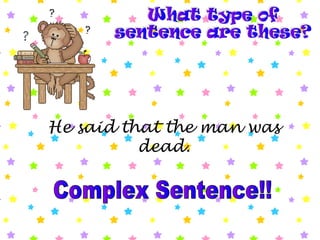
He said that the man was
dead.
He said that the man was
dead and he abandoned the
investigation.
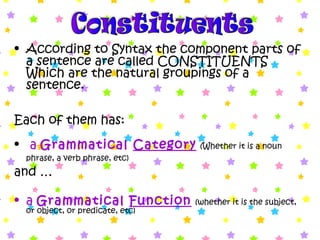
• According to Syntax the component parts of
a sentence are called CONSTITUENTS
Which are the natural groupings of a
sentence.
Each of them has:
• a Grammatical Category (Whether it is a noun
phrase, a verb phrase, etc)
and …
• a Grammatical Function (whether it is the subject,
or object, or predicate, etc)
A constituent is formed if…
1) Constituents can stand alone
• Ex. “What did you find?” “A puppy” (not “found a”)
2) Constituents can be replaced by one word.
• Ex. “Where did you find a puppy?” “I found HIM in
the park.”
3) Constituents move together.
• Ex. It was [a puppy] that the child found.
• [A puppy] was found by the child.
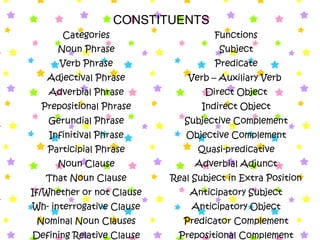
CONSTITUENTS
Categories Functions
Noun Phrase
Verb Phrase
Adjectival Phrase
Adverbial Phrase
Prepositional Phrase
Gerundial Phrase
Infinitival Phrase
Participial Phrase
Noun Clause
That Noun Clause
If/Whether or not Clause
Wh- interrogative Clause
Nominal Noun Clauses
Defining Relative Clause
Subject
Predicate
Verb – Auxiliary Verb
Direct Object
Indirect Object
Subjective Complement
Objective Complement
Quasi-predicative
Adverbial Adjunct
Real Subject in Extra Position
Anticipatory Subject
Anticipatory Object
Predicator Complement
Prepositional Complement
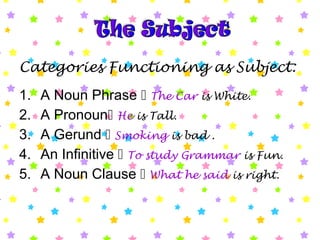
Categories Functioning as Subject:
1. A Noun Phrase  The Car is White.
2. A Pronoun He is Tall.
3. A Gerund  Smoking is bad .
4. An Infinitive  To study Grammar is Fun.
5. A Noun Clause  What he said is right.
Verbs can be either Transitive or Intransitive;
and their predication can be either Complete or
Incomplete.
I.V.C.P = S + [ V + (A.A) ]
T.V.C.P = S + [ V + D.O + (A.A) ]
BI T.V.C.P = S+ [ V+ D.O. + I.O + (A.A) ]
T.V.I.P = S + [ V + D.O. + O.C + (A.A)]
I.V.I.P = [V + S.C + (A.A) ]
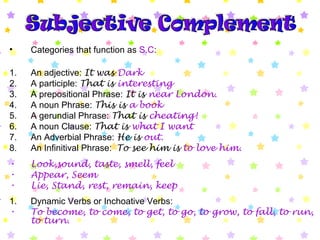
• Categories that function as S.C:
1. An adjective: It was Dark
2. A participle: That is interesting
3. A prepositional Phrase: It is near London.
4. A noun Phrase: This is a book
5. A gerundial Phrase: That is cheating!
6. A noun Clause: That is what I want
7. An Adverbial Phrase: He is out.
8. An Infinitival Phrase: To see him is to love him.
• Look,sound, taste, smell, feel
• Appear, Seem
• Lie, Stand, rest, remain, keep
1. Dynamic Verbs or Inchoative Verbs:
• To become, to come, to get, to go, to grow, to fall, to run,
to turn.
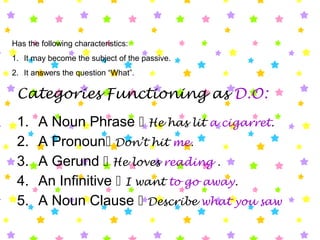
Has the following characteristics:
1. It may become the subject of the passive.
2. It answers the question “What”.
Categories Functioning as D.O:
1. A Noun Phrase  He has lit a cigarret.
2. A Pronoun Don’t hit me.
3. A Gerund  He loves reading .
4. An Infinitive  I want to go away.
5. A Noun Clause  Describe what you saw
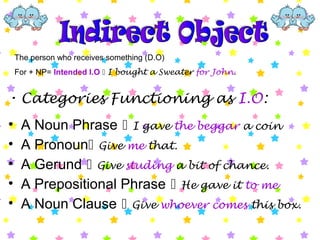
• Categories Functioning as I.O:
• A Noun Phrase  I gave the beggar a coin
• A Pronoun Give me that.
• A Gerund  Give studing a bit of chance.
• A Prepositional Phrase  He gave it to me
• A Noun Clause  Give whoever comes this box.
The person who receives something (D.O)
For + NP= Intended I.O  I bought a Sweater for John.
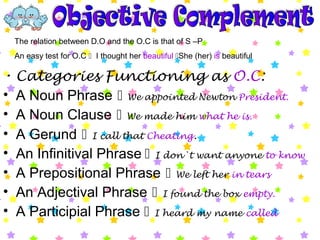
• Categories Functioning as O.C:
• A Noun Phrase  We appointed Newton President.
• A Noun Clause  We made him what he is.
• A Gerund  I call that Cheating.
• An Infinitival Phrase  I don`t want anyone to know
• A Prepositional Phrase  We left her in tears
• An Adjectival Phrase  I found the box empty.
• A Participial Phrase  I heard my name called
The relation between D.O and the O.C is that of S –P
An easy test for O.C  I thought her beautiful She (her) is beautiful
Sentence Advervials
The Predicator Complement
Adjectival Complement
The Agentive Complement
The Quasi Predicative
Semantic analisis
Verbs
Nouns
Adjectives
Adverbs
Articles
Conjunctions
Syntactic analysis-1211248481598474-9

Syntactic analysis-1211248481598474-9

  • 1.
    A Course tosurvive Marina`s Classes.
  • 2.
    • Grammar isthe study of the rules governing the use of a given natural language, and, as such, is a field of linguistics. • Traditionally, grammar included morphology and syntax. • In modern linguistics these subfields are complemented by phonetics, phonology, semantics, and pragmatics.
  • 3.
    • In LinguisticsSyntax are the rules of a language that show how the words of that language are to be arranged to make a sentence of that language. So… • It is the study of how words are combined together to form sentences.
  • 4.
    • The fivegrammatical units: 1. The Sentence: Composed by one 0r more Clauses. 2. The Clause: Composed by one 0r more Phrases. 3. The Phrase: Composed by one 0r more words. 4. The word: Composed by one 0r more morphemes. 5. The Morpheme: The smallest unit in form and meaning.
  • 5.
    Classification by structure: • A Simple Sentence consists of a single independent Clause with no dependent Clauses. • A Compound sentence consists of multiple independent clauses with no dependent clauses. These clauses are joined together using Conjunctions, punctuation, or both. (and, but, so, etc) • A Complex Sentence consists of one or more independent clauses with at least one dependent clause (That, if, whether, etc) • A compound-complex sentence consists of multiple independent clauses, at least one of which has at least one dependent clause. (Coord and subordinators)
  • 7.
    The Inspector abandonedthe investigation.
  • 8.
    The Inspector abandonedthe investigation but I didn’t.
  • 9.
    He said thatthe man was dead.
  • 10.
    He said thatthe man was dead and he abandoned the investigation.
  • 11.
    • According toSyntax the component parts of a sentence are called CONSTITUENTS Which are the natural groupings of a sentence. Each of them has: • a Grammatical Category (Whether it is a noun phrase, a verb phrase, etc) and … • a Grammatical Function (whether it is the subject, or object, or predicate, etc)
  • 12.
    A constituent isformed if… 1) Constituents can stand alone • Ex. “What did you find?” “A puppy” (not “found a”) 2) Constituents can be replaced by one word. • Ex. “Where did you find a puppy?” “I found HIM in the park.” 3) Constituents move together. • Ex. It was [a puppy] that the child found. • [A puppy] was found by the child.
  • 13.
    CONSTITUENTS Categories Functions Noun Phrase VerbPhrase Adjectival Phrase Adverbial Phrase Prepositional Phrase Gerundial Phrase Infinitival Phrase Participial Phrase Noun Clause That Noun Clause If/Whether or not Clause Wh- interrogative Clause Nominal Noun Clauses Defining Relative Clause Subject Predicate Verb – Auxiliary Verb Direct Object Indirect Object Subjective Complement Objective Complement Quasi-predicative Adverbial Adjunct Real Subject in Extra Position Anticipatory Subject Anticipatory Object Predicator Complement Prepositional Complement
  • 14.
    Categories Functioning asSubject: 1. A Noun Phrase  The Car is White. 2. A Pronoun He is Tall. 3. A Gerund  Smoking is bad . 4. An Infinitive  To study Grammar is Fun. 5. A Noun Clause  What he said is right.
  • 15.
    Verbs can beeither Transitive or Intransitive; and their predication can be either Complete or Incomplete. I.V.C.P = S + [ V + (A.A) ] T.V.C.P = S + [ V + D.O + (A.A) ] BI T.V.C.P = S+ [ V+ D.O. + I.O + (A.A) ] T.V.I.P = S + [ V + D.O. + O.C + (A.A)] I.V.I.P = [V + S.C + (A.A) ]
  • 16.
    • Categories thatfunction as S.C: 1. An adjective: It was Dark 2. A participle: That is interesting 3. A prepositional Phrase: It is near London. 4. A noun Phrase: This is a book 5. A gerundial Phrase: That is cheating! 6. A noun Clause: That is what I want 7. An Adverbial Phrase: He is out. 8. An Infinitival Phrase: To see him is to love him. • Look,sound, taste, smell, feel • Appear, Seem • Lie, Stand, rest, remain, keep 1. Dynamic Verbs or Inchoative Verbs: • To become, to come, to get, to go, to grow, to fall, to run, to turn.
  • 17.
    Has the followingcharacteristics: 1. It may become the subject of the passive. 2. It answers the question “What”. Categories Functioning as D.O: 1. A Noun Phrase  He has lit a cigarret. 2. A Pronoun Don’t hit me. 3. A Gerund  He loves reading . 4. An Infinitive  I want to go away. 5. A Noun Clause  Describe what you saw
  • 18.
    • Categories Functioningas I.O: • A Noun Phrase  I gave the beggar a coin • A Pronoun Give me that. • A Gerund  Give studing a bit of chance. • A Prepositional Phrase  He gave it to me • A Noun Clause  Give whoever comes this box. The person who receives something (D.O) For + NP= Intended I.O  I bought a Sweater for John.
  • 19.
    • Categories Functioningas O.C: • A Noun Phrase  We appointed Newton President. • A Noun Clause  We made him what he is. • A Gerund  I call that Cheating. • An Infinitival Phrase  I don`t want anyone to know • A Prepositional Phrase  We left her in tears • An Adjectival Phrase  I found the box empty. • A Participial Phrase  I heard my name called The relation between D.O and the O.C is that of S –P An easy test for O.C  I thought her beautiful She (her) is beautiful
  • 20.
  • 21.
  • 22.
  • 23.
  • 24.
  • 25.
  • 26.
  • 27.
  • 28.
  • 29.
  • 30.
  • 31.