Syntax and Stylistics Passive, Theta Roles, and Wh-movement
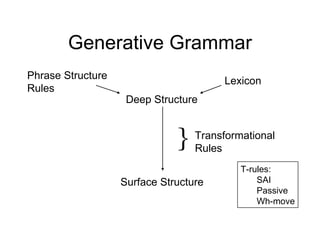
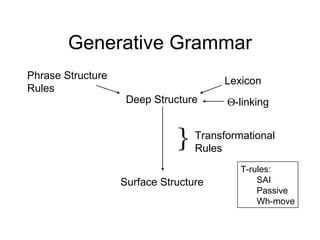
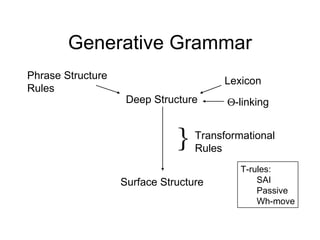
Generative Grammar Phrase Structure Rules Lexicon Deep Structure Surface Structure  Transformational Rules T-rules: SAI Passive Wh-move
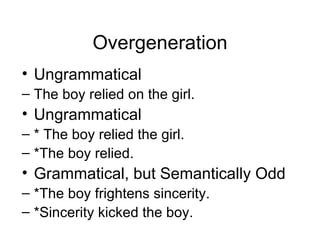
Overgeneration Ungrammatical The boy relied on the girl. Ungrammatical * The boy relied the girl. *The boy relied. Grammatical, but Semantically Odd *The boy frightens sincerity. *Sincerity kicked the boy.
Subcategorization frames Verbs come in different flavors: V i :  The woman walked V t :  John loves Mary V dt :  Mary gave Peter flowers V s :  I know that she likes you This can be expressed as a kind of frame associated with the lexical entry for each verb: walked , V i ,   [ ___ ] love , V t ,   [ ___ NP] put , V dt ,   [ ___ NP NP] know , V s , [ ___ S]
Connecting PS and V frames S NP VP V put  [ ___ NP PP] the The boys PP P NP on the porch NP dinner The frame puts selectional restrictions on where a particular verb can appear.
Argument Structure Through subcategorization, the verb makes sure that it has all the arguments it requires.
Exercise #1 Workout the subcategorization frame of each of the lexical items:  aspire ,  declare, conduct, aware, transport, arrange, deliver, silent
Subacategorization But what about:  The dinner was put on the porch. No direct object for  put . Won’t take one: *The dinner was put  the steak  on the porch.
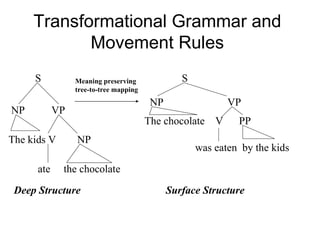
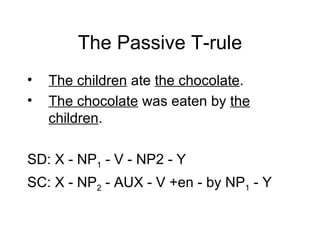
Passive Transformation  Demotion of the subject to an adjunct introduced by  by.   Promotion of the object to subject status. Introduction of an auxiliary verb:  English  be  or  get   The chlidren ate the chocolate.  -->  The chocolate  was/got  eaten  by  the children.
Transformational Grammar and Movement Rules S NP  VP The kids V  NP ate  the chocolate Deep Structure S NP  VP The chocolate  V  PP was eaten  by the kids Surface Structure Meaning preserving tree-to-tree mapping
The Passive T-rule The children  ate  the chocolate . The chocolate  was eaten by  the children . SD: X - NP 1  - V - NP2 - Y SC: X - NP 2  - AUX - V +en - by NP 1  - Y
Passives Why do writers often mistakenly think that some sentences are passive, when they are not? My friend suffered an injury while we were canoeing.
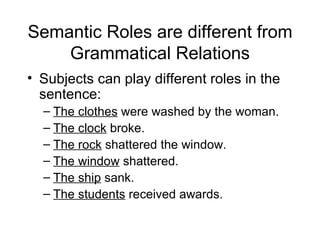
Semantic Roles are different from Grammatical Relations Subjects can play different roles in the sentence: The clothes  were washed by the woman. The clock  broke. The rock  shattered the window. The window  shattered. The ship  sank. The students  received awards.
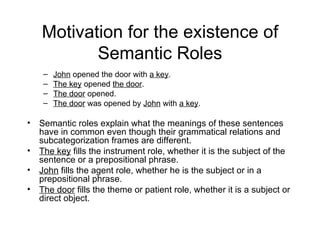
Motivation for the existence of Semantic Roles John  opened the door with  a key . The key  opened  the door . The door  opened. The door  was opened by  John  with  a key . Semantic roles explain what the meanings of these sentences have in common even though their grammatical relations and subcategorization frames are different. The key  fills the instrument role, whether it is the subject of the sentence or a prepositional phrase. John  fills the agent role, whether he is the subject or in a prepositional phrase. The door  fills the theme or patient role, whether it is a subject or direct object.
Thematic Roles Because linguists like to make up technical-sounding words, they usually refer to semantic roles as “Thematic Roles” or just “  -roles.”
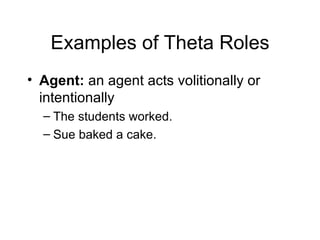
Examples of Theta Roles Agent:  an agent acts volitionally or intentionally The students worked. Sue baked a cake.
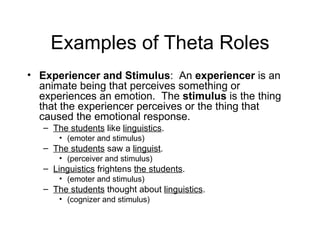
Examples of Theta Roles Experiencer and Stimulus :  An  experiencer  is an animate being that perceives something or experiences an emotion.  The  stimulus  is the thing that the experiencer perceives or the thing that caused the emotional response.  The students  like  linguistics .  (emoter and stimulus) The students  saw a  linguist .  (perceiver and stimulus) Linguistics  frightens  the students .  (emoter and stimulus) The students  thought about  linguistics .  (cognizer and stimulus)
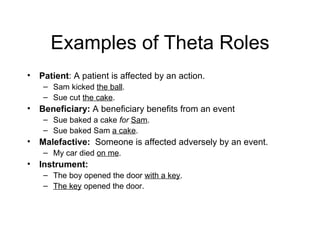
Examples of Theta Roles Patient : A patient is affected by an action. Sam kicked  the ball . Sue cut  the cake . Beneficiary:  A beneficiary benefits from an event Sue baked a cake  for  Sam . Sue baked Sam  a cake . Malefactive:   Someone is affected adversely by an event. My car died  on me .  Instrument:   The boy opened the door  with a key . The key  opened the door.
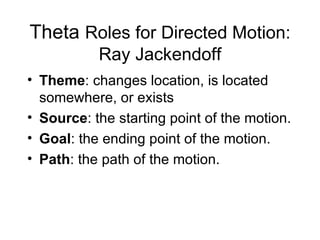
Theta  Roles for Directed Motion: Ray Jackendoff Theme : changes location, is located somewhere, or exists Source : the starting point of the motion. Goal : the ending point of the motion. Path : the path of the motion.
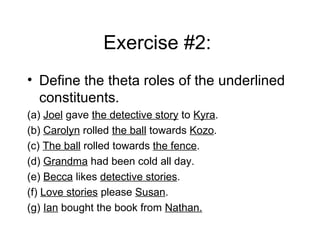
Exercise #2:  Define the theta roles of the underlined constituents. (a)  Joel  gave  the detective story  to  Kyra . (b)  Carolyn  rolled  the ball  towards  Kozo . (c)  The ball  rolled towards  the fence . (d)  Grandma  had been cold all day. (e)  Becca  likes  detective stories . (f)  Love stories  please  Susan . (g)  Ian  bought the book from  Nathan.
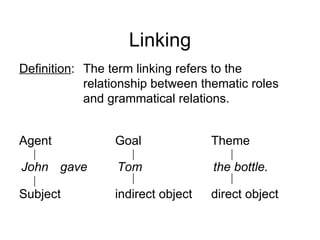
Linking Definition : The term linking refers to the  relationship between thematic roles  and grammatical relations. Agent Goal Theme John   gave Tom the bottle. Subject indirect object direct object
Linking In an unmarked declarative sentence,  agents  map to subject positions,  themes  onto object position, and  goals  onto indirect objects. Only arguments of the verb have a   -role.  NPs can have only one   -role at a time.
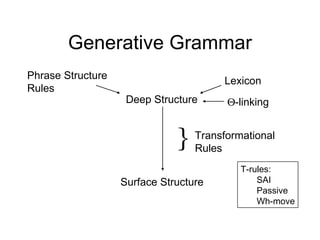
Generative Grammar Phrase Structure Rules Lexicon Deep Structure Surface Structure  Transformational Rules T-rules: SAI Passive Wh-move  -linking
Theta-role prerequisite for the passive:  Object must be a patient! That means, the object must have been affected by the relevant event before it can be moved into the subject position. Passives
Only English allows for passivization of imperatives: Don’t get bitten by snakes! German: * Werde nicht von Schlangen gebissen!  Lass dich nicht von Schlangen beißen!
Only German allows for passivization of intransitives: In den Fluren wird nicht gerannt! (subjectless) English:  Running is not allowed in the corridors.
Problems with Semantic Roles The definitions are vague: If themes are things that moved, is his hand a theme in John moved his hand? Linguists keep making up new role names without proper motivation.  Proper motivation would be a test. Linguists keep writing about the same small set of verbs that have clearly identified roles.  Many roles are not clearly covered.  He risked death. We resisted the enemy. She resembles her mother.
Generative Grammar Phrase Structure Rules Lexicon Deep Structure Surface Structure  Transformational Rules T-rules: SAI Passive Wh-move  -linking
Two kinds of Questions Yes/No questions: Did you see the octopus? yes/no/*dog Have you eaten yet? yes/no/*apple Wh-questions Who was here last week? Fergus/*no What do you have there? donuts/*yes
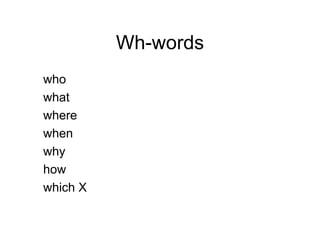
Wh-words who what  where  when why how which X
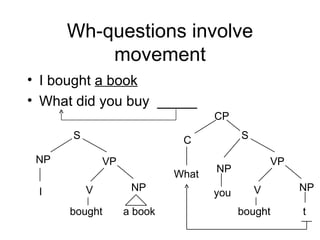
Wh-questions involve movement I bought  a book What did you buy  _____ S NP VP I V NP bought a book S NP VP you V NP bought t What CP C
Where from? What  did you say [ was hit ______ ]? gets theta role here cf. John hit  the ball Ends up here
How Far away? What  did you say Joel dreamed Kyra thought Ayla said [ was hit ______ ]? still gets theta role here
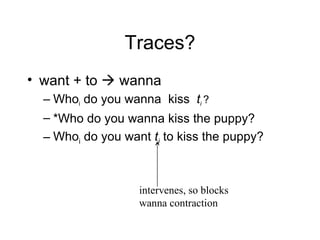
Traces? want + to    wanna Who i  do you wanna  kiss  t i  ? *Who do you wanna kiss the puppy? Who i  do you want  t i  to kiss the puppy? intervenes, so blocks wanna contraction
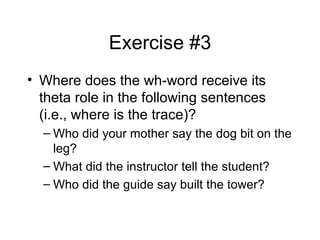
Exercise #3 Where does the wh-word receive its theta role in the following sentences (i.e., where is the trace)? Who did your mother say the dog bit on the leg? What did the instructor tell the student? Who did the guide say built the tower?
Generative Grammar Phrase Structure Rules Lexicon Deep Structure Surface Structure  Transformational Rules T-rules: SAI Passive Wh-move  -linking
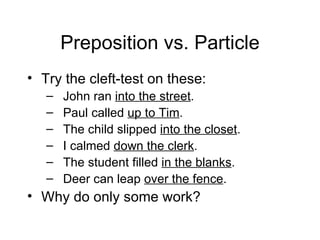
Preposition vs. Particle Try the cleft-test on these: John ran  into the street . Paul called  up to Tim . The child slipped  into the closet . I calmed  down the clerk . The student filled  in the blanks . Deer can leap  over the fence . Why do only some work?
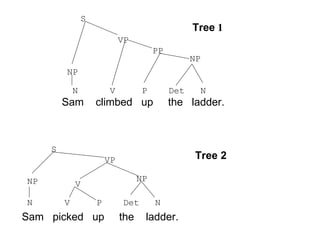
Sam  climbed  up  the  ladder. Sam  picked  up  the  ladder. N  V  P  Det  N N  V  P  Det  N NP NP NP VP S V S Tree  1 Tree 2 NP VP PP
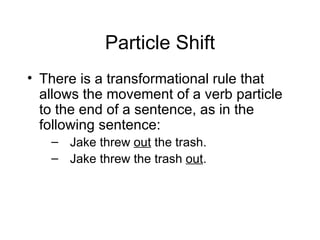
Particle Shift There is a transformational rule that allows the movement of a verb particle to the end of a sentence, as in the following sentence: Jake threw  out  the trash. Jake threw the trash  out .
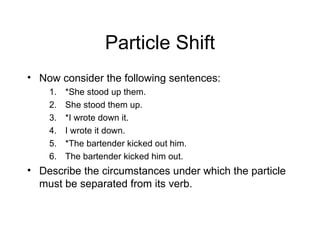
Particle Shift Now consider the following sentences: *She stood up them. She stood them up. *I wrote down it. I wrote it down. *The bartender kicked out him. The bartender kicked him out. Describe the circumstances under which the particle must be separated from its verb.

Syntax & Stylistics5

  • 1.
    Syntax and StylisticsPassive, Theta Roles, and Wh-movement
  • 2.
    Generative Grammar PhraseStructure Rules Lexicon Deep Structure Surface Structure  Transformational Rules T-rules: SAI Passive Wh-move
  • 3.
    Overgeneration Ungrammatical Theboy relied on the girl. Ungrammatical * The boy relied the girl. *The boy relied. Grammatical, but Semantically Odd *The boy frightens sincerity. *Sincerity kicked the boy.
  • 4.
    Subcategorization frames Verbscome in different flavors: V i : The woman walked V t : John loves Mary V dt : Mary gave Peter flowers V s : I know that she likes you This can be expressed as a kind of frame associated with the lexical entry for each verb: walked , V i , [ ___ ] love , V t , [ ___ NP] put , V dt , [ ___ NP NP] know , V s , [ ___ S]
  • 5.
    Connecting PS andV frames S NP VP V put [ ___ NP PP] the The boys PP P NP on the porch NP dinner The frame puts selectional restrictions on where a particular verb can appear.
  • 6.
    Argument Structure Throughsubcategorization, the verb makes sure that it has all the arguments it requires.
  • 7.
    Exercise #1 Workoutthe subcategorization frame of each of the lexical items: aspire , declare, conduct, aware, transport, arrange, deliver, silent
  • 8.
    Subacategorization But whatabout: The dinner was put on the porch. No direct object for put . Won’t take one: *The dinner was put the steak on the porch.
  • 9.
    Passive Transformation Demotion of the subject to an adjunct introduced by by. Promotion of the object to subject status. Introduction of an auxiliary verb: English be or get The chlidren ate the chocolate. --> The chocolate was/got eaten by the children.
  • 10.
    Transformational Grammar andMovement Rules S NP VP The kids V NP ate the chocolate Deep Structure S NP VP The chocolate V PP was eaten by the kids Surface Structure Meaning preserving tree-to-tree mapping
  • 11.
    The Passive T-ruleThe children ate the chocolate . The chocolate was eaten by the children . SD: X - NP 1 - V - NP2 - Y SC: X - NP 2 - AUX - V +en - by NP 1 - Y
  • 12.
    Passives Why dowriters often mistakenly think that some sentences are passive, when they are not? My friend suffered an injury while we were canoeing.
  • 13.
    Semantic Roles aredifferent from Grammatical Relations Subjects can play different roles in the sentence: The clothes were washed by the woman. The clock broke. The rock shattered the window. The window shattered. The ship sank. The students received awards.
  • 14.
    Motivation for theexistence of Semantic Roles John opened the door with a key . The key opened the door . The door opened. The door was opened by John with a key . Semantic roles explain what the meanings of these sentences have in common even though their grammatical relations and subcategorization frames are different. The key fills the instrument role, whether it is the subject of the sentence or a prepositional phrase. John fills the agent role, whether he is the subject or in a prepositional phrase. The door fills the theme or patient role, whether it is a subject or direct object.
  • 15.
    Thematic Roles Becauselinguists like to make up technical-sounding words, they usually refer to semantic roles as “Thematic Roles” or just “  -roles.”
  • 16.
    Examples of ThetaRoles Agent: an agent acts volitionally or intentionally The students worked. Sue baked a cake.
  • 17.
    Examples of ThetaRoles Experiencer and Stimulus : An experiencer is an animate being that perceives something or experiences an emotion. The stimulus is the thing that the experiencer perceives or the thing that caused the emotional response. The students like linguistics . (emoter and stimulus) The students saw a linguist . (perceiver and stimulus) Linguistics frightens the students . (emoter and stimulus) The students thought about linguistics . (cognizer and stimulus)
  • 18.
    Examples of ThetaRoles Patient : A patient is affected by an action. Sam kicked the ball . Sue cut the cake . Beneficiary: A beneficiary benefits from an event Sue baked a cake for Sam . Sue baked Sam a cake . Malefactive: Someone is affected adversely by an event. My car died on me . Instrument: The boy opened the door with a key . The key opened the door.
  • 19.
    Theta Rolesfor Directed Motion: Ray Jackendoff Theme : changes location, is located somewhere, or exists Source : the starting point of the motion. Goal : the ending point of the motion. Path : the path of the motion.
  • 20.
    Exercise #2: Define the theta roles of the underlined constituents. (a) Joel gave the detective story to Kyra . (b) Carolyn rolled the ball towards Kozo . (c) The ball rolled towards the fence . (d) Grandma had been cold all day. (e) Becca likes detective stories . (f) Love stories please Susan . (g) Ian bought the book from Nathan.
  • 21.
    Linking Definition :The term linking refers to the relationship between thematic roles and grammatical relations. Agent Goal Theme John gave Tom the bottle. Subject indirect object direct object
  • 22.
    Linking In anunmarked declarative sentence, agents map to subject positions, themes onto object position, and goals onto indirect objects. Only arguments of the verb have a  -role. NPs can have only one  -role at a time.
  • 23.
    Generative Grammar PhraseStructure Rules Lexicon Deep Structure Surface Structure  Transformational Rules T-rules: SAI Passive Wh-move  -linking
  • 24.
    Theta-role prerequisite forthe passive: Object must be a patient! That means, the object must have been affected by the relevant event before it can be moved into the subject position. Passives
  • 25.
    Only English allowsfor passivization of imperatives: Don’t get bitten by snakes! German: * Werde nicht von Schlangen gebissen! Lass dich nicht von Schlangen beißen!
  • 26.
    Only German allowsfor passivization of intransitives: In den Fluren wird nicht gerannt! (subjectless) English: Running is not allowed in the corridors.
  • 27.
    Problems with SemanticRoles The definitions are vague: If themes are things that moved, is his hand a theme in John moved his hand? Linguists keep making up new role names without proper motivation. Proper motivation would be a test. Linguists keep writing about the same small set of verbs that have clearly identified roles. Many roles are not clearly covered. He risked death. We resisted the enemy. She resembles her mother.
  • 28.
    Generative Grammar PhraseStructure Rules Lexicon Deep Structure Surface Structure  Transformational Rules T-rules: SAI Passive Wh-move  -linking
  • 29.
    Two kinds ofQuestions Yes/No questions: Did you see the octopus? yes/no/*dog Have you eaten yet? yes/no/*apple Wh-questions Who was here last week? Fergus/*no What do you have there? donuts/*yes
  • 30.
    Wh-words who what where when why how which X
  • 31.
    Wh-questions involve movementI bought a book What did you buy _____ S NP VP I V NP bought a book S NP VP you V NP bought t What CP C
  • 32.
    Where from? What did you say [ was hit ______ ]? gets theta role here cf. John hit the ball Ends up here
  • 33.
    How Far away?What did you say Joel dreamed Kyra thought Ayla said [ was hit ______ ]? still gets theta role here
  • 34.
    Traces? want +to  wanna Who i do you wanna kiss t i ? *Who do you wanna kiss the puppy? Who i do you want t i to kiss the puppy? intervenes, so blocks wanna contraction
  • 35.
    Exercise #3 Wheredoes the wh-word receive its theta role in the following sentences (i.e., where is the trace)? Who did your mother say the dog bit on the leg? What did the instructor tell the student? Who did the guide say built the tower?
  • 36.
    Generative Grammar PhraseStructure Rules Lexicon Deep Structure Surface Structure  Transformational Rules T-rules: SAI Passive Wh-move  -linking
  • 37.
    Preposition vs. ParticleTry the cleft-test on these: John ran into the street . Paul called up to Tim . The child slipped into the closet . I calmed down the clerk . The student filled in the blanks . Deer can leap over the fence . Why do only some work?
  • 38.
    Sam climbed up the ladder. Sam picked up the ladder. N V P Det N N V P Det N NP NP NP VP S V S Tree 1 Tree 2 NP VP PP
  • 39.
    Particle Shift Thereis a transformational rule that allows the movement of a verb particle to the end of a sentence, as in the following sentence: Jake threw out the trash. Jake threw the trash out .
  • 40.
    Particle Shift Nowconsider the following sentences: *She stood up them. She stood them up. *I wrote down it. I wrote it down. *The bartender kicked out him. The bartender kicked him out. Describe the circumstances under which the particle must be separated from its verb.