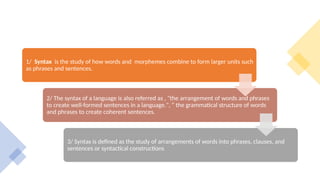
1/ Syntax isthe study of how words and morphemes combine to form larger units such
as phrases and sentences.
2/ The syntax of a language is also referred as , "the arrangement of words and phrases
to create well-formed sentences in a language.", “ the grammatical structure of words
and phrases to create coherent sentences.
3/ Syntax is defined as the study of arrangements of words into phrases, clauses, and
sentences or syntactical constructions
4.
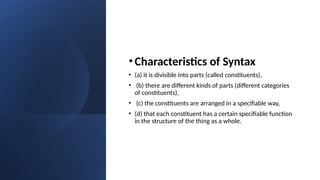
•Characteristics of Syntax
•(a) it is divisible into parts (called constituents),
• (b) there are different kinds of parts (different categories
of constituents),
• (c) the constituents are arranged in a specifiable way,
• (d) that each constituent has a certain specifiable function
in the structure of the thing as a whole.
Important
Concepts in Syntax
•1.Immediate Constituents
2.Hierarical Structure
3.Ungrammatical Structure
4.Syntatic Constructions
• 5.Words,Phrases and Sentences
• 6. Subject and Predicate
8.
Syntax and
Immediate
Constituents
1
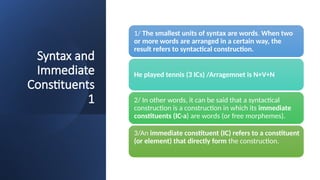
1/ Thesmallest units of syntax are words. When two
or more words are arranged in a certain way, the
result refers to syntactical construction.
He played tennis (3 ICs) /Arragemnet is N+V+N
2/ In other words, it can be said that a syntactical
construction is a construction in which its immediate
constituents (IC-a) are words (or free morphemes).
3/An immediate constituent (IC) refers to a constituent
(or element) that directly form the construction.
9.
Syntax and ImmediateConstituents 2
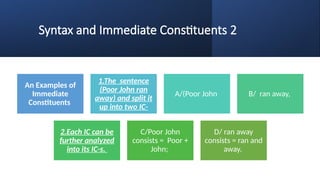
An Examples of
Immediate
Constituents
1.The sentence
(Poor John ran
away) and split it
up into two IC-
A/(Poor John B/ ran away,
2.Each IC can be
further analyzed
into its IC-s.
C/Poor John
consists = Poor +
John;
D/ ran away
consists = ran and
away.
10.
Syntax and
Hierarchical
Structure
• 1/Whenanything can be analysed in this
way (IC way), we say that it has structure.
• 2/ In considering structure it is important
to note that the parts themselves consist
of parts which may in turn consist of
further parts.
• 3/When this is so we may speak of a
hierarchy of parts and of hierarchical
structure.
• Poor John run away (Two Parts:
Strcutures)
• It is a sentence because we can divide it
into parts and it has IC.
11.
Syntax and
Ungrammatical
Structure
When asequence of words fails to
constitute a good expression in the
language, it is considered as
ungrammatical (or ill-formed) and mark
it with an asterisk (*).
Here are some examples:
[1a] *the nevertheless procrastinate in
foxtrot [1b] *disappears none girls of
the students [1c] *Max will bought a
frying pans.
12.
Words in
Syntax
1/ Wordshave no relationship to
each other except the relationship
of being in a certain order in the
same sentence.
2/ The position of words in a
sentence is determined by the fact
that the words are not immediate
constituents of the sentence, but
belong with other words to form
groups or the so-called phrases.
13.
Phrases In Syntax
Phraseshave their own position
in the structure of the sentence. It
is these phrases that function as
immediate constituents of the
sentence.
Phrases form not only syntactic
units (constituents in the
structural form of sentences) but
also semantic units. In other
words, they form identifiable
parts of the meaning of
sentences; they form coherent
units of sense.
14.
Sentence in
Syntax
Sentences certainlycontain words, they
don’t consist of words. They consist of
phrases.
In dividing sentences, sentences can have
two constituents, the first of which is
traditionally said to function as subject, and
the second as predicate.
The subject is being used to mention
something (e.g. the ducks) and the predicate
as used to say something about the subject
(e.g. that they were paddling away
All parts of a sentence are necessary in
order for that sentence to be complete and
well-formed.
15.
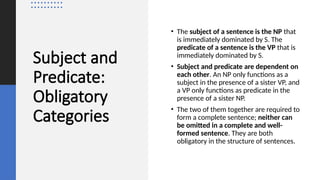
Subject and
Predicate:
Obligatory
Categories
• Thesubject of a sentence is the NP that
is immediately dominated by S. The
predicate of a sentence is the VP that is
immediately dominated by S.
• Subject and predicate are dependent on
each other. An NP only functions as a
subject in the presence of a sister VP, and
a VP only functions as predicate in the
presence of a sister NP.
• The two of them together are required to
form a complete sentence; neither can
be omitted in a complete and well-
formed sentence. They are both
obligatory in the structure of sentences.
16.
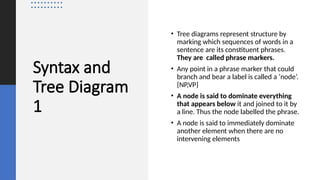
Syntax and
Tree Diagram
1
•Tree diagrams represent structure by
marking which sequences of words in a
sentence are its constituent phrases.
They are called phrase markers.
• Any point in a phrase marker that could
branch and bear a label is called a ‘node’.
{NP,VP}
• A node is said to dominate everything
that appears below it and joined to it by
a line. Thus the node labelled the phrase.
• A node is said to immediately dominate
another element when there are no
intervening elements
17.
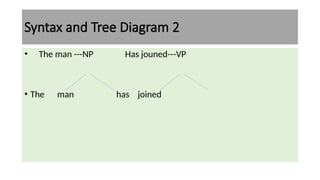
Syntax and TreeDiagram 2
• The man ---NP Has jouned---VP
• The man has joined
18.
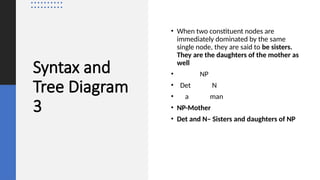
Syntax and
Tree Diagram
3
•When two constituent nodes are
immediately dominated by the same
single node, they are said to be sisters.
They are the daughters of the mother as
well
• NP
• Det N
• a man
• NP-Mother
• Det and N– Sisters and daughters of NP
PHRASES
20
Phrases are largerstructural units that
come between the word and the clause
(or sentence).
They can be groups of words or single
words behaving as a unit. As such they
can be substituted, moved, extended or
reduced, without modifying the meaning
of the sentence.
21.
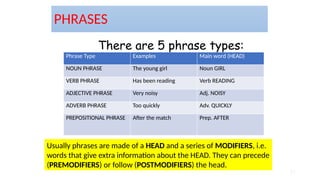
21
There are 5phrase types:
PHRASES
Phrase Type Examples Main word (HEAD)
NOUN PHRASE The young girl Noun GIRL
VERB PHRASE Has been reading Verb READING
ADJECTIVE PHRASE Very noisy Adj. NOISY
ADVERB PHRASE Too quickly Adv. QUICKLY
PREPOSITIONAL PHRASE After the match Prep. AFTER
Usually phrases are made of a HEAD and a series of MODIFIERS, i.e.
words that give extra information about the HEAD. They can precede
(PREMODIFIERS) or follow (POSTMODIFIERS) the head.
22.
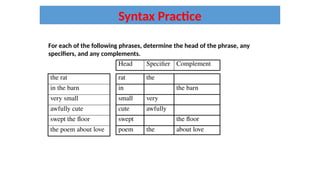
Syntax Practice
For eachof the following phrases, determine the head of the phrase, any
specifiers, and any complements.
the rat
in the barn
very small
awfully cute
swept the floor
the poem about love
rat the
in the barn
small very
cute awfully
swept the floor
poem the about love
Head Specifier Complement
23.
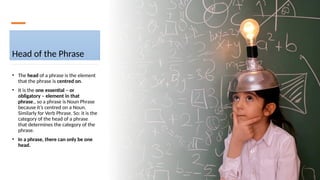
Head of thePhrase
• The head of a phrase is the element
that the phrase is centred on.
• It is the one essential – or
obligatory – element in that
phrase., so a phrase is Noun Phrase
because it’s centred on a Noun.
Similarly for Verb Phrase. So: it is the
category of the head of a phrase
that determines the category of the
phrase.
• In a phrase, there can only be one
head.
24.
Heads and ModifiersRelation
Optional and Obligatory
Elements
The big difference
between modifiers and
heads, then, is this: in the
structure of a phrase,
modifiers are optional; the
head is the obligatory
element.
25.
Nouns and NounPhrases
• 1/Apple, Bill, India, Muscat Honesty, suspicions, and January are nouns because they
occupy the same range of positions and have the same range of functions – i.e. have the
same distribution – as other words that obviously are nouns by the traditional
definition.
• 2/ Nouns have word forms such as plural “ s”{books}, genitive or possessive “s” Bill’s
book.
• 3/All nouns have definite and indefinite articles.
• 4/Pronouns are used to stand in place of complete Noun Phrases (NPs).
• 5/It is the head noun that determines the number (singular or plural) and the gender
(masculine, feminine, or neutral) of the Noun Phrase as a whole.
26.
Noun Phrases: Pre-modifiers
•Determiners introduce noun phrases and come before any PREMODIFERS. /Definite and
indefinite articles (the, a, an)
- Possessive pronouns (his, their, our ,her)
- Demonstrative pronouns (this ,that, these , those)
- Numerals (one ,first)
- Quantifiers (each, every, all, both, some, many, more, most)
27.
Example of Nounphrase – Premodifiers {8}
The young girl who lives next door
Adjectives:
They occur before the noun and after any determiners.
In a noun phrase the premodifier is typically an adjective.
Young girls, a young girl, some young girl;
Premodifiers can co-occur (more than one adj.):
Lovely young girls; a mature young girl; some intelligent young girls.
Other words can function as premodifiers in a noun phrase:
Nouns: bathroom door; our history professor
Genitive: the teacher’s office; our child’s games
27
28.
Noun phrase- Postmodifiers
Prepositionalphrases usually occur after a noun, generally introduced by of:
A box of chocolate, a piece of mind, a biography of Hitler .The Tower of London.
- Other prepositions:
-A room [for two] [in a bed & cottage on the beach, the museum in New York, the road to Calcutta, a
room with a shower, people without cell phone…
Postmodifiers of noun phrases can also be:
- Relative clauses
The shop [in via Roma] [that sells shoes];
The phone [you borrowed] [from my mother.]
29.
Analyze the
following
phrases:
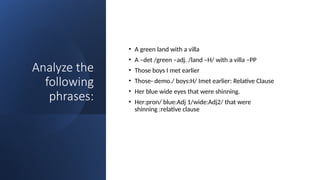
• Agreen land with a villa
• A –det /green –adj. /land –H/ with a villa –PP
• Those boys I met earlier
• Those- demo./ boys:H/ Imet earlier: Relative Clause
• Her blue wide eyes that were shinning.
• Her:pron/ blue:Adj 1/wide:Adj2/ that were
shinning :relative clause
30.
Extend the followingphrases using pre-modeifier and post-modifier:
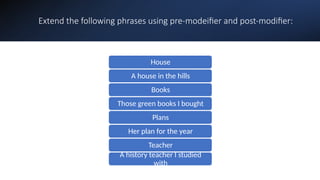
House
A house in the hills
Books
Those green books I bought
Plans
Her plan for the year
Teacher
A history teacher I studied
with
31.
Replace the
following with
wordsto form
phrases
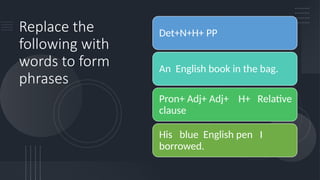
Det+N+H+ PP
An English book in the bag.
Pron+ Adj+ Adj+ H+ Relative
clause
His blue English pen I
borrowed.
32.
Analysis of
Noun Phrases
Nounphrases (NP)
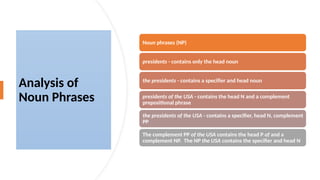
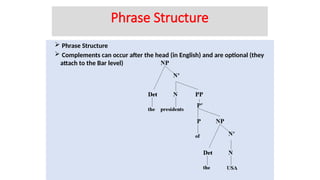
presidents - contains only the head noun
the presidents - contains a specifier and head noun
presidents of the USA - contains the head N and a complement
prepositional phrase
the presidents of the USA - contains a specifier, head N, complement
PP
The complement PP of the USA contains the head P of and a
complement NP. The NP the USA contains the specifier and head N
33.
Adjective Phrase 1
•Suspiciouss and subtle are adjectives.
• Any word that has the same distribution as those words is an adjective. Many
adjectives have characteristic endings, such as -able, -al, -ate, -ful, -ic, -ing, -ish, -ive, -
less, -ous, -y. Examples are: capable, economical, Italianate, beautiful, microscopic,
surprising, priggish, inventive, hopeless, eponymous, fluffy.
• Features of Adjectives
• 1/Many adjectives have the morphological possibility of taking a comparative (-er) and a
superlative (-est) suffix, as in newer and newest, subtler and subtlest.
34.
Adjective Phrase 2
•2/ Others do not (cf. *beautifuller/*beautifullest, *dubiouser/*dubiousest) but instead
may be modified by the comparative and superlative degree adverbs more and most,
less and least.
• 3/ Yet others have irregular comparative and superlative forms (good, better, best).
• Degree adverbs are words having the same distribution as rather and extremely, for
example: very, quite, so, too, slightly, hardly, highly, moderately, completely, increasingly,
incredibly, somewhat, etc.
35.
Adjective phrases 3
AdjectivePhrases (AP) are
centred on adjectives (A). And,
like NPs, an AP can consist of
an unmodified head, a simple
adjective.
For example, in Aldo’s quite
delicious pizzas the AP, quite
delicious, functions as the
modifier of pizzas and delicious
is the adjective functioning as
the head of the AP.
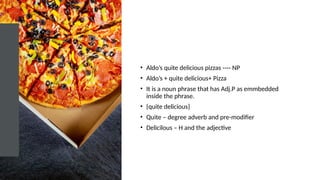
36.
• Aldo’s quitedelicious pizzas ---- NP
• Aldo’s + quite delicious+ Pizza
• It is a noun phrase that has Adj.P as emmbedded
inside the phrase.
• {quite delicious}
• Quite – degree adverb and pre-modifier
• Delicilous – H and the adjective
37.
Modification in AdjectivePhrase
1/ Adjective phrases usually have the following structure:
Premodifier Adjective (HEAD) Postmodifier
VERY SORRY TO GO
2/ The premodifier in an adjective phrase is most commonly an adverb (intensifier), or
another adjective:
It is extremely/very/ fairly/quite cold;
Or, a noun phrase (in measurements and age):
three months old; a metre long
3/ Postmodifiers:
Happy you can make it (Relative Clause)
; delighted to meet you; (Infinitive cluase)
guilty of murder (PP)
Fond of animals; (PP)
38.
Analysis of AdjectiveClauses
Adjective Phrases (AP)
happy - contains only the head adjective (A)
very happy - contains a specifier and head Aa
happy with the results - contains the head A and a complement PP
very happy with the results - contains a specifier, head A, complement PP
The complement PP with the results contains the head P and complement NP the
results. The NP contains specifier and head N.
39.
Verb Phrases 1
•1/ A full VP must contain a lexical verb and it may contain auxiliary verbs.
• [1a] Diana plays the piano.
• [1b] Diana played the piano.
• [2] Anders is explaining his generalisation.
• [3] Maggie should have recycled those bottles.
• [4] Wim may have been preparing his lecture.
• 2/ In VPs containing only a lexical verb, that verb will always carry a present or past
meaning
40.
Verb phrases 2
Verbphrases usually contain lexical verbs as main verbs.
Lexical verbs may be preceded by one or more auxiliary verbs:
1 2 3 MAIN VERB
That car may have been stolen
When two or more auxiliary verbs appear before the main verb in a verb phrase
they observe the following order:
MODAL-PERFECTIVE-PROGRESSIVE-PASSIVE
Modal-Passive: The car can be parked
Progressive-Passive: The car is being parked
Perfective-Progressive: She has been parking her car for years;
Perfective-Passive: The car has been parked
Modal-Perfective-Passive: The car should have been parked
41.
Verb Phrase andNoun Phrase 1
• A transitive verb
• A transitive verb is one which requires a single Noun Phrase to complement it. Of the
verbs considered above, then, dread, make, spot, throw, and inspect are transitive verbs.
The NP that complements a transitive verb is said to function (more specifically) as its
direct object. So, in Phil dreads affectionate cats, the NP within the VP (affectionate cats)
is complementing the transitive verb dread as its direct object.
• SHE directs ME.
• Me- Direct Object
42.
Verb Phrase
and Noun
Phrase2
• An intransitive
• An intransitive verb is one that does not
require any further constituent as a
sister in the VP.
• ‘ntransitive’ means ‘has (and needs) no
complement’.
• Disappear, die, laugh, vegetate are
intransitive verbs.
43.
Verb Phrase
and Noun
Phrase3
• Ditransitive verbs
• Ditransitive verbs require TWO NPs as
complements. The classic example of a
ditransitive verb is give. Others are send
and buy:
• 1. William gave Millie some bleach.
• 2. The staff sent the general a message.
• 3. Max buys his butler all necessary
work-clothes.
44.
Verb Phrase
and Noun
Phrase3
• Intensive Verbs
• Intensive verbs require a single
complement, which can take the form of
an Adjective Phrase, a Noun Phrase or a
Prepositional Phrase. The most obvious
and commonly used intensive verb is be.
• When a verb is complemented just by an
AP, you can be sure you are dealing with
an intensive verb. This is because
[intensive] is the only sub-category of
verb that can take just an AP
complement.
• Mary was my teacher
• My teacher is a predicate
• Was is the intensive verb
45.
Analysis of
Verb Phrase
VerbPhrases (VP)
sings - contains only the head verb
often sings - contains a specifier and
head verb
sings a ballad - contains the head V
and a complement NP
often sings a ballad - contains a
specifier, head V, complement NP
The complement NP a ballad contains
the head N ballad and specifier a.
46.
Adverbial phrases
Adverbial phrasesusually present an adverb as the HEAD:
The child cried loudly
The child cried very loudly
The child cried very loudly indeed
The Premodifier in an adverb phrase is always an intensifier:
VERY, TOO, EXTREMELY, QUITE
Postmodifiers in adverb phrases are RARE. Apart from indeed, only enough is commonly
used:
Strange enough, funnily enough, oddly enough, naturally enough..
47.
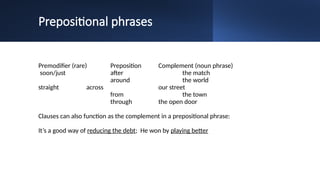
Prepositional phrases
Premodifier (rare)Preposition Complement (noun phrase)
soon/just after the match
around the world
straight across our street
from the town
through the open door
Clauses can also function as the complement in a prepositional phrase:
It’s a good way of reducing the debt; He won by playing better
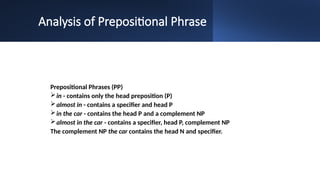
48.
Analysis of PrepositionalPhrase
Prepositional Phrases (PP)
in - contains only the head preposition (P)
almost in - contains a specifier and head P
in the car - contains the head P and a complement NP
almost in the car - contains a specifier, head P, complement NP
The complement NP the car contains the head N and specifier.
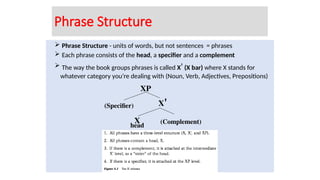
Phrase Structure- units of words, but not sentences = phrases
Each phrase consists of the head, a specifier and a complement
The way the book groups phrases is called X' (X bar) where X stands for
whatever category you’re dealing with (Noun, Verb, Adjectives, Prepositions)
XP
X'
X (Complement)
head
(Specifier)
Phrase Structure
51.
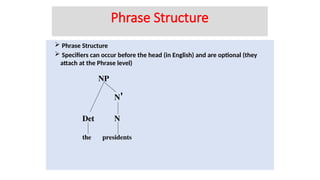
Phrase Structure
Specifiers can occur before the head (in English) and are optional (they
attach at the Phrase level)
the
Det
NP
N'
N
presidents
Phrase Structure
52.
Phrase Structure
Complements can occur after the head (in English) and are optional (they
attach to the Bar level)
Phrase Structure
53.
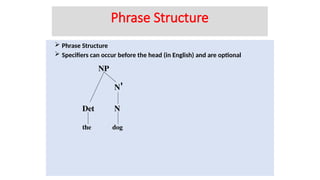
Phrase Structure
Specifiers can occur before the head (in English) and are optional
the
Det
NP
N'
N
dog
Phrase Structure
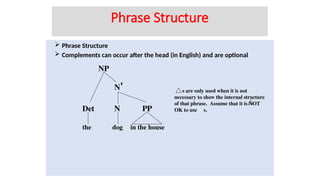
54.
Phrase Structure
Complements can occur after the head (in English) and are optional
the
Det
NP
N'
N
dog in the house
PP
s are only used when it is not
necessary to show the internal structure
of that phrase. Assume that it is NOT
OK to use s.
Phrase Structure
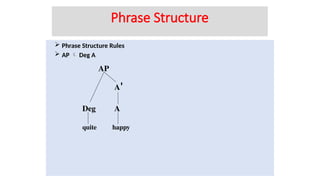
55.
Phrase StructureRules
AP Deg A
quite
Deg
AP
A'
A
happy
Phrase Structure
56.
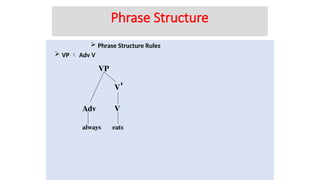
Phrase StructureRules
VP Adv V
always
Adv
VP
V'
V
eats
Phrase Structure
57.
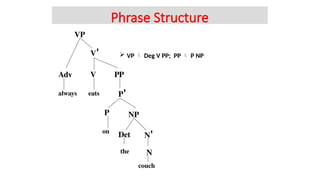
VP Deg V PP; PP P NP
couch
NP
PP
P'
P
on
Det N'
N
the
always
Adv
VP
V'
V
eats
Phrase Structure
58.
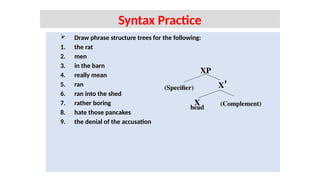
Draw phrasestructure trees for the following:
1. the rat
2. men
3. in the barn
4. really mean
5. ran
6. ran into the shed
7. rather boring
8. hate those pancakes
9. the denial of the accusation
Syntax Practice
XP
X'
X (Complement)
head
(Specifier)
59.
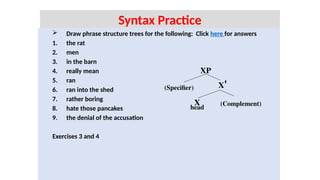
Draw phrasestructure trees for the following: Click here for answers
1. the rat
2. men
3. in the barn
4. really mean
5. ran
6. ran into the shed
7. rather boring
8. hate those pancakes
9. the denial of the accusation
Exercises 3 and 4
Syntax Practice
XP
X'
X (Complement)
head
(Specifier)
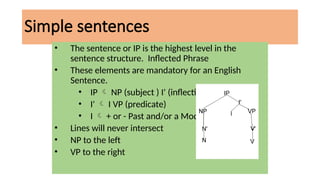
Simple sentences
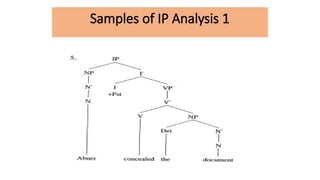
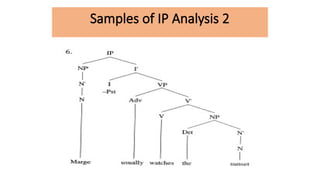
• Thesentence or IP is the highest level in the
sentence structure. Inflected Phrase
• These elements are mandatory for an English
Sentence.
• IP NP (subject ) I' (inflection)
• I' I VP (predicate)
• I + or - Past and/or a Modal
• Lines will never intersect
• NP to the left
• VP to the right
62.
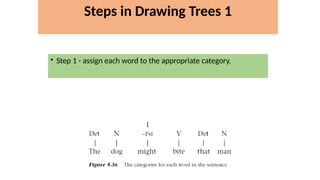
• Step 1- assign each word to the appropriate category.
Steps in Drawing Trees 1
63.
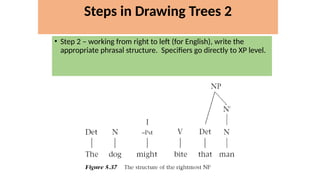
• Step 2– working from right to left (for English), write the
appropriate phrasal structure. Specifiers go directly to XP level.
Steps in Drawing Trees 2
64.
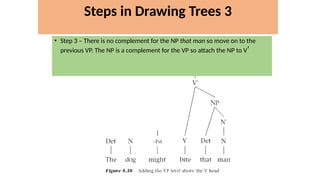
• Step 3– There is no complement for the NP that man so move on to the
previous VP. The NP is a complement for the VP so attach the NP to V'
Steps in Drawing Trees 3
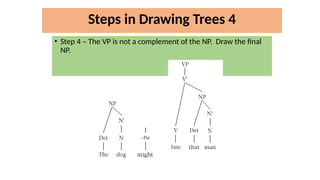
65.
• Step 4– The VP is not a complement of the NP. Draw the final
NP.
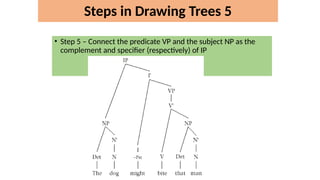
Steps in Drawing Trees 4
66.
• Step 5– Connect the predicate VP and the subject NP as the
complement and specifier (respectively) of IP
Steps in Drawing Trees 5
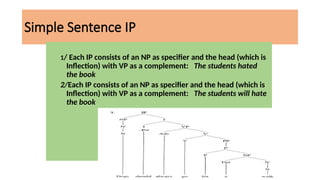
67.
Simple Sentence IP
1/Each IP consists of an NP as specifier and the head (which is
Inflection) with VP as a complement: The students hated
the book
2/Each IP consists of an NP as specifier and the head (which is
Inflection) with VP as a complement: The students will hate
the book
“Simple” sentences
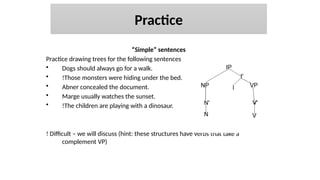
Practice drawingtrees for the following sentences
• Dogs should always go for a walk.
• !Those monsters were hiding under the bed.
• Abner concealed the document.
• Marge usually watches the sunset.
• !The children are playing with a dinosaur.
! Difficult – we will discuss (hint: these structures have verbs that take a
complement VP)
Practice
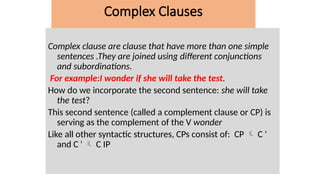
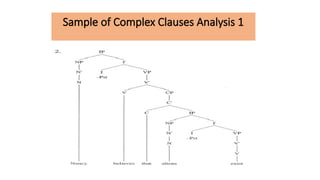
Complex clause areclause that have more than one simple
sentences .They are joined using different conjunctions
and subordinations.
For example:I wonder if she will take the test.
How do we incorporate the second sentence: she will take
the test?
This second sentence (called a complement clause or CP) is
serving as the complement of the V wonder
Like all other syntactic structures, CPs consist of: CP C '
and C ' C IP
Complex Clauses
73.
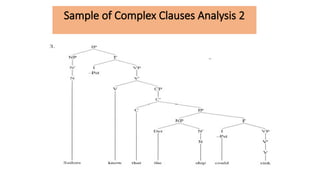
•Words such asthat, whether and if
are known as complementizers (C).
•The specifier position is open for
Move operations (discussed later)
•Matrix clauses are the largest clause
that contain the CP(s)
[I wonder [if she will take the test.]]
Complex Clauses
Practice 1
• Identifythe CP (Complement Phrase) in
the following matrix sentences. Put
brackets [ ] around the CP.
•1.) The teacher hopes that the students
will study hard .
•2.) The janitor wondered if the floor
would stay clean.
•3.) The floor knew that it would not stay
clean .
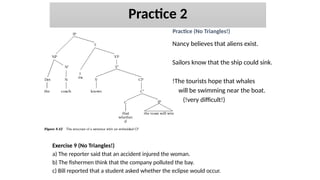
77.
Nancy believes thataliens exist.
Sailors know that the ship could sink.
!The tourists hope that whales
will be swimming near the boat.
(!very difficult!)
Practice (No Triangles!)
Exercise 9 (No Triangles!)
a) The reporter said that an accident injured the woman.
b) The fishermen think that the company polluted the bay.
c) Bill reported that a student asked whether the eclipse would occur.
Practice 2
What is structuralAmbiguity?
• Structural or syntactic ambiguity is the potential of
multiple interpretations for a piece of written or spoken
language because of the way words or phrases are
organized. Linguistic ambiguity makes it difficult to
determine meaning unless further information is
available that clarifies the context.
80.
• The girlhit the boy with a book VP NP PP .
• The sentence may mean ‘The girl hit the boy using a
book’ or ‘The boy is holding a book when the girl hit him.
This type of ambiguity occurs since the prepositional
phrase ‘with a book’ can modify two nouns ‘the girl or
the boy’.
• This type of structural ambiguity results from the lack of
information in the construction.
• If additional information is added to it, the sentence
becomes unambiguous: • The girl hit the boy with a
book. The book is broken. • The girl hit the boy with a
book. The boy hurts.
Structural Ambiguity Analysis 1
81.
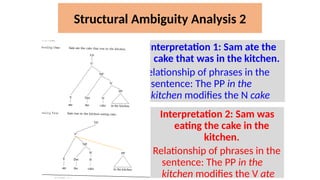
Structural Ambiguity Analysis2
Interpretation 1: Sam ate the
cake that was in the kitchen.
Relationship of phrases in the
sentence: The PP in the
kitchen modifies the N cake
Interpretation 2: Sam was
eating the cake in the
kitchen.
Relationship of phrases in the
sentence: The PP in the
kitchen modifies the V ate
Following our rulesfor sentence structure how do we account
for questions?
Is the man intelligent?
Can you come to dinner?
In the first example, there is no NP to the left of the IP and
in the second, the modal is before the subject.
Accounting for sentences such as questions and passives with
a new set of rules would be messy.
Transformational grammar accounts for the differences with
transformations (move). All sentences in deep structure
(before the move) will follow our previous phrasal rules.
Questions and Deep Structure 1
84.
What will yousay?
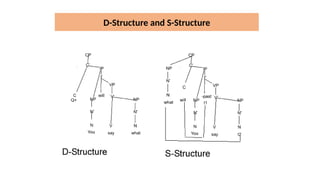
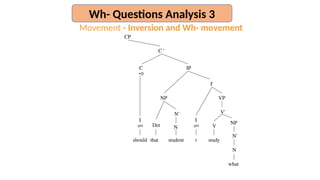
In this sentence What is functioning as the object of the sentence.
This can be demonstrated by trying to add an object after the verb.
* What will you say goodbye.
In this sentence, the verb requires an object, so omitting it in the non-
question form does not work -----* You will say
Deep structure for this sentence is -You will say what?
To arrive at deep structure
Merge -> Deep Structure
Deep Structure -> Move
Surface structure
Surface structure trees must show traces of unit’s original position.
Questions and Deep Structure 2
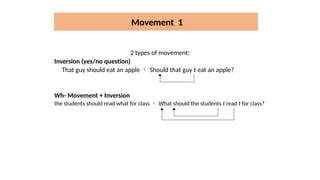
Movement 1
2 typesof movement:
Inversion (yes/no question)
That guy should eat an apple Should that guy t eat an apple?
Wh- Movement + Inversion
the students should read what for class What should the students t read t for class?
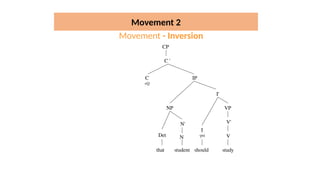
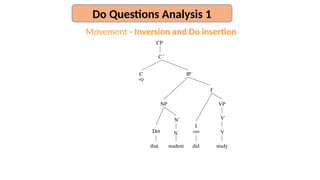
Movement - Inversionand Do insertion
student
that studied
V
Det
V'
VP
I'
I
+pst
N
N'
NP
IP
CP
C '
C
+Q
did study
Do Questions Analysis 1
90.
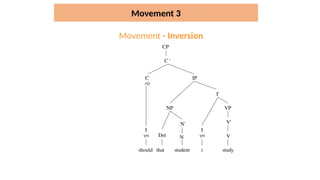
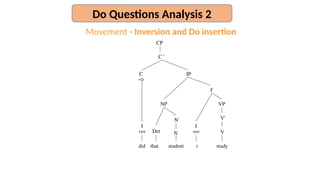
Movement - Inversionand Do insertion
student
that study
V
Det
V'
VP
I'
I
+pst
N
N'
NP
IP
CP
C '
C
+Q
I
+pst
did t
Do Questions Analysis 2
91.
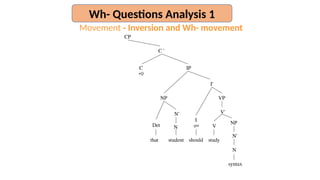
Movement - Inversionand Wh- movement
student
that
V
Det
V'
VP
I'
I
-pst
N
N'
NP
IP
CP
C '
C
+Q
should study
N
N'
syntax
NP
Wh- Questions Analysis 1
92.
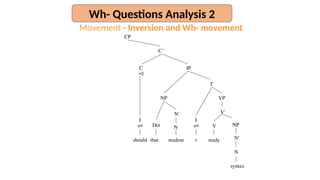
Movement - Inversionand Wh- movement
student
that
V
Det
V'
VP
I'
I
-pst
N
N'
NP
IP
CP
C '
C
+Q
t study
N
N'
syntax
NP
I
-pst
should
Wh- Questions Analysis 2
93.
Movement - Inversionand Wh- movement
student
that
V
Det
V'
VP
I'
I
-pst
N
N'
NP
IP
CP
C '
C
+Q
t study
N
N'
what
NP
I
-pst
should
Wh- Questions Analysis 3
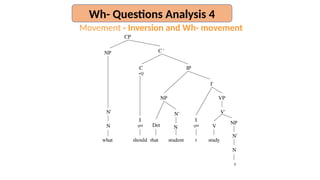
94.
Movement - Inversionand Wh- movement
student
that
V
Det
V'
VP
I'
I
-pst
N
N'
NP
IP
CP
C '
C
+Q
t study
N
N'
t
NP
I
-pst
should
N
N'
what
NP
Wh- Questions Analysis 4
95.
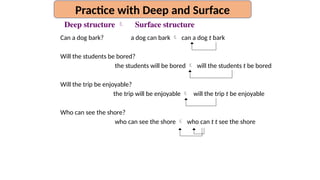
Can a dogbark?
Will the students be bored?
Will the trip be enjoyable?
Who can see the shore?
a dog can bark can a dog t bark
the students will be bored will the students t be bored
the trip will be enjoyable will the trip t be enjoyable
who can see the shore who can t t see the shore
Deep structure Surface structure
Practice with Deep and Surface


![Syntax and
Ungrammatical
Structure
When a sequence of words fails to
constitute a good expression in the
language, it is considered as
ungrammatical (or ill-formed) and mark
it with an asterisk (*).
Here are some examples:
[1a] *the nevertheless procrastinate in
foxtrot [1b] *disappears none girls of
the students [1c] *Max will bought a
frying pans.](https://image.slidesharecdn.com/syntax2022-20238fc6fcd70edb09f07362a3df6b1b9af1-250926170710-6e64e993/85/Syntax-2022-2023_8fc6fcd70edb09f07362a3df6b1b9af1-pptx-11-320.jpg)

![Noun phrase- Postmodifiers
Prepositional phrases usually occur after a noun, generally introduced by of:
A box of chocolate, a piece of mind, a biography of Hitler .The Tower of London.
- Other prepositions:
-A room [for two] [in a bed & cottage on the beach, the museum in New York, the road to Calcutta, a
room with a shower, people without cell phone…
Postmodifiers of noun phrases can also be:
- Relative clauses
The shop [in via Roma] [that sells shoes];
The phone [you borrowed] [from my mother.]](https://image.slidesharecdn.com/syntax2022-20238fc6fcd70edb09f07362a3df6b1b9af1-250926170710-6e64e993/85/Syntax-2022-2023_8fc6fcd70edb09f07362a3df6b1b9af1-pptx-28-320.jpg)
![Verb Phrases 1
• 1/ A full VP must contain a lexical verb and it may contain auxiliary verbs.
• [1a] Diana plays the piano.
• [1b] Diana played the piano.
• [2] Anders is explaining his generalisation.
• [3] Maggie should have recycled those bottles.
• [4] Wim may have been preparing his lecture.
• 2/ In VPs containing only a lexical verb, that verb will always carry a present or past
meaning](https://image.slidesharecdn.com/syntax2022-20238fc6fcd70edb09f07362a3df6b1b9af1-250926170710-6e64e993/85/Syntax-2022-2023_8fc6fcd70edb09f07362a3df6b1b9af1-pptx-39-320.jpg)
![Verb Phrase
and Noun
Phrase 3
• Intensive Verbs
• Intensive verbs require a single
complement, which can take the form of
an Adjective Phrase, a Noun Phrase or a
Prepositional Phrase. The most obvious
and commonly used intensive verb is be.
• When a verb is complemented just by an
AP, you can be sure you are dealing with
an intensive verb. This is because
[intensive] is the only sub-category of
verb that can take just an AP
complement.
• Mary was my teacher
• My teacher is a predicate
• Was is the intensive verb](https://image.slidesharecdn.com/syntax2022-20238fc6fcd70edb09f07362a3df6b1b9af1-250926170710-6e64e993/85/Syntax-2022-2023_8fc6fcd70edb09f07362a3df6b1b9af1-pptx-44-320.jpg)

![•Words such as that, whether and if
are known as complementizers (C).
•The specifier position is open for
Move operations (discussed later)
•Matrix clauses are the largest clause
that contain the CP(s)
[I wonder [if she will take the test.]]
Complex Clauses](https://image.slidesharecdn.com/syntax2022-20238fc6fcd70edb09f07362a3df6b1b9af1-250926170710-6e64e993/85/Syntax-2022-2023_8fc6fcd70edb09f07362a3df6b1b9af1-pptx-73-320.jpg)
![Practice 1
• Identify the CP (Complement Phrase) in
the following matrix sentences. Put
brackets [ ] around the CP.
•1.) The teacher hopes that the students
will study hard .
•2.) The janitor wondered if the floor
would stay clean.
•3.) The floor knew that it would not stay
clean .](https://image.slidesharecdn.com/syntax2022-20238fc6fcd70edb09f07362a3df6b1b9af1-250926170710-6e64e993/85/Syntax-2022-2023_8fc6fcd70edb09f07362a3df6b1b9af1-pptx-76-320.jpg)