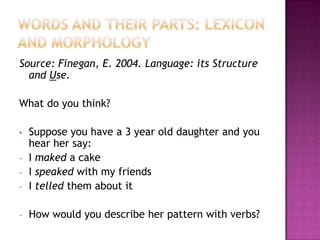
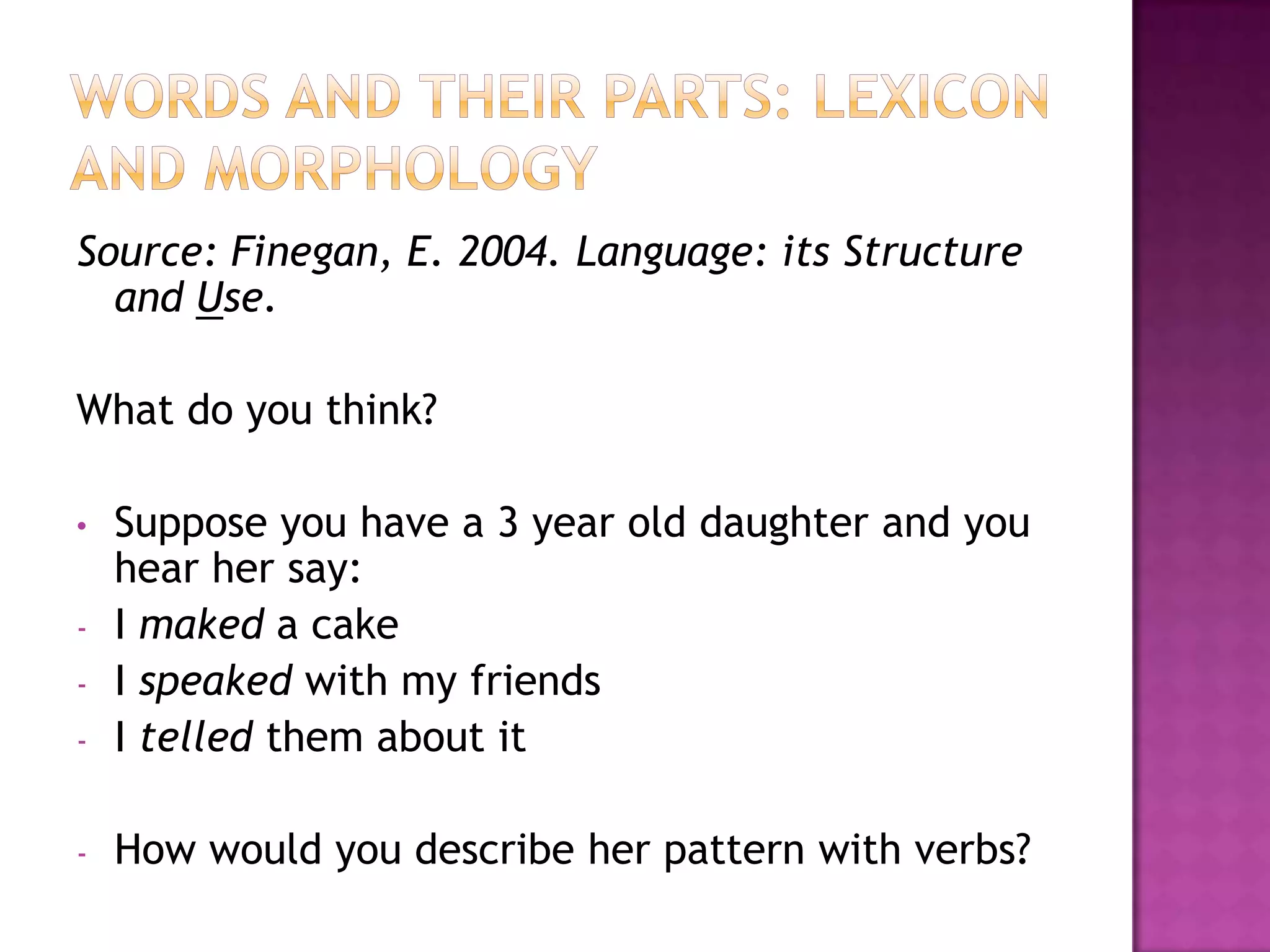
Words and their parts: Lexicon and morphologySource: Finegan, E. 2004. Language: its Structure and Use.What do you think?Suppose you have a 3 year old daughter and you hear her say:
I maked a cake
I speaked with my friends
I telledthem about it
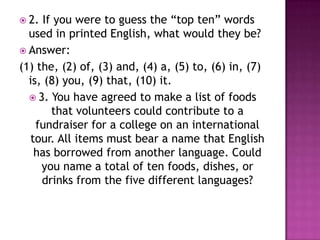
How would you describe her pattern with verbs?2. If you were to guess the “top ten” words used in printed English, what would they be?Answer:(1) the, (2) of, (3) and, (4) a, (5) to, (6) in, (7) is, (8) you, (9) that, (10) it.3. You have agreed to make a list of foods that volunteers could contribute to a fundraiser for a college on an international tour. All items must bear a name that English has borrowed from another language. Could you name a total of ten foods, dishes, or drinks from the five different languages?
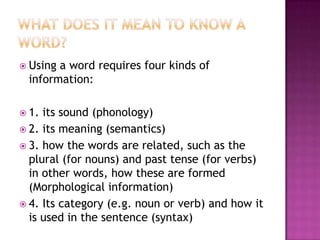
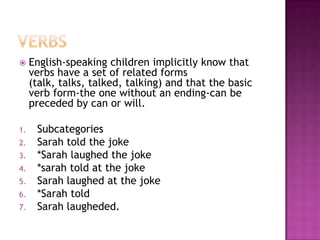
What does it mean to know a word?Using a word requires four kinds of information:1. its sound (phonology)2. its meaning (semantics)3. how the words are related,such as the plural (for nouns) and past tense (for verbs) in other words, how these are formed (Morphological information)4. Its category (e.g. noun or verb) and how it is used in the sentence (syntax)
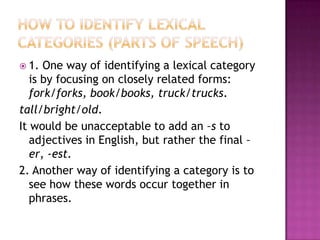
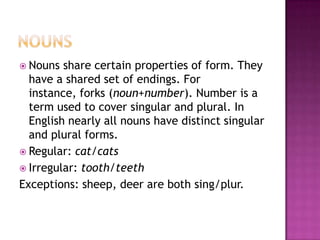
How to identify lexical categories (parts of speech)1. One way of identifying a lexical category is by focusing on closely related forms: fork/forks, book/books, truck/trucks. tall/bright/old.It would be unacceptable to add an –s to adjectives in English, but rather the final –er, -est.2. Another way of identifying a category is to see how these words occur together in phrases.
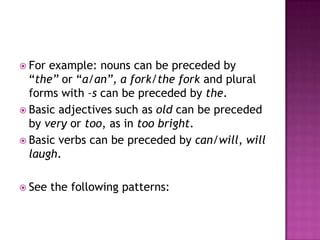
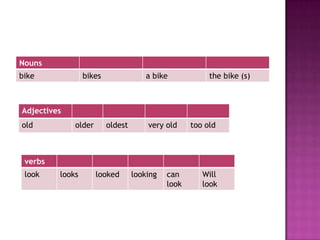
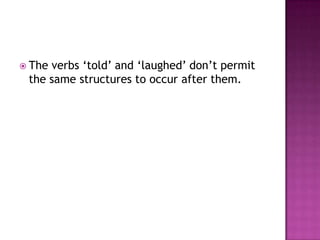
For example: nouns can be preceded by “the” or “a/an”, a fork/the fork and plural forms with –s can be preceded by the.Basic adjectives such as old can be preceded by very or too, as in too bright.Basic verbs can be preceded by can/will, willlaugh.See the following patterns:

Week 7 morphology (part 1)

  • 1.
    Words and theirparts: Lexicon and morphologySource: Finegan, E. 2004. Language: its Structure and Use.What do you think?Suppose you have a 3 year old daughter and you hear her say:
  • 2.
  • 3.
    I speaked withmy friends
  • 4.
  • 5.
    How would youdescribe her pattern with verbs?2. If you were to guess the “top ten” words used in printed English, what would they be?Answer:(1) the, (2) of, (3) and, (4) a, (5) to, (6) in, (7) is, (8) you, (9) that, (10) it.3. You have agreed to make a list of foods that volunteers could contribute to a fundraiser for a college on an international tour. All items must bear a name that English has borrowed from another language. Could you name a total of ten foods, dishes, or drinks from the five different languages?
  • 6.
    What does itmean to know a word?Using a word requires four kinds of information:1. its sound (phonology)2. its meaning (semantics)3. how the words are related,such as the plural (for nouns) and past tense (for verbs) in other words, how these are formed (Morphological information)4. Its category (e.g. noun or verb) and how it is used in the sentence (syntax)
  • 7.
    How to identifylexical categories (parts of speech)1. One way of identifying a lexical category is by focusing on closely related forms: fork/forks, book/books, truck/trucks. tall/bright/old.It would be unacceptable to add an –s to adjectives in English, but rather the final –er, -est.2. Another way of identifying a category is to see how these words occur together in phrases.
  • 8.
    For example: nounscan be preceded by “the” or “a/an”, a fork/the fork and plural forms with –s can be preceded by the.Basic adjectives such as old can be preceded by very or too, as in too bright.Basic verbs can be preceded by can/will, willlaugh.See the following patterns: