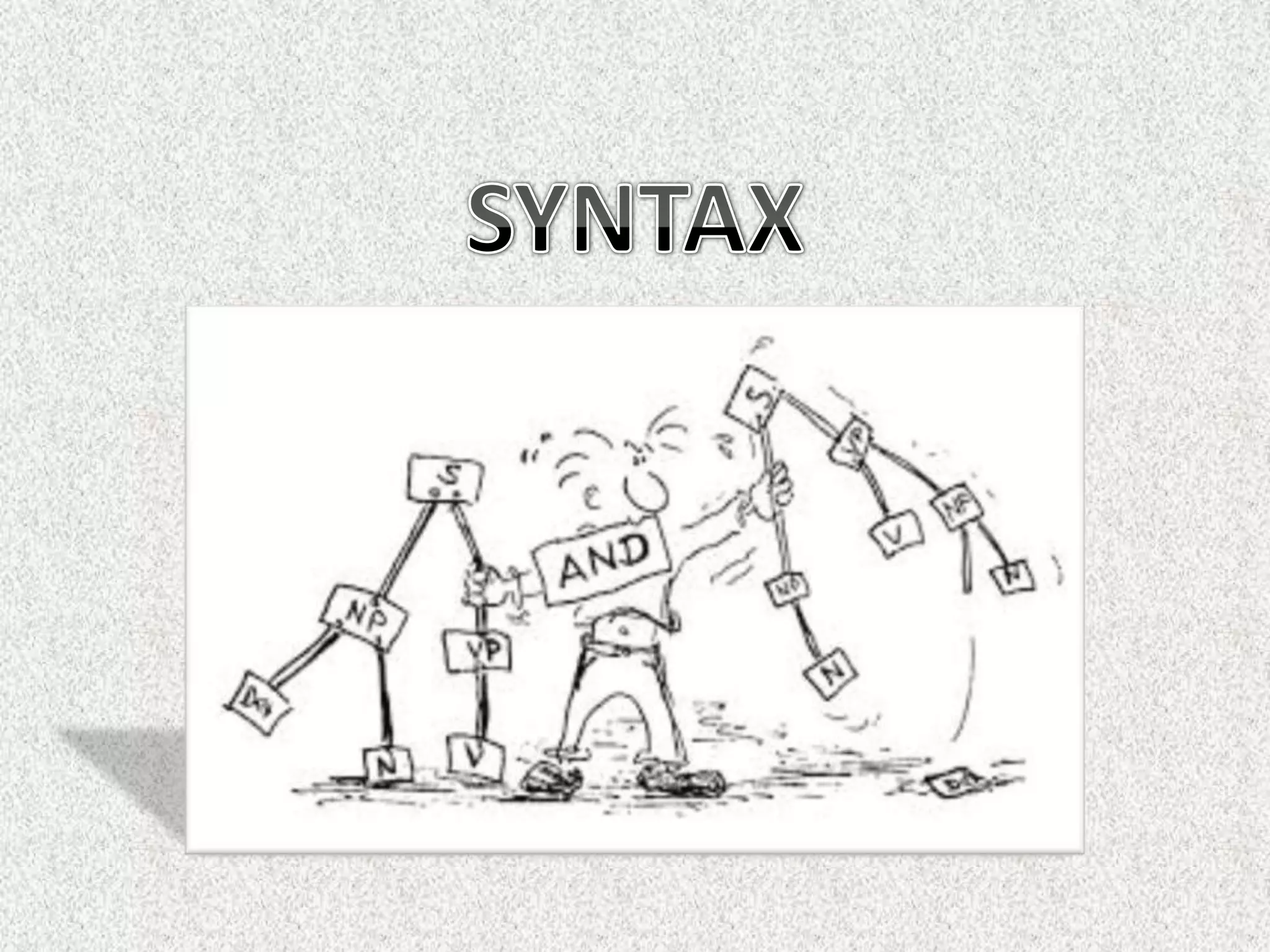
When we concentrate on the structure and
ordering of components within a sentence, we
are studying the syntax of a language.
Generative grammar
 Linguistics have attempted to produce a
particular type of grammar that has a very
explicit system of rules.
 This very explicit system of rules would have a
lot in common with the types of rules found in
mathematics.
Noam Chomsky
 His most influential contribution to the fiel is
the claim that modeling knowledge of
language using a formal grammar accounts for
the “ productivity “ or “creativity” of
language.
 Chomsky seems to have taken the view that
the essential structure of language can be
expressed in mathematical terms.
 “I will consider a language to be a set ( finite
or infinite) of sentences (1957:13).
Syntactic structures
 The grammar will generate all the well-formed
syntactic structures of the language and will not
generate any ill- formed structures.
 This has been called the “all and only” criterion,
that is all the grammatical sentences and only the
grammatical sentences will be produced.
 The grammar will have a finite number of rules,
but will be capable of generating an infinite
number of well- formed structures.
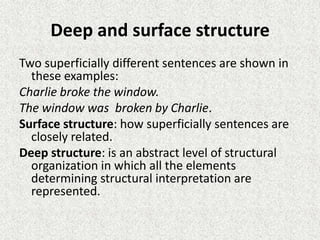
Deep and surface structure
Two superficially different sentences are shown in
these examples:
Charlie broke the window.
The window was broken by Charlie.
Surface structure: how superficially sentences are
closely related.
Deep structure: is an abstract level of structural
organization in which all the elements
determining structural interpretation are
represented.
Structural ambiguity
Annie whacked a man with an umbrella.
 It has two distinct underlying interpretations
that have to be represented differently in
deep structure.
 The grammar will have to be capable of
showing the structural distinction between
these underlying interpretations.
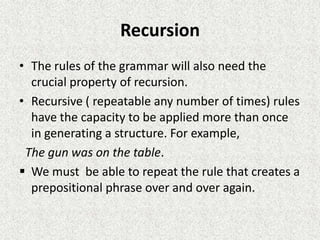
Recursion
• The rules of the grammar will also need the
crucial property of recursion.
• Recursive ( repeatable any number of times) rules
have the capacity to be applied more than once
in generating a structure. For example,
The gun was on the table.
 We must be able to repeat the rule that creates a
prepositional phrase over and over again.
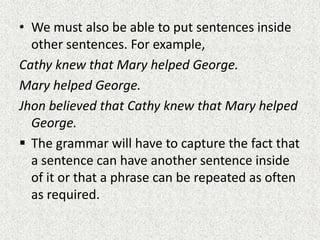
• We must also be able to put sentences inside
other sentences. For example,
Cathy knew that Mary helped George.
Mary helped George.
Jhon believed that Cathy knew that Mary helped
George.
 The grammar will have to capture the fact that
a sentence can have another sentence inside
of it or that a phrase can be repeated as often
as required.
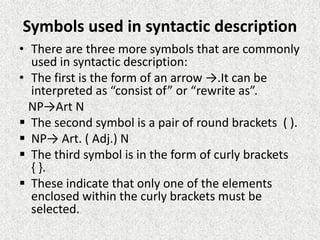
Symbols used in syntactic description
• There are three more symbols that are commonly
used in syntactic description:
• The first is the form of an arrow →.It can be
interpreted as “consist of” or “rewrite as”.
NP→Art N
 The second symbol is a pair of round brackets ( ).
 NP→ Art. ( Adj.) N
 The third symbol is in the form of curly brackets
{ }.
 These indicate that only one of the elements
enclosed within the curly brackets must be
selected.
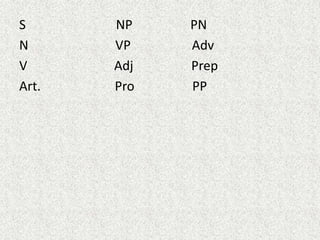
S
N
V
Art.

NP
VP
Adj
Pro

PN
Adv
Prep
PP
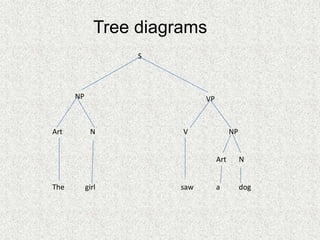
Tree diagrams
S

NP

Art

VP

N

V

NP
Art

The

girl

saw

N

a

dog
Phrase structure rules
NP
Art

Art N

NP

N

Lexical rules
PN
N
Art

Mary, George
girl, dog, boy
a, the

V
adj
Prep.

followed, helped
small, crazy
near, with

Pro

it, you

Adv

recently, yesterday

1 A boy helped the dog
2 You saw it yesterday.
3 George saw a dog

4_ You it saw
5 _ Followed the dog
Back to recursion
Mary helped George
Cathy knew that Mary helped George
John believed that knew that Mary helped George
Complement phrases
CP

CS
S
NP

VP
V

CP
C

S
VP

NP
V

CP
C

S
VP

NP
PN

PN

PN

V

NP
PN

John believed that Cathy knew that Mary helped George

Syntax

  • 2.
    When we concentrateon the structure and ordering of components within a sentence, we are studying the syntax of a language.
  • 3.
    Generative grammar  Linguisticshave attempted to produce a particular type of grammar that has a very explicit system of rules.  This very explicit system of rules would have a lot in common with the types of rules found in mathematics.
  • 4.
  • 5.
     His mostinfluential contribution to the fiel is the claim that modeling knowledge of language using a formal grammar accounts for the “ productivity “ or “creativity” of language.  Chomsky seems to have taken the view that the essential structure of language can be expressed in mathematical terms.  “I will consider a language to be a set ( finite or infinite) of sentences (1957:13).
  • 6.
    Syntactic structures  Thegrammar will generate all the well-formed syntactic structures of the language and will not generate any ill- formed structures.  This has been called the “all and only” criterion, that is all the grammatical sentences and only the grammatical sentences will be produced.  The grammar will have a finite number of rules, but will be capable of generating an infinite number of well- formed structures.
  • 7.
    Deep and surfacestructure Two superficially different sentences are shown in these examples: Charlie broke the window. The window was broken by Charlie. Surface structure: how superficially sentences are closely related. Deep structure: is an abstract level of structural organization in which all the elements determining structural interpretation are represented.
  • 8.
    Structural ambiguity Annie whackeda man with an umbrella.  It has two distinct underlying interpretations that have to be represented differently in deep structure.  The grammar will have to be capable of showing the structural distinction between these underlying interpretations.
  • 9.
    Recursion • The rulesof the grammar will also need the crucial property of recursion. • Recursive ( repeatable any number of times) rules have the capacity to be applied more than once in generating a structure. For example, The gun was on the table.  We must be able to repeat the rule that creates a prepositional phrase over and over again.
  • 10.
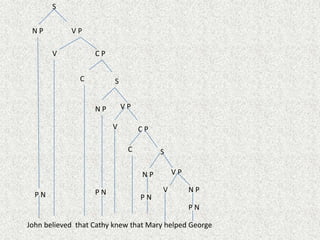
    • We mustalso be able to put sentences inside other sentences. For example, Cathy knew that Mary helped George. Mary helped George. Jhon believed that Cathy knew that Mary helped George.  The grammar will have to capture the fact that a sentence can have another sentence inside of it or that a phrase can be repeated as often as required.
  • 11.
    Symbols used insyntactic description • There are three more symbols that are commonly used in syntactic description: • The first is the form of an arrow →.It can be interpreted as “consist of” or “rewrite as”. NP→Art N  The second symbol is a pair of round brackets ( ).  NP→ Art. ( Adj.) N  The third symbol is in the form of curly brackets { }.  These indicate that only one of the elements enclosed within the curly brackets must be selected.
  • 12.
  • 13.
  • 14.
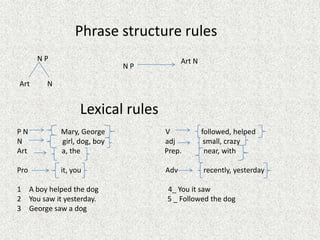
    Phrase structure rules NP Art ArtN NP N Lexical rules PN N Art Mary, George girl, dog, boy a, the V adj Prep. followed, helped small, crazy near, with Pro it, you Adv recently, yesterday 1 A boy helped the dog 2 You saw it yesterday. 3 George saw a dog 4_ You it saw 5 _ Followed the dog
  • 15.
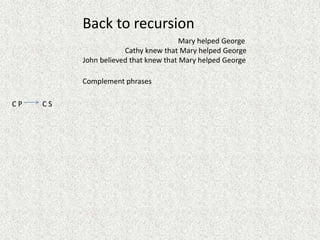
    Back to recursion Maryhelped George Cathy knew that Mary helped George John believed that knew that Mary helped George Complement phrases CP CS
  • 16.