Transformational-
Generative Grammar
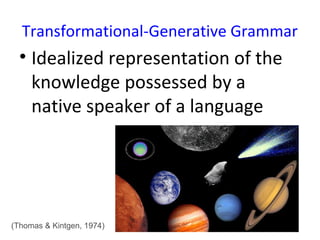
Transformational-Generative Grammar
  • Idealized representation of the
    knowledge possessed by a
    native speaker of a language


(Thomas & Kintgen, 1974)
Transformational-Generative Grammar

     T                  G
Arrangement          Elements
Grammatical            Rules
The Farmer in the Dell
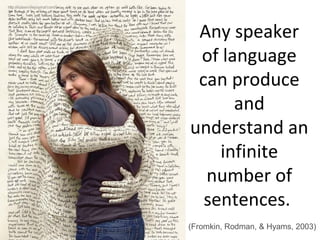
Any speaker
 of language
 can produce
      and
understand an
    infinite
  number of
  sentences.
(Fromkin, Rodman, & Hyams, 2003)
Features
of Syntax


            (Payne, 2006)
Features of Syntax
1. Constituency
2. Hierarchical Structure
3. Linear Word Order
4. Syntactic Category
1

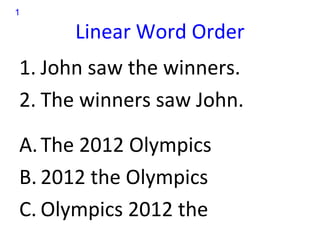
     Linear Word Order
1. John saw the winners.
2. The winners saw John.

A. The 2012 Olympics
B. 2012 the Olympics
C. Olympics 2012 the
2

         Constituency
1. [Good girls] and boys
2. Good [girls and boys]
Constituency
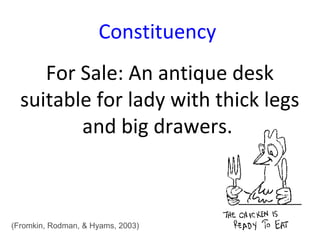
     For Sale: An antique desk
  suitable for lady with thick legs
         and big drawers.


(Fromkin, Rodman, & Hyams, 2003)
Memory Challenge
1. 09214182789
2. 9320608
3. 1119
4. 9780521671507
5. EDL201
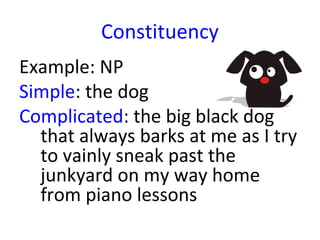
Constituency
Example: NP
Simple: the dog
Complicated: the big black dog
  that always barks at me as I try
  to vainly sneak past the
  junkyard on my way home
  from piano lessons
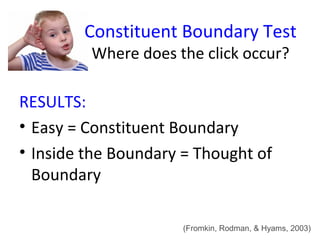
Constituent Boundary Test
         Where does the click occur?

RESULTS:
• Easy = Constituent Boundary
• Inside the Boundary = Thought of
  Boundary

                      (Fromkin, Rodman, & Hyams, 2003)
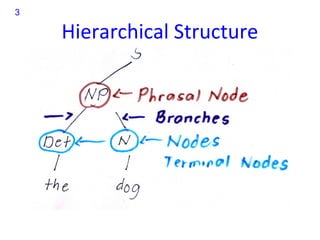
3

    Hierarchical Structure
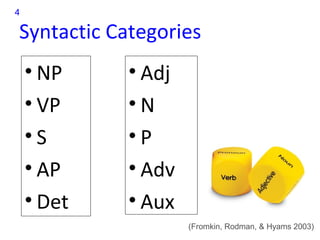
4

Syntactic Categories
    • NP    • Adj
    • VP    •N
    •S      •P
    • AP    • Adv
    • Det   • Aux
                    (Fromkin, Rodman, & Hyams 2003)
Phrase/Constituent Structure Tree
        or Phrase Marker
• Graphic representation
• Evaluated, Validated, and Sanctioned
  by PS rules


                               (Payne, 2006)
Phrase Structure (PS) Rules
• Ways of representing idealized
  patterns of constituent structure
• Specify constituent arrangement
• Recursive


                  (Payne, 2006 & Rowe & Levine, 2009)
Recursion

     Repetition
         =
    Productivity
            (Rowe & Levine, 2009)
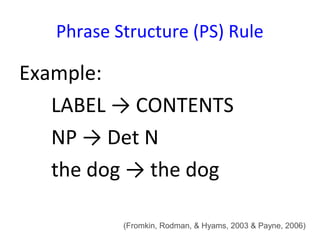
Phrase Structure (PS) Rule

Example:
   LABEL → CONTENTS
   NP → Det N
   the dog → the dog

           (Fromkin, Rodman, & Hyams, 2003 & Payne, 2006)
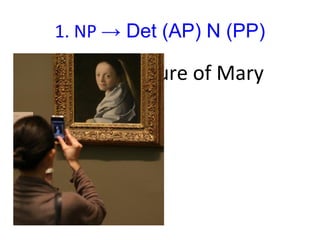
1. NP → Det (AP) N (PP)

a small picture of Mary
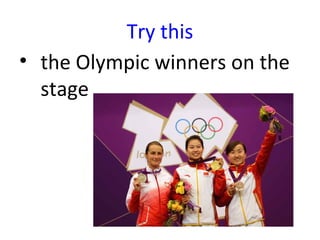
Try this
• the Olympic winners on the
  stage
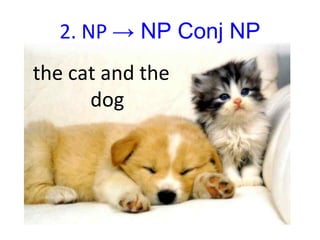
2. NP → NP Conj NP
the cat and the
      dog
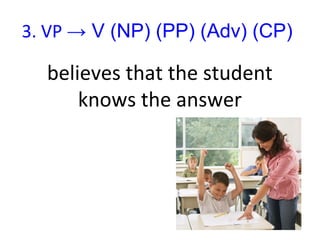
3. VP → V (NP) (PP) (Adv) (CP)

  believes that the student
      knows the answer
Try these
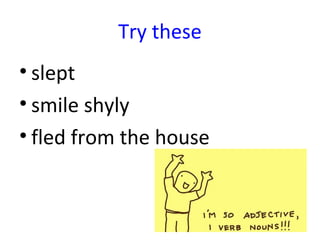
• slept
• smile shyly
• fled from the house
4. S → NP Aux VP


         The men fled
           from the
            house.
Try these
• The boat sailed the river.
• The wind swept the kite into
  the sky.
Transformational Rules (T-rules)
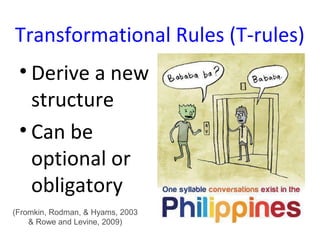
 • Derive a new
   structure
 • Can be
   optional or
   obligatory
(Fromkin, Rodman, & Hyams, 2003
    & Rowe and Levine, 2009)
T-rules
1. Deletion
2. Insertion
3. Movement
4. Substitution
1

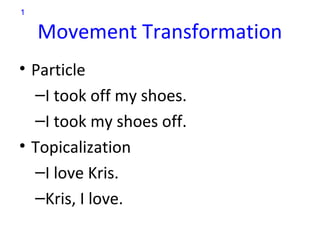
    Movement Transformation
• Particle
  –I took off my shoes.
  –I took my shoes off.
• Topicalization
  –I love Kris.
  –Kris, I love.
2

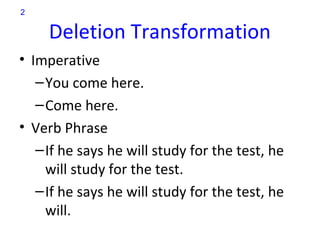
     Deletion Transformation
• Imperative
   – You come here.
   – Come here.
• Verb Phrase
   – If he says he will study for the test, he
     will study for the test.
   – If he says he will study for the test, he
     will.
3

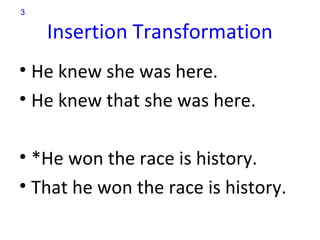
    Insertion Transformation
• He knew she was here.
• He knew that she was here.

• *He won the race is history.
• That he won the race is history.
4

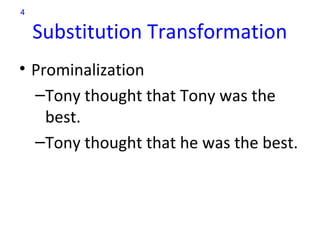
    Substitution Transformation
• Prominalization
  –Tony thought that Tony was the
    best.
  –Tony thought that he was the best.
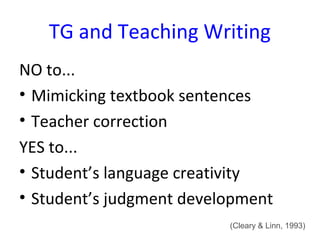
TG and Teaching Writing
NO to...
• Mimicking textbook sentences
• Teacher correction
YES to...
• Student’s language creativity
• Student’s judgment development
                          (Cleary & Linn, 1993)
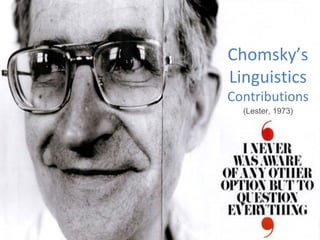
Chomsky’s
Linguistics
Contributions
  (Lester, 1973)
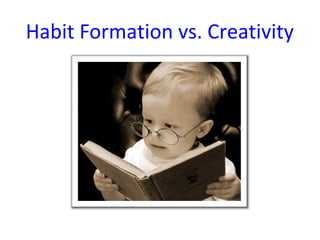
Habit Formation vs. Creativity
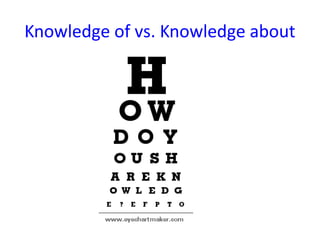
Knowledge of vs. Knowledge about
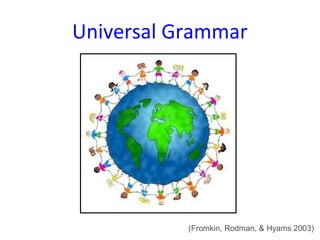
Universal Grammar


           (Fromkin, Rodman, & Hyams 2003)
Language Acquisition Device
Bibliography
Cleary, L. M., & Linn, M. D. (1993). Linguistics for teachers.
  New York: McGraw-Hill.
Fromkin, V., Rodman, R., & Hyams, N. M. (2003). An
  introduction to language (7th ed.). Boston: Thomson,
  Heinle.
Google Images. (n.d.). Google. Retrieved August 7, 2012, from
  http://www.google.com.ph/imghp?hl=fil&tab=wi
Language Acquisition Device | TeachingEnglish | British
  Council | BBC. (n.d.). TeachingEnglish | British Council |
  BBC. Retrieved August 7, 2012, from
  http://www.teachingenglish.org.uk/knowledge-
  database/language-acquisition-device
Bibliography
Lasnik, H., Depiante, M. A., & Stepanov, A. (2000). Syntactic
  structures revisited: contemporary lectures on classic
  transformational theory. Cambridge, Mass. [u.a.: MIT
  Press.
Lester, M. (1973). Readings in applied transformational
  grammar (2nd ed.). New York: Holt, Rinehart and Winston.
Murcia, M., & Freeman, D. (1983). The grammar book: an
  ESL/EFL teacher's course. Rowley, Mass.: Newbury House.
Ouhalla, J. (1994). Introducing transformational grammar:
  from rules to principles and parameters. London: E. Arnold.
Bibliography
Payne, T. E. (2006). Exploring language structure: a student's guide.
   Cambridge, UK: Cambridge University Press.
Rowe, B. M., & Levine, D. P. (2009). A concise introduction to
   linguistics (2nd ed.). Boston, MA: Pearson/Allyn and Bacon.
Thomas, O., & Kintgen, E. R. (1974). Transformational grammar and
   the teacher of English: theory and practice (2nd ed.). New York:
   Holt Rinehart and Winston.
Widdowson, H. G. (1996). Linguistics. Oxford: Oxford University
   Press.
"facebook.com." Facebook. N.p., n.d. Web. 10 Aug. 2012.
   <https://www.facebook.com/photo.php?
   fbid=397305633656134&set=a.1640888

                                            APA formatting by BibMe.org.

Transformational generative grammar

  • 1.
  • 2.
    Transformational-Generative Grammar • Idealized representation of the knowledge possessed by a native speaker of a language (Thomas & Kintgen, 1974)
  • 3.
    Transformational-Generative Grammar T G Arrangement Elements Grammatical Rules
  • 4.
    The Farmer inthe Dell
  • 6.
    Any speaker oflanguage can produce and understand an infinite number of sentences. (Fromkin, Rodman, & Hyams, 2003)
  • 7.
    Features of Syntax (Payne, 2006)
  • 8.
    Features of Syntax 1.Constituency 2. Hierarchical Structure 3. Linear Word Order 4. Syntactic Category
  • 9.
    1 Linear Word Order 1. John saw the winners. 2. The winners saw John. A. The 2012 Olympics B. 2012 the Olympics C. Olympics 2012 the
  • 10.
    2 Constituency 1. [Good girls] and boys 2. Good [girls and boys]
  • 11.
    Constituency For Sale: An antique desk suitable for lady with thick legs and big drawers. (Fromkin, Rodman, & Hyams, 2003)
  • 12.
    Memory Challenge 1. 09214182789 2.9320608 3. 1119 4. 9780521671507 5. EDL201
  • 13.
    Constituency Example: NP Simple: thedog Complicated: the big black dog that always barks at me as I try to vainly sneak past the junkyard on my way home from piano lessons
  • 14.
    Constituent Boundary Test Where does the click occur? RESULTS: • Easy = Constituent Boundary • Inside the Boundary = Thought of Boundary (Fromkin, Rodman, & Hyams, 2003)
  • 15.
    3 Hierarchical Structure
  • 16.
    4 Syntactic Categories • NP • Adj • VP •N •S •P • AP • Adv • Det • Aux (Fromkin, Rodman, & Hyams 2003)
  • 17.
    Phrase/Constituent Structure Tree or Phrase Marker • Graphic representation • Evaluated, Validated, and Sanctioned by PS rules (Payne, 2006)
  • 18.
    Phrase Structure (PS)Rules • Ways of representing idealized patterns of constituent structure • Specify constituent arrangement • Recursive (Payne, 2006 & Rowe & Levine, 2009)
  • 19.
    Recursion Repetition = Productivity (Rowe & Levine, 2009)
  • 20.
    Phrase Structure (PS)Rule Example: LABEL → CONTENTS NP → Det N the dog → the dog (Fromkin, Rodman, & Hyams, 2003 & Payne, 2006)
  • 21.
    1. NP →Det (AP) N (PP) a small picture of Mary
  • 22.
    Try this • theOlympic winners on the stage
  • 23.
    2. NP →NP Conj NP the cat and the dog
  • 24.
    3. VP →V (NP) (PP) (Adv) (CP) believes that the student knows the answer
  • 25.
    Try these • slept •smile shyly • fled from the house
  • 26.
    4. S →NP Aux VP The men fled from the house.
  • 27.
    Try these • Theboat sailed the river. • The wind swept the kite into the sky.
  • 28.
    Transformational Rules (T-rules) • Derive a new structure • Can be optional or obligatory (Fromkin, Rodman, & Hyams, 2003 & Rowe and Levine, 2009)
  • 29.
    T-rules 1. Deletion 2. Insertion 3.Movement 4. Substitution
  • 30.
    1 Movement Transformation • Particle –I took off my shoes. –I took my shoes off. • Topicalization –I love Kris. –Kris, I love.
  • 31.
    2 Deletion Transformation • Imperative – You come here. – Come here. • Verb Phrase – If he says he will study for the test, he will study for the test. – If he says he will study for the test, he will.
  • 32.
    3 Insertion Transformation • He knew she was here. • He knew that she was here. • *He won the race is history. • That he won the race is history.
  • 33.
    4 Substitution Transformation • Prominalization –Tony thought that Tony was the best. –Tony thought that he was the best.
  • 35.
    TG and TeachingWriting NO to... • Mimicking textbook sentences • Teacher correction YES to... • Student’s language creativity • Student’s judgment development (Cleary & Linn, 1993)
  • 36.
  • 37.
  • 38.
    Knowledge of vs.Knowledge about
  • 39.
    Universal Grammar (Fromkin, Rodman, & Hyams 2003)
  • 40.
  • 41.
    Bibliography Cleary, L. M.,& Linn, M. D. (1993). Linguistics for teachers. New York: McGraw-Hill. Fromkin, V., Rodman, R., & Hyams, N. M. (2003). An introduction to language (7th ed.). Boston: Thomson, Heinle. Google Images. (n.d.). Google. Retrieved August 7, 2012, from http://www.google.com.ph/imghp?hl=fil&tab=wi Language Acquisition Device | TeachingEnglish | British Council | BBC. (n.d.). TeachingEnglish | British Council | BBC. Retrieved August 7, 2012, from http://www.teachingenglish.org.uk/knowledge- database/language-acquisition-device
  • 42.
    Bibliography Lasnik, H., Depiante,M. A., & Stepanov, A. (2000). Syntactic structures revisited: contemporary lectures on classic transformational theory. Cambridge, Mass. [u.a.: MIT Press. Lester, M. (1973). Readings in applied transformational grammar (2nd ed.). New York: Holt, Rinehart and Winston. Murcia, M., & Freeman, D. (1983). The grammar book: an ESL/EFL teacher's course. Rowley, Mass.: Newbury House. Ouhalla, J. (1994). Introducing transformational grammar: from rules to principles and parameters. London: E. Arnold.
  • 43.
    Bibliography Payne, T. E.(2006). Exploring language structure: a student's guide. Cambridge, UK: Cambridge University Press. Rowe, B. M., & Levine, D. P. (2009). A concise introduction to linguistics (2nd ed.). Boston, MA: Pearson/Allyn and Bacon. Thomas, O., & Kintgen, E. R. (1974). Transformational grammar and the teacher of English: theory and practice (2nd ed.). New York: Holt Rinehart and Winston. Widdowson, H. G. (1996). Linguistics. Oxford: Oxford University Press. "facebook.com." Facebook. N.p., n.d. Web. 10 Aug. 2012. <https://www.facebook.com/photo.php? fbid=397305633656134&set=a.1640888 APA formatting by BibMe.org.

Editor's Notes

  • #11 Grouping/clumping Identical linear oder
  • #14 Grouping/clumping Identical linear oder