TOPIC-SUPERCONDUCTING MATERIAL
GUIDED BY:-
MEDHA MAM
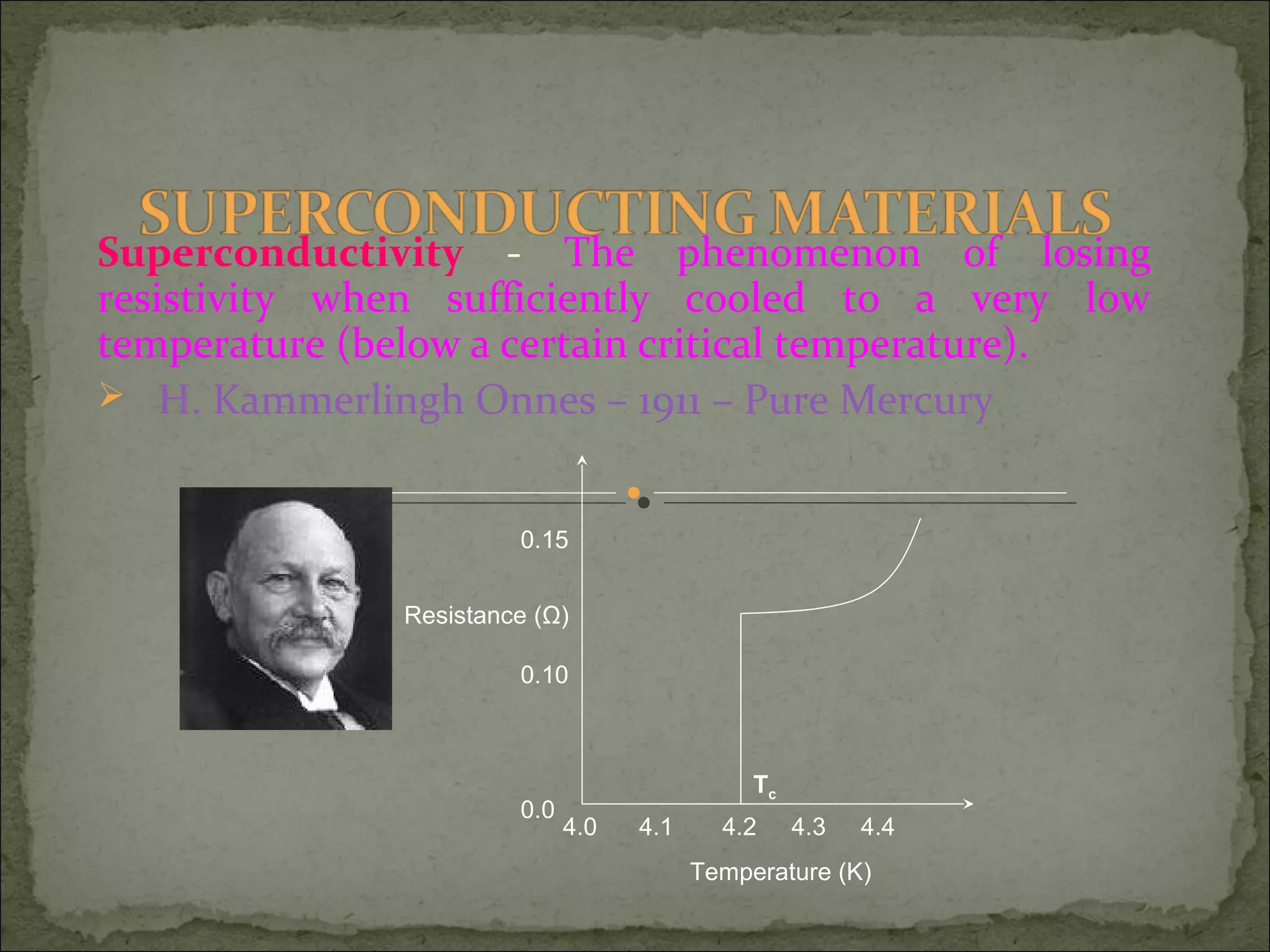
Superconductivity - The phenomenon of losing
resistivity when sufficiently cooled to a very low
temperature (below a certain critical temperature).
 H. Kammerlingh Onnes – 1911 – Pure Mercury
Resistance (Ω)
4.0 4.1 4.2 4.3 4.4
Temperature (K)
0.15
0.10
0.0
Tc
Temperature at which a normal conductor loses
its resistivity and becomes a superconductor.
 Definite for a material
 Superconducting transition reversible
 Very good electrical conductors not
superconductors eg. Cu, Ag, Au
 Types
1. Low TC superconductors
2. High TC superconductors
Superconducting Elements TC (K)
Sn (Tin) 3.72
Hg (Mercury) 4.15
Pb (Lead) 7.19
Superconducting Compounds
NbTi (Niobium Titanium) 10
Nb3Sn (Niobium Tin) 18.1
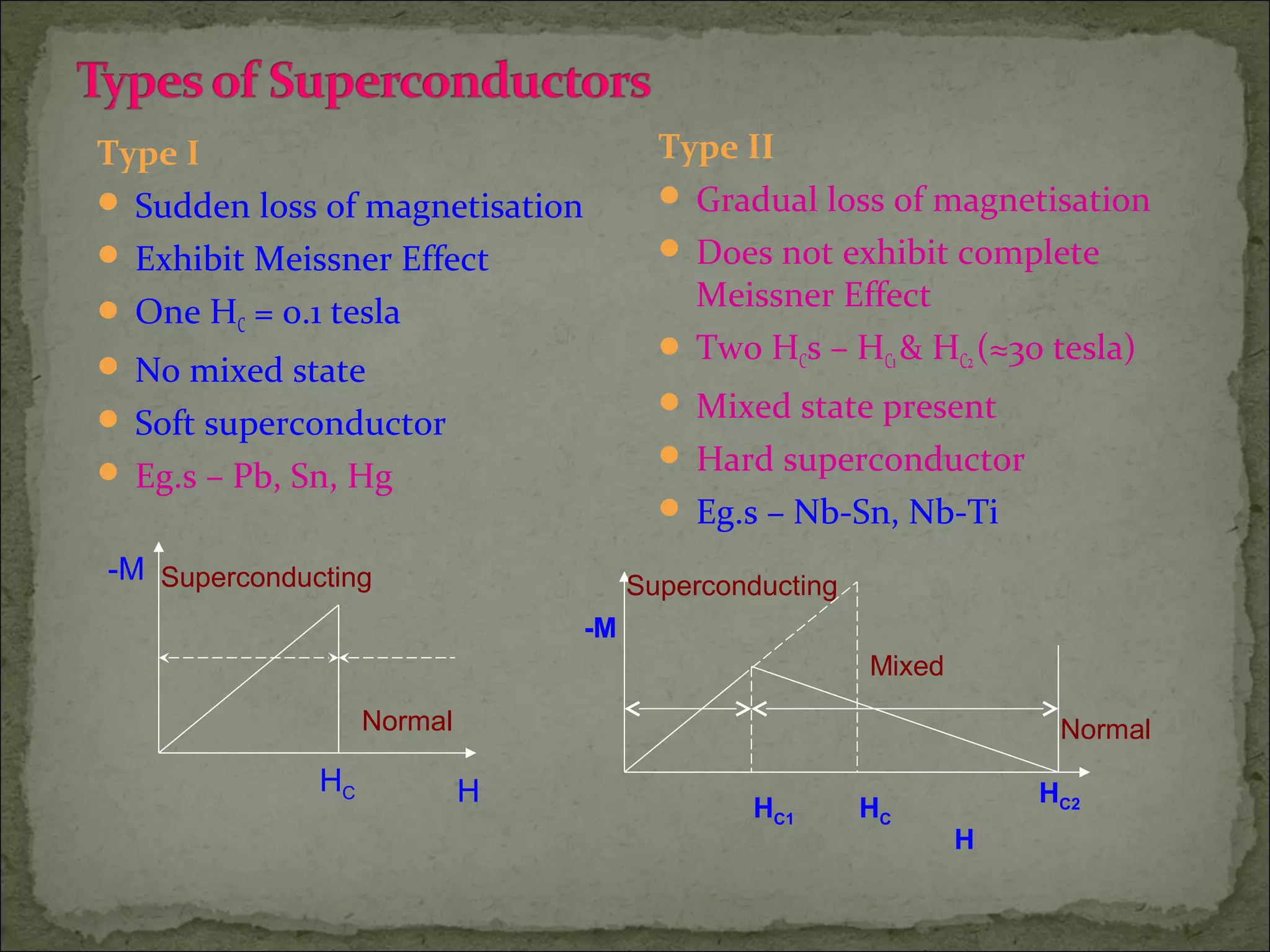
Type I
 Sudden loss of magnetisation
 Exhibit Meissner Effect
 One HC = 0.1 tesla
 No mixed state
 Soft superconductor
 Eg.s – Pb, Sn, Hg
Type II
 Gradual loss of magnetisation
 Does not exhibit complete
Meissner Effect
 Two HCs – HC1 & HC2 (≈30 tesla)
 Mixed state present
 Hard superconductor
 Eg.s – Nb-Sn, Nb-Ti
-M
HHC
Superconducting
Normal
Superconducting
-M
Normal
Mixed
HC1 HC
HC2
H
Characteristics
High TC
1-2-3 Compound
Perovskite crystal
structure
Direction dependent
Reactive, brittle
Oxides of Cu + other
elements
Large distance power transmission (ρ = 0)
Switching device (easy destruction of
superconductivity)
Sensitive electrical equipment (small V variation 
large constant current)
Memory / Storage element (persistent current)
Highly efficient small sized electrical generator and
transformer
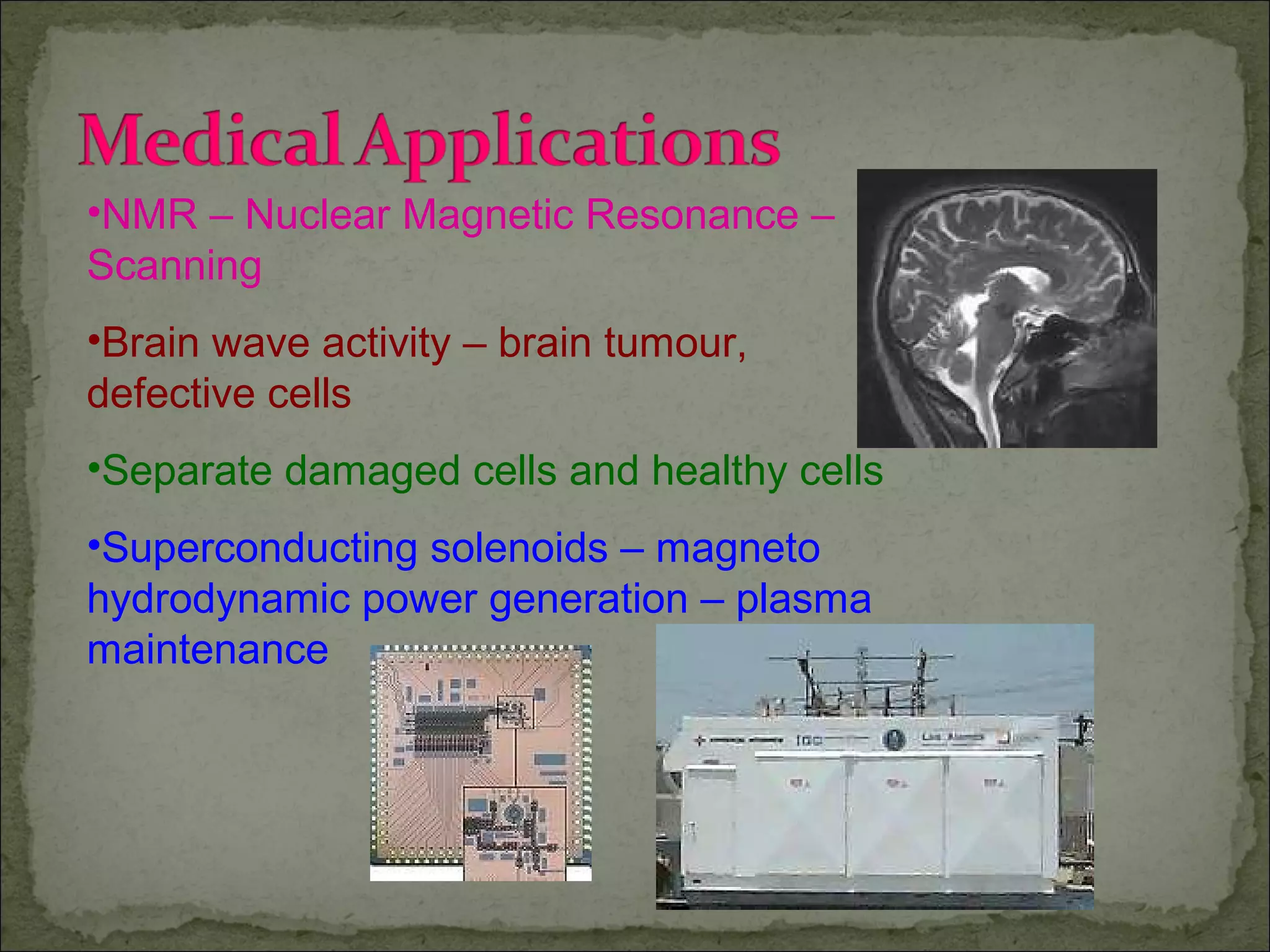
•NMR – Nuclear Magnetic Resonance –
Scanning
•Brain wave activity – brain tumour,
defective cells
•Separate damaged cells and healthy cells
•Superconducting solenoids – magneto
hydrodynamic power generation – plasma
maintenance
 Superconductivity is a
phenomenon in certain
materials at extremely low
temperatures ,characterized by
exactly zero electrical resistance
and exclusion of the interior
magnetic field (i.e. the Meissner
effect)
 This phenomenon is nothing
but losing the resistivity
absolutely when cooled to
sufficient low temperatures
Before the discovery of the superconductors it was
thought that the electrical resistance of a conductor
becomes zero only at absolute zero
But it was found that in some materials electrical
resistance becomes zero when cooled to very low
temperatures
These materials are nothing but the SUPER
CONDUTORS.
Superconductivity was discovered in 1911 by Heike
Kammerlingh Onnes , who studied the resistance
of solid mercury at cryogenic temperatures using
the recently discovered liquid helium as
‘refrigerant’.
 At the temperature of 4.2 K , he observed that the
resistance abruptly disappears.
For this discovery he got the NOBEL PRIZE in
PHYSICS in 1913.
In 1913 lead was found to super conduct at 7K.
In 1941 niobium nitride was found to super
conduct at 16K
Transmission of power
Switching devices
Sensitive electrical instruments
Memory (or) storage element in computers.
Manufacture of electrical generators and transformers
Nuclear Magnetic Resonance (NMR)
Diagnosis of brain tumor
Magneto – hydrodynamic power generation
PREPARED BY:-
PARVEZ SHEIKH
151080106026
CIVIL

superconducting materials

  • 1.
  • 2.
    Superconductivity - Thephenomenon of losing resistivity when sufficiently cooled to a very low temperature (below a certain critical temperature).  H. Kammerlingh Onnes – 1911 – Pure Mercury Resistance (Ω) 4.0 4.1 4.2 4.3 4.4 Temperature (K) 0.15 0.10 0.0 Tc
  • 3.
    Temperature at whicha normal conductor loses its resistivity and becomes a superconductor.  Definite for a material  Superconducting transition reversible  Very good electrical conductors not superconductors eg. Cu, Ag, Au  Types 1. Low TC superconductors 2. High TC superconductors
  • 4.
    Superconducting Elements TC(K) Sn (Tin) 3.72 Hg (Mercury) 4.15 Pb (Lead) 7.19 Superconducting Compounds NbTi (Niobium Titanium) 10 Nb3Sn (Niobium Tin) 18.1
  • 5.
    Type I  Suddenloss of magnetisation  Exhibit Meissner Effect  One HC = 0.1 tesla  No mixed state  Soft superconductor  Eg.s – Pb, Sn, Hg Type II  Gradual loss of magnetisation  Does not exhibit complete Meissner Effect  Two HCs – HC1 & HC2 (≈30 tesla)  Mixed state present  Hard superconductor  Eg.s – Nb-Sn, Nb-Ti -M HHC Superconducting Normal Superconducting -M Normal Mixed HC1 HC HC2 H
  • 6.
    Characteristics High TC 1-2-3 Compound Perovskitecrystal structure Direction dependent Reactive, brittle Oxides of Cu + other elements
  • 7.
    Large distance powertransmission (ρ = 0) Switching device (easy destruction of superconductivity) Sensitive electrical equipment (small V variation  large constant current) Memory / Storage element (persistent current) Highly efficient small sized electrical generator and transformer
  • 8.
    •NMR – NuclearMagnetic Resonance – Scanning •Brain wave activity – brain tumour, defective cells •Separate damaged cells and healthy cells •Superconducting solenoids – magneto hydrodynamic power generation – plasma maintenance
  • 9.
     Superconductivity isa phenomenon in certain materials at extremely low temperatures ,characterized by exactly zero electrical resistance and exclusion of the interior magnetic field (i.e. the Meissner effect)  This phenomenon is nothing but losing the resistivity absolutely when cooled to sufficient low temperatures
  • 10.
    Before the discoveryof the superconductors it was thought that the electrical resistance of a conductor becomes zero only at absolute zero But it was found that in some materials electrical resistance becomes zero when cooled to very low temperatures These materials are nothing but the SUPER CONDUTORS.
  • 11.
    Superconductivity was discoveredin 1911 by Heike Kammerlingh Onnes , who studied the resistance of solid mercury at cryogenic temperatures using the recently discovered liquid helium as ‘refrigerant’.  At the temperature of 4.2 K , he observed that the resistance abruptly disappears. For this discovery he got the NOBEL PRIZE in PHYSICS in 1913. In 1913 lead was found to super conduct at 7K. In 1941 niobium nitride was found to super conduct at 16K
  • 13.
    Transmission of power Switchingdevices Sensitive electrical instruments Memory (or) storage element in computers. Manufacture of electrical generators and transformers
  • 14.
    Nuclear Magnetic Resonance(NMR) Diagnosis of brain tumor Magneto – hydrodynamic power generation
  • 15.