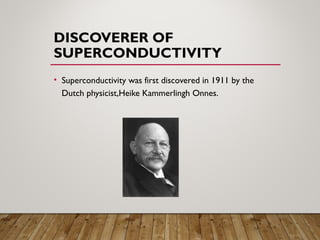
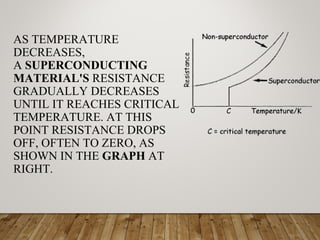
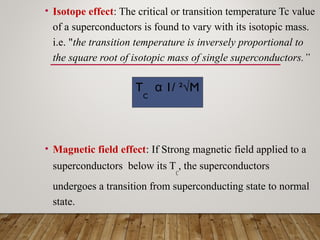
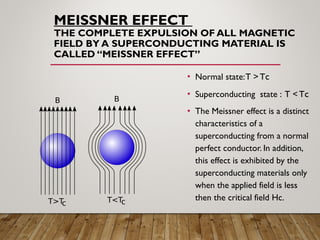
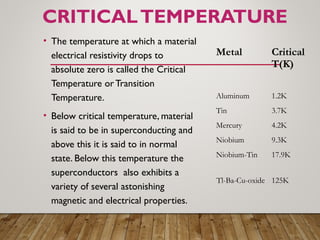
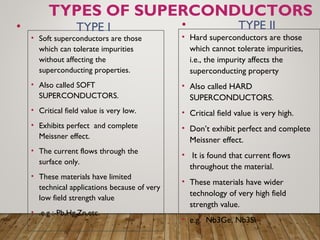
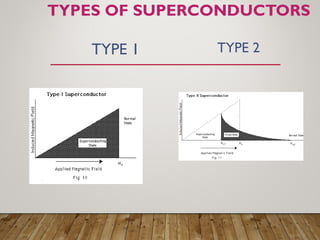
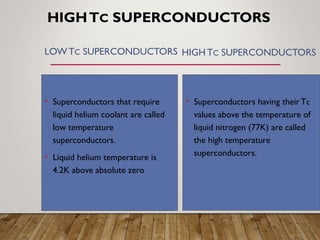
This document discusses superconductors and their properties. It begins by defining superconductors as materials that have zero resistivity and behave as perfect diamagnets below a critical temperature. The first discovery of superconductivity was made in 1911 by Heike Kamerlingh Onnes. Below the critical temperature, a superconductor's resistance gradually decreases to zero. Superconductors are classified as either type 1 or type 2, with type 2 being able to tolerate impurities better and having higher critical magnetic fields. Applications of superconductors discussed include maglev trains, MRI machines, and power transmission.