Superconductivity
Exploring the world of Low Temperatures and Quantum effects
◦ What are superconductors?
• Superconductors are the material having almost zero
resistivity and behave as diamagnetic below the
superconducting transiting temperature
• Superconductivity is the flow of electric current without
resistance in certain metals, alloys, and ceramics at
temperatures near absolute zero, and in some cases at
temperatures hundreds of degrees above absolute zero =
-273ºK.
 Superconductivity was first discovered in 1911 by the
Dutch physicist,Heike Kammerlingh Onnes.
 Onnes, felt that a cold wire's resistance would dissipate. This
suggested that there would be a steady decrease in electrical
resistance, allowing for better conduction of electricity.
 At some very low temperature point, scientists felt that there
would be a leveling off as the resistance reached some ill-
defined minimum value allowing the current to flow with little
or no resistance.
 Onnes passed a current through a very pure mercury wire
and measured its resistance as he steadily lowered the
temperature. Much to his surprise there was no resistance at
4.2K.
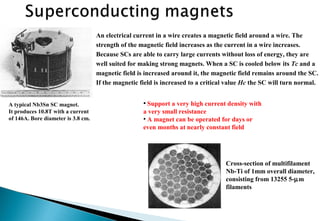
An electrical current in a wire creates a magnetic field around a wire. The
strength of the magnetic field increases as the current in a wire increases.
Because SCs are able to carry large currents without loss of energy, they are
well suited for making strong magnets. When a SC is cooled below its Tc and a
magnetic field is increased around it, the magnetic field remains around the SC.
If the magnetic field is increased to a critical value Hc the SC will turn normal.
• Support a very high current density with
a very small resistance
• A magnet can be operated for days or
even months at nearly constant field
A typical Nb3Sn SC magnet.
It produces 10.8T with a current
of 146A. Bore diameter is 3.8 cm.
Cross-section of multifilament
Nb-Ti of 1mm overall diameter,
consisting from 13255 5-µm
filaments
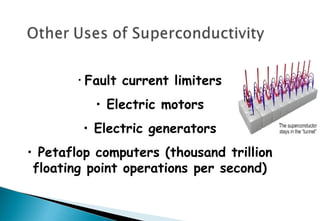
• Fault current limiters
• Electric motors
• Electric generators
• Petaflop computers (thousand trillion
floating point operations per second)
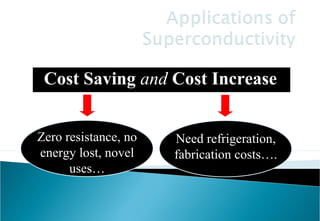
Trade off between:
Cost Saving and Cost Increase
Zero resistance, no
energy lost, novel
uses…
Need refrigeration,
fabrication costs….
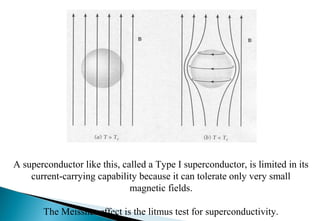
A superconductor like this, called a Type I superconductor, is limited in its
current-carrying capability because it can tolerate only very small
magnetic fields.
The Meissner effect is the litmus test for superconductivity.
A Type II superconductor acts like a Type I superconductor in small
magnetic fields. In large magnetic fields, it “sacrifices” part of itself so
that the rest can remain superconducting.
Type II superconductors can carry enormous currents and make incredibly
powerful superconducting electromagnets.
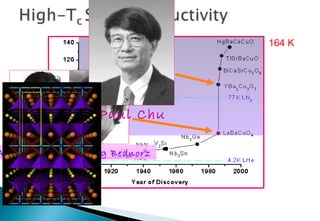
Alex Müller and Georg Bednorz
Paul Chu
164 K
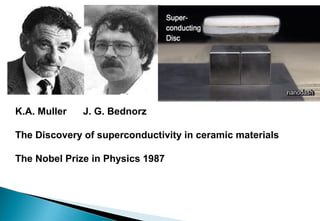
K.A. Muller J. G. Bednorz
The Discovery of superconductivity in ceramic materials
The Nobel Prize in Physics 1987
Super
conductor
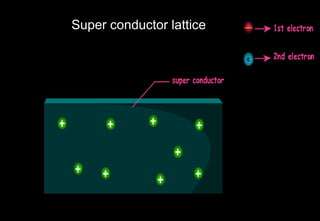
lattice
Super conductor lattice
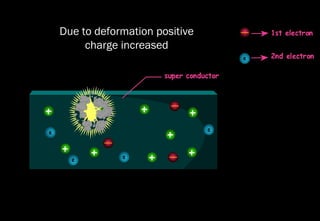
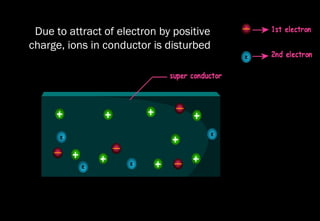
Due to attract of electron by positive
charge, ions in conductor is disturbed
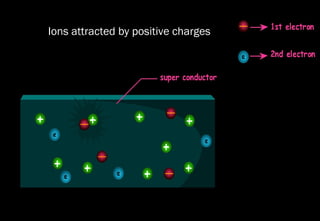
Ions attracted by positive charges
Due to deformation positive
charge increased
Electrons get attracted due to
increased positive charges
Cooper pairs formed
 Can carry large quantities of energy without heat loss.
 Able to generate strong magnetic fields.
 Superconductors beneficial applications in medical
imaging techniques.
 New superconductive films may result in
miniaturization .
 Superconductors increased speed in computer chips.
 Superconducting materials conduct current at
only given temperature known as transition
temperature.
 Superconductors still do not show up in most
everyday electronics.
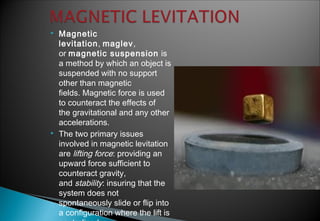
 Magnetic
levitation, maglev,
or magnetic suspension is
a method by which an object is
suspended with no support
other than magnetic
fields. Magnetic force is used
to counteract the effects of
the gravitational and any other
accelerations.
 The two primary issues
involved in magnetic levitation
are lifting force: providing an
upward force sufficient to
counteract gravity,
and stability: insuring that the
system does not
spontaneously slide or flip into
a configuration where the lift is
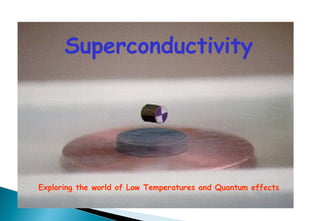
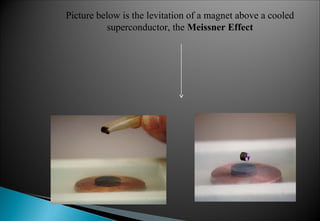
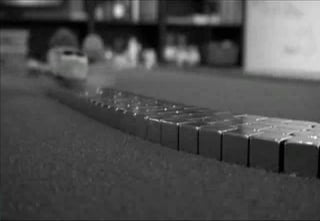
Picture below is the levitation of a magnet above a cooled
superconductor, the Meissner Effect
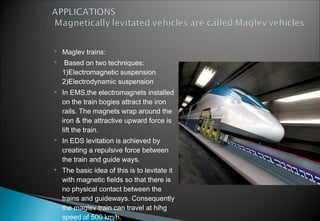
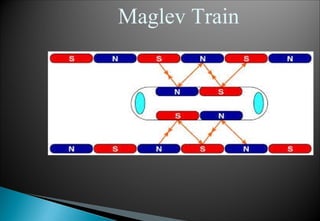
 Maglev trains:
 Based on two techniques:
1)Electromagnetic suspension
2)Electrodynamic suspension
 In EMS,the electromagnets installed
on the train bogies attract the iron
rails. The magnets wrap around the
iron & the attractive upward force is
lift the train.
 In EDS levitation is achieved by
creating a repulsive force between
the train and guide ways.
 The basic idea of this is to levitate it
with magnetic fields so that there is
no physical contact between the
trains and guideways. Consequently
the maglev train can travel at hihg
speed of 500 km/h.
Maglev Train
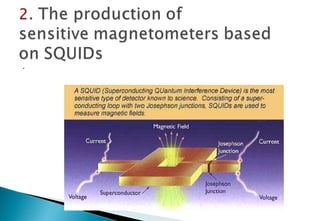
.
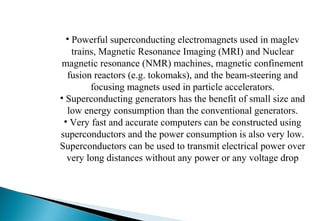
• Powerful superconducting electromagnets used in maglev
trains, Magnetic Resonance Imaging (MRI) and Nuclear
magnetic resonance (NMR) machines, magnetic confinement
fusion reactors (e.g. tokomaks), and the beam-steering and
focusing magnets used in particle accelerators.
• Superconducting generators has the benefit of small size and
low energy consumption than the conventional generators.
• Very fast and accurate computers can be constructed using
superconductors and the power consumption is also very low.
Superconductors can be used to transmit electrical power over
very long distances without any power or any voltage drop
Superconductivity by varun yashoda dabhade ppt

Superconductivity by varun yashoda dabhade ppt

  • 1.
    Superconductivity Exploring the worldof Low Temperatures and Quantum effects
  • 2.
    ◦ What aresuperconductors? • Superconductors are the material having almost zero resistivity and behave as diamagnetic below the superconducting transiting temperature • Superconductivity is the flow of electric current without resistance in certain metals, alloys, and ceramics at temperatures near absolute zero, and in some cases at temperatures hundreds of degrees above absolute zero = -273ºK.
  • 3.
     Superconductivity wasfirst discovered in 1911 by the Dutch physicist,Heike Kammerlingh Onnes.
  • 4.
     Onnes, feltthat a cold wire's resistance would dissipate. This suggested that there would be a steady decrease in electrical resistance, allowing for better conduction of electricity.  At some very low temperature point, scientists felt that there would be a leveling off as the resistance reached some ill- defined minimum value allowing the current to flow with little or no resistance.  Onnes passed a current through a very pure mercury wire and measured its resistance as he steadily lowered the temperature. Much to his surprise there was no resistance at 4.2K.
  • 5.
    An electrical currentin a wire creates a magnetic field around a wire. The strength of the magnetic field increases as the current in a wire increases. Because SCs are able to carry large currents without loss of energy, they are well suited for making strong magnets. When a SC is cooled below its Tc and a magnetic field is increased around it, the magnetic field remains around the SC. If the magnetic field is increased to a critical value Hc the SC will turn normal. • Support a very high current density with a very small resistance • A magnet can be operated for days or even months at nearly constant field A typical Nb3Sn SC magnet. It produces 10.8T with a current of 146A. Bore diameter is 3.8 cm. Cross-section of multifilament Nb-Ti of 1mm overall diameter, consisting from 13255 5-µm filaments
  • 6.
    • Fault currentlimiters • Electric motors • Electric generators • Petaflop computers (thousand trillion floating point operations per second)
  • 7.
    Trade off between: CostSaving and Cost Increase Zero resistance, no energy lost, novel uses… Need refrigeration, fabrication costs….
  • 9.
    A superconductor likethis, called a Type I superconductor, is limited in its current-carrying capability because it can tolerate only very small magnetic fields. The Meissner effect is the litmus test for superconductivity.
  • 10.
    A Type IIsuperconductor acts like a Type I superconductor in small magnetic fields. In large magnetic fields, it “sacrifices” part of itself so that the rest can remain superconducting. Type II superconductors can carry enormous currents and make incredibly powerful superconducting electromagnets.
  • 11.
    Alex Müller andGeorg Bednorz Paul Chu 164 K
  • 12.
    K.A. Muller J.G. Bednorz The Discovery of superconductivity in ceramic materials The Nobel Prize in Physics 1987
  • 13.
  • 14.
  • 15.
    Due to attractof electron by positive charge, ions in conductor is disturbed
  • 16.
    Ions attracted bypositive charges
  • 17.
    Due to deformationpositive charge increased
  • 18.
    Electrons get attracteddue to increased positive charges
  • 19.
  • 20.
     Can carrylarge quantities of energy without heat loss.  Able to generate strong magnetic fields.  Superconductors beneficial applications in medical imaging techniques.  New superconductive films may result in miniaturization .  Superconductors increased speed in computer chips.
  • 21.
     Superconducting materialsconduct current at only given temperature known as transition temperature.  Superconductors still do not show up in most everyday electronics.
  • 22.
     Magnetic levitation, maglev, or magnetic suspension is amethod by which an object is suspended with no support other than magnetic fields. Magnetic force is used to counteract the effects of the gravitational and any other accelerations.  The two primary issues involved in magnetic levitation are lifting force: providing an upward force sufficient to counteract gravity, and stability: insuring that the system does not spontaneously slide or flip into a configuration where the lift is
  • 23.
    Picture below isthe levitation of a magnet above a cooled superconductor, the Meissner Effect
  • 24.
     Maglev trains: Based on two techniques: 1)Electromagnetic suspension 2)Electrodynamic suspension  In EMS,the electromagnets installed on the train bogies attract the iron rails. The magnets wrap around the iron & the attractive upward force is lift the train.  In EDS levitation is achieved by creating a repulsive force between the train and guide ways.  The basic idea of this is to levitate it with magnetic fields so that there is no physical contact between the trains and guideways. Consequently the maglev train can travel at hihg speed of 500 km/h.
  • 25.
  • 27.
  • 28.
    • Powerful superconductingelectromagnets used in maglev trains, Magnetic Resonance Imaging (MRI) and Nuclear magnetic resonance (NMR) machines, magnetic confinement fusion reactors (e.g. tokomaks), and the beam-steering and focusing magnets used in particle accelerators. • Superconducting generators has the benefit of small size and low energy consumption than the conventional generators. • Very fast and accurate computers can be constructed using superconductors and the power consumption is also very low. Superconductors can be used to transmit electrical power over very long distances without any power or any voltage drop