Out line of lecture
 What is superconductivity?
 Superconducting materials
 Meissner effect
 Superconducting parameters
 High Tc Superconductors mainly
Cuprate
 Preparation of HTSC
 Structure of Cuprate HTSC
What is superconductivity?
 Disappearance of the
electrical resistance of
various kind of metals in
small temperature range
at a critical temperature
Tc.
 This is the characteristic
of certain materials
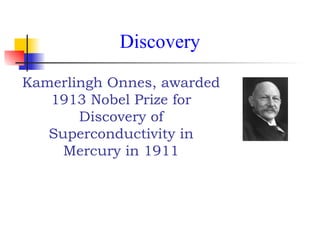
Kamerlingh Onnes, awarded
1913 Nobel Prize for
Discovery of
Superconductivity in
Mercury in 1911
Discovery
Is the resistance identically zero?
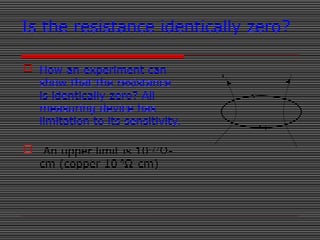
 How an experiment can
show that the resistance
is identically zero? All
measuring device has
limitation to its sensitivity.
 An upper limit is 10-27
Ω-
cm (copper 10-9
Ω-cm)
Superconducting materials
 Soon after discovery, various kinds of
element tried and found around 26
elements show superconductivity.
 Among elements Maximum Tc 9.26 K in Nb
and lowest 0.012K in Tungsten
 Tc depends not only chemical composition
but also crystal structure. -La and -La
have Tc 4.9K and 6.06K.
 This means the superconductivity is not a
property of isolated atoms but it is
collective effect determined by the
structure of the whole samples
Superconducting materials
 It was expected that the good conductor
mainly copper silver and gold may turn to
superconductivity at low temperature but
they did not.
 Majority of superconductors are not pure
element, but alloys and compound. Today
over 6000 SCs are known and are
constantly growing.
Superconducting materials
 For many years the record holder for
maximum Tc was Niobium-tin alloy (18.1K)
and in 1973 discovered 22.3 K in thin film
of Nb3Ge.
 In 1986, 75 th
anniversary of discovery of
superconductivity was marked by new
class of superconductors copper oxide
based.
Superconducting materials
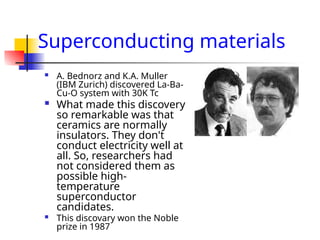
 A. Bednorz and K.A. Muller
(IBM Zurich) discovered La-Ba-
Cu-O system with 30K Tc
 What made this discovery
so remarkable was that
ceramics are normally
insulators. They don't
conduct electricity well at
all. So, researchers had
not considered them as
possible high-
temperature
superconductor
candidates.
 This discovary won the Noble
prize in 1987
Superconducting materials
 Müller and Bednorz' discovery triggered a flurry of
activity in the field of superconductivity.
 Researchers around the world began "cooking" up
ceramics of every imaginable combination in a quest
for higher and higher Tc's.
 In January of 1987 a research team at the University of
Alabama-Huntsville substituted Yttrium for Lanthanum
in the Müller and Bednorz molecule and achieved an
incredible 92 K Tc.
 For the first time a material (today referred to as YBCO)
had been found that would superconduct at
temperatures warmer than liquid nitrogen - a
commonly available coolant.
Perfect diamagnetism
Meissner effect
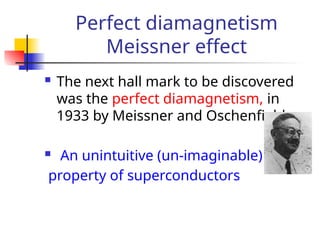
 The next hall mark to be discovered
was the perfect diamagnetism, in
1933 by Meissner and Oschenfield
 An unintuitive (un-imaginable)
property of superconductors
Meissner effect
 A diamagnetic property exhibited by
superconductors.
 End result is the exclusion of
magnetic field from the interior of a
superconductor.
 What is diamagnetism?
Diamagnetism?
 A superconductor is not only a
perfect conductor (R=0), but a perfect
diamagnet.
 It will tend to repel a magnet.
So, Superconductors are
Perfect Diamagnets?
 If a superconductor was only a
perfect conductor, would there be a
Meissner Effect?
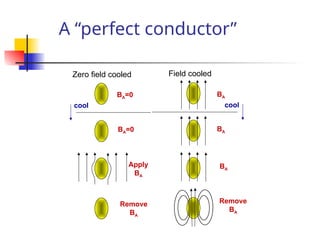
A “perfect conductor”
Field cooled
BA
BA
cool
Remove
BA
BA
Zero field cooled
BA=0
BA=0
cool
Apply
BA
Remove
BA
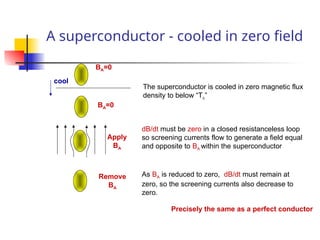
A superconductor - cooled in zero field
BA=0
Apply
BA
dB/dt must be zero in a closed resistanceless loop
so screening currents flow to generate a field equal
and opposite to BA within the superconductor
Remove
BA
As BA is reduced to zero, dB/dt must remain at
zero, so the screening currents also decrease to
zero.
cool
BA=0
The superconductor is cooled in zero magnetic flux
density to below “Tc”
Precisely the same as a perfect conductor
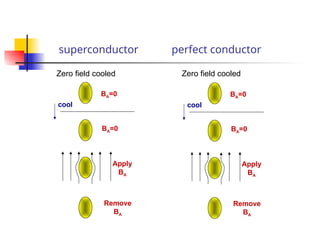
superconductor perfect conductor
Zero field cooled
BA=0
BA=0
cool
Apply
BA
Remove
BA
BA=0
BA=0
cool
Apply
BA
Remove
BA
Zero field cooled
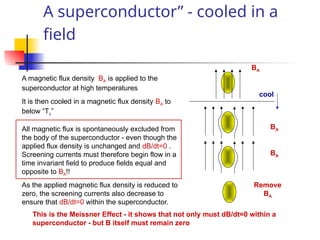
A superconductor” - cooled in a
field
BA
A magnetic flux density BA is applied to the
superconductor at high temperatures
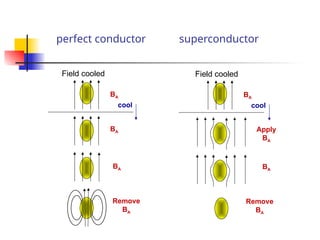
This is the Meissner Effect - it shows that not only must dB/dt=0 within a
superconductor - but B itself must remain zero
cool
It is then cooled in a magnetic flux density BA to
below “Tc”
BA
Remove
BA
As the applied magnetic flux density is reduced to
zero, the screening currents also decrease to
ensure that dB/dt=0 within the superconductor.
BA
All magnetic flux is spontaneously excluded from
the body of the superconductor - even though the
applied flux density is unchanged and dB/dt=0 .
Screening currents must therefore begin flow in a
time invariant field to produce fields equal and
opposite to BA!!
perfect conductor superconductor
Field cooled
BA
cool
Remove
BA
BA
Apply
BA
BA
BA
cool
Remove
BA
BA
Field cooled
Net flux distribution - solid
sample
BA
i i i
BA
applied flux flux from
magnetisation
screening currents
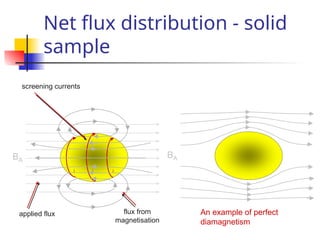
An example of perfect
diamagnetism
The Meissner Effect - summary
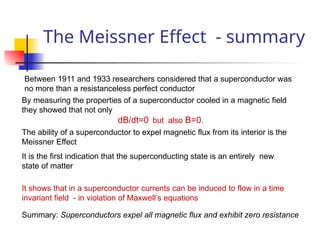
Between 1911 and 1933 researchers considered that a superconductor was
no more than a resistanceless perfect conductor
By measuring the properties of a superconductor cooled in a magnetic field
they showed that not only
dB/dt=0 but also B=0.
The ability of a superconductor to expel magnetic flux from its interior is the
Meissner Effect
It is the first indication that the superconducting state is an entirely new
state of matter
It shows that in a superconductor currents can be induced to flow in a time
invariant field - in violation of Maxwell’s equations
Summary: Superconductors expel all magnetic flux and exhibit zero resistance
Critical field
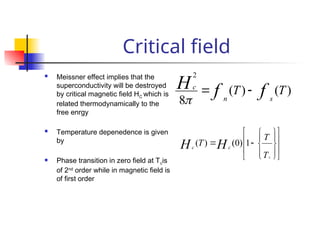
 Meissner effect implies that the
superconductivity will be destroyed
by critical magnetic field HC which is
related thermodynamically to the
free enrgy
 Temperature depenedence is given
by
 Phase transition in zero field at Tcis
of 2nd
order while in magnetic field is
of first order
)
(
)
(
8
2
T
T f
f
H
s
n
c























T
T
T
c
H
H c
c
1
)
0
(
)
(
Type I and Type II superconductors
 Superconductors exist in one of two types. In the first kind an
external magnetic field cannot penetrate into the bulk of the
sample without destroying the superconducting condensate
state that is called Type I or Soft superconductors.
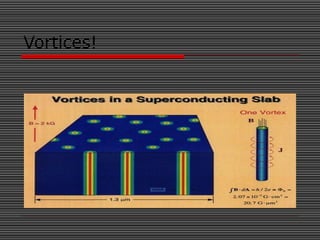
 The second kind of superconductors, of which HTS are
prominent members, are able to remain superconducting over a
range of fields H in the interval Hc1 < H < Hc2. At the lower
critical field Hc1 the first magnetic flux starts to enter the bulk of
the superconductor. The field does not penetrate the bulk in a
homogenous way rather in a regular array of flux tubes each
carrying one quantum of flux o = 2.07x10⁻⁷
G-cm2
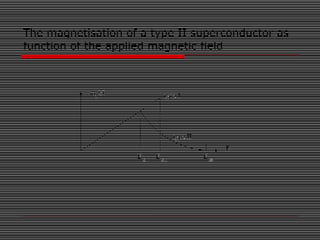
The magnetisation of a type II superconductor as
function of the applied magnetic field
Vortices!
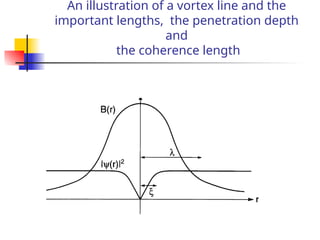
An illustration of a vortex line and the
important lengths, the penetration depth
and
the coherence length
Mystery of Superconductivity
 Isotope Effect: Probably this is the effect,
which shows the way to the correct theory.
 TC M1/2
= constant
 Isotope mass is the characteristic of lattice
and related to the lattice vibration Ω≈M-0.5
.
Superconductivity is the property of
electron system. Thus this means the
electron lattice interaction is related to
superconductivity.
 Also the lattice interaction is responsible for
electrical resistance.
Mystery of Superconductivity
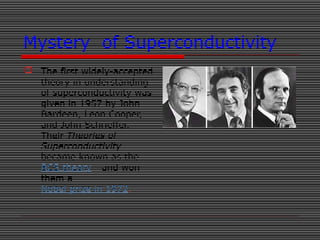
 The first widely-accepted
theory in understanding
of superconductivity was
given in 1957 by John
Bardeen, Leon Cooper,
and John Schrieffer.
Their Theories of
Superconductivity
became known as the
BCS theory - and won
them a
Nobel prize in 1972.
BCS Theory
 The two electrons forms a pair i.e. called
Cooper pair. This pair is no more fermion
rather, it is boson and follow Bose Einstein
statistics.
 The lattice play a role in providing the
attraction between the two electrons
 An electron moving in the metal deform
lattice or polarize it and electron
surrounded by the cloud of positive charge
attract the other electron.
High Tc Superconductors
 Müller and Bednorz' discovery of La-Ba-Cu-O around
30K triggered a flurry of activity in the field of
superconductivity.
 Researchers around the world began "cooking" up
ceramics of every imaginable combination in a quest
for higher and higher Tc's.
 In January of 1987 a research team at the University
of Alabama-Huntsville substituted Yttrium for
Lanthanum in the Müller and Bednorz molecule and
achieved an incredible 92 K Tc. For the first time a
material YBa2Cu3O7-(today referred to as YBCO or
123) had been found that would superconduct at
temperatures warmer than liquid nitrogen - a
commonly available coolant.
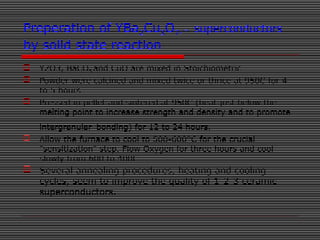
Preperation of YBa2Cu3O7- superconductors
by solid state reaction
 Y2O3, BaCO3 and CuO are mixed in Stoichiometric
 Powder were calcined and mixed twice or thrice at 950C for 4
to 5 hours
 Pressed in pellet and sintered at 950C (heat just below the
melting point to increase strength and density and to promote
intergranular bonding) for 12 to 24 hours.
 Allow the furnace to cool to 500-600°C for the crucial
"sensitization" step. Flow Oxygen for three hours and cool
slowly from 600 to 400C
 Several annealing procedures, heating and cooling
cycles, seem to improve the quality of 1-2-3 ceramic
superconductors.
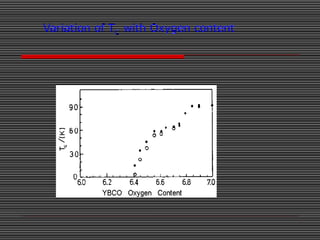
Variation of TC with Oxygen content
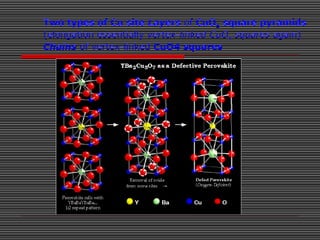
Two types of Cu site Layers of CuO5 square pyramids
(elongation essentially vertex-linked CuO4 squares again)
Chains of vertex-linked CuO4 squares
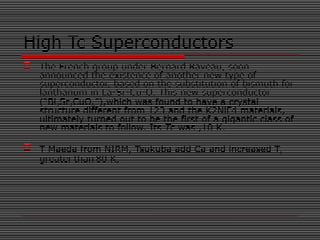
 The French group under Bernard Raveau, soon
announced the existence of another new type of
superconductor, based on the substitution of bismuth for
lanthanum in La-Sr-Cu-O. This new superconductor
(“Bi2Sr2CuO6”),which was found to have a crystal
structure different from 123 and the K2NiF4 materials,
ultimately turned out to be the first of a gigantic class of
new materials to follow. Its Tc was ,10 K.
 T Maeda from NIRM, Tsukuba add Ca and increased TC
greater than 80 K,
High Tc Superconductors
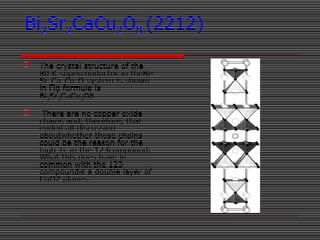
Bi2Sr2CaCu2O8 (2212)
 The crystal structure of the
80 K superconductor in theBi-
Sr-Ca-Cu-O system is shown
in Fig formula is
Bi2Sr2CaCu2O8.
 There are no copper oxide
chains and, therefore, that
ended all discussion
aboutwhether those chains
could be the reason for the
high Tc in the 123compound.
What this does have in
common with the 123
compoundis a double layer of
CuO2 planes.
Tc depending on no. of CuO2 layer
and the Insulating layer
 Bi2Sr2Ca2Cu3O10 (2223) – 110 K
 Tl2Ba2Ca2Cu3O10 - 125K
 HgBa2Ca2Cu3O9, - 134K at high
pressure164 K
 Y2Ba4Cu7O15 Tc~95K
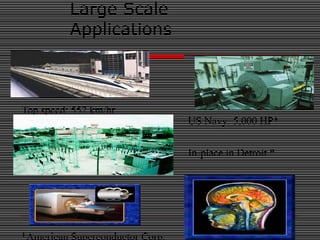
Large Scale
Applications
Top speed: 552 km/hr
In-place in Detroit.*
US Navy: 5,000 HP*
Conclusion
 New Materials are coming showing
higher and higher Tc
 Next challenge is to make the
materials suitable for application
 Dreamed room temperature
superconductors may be reality one
day

lecture_on_introduction_to_superconductivity.pptx

  • 1.
    Out line oflecture  What is superconductivity?  Superconducting materials  Meissner effect  Superconducting parameters  High Tc Superconductors mainly Cuprate  Preparation of HTSC  Structure of Cuprate HTSC
  • 2.
    What is superconductivity? Disappearance of the electrical resistance of various kind of metals in small temperature range at a critical temperature Tc.  This is the characteristic of certain materials
  • 3.
    Kamerlingh Onnes, awarded 1913Nobel Prize for Discovery of Superconductivity in Mercury in 1911 Discovery
  • 4.
    Is the resistanceidentically zero?  How an experiment can show that the resistance is identically zero? All measuring device has limitation to its sensitivity.  An upper limit is 10-27 Ω- cm (copper 10-9 Ω-cm)
  • 5.
    Superconducting materials  Soonafter discovery, various kinds of element tried and found around 26 elements show superconductivity.  Among elements Maximum Tc 9.26 K in Nb and lowest 0.012K in Tungsten  Tc depends not only chemical composition but also crystal structure. -La and -La have Tc 4.9K and 6.06K.  This means the superconductivity is not a property of isolated atoms but it is collective effect determined by the structure of the whole samples
  • 6.
    Superconducting materials  Itwas expected that the good conductor mainly copper silver and gold may turn to superconductivity at low temperature but they did not.  Majority of superconductors are not pure element, but alloys and compound. Today over 6000 SCs are known and are constantly growing.
  • 7.
    Superconducting materials  Formany years the record holder for maximum Tc was Niobium-tin alloy (18.1K) and in 1973 discovered 22.3 K in thin film of Nb3Ge.  In 1986, 75 th anniversary of discovery of superconductivity was marked by new class of superconductors copper oxide based.
  • 8.
    Superconducting materials  A.Bednorz and K.A. Muller (IBM Zurich) discovered La-Ba- Cu-O system with 30K Tc  What made this discovery so remarkable was that ceramics are normally insulators. They don't conduct electricity well at all. So, researchers had not considered them as possible high- temperature superconductor candidates.  This discovary won the Noble prize in 1987
  • 9.
    Superconducting materials  Müllerand Bednorz' discovery triggered a flurry of activity in the field of superconductivity.  Researchers around the world began "cooking" up ceramics of every imaginable combination in a quest for higher and higher Tc's.  In January of 1987 a research team at the University of Alabama-Huntsville substituted Yttrium for Lanthanum in the Müller and Bednorz molecule and achieved an incredible 92 K Tc.  For the first time a material (today referred to as YBCO) had been found that would superconduct at temperatures warmer than liquid nitrogen - a commonly available coolant.
  • 10.
    Perfect diamagnetism Meissner effect The next hall mark to be discovered was the perfect diamagnetism, in 1933 by Meissner and Oschenfield  An unintuitive (un-imaginable) property of superconductors
  • 11.
    Meissner effect  Adiamagnetic property exhibited by superconductors.  End result is the exclusion of magnetic field from the interior of a superconductor.  What is diamagnetism?
  • 12.
    Diamagnetism?  A superconductoris not only a perfect conductor (R=0), but a perfect diamagnet.  It will tend to repel a magnet.
  • 13.
    So, Superconductors are PerfectDiamagnets?  If a superconductor was only a perfect conductor, would there be a Meissner Effect?
  • 14.
    A “perfect conductor” Fieldcooled BA BA cool Remove BA BA Zero field cooled BA=0 BA=0 cool Apply BA Remove BA
  • 15.
    A superconductor -cooled in zero field BA=0 Apply BA dB/dt must be zero in a closed resistanceless loop so screening currents flow to generate a field equal and opposite to BA within the superconductor Remove BA As BA is reduced to zero, dB/dt must remain at zero, so the screening currents also decrease to zero. cool BA=0 The superconductor is cooled in zero magnetic flux density to below “Tc” Precisely the same as a perfect conductor
  • 16.
    superconductor perfect conductor Zerofield cooled BA=0 BA=0 cool Apply BA Remove BA BA=0 BA=0 cool Apply BA Remove BA Zero field cooled
  • 17.
    A superconductor” -cooled in a field BA A magnetic flux density BA is applied to the superconductor at high temperatures This is the Meissner Effect - it shows that not only must dB/dt=0 within a superconductor - but B itself must remain zero cool It is then cooled in a magnetic flux density BA to below “Tc” BA Remove BA As the applied magnetic flux density is reduced to zero, the screening currents also decrease to ensure that dB/dt=0 within the superconductor. BA All magnetic flux is spontaneously excluded from the body of the superconductor - even though the applied flux density is unchanged and dB/dt=0 . Screening currents must therefore begin flow in a time invariant field to produce fields equal and opposite to BA!!
  • 18.
    perfect conductor superconductor Fieldcooled BA cool Remove BA BA Apply BA BA BA cool Remove BA BA Field cooled
  • 19.
    Net flux distribution- solid sample BA i i i BA applied flux flux from magnetisation screening currents An example of perfect diamagnetism
  • 20.
    The Meissner Effect- summary Between 1911 and 1933 researchers considered that a superconductor was no more than a resistanceless perfect conductor By measuring the properties of a superconductor cooled in a magnetic field they showed that not only dB/dt=0 but also B=0. The ability of a superconductor to expel magnetic flux from its interior is the Meissner Effect It is the first indication that the superconducting state is an entirely new state of matter It shows that in a superconductor currents can be induced to flow in a time invariant field - in violation of Maxwell’s equations Summary: Superconductors expel all magnetic flux and exhibit zero resistance
  • 21.
    Critical field  Meissnereffect implies that the superconductivity will be destroyed by critical magnetic field HC which is related thermodynamically to the free enrgy  Temperature depenedence is given by  Phase transition in zero field at Tcis of 2nd order while in magnetic field is of first order ) ( ) ( 8 2 T T f f H s n c                        T T T c H H c c 1 ) 0 ( ) (
  • 22.
    Type I andType II superconductors  Superconductors exist in one of two types. In the first kind an external magnetic field cannot penetrate into the bulk of the sample without destroying the superconducting condensate state that is called Type I or Soft superconductors.  The second kind of superconductors, of which HTS are prominent members, are able to remain superconducting over a range of fields H in the interval Hc1 < H < Hc2. At the lower critical field Hc1 the first magnetic flux starts to enter the bulk of the superconductor. The field does not penetrate the bulk in a homogenous way rather in a regular array of flux tubes each carrying one quantum of flux o = 2.07x10⁻⁷ G-cm2
  • 23.
    The magnetisation ofa type II superconductor as function of the applied magnetic field
  • 24.
  • 25.
    An illustration ofa vortex line and the important lengths, the penetration depth and the coherence length
  • 26.
    Mystery of Superconductivity Isotope Effect: Probably this is the effect, which shows the way to the correct theory.  TC M1/2 = constant  Isotope mass is the characteristic of lattice and related to the lattice vibration Ω≈M-0.5 . Superconductivity is the property of electron system. Thus this means the electron lattice interaction is related to superconductivity.  Also the lattice interaction is responsible for electrical resistance.
  • 27.
    Mystery of Superconductivity The first widely-accepted theory in understanding of superconductivity was given in 1957 by John Bardeen, Leon Cooper, and John Schrieffer. Their Theories of Superconductivity became known as the BCS theory - and won them a Nobel prize in 1972.
  • 28.
    BCS Theory  Thetwo electrons forms a pair i.e. called Cooper pair. This pair is no more fermion rather, it is boson and follow Bose Einstein statistics.  The lattice play a role in providing the attraction between the two electrons  An electron moving in the metal deform lattice or polarize it and electron surrounded by the cloud of positive charge attract the other electron.
  • 29.
    High Tc Superconductors Müller and Bednorz' discovery of La-Ba-Cu-O around 30K triggered a flurry of activity in the field of superconductivity.  Researchers around the world began "cooking" up ceramics of every imaginable combination in a quest for higher and higher Tc's.  In January of 1987 a research team at the University of Alabama-Huntsville substituted Yttrium for Lanthanum in the Müller and Bednorz molecule and achieved an incredible 92 K Tc. For the first time a material YBa2Cu3O7-(today referred to as YBCO or 123) had been found that would superconduct at temperatures warmer than liquid nitrogen - a commonly available coolant.
  • 30.
    Preperation of YBa2Cu3O7-superconductors by solid state reaction  Y2O3, BaCO3 and CuO are mixed in Stoichiometric  Powder were calcined and mixed twice or thrice at 950C for 4 to 5 hours  Pressed in pellet and sintered at 950C (heat just below the melting point to increase strength and density and to promote intergranular bonding) for 12 to 24 hours.  Allow the furnace to cool to 500-600°C for the crucial "sensitization" step. Flow Oxygen for three hours and cool slowly from 600 to 400C  Several annealing procedures, heating and cooling cycles, seem to improve the quality of 1-2-3 ceramic superconductors.
  • 31.
    Variation of TCwith Oxygen content
  • 32.
    Two types ofCu site Layers of CuO5 square pyramids (elongation essentially vertex-linked CuO4 squares again) Chains of vertex-linked CuO4 squares
  • 33.
     The Frenchgroup under Bernard Raveau, soon announced the existence of another new type of superconductor, based on the substitution of bismuth for lanthanum in La-Sr-Cu-O. This new superconductor (“Bi2Sr2CuO6”),which was found to have a crystal structure different from 123 and the K2NiF4 materials, ultimately turned out to be the first of a gigantic class of new materials to follow. Its Tc was ,10 K.  T Maeda from NIRM, Tsukuba add Ca and increased TC greater than 80 K, High Tc Superconductors
  • 34.
    Bi2Sr2CaCu2O8 (2212)  Thecrystal structure of the 80 K superconductor in theBi- Sr-Ca-Cu-O system is shown in Fig formula is Bi2Sr2CaCu2O8.  There are no copper oxide chains and, therefore, that ended all discussion aboutwhether those chains could be the reason for the high Tc in the 123compound. What this does have in common with the 123 compoundis a double layer of CuO2 planes.
  • 35.
    Tc depending onno. of CuO2 layer and the Insulating layer  Bi2Sr2Ca2Cu3O10 (2223) – 110 K  Tl2Ba2Ca2Cu3O10 - 125K  HgBa2Ca2Cu3O9, - 134K at high pressure164 K  Y2Ba4Cu7O15 Tc~95K
  • 36.
    Large Scale Applications Top speed:552 km/hr In-place in Detroit.* US Navy: 5,000 HP*
  • 37.
    Conclusion  New Materialsare coming showing higher and higher Tc  Next challenge is to make the materials suitable for application  Dreamed room temperature superconductors may be reality one day

Editor's Notes

  • #20 Show how it violates Maxwell's equation see notes…I.e assume r=0 does not explain superconductivty fully!