AMIRAJ COLLEGE OF
ENGINEERING & TECHNOLOGY
Prepared by:-
Maru Hitesh (151080106011)
Nandpal Prashant (151080106012)
Anand Ojha (151080106013)
 Classification of types of buildings
 Different types of buidings
 Functions of buildings
 The various building components with their
desirable functions are important for
understanding what to construct & how to
construct.
 The buildings is classified in main 2types
I)Based upon occupancy
II)Based upon structure
 It is also define as purpose served building by
user.
 Here some type of buildings is given as follow
under.
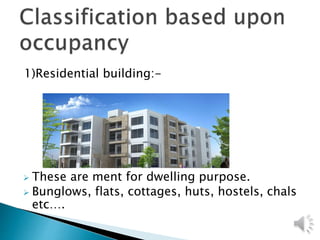
1)Residential building:-
 These are ment for dwelling purpose.
 Bunglows, flats, cottages, huts, hostels, chals
etc….
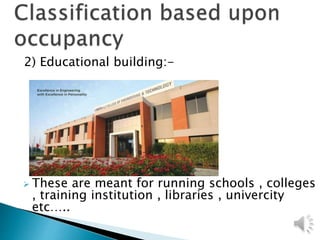
2) Educational building:-
 These are meant for running schools , colleges
, training institution , libraries , univercity
etc…..
3)Institutional building:-
 It means a building constructed by government
, semi-government organisations , public
sector , charitable trusts.
 It is utilized for public activities such as
education , medical , recreational and cultural ,
hostel , auditorium , orphans , etc…
 It is also used for treatment or care of person
suffering for physical or mental illness.
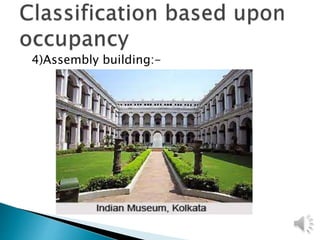
4)Assembly building:-
 These building are meant for assembly a
large number of people for amusement ,
recreation , social , religion , civil and similar
purpose.
 Theaters , halls , auditoria , museums ,
gymnasiums , restaurants , temple , church ,
mosque , dance halls , club , art galaries etc…
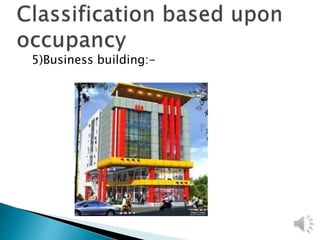
5)Business building:-
 These are meant for running business.
 For transactions , keeping of accounts and
records and similar purpose.
 Banks , city halls , court houses etc…
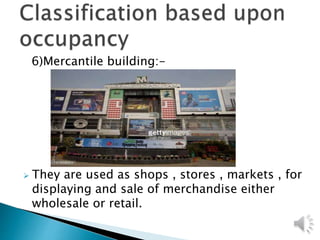
6)Mercantile building:-
 They are used as shops , stores , markets , for
displaying and sale of merchandise either
wholesale or retail.
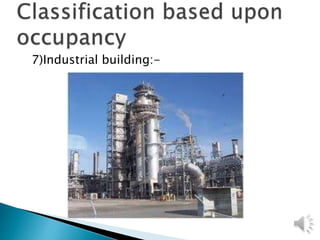
7)Industrial building:-
 There are the buildings in which products or
materials of all kinds and properties are
fabricated , assembled or processed.
 They accommodate plants and machinery ,
refineries , power plants , dairies , saw mills ,
cleaning plants , pumping stations etc…
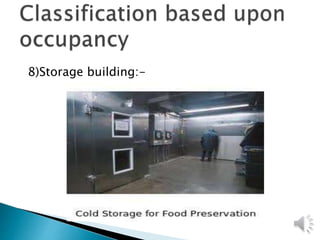
8)Storage building:-
 These are used for storage or sheltering of
goods , water , vehicles etc…
 Water-houses , cold storage , godawns ,
freight depots , transit sheds , store houses ,
garages , hangers etc…
 According to structure there are two types of
buildings.
1)Load bearing structure
2)Framed structure
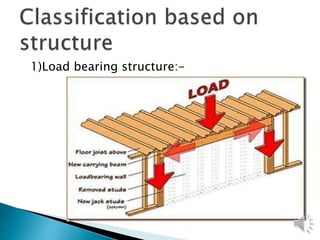
1)Load bearing structure:-
 It has load bearing walls which receives the
load and transmit the same to the ground
through their foundation.
 The load bearing walls supports R.C.C beams
and slabs.
 Colums are avoided.
 20 , 30 , 40 cm thick walls are load bearing
walls.
 Load bearing structure adopted for the
buildings up to 3 storey construction.
 It is provided where soil starta is hardat
shallow depth.
 The walls on all the floors are provided one
above the another.
 Thickness of walls can be reduce on first floor
compare to ground floor.
 As the construction activity proceeds vertically
floor by floor the thickness of the wall
reduces.
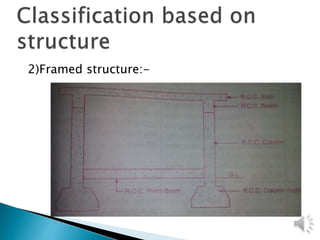
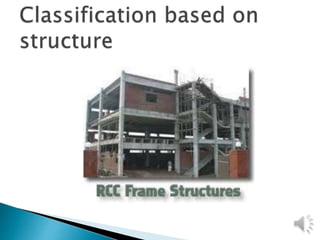
2)Framed structure:-
 It consists a rigidly connected network of
columns and beams.
 The beams support the walls and slabs.
 The columns receives the whole load of the
structure and transmit the same to the ground
through footings.
 These provide greater floor area.
 The walls are partition (non load bearing)
walls.
 In this construction work of various floors
handled simultaneously.
 Speed in construction of a framed structure
can be easyily achieved.
 On upper floor air circulation is better.
 On higher floor noise of abutting streets and
traffic is curtailed.
 It is adopted for low and high rise buildings.
 To keep resistance tovarious loads specially
of earthquake , the columns are tie up with
each other by plinth beams.
Types of building
Types of building

Types of building

  • 1.
  • 2.
    Prepared by:- Maru Hitesh(151080106011) Nandpal Prashant (151080106012) Anand Ojha (151080106013)
  • 3.
     Classification oftypes of buildings  Different types of buidings  Functions of buildings
  • 4.
     The variousbuilding components with their desirable functions are important for understanding what to construct & how to construct.  The buildings is classified in main 2types I)Based upon occupancy II)Based upon structure
  • 5.
     It isalso define as purpose served building by user.  Here some type of buildings is given as follow under.
  • 6.
    1)Residential building:-  Theseare ment for dwelling purpose.  Bunglows, flats, cottages, huts, hostels, chals etc….
  • 7.
    2) Educational building:- These are meant for running schools , colleges , training institution , libraries , univercity etc…..
  • 8.
  • 9.
     It meansa building constructed by government , semi-government organisations , public sector , charitable trusts.  It is utilized for public activities such as education , medical , recreational and cultural , hostel , auditorium , orphans , etc…  It is also used for treatment or care of person suffering for physical or mental illness.
  • 10.
  • 11.
     These buildingare meant for assembly a large number of people for amusement , recreation , social , religion , civil and similar purpose.  Theaters , halls , auditoria , museums , gymnasiums , restaurants , temple , church , mosque , dance halls , club , art galaries etc…
  • 12.
  • 13.
     These aremeant for running business.  For transactions , keeping of accounts and records and similar purpose.  Banks , city halls , court houses etc…
  • 14.
    6)Mercantile building:-  Theyare used as shops , stores , markets , for displaying and sale of merchandise either wholesale or retail.
  • 15.
  • 16.
     There arethe buildings in which products or materials of all kinds and properties are fabricated , assembled or processed.  They accommodate plants and machinery , refineries , power plants , dairies , saw mills , cleaning plants , pumping stations etc…
  • 17.
  • 18.
     These areused for storage or sheltering of goods , water , vehicles etc…  Water-houses , cold storage , godawns , freight depots , transit sheds , store houses , garages , hangers etc…
  • 19.
     According tostructure there are two types of buildings. 1)Load bearing structure 2)Framed structure
  • 20.
  • 21.
     It hasload bearing walls which receives the load and transmit the same to the ground through their foundation.  The load bearing walls supports R.C.C beams and slabs.  Colums are avoided.  20 , 30 , 40 cm thick walls are load bearing walls.  Load bearing structure adopted for the buildings up to 3 storey construction.
  • 22.
     It isprovided where soil starta is hardat shallow depth.  The walls on all the floors are provided one above the another.  Thickness of walls can be reduce on first floor compare to ground floor.  As the construction activity proceeds vertically floor by floor the thickness of the wall reduces.
  • 23.
  • 24.
     It consistsa rigidly connected network of columns and beams.  The beams support the walls and slabs.  The columns receives the whole load of the structure and transmit the same to the ground through footings.  These provide greater floor area.  The walls are partition (non load bearing) walls.  In this construction work of various floors handled simultaneously.
  • 25.
     Speed inconstruction of a framed structure can be easyily achieved.  On upper floor air circulation is better.  On higher floor noise of abutting streets and traffic is curtailed.  It is adopted for low and high rise buildings.  To keep resistance tovarious loads specially of earthquake , the columns are tie up with each other by plinth beams.