


Superconducting Quantum Interference Device
SQUID
C. P. Sun
Department of Physics
National Sun Yat Sen University
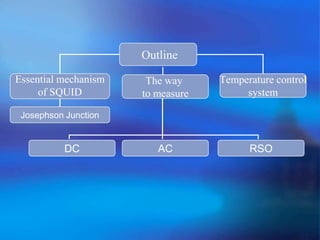
Outline
Essential mechanism
of SQUID
The way
to measure
Temperature control
system
Josephson Junction
DC AC RSO
Introduction
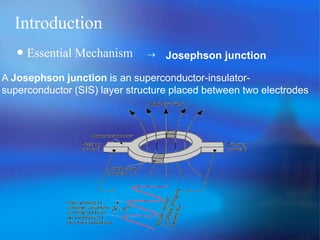
● Essential Mechanism
A Josephson junction is an superconductor-insulator-
superconductor (SIS) layer structure placed between two electrodes
Josephson junction
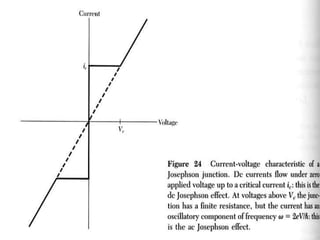
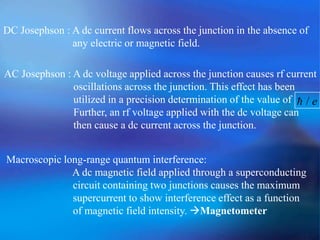
DC Josephson : A dc current flows across the junction in the absence of
any electric or magnetic field.
AC Josephson : A dc voltage applied across the junction causes rf current
oscillations across the junction. This effect has been
utilized in a precision determination of the value of
Further, an rf voltage applied with the dc voltage can
then cause a dc current across the junction.
e/
Macroscopic long-range quantum interference:
A dc magnetic field applied through a superconducting
circuit containing two junctions causes the maximum
supercurrent to show interference effect as a function
of magnetic field intensity. Magnetometer
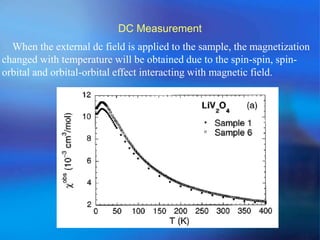
DC Measurement
When the external dc field is applied to the sample, the magnetization
changed with temperature will be obtained due to the spin-spin, spin-
orbital and orbital-orbital effect interacting with magnetic field.
AC Measurement:
An oscillating AC magnetic field is applied to the sample. The
change in flux seen by the detection circuitry is caused only by the
magnetic moment of the sample as it responses the applied AC field.
Xac= dM/dH obtained from these measurement is described as
having both real and imaginary components X’ and X’’ , where
the imaginary component is proportional to the energy losses in
the sample.
What can be derived from AC Measurement?
Structure details of materials, resonance phenomena, electrical
conductivity by induced currents, relaxation processes such as
flux creep in SC and energy exchange between magnetic spins
and the lattice in the paramagnetic materials.
Advantage of MPMS AC System
Conventional AC suceptometers measure the voltage induced
in an inductive detection coil by an oscillating AC magnetic moment.
The most common systems use mutual inductance bridge to
measure the voltage induced.
These systems measure only signals with frequencies at or very
near the applied excitation.
Voltage induced is proportional to the frequencies of the oscillating
drive field
 High pressure effect
 The natural constraint
How does MPMS solve it?
★ MPMS AC option combining an AC drive field with a SQUID-bas
detection system.
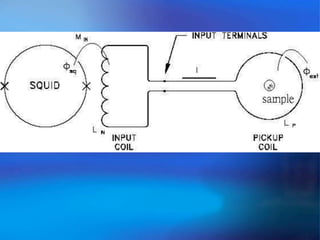
★The SQUID is an extremely sensitive flux-to-voltage converter th
directly measures the change in flux as the sample moves throu
superconducting detection coil coupled to the SQUID circuit.
RSO Measurement (Reciprocating Sample Option)
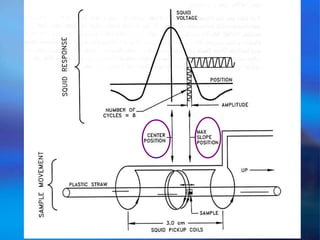
RSO measure a sample by moving it rapidly and sinusoidally
through the SQUID pickup coil.
The option’s use of a high-quality servo motor and a digital signal
processor (DSP) allow rapid measurement. The servo motor, unlike
the stepper motor performing DC measurements, doesn’t stop sample
movement for each data reading. Lock-in techniques that use the DSP
reduce the contribution of low-frequency noise to the measurement.
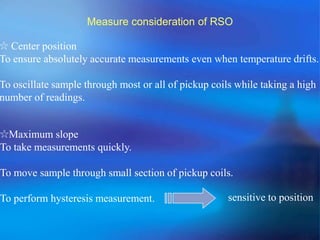
Measure consideration of RSO
☆ Center position
To ensure absolutely accurate measurements even when temperature drifts.
To oscillate sample through most or all of pickup coils while taking a high
number of readings.
☆Maximum slope
To take measurements quickly.
To move sample through small section of pickup coils.
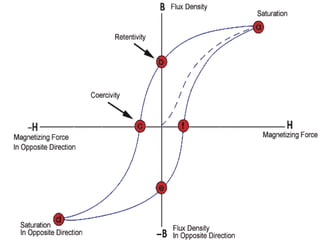
To perform hysteresis measurement. sensitive to position
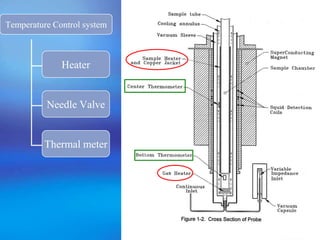
Temperature Control system
Heater
Needle Valve
Thermal meter
Thank you for attention
Sun 2005.05.18
Conclusion
Tc [Curie Temperature] Ths phase transition between paramagnetic
and ferromagnetic behavior.
TN [Neel’ Temperature] Ths phase transition between paramagnetic
and Antiferromagnetic behavior.
Collect More Data After More Experience
More Experience can help us think more details
27
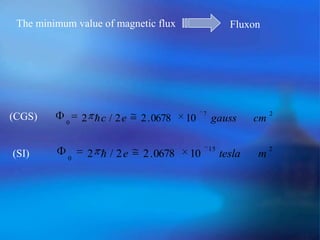
0
100678.22/2 cmgaussec(CGS)
(SI)
215
0
100678.22/2 mteslae
The minimum value of magnetic flux Fluxon
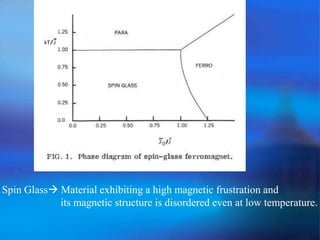
Spin Glass Material exhibiting a high magnetic frustration and
its magnetic structure is disordered even at low temperature.
Tc [Curie Temperature] Ths phase transition between paramagnetic
and ferromagnetic behavior.
TN [Neel’ Temperature] Ths phase transition between paramagnetic
and Antiferromagnetic behavior.

Squid2

  • 1.
    Superconducting Quantum InterferenceDevice SQUID C. P. Sun Department of Physics National Sun Yat Sen University
  • 2.
    Outline Essential mechanism of SQUID Theway to measure Temperature control system Josephson Junction DC AC RSO
  • 3.
    Introduction ● Essential Mechanism AJosephson junction is an superconductor-insulator- superconductor (SIS) layer structure placed between two electrodes Josephson junction
  • 4.
    DC Josephson :A dc current flows across the junction in the absence of any electric or magnetic field. AC Josephson : A dc voltage applied across the junction causes rf current oscillations across the junction. This effect has been utilized in a precision determination of the value of Further, an rf voltage applied with the dc voltage can then cause a dc current across the junction. e/ Macroscopic long-range quantum interference: A dc magnetic field applied through a superconducting circuit containing two junctions causes the maximum supercurrent to show interference effect as a function of magnetic field intensity. Magnetometer
  • 5.
    DC Measurement When theexternal dc field is applied to the sample, the magnetization changed with temperature will be obtained due to the spin-spin, spin- orbital and orbital-orbital effect interacting with magnetic field.
  • 6.
    AC Measurement: An oscillatingAC magnetic field is applied to the sample. The change in flux seen by the detection circuitry is caused only by the magnetic moment of the sample as it responses the applied AC field. Xac= dM/dH obtained from these measurement is described as having both real and imaginary components X’ and X’’ , where the imaginary component is proportional to the energy losses in the sample. What can be derived from AC Measurement? Structure details of materials, resonance phenomena, electrical conductivity by induced currents, relaxation processes such as flux creep in SC and energy exchange between magnetic spins and the lattice in the paramagnetic materials.
  • 7.
    Advantage of MPMSAC System Conventional AC suceptometers measure the voltage induced in an inductive detection coil by an oscillating AC magnetic moment. The most common systems use mutual inductance bridge to measure the voltage induced. These systems measure only signals with frequencies at or very near the applied excitation. Voltage induced is proportional to the frequencies of the oscillating drive field  High pressure effect  The natural constraint
  • 8.
    How does MPMSsolve it? ★ MPMS AC option combining an AC drive field with a SQUID-bas detection system. ★The SQUID is an extremely sensitive flux-to-voltage converter th directly measures the change in flux as the sample moves throu superconducting detection coil coupled to the SQUID circuit.
  • 9.
    RSO Measurement (ReciprocatingSample Option) RSO measure a sample by moving it rapidly and sinusoidally through the SQUID pickup coil. The option’s use of a high-quality servo motor and a digital signal processor (DSP) allow rapid measurement. The servo motor, unlike the stepper motor performing DC measurements, doesn’t stop sample movement for each data reading. Lock-in techniques that use the DSP reduce the contribution of low-frequency noise to the measurement.
  • 12.
    Measure consideration ofRSO ☆ Center position To ensure absolutely accurate measurements even when temperature drifts. To oscillate sample through most or all of pickup coils while taking a high number of readings. ☆Maximum slope To take measurements quickly. To move sample through small section of pickup coils. To perform hysteresis measurement. sensitive to position
  • 13.
  • 14.
    Thank you forattention Sun 2005.05.18
  • 16.
    Conclusion Tc [Curie Temperature]Ths phase transition between paramagnetic and ferromagnetic behavior. TN [Neel’ Temperature] Ths phase transition between paramagnetic and Antiferromagnetic behavior.
  • 17.
    Collect More DataAfter More Experience More Experience can help us think more details
  • 18.
  • 19.
    Spin Glass Materialexhibiting a high magnetic frustration and its magnetic structure is disordered even at low temperature.
  • 21.
    Tc [Curie Temperature]Ths phase transition between paramagnetic and ferromagnetic behavior. TN [Neel’ Temperature] Ths phase transition between paramagnetic and Antiferromagnetic behavior.