S.S. JAIN SUBODH
P.G.(AUTONOMOUS) COLLEGE, JAIPUR
SUPERCONDUCTORS
Guided by: Presented by:
Dr. Santosh Kumar Rakshita Sharma
Agrawal
CONTENTS
 Super conductor
 Discovery
 BCS Theory
 Properties
 Classification
 Superconducting materials
 Applications
 Limitations
WHAT ARE
SUPERCONDUCTORS ?
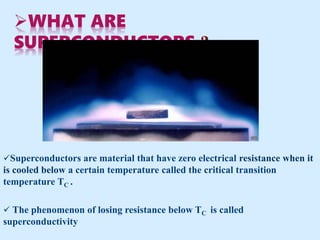
Superconductors are material that have zero electrical resistance when it
is cooled below a certain temperature called the critical transition
temperature TC .
 The phenomenon of losing resistance below TC is called
superconductivity
TRANSITION TEMPERATURE
The temperature at which a
material’s electrical resistivity becomes
zero is called the transition temperature
Tc
The electrical resistivity of normal
metal decreases with temperature
Discovery
Superconductivity was discovered by Heike
Kamerlingh Onnes.
BCS THEORY
American researchers - John Bardeen, Leon Cooper and John Schrieffer
- established this theory of superconductivity.
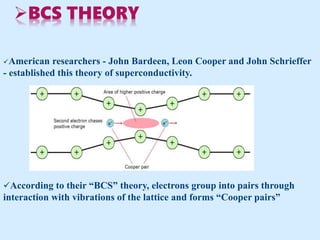
According to their “BCS” theory, electrons group into pairs through
interaction with vibrations of the lattice and forms “Cooper pairs”
Electrons are not scattered by nucleus when they are paired. Below
transition temperature, there is not enough thermal energy to break up the
pair. Hence an electrical current can flow without resistance (negligible)
The electrons exchange vibrational lattice energy called phonons which
result in the electrons becoming attracted to one another
PROPERTIES
EFFECT
OF
IMPURITIE
S
ISOTOP
E
EFFECT
MEISSNER
EFFECT
MAGNETIC
PROPERTIES
ELECTRICA
L
PROPERTIE
S
ELECTRICAL EFFECTS
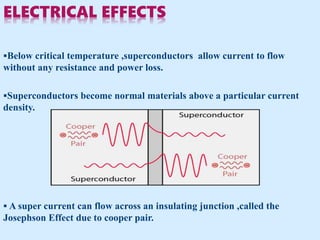
Below critical temperature ,superconductors allow current to flow
without any resistance and power loss.
Superconductors become normal materials above a particular current
density.
 A super current can flow across an insulating junction ,called the
Josephson Effect due to cooper pair.
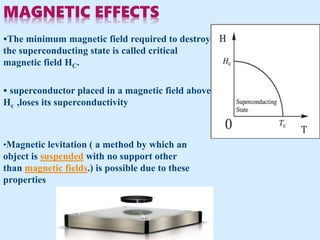
MAGNETIC EFFECTS
The minimum magnetic field required to destroy
the superconducting state is called critical
magnetic field HC.
 superconductor placed in a magnetic field above
Hc ,loses its superconductivity
•Magnetic levitation ( a method by which an
object is suspended with no support other
than magnetic fields.) is possible due to these
properties
EFFECTS OF IMPURITIES
•When impurities are added to superconducting element, its
superconductivity varies according to the impurity.
•Ex: when FeSe0.5Te0.5 is doped with Mn or by Co cause a slight
enhancement while Ni or Cu destroys the superconductivity completely.
Isotope effect
•The critical temperature TC of a superconductor is found to vary
with its isotopic mass. This variation in TC with its isotopic mass is
called the isotopic effect.
•Example : When SrTiO3 is doped by isotope i.e.16O atoms are
replaced by the heavier isotope 18O its TC and Hc is increased.
MEISSNER EFFECT
When H<HC and T<Tc material rejects
all the magnetic field penetrating through
it.
The complete expulsion of the
magnetic field by a superconducting
material is called the “ Meissner
effect
Meissner effect produces quantum levitation which is a remarkable
phenomenon of science
German physicists Walther Meissner and Robert Ochsenfeild discovered
this phenomenon in 1933
 CLASSIFICATIONS
On the basis of response to a magnetic field superconductors are classified
as Type I and Type II superconductors
Type I superconductors
 Also known as soft superconductors.
 single critical field, below which the magnetic field is completely
expelled from the superconductor
 perfectly obey Meissner effect.
Examples : Pure metals such as Aluminum, lead, Zinc and mercury.
And only known allow of this type is TaSi2.
Type II superconductors
Also known as hard superconductors.
 it has two critical fields Hc1 and Hc2
 critical field value is very high
 They do not exhibit perfect and complete Meissner effect.
They are usually made of metal alloys or complex oxide ceramics.
 Examples : Nb3Ge, Nb3Si, all high temperature superconductors etc.
• On the basis of critical temperature, superconductors are classified as:
high temperature (if it reaches a superconducting state when cooled
using liquid nitrogen) and low temperature superconductors (that require
liquid helium as coolant. )
• On the basis of material, classification is as follows:
Chemical elements (e.g. :mercury or lead ), alloys (such as Nb-Ti and Nb-
Zr ), ceramics (YBCO), organic superconductors, pnictides etc.
 SUPERCONDUCTING
MATERIALS
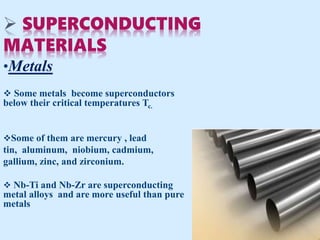
•Metals
 Some metals become superconductors
below their critical temperatures Tc.
Some of them are mercury , lead
tin, aluminum, niobium, cadmium,
gallium, zinc, and zirconium.
 Nb-Ti and Nb-Zr are superconducting
metal alloys and are more useful than pure
metals
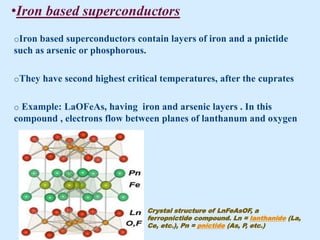
oIron based superconductors contain layers of iron and a pnictide
such as arsenic or phosphorous.
oThey have second highest critical temperatures, after the cuprates
o Example: LaOFeAs, having iron and arsenic layers . In this
compound , electrons flow between planes of lanthanum and oxygen
•Iron based superconductors
Crystal structure of LnFeAsOF, a
ferropnictide compound. Ln = lanthanide (La,
Ce, etc.), Pn = pnictide (As, P, etc.)
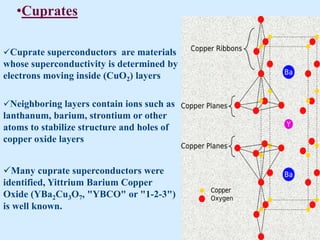
Cuprate superconductors are materials
whose superconductivity is determined by
electrons moving inside (CuO2) layers
Neighboring layers contain ions such as
lanthanum, barium, strontium or other
atoms to stabilize structure and holes of
copper oxide layers
Many cuprate superconductors were
identified, Yittrium Barium Copper
Oxide (YBa2Cu3O7, "YBCO" or "1-2-3")
is well known.
•Cuprates
ORGANIC SUPERCONDUCTORS
Organic superconductors were first suggested by Little in 1965. They are part of
the organic conductor family.
These are two component systems in which one is a π electron donor and one is
electron pair acceptor.
Examples of organic super conductors are :
(TMTSF)2ClO4
[tetramethyltetraselenafulvalene + acceptor]
Bis(ethylenedithio)-TTF
BEDT-TTF )
 APPLICATIONS
Fast digital circuits
Powerful superconducting electromagnets used in maglev
trains, magnetic resonance imaging(MRI) and Nuclear magnetic
resonance (NMR) machines
Low-loss power cables
Electric motors and generators
Maglev trains
 LIMITATIONS
•Low critical temperatures are difficult, expensive and energy intensive to
maintain.
•The materials are usually brittle, not ductile and hard to shape.
•It cannot function with AC electricity, as the switching in AC destroys
Cooper pairs.
•There is a "limit" to the current passing through the material before it
loses its superconducting properties.
superconductors

superconductors

  • 1.
    S.S. JAIN SUBODH P.G.(AUTONOMOUS)COLLEGE, JAIPUR SUPERCONDUCTORS Guided by: Presented by: Dr. Santosh Kumar Rakshita Sharma Agrawal
  • 2.
    CONTENTS  Super conductor Discovery  BCS Theory  Properties  Classification  Superconducting materials  Applications  Limitations
  • 3.
    WHAT ARE SUPERCONDUCTORS ? Superconductorsare material that have zero electrical resistance when it is cooled below a certain temperature called the critical transition temperature TC .  The phenomenon of losing resistance below TC is called superconductivity
  • 4.
    TRANSITION TEMPERATURE The temperatureat which a material’s electrical resistivity becomes zero is called the transition temperature Tc The electrical resistivity of normal metal decreases with temperature Discovery Superconductivity was discovered by Heike Kamerlingh Onnes.
  • 5.
    BCS THEORY American researchers- John Bardeen, Leon Cooper and John Schrieffer - established this theory of superconductivity. According to their “BCS” theory, electrons group into pairs through interaction with vibrations of the lattice and forms “Cooper pairs”
  • 6.
    Electrons are notscattered by nucleus when they are paired. Below transition temperature, there is not enough thermal energy to break up the pair. Hence an electrical current can flow without resistance (negligible) The electrons exchange vibrational lattice energy called phonons which result in the electrons becoming attracted to one another
  • 7.
  • 8.
    ELECTRICAL EFFECTS Below criticaltemperature ,superconductors allow current to flow without any resistance and power loss. Superconductors become normal materials above a particular current density.  A super current can flow across an insulating junction ,called the Josephson Effect due to cooper pair.
  • 9.
    MAGNETIC EFFECTS The minimummagnetic field required to destroy the superconducting state is called critical magnetic field HC.  superconductor placed in a magnetic field above Hc ,loses its superconductivity •Magnetic levitation ( a method by which an object is suspended with no support other than magnetic fields.) is possible due to these properties
  • 10.
    EFFECTS OF IMPURITIES •Whenimpurities are added to superconducting element, its superconductivity varies according to the impurity. •Ex: when FeSe0.5Te0.5 is doped with Mn or by Co cause a slight enhancement while Ni or Cu destroys the superconductivity completely. Isotope effect •The critical temperature TC of a superconductor is found to vary with its isotopic mass. This variation in TC with its isotopic mass is called the isotopic effect. •Example : When SrTiO3 is doped by isotope i.e.16O atoms are replaced by the heavier isotope 18O its TC and Hc is increased.
  • 11.
    MEISSNER EFFECT When H<HCand T<Tc material rejects all the magnetic field penetrating through it. The complete expulsion of the magnetic field by a superconducting material is called the “ Meissner effect Meissner effect produces quantum levitation which is a remarkable phenomenon of science German physicists Walther Meissner and Robert Ochsenfeild discovered this phenomenon in 1933
  • 12.
     CLASSIFICATIONS On thebasis of response to a magnetic field superconductors are classified as Type I and Type II superconductors Type I superconductors  Also known as soft superconductors.  single critical field, below which the magnetic field is completely expelled from the superconductor  perfectly obey Meissner effect. Examples : Pure metals such as Aluminum, lead, Zinc and mercury. And only known allow of this type is TaSi2.
  • 14.
    Type II superconductors Alsoknown as hard superconductors.  it has two critical fields Hc1 and Hc2  critical field value is very high  They do not exhibit perfect and complete Meissner effect. They are usually made of metal alloys or complex oxide ceramics.  Examples : Nb3Ge, Nb3Si, all high temperature superconductors etc.
  • 15.
    • On thebasis of critical temperature, superconductors are classified as: high temperature (if it reaches a superconducting state when cooled using liquid nitrogen) and low temperature superconductors (that require liquid helium as coolant. ) • On the basis of material, classification is as follows: Chemical elements (e.g. :mercury or lead ), alloys (such as Nb-Ti and Nb- Zr ), ceramics (YBCO), organic superconductors, pnictides etc.
  • 16.
     SUPERCONDUCTING MATERIALS •Metals  Somemetals become superconductors below their critical temperatures Tc. Some of them are mercury , lead tin, aluminum, niobium, cadmium, gallium, zinc, and zirconium.  Nb-Ti and Nb-Zr are superconducting metal alloys and are more useful than pure metals
  • 17.
    oIron based superconductorscontain layers of iron and a pnictide such as arsenic or phosphorous. oThey have second highest critical temperatures, after the cuprates o Example: LaOFeAs, having iron and arsenic layers . In this compound , electrons flow between planes of lanthanum and oxygen •Iron based superconductors Crystal structure of LnFeAsOF, a ferropnictide compound. Ln = lanthanide (La, Ce, etc.), Pn = pnictide (As, P, etc.)
  • 18.
    Cuprate superconductors arematerials whose superconductivity is determined by electrons moving inside (CuO2) layers Neighboring layers contain ions such as lanthanum, barium, strontium or other atoms to stabilize structure and holes of copper oxide layers Many cuprate superconductors were identified, Yittrium Barium Copper Oxide (YBa2Cu3O7, "YBCO" or "1-2-3") is well known. •Cuprates
  • 19.
    ORGANIC SUPERCONDUCTORS Organic superconductorswere first suggested by Little in 1965. They are part of the organic conductor family. These are two component systems in which one is a π electron donor and one is electron pair acceptor. Examples of organic super conductors are : (TMTSF)2ClO4 [tetramethyltetraselenafulvalene + acceptor] Bis(ethylenedithio)-TTF BEDT-TTF )
  • 20.
     APPLICATIONS Fast digitalcircuits Powerful superconducting electromagnets used in maglev trains, magnetic resonance imaging(MRI) and Nuclear magnetic resonance (NMR) machines Low-loss power cables Electric motors and generators Maglev trains
  • 21.
     LIMITATIONS •Low criticaltemperatures are difficult, expensive and energy intensive to maintain. •The materials are usually brittle, not ductile and hard to shape. •It cannot function with AC electricity, as the switching in AC destroys Cooper pairs. •There is a "limit" to the current passing through the material before it loses its superconducting properties.