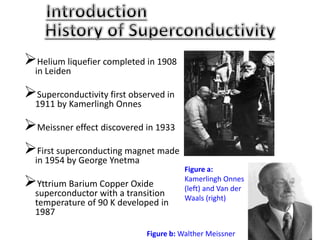
Helium liquefier completed in 1908
in Leiden
Superconductivity first observed in
1911 by Kamerlingh Onnes
Meissner effect discovered in 1933
First superconducting magnet made
in 1954 by George Ynetma
Yttrium Barium Copper Oxide
superconductor with a transition
temperature of 90 K developed in
1987
Figure b: Walther Meissner
Figure a:
Kamerlingh Onnes
(left) and Van der
Waals (right)
In perfect conductor resistance has low but
superconductor material has resistance
present exactly zero.
Mostly conductor no need to want
temperature but superconductor occur only
on critical temperature (Tc).
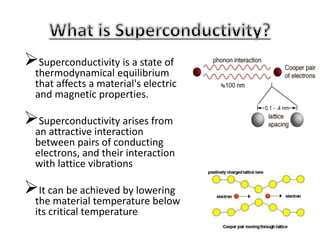
Superconductivity is a state of
thermodynamical equilibrium
that affects a material's electric
and magnetic properties.
Superconductivity arises from
an attractive interaction
between pairs of conducting
electrons, and their interaction
with lattice vibrations
It can be achieved by lowering
the material temperature below
its critical temperature
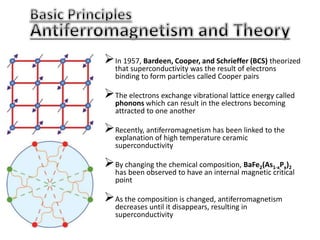
In 1957, Bardeen, Cooper, and Schrieffer (BCS) theorized
that superconductivity was the result of electrons
binding to form particles called Cooper pairs
The electrons exchange vibrational lattice energy called
phonons which can result in the electrons becoming
attracted to one another
Recently, antiferromagnetism has been linked to the
explanation of high temperature ceramic
superconductivity
By changing the chemical composition, BaFe2(As1-xPx)2
has been observed to have an internal magnetic critical
point
As the composition is changed, antiferromagnetism
decreases until it disappears, resulting in
superconductivity
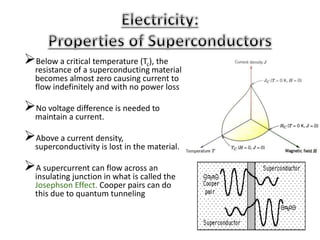
Below a critical temperature (Tc), the
resistance of a superconducting material
becomes almost zero causing current to
flow indefinitely and with no power loss
No voltage difference is needed to
maintain a current.
Above a current density,
superconductivity is lost in the material.
A supercurrent can flow across an
insulating junction in what is called the
Josephson Effect. Cooper pairs can do
this due to quantum tunneling
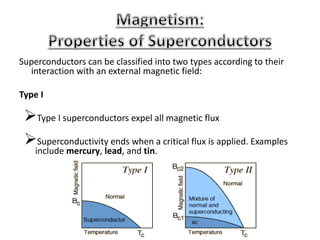
Superconductors can be classified into two types according to their
interaction with an external magnetic field:
Type I
Type I superconductors expel all magnetic flux
Superconductivity ends when a critical flux is applied. Examples
include mercury, lead, and tin.
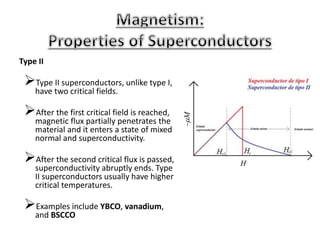
Type II
Type II superconductors, unlike type I,
have two critical fields.
After the first critical field is reached,
magnetic flux partially penetrates the
material and it enters a state of mixed
normal and superconductivity.
After the second critical flux is passed,
superconductivity abruptly ends. Type
II superconductors usually have higher
critical temperatures.
Examples include YBCO, vanadium,
and BSCCO
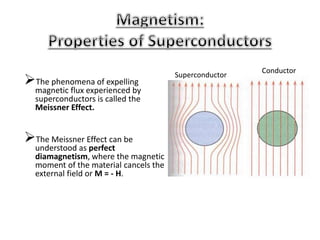
The phenomena of expelling
magnetic flux experienced by
superconductors is called the
Meissner Effect.
The Meissner Effect can be
understood as perfect
diamagnetism, where the magnetic
moment of the material cancels the
external field or M = - H.
Superconductor
Conductor
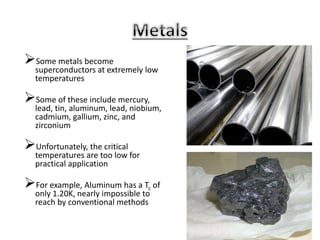
Some metals become
superconductors at extremely low
temperatures
Some of these include mercury,
lead, tin, aluminum, lead, niobium,
cadmium, gallium, zinc, and
zirconium
Unfortunately, the critical
temperatures are too low for
practical application
For example, Aluminum has a Tc of
only 1.20K, nearly impossible to
reach by conventional methods
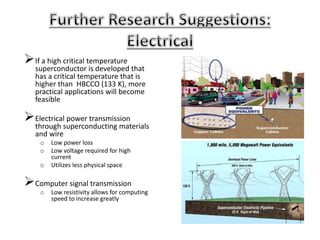
If a high critical temperature
superconductor is developed that
has a critical temperature that is
higher than HBCCO (133 K), more
practical applications will become
feasible
Electrical power transmission
through superconducting materials
and wire
o Low power loss
o Low voltage required for high
current
o Utilizes less physical space
Computer signal transmission
o Low resistivity allows for computing
speed to increase greatly
Yttrium Barium Copper Oxide was the first
superconductor developed with a Tc above
the boiling point of Nitrogen (Tc=90 K).
Thallium Barium Calcium Copper Oxide
has the highest Tc out of all
superconductors (Tc=125 K)
This suggests that the electrons interact
strongly with the positions of copper and
oxygen in the lattice (Cooper pair).
Antiferromagnetism must be eliminated
for superconductivity to appear.
CopperIron
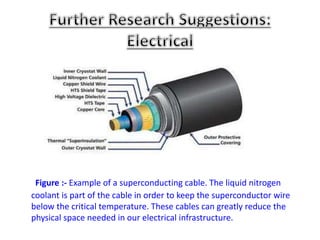
Figure :- Example of a superconducting cable. The liquid nitrogen
coolant is part of the cable in order to keep the superconductor wire
below the critical temperature. These cables can greatly reduce the
physical space needed in our electrical infrastructure.
Some applications are used today:
o Magnetic Resonance Imaging
o Nuclear Magnetic Resonance Spectroscopy
Future applications can benefit from
interesting magnetic properties displayed by
superconductors
Particle Accelerators
Magnetic Levitation
o High-Speed Magnetic Levitation Trains for
mass transport
o By utilizing levitation, friction between the
train and the track is eliminated
o This can allow trains to increase their speed
dramatically
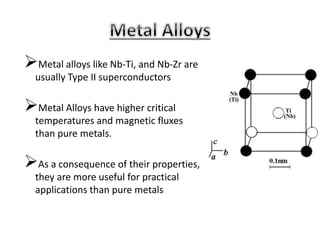
Metal alloys like Nb-Ti, and Nb-Zr are
usually Type II superconductors
Metal Alloys have higher critical
temperatures and magnetic fluxes
than pure metals.
As a consequence of their properties,
they are more useful for practical
applications than pure metals
Superconductivity is a state of
thermodynamical equilibrium
where the electrical resistance is
0 and that is achieved at near 0 K
temperatures
Superconducting ceramic
materials have shown the most
promise for future technologies
because of their relatively high
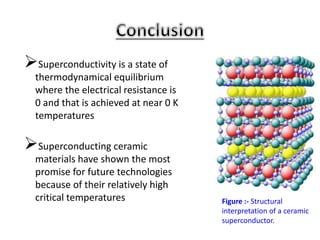
critical temperatures Figure :- Structural
interpretation of a ceramic
superconductor.

Laxmikant vermamsc 3rd

  • 3.
    Helium liquefier completedin 1908 in Leiden Superconductivity first observed in 1911 by Kamerlingh Onnes Meissner effect discovered in 1933 First superconducting magnet made in 1954 by George Ynetma Yttrium Barium Copper Oxide superconductor with a transition temperature of 90 K developed in 1987 Figure b: Walther Meissner Figure a: Kamerlingh Onnes (left) and Van der Waals (right)
  • 4.
    In perfect conductorresistance has low but superconductor material has resistance present exactly zero. Mostly conductor no need to want temperature but superconductor occur only on critical temperature (Tc).
  • 5.
    Superconductivity is astate of thermodynamical equilibrium that affects a material's electric and magnetic properties. Superconductivity arises from an attractive interaction between pairs of conducting electrons, and their interaction with lattice vibrations It can be achieved by lowering the material temperature below its critical temperature
  • 6.
    In 1957, Bardeen,Cooper, and Schrieffer (BCS) theorized that superconductivity was the result of electrons binding to form particles called Cooper pairs The electrons exchange vibrational lattice energy called phonons which can result in the electrons becoming attracted to one another Recently, antiferromagnetism has been linked to the explanation of high temperature ceramic superconductivity By changing the chemical composition, BaFe2(As1-xPx)2 has been observed to have an internal magnetic critical point As the composition is changed, antiferromagnetism decreases until it disappears, resulting in superconductivity
  • 7.
    Below a criticaltemperature (Tc), the resistance of a superconducting material becomes almost zero causing current to flow indefinitely and with no power loss No voltage difference is needed to maintain a current. Above a current density, superconductivity is lost in the material. A supercurrent can flow across an insulating junction in what is called the Josephson Effect. Cooper pairs can do this due to quantum tunneling
  • 9.
    Superconductors can beclassified into two types according to their interaction with an external magnetic field: Type I Type I superconductors expel all magnetic flux Superconductivity ends when a critical flux is applied. Examples include mercury, lead, and tin.
  • 10.
    Type II Type IIsuperconductors, unlike type I, have two critical fields. After the first critical field is reached, magnetic flux partially penetrates the material and it enters a state of mixed normal and superconductivity. After the second critical flux is passed, superconductivity abruptly ends. Type II superconductors usually have higher critical temperatures. Examples include YBCO, vanadium, and BSCCO
  • 11.
    The phenomena ofexpelling magnetic flux experienced by superconductors is called the Meissner Effect. The Meissner Effect can be understood as perfect diamagnetism, where the magnetic moment of the material cancels the external field or M = - H. Superconductor Conductor
  • 12.
    Some metals become superconductorsat extremely low temperatures Some of these include mercury, lead, tin, aluminum, lead, niobium, cadmium, gallium, zinc, and zirconium Unfortunately, the critical temperatures are too low for practical application For example, Aluminum has a Tc of only 1.20K, nearly impossible to reach by conventional methods
  • 13.
    If a highcritical temperature superconductor is developed that has a critical temperature that is higher than HBCCO (133 K), more practical applications will become feasible Electrical power transmission through superconducting materials and wire o Low power loss o Low voltage required for high current o Utilizes less physical space Computer signal transmission o Low resistivity allows for computing speed to increase greatly
  • 14.
    Yttrium Barium CopperOxide was the first superconductor developed with a Tc above the boiling point of Nitrogen (Tc=90 K). Thallium Barium Calcium Copper Oxide has the highest Tc out of all superconductors (Tc=125 K) This suggests that the electrons interact strongly with the positions of copper and oxygen in the lattice (Cooper pair). Antiferromagnetism must be eliminated for superconductivity to appear. CopperIron
  • 15.
    Figure :- Exampleof a superconducting cable. The liquid nitrogen coolant is part of the cable in order to keep the superconductor wire below the critical temperature. These cables can greatly reduce the physical space needed in our electrical infrastructure.
  • 16.
    Some applications areused today: o Magnetic Resonance Imaging o Nuclear Magnetic Resonance Spectroscopy Future applications can benefit from interesting magnetic properties displayed by superconductors Particle Accelerators Magnetic Levitation o High-Speed Magnetic Levitation Trains for mass transport o By utilizing levitation, friction between the train and the track is eliminated o This can allow trains to increase their speed dramatically
  • 17.
    Metal alloys likeNb-Ti, and Nb-Zr are usually Type II superconductors Metal Alloys have higher critical temperatures and magnetic fluxes than pure metals. As a consequence of their properties, they are more useful for practical applications than pure metals
  • 18.
    Superconductivity is astate of thermodynamical equilibrium where the electrical resistance is 0 and that is achieved at near 0 K temperatures Superconducting ceramic materials have shown the most promise for future technologies because of their relatively high critical temperatures Figure :- Structural interpretation of a ceramic superconductor.