Super computer
Contents
 Introduction
 History
 Need&application
 Examples
 Technology
 Architecture
 Amdahl's Law
Introduction
 A supercomputer is a computer with a
high level of computational
capacity compared to a general-purpose
computer
History
 The history of supercomputing goes back to the
1960s, with the Atlas at the University of
Manchester designed by Seymour Cray
 The ”Atlas” was a joint venture between ’Ferranti’ and
the ‘Manchester University’ and was operated at
processing speed of one microsecond per
instruction, about one million instructions per
second.
 The first “Atlas” was officially commissioned on 7
December 1962 as one of the world's first
supercomputers and is equivalent to four IBM 7094s.
Need & Application
 Used for solving highly calculation intensive tasks
like in
 Weather forecasts
 Explosions - detonation of nuclear weapons
 Analysis of data
 Astronomical observations
 Integrate design of engineering products
Examples of super computers
 Ex: CDC6600
 1-10 MFlops
 Single CPU
 60-bit word length
 RISC
 Central Processor has 10 parallel functional units
-superscalar.
 Implemented 10 peripheral processors
 no pipelining
EX:
 CDC7600 (1969-1975)
 10-100 MFlops
 Instruction Pipelining
 Pipelined execution on functional units in parallel 8
processors
( Cray series)
Worked on new design - vector processors load large
data at once.
Technology in super conductors
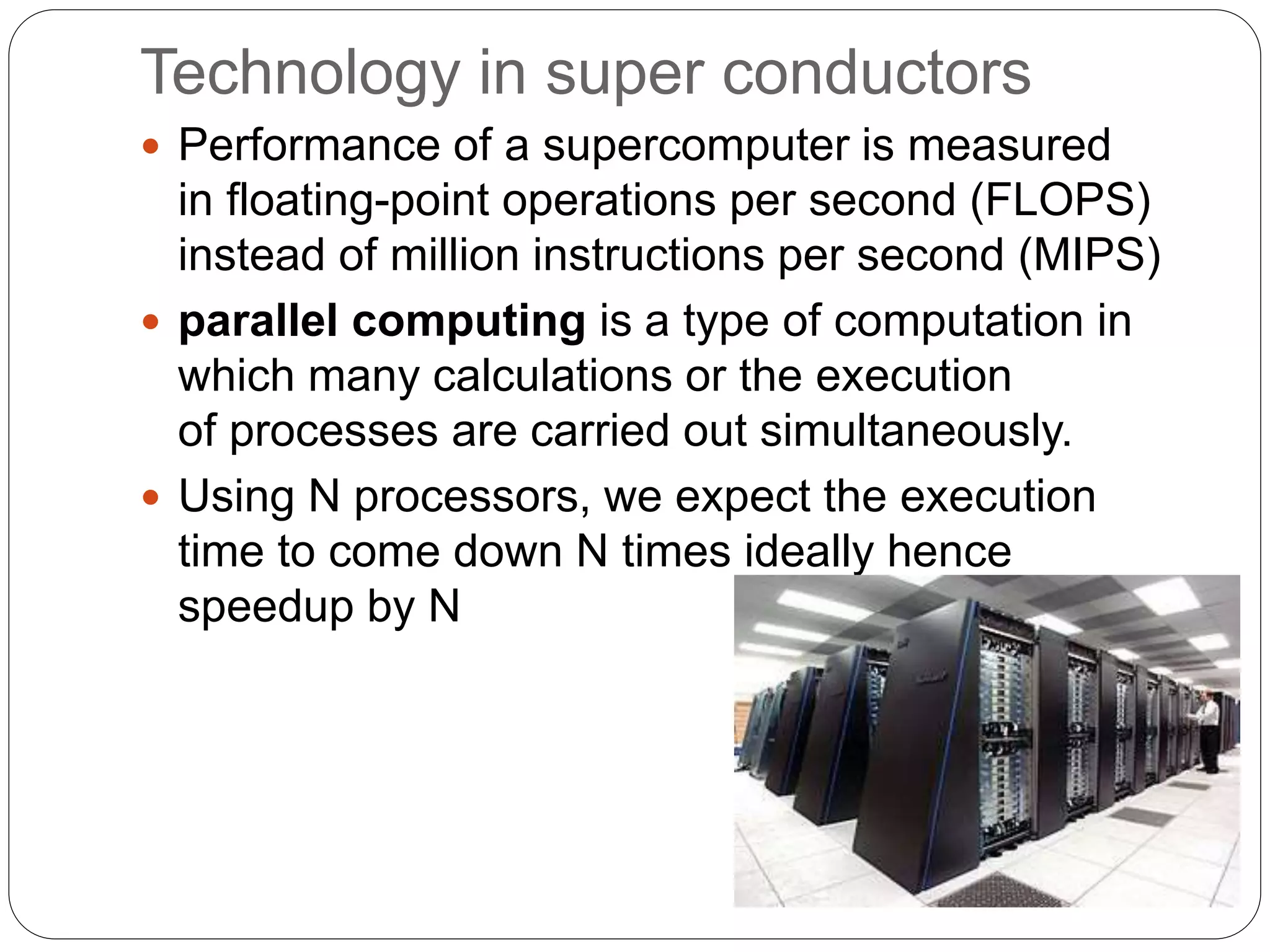
 Performance of a supercomputer is measured
in floating-point operations per second (FLOPS)
instead of million instructions per second (MIPS)
 parallel computing is a type of computation in
which many calculations or the execution
of processes are carried out simultaneously.
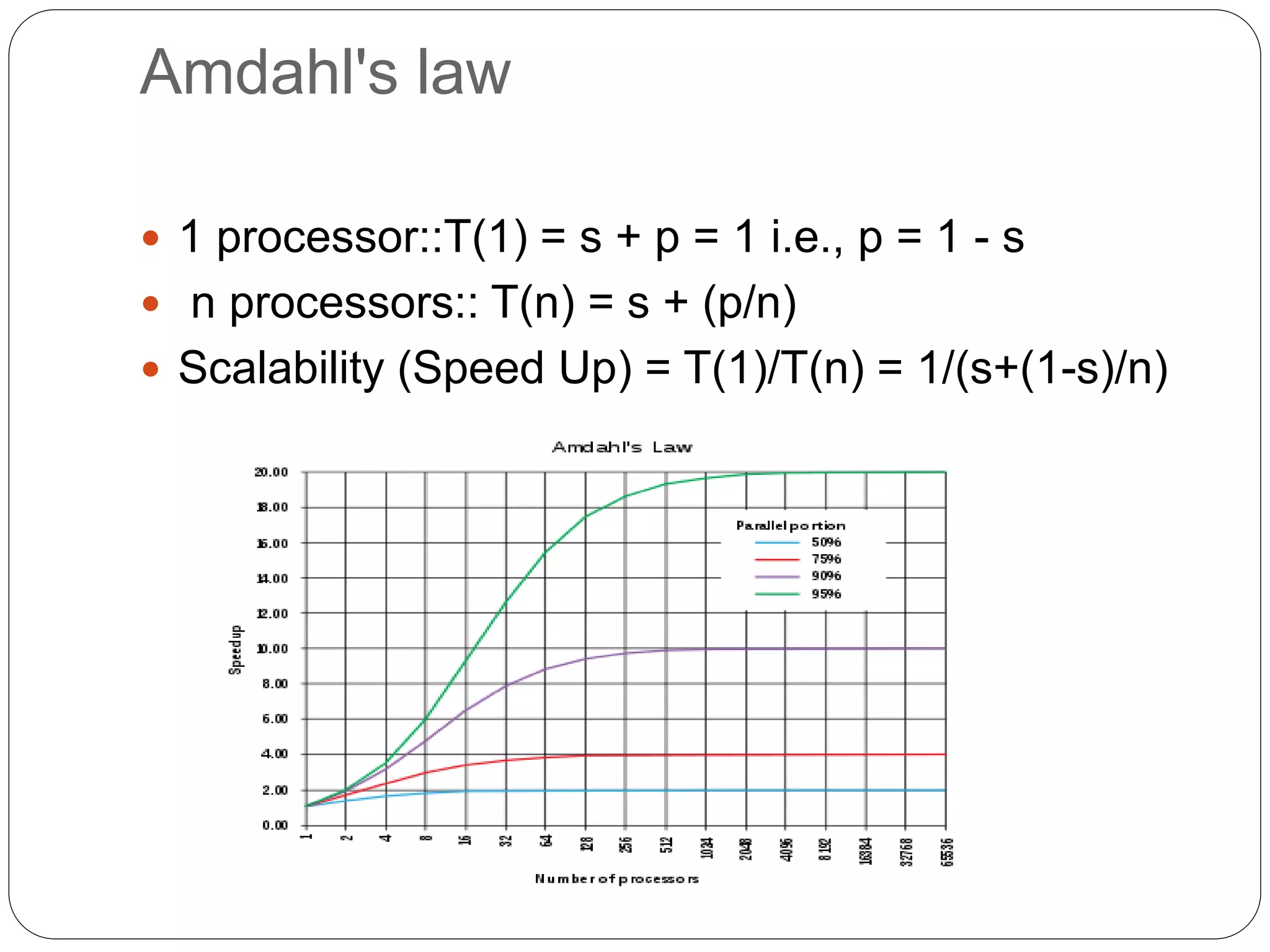
 Using N processors, we expect the execution
time to come down N times ideally hence
speedup by N
 1 processor::T(1) = s + p = 1 i.e., p = 1 - s
 n processors:: T(n) = s + (p/n)
 Scalability (Speed Up) = T(1)/T(n) = 1/(s+(1-s)/n)
Amdahl's law
Architecture of super computer
 Different architectures to implement parallel
algorithm
 1 Shared-memory systems
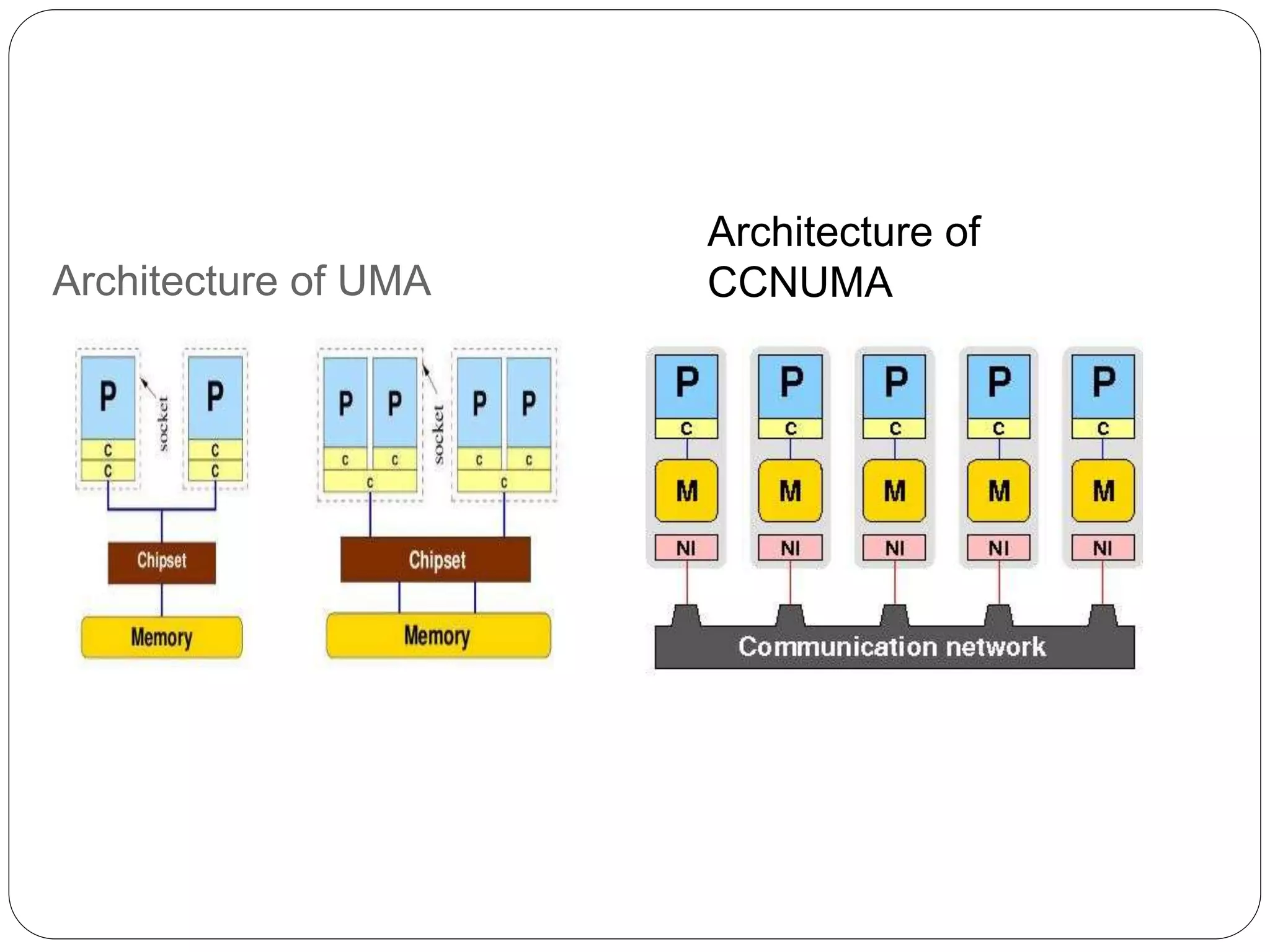
 Uniform Memory Access (UMA)
 cache coherent Non-Uniform Memory Access
(ccNUMA)
 2 Distributed-memory systems
 Massively Parallel Processing
 Cluster computing
 Each has a standardized programming model
Shared memory systems
 Two basic categories of shared memory systems
 Uniform Memory Access (UMA): Memory is
equally accessible to all processors with the same
performance (Bandwidth & Latency)
 Simplest example - dual core processor
 cache-coherent Non Uniform Memory Access
(ccNUMA): Memory is physically distributed but
appears as a single address space: Performance
(Bandwidth & Latency) is different for local and
remote memory access.
 Examples: AMD Opteron nodes, SGI Altix, Intel
Nehalem nodes – all modern multi-socket nodes
Distributed memory systems
 Pure distributed-memory parallel
computer
 No global cache-coherent shared
address space No Remote Memory
Access (NORMA)
 Data exchange between nodes:
Passing messages via network
Architecture of UMA
Architecture of
CCNUMA
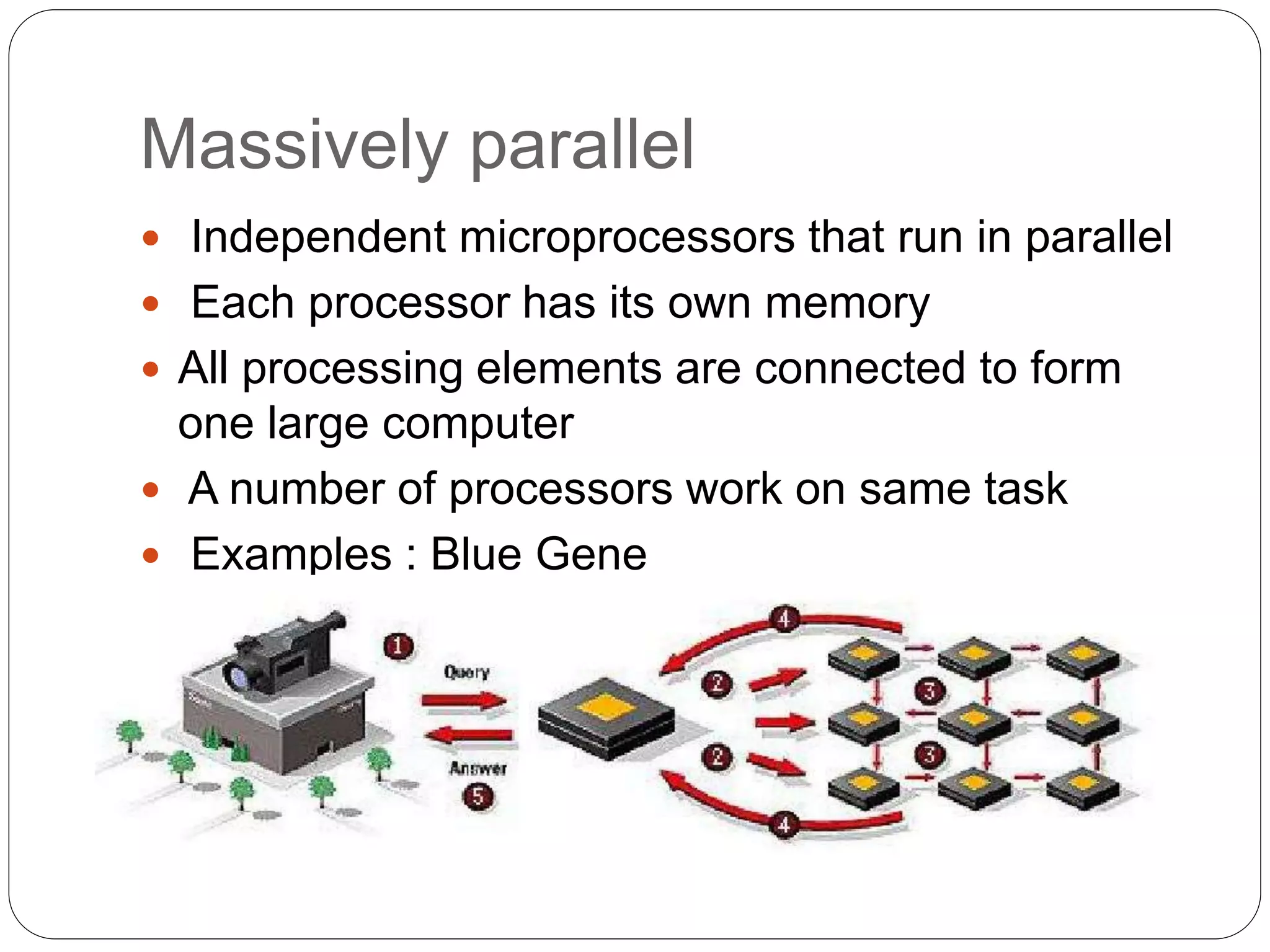
Massively parallel
 Independent microprocessors that run in parallel
 Each processor has its own memory
 All processing elements are connected to form
one large computer
 A number of processors work on same task
 Examples : Blue Gene
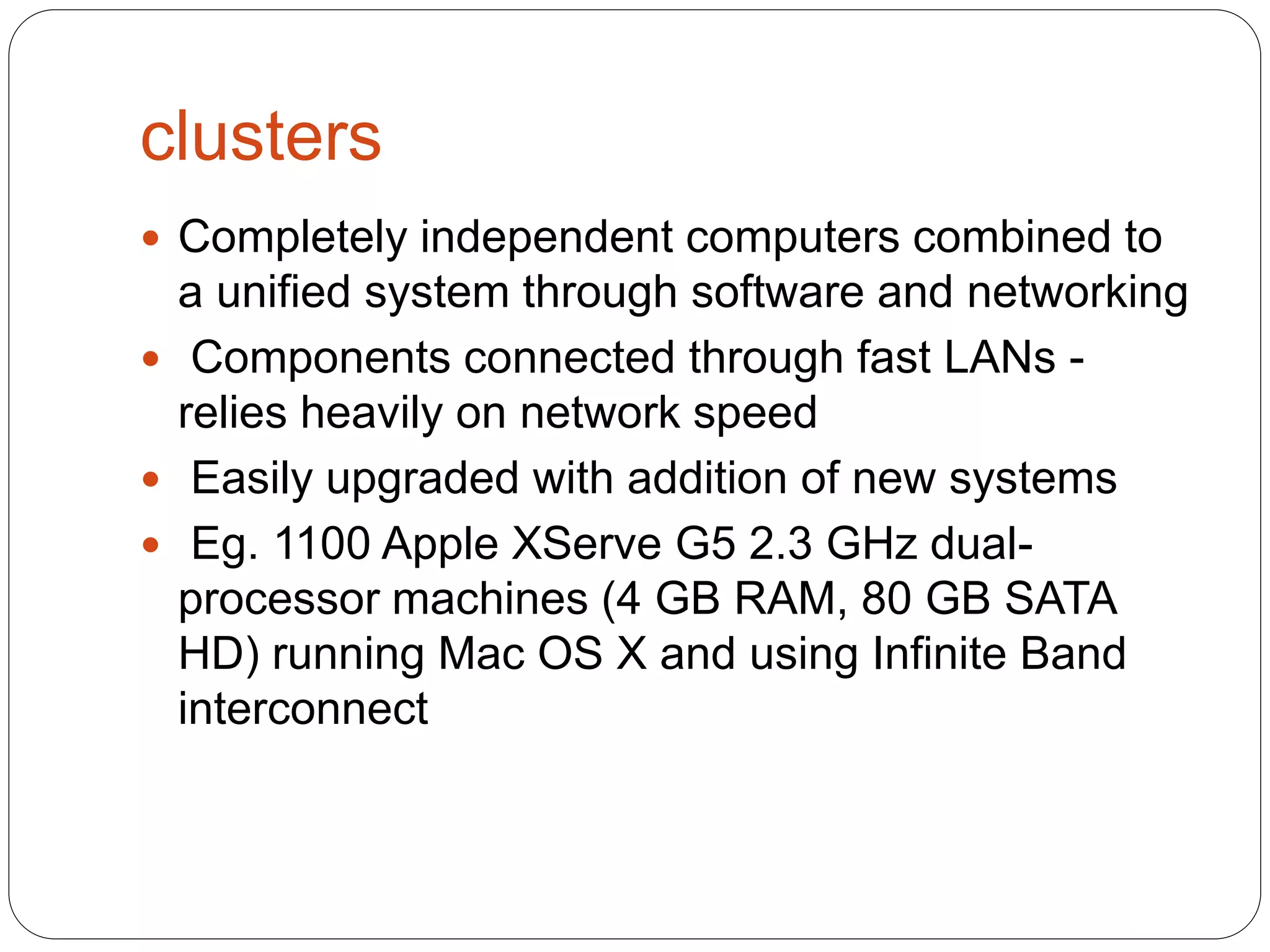
clusters
 Completely independent computers combined to
a unified system through software and networking
 Components connected through fast LANs -
relies heavily on network speed
 Easily upgraded with addition of new systems
 Eg. 1100 Apple XServe G5 2.3 GHz dual-
processor machines (4 GB RAM, 80 GB SATA
HD) running Mac OS X and using Infinite Band
interconnect
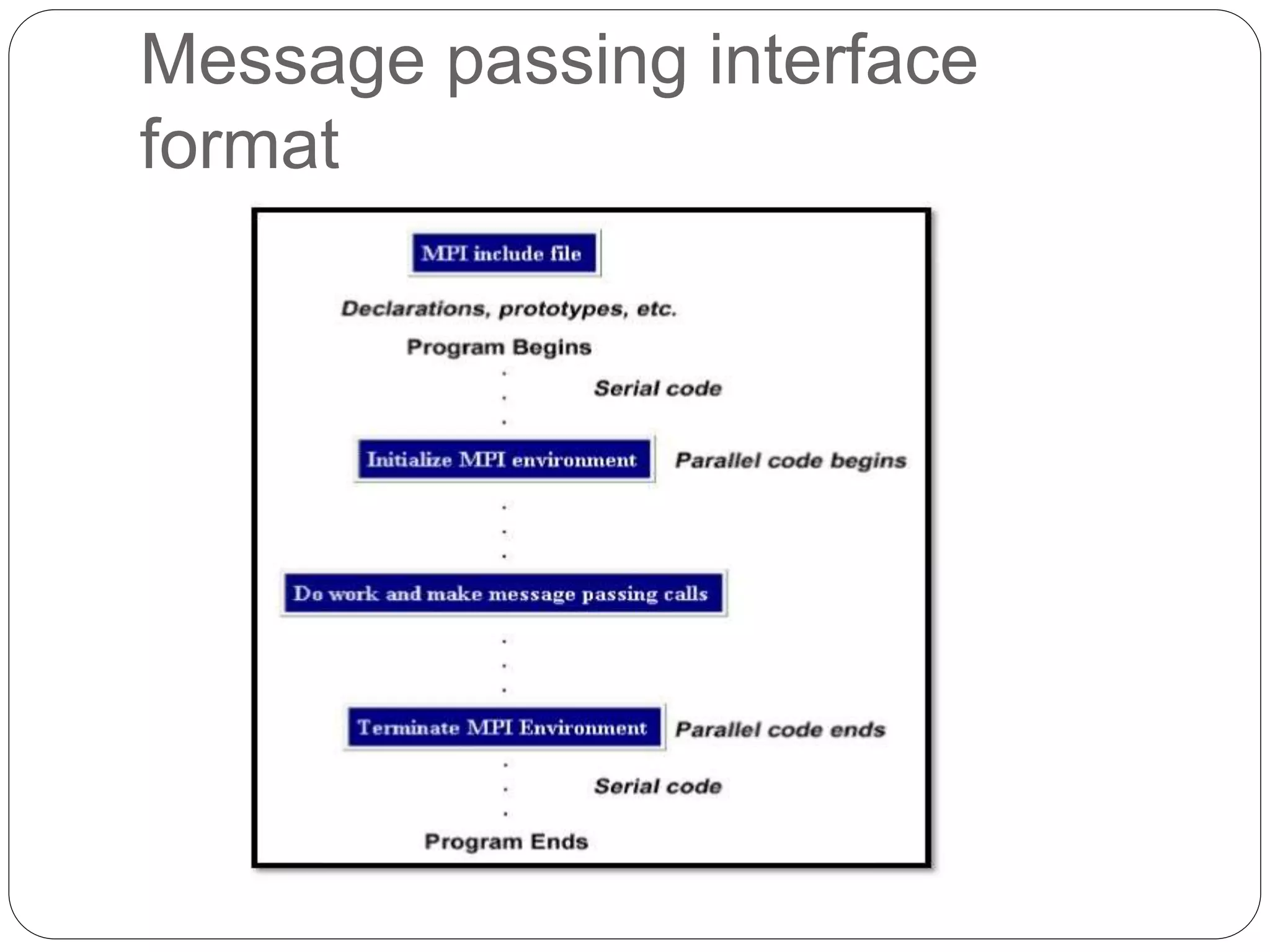
Message passing interface
format
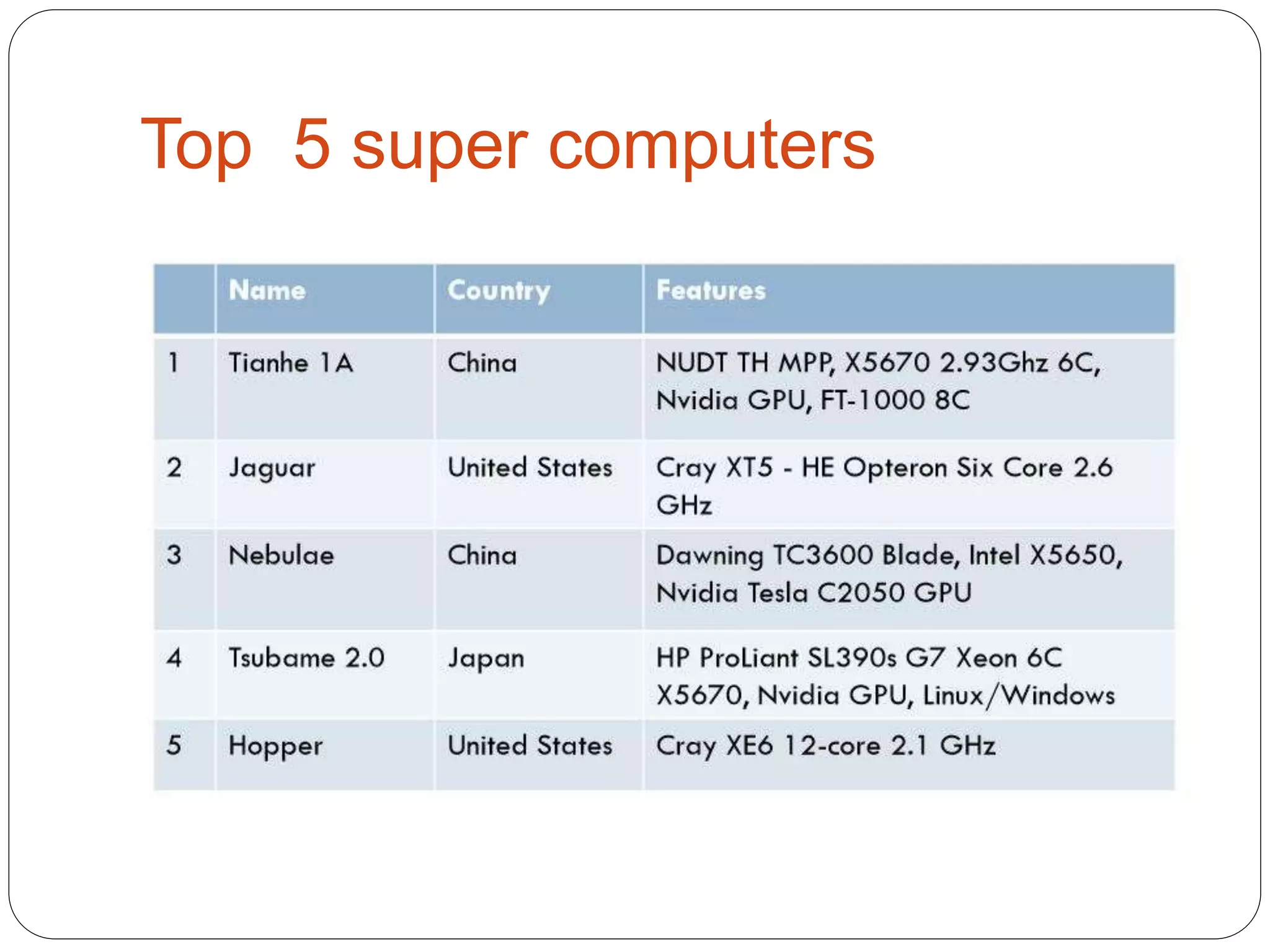
Top 5 super computers
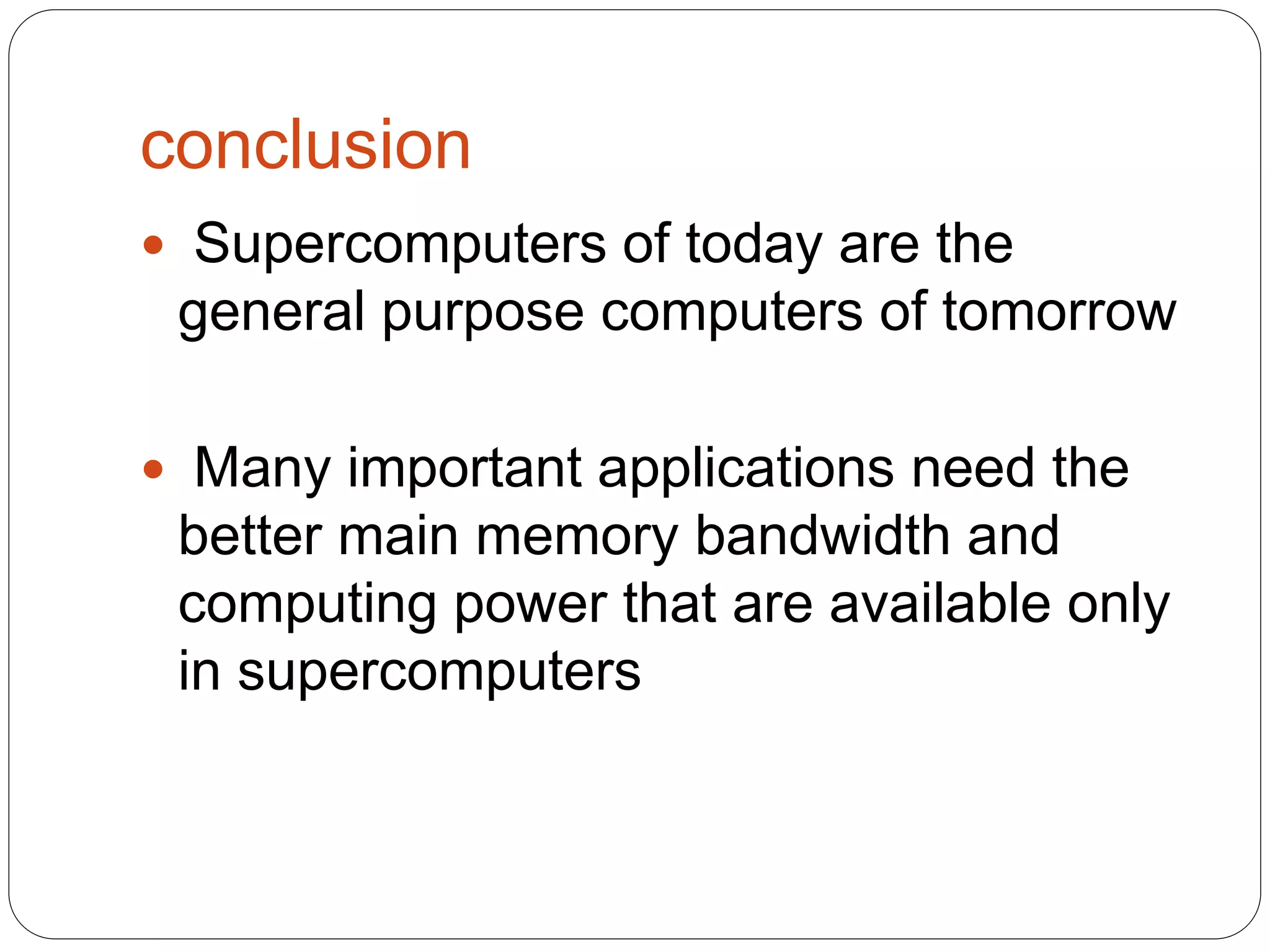
conclusion
 Supercomputers of today are the
general purpose computers of tomorrow
 Many important applications need the
better main memory bandwidth and
computing power that are available only
in supercomputers
Super computer
Super computer

Super computer

  • 1.
  • 2.
    Contents  Introduction  History Need&application  Examples  Technology  Architecture  Amdahl's Law
  • 3.
    Introduction  A supercomputeris a computer with a high level of computational capacity compared to a general-purpose computer
  • 4.
    History  The historyof supercomputing goes back to the 1960s, with the Atlas at the University of Manchester designed by Seymour Cray  The ”Atlas” was a joint venture between ’Ferranti’ and the ‘Manchester University’ and was operated at processing speed of one microsecond per instruction, about one million instructions per second.  The first “Atlas” was officially commissioned on 7 December 1962 as one of the world's first supercomputers and is equivalent to four IBM 7094s.
  • 5.
    Need & Application Used for solving highly calculation intensive tasks like in  Weather forecasts  Explosions - detonation of nuclear weapons  Analysis of data  Astronomical observations  Integrate design of engineering products
  • 6.
    Examples of supercomputers  Ex: CDC6600  1-10 MFlops  Single CPU  60-bit word length  RISC  Central Processor has 10 parallel functional units -superscalar.  Implemented 10 peripheral processors  no pipelining
  • 7.
    EX:  CDC7600 (1969-1975) 10-100 MFlops  Instruction Pipelining  Pipelined execution on functional units in parallel 8 processors ( Cray series) Worked on new design - vector processors load large data at once.
  • 8.
    Technology in superconductors  Performance of a supercomputer is measured in floating-point operations per second (FLOPS) instead of million instructions per second (MIPS)  parallel computing is a type of computation in which many calculations or the execution of processes are carried out simultaneously.  Using N processors, we expect the execution time to come down N times ideally hence speedup by N
  • 9.
     1 processor::T(1)= s + p = 1 i.e., p = 1 - s  n processors:: T(n) = s + (p/n)  Scalability (Speed Up) = T(1)/T(n) = 1/(s+(1-s)/n) Amdahl's law
  • 10.
    Architecture of supercomputer  Different architectures to implement parallel algorithm  1 Shared-memory systems  Uniform Memory Access (UMA)  cache coherent Non-Uniform Memory Access (ccNUMA)  2 Distributed-memory systems  Massively Parallel Processing  Cluster computing  Each has a standardized programming model
  • 11.
    Shared memory systems Two basic categories of shared memory systems  Uniform Memory Access (UMA): Memory is equally accessible to all processors with the same performance (Bandwidth & Latency)  Simplest example - dual core processor  cache-coherent Non Uniform Memory Access (ccNUMA): Memory is physically distributed but appears as a single address space: Performance (Bandwidth & Latency) is different for local and remote memory access.  Examples: AMD Opteron nodes, SGI Altix, Intel Nehalem nodes – all modern multi-socket nodes
  • 12.
    Distributed memory systems Pure distributed-memory parallel computer  No global cache-coherent shared address space No Remote Memory Access (NORMA)  Data exchange between nodes: Passing messages via network
  • 13.
  • 14.
    Massively parallel  Independentmicroprocessors that run in parallel  Each processor has its own memory  All processing elements are connected to form one large computer  A number of processors work on same task  Examples : Blue Gene
  • 15.
    clusters  Completely independentcomputers combined to a unified system through software and networking  Components connected through fast LANs - relies heavily on network speed  Easily upgraded with addition of new systems  Eg. 1100 Apple XServe G5 2.3 GHz dual- processor machines (4 GB RAM, 80 GB SATA HD) running Mac OS X and using Infinite Band interconnect
  • 16.
  • 17.
    Top 5 supercomputers
  • 18.
    conclusion  Supercomputers oftoday are the general purpose computers of tomorrow  Many important applications need the better main memory bandwidth and computing power that are available only in supercomputers