2
Overview
• Flynn’s taxonomy
•Classification based on the memory arrangement
• Classification based on communication
• Classification based on the kind of parallelism
– Data-parallel
– Function-parallel
3.
3
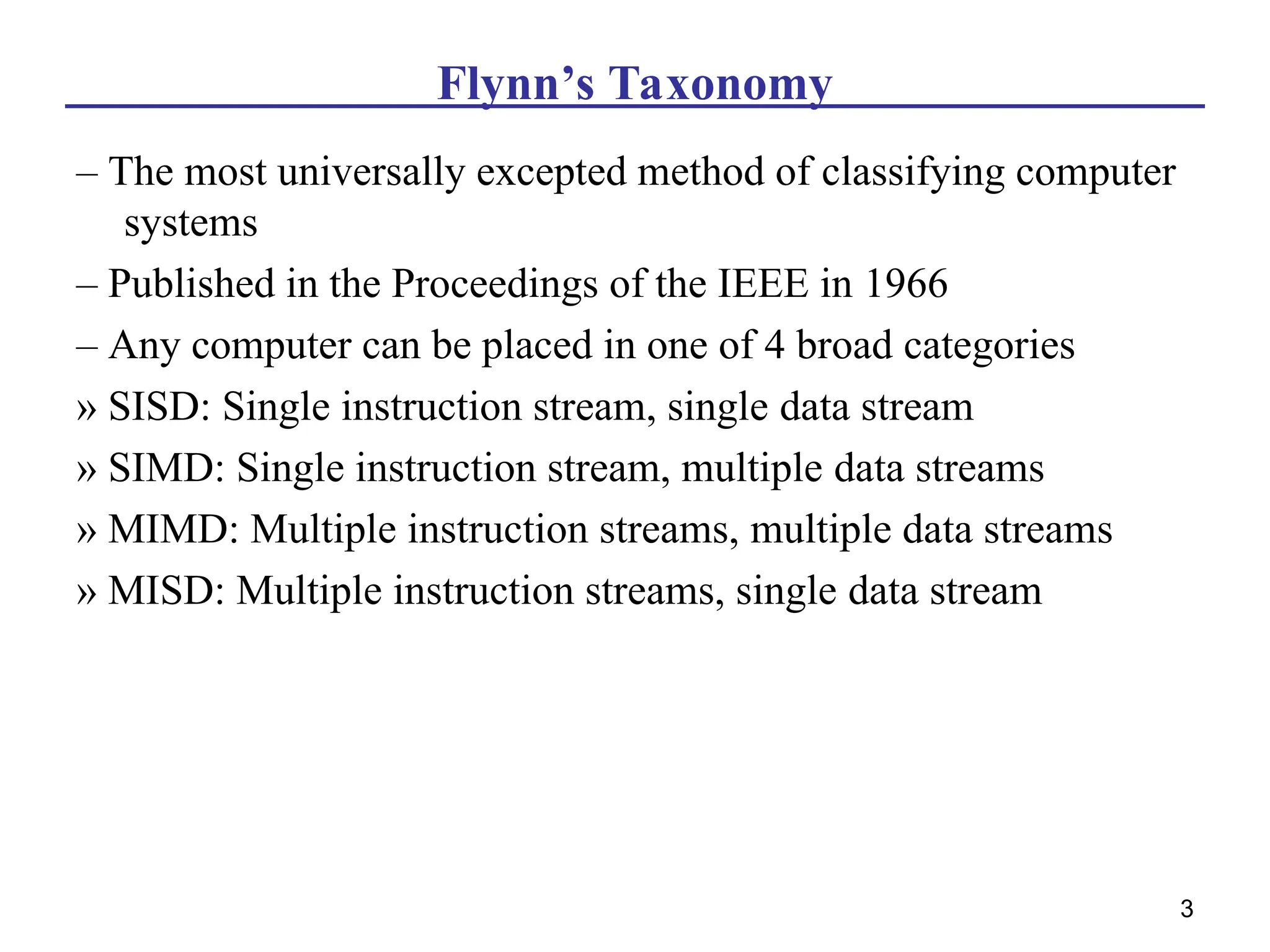
Flynn’s Taxonomy
– Themost universally excepted method of classifying computer
systems
– Published in the Proceedings of the IEEE in 1966
– Any computer can be placed in one of 4 broad categories
» SISD: Single instruction stream, single data stream
» SIMD: Single instruction stream, multiple data streams
» MIMD: Multiple instruction streams, multiple data streams
» MISD: Multiple instruction streams, single data stream
6
SIMD Architectures
• Fine-grained
–Image processing application
– Large number of PEs
– Minimum complexity PEs
– Programming language is a simple extension of a sequential
language
• Coarse-grained
– Each PE is of higher complexity and it is usually built with
commercial devices
– Each PE has local memory
9
Flynn taxonomy
– Advantagesof Flynn
» Universally accepted
» Compact Notation
» Easy to classify a system (?)
– Disadvantages of Flynn
» Very coarse-grain differentiation among machine
systems
» Comparison of different systems is limited
» Interconnections, I/O, memory not considered in the
scheme
11
Shared-memory multiprocessors
• UniformMemory Access (UMA)
• Non-Uniform Memory Access (NUMA)
• Cache-only Memory Architecture (COMA)
• Memory is common to all the processors.
• Processors easily communicate by means of shared
variables.
12.
12
The UMA Model
•Tightly-coupled systems (high degree of resource
sharing)
• Suitable for general-purpose and time-sharing
applications by multiple users.
P1
$
Interconnection network
$
Pn
Mem Mem
13.
13
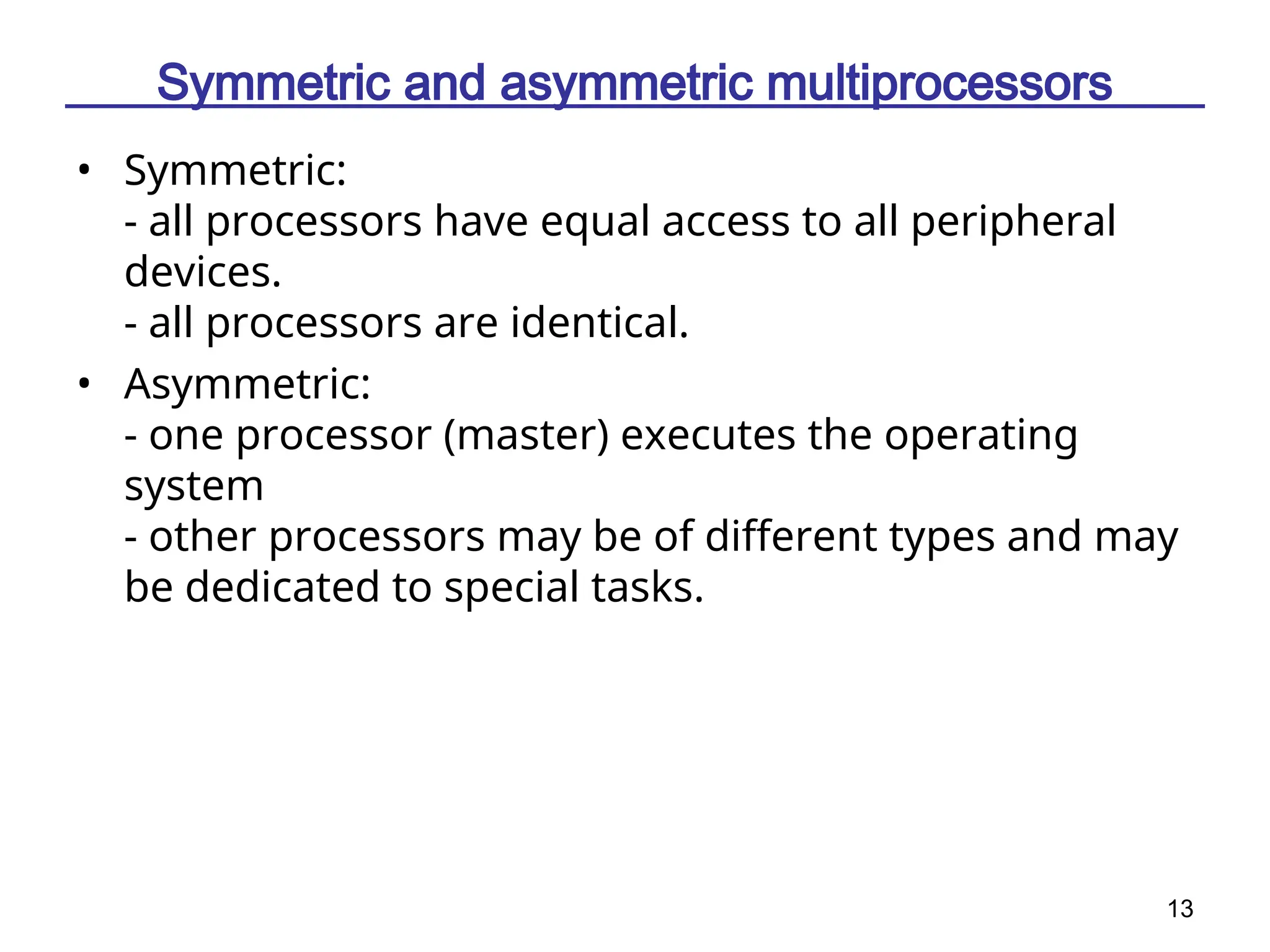
Symmetric and asymmetricmultiprocessors
• Symmetric:
- all processors have equal access to all peripheral
devices.
- all processors are identical.
• Asymmetric:
- one processor (master) executes the operating
system
- other processors may be of different types and may
be dedicated to special tasks.
14.
14
The NUMA Model
•The access time varies with the location of the memory word.
• Shared memory is distributed to local memories.
• All local memories form a global address space accessible by
all processors
P1
$
Interconnection network
$
Pn
Mem Mem
Distributed Memory (NUMA)
Access time: Cache, Local memory, Remote memory
COMA - Cache-only Memory Architecture
15.
15
Distributed memory multicomputers
•Multiple computers- nodes
• Message-passing network
• Local memories are private with its own
program and data
• No memory contention so that the
number of processors is very large
• The processors are connected by
communication lines, and the precise
way in which the lines are connected is
called the topology of the multicomputer.
• A typical program consists of subtasks
residing in all the memories. PE
Interconnection
network
M
PE
M
PE
M
PE
M
PE
M
PE
M
17
Interconnection Network [1]
•Mode of Operation (Synchronous vs. Asynchronous)
• Control Strategy (Centralized vs. Decentralized)
• Switching Techniques (Packet switching vs. Circuit
switching)
• Topology (Static Vs. Dynamic)
18.
18
Classification based onthe kind of
parallelism[3]
Parallel
architectures
PAs
Data-parallel architectures Function-parallel architectures
Instruction-level
PAs
Thread-level
PAs
Process-level
PAs
ILPS MIMDs
Vector
architecture
Associative
architecture
architecture
and neural
SIMDs Systolic Pipelined
processors
Processors)
processors
VLIWs Superscalar Ditributed
memory
(multi-computer)
Shared
memory
(multi-
MIMD
DPs
19.
19
References
1. Advanced ComputerArchitecture and Parallel
Processing, by Hesham El-Rewini and Mostafa Abd-El-
Barr, John Wiley and Sons, 2005.
2. Advanced Computer Architecture Parallelism,
Scalability, Programmability, by K. Hwang, McGraw-Hill
1993.
3. Advanced Computer Architectures – A Design Space
Approach by Desco Sima, Terence Fountain and Peter
Kascuk, Pearson, 1997.
20.
20
Speedup
• S =Speed(new) / Speed(old)
• S = Work/time(new) / Work/time(old)
• S = time(old) / time(new)
• S = time(before improvement) /
time(after improvement)
22
Amdahl’s Law
The performanceimprovement to be gained from using
some faster mode of execution is limited by the fraction
of the time the faster mode can be used
23.
23
20 hours
200 miles
AB
Walk 4 miles /hour
Bike 10 miles / hour
Car-1 50 miles / hour
Car-2 120 miles / hour
Car-3 600 miles /hour
must walk
Example
24.
24
20 hours
200 miles
AB
Walk 4 miles /hour 50 + 20 = 70 hours S = 1
Bike 10 miles / hour 20 + 20 = 40 hours S = 1.8
Car-1 50 miles / hour 4 + 20 = 24 hours S = 2.9
Car-2 120 miles / hour 1.67 + 20 = 21.67 hours S = 3.2
Car-3 600 miles /hour 0.33 + 20 = 20.33 hours S = 3.4
must walk
Example
25.
25
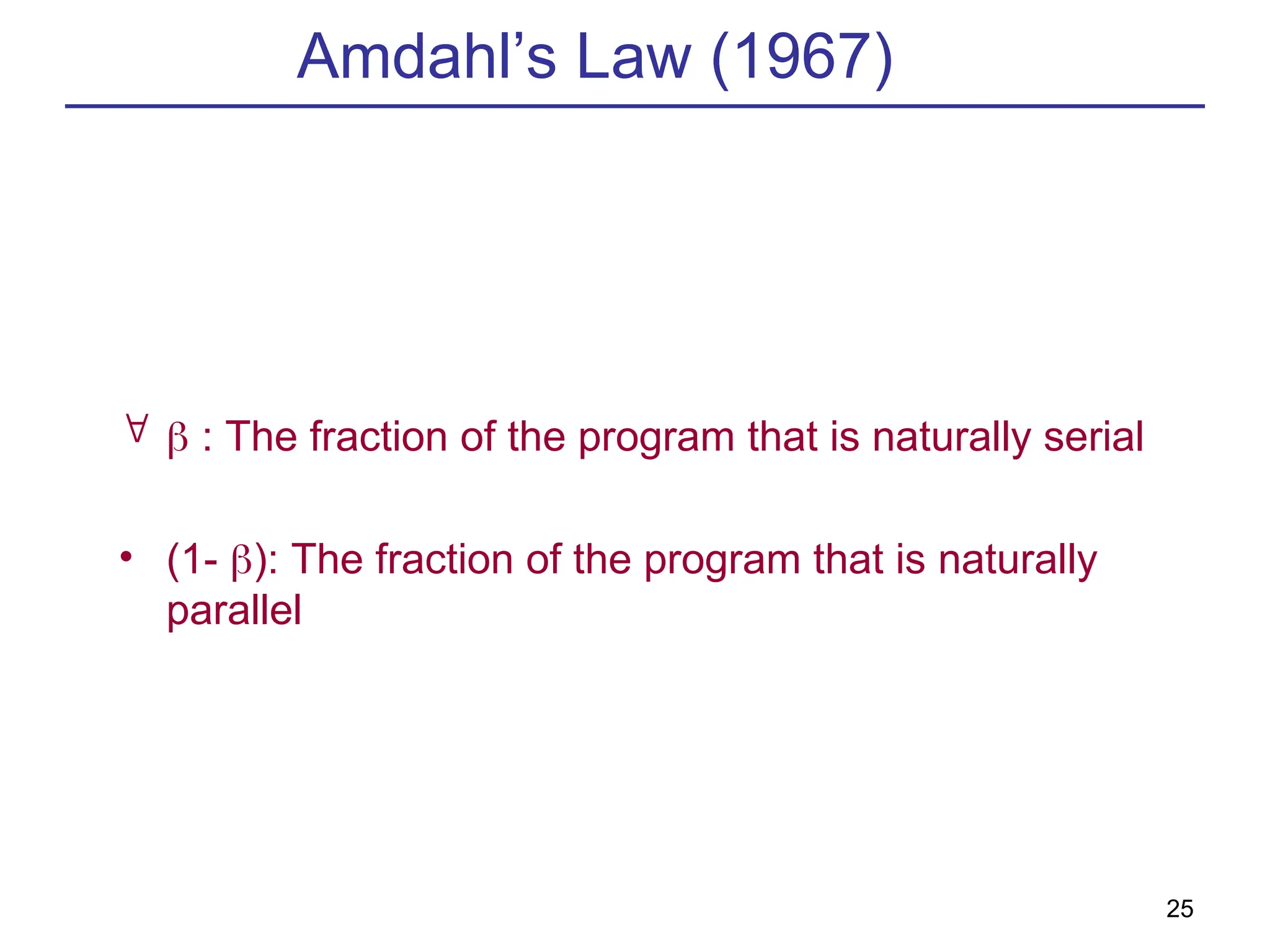
Amdahl’s Law (1967)
: The fraction of the program that is naturally serial
• (1- ): The fraction of the program that is naturally
parallel
#3 Two types of information flow into a processor:
instructions and
data.
The instruction stream is defined as the sequence of instructions performed by the processing unit.
The data stream is defined as the data traffic exchanged between the memory and the processing unit.
According to Flynn’s classification, either of the instruction or data streams can be single or multiple.
Comparisson with car assembly:
SISD – one person is doing all the tasks one at the time
MISD – one worker continues the work of the previous worker
SIMD – several workers perform the same task concurrently; after all the workers are finished, another taks is given ot them
MIMD – each worker constructs a car independently following his own set of instructions
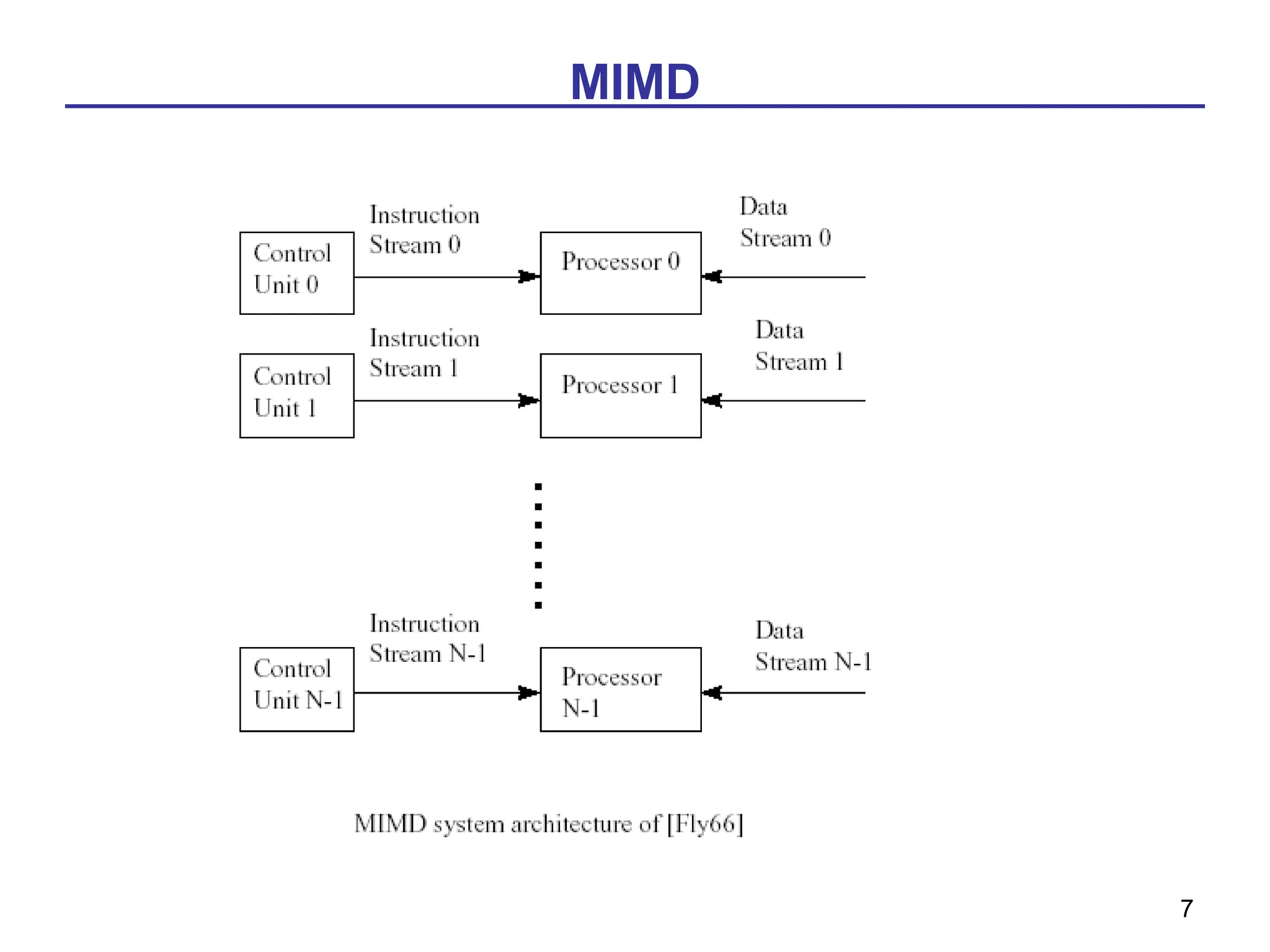
#4 A processing elements is capable to process a instruction passed by another entity, where a memory can be used to hold computational values. The first figure demonstrate the interaction between a processing element and its memory module.
A single instruction, single data architecture is represented in the second figure. The Control Unit will provide a instruction to the processing element and the memory module will serve as mention above. Another function here of the memory module is that its capable store information provided by the processing element and provide a instruction to the Control Unit.
#5 This architecture is capable to run with a boost of speedup compared to a sequential architectures. Since all processors are running at the same time, there a existence of certain processors waiting for others processors to finish running a specific instructions. The following example shows the same instruction running on two different processors.
----------------- | -----------------
PROCESSOR 1 | PROCESSOR 2
----------------- |-----------------
INST 1 |INST 1
INST 2 |INST 2
IF (A > B) |IF (A > B) //this processor will not validate this condition and will jump to INST 4
INST 3 | INST 3
INST 4 |INST 4
When processor 1 validates the condition instruction, it will have to do more computation compared to processor 2 which jumps to INST 4 since the condition is false.
The SIMD model of parallel computing consists of two parts:
a front-end computer of the usual von Neumann style,
and a processor array.
The processor array is a set of identical synchronized processing elements capable of simultaneously performing the same operation on different data.
Each processor in the array has a small amount of local memory where the distributed data resides while it is being processed in parallel.
A program can be developed and executed on the front end using a traditional serial programming language.
The application program is executed by the front end in the usual serial way, but issues commands to the processor array to carry out SIMD operations in parallel.
The similarity between serial and data parallel programming is one of the strong points of data parallelism.
Synchronization is made irrelevant by the lock–step synchronization of the processors: Processors either do nothing or exactly the same operations at the same time.
Fine-grained architectures: each processor processes few data elements
Processor complexity
#10 Shared memory: bulletin board
Message passing: letters
Using the shared memory model for multiprocessor could induce a bottleneck to the architecture. Multiple processor could be writing at a occasion. And at some instance, more then one processor could be accessing the same memory location which could greatly ones computation output.
Using a local memory for each processing element and using the message passing model improves the previously issue.
#11
Each processor may have registers, buffers, caches, and local memory banks as additional memory resources.
These include
access control - determines which process accesses are possible to which resources. Access control models make the required check for every access request issued by the processors to the shared memory, against the contents of the access control table.
Synchronization constraints limit the time of accesses from sharing processes to shared resources.
Protection is a system feature that prevents processes from making arbitrary access to resources belonging to other processes
#12 The UMA model is when any processor are reading a memory location through the cache, they will all have the same delay.
#14
The NUMA model :
- Each processor have their own local memory
- And memories are all part of a big address space where the processor holds that space with exclusivity
Ex:
Processor 1 -> 0 – 1GB
Processor 2 -> 1GB – 2GB
#15 Processor have each their own local memory. These memory modules are not shared from a big address space as seen in the NUMA model
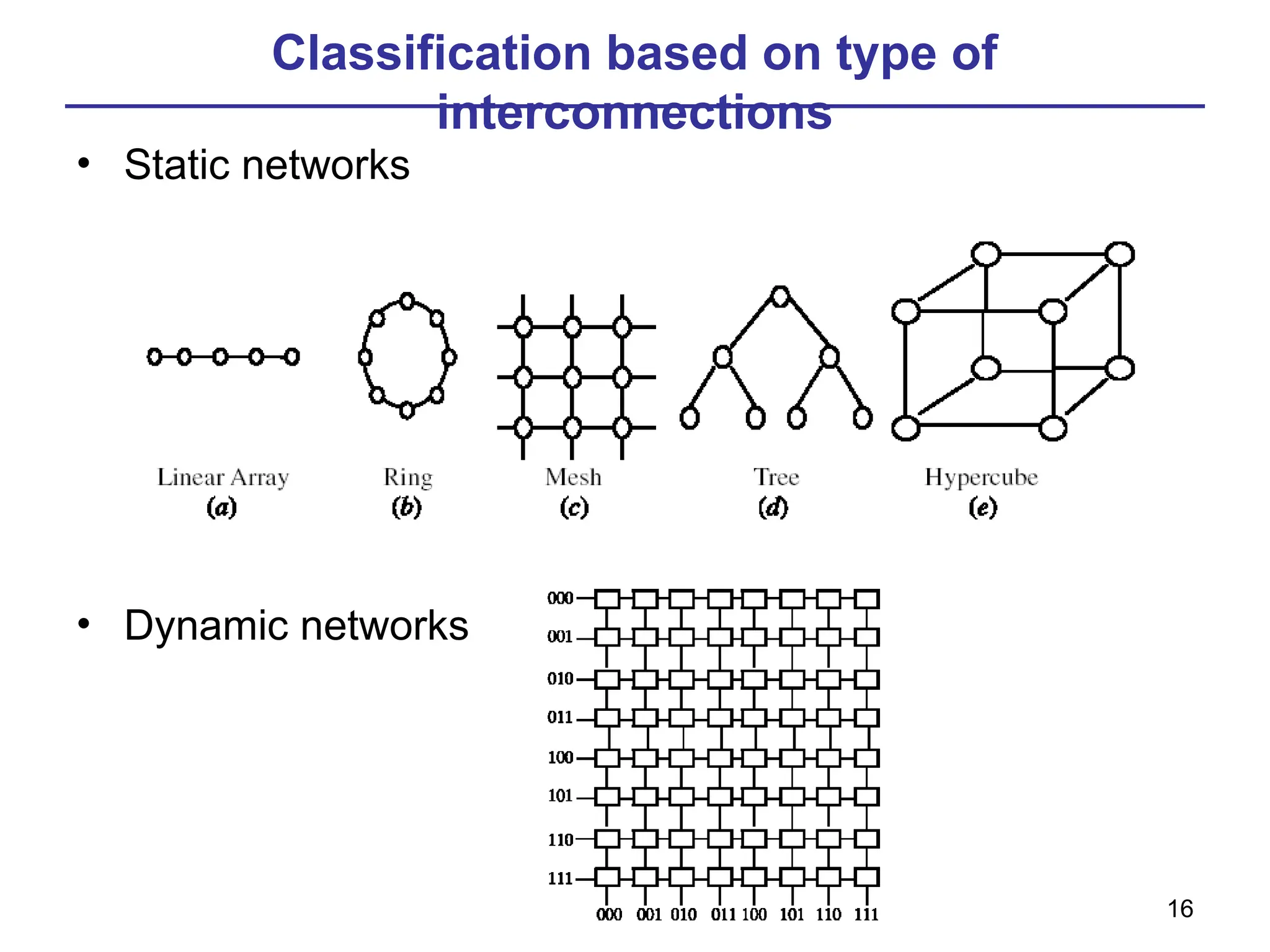
#16 In static networks, direct fixed links are established among nodes to form a fixed network
in dynamic networks, connections are established as needed.
Shared memory systems can be designed using bus-based or switch-based INs.
Message passing INs can be divided into static and dynamic.
#17 In synchronous mode of operation, a single global clock is used by all
components in the system such that the whole system is operating in a lock–step
manner. Asynchronous mode of operation, on the other hand, does not require a
global clock. Handshaking signals are used instead in order to coordinate the
operation of asynchronous systems. While synchronous systems tend to be slower
compared to asynchronous systems, they are race and hazard-free.
Packet switching is the procedure for which the packet are responsible to find a path to the desire source
Circuit switching is when a path has been designed for a packet to reach from the initial source to its destination








![17
Interconnection Network [1]
• Mode of Operation (Synchronous vs. Asynchronous)
• Control Strategy (Centralized vs. Decentralized)
• Switching Techniques (Packet switching vs. Circuit
switching)
• Topology (Static Vs. Dynamic)](https://image.slidesharecdn.com/ceg4131models-250408222227-81a49a5b/75/ceg4131_models-ppthjjjjjjjhhjhjhjhjhjhjhj-17-2048.jpg)
![18
Classification based on the kind of
parallelism[3]
Parallel
architectures
PAs
Data-parallel architectures Function-parallel architectures
Instruction-level
PAs
Thread-level
PAs
Process-level
PAs
ILPS MIMDs
Vector
architecture
Associative
architecture
architecture
and neural
SIMDs Systolic Pipelined
processors
Processors)
processors
VLIWs Superscalar Ditributed
memory
(multi-computer)
Shared
memory
(multi-
MIMD
DPs](https://image.slidesharecdn.com/ceg4131models-250408222227-81a49a5b/75/ceg4131_models-ppthjjjjjjjhhjhjhjhjhjhjhj-18-2048.jpg)