SuperSuper ComputersComputers
By RachnaBy Rachna
What is a Supercomputer?What is a Supercomputer?
Supercomputer is a broad term for one ofSupercomputer is a broad term for one of
the fastest computer currently available.the fastest computer currently available.
Super computers were designed and builtSuper computers were designed and built
to work on extremely large jobs that couldto work on extremely large jobs that could
not be handled by no other types ofnot be handled by no other types of
computing systems.computing systems.
History of SupercomputersHistory of Supercomputers
 The history of supercomputing goes backThe history of supercomputing goes back
to the 1960s when a series of computersto the 1960s when a series of computers
at Control Data Corporation (CDC) wereat Control Data Corporation (CDC) were
designed bydesigned by Seymour CraySeymour Cray to useto use
innovative designs and parallelism toinnovative designs and parallelism to
achieve superior computational peakachieve superior computational peak
performance.performance.
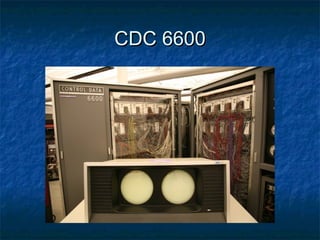
 TheThe CDC 6600CDC 6600, released in 1964, is, released in 1964, is
generally considered the firstgenerally considered the first
supercomputersupercomputer
CDC 6600CDC 6600
History of SupercomputersHistory of Supercomputers
(cont’d)(cont’d)
 Cray then developed the CDC 7600 inCray then developed the CDC 7600 in
1970.1970.
 Cray-1 supercomputers project started inCray-1 supercomputers project started in
1972 and finished in 1974 and was twice1972 and finished in 1974 and was twice
as fast as the 7600 with a vector speed ofas fast as the 7600 with a vector speed of
80 MFLOPS.80 MFLOPS.
History of SupercomputersHistory of Supercomputers
(cont’d)(cont’d)
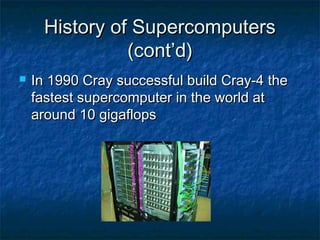
 In 1990 Cray successful build Cray-4 theIn 1990 Cray successful build Cray-4 the
fastest supercomputer in the world atfastest supercomputer in the world at
around 10 gigaflopsaround 10 gigaflops
Measurement of Speed :Measurement of Speed :
Supercomputers speed are measured inSupercomputers speed are measured in
floating point operations per secondfloating point operations per second
(FLOPS) in units of :(FLOPS) in units of :
 megaflops (MFLOPS)megaflops (MFLOPS)
 gigaflops (GFLOPS)gigaflops (GFLOPS)
 teraflops (TFLOPS)teraflops (TFLOPS)
Uses of supercomputers :Uses of supercomputers :
 scientific simulationsscientific simulations
 Molecular Dynamics SimulationMolecular Dynamics Simulation
 analysis of geological dataanalysis of geological data
 nuclear energy researchnuclear energy research
 Computational fluid dynamicsComputational fluid dynamics
 Weather forecasting and meteorologyWeather forecasting and meteorology
 Aerodynamic researchAerodynamic research
 Probabilistic analysisProbabilistic analysis
HardwareHardware
 While the supercomputers of the 1970sWhile the supercomputers of the 1970s
used only a fewused only a few processorsprocessors, in the 1990s,, in the 1990s,
machines with thousands of processorsmachines with thousands of processors
began to appear and by the end of thebegan to appear and by the end of the
20th century, massively parallel20th century, massively parallel
supercomputers with thousands of "off-supercomputers with thousands of "off-
the-shelf" processors were the norm.the-shelf" processors were the norm.
 Supercomputers of the 21st century canSupercomputers of the 21st century can
use over 100,000 processors.use over 100,000 processors.
Operating System :Operating System :
 modernmodern massively parallelmassively parallel
supercomputers typically separatesupercomputers typically separate
computations from other services by usingcomputations from other services by using
multiple types ofmultiple types of nodesnodes, they usually run, they usually run
different operating systems on differentdifferent operating systems on different
nodes, e.g. using a small and efficientnodes, e.g. using a small and efficient
lightweight kernel on compute nodes, butlightweight kernel on compute nodes, but
a larger system such as a Linux-derivativea larger system such as a Linux-derivative
on server and I/O nodes.on server and I/O nodes.
ArchitectureArchitecture
 Approaches to supercomputerApproaches to supercomputer
architecture have taken dramatic turnsarchitecture have taken dramatic turns
since the earliest systems were introducedsince the earliest systems were introduced
in the 1960s. Early supercomputerin the 1960s. Early supercomputer
architectures pioneered by Seymour Crayarchitectures pioneered by Seymour Cray
relied on compact innovative designs andrelied on compact innovative designs and
local parallelism to achieve superiorlocal parallelism to achieve superior
computational peak performance.computational peak performance.
 However, in time the demand forHowever, in time the demand for
increased computational power ushered inincreased computational power ushered in
the age of massively parallel systemsthe age of massively parallel systems
Systems with a massive numberSystems with a massive number
of processors use one of twoof processors use one of two
paths:paths:
 In first approach, e.g. in grid computingIn first approach, e.g. in grid computing
the processing power of a large number ofthe processing power of a large number of
computers in distributed, diversecomputers in distributed, diverse
administrative domains, is used wheneveradministrative domains, is used whenever
a computer is available.a computer is available.
 In another approach, a large number ofIn another approach, a large number of
processors are used in close proximity toprocessors are used in close proximity to
each other, e.g. in a computer cluster.each other, e.g. in a computer cluster.
 In such a centralized massively parallelIn such a centralized massively parallel
system the speed and flexibility of thesystem the speed and flexibility of the
interconnect becomes very important andinterconnect becomes very important and
modern supercomputers have usedmodern supercomputers have used
various approaches ranging fromvarious approaches ranging from
enhanced Infiniband systems to three-enhanced Infiniband systems to three-
dimensional torus interconnects.dimensional torus interconnects.
What do you mean byWhat do you mean by
Cluster ComputersCluster Computers
Cluster computers are two or moreCluster computers are two or more
computers working parallel to achievecomputers working parallel to achieve
greater performances. Cluster computersgreater performances. Cluster computers
breakup work among the computers in thebreakup work among the computers in the
cluster.cluster.
Cluster Computers (cont’d)Cluster Computers (cont’d)
 Each computer in the cluster is a cpu itselfEach computer in the cluster is a cpu itself
with its own processor, memory, and disk.with its own processor, memory, and disk.
 The computers communicate with eachThe computers communicate with each
other via an interconnecting bus.other via an interconnecting bus.
What are Multi-ProcessorWhat are Multi-Processor
ComputersComputers
A multi-processor computer has 2 or moreA multi-processor computer has 2 or more
cpus. Each processor is capable of runningcpus. Each processor is capable of running
different program simultaneously (truedifferent program simultaneously (true
multitasking).multitasking).
Multi-Processor (cont’d)Multi-Processor (cont’d)
 The cpus all shared the other parts of theThe cpus all shared the other parts of the
computers: memory, disk system, bus, etc.computers: memory, disk system, bus, etc.
 Cpu communicate via memory and the systemCpu communicate via memory and the system
bus.bus.
 Cheaper than cluster computers but does notCheaper than cluster computers but does not
perform as well.perform as well.
From top 500 supercomputers the 3 topFrom top 500 supercomputers the 3 top
ranked supercomputers are:-ranked supercomputers are:-
 RANK NO.1:-JAGUARRANK NO.1:-JAGUAR
SUPERCOMPUTERSUPERCOMPUTER
 RANK NO.2:-ROADRUNNERRANK NO.2:-ROADRUNNER
 RANK NO.3:-TENNESSEE’s KRAKENRANK NO.3:-TENNESSEE’s KRAKEN
World’s FastestWorld’s Fastest
SuperComputer:SuperComputer:
Oak Ridge ‘Jaguar’Oak Ridge ‘Jaguar’
About Jaguar :About Jaguar :
 SITE:-Oak Ridge NationalSITE:-Oak Ridge National
LaboratoryLaboratory(ORNL’s)(ORNL’s)
 SYSTEM MODEL:-Cray XT5-HESYSTEM MODEL:-Cray XT5-HE
 COMPUTER:-Cray XT5-HE Operation SixCOMPUTER:-Cray XT5-HE Operation Six
Core 2.6GHzCore 2.6GHz
 VENDOR:-Cray Inc.VENDOR:-Cray Inc.
 INSTALLATION YEAR:-2009INSTALLATION YEAR:-2009
 OPERATING SYSTEM:-LinuxOPERATING SYSTEM:-Linux
 PROCESSOR:-AMD x86-64 Operation SixPROCESSOR:-AMD x86-64 Operation Six
Core 2600MHz(10.4 Gflops)Core 2600MHz(10.4 Gflops)
FEATURES OF JAGUARFEATURES OF JAGUAR
SUPERCOMPUTERSUPERCOMPUTER
 Cray XT computer systemCray XT computer system
 2.595 petaflops peak theoretical2.595 petaflops peak theoretical
performanceperformance
 255,584 processing cores255,584 processing cores
 System memory: 362 terabytesSystem memory: 362 terabytes
 Unmatched input/output bandwidth to readUnmatched input/output bandwidth to read
and write files: 284 gigabytes per secondand write files: 284 gigabytes per second
ADVANTAGES OF JAGUARADVANTAGES OF JAGUAR
SUPERCOMPUTERSUPERCOMPUTER
 High speed(1.759Petaflop)High speed(1.759Petaflop)
 Greater performanceGreater performance..
 High data transfer rate(284gb/s)High data transfer rate(284gb/s)
 High system memory(362tb)High system memory(362tb)
DISADVANTAGES OFDISADVANTAGES OF
JAGUAR SUPERCOMPUTERJAGUAR SUPERCOMPUTER
 Required large area.Required large area.
 Very costlyVery costly($19.5 million).($19.5 million).
 Required more electricity.Required more electricity.
 Large no . of chips(37,376chips).Large no . of chips(37,376chips).
Supercomputers in IndiaSupercomputers in India
Some top ranked supercomputers are:Some top ranked supercomputers are:
HP Cluster Platform 3000 BL460c :HP Cluster Platform 3000 BL460c :
Dual Intel Xeon 2.6 GHz eight coreDual Intel Xeon 2.6 GHz eight core
Performance : 303.9 TFLOPSPerformance : 303.9 TFLOPS
HP and Wipro Heterogeneous ClusterHP and Wipro Heterogeneous Cluster
Dual Intel Xeon E5530 quad core andDual Intel Xeon E5530 quad core and
Xeon E5645 hexa core CPUs, and dualXeon E5645 hexa core CPUs, and dual
Intel 448-coreIntel 448-core
Performance : 188.7 TFLOPSPerformance : 188.7 TFLOPS
IBM cluster :IBM cluster :
IBM P6 4.7 GHz sixteen dual-coreIBM P6 4.7 GHz sixteen dual-core
processorprocessor
Performance : 45.84 TFLOPSPerformance : 45.84 TFLOPS
PARAM cluster :PARAM cluster :
Intel Xeon (Tigerton) 2.93 GHz
quad core processor
Performance : 38.1 TFLOPS

Super computers by rachna

  • 1.
  • 2.
    What is aSupercomputer?What is a Supercomputer? Supercomputer is a broad term for one ofSupercomputer is a broad term for one of the fastest computer currently available.the fastest computer currently available. Super computers were designed and builtSuper computers were designed and built to work on extremely large jobs that couldto work on extremely large jobs that could not be handled by no other types ofnot be handled by no other types of computing systems.computing systems.
  • 3.
    History of SupercomputersHistoryof Supercomputers  The history of supercomputing goes backThe history of supercomputing goes back to the 1960s when a series of computersto the 1960s when a series of computers at Control Data Corporation (CDC) wereat Control Data Corporation (CDC) were designed bydesigned by Seymour CraySeymour Cray to useto use innovative designs and parallelism toinnovative designs and parallelism to achieve superior computational peakachieve superior computational peak performance.performance.  TheThe CDC 6600CDC 6600, released in 1964, is, released in 1964, is generally considered the firstgenerally considered the first supercomputersupercomputer
  • 4.
  • 5.
    History of SupercomputersHistoryof Supercomputers (cont’d)(cont’d)  Cray then developed the CDC 7600 inCray then developed the CDC 7600 in 1970.1970.  Cray-1 supercomputers project started inCray-1 supercomputers project started in 1972 and finished in 1974 and was twice1972 and finished in 1974 and was twice as fast as the 7600 with a vector speed ofas fast as the 7600 with a vector speed of 80 MFLOPS.80 MFLOPS.
  • 6.
    History of SupercomputersHistoryof Supercomputers (cont’d)(cont’d)  In 1990 Cray successful build Cray-4 theIn 1990 Cray successful build Cray-4 the fastest supercomputer in the world atfastest supercomputer in the world at around 10 gigaflopsaround 10 gigaflops
  • 7.
    Measurement of Speed:Measurement of Speed : Supercomputers speed are measured inSupercomputers speed are measured in floating point operations per secondfloating point operations per second (FLOPS) in units of :(FLOPS) in units of :  megaflops (MFLOPS)megaflops (MFLOPS)  gigaflops (GFLOPS)gigaflops (GFLOPS)  teraflops (TFLOPS)teraflops (TFLOPS)
  • 8.
    Uses of supercomputers:Uses of supercomputers :  scientific simulationsscientific simulations  Molecular Dynamics SimulationMolecular Dynamics Simulation  analysis of geological dataanalysis of geological data  nuclear energy researchnuclear energy research  Computational fluid dynamicsComputational fluid dynamics  Weather forecasting and meteorologyWeather forecasting and meteorology  Aerodynamic researchAerodynamic research  Probabilistic analysisProbabilistic analysis
  • 9.
    HardwareHardware  While thesupercomputers of the 1970sWhile the supercomputers of the 1970s used only a fewused only a few processorsprocessors, in the 1990s,, in the 1990s, machines with thousands of processorsmachines with thousands of processors began to appear and by the end of thebegan to appear and by the end of the 20th century, massively parallel20th century, massively parallel supercomputers with thousands of "off-supercomputers with thousands of "off- the-shelf" processors were the norm.the-shelf" processors were the norm.  Supercomputers of the 21st century canSupercomputers of the 21st century can use over 100,000 processors.use over 100,000 processors.
  • 10.
    Operating System :OperatingSystem :  modernmodern massively parallelmassively parallel supercomputers typically separatesupercomputers typically separate computations from other services by usingcomputations from other services by using multiple types ofmultiple types of nodesnodes, they usually run, they usually run different operating systems on differentdifferent operating systems on different nodes, e.g. using a small and efficientnodes, e.g. using a small and efficient lightweight kernel on compute nodes, butlightweight kernel on compute nodes, but a larger system such as a Linux-derivativea larger system such as a Linux-derivative on server and I/O nodes.on server and I/O nodes.
  • 11.
    ArchitectureArchitecture  Approaches tosupercomputerApproaches to supercomputer architecture have taken dramatic turnsarchitecture have taken dramatic turns since the earliest systems were introducedsince the earliest systems were introduced in the 1960s. Early supercomputerin the 1960s. Early supercomputer architectures pioneered by Seymour Crayarchitectures pioneered by Seymour Cray relied on compact innovative designs andrelied on compact innovative designs and local parallelism to achieve superiorlocal parallelism to achieve superior computational peak performance.computational peak performance.  However, in time the demand forHowever, in time the demand for increased computational power ushered inincreased computational power ushered in the age of massively parallel systemsthe age of massively parallel systems
  • 12.
    Systems with amassive numberSystems with a massive number of processors use one of twoof processors use one of two paths:paths:  In first approach, e.g. in grid computingIn first approach, e.g. in grid computing the processing power of a large number ofthe processing power of a large number of computers in distributed, diversecomputers in distributed, diverse administrative domains, is used wheneveradministrative domains, is used whenever a computer is available.a computer is available.
  • 13.
     In anotherapproach, a large number ofIn another approach, a large number of processors are used in close proximity toprocessors are used in close proximity to each other, e.g. in a computer cluster.each other, e.g. in a computer cluster.  In such a centralized massively parallelIn such a centralized massively parallel system the speed and flexibility of thesystem the speed and flexibility of the interconnect becomes very important andinterconnect becomes very important and modern supercomputers have usedmodern supercomputers have used various approaches ranging fromvarious approaches ranging from enhanced Infiniband systems to three-enhanced Infiniband systems to three- dimensional torus interconnects.dimensional torus interconnects.
  • 14.
    What do youmean byWhat do you mean by Cluster ComputersCluster Computers Cluster computers are two or moreCluster computers are two or more computers working parallel to achievecomputers working parallel to achieve greater performances. Cluster computersgreater performances. Cluster computers breakup work among the computers in thebreakup work among the computers in the cluster.cluster.
  • 15.
    Cluster Computers (cont’d)ClusterComputers (cont’d)  Each computer in the cluster is a cpu itselfEach computer in the cluster is a cpu itself with its own processor, memory, and disk.with its own processor, memory, and disk.  The computers communicate with eachThe computers communicate with each other via an interconnecting bus.other via an interconnecting bus.
  • 16.
    What are Multi-ProcessorWhatare Multi-Processor ComputersComputers A multi-processor computer has 2 or moreA multi-processor computer has 2 or more cpus. Each processor is capable of runningcpus. Each processor is capable of running different program simultaneously (truedifferent program simultaneously (true multitasking).multitasking).
  • 17.
    Multi-Processor (cont’d)Multi-Processor (cont’d) The cpus all shared the other parts of theThe cpus all shared the other parts of the computers: memory, disk system, bus, etc.computers: memory, disk system, bus, etc.  Cpu communicate via memory and the systemCpu communicate via memory and the system bus.bus.  Cheaper than cluster computers but does notCheaper than cluster computers but does not perform as well.perform as well.
  • 18.
    From top 500supercomputers the 3 topFrom top 500 supercomputers the 3 top ranked supercomputers are:-ranked supercomputers are:-  RANK NO.1:-JAGUARRANK NO.1:-JAGUAR SUPERCOMPUTERSUPERCOMPUTER  RANK NO.2:-ROADRUNNERRANK NO.2:-ROADRUNNER  RANK NO.3:-TENNESSEE’s KRAKENRANK NO.3:-TENNESSEE’s KRAKEN
  • 19.
  • 20.
    About Jaguar :AboutJaguar :  SITE:-Oak Ridge NationalSITE:-Oak Ridge National LaboratoryLaboratory(ORNL’s)(ORNL’s)  SYSTEM MODEL:-Cray XT5-HESYSTEM MODEL:-Cray XT5-HE  COMPUTER:-Cray XT5-HE Operation SixCOMPUTER:-Cray XT5-HE Operation Six Core 2.6GHzCore 2.6GHz  VENDOR:-Cray Inc.VENDOR:-Cray Inc.  INSTALLATION YEAR:-2009INSTALLATION YEAR:-2009  OPERATING SYSTEM:-LinuxOPERATING SYSTEM:-Linux  PROCESSOR:-AMD x86-64 Operation SixPROCESSOR:-AMD x86-64 Operation Six Core 2600MHz(10.4 Gflops)Core 2600MHz(10.4 Gflops)
  • 21.
    FEATURES OF JAGUARFEATURESOF JAGUAR SUPERCOMPUTERSUPERCOMPUTER  Cray XT computer systemCray XT computer system  2.595 petaflops peak theoretical2.595 petaflops peak theoretical performanceperformance  255,584 processing cores255,584 processing cores  System memory: 362 terabytesSystem memory: 362 terabytes  Unmatched input/output bandwidth to readUnmatched input/output bandwidth to read and write files: 284 gigabytes per secondand write files: 284 gigabytes per second
  • 22.
    ADVANTAGES OF JAGUARADVANTAGESOF JAGUAR SUPERCOMPUTERSUPERCOMPUTER  High speed(1.759Petaflop)High speed(1.759Petaflop)  Greater performanceGreater performance..  High data transfer rate(284gb/s)High data transfer rate(284gb/s)  High system memory(362tb)High system memory(362tb)
  • 23.
    DISADVANTAGES OFDISADVANTAGES OF JAGUARSUPERCOMPUTERJAGUAR SUPERCOMPUTER  Required large area.Required large area.  Very costlyVery costly($19.5 million).($19.5 million).  Required more electricity.Required more electricity.  Large no . of chips(37,376chips).Large no . of chips(37,376chips).
  • 24.
    Supercomputers in IndiaSupercomputersin India Some top ranked supercomputers are:Some top ranked supercomputers are: HP Cluster Platform 3000 BL460c :HP Cluster Platform 3000 BL460c : Dual Intel Xeon 2.6 GHz eight coreDual Intel Xeon 2.6 GHz eight core Performance : 303.9 TFLOPSPerformance : 303.9 TFLOPS HP and Wipro Heterogeneous ClusterHP and Wipro Heterogeneous Cluster Dual Intel Xeon E5530 quad core andDual Intel Xeon E5530 quad core and Xeon E5645 hexa core CPUs, and dualXeon E5645 hexa core CPUs, and dual Intel 448-coreIntel 448-core Performance : 188.7 TFLOPSPerformance : 188.7 TFLOPS
  • 25.
    IBM cluster :IBMcluster : IBM P6 4.7 GHz sixteen dual-coreIBM P6 4.7 GHz sixteen dual-core processorprocessor Performance : 45.84 TFLOPSPerformance : 45.84 TFLOPS PARAM cluster :PARAM cluster : Intel Xeon (Tigerton) 2.93 GHz quad core processor Performance : 38.1 TFLOPS