PRESENTATION ON-
HISTORY OF SUPERCOMPUTER
SUBMITTED TO:- DR. RUPESH KUMAR
(ASSOCIATE PROF. DSW)
SUBMITTED BY:- AVANISH KUMAR
MSW 3rd SEM.(REGULAR)
DEPARTMENT OF SOCIAL WORK
UNIVERSITY OF LUCKNOW
Introduction
There have always been "wow that's fast!"
computers, but we didn't start calling them
supercomputers until 1964.
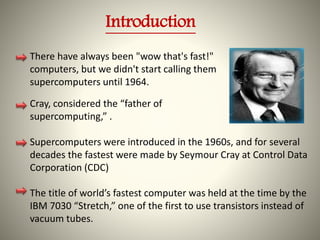
Cray, considered the “father of
supercomputing,” .
Supercomputers were introduced in the 1960s, and for several
decades the fastest were made by Seymour Cray at Control Data
Corporation (CDC)
The title of world’s fastest computer was held at the time by the
IBM 7030 “Stretch,” one of the first to use transistors instead of
vacuum tubes.
Supercomputer
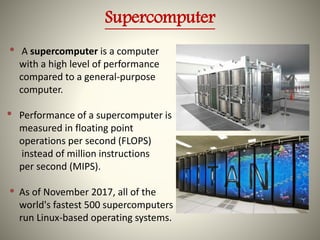
A supercomputer is a computer
with a high level of performance
compared to a general-purpose
computer.
Performance of a supercomputer is
measured in floating point
operations per second (FLOPS)
instead of million instructions
per second (MIPS).
As of November 2017, all of the
world's fastest 500 supercomputers
run Linux-based operating systems.
Indian context
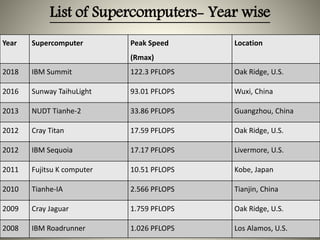
List of Supercomputers- Year wise
Year Supercomputer Peak Speed
(Rmax)
Location
2018 IBM Summit 122.3 PFLOPS Oak Ridge, U.S.
2016 Sunway TaihuLight 93.01 PFLOPS Wuxi, China
2013 NUDT Tianhe-2 33.86 PFLOPS Guangzhou, China
2012 Cray Titan 17.59 PFLOPS Oak Ridge, U.S.
2012 IBM Sequoia 17.17 PFLOPS Livermore, U.S.
2011 Fujitsu K computer 10.51 PFLOPS Kobe, Japan
2010 Tianhe-IA 2.566 PFLOPS Tianjin, China
2009 Cray Jaguar 1.759 PFLOPS Oak Ridge, U.S.
2008 IBM Roadrunner 1.026 PFLOPS Los Alamos, U.S.
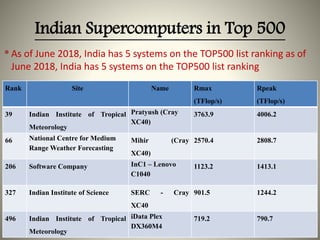
Indian Supercomputers in Top 500
Rank Site Name Rmax
(TFlop/s)
Rpeak
(TFlop/s)
39 Indian Institute of Tropical
Meteorology
Pratyush (Cray
XC40)
3763.9 4006.2
66 National Centre for Medium
Range Weather Forecasting
Mihir (Cray
XC40)
2570.4 2808.7
206 Software Company InC1 – Lenovo
C1040
1123.2 1413.1
327 Indian Institute of Science SERC - Cray
XC40
901.5 1244.2
496 Indian Institute of Tropical
Meteorology
iData Plex
DX360M4
719.2 790.7
As of June 2018, India has 5 systems on the TOP500 list ranking as of
June 2018, India has 5 systems on the TOP500 list ranking
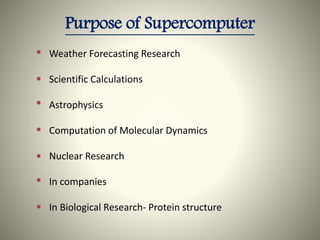
Purpose of Supercomputer
Weather Forecasting Research
Scientific Calculations
Astrophysics
Computation of Molecular Dynamics
Nuclear Research
In companies
In Biological Research- Protein structure
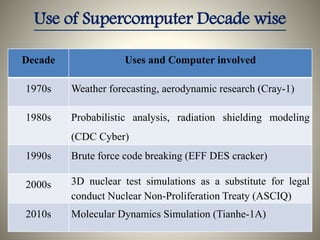
Use of Supercomputer Decade wise
Decade Uses and Computer involved
1970s Weather forecasting, aerodynamic research (Cray-1)
1980s Probabilistic analysis, radiation shielding modeling
(CDC Cyber)
1990s Brute force code breaking (EFF DES cracker)
2000s 3D nuclear test simulations as a substitute for legal
conduct Nuclear Non-Proliferation Treaty (ASCIQ)
2010s Molecular Dynamics Simulation (Tianhe-1A)
Conclusion
Supercomputer will become necessary in our future.
Supercomputer has strong operation system, storage
capacity and function to help us to calculation.
Supercomputer helps in weather forecasting, Nuclear
research and scientific research and calculations.
In the future, the progress of science and technology make
supercomputer become smaller and lighter, but better
functions.

Supercomputer ppt

  • 1.
    PRESENTATION ON- HISTORY OFSUPERCOMPUTER SUBMITTED TO:- DR. RUPESH KUMAR (ASSOCIATE PROF. DSW) SUBMITTED BY:- AVANISH KUMAR MSW 3rd SEM.(REGULAR) DEPARTMENT OF SOCIAL WORK UNIVERSITY OF LUCKNOW
  • 2.
    Introduction There have alwaysbeen "wow that's fast!" computers, but we didn't start calling them supercomputers until 1964. Cray, considered the “father of supercomputing,” . Supercomputers were introduced in the 1960s, and for several decades the fastest were made by Seymour Cray at Control Data Corporation (CDC) The title of world’s fastest computer was held at the time by the IBM 7030 “Stretch,” one of the first to use transistors instead of vacuum tubes.
  • 3.
    Supercomputer A supercomputer isa computer with a high level of performance compared to a general-purpose computer. Performance of a supercomputer is measured in floating point operations per second (FLOPS) instead of million instructions per second (MIPS). As of November 2017, all of the world's fastest 500 supercomputers run Linux-based operating systems.
  • 5.
  • 6.
    List of Supercomputers-Year wise Year Supercomputer Peak Speed (Rmax) Location 2018 IBM Summit 122.3 PFLOPS Oak Ridge, U.S. 2016 Sunway TaihuLight 93.01 PFLOPS Wuxi, China 2013 NUDT Tianhe-2 33.86 PFLOPS Guangzhou, China 2012 Cray Titan 17.59 PFLOPS Oak Ridge, U.S. 2012 IBM Sequoia 17.17 PFLOPS Livermore, U.S. 2011 Fujitsu K computer 10.51 PFLOPS Kobe, Japan 2010 Tianhe-IA 2.566 PFLOPS Tianjin, China 2009 Cray Jaguar 1.759 PFLOPS Oak Ridge, U.S. 2008 IBM Roadrunner 1.026 PFLOPS Los Alamos, U.S.
  • 7.
    Indian Supercomputers inTop 500 Rank Site Name Rmax (TFlop/s) Rpeak (TFlop/s) 39 Indian Institute of Tropical Meteorology Pratyush (Cray XC40) 3763.9 4006.2 66 National Centre for Medium Range Weather Forecasting Mihir (Cray XC40) 2570.4 2808.7 206 Software Company InC1 – Lenovo C1040 1123.2 1413.1 327 Indian Institute of Science SERC - Cray XC40 901.5 1244.2 496 Indian Institute of Tropical Meteorology iData Plex DX360M4 719.2 790.7 As of June 2018, India has 5 systems on the TOP500 list ranking as of June 2018, India has 5 systems on the TOP500 list ranking
  • 8.
    Purpose of Supercomputer WeatherForecasting Research Scientific Calculations Astrophysics Computation of Molecular Dynamics Nuclear Research In companies In Biological Research- Protein structure
  • 9.
    Use of SupercomputerDecade wise Decade Uses and Computer involved 1970s Weather forecasting, aerodynamic research (Cray-1) 1980s Probabilistic analysis, radiation shielding modeling (CDC Cyber) 1990s Brute force code breaking (EFF DES cracker) 2000s 3D nuclear test simulations as a substitute for legal conduct Nuclear Non-Proliferation Treaty (ASCIQ) 2010s Molecular Dynamics Simulation (Tianhe-1A)
  • 10.
    Conclusion Supercomputer will becomenecessary in our future. Supercomputer has strong operation system, storage capacity and function to help us to calculation. Supercomputer helps in weather forecasting, Nuclear research and scientific research and calculations. In the future, the progress of science and technology make supercomputer become smaller and lighter, but better functions.