GRAPHICS PROCESSING
UNIT(GPU)
BY
AMALRAJ.R
ELECTRONICS
C.P.T.C
INTRODUCTION
What is GPU?
• It is a processor optimized for 2D/3D graphics, video,
visual computing, and display.
• It is highly parallel, highly multithreaded
multiprocessor optimized for visual computing.
• Its uses parallel archetecture.It is also called Visual
processing unit
• It serves as both a programmable graphics processor
and a scalable parallel computing platform.
• It works along with CPU
CPU VERSUS GPU
• A SIMPLE WAY TO UNDERSTAND THE DIFFERENCE
BETWEEN A CPU ANDGPU IS TO COMPARE HOW
THEY PROCESS TASKS. A CPU CONSISTS OF A FEW
CORES OPTIMIZED FOR SEQUENTIAL SERIAL
PROCESSING WHILE A GPU HAS A MASSIVELY
PARALLEL ARCHITECTURE CONSISTS OF THOUSANDS
OF SMALLER, MORE EFFICIENT CORES DESIGNED FOR
HANDLING MULTIPLE TASKS SIMULTANEOUSLY
• GPUS HAVE THOUSANDS OF CORES TO
PROCESS PARALLEL WORKLOADS EFFICIENTLY
GPU vs CPU
• A GPU is tailored for highly parallel operation while a CPU
executes programs serially
• For this reason, GPUs have many parallel execution units and
higher transistor counts, while CPUs have few execution units
and higher clockspeeds
• GPUs have much deeper pipelines (several thousand stages
vs 10-20 for CPUs)
• GPUs have significantly faster and more advanced memory
interfaces as they need to shift around a lot more data than
CPUs
CPU VERSUS GPU
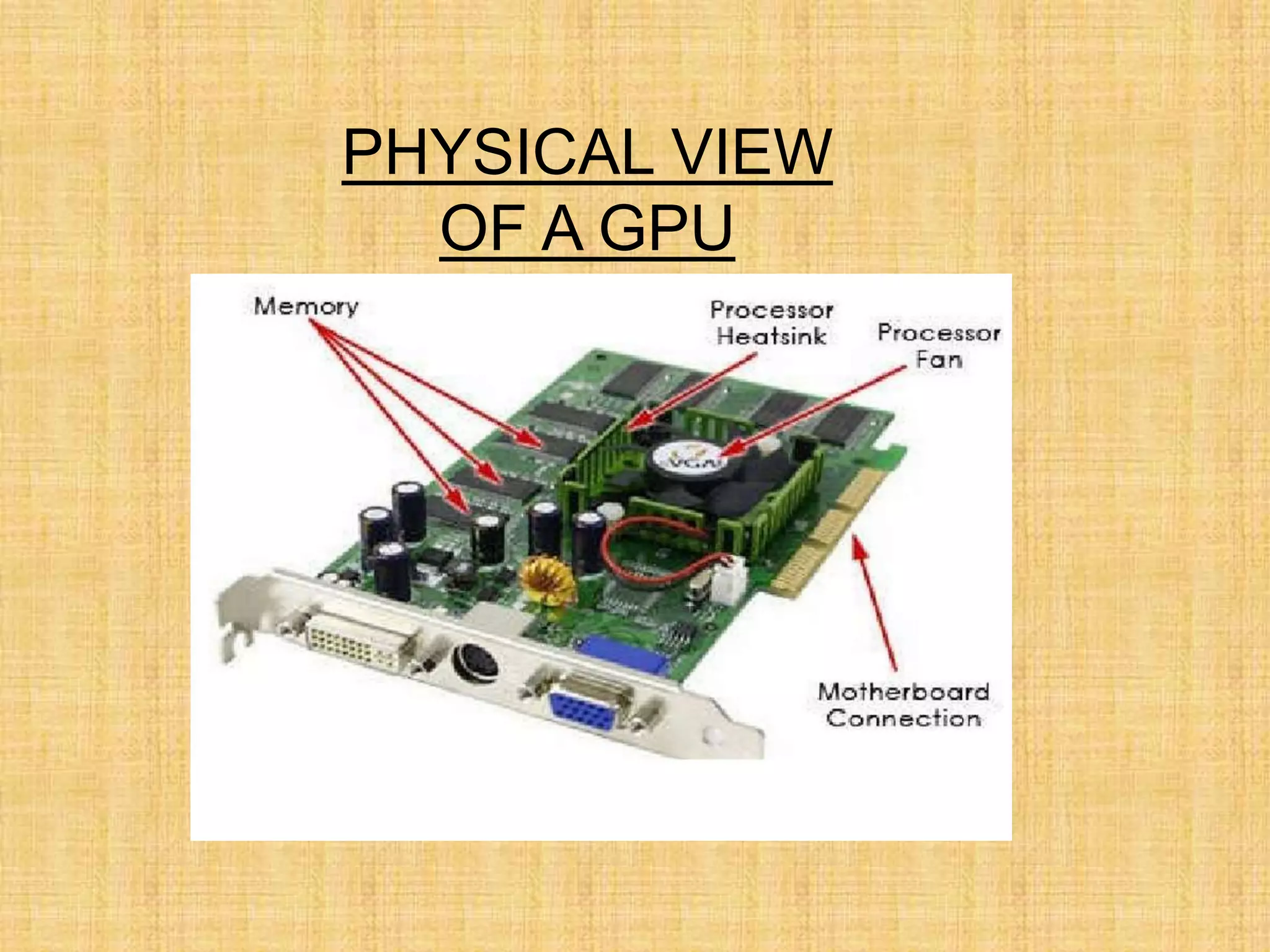
PHYSICAL VIEW
OF A GPU
COMPONENTS OF A GPU
* MOTHERBOARD
* GRAPHICS PROCESSOR
* MEMORY
* DISPLAY CONNECTOR
The images you see on your monitor are made of tiny
dots called pixels. At most common resolution
settings, a screen displays over a million pixels, and the
computer has to decide what to do with every one in
order to create an image. To do this, it needs a
translator something to take binary data from the CPU
and turn it into a picture you can see. Unless a
computer has graphics capability built into the
motherboard, that translation takes place on the
graphics card
Working
The CPU sends information about the image to the
graphics card. The graphics card decides how to use the
pixels on the screen to create the image. It then sends that
information to the monitor through a cable
To make a 3Dimage,the graphics card first creates a wire
frame out of straight lines. Then, it rasterizes the image
(fills in the remaining pixels). It also adds lighting,
texture and color. For fastpaced games,the computer
has to go through this process about sixty times per
second. Without a graphics card to perform the necessary
calculations, the workload would be too much for the
computer to handle.
Working Continues……
The graphics card accomplishes this task
using four main components:
A motherboard connection for data and
power
A processor to decide what to do with each
pixel on the screen
Memory to hold information about each
pixel and to temporarily store completed
pictures
GRAPHICS PROCESSOR
A graphics card's processor, called a graphics processing unit
(GPU), is similar to a computer's CPU. A GPU is designed
specifically for performing the complex mathematical and
geometric calculations that are necessary for graphics
rendering. Some of the fastest GPUs have more transistors
than the average CPU. A GPU produces a lot of heat, so it is
usually located under a heat sink or a fan.
RAM
As the GPU creates images, it needs somewhere to hold
information and completed pictures. It uses the card's RAM for
this purpose, storing data about each pixel, its color and its
location on the screen
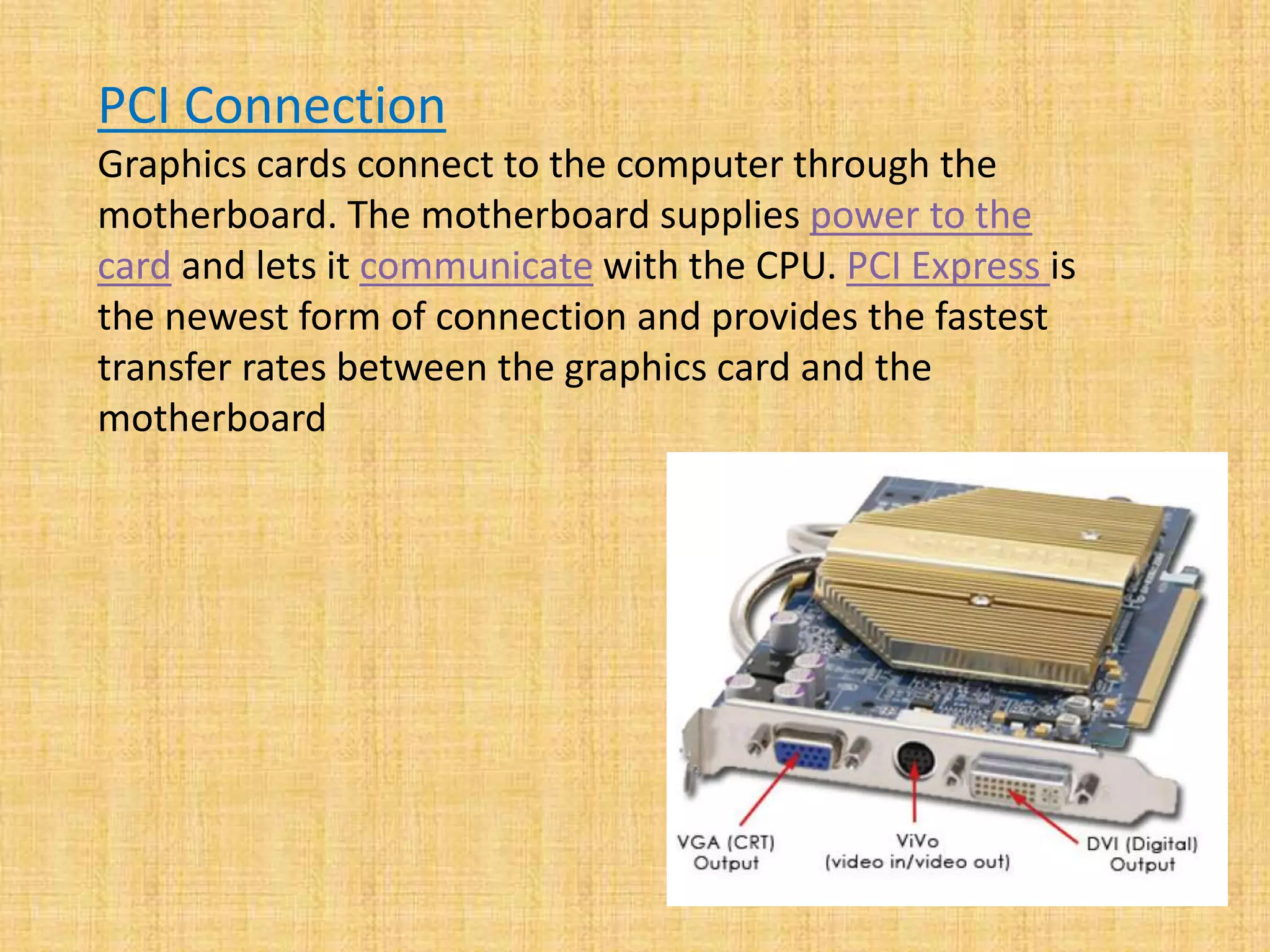
PCI Connection
Graphics cards connect to the computer through the
motherboard. The motherboard supplies power to the
card and lets it communicate with the CPU. PCI Express is
the newest form of connection and provides the fastest
transfer rates between the graphics card and the
motherboard
A good overall measurement of a card's performance is
its frame rate, measured in frames per second (FPS). The
frame rate describes how many complete images the card can
display per second. The human eye can process about 25
frames every second, but fast action games require a frame
rate of at least 60 FPS to provide smooth animation and
scrolling
The graphics card's hardware directly affects its speed. These
are the hardware specifications that most affect the card's
speed and the units in which they are measured:
GPU clock speed (MHz)
Size of the memory bus (bits)
Amount of available memory (MB)
Memory clock rate (MHz)
Specifications
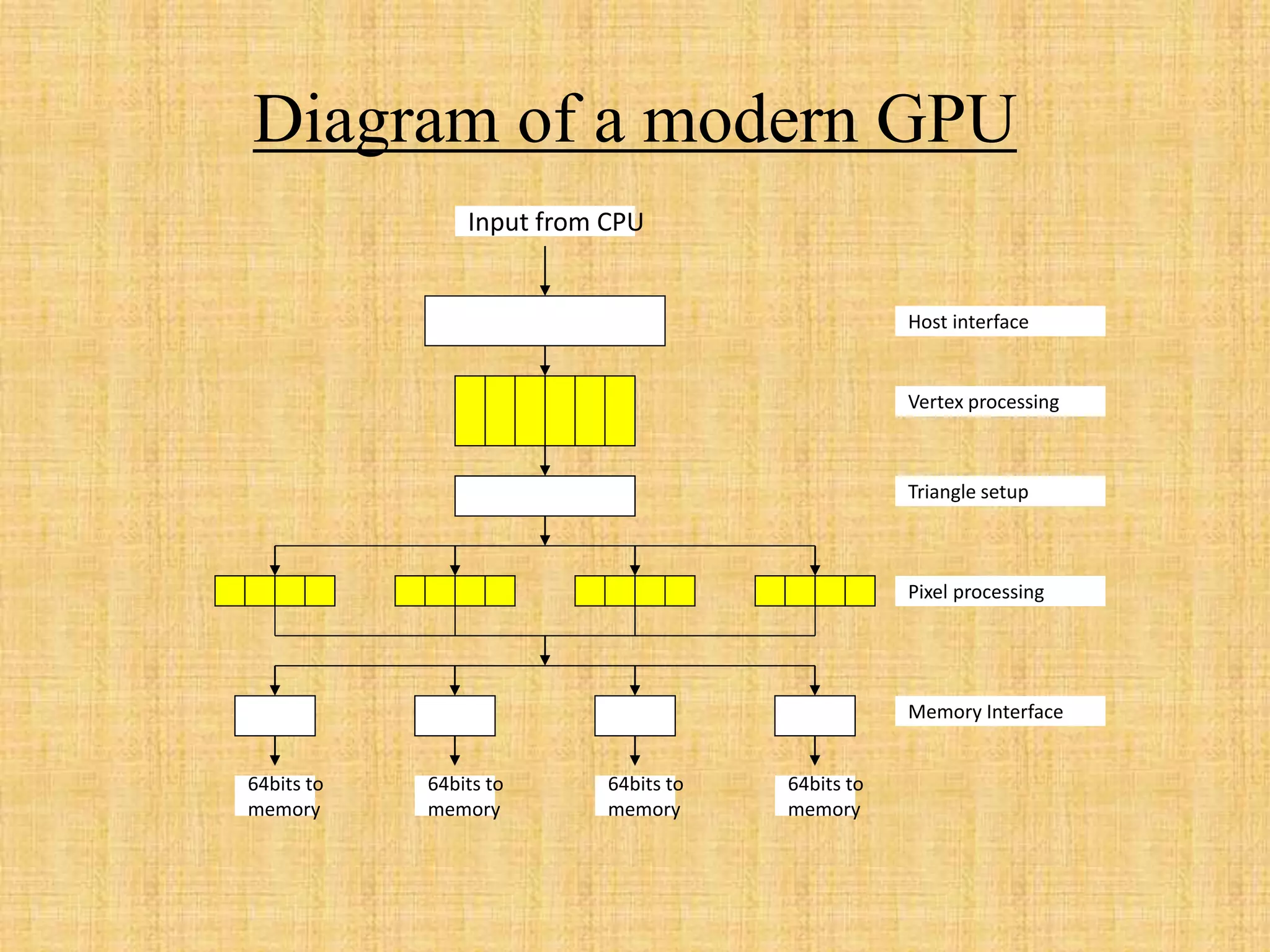
Modern GPU Architecture
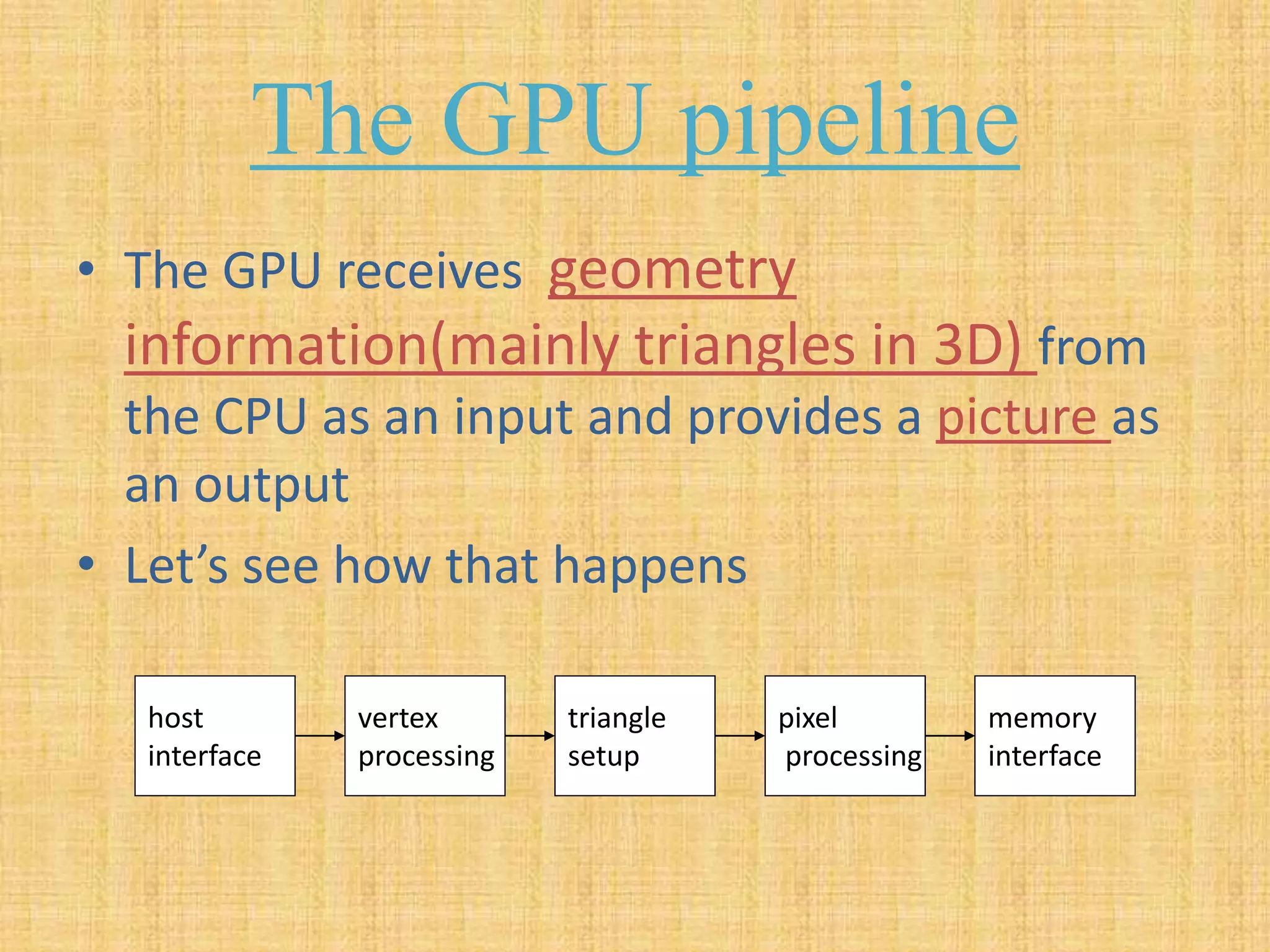
The GPU pipeline
• The GPU receives geometry
information(mainly triangles in 3D) from
the CPU as an input and provides a picture as
an output
• Let’s see how that happens
host
interface
vertex
processing
triangle
setup
pixel
processing
memory
interface
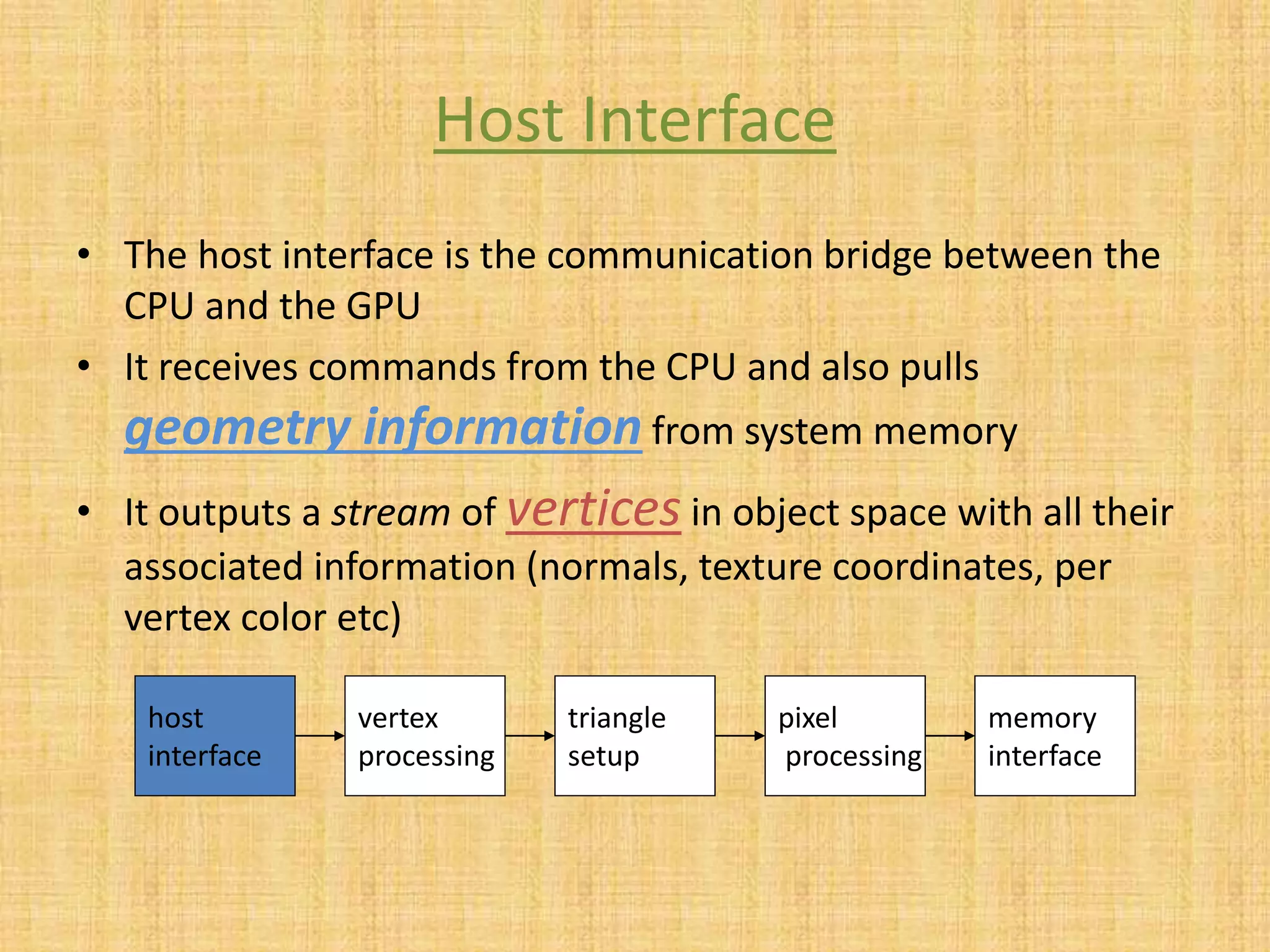
Host Interface
• The host interface is the communication bridge between the
CPU and the GPU
• It receives commands from the CPU and also pulls
geometry information from system memory
• It outputs a stream of vertices in object space with all their
associated information (normals, texture coordinates, per
vertex color etc)
host
interface
vertex
processing
triangle
setup
pixel
processing
memory
interface
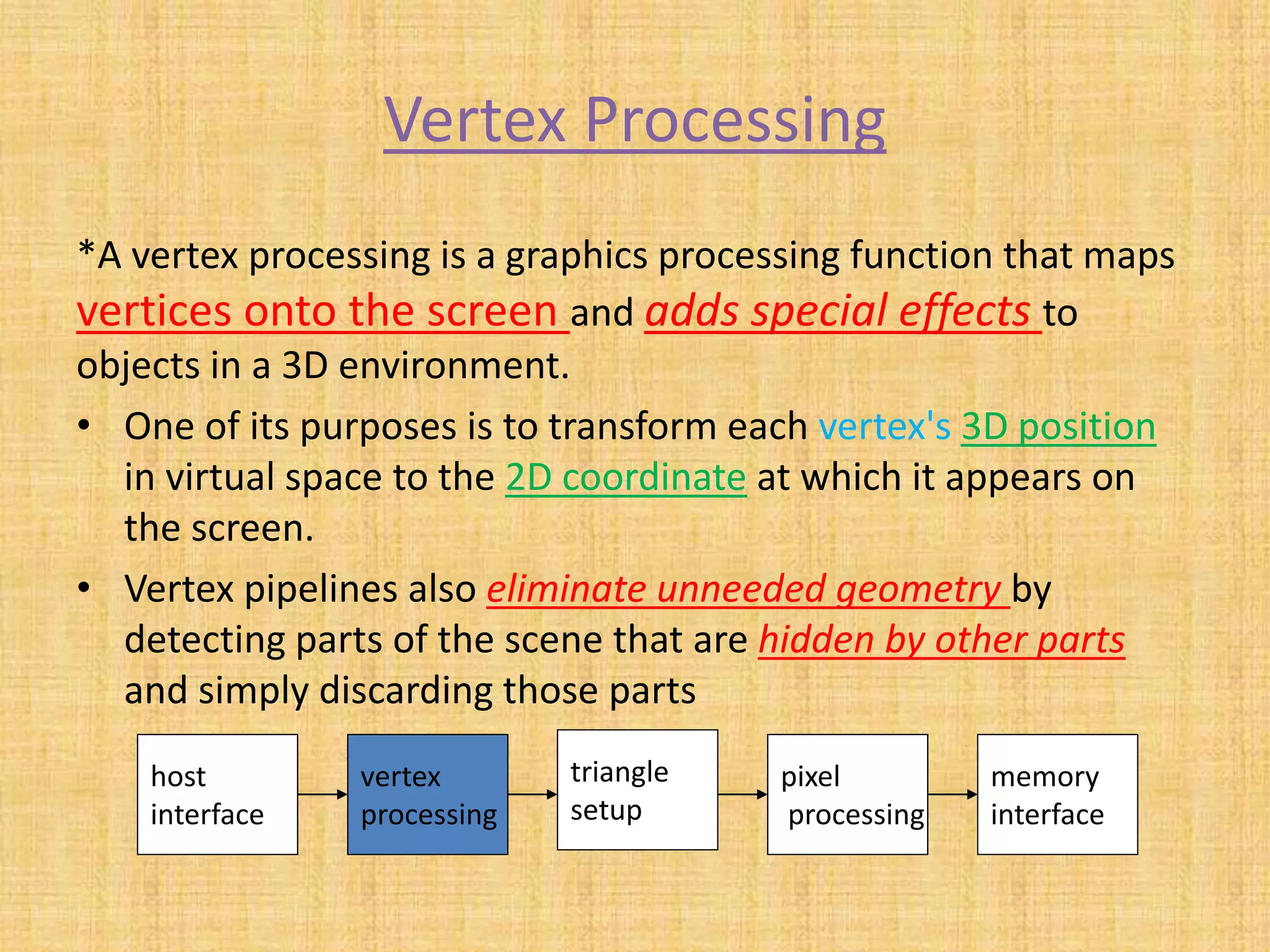
Vertex Processing
*A vertex processing is a graphics processing function that maps
vertices onto the screen and adds special effects to
objects in a 3D environment.
• One of its purposes is to transform each vertex's 3D position
in virtual space to the 2D coordinate at which it appears on
the screen.
• Vertex pipelines also eliminate unneeded geometry by
detecting parts of the scene that are hidden by other parts
and simply discarding those parts
host
interface
vertex
processing
triangle
setup
pixel
processing
memory
interface
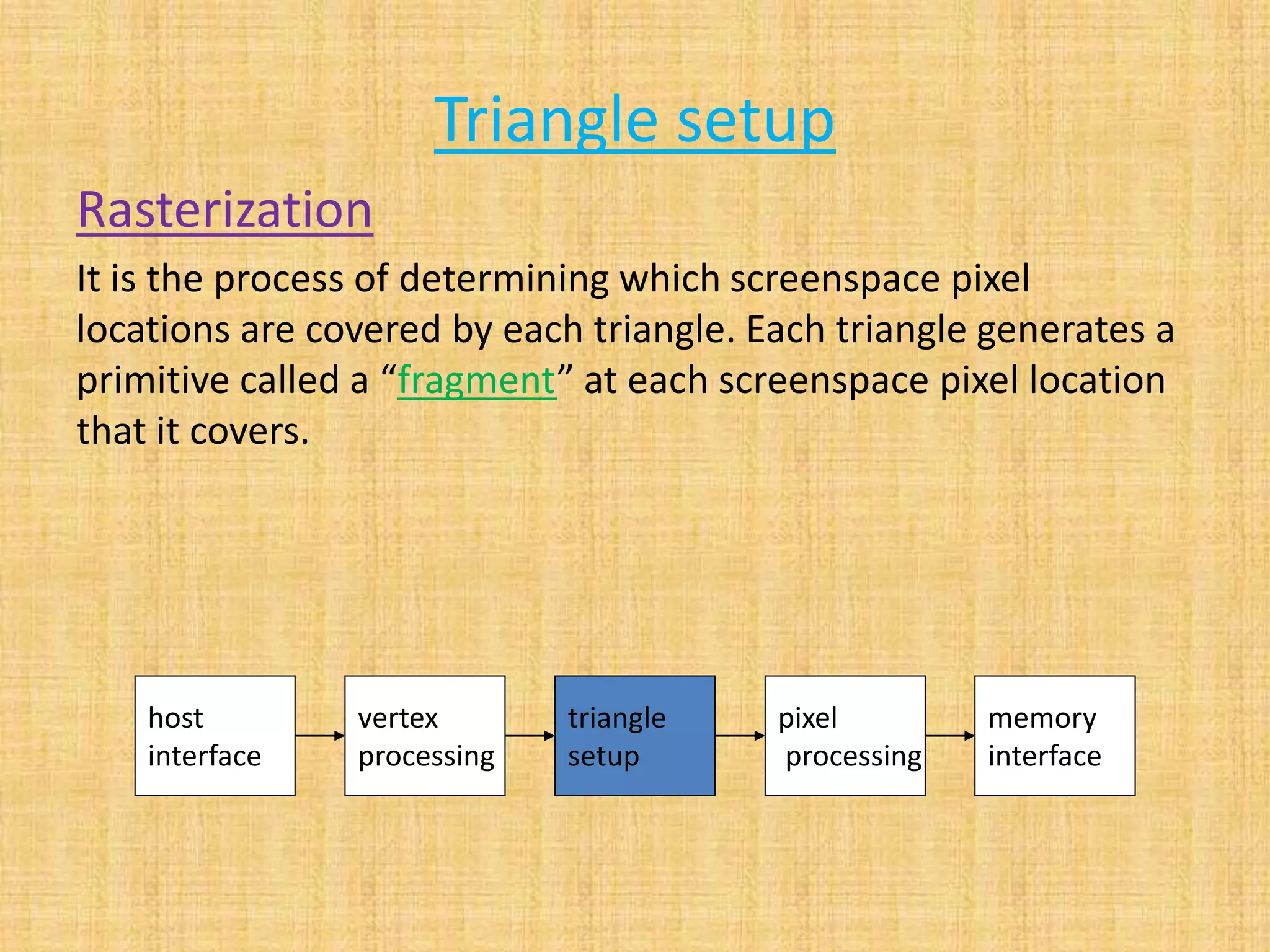
Triangle setup
Rasterization
It is the process of determining which screenspace pixel
locations are covered by each triangle. Each triangle generates a
primitive called a “fragment” at each screenspace pixel location
that it covers.
host
interface
vertex
processing
triangle
setup
pixel
processing
memory
interface
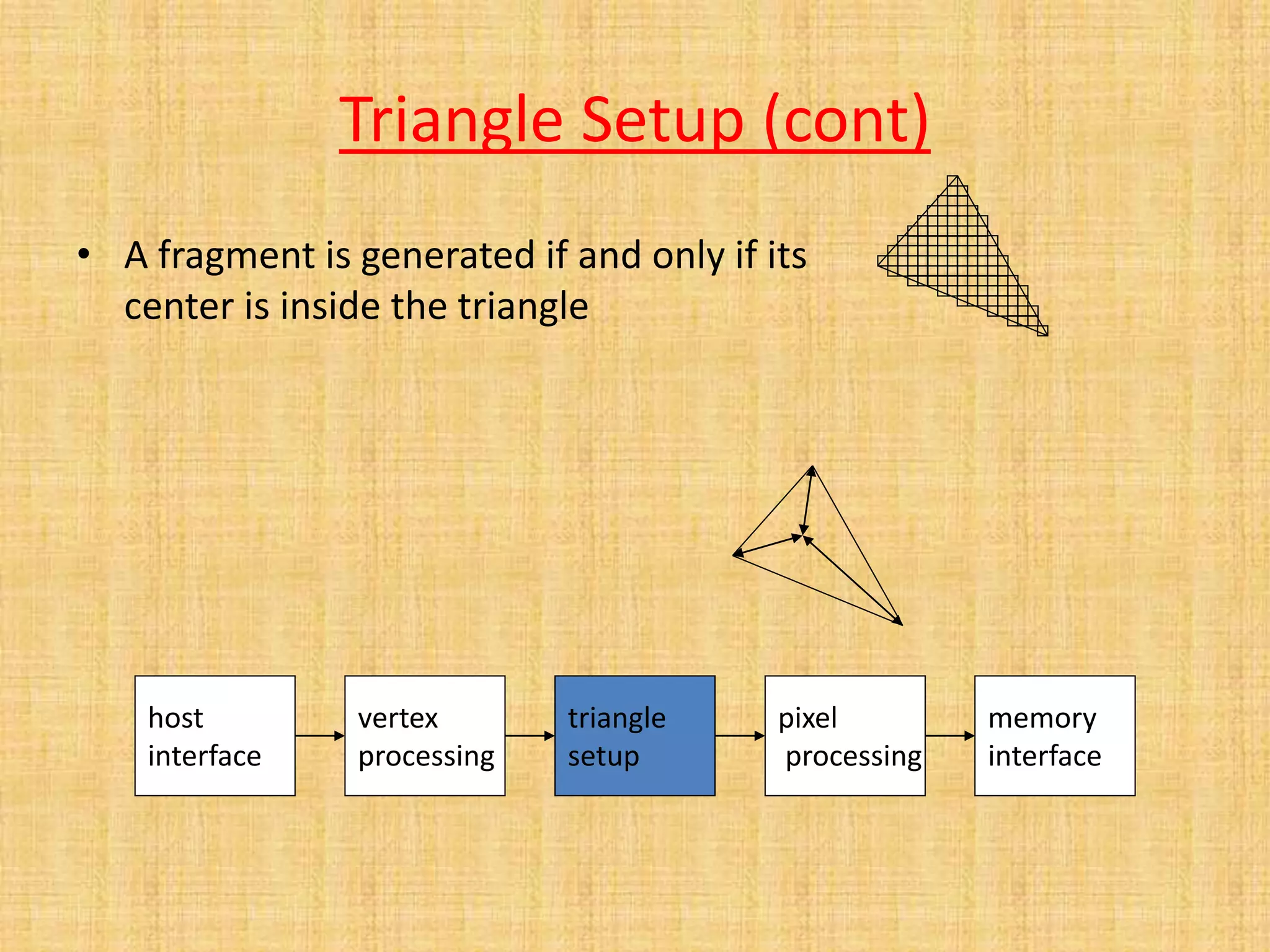
Triangle Setup (cont)
• A fragment is generated if and only if its
center is inside the triangle
host
interface
vertex
processing
triangle
setup
pixel
processing
memory
interface
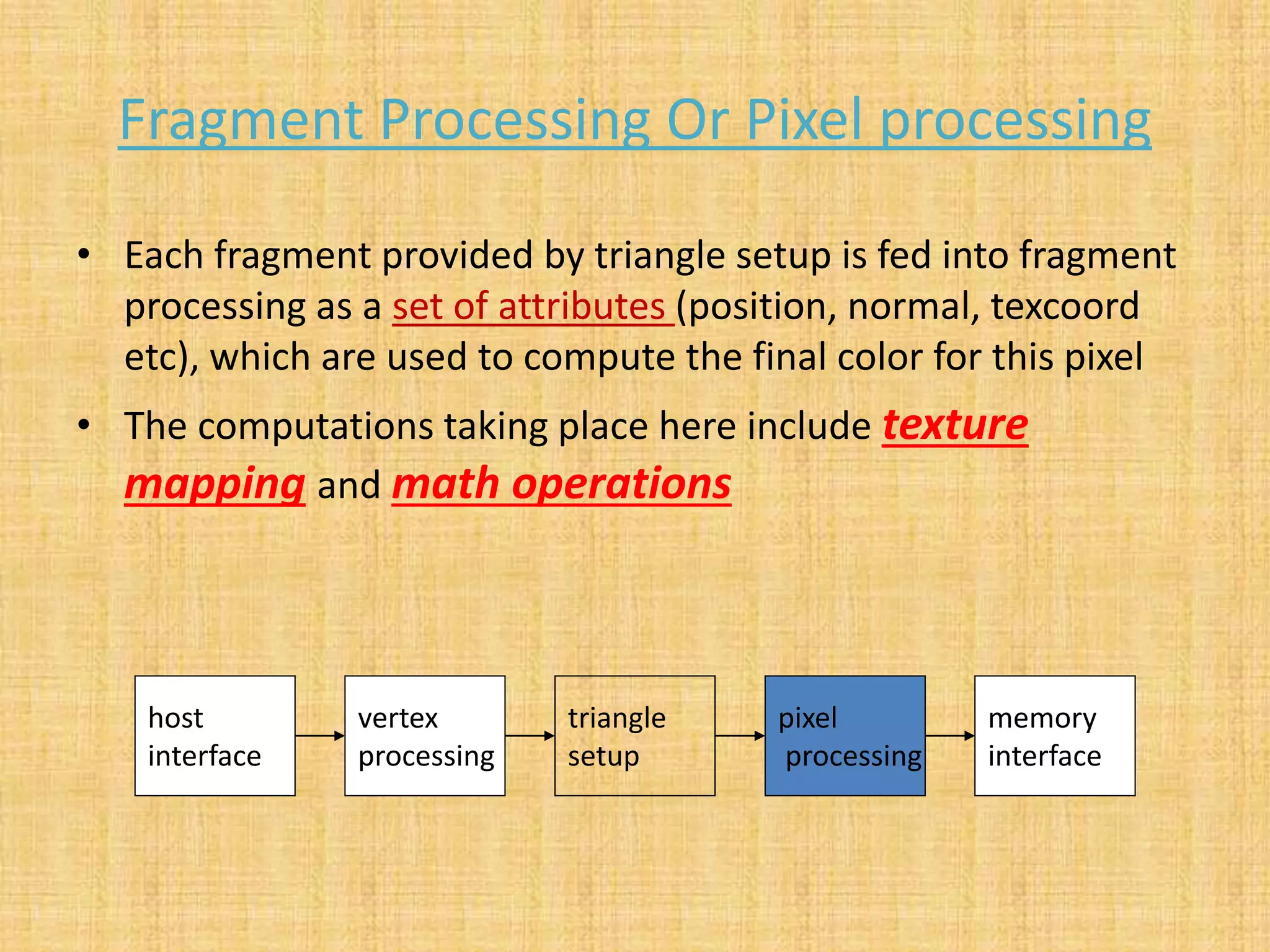
Fragment Processing Or Pixel processing
• Each fragment provided by triangle setup is fed into fragment
processing as a set of attributes (position, normal, texcoord
etc), which are used to compute the final color for this pixel
• The computations taking place here include texture
mapping and math operations
host
interface
vertex
processing
triangle
setup
pixel
processing
memory
interface
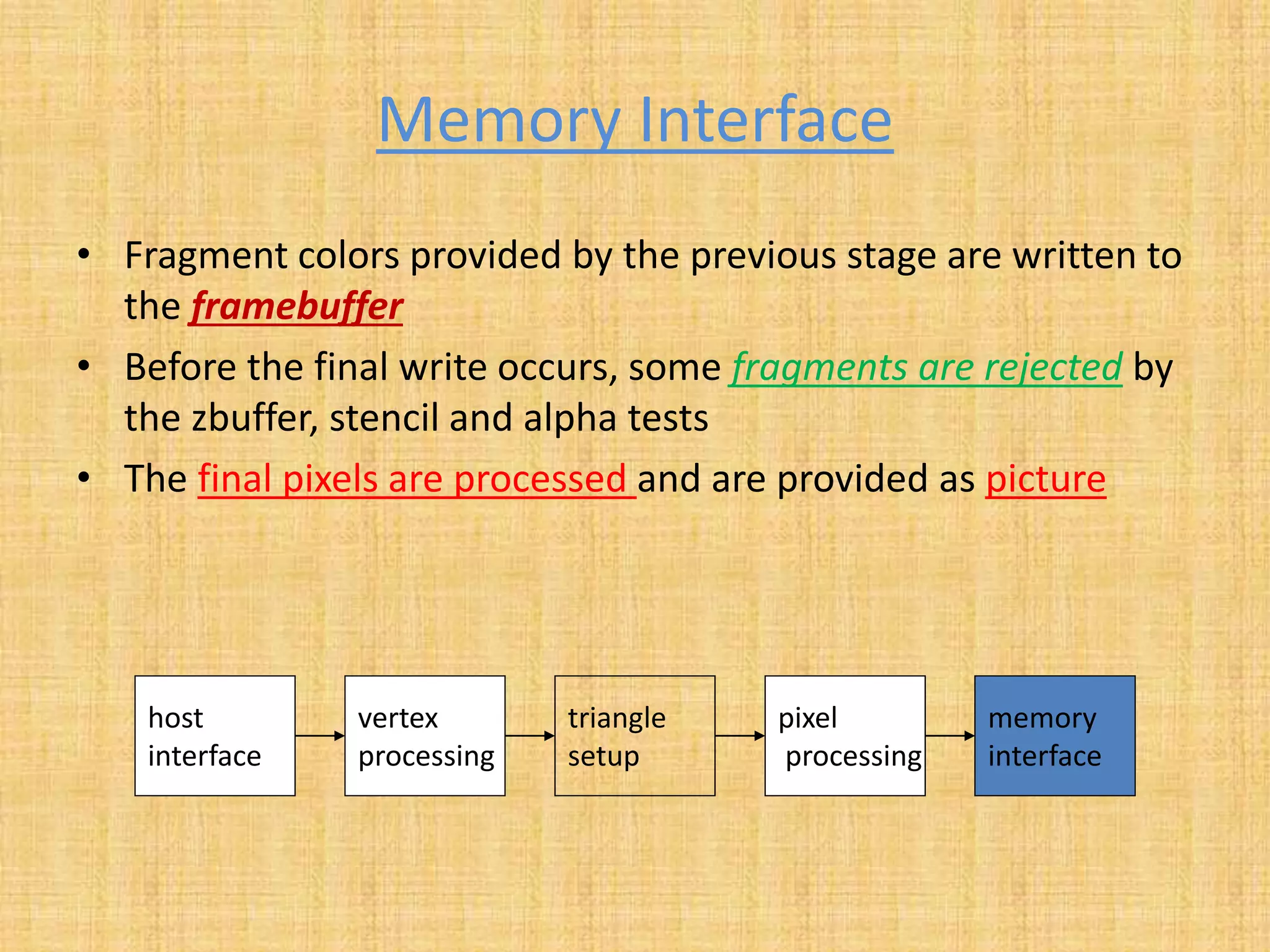
Memory Interface
• Fragment colors provided by the previous stage are written to
the framebuffer
• Before the final write occurs, some fragments are rejected by
the zbuffer, stencil and alpha tests
• The final pixels are processed and are provided as picture
host
interface
vertex
processing
triangle
setup
pixel
processing
memory
interface
Diagram of a modern GPU
64bits to
memory
64bits to
memory
64bits to
memory
64bits to
memory
Input from CPU
Host interface
Vertex processing
Triangle setup
Pixel processing
Memory Interface
GPU MANUFACTURERS:
*NVIDIA
*ATI/AMD
*INTEL
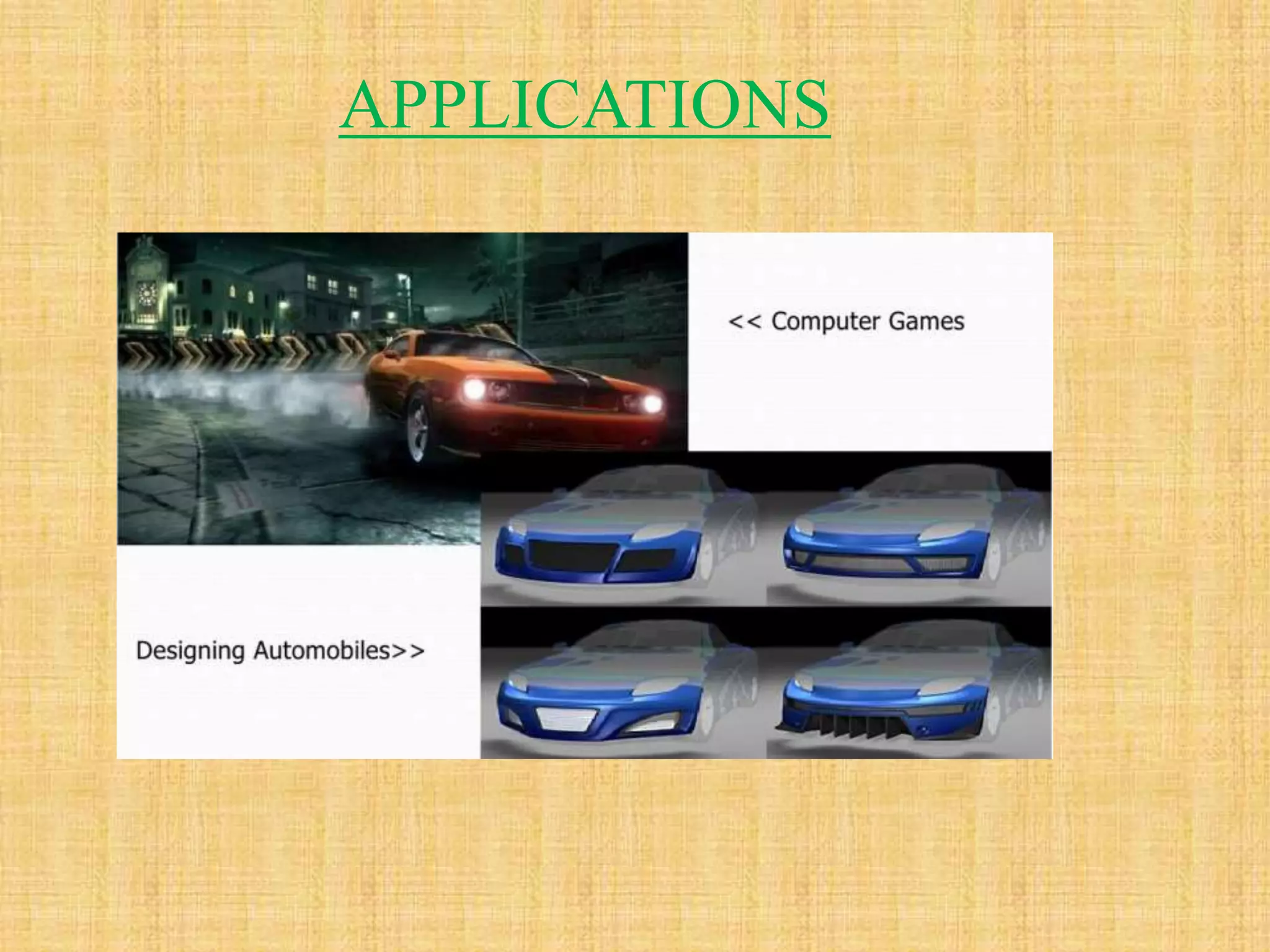
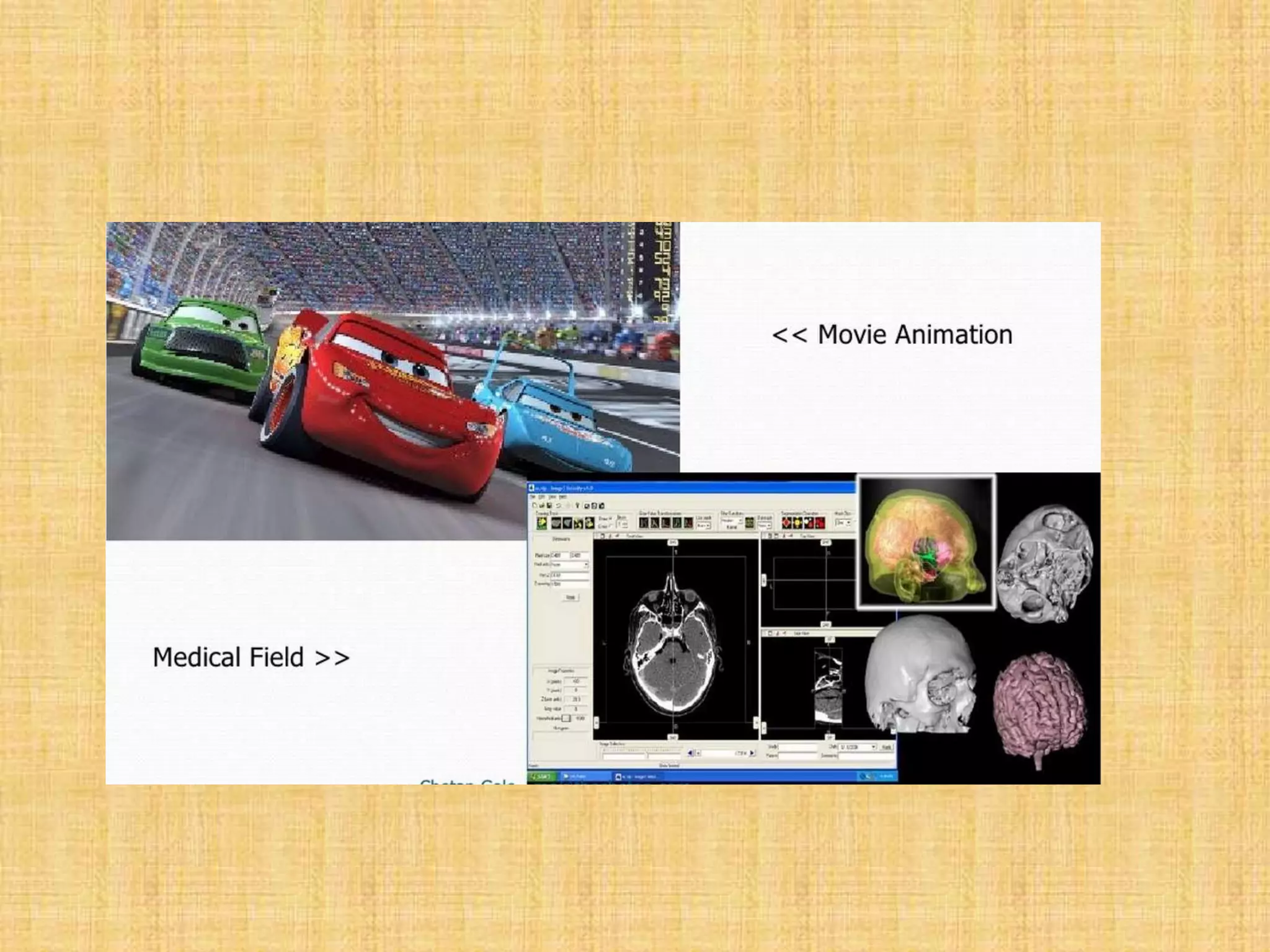
APPLICATIONS
LATEST GPU TECHNLOGY
CUDA Parallel Computing
CUDA IS NVIDIA’S PARALLEL COMPUTING ARCHITECTURE THAT
ENABLES DRAMATIC INCREASES IN COMPUTING PERFORMANCE
BY HARNESSING THE POWER OF THE GPU (GRAPHICS PROCESSING
UNIT).
PHYSX TECHNOLOGY
NVIDIA PHYSX TECHNOLOGY HELPS GAMES PLAY BETTER AND FEEL
BETTER BY MAKING INTERACTION WITH ENVIRONMENTS AND
CHARACTERS FAR MORE REALISTIC THAN EVER BEFORE. BY
MAKING BEHAVIOR MORE REALISTIC, THE GRAPHICS LOOK AND
“FEEL”BETTER
NVIDIA 3D Vision Technology
NVIDIA 3D VISION® TECHNOLOGY DELIVERS STEREOSCOPIC 3D
IMAGES FOR GAMERS, MOVIE‐LOVERS AND PHOTO ENTHUSIASTS
WHEN CONFIGURED WITH NVIDIA GPUS, NVIDIA 3D VISION
ACTIVE SHUTTER GLASSES, AND 3D VISION‐READY
DISPLAY/PROJECTOR.
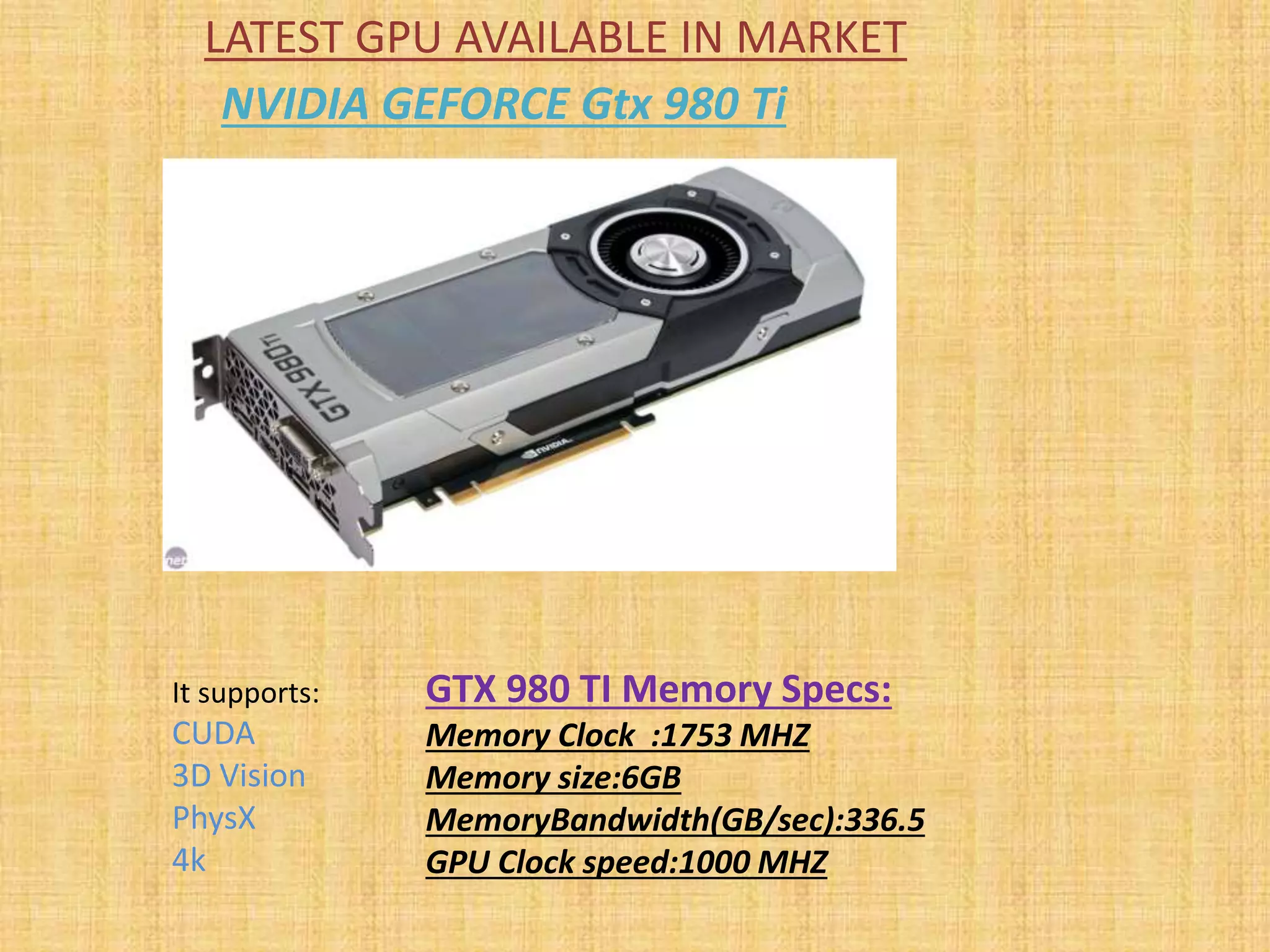
LATEST GPU AVAILABLE IN MARKET
NVIDIA GEFORCE Gtx 980 Ti
It supports:
CUDA
3D Vision
PhysX
4k
GTX 980 TI Memory Specs:
Memory Clock :1753 MHZ
Memory size:6GB
MemoryBandwidth(GB/sec):336.5
GPU Clock speed:1000 MHZ
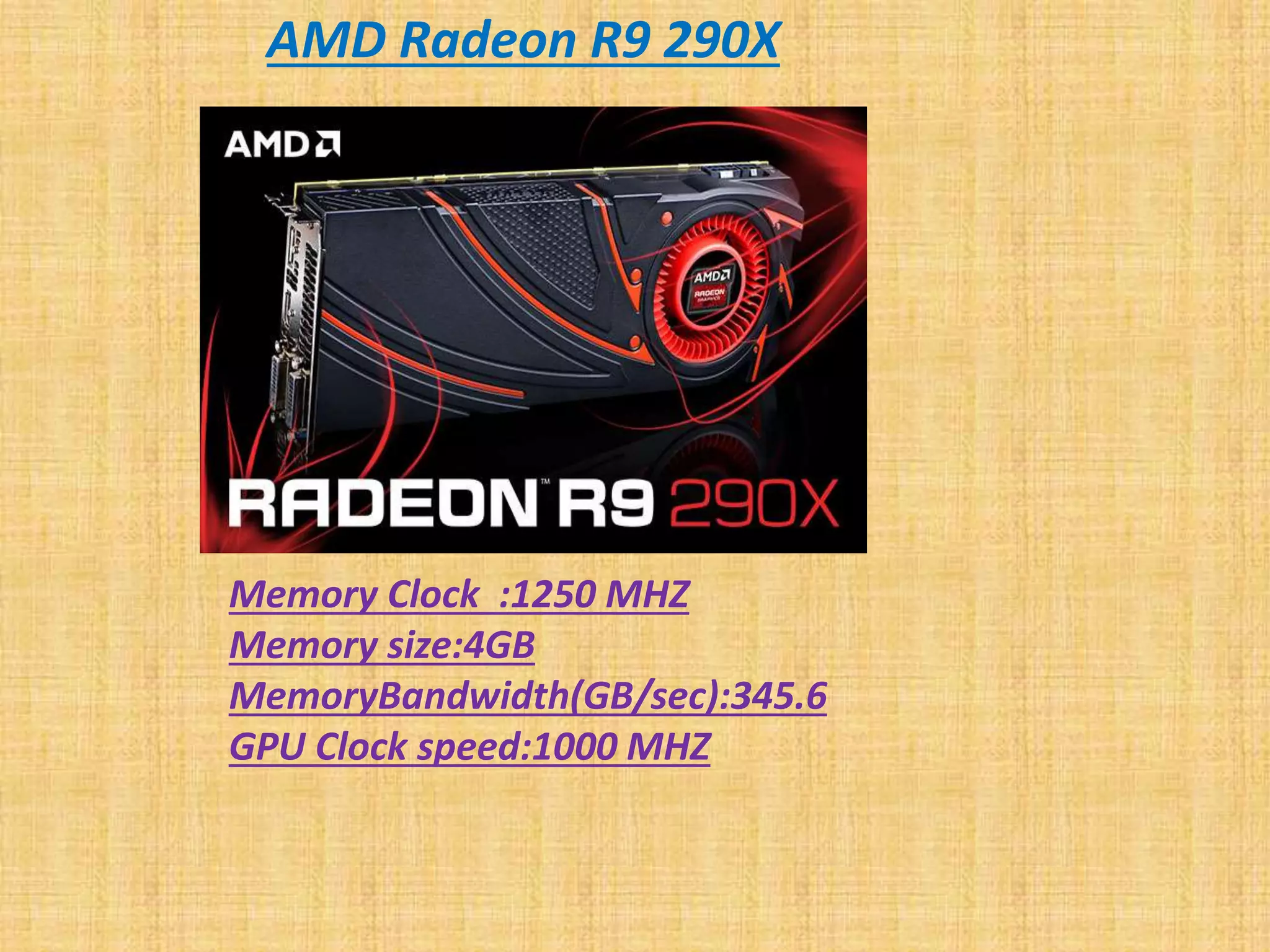
AMD Radeon R9 290X
Memory Clock :1250 MHZ
Memory size:4GB
MemoryBandwidth(GB/sec):345.6
GPU Clock speed:1000 MHZ
THANK YOU

Graphics processing unit (GPU)

  • 1.
  • 2.
    INTRODUCTION What is GPU? •It is a processor optimized for 2D/3D graphics, video, visual computing, and display. • It is highly parallel, highly multithreaded multiprocessor optimized for visual computing. • Its uses parallel archetecture.It is also called Visual processing unit • It serves as both a programmable graphics processor and a scalable parallel computing platform. • It works along with CPU
  • 3.
    CPU VERSUS GPU •A SIMPLE WAY TO UNDERSTAND THE DIFFERENCE BETWEEN A CPU ANDGPU IS TO COMPARE HOW THEY PROCESS TASKS. A CPU CONSISTS OF A FEW CORES OPTIMIZED FOR SEQUENTIAL SERIAL PROCESSING WHILE A GPU HAS A MASSIVELY PARALLEL ARCHITECTURE CONSISTS OF THOUSANDS OF SMALLER, MORE EFFICIENT CORES DESIGNED FOR HANDLING MULTIPLE TASKS SIMULTANEOUSLY • GPUS HAVE THOUSANDS OF CORES TO PROCESS PARALLEL WORKLOADS EFFICIENTLY
  • 4.
    GPU vs CPU •A GPU is tailored for highly parallel operation while a CPU executes programs serially • For this reason, GPUs have many parallel execution units and higher transistor counts, while CPUs have few execution units and higher clockspeeds • GPUs have much deeper pipelines (several thousand stages vs 10-20 for CPUs) • GPUs have significantly faster and more advanced memory interfaces as they need to shift around a lot more data than CPUs
  • 5.
  • 6.
  • 7.
    COMPONENTS OF AGPU * MOTHERBOARD * GRAPHICS PROCESSOR * MEMORY * DISPLAY CONNECTOR
  • 8.
    The images yousee on your monitor are made of tiny dots called pixels. At most common resolution settings, a screen displays over a million pixels, and the computer has to decide what to do with every one in order to create an image. To do this, it needs a translator something to take binary data from the CPU and turn it into a picture you can see. Unless a computer has graphics capability built into the motherboard, that translation takes place on the graphics card Working
  • 9.
    The CPU sendsinformation about the image to the graphics card. The graphics card decides how to use the pixels on the screen to create the image. It then sends that information to the monitor through a cable To make a 3Dimage,the graphics card first creates a wire frame out of straight lines. Then, it rasterizes the image (fills in the remaining pixels). It also adds lighting, texture and color. For fastpaced games,the computer has to go through this process about sixty times per second. Without a graphics card to perform the necessary calculations, the workload would be too much for the computer to handle. Working Continues……
  • 10.
    The graphics cardaccomplishes this task using four main components: A motherboard connection for data and power A processor to decide what to do with each pixel on the screen Memory to hold information about each pixel and to temporarily store completed pictures
  • 11.
    GRAPHICS PROCESSOR A graphicscard's processor, called a graphics processing unit (GPU), is similar to a computer's CPU. A GPU is designed specifically for performing the complex mathematical and geometric calculations that are necessary for graphics rendering. Some of the fastest GPUs have more transistors than the average CPU. A GPU produces a lot of heat, so it is usually located under a heat sink or a fan. RAM As the GPU creates images, it needs somewhere to hold information and completed pictures. It uses the card's RAM for this purpose, storing data about each pixel, its color and its location on the screen
  • 12.
    PCI Connection Graphics cardsconnect to the computer through the motherboard. The motherboard supplies power to the card and lets it communicate with the CPU. PCI Express is the newest form of connection and provides the fastest transfer rates between the graphics card and the motherboard
  • 13.
    A good overallmeasurement of a card's performance is its frame rate, measured in frames per second (FPS). The frame rate describes how many complete images the card can display per second. The human eye can process about 25 frames every second, but fast action games require a frame rate of at least 60 FPS to provide smooth animation and scrolling The graphics card's hardware directly affects its speed. These are the hardware specifications that most affect the card's speed and the units in which they are measured: GPU clock speed (MHz) Size of the memory bus (bits) Amount of available memory (MB) Memory clock rate (MHz) Specifications
  • 14.
  • 15.
    The GPU pipeline •The GPU receives geometry information(mainly triangles in 3D) from the CPU as an input and provides a picture as an output • Let’s see how that happens host interface vertex processing triangle setup pixel processing memory interface
  • 16.
    Host Interface • Thehost interface is the communication bridge between the CPU and the GPU • It receives commands from the CPU and also pulls geometry information from system memory • It outputs a stream of vertices in object space with all their associated information (normals, texture coordinates, per vertex color etc) host interface vertex processing triangle setup pixel processing memory interface
  • 17.
    Vertex Processing *A vertexprocessing is a graphics processing function that maps vertices onto the screen and adds special effects to objects in a 3D environment. • One of its purposes is to transform each vertex's 3D position in virtual space to the 2D coordinate at which it appears on the screen. • Vertex pipelines also eliminate unneeded geometry by detecting parts of the scene that are hidden by other parts and simply discarding those parts host interface vertex processing triangle setup pixel processing memory interface
  • 18.
    Triangle setup Rasterization It isthe process of determining which screenspace pixel locations are covered by each triangle. Each triangle generates a primitive called a “fragment” at each screenspace pixel location that it covers. host interface vertex processing triangle setup pixel processing memory interface
  • 19.
    Triangle Setup (cont) •A fragment is generated if and only if its center is inside the triangle host interface vertex processing triangle setup pixel processing memory interface
  • 20.
    Fragment Processing OrPixel processing • Each fragment provided by triangle setup is fed into fragment processing as a set of attributes (position, normal, texcoord etc), which are used to compute the final color for this pixel • The computations taking place here include texture mapping and math operations host interface vertex processing triangle setup pixel processing memory interface
  • 21.
    Memory Interface • Fragmentcolors provided by the previous stage are written to the framebuffer • Before the final write occurs, some fragments are rejected by the zbuffer, stencil and alpha tests • The final pixels are processed and are provided as picture host interface vertex processing triangle setup pixel processing memory interface
  • 22.
    Diagram of amodern GPU 64bits to memory 64bits to memory 64bits to memory 64bits to memory Input from CPU Host interface Vertex processing Triangle setup Pixel processing Memory Interface
  • 23.
  • 24.
  • 27.
    LATEST GPU TECHNLOGY CUDAParallel Computing CUDA IS NVIDIA’S PARALLEL COMPUTING ARCHITECTURE THAT ENABLES DRAMATIC INCREASES IN COMPUTING PERFORMANCE BY HARNESSING THE POWER OF THE GPU (GRAPHICS PROCESSING UNIT). PHYSX TECHNOLOGY NVIDIA PHYSX TECHNOLOGY HELPS GAMES PLAY BETTER AND FEEL BETTER BY MAKING INTERACTION WITH ENVIRONMENTS AND CHARACTERS FAR MORE REALISTIC THAN EVER BEFORE. BY MAKING BEHAVIOR MORE REALISTIC, THE GRAPHICS LOOK AND “FEEL”BETTER NVIDIA 3D Vision Technology NVIDIA 3D VISION® TECHNOLOGY DELIVERS STEREOSCOPIC 3D IMAGES FOR GAMERS, MOVIE‐LOVERS AND PHOTO ENTHUSIASTS WHEN CONFIGURED WITH NVIDIA GPUS, NVIDIA 3D VISION ACTIVE SHUTTER GLASSES, AND 3D VISION‐READY DISPLAY/PROJECTOR.
  • 28.
    LATEST GPU AVAILABLEIN MARKET NVIDIA GEFORCE Gtx 980 Ti It supports: CUDA 3D Vision PhysX 4k GTX 980 TI Memory Specs: Memory Clock :1753 MHZ Memory size:6GB MemoryBandwidth(GB/sec):336.5 GPU Clock speed:1000 MHZ
  • 29.
    AMD Radeon R9290X Memory Clock :1250 MHZ Memory size:4GB MemoryBandwidth(GB/sec):345.6 GPU Clock speed:1000 MHZ
  • 30.