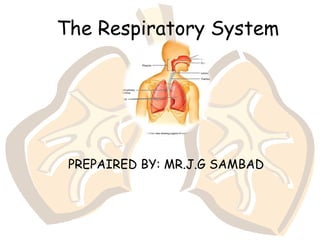
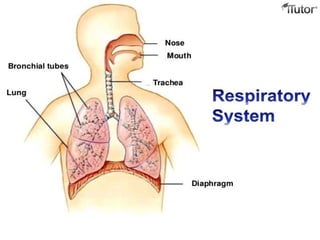
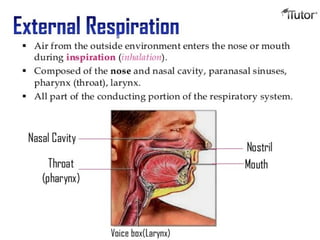
The Respiratory System
PREPAIRED BY: MR.J.G SAMBAD
Divisions of the Respiratory
System
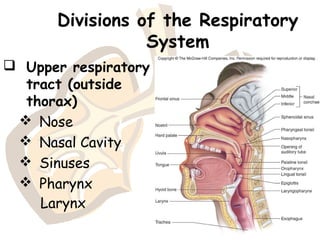
 Upper respiratory
tract (outside
thorax)
 Nose
 Nasal Cavity
 Sinuses
 Pharynx
Larynx
Divisions of the Respiratory
System
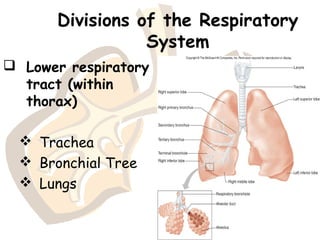
 Lower respiratory
tract (within
thorax)
 Trachea
 Bronchial Tree
 Lungs
Structures of the Upper
Respiratory Tract
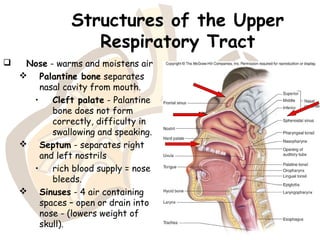
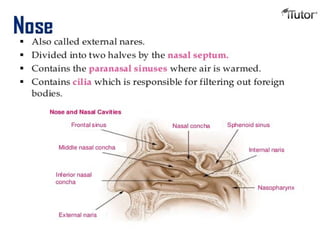
 Nose - warms and moistens air
 Palantine bone separates
nasal cavity from mouth.
• Cleft palate - Palantine
bone does not form
correctly, difficulty in
swallowing and speaking.
 Septum - separates right
and left nostrils
• rich blood supply = nose
bleeds.
 Sinuses - 4 air containing
spaces – open or drain into
nose - (lowers weight of
skull).
Structures of the Lower
Respiratory Tract
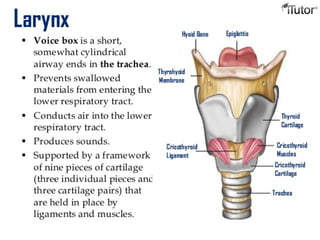
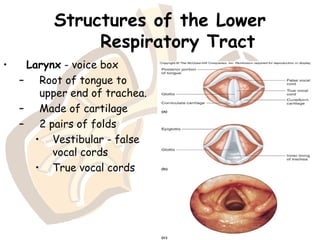
• Larynx - voice box
– Root of tongue to
upper end of trachea.
– Made of cartilage
– 2 pairs of folds
• Vestibular - false
vocal cords
• True vocal cords
Structures of the Lower
Respiratory Tract larynx
cont…
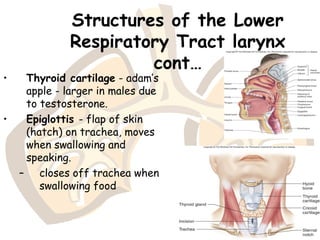
• Thyroid cartilage - adam’s
apple - larger in males due
to testosterone.
• Epiglottis - flap of skin
(hatch) on trachea, moves
when swallowing and
speaking.
– closes off trachea when
swallowing food
Structures of the Lower
Respiratory Tract
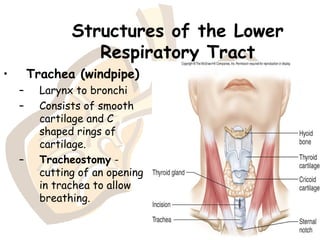
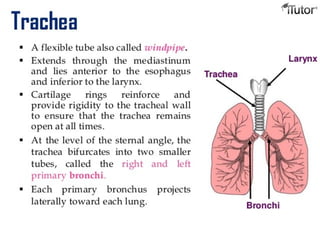
• Trachea (windpipe)
– Larynx to bronchi
– Consists of smooth
cartilage and C
shaped rings of
cartilage.
– Tracheostomy -
cutting of an opening
in trachea to allow
breathing.
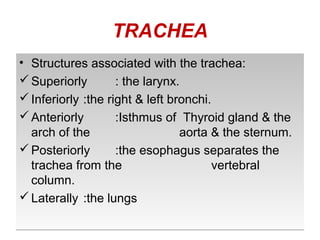
TRACHEA
• Structures associated with the trachea:
Superiorly : the larynx.
Inferiorly :the right & left bronchi.
Anteriorly :Isthmus of Thyroid gland & the
arch of the aorta & the sternum.
Posteriorly :the esophagus separates the
trachea from the vertebral
column.
Laterally :the lungs
• Structures associated with the trachea:
Superiorly : the larynx.
Inferiorly :the right & left bronchi.
Anteriorly :Isthmus of Thyroid gland & the
arch of the aorta & the sternum.
Posteriorly :the esophagus separates the
trachea from the vertebral
column.
Laterally :the lungs
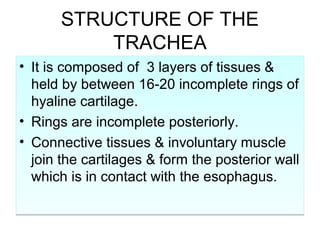
STRUCTURE OF THE
TRACHEA
• It is composed of 3 layers of tissues &
held by between 16-20 incomplete rings of
hyaline cartilage.
• Rings are incomplete posteriorly.
• Connective tissues & involuntary muscle
join the cartilages & form the posterior wall
which is in contact with the esophagus.
• It is composed of 3 layers of tissues &
held by between 16-20 incomplete rings of
hyaline cartilage.
• Rings are incomplete posteriorly.
• Connective tissues & involuntary muscle
join the cartilages & form the posterior wall
which is in contact with the esophagus.
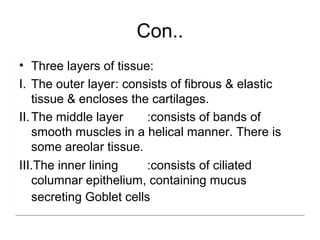
Con..
• Three layers of tissue:
I. The outer layer: consists of fibrous & elastic
tissue & encloses the cartilages.
II.The middle layer :consists of bands of
smooth muscles in a helical manner. There is
some areolar tissue.
III.The inner lining :consists of ciliated
columnar epithelium, containing mucus
secreting Goblet cells.
• Three layers of tissue:
I. The outer layer: consists of fibrous & elastic
tissue & encloses the cartilages.
II.The middle layer :consists of bands of
smooth muscles in a helical manner. There is
some areolar tissue.
III.The inner lining :consists of ciliated
columnar epithelium, containing mucus
secreting Goblet cells.
Structures of the Lower
Respiratory Tract
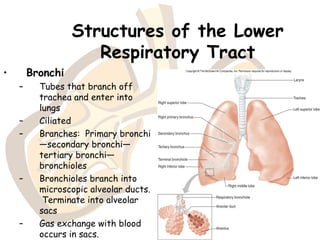
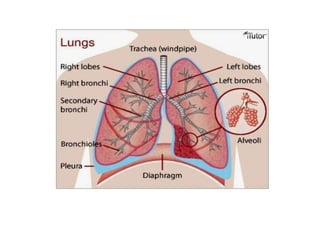
• Bronchi
– Tubes that branch off
trachea and enter into
lungs
– Ciliated
– Branches: Primary bronchi
—secondary bronchi—
tertiary bronchi—
bronchioles
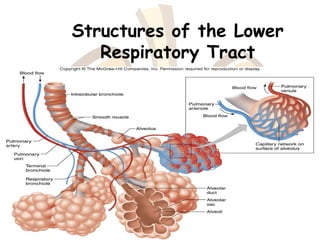
– Bronchioles branch into
microscopic alveolar ducts.
Terminate into alveolar
sacs
– Gas exchange with blood
occurs in sacs.
Structures of the Lower
Respiratory Tract
Structures of the Lower
Respiratory Tract
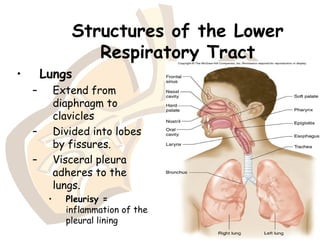
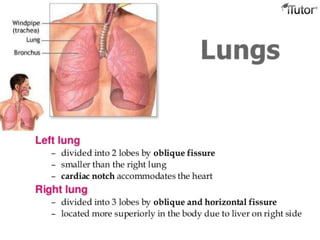
• Lungs
– Extend from
diaphragm to
clavicles
– Divided into lobes
by fissures.
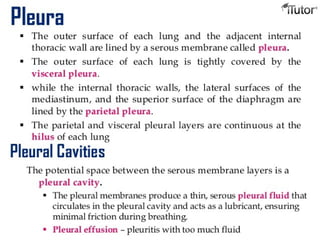
– Visceral pleura
adheres to the
lungs.
• Pleurisy =
inflammation of the
pleural lining
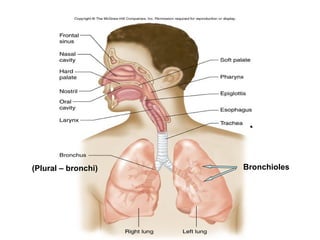
Bronchioles(Plural – bronchi)
Inside the lungs..
• Bronchi & bronchioles:
Two primary bronchi are formed when trachea
divides at the level of 5th
thoracic vertebra.
The right bronchus:
- wider, shorter & more vertical than the left one.
- Approx 2.5 cm
The left bronchus:
- About 5cm long
- Narrower.
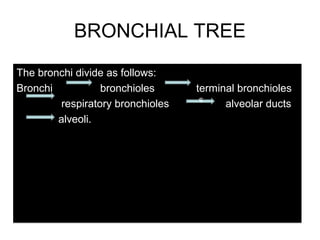
BRONCHIAL TREE
The bronchi divide as follows:
Bronchi bronchioles terminal bronchioles
respiratory bronchioles alveolar ducts
alveoli.
The bronchi divide as follows:
Bronchi bronchioles terminal bronchioles
respiratory bronchioles alveolar ducts
alveoli.
s
BLOOD SUPPLY
 The pulmonary trunk divided into the right and left pulmonary
arteries, carrying deoxygenated blood to each lung.
 Within the lungs each pulmonary artery divides into many branches,
which eventually end in dense capillary network around the alveoli.
 The walls of merge into a network of pulmonary venules.which in
turn from two pulmonary veins carrying oxygenated blood from two
pulmonary veins carrying oxygenated blood from each lung back to
the left atrium of the heart.
Respiratory Physiology
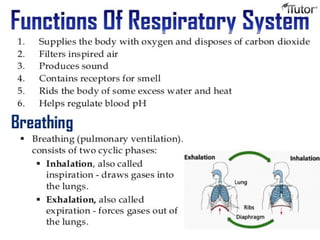
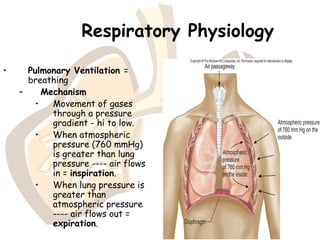
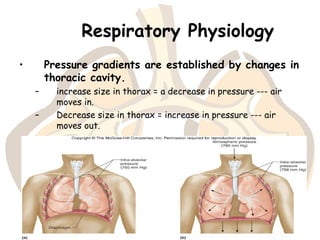
• Pulmonary Ventilation =
breathing
– Mechanism
• Movement of gases
through a pressure
gradient - hi to low.
• When atmospheric
pressure (760 mmHg)
is greater than lung
pressure ---- air flows
in = inspiration.
• When lung pressure is
greater than
atmospheric pressure
---- air flows out =
expiration.
Respiratory Physiology
• Pressure gradients are established by changes in
thoracic cavity.
– increase size in thorax = a decrease in pressure --- air
moves in.
– Decrease size in thorax = increase in pressure --- air
moves out.
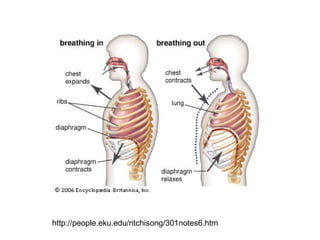
http://people.eku.edu/ritchisong/301notes6.htm
Inspiration
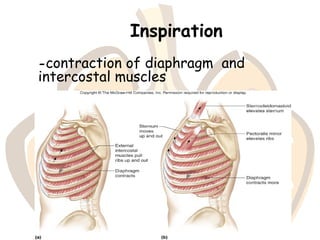
-contraction of diaphragm and
intercostal muscles
Expiration
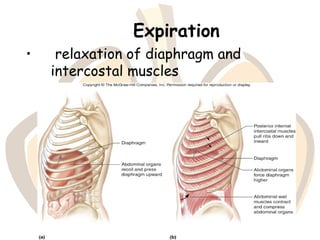
• relaxation of diaphragm and
intercostal muscles
Volumes of Air Exchange
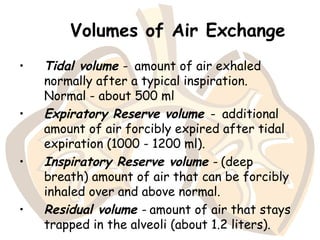
• Tidal volume - amount of air exhaled
normally after a typical inspiration.
Normal - about 500 ml
• Expiratory Reserve volume - additional
amount of air forcibly expired after tidal
expiration (1000 - 1200 ml).
• Inspiratory Reserve volume - (deep
breath) amount of air that can be forcibly
inhaled over and above normal.
• Residual volume - amount of air that stays
trapped in the alveoli (about 1.2 liters).
Volumes of Air Exchange
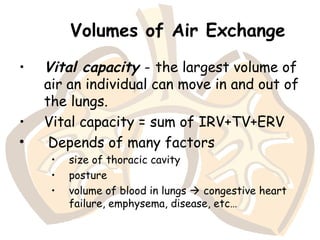
• Vital capacity - the largest volume of
air an individual can move in and out of
the lungs.
• Vital capacity = sum of IRV+TV+ERV
• Depends of many factors
• size of thoracic cavity
• posture
• volume of blood in lungs  congestive heart
failure, emphysema, disease, etc…
Volumes of Air Exchange
• Eupnea - normal quiet breathing, 12-17
breaths per minute.
• Hyperpnea - increase in breathing to meet
an increased demand by body for oxygen.
• Hyperventilation - increase in pulmonary
ventilation in excess of the need for
oxygen.
– Someone hysterical Breathe into
– exertion paper bag.
• Hypoventilation - decrease in pulmonary
ventilation.
• Apnea - temporary cessation of breathing
at the end of normal expiration.
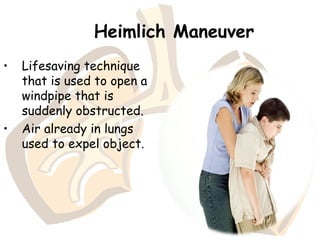
Heimlich Maneuver
• Lifesaving technique
that is used to open a
windpipe that is
suddenly obstructed.
• Air already in lungs
used to expel object.
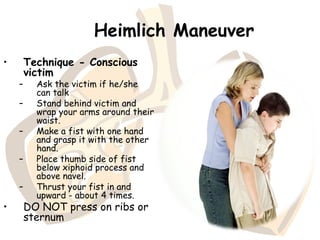
Heimlich Maneuver
• Technique - Conscious
victim
– Ask the victim if he/she
can talk
– Stand behind victim and
wrap your arms around their
waist.
– Make a fist with one hand
and grasp it with the other
hand.
– Place thumb side of fist
below xiphoid process and
above navel.
– Thrust your fist in and
upward - about 4 times.
• DO NOT press on ribs or
sternum
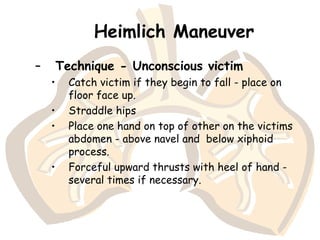
Heimlich Maneuver
– Technique - Unconscious victim
• Catch victim if they begin to fall - place on
floor face up.
• Straddle hips
• Place one hand on top of other on the victims
abdomen - above navel and below xiphoid
process.
• Forceful upward thrusts with heel of hand -
several times if necessary.
Alveoli
• Structure of alveoli
– Alveolar duct
– Alveolar sac
– Alveolus
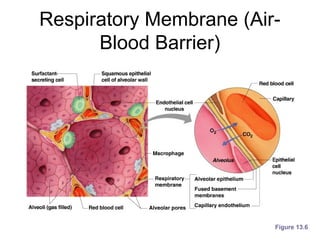
• Gas exchange takes place within the
alveoli in the respiratory membrane
• Squamous epithelial lining alveolar walls
• Covered with pulmonary capillaries on
external surfaces
Respiratory Membrane (Air-
Blood Barrier)
Figure 13.6
Gas Exchange
• Gas crosses the respiratory membrane by
diffusion
– Oxygen enters the blood
– Carbon dioxide enters the alveoli
• Macrophages add protection
• Surfactant coats gas-exposed alveolar
surfaces
Events of Respiration
• Pulmonary ventilation – moving air in and
out of the lungs
• External respiration – gas exchange
between pulmonary blood and alveoli
Events of Respiration
• Respiratory gas transport – transport of
oxygen and carbon dioxide via the
bloodstream
• Internal respiration – gas exchange
between blood and tissue cells in systemic
capillaries
Mechanics of Breathing
(Pulmonary Ventilation)
• Mechanical process
• Depends on volume changes in the
thoracic cavity
• Volume changes lead to pressure
changes, which lead to equalize pressure
of flow of gases
• 2 phases
– Inspiration – flow of air into lung
– Expiration – air leaving lung
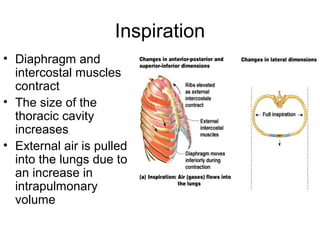
Inspiration
• Diaphragm and
intercostal muscles
contract
• The size of the
thoracic cavity
increases
• External air is pulled
into the lungs due to
an increase in
intrapulmonary
volume
Expiration
• Passive process dependent up on natural
lung elasticity
• As muscles relax, air is pushed out of the
lungs
• Forced expiration can occur mostly by
contracting internal intercostal muscles to
depress the rib cage
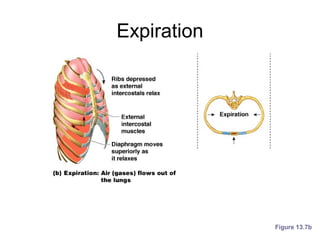
Expiration
Figure 13.7b
Pressure Differences in the
Thoracic Cavity
• Normal pressure within the pleural space
is always negative (intrapleural pressure)
• Differences in lung and pleural space
pressures keep lungs from collapsing
Nonrespiratory Air Movements
• Caused by reflexes or voluntary actions
• Examples
– Cough and sneeze – clears lungs of debris
– Laughing
– Crying
– Yawn
– Hiccup
Respiratory Sounds
• Sounds are monitored with a stethoscope
• Bronchial sounds – produced by air
rushing through trachea and bronchi
• Vesicular breathing sounds – soft sounds
of air filling alveoli
External Respiration
• Oxygen movement into the blood
– The alveoli always has more oxygen than the
blood
– Oxygen moves by diffusion towards the area
of lower concentration
– Pulmonary capillary blood gains oxygen
External Respiration
• Carbon dioxide movement out of the blood
– Blood returning from tissues has higher
concentrations of carbon dioxide than air in
the alveoli
– Pulmonary capillary blood gives up carbon
dioxide
• Blood leaving the lungs is oxygen-rich and
carbon dioxide-poor
Gas Transport in the Blood
• Oxygen transport in the blood
– Inside red blood cells attached to hemoglobin
(oxyhemoglobin [HbO2])
– A small amount is carried dissolved in the
plasma
• Carbon dioxide transport in the blood
– Most is transported in the plasma as
bicarbonate ion (HCO3–)
– A small amount is carried inside red blood
cells on hemoglobin, but at different binding
sites than those of oxygen
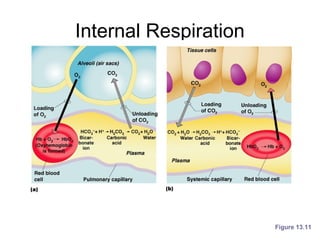
Internal Respiration
• Exchange of gases between blood and
body cells
• An opposite reaction to what occurs in the
lungs
– Carbon dioxide diffuses out of tissue to blood
– Oxygen diffuses from blood into tissue
Internal Respiration
Figure 13.11
Neural Regulation of
Respiration
• Activity of respiratory muscles is transmitted to
the brain by the phrenic and intercostal nerves
• Neural centers that control rate & depth are
located in the medulla
• The pons appears to smooth out respiratory rate
• Normal respiratory rate (eupnea) is 12–15 min.
• Hypernia is increased respiratory rate often due
to extra oxygen needs
Factors Influencing Respiratory
Rate and Depth
• Physical factors
– Increased body temperature
– Exercise
– Talking
– Coughing
• Volition (conscious control)
• Emotional factors
Factors Influencing Respiratory
Rate and Depth
• Chemical factors
– Carbon dioxide levels
• Level of carbon dioxide in the blood is the
main regulatory chemical for respiration
• Increased carbon dioxide increases
respiration
• Changes in carbon dioxide act directly on
the medulla oblongata
Factors Influencing Respiratory
Rate and Depth
• Chemical factors (continued)
– Oxygen levels
• Changes in oxygen concentration in the
blood are detected by chemoreceptors in
the aorta and carotid artery
• Information is sent to the medulla
oblongata
Respiratory Rate Changes
Throughout Life
Respiration rate:
• Newborns – 40 to 80 min.
• Infants – 30 min.
• Age 5 – 25 min.
• Adults – 12 to 18 min
• Rate often increases with old age
The Respiratory system

The Respiratory system

  • 1.
  • 6.
    Divisions of theRespiratory System  Upper respiratory tract (outside thorax)  Nose  Nasal Cavity  Sinuses  Pharynx Larynx
  • 7.
    Divisions of theRespiratory System  Lower respiratory tract (within thorax)  Trachea  Bronchial Tree  Lungs
  • 8.
    Structures of theUpper Respiratory Tract  Nose - warms and moistens air  Palantine bone separates nasal cavity from mouth. • Cleft palate - Palantine bone does not form correctly, difficulty in swallowing and speaking.  Septum - separates right and left nostrils • rich blood supply = nose bleeds.  Sinuses - 4 air containing spaces – open or drain into nose - (lowers weight of skull).
  • 14.
    Structures of theLower Respiratory Tract • Larynx - voice box – Root of tongue to upper end of trachea. – Made of cartilage – 2 pairs of folds • Vestibular - false vocal cords • True vocal cords
  • 15.
    Structures of theLower Respiratory Tract larynx cont… • Thyroid cartilage - adam’s apple - larger in males due to testosterone. • Epiglottis - flap of skin (hatch) on trachea, moves when swallowing and speaking. – closes off trachea when swallowing food
  • 16.
    Structures of theLower Respiratory Tract • Trachea (windpipe) – Larynx to bronchi – Consists of smooth cartilage and C shaped rings of cartilage. – Tracheostomy - cutting of an opening in trachea to allow breathing.
  • 18.
    TRACHEA • Structures associatedwith the trachea: Superiorly : the larynx. Inferiorly :the right & left bronchi. Anteriorly :Isthmus of Thyroid gland & the arch of the aorta & the sternum. Posteriorly :the esophagus separates the trachea from the vertebral column. Laterally :the lungs • Structures associated with the trachea: Superiorly : the larynx. Inferiorly :the right & left bronchi. Anteriorly :Isthmus of Thyroid gland & the arch of the aorta & the sternum. Posteriorly :the esophagus separates the trachea from the vertebral column. Laterally :the lungs
  • 19.
    STRUCTURE OF THE TRACHEA •It is composed of 3 layers of tissues & held by between 16-20 incomplete rings of hyaline cartilage. • Rings are incomplete posteriorly. • Connective tissues & involuntary muscle join the cartilages & form the posterior wall which is in contact with the esophagus. • It is composed of 3 layers of tissues & held by between 16-20 incomplete rings of hyaline cartilage. • Rings are incomplete posteriorly. • Connective tissues & involuntary muscle join the cartilages & form the posterior wall which is in contact with the esophagus.
  • 20.
    Con.. • Three layersof tissue: I. The outer layer: consists of fibrous & elastic tissue & encloses the cartilages. II.The middle layer :consists of bands of smooth muscles in a helical manner. There is some areolar tissue. III.The inner lining :consists of ciliated columnar epithelium, containing mucus secreting Goblet cells. • Three layers of tissue: I. The outer layer: consists of fibrous & elastic tissue & encloses the cartilages. II.The middle layer :consists of bands of smooth muscles in a helical manner. There is some areolar tissue. III.The inner lining :consists of ciliated columnar epithelium, containing mucus secreting Goblet cells.
  • 21.
    Structures of theLower Respiratory Tract • Bronchi – Tubes that branch off trachea and enter into lungs – Ciliated – Branches: Primary bronchi —secondary bronchi— tertiary bronchi— bronchioles – Bronchioles branch into microscopic alveolar ducts. Terminate into alveolar sacs – Gas exchange with blood occurs in sacs.
  • 22.
    Structures of theLower Respiratory Tract
  • 23.
    Structures of theLower Respiratory Tract • Lungs – Extend from diaphragm to clavicles – Divided into lobes by fissures. – Visceral pleura adheres to the lungs. • Pleurisy = inflammation of the pleural lining
  • 26.
  • 29.
    Inside the lungs.. •Bronchi & bronchioles: Two primary bronchi are formed when trachea divides at the level of 5th thoracic vertebra. The right bronchus: - wider, shorter & more vertical than the left one. - Approx 2.5 cm The left bronchus: - About 5cm long - Narrower.
  • 30.
    BRONCHIAL TREE The bronchidivide as follows: Bronchi bronchioles terminal bronchioles respiratory bronchioles alveolar ducts alveoli. The bronchi divide as follows: Bronchi bronchioles terminal bronchioles respiratory bronchioles alveolar ducts alveoli. s
  • 32.
    BLOOD SUPPLY  Thepulmonary trunk divided into the right and left pulmonary arteries, carrying deoxygenated blood to each lung.  Within the lungs each pulmonary artery divides into many branches, which eventually end in dense capillary network around the alveoli.  The walls of merge into a network of pulmonary venules.which in turn from two pulmonary veins carrying oxygenated blood from two pulmonary veins carrying oxygenated blood from each lung back to the left atrium of the heart.
  • 33.
    Respiratory Physiology • PulmonaryVentilation = breathing – Mechanism • Movement of gases through a pressure gradient - hi to low. • When atmospheric pressure (760 mmHg) is greater than lung pressure ---- air flows in = inspiration. • When lung pressure is greater than atmospheric pressure ---- air flows out = expiration.
  • 34.
    Respiratory Physiology • Pressuregradients are established by changes in thoracic cavity. – increase size in thorax = a decrease in pressure --- air moves in. – Decrease size in thorax = increase in pressure --- air moves out.
  • 35.
  • 36.
  • 37.
    Expiration • relaxation ofdiaphragm and intercostal muscles
  • 38.
    Volumes of AirExchange • Tidal volume - amount of air exhaled normally after a typical inspiration. Normal - about 500 ml • Expiratory Reserve volume - additional amount of air forcibly expired after tidal expiration (1000 - 1200 ml). • Inspiratory Reserve volume - (deep breath) amount of air that can be forcibly inhaled over and above normal. • Residual volume - amount of air that stays trapped in the alveoli (about 1.2 liters).
  • 39.
    Volumes of AirExchange • Vital capacity - the largest volume of air an individual can move in and out of the lungs. • Vital capacity = sum of IRV+TV+ERV • Depends of many factors • size of thoracic cavity • posture • volume of blood in lungs  congestive heart failure, emphysema, disease, etc…
  • 40.
    Volumes of AirExchange • Eupnea - normal quiet breathing, 12-17 breaths per minute. • Hyperpnea - increase in breathing to meet an increased demand by body for oxygen. • Hyperventilation - increase in pulmonary ventilation in excess of the need for oxygen. – Someone hysterical Breathe into – exertion paper bag. • Hypoventilation - decrease in pulmonary ventilation. • Apnea - temporary cessation of breathing at the end of normal expiration.
  • 41.
    Heimlich Maneuver • Lifesavingtechnique that is used to open a windpipe that is suddenly obstructed. • Air already in lungs used to expel object.
  • 42.
    Heimlich Maneuver • Technique- Conscious victim – Ask the victim if he/she can talk – Stand behind victim and wrap your arms around their waist. – Make a fist with one hand and grasp it with the other hand. – Place thumb side of fist below xiphoid process and above navel. – Thrust your fist in and upward - about 4 times. • DO NOT press on ribs or sternum
  • 43.
    Heimlich Maneuver – Technique- Unconscious victim • Catch victim if they begin to fall - place on floor face up. • Straddle hips • Place one hand on top of other on the victims abdomen - above navel and below xiphoid process. • Forceful upward thrusts with heel of hand - several times if necessary.
  • 44.
    Alveoli • Structure ofalveoli – Alveolar duct – Alveolar sac – Alveolus • Gas exchange takes place within the alveoli in the respiratory membrane • Squamous epithelial lining alveolar walls • Covered with pulmonary capillaries on external surfaces
  • 45.
  • 46.
    Gas Exchange • Gascrosses the respiratory membrane by diffusion – Oxygen enters the blood – Carbon dioxide enters the alveoli • Macrophages add protection • Surfactant coats gas-exposed alveolar surfaces
  • 47.
    Events of Respiration •Pulmonary ventilation – moving air in and out of the lungs • External respiration – gas exchange between pulmonary blood and alveoli
  • 48.
    Events of Respiration •Respiratory gas transport – transport of oxygen and carbon dioxide via the bloodstream • Internal respiration – gas exchange between blood and tissue cells in systemic capillaries
  • 49.
    Mechanics of Breathing (PulmonaryVentilation) • Mechanical process • Depends on volume changes in the thoracic cavity • Volume changes lead to pressure changes, which lead to equalize pressure of flow of gases • 2 phases – Inspiration – flow of air into lung – Expiration – air leaving lung
  • 50.
    Inspiration • Diaphragm and intercostalmuscles contract • The size of the thoracic cavity increases • External air is pulled into the lungs due to an increase in intrapulmonary volume
  • 51.
    Expiration • Passive processdependent up on natural lung elasticity • As muscles relax, air is pushed out of the lungs • Forced expiration can occur mostly by contracting internal intercostal muscles to depress the rib cage
  • 52.
  • 53.
    Pressure Differences inthe Thoracic Cavity • Normal pressure within the pleural space is always negative (intrapleural pressure) • Differences in lung and pleural space pressures keep lungs from collapsing
  • 54.
    Nonrespiratory Air Movements •Caused by reflexes or voluntary actions • Examples – Cough and sneeze – clears lungs of debris – Laughing – Crying – Yawn – Hiccup
  • 55.
    Respiratory Sounds • Soundsare monitored with a stethoscope • Bronchial sounds – produced by air rushing through trachea and bronchi • Vesicular breathing sounds – soft sounds of air filling alveoli
  • 56.
    External Respiration • Oxygenmovement into the blood – The alveoli always has more oxygen than the blood – Oxygen moves by diffusion towards the area of lower concentration – Pulmonary capillary blood gains oxygen
  • 57.
    External Respiration • Carbondioxide movement out of the blood – Blood returning from tissues has higher concentrations of carbon dioxide than air in the alveoli – Pulmonary capillary blood gives up carbon dioxide • Blood leaving the lungs is oxygen-rich and carbon dioxide-poor
  • 58.
    Gas Transport inthe Blood • Oxygen transport in the blood – Inside red blood cells attached to hemoglobin (oxyhemoglobin [HbO2]) – A small amount is carried dissolved in the plasma • Carbon dioxide transport in the blood – Most is transported in the plasma as bicarbonate ion (HCO3–) – A small amount is carried inside red blood cells on hemoglobin, but at different binding sites than those of oxygen
  • 59.
    Internal Respiration • Exchangeof gases between blood and body cells • An opposite reaction to what occurs in the lungs – Carbon dioxide diffuses out of tissue to blood – Oxygen diffuses from blood into tissue
  • 60.
  • 61.
    Neural Regulation of Respiration •Activity of respiratory muscles is transmitted to the brain by the phrenic and intercostal nerves • Neural centers that control rate & depth are located in the medulla • The pons appears to smooth out respiratory rate • Normal respiratory rate (eupnea) is 12–15 min. • Hypernia is increased respiratory rate often due to extra oxygen needs
  • 62.
    Factors Influencing Respiratory Rateand Depth • Physical factors – Increased body temperature – Exercise – Talking – Coughing • Volition (conscious control) • Emotional factors
  • 63.
    Factors Influencing Respiratory Rateand Depth • Chemical factors – Carbon dioxide levels • Level of carbon dioxide in the blood is the main regulatory chemical for respiration • Increased carbon dioxide increases respiration • Changes in carbon dioxide act directly on the medulla oblongata
  • 64.
    Factors Influencing Respiratory Rateand Depth • Chemical factors (continued) – Oxygen levels • Changes in oxygen concentration in the blood are detected by chemoreceptors in the aorta and carotid artery • Information is sent to the medulla oblongata
  • 65.
    Respiratory Rate Changes ThroughoutLife Respiration rate: • Newborns – 40 to 80 min. • Infants – 30 min. • Age 5 – 25 min. • Adults – 12 to 18 min • Rate often increases with old age