P3 outline the gross structure of
all the main body systems
Structure and Function of the
Major Body Systems.
You have been employed by a
local hospital to help develop
resources for a group of trainee
nurses. You are required to
produce a detailed booklet
outlining the structure and
function of the major body
systems.
The booklet should cover the
following areas;
• Respiratory system
• Cardiovascular system
• Digestive system
• Renal system
• Nervous system
• Endocrine system
• Musculo-skeletal system
• Immune system
• Reproductive system (male
and female)
• Lymphatic system.
Human Gas Exchange System
• Describe the structure and
function of the human gas
exchange system
• Investigate the structure of the
walls of the:
– Trachea
– Bronchioles
– Alveoli
• Explain how, at cellular level, each
structure is adapted to its
function
The Lungs
• Gas exchange occurs within the lungs.
• Connected to the outside air with a set of
tubes.
• The trachea starts at the back of the moth
and branches to form 2 bronchi.
• One bronchus goes into each lung.
• Each bronchus branches many times getting
smaller and smaller form tubes called
bronchioles.
• All of these tubes have cartilage rings for
support, except the microscopic ones.
• At the end of the bronchioles are the
alveoli.
• Each alveolus is folded top for a set of
interconnected spaces.
• There are many alveoli, providing a very
large surface area for gas exchange.
• The alveoli are surrounded by blood
capillaries transporting blood to and from
the lungs
• Describe the structure and function
of the human gas exchange system
• Investigate the structure of the walls
of the:
– Trachea
– Bronchioles
– Alveoli
• Explain how, at cellular level, each
structure is adapted to its function
• Describe the structure and function of the human gas exchange system
• Investigate the structure of the walls of the:
– Trachea
– Bronchioles
– Alveoli
• Explain how, at cellular level, each structure is adapted to its function
Structure Function and Adaptation
Trachea
Bronchioles
Alveoli
For each structure of the breathing
system, describe what it does and how it is
adapted to perform it’s function
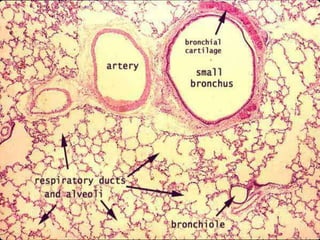
BronchioleTrachea
• Cartilage – airways open / air resistance low
• Trachea – ‘C’ shaped
• Bronchi – blocks
• Bronchioles smooth muscle
• Warming / moistening
• Hairs – traps large particles
• Trachea / Bronchi – goblet cells trap small particles (very few in bronchiole)
• Ciliated cells – beat to remove trapped mucus into the throat
• Macrophages – Bacterial scavengers
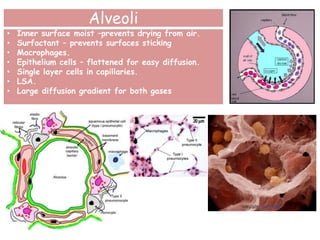
• Inner surface moist –prevents drying from air.
• Surfactant – prevents surfaces sticking
• Macrophages.
• Epithelium cells – flattened for easy diffusion.
• Single layer cells in capillaries.
• LSA.
• Large diffusion gradient for both gases
Alveoli
Investigating at Cellular Level
Lung Structure – Cellular Level
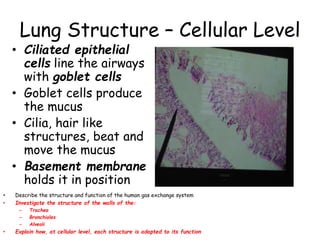
• Ciliated epithelial
cells line the airways
with goblet cells
• Goblet cells produce
the mucus
• Cilia, hair like
structures, beat and
move the mucus
• Basement membrane
holds it in position
• Describe the structure and function of the human gas exchange system
• Investigate the structure of the walls of the:
– Trachea
– Bronchioles
– Alveoli
• Explain how, at cellular level, each structure is adapted to its function
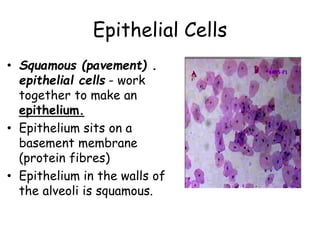
Epithelial Cells
• Squamous (pavement) .
epithelial cells - work
together to make an
epithelium.
• Epithelium sits on a
basement membrane
(protein fibres)
• Epithelium in the walls of
the alveoli is squamous.
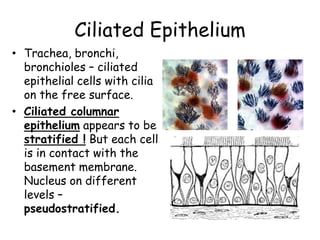
Ciliated Epithelium
• Trachea, bronchi,
bronchioles – ciliated
epithelial cells with cilia
on the free surface.
• Ciliated columnar
epithelium appears to be
stratified ! But each cell
is in contact with the
basement membrane.
Nucleus on different
levels –
pseudostratified.
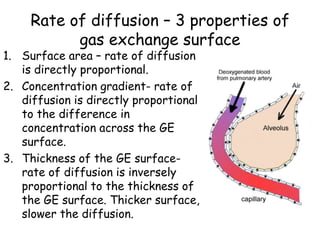
Rate of diffusion – 3 properties of
gas exchange surface
1. Surface area – rate of diffusion
is directly proportional.
2. Concentration gradient- rate of
diffusion is directly proportional
to the difference in
concentration across the GE
surface.
3. Thickness of the GE surface-
rate of diffusion is inversely
proportional to the thickness of
the GE surface. Thicker surface,
slower the diffusion.

Lung structure function_and_cellular_function

  • 1.
    P3 outline thegross structure of all the main body systems Structure and Function of the Major Body Systems. You have been employed by a local hospital to help develop resources for a group of trainee nurses. You are required to produce a detailed booklet outlining the structure and function of the major body systems. The booklet should cover the following areas; • Respiratory system • Cardiovascular system • Digestive system • Renal system • Nervous system • Endocrine system • Musculo-skeletal system • Immune system • Reproductive system (male and female) • Lymphatic system.
  • 2.
    Human Gas ExchangeSystem • Describe the structure and function of the human gas exchange system • Investigate the structure of the walls of the: – Trachea – Bronchioles – Alveoli • Explain how, at cellular level, each structure is adapted to its function
  • 3.
    The Lungs • Gasexchange occurs within the lungs. • Connected to the outside air with a set of tubes. • The trachea starts at the back of the moth and branches to form 2 bronchi. • One bronchus goes into each lung. • Each bronchus branches many times getting smaller and smaller form tubes called bronchioles. • All of these tubes have cartilage rings for support, except the microscopic ones. • At the end of the bronchioles are the alveoli. • Each alveolus is folded top for a set of interconnected spaces. • There are many alveoli, providing a very large surface area for gas exchange. • The alveoli are surrounded by blood capillaries transporting blood to and from the lungs • Describe the structure and function of the human gas exchange system • Investigate the structure of the walls of the: – Trachea – Bronchioles – Alveoli • Explain how, at cellular level, each structure is adapted to its function
  • 4.
    • Describe thestructure and function of the human gas exchange system • Investigate the structure of the walls of the: – Trachea – Bronchioles – Alveoli • Explain how, at cellular level, each structure is adapted to its function Structure Function and Adaptation Trachea Bronchioles Alveoli For each structure of the breathing system, describe what it does and how it is adapted to perform it’s function
  • 5.
    BronchioleTrachea • Cartilage –airways open / air resistance low • Trachea – ‘C’ shaped • Bronchi – blocks • Bronchioles smooth muscle • Warming / moistening • Hairs – traps large particles • Trachea / Bronchi – goblet cells trap small particles (very few in bronchiole) • Ciliated cells – beat to remove trapped mucus into the throat • Macrophages – Bacterial scavengers
  • 8.
    • Inner surfacemoist –prevents drying from air. • Surfactant – prevents surfaces sticking • Macrophages. • Epithelium cells – flattened for easy diffusion. • Single layer cells in capillaries. • LSA. • Large diffusion gradient for both gases Alveoli
  • 9.
  • 10.
    Lung Structure –Cellular Level • Ciliated epithelial cells line the airways with goblet cells • Goblet cells produce the mucus • Cilia, hair like structures, beat and move the mucus • Basement membrane holds it in position • Describe the structure and function of the human gas exchange system • Investigate the structure of the walls of the: – Trachea – Bronchioles – Alveoli • Explain how, at cellular level, each structure is adapted to its function
  • 11.
    Epithelial Cells • Squamous(pavement) . epithelial cells - work together to make an epithelium. • Epithelium sits on a basement membrane (protein fibres) • Epithelium in the walls of the alveoli is squamous.
  • 12.
    Ciliated Epithelium • Trachea,bronchi, bronchioles – ciliated epithelial cells with cilia on the free surface. • Ciliated columnar epithelium appears to be stratified ! But each cell is in contact with the basement membrane. Nucleus on different levels – pseudostratified.
  • 14.
    Rate of diffusion– 3 properties of gas exchange surface 1. Surface area – rate of diffusion is directly proportional. 2. Concentration gradient- rate of diffusion is directly proportional to the difference in concentration across the GE surface. 3. Thickness of the GE surface- rate of diffusion is inversely proportional to the thickness of the GE surface. Thicker surface, slower the diffusion.