LEARNING OUTCOME
At theend of the lesson, students must be able to :
1.Understand the structure of the human respiratory system.
2.Explain process of the breathing
3.State the component of the respiratory system.
4.State the function of the respiratory system.
4.
WHAT IS RESPIRATION?
Respirationis the process by which cells produce energy.
There are two main types :
aerobic respiration
anaerobic respiration
THE RESPIRATORY SYSTEM
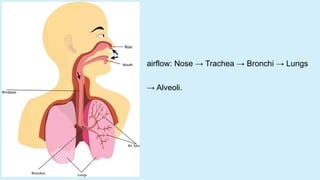
Therespiratory system is responsible for taking in oxygen from the air and
removing carbon dioxide from the body. The main organs involved in the
respiratory system are:
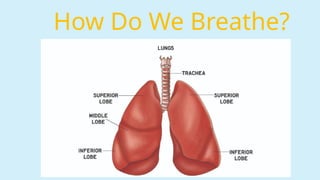
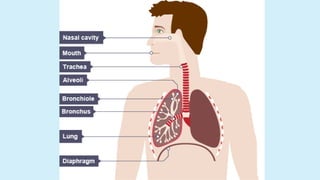
1. Nose/Mouth: Air enters and is filtered, moistened, and warmed.
2. Trachea (windpipe): A tube that carries air to the lungs.
3. Bronchi: Two branches leading to each lung.
4. Lungs: Main organs where gas exchange happens.
5. Alveoli: Tiny air sacs in the lungs where oxygen is absorbed into the blood, and
carbon dioxide is removed.
6. Diaphragm: A muscle that helps the lungs expand and contract for breathing.
8.
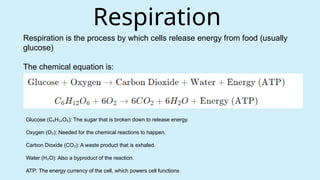
Respiration is theprocess by which cells release energy from food (usually
glucose)
The chemical equation is:
Respiration
Glucose (C H O ): The sugar that is broken down to release energy.
₆ ₁₂ ₆
Oxygen (O ): Needed for the chemical reactions to happen.
₂
Carbon Dioxide (CO ): A waste product that is exhaled.
₂
Water (H O): Also a byproduct of the reaction.
₂
ATP: The energy currency of the cell, which powers cell functions
9.
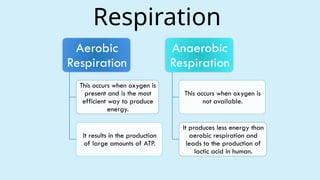
Respiration
Aerobic
Respiration
This occurs whenoxygen is
present and is the most
efficient way to produce
energy.
It results in the production
of large amounts of ATP.
Anaerobic
Respiration
This occurs when oxygen is
not available.
It produces less energy than
aerobic respiration and
leads to the production of
lactic acid in human.
10.
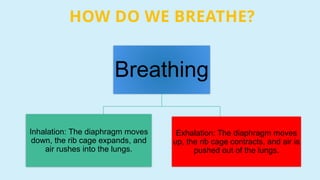
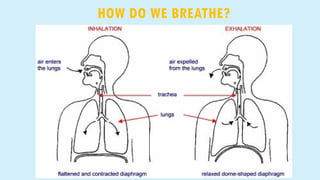
HOW DO WEBREATHE?
Breathing
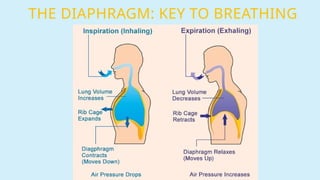
Inhalation: The diaphragm moves
down, the rib cage expands, and
air rushes into the lungs.
Exhalation: The diaphragm moves
up, the rib cage contracts, and air is
pushed out of the lungs.
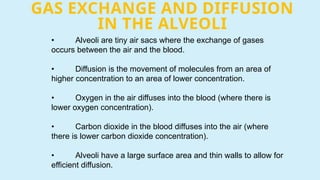
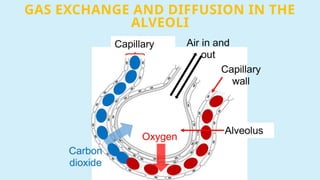
GAS EXCHANGE ANDDIFFUSION
IN THE ALVEOLI
• Alveoli are tiny air sacs where the exchange of gases
occurs between the air and the blood.
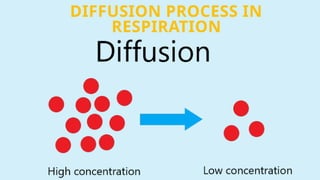
• Diffusion is the movement of molecules from an area of
higher concentration to an area of lower concentration.
• Oxygen in the air diffuses into the blood (where there is
lower oxygen concentration).
• Carbon dioxide in the blood diffuses into the air (where
there is lower carbon dioxide concentration).
• Alveoli have a large surface area and thin walls to allow for
efficient diffusion.
DIFFUSION PROCESS IN
RESPIRATION
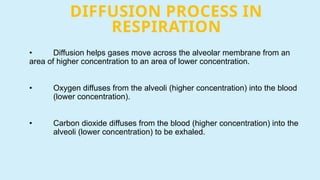
•Diffusion helps gases move across the alveolar membrane from an
area of higher concentration to an area of lower concentration.
• Oxygen diffuses from the alveoli (higher concentration) into the blood
(lower concentration).
• Carbon dioxide diffuses from the blood (higher concentration) into the
alveoli (lower concentration) to be exhaled.
THE DIAPHRAGM: KEYTO BREATHING
• The diaphragm is a muscle located below the lungs.
• During inhalation, it contracts and moves down, increasing lung
volume and drawing air in.
• During exhalation, the diaphragm relaxes and moves up,
forcing air out.
WHY DOES YOURBREATHING RATE
CHANGE?
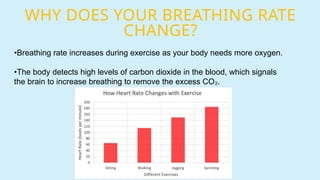
•Breathing rate increases during exercise as your body needs more oxygen.
•The body detects high levels of carbon dioxide in the blood, which signals
the brain to increase breathing to remove the excess CO .
₂
19.
SUMMARY OF KEYCONCEPTS
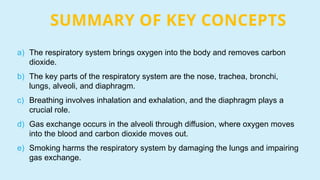
a) The respiratory system brings oxygen into the body and removes carbon
dioxide.
b) The key parts of the respiratory system are the nose, trachea, bronchi,
lungs, alveoli, and diaphragm.
c) Breathing involves inhalation and exhalation, and the diaphragm plays a
crucial role.
d) Gas exchange occurs in the alveoli through diffusion, where oxygen moves
into the blood and carbon dioxide moves out.
e) Smoking harms the respiratory system by damaging the lungs and impairing
gas exchange.