Game
Analysis
Prepared By
Manu Melwin Joy
Research Scholar
School of Management Studies
CUSAT, Kerala, India.
Phone – 9744551114
Mail – manu_melwinjoy@yahoo.com
Kindly restrict the use of slides for personal purpose.
Please seek permission to reproduce the same in public
forms and presentations.
Contents – Part I
• Definition of games.
• Typical features of games.
• Different degree of games.
• Why people play games?
• Advantages of playing games.
• Positive payoff of playing games.
Contents – Part II
• Life Games.
• Marital Games.
• Party Games.
• Sexual Games.
• Underworld Games.
• Consulting Room Games.
• Good Games.
Definition of game
In simple language,
“A game is a process of doing
something with an ulterior
motive that:
– Is outside adult awareness.
– Does not become explicit until
the participants switch the way
they are behaving and
– Results in everyone feeling
confused, misunderstood and
wanting to blame the other
person.
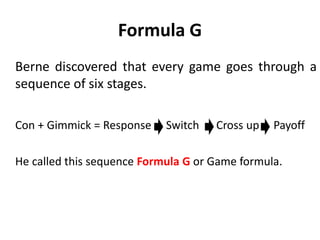
Formula G
Berne discovered that every game goes through a
sequence of six stages.
Con + Gimmick = Response Switch Cross up Payoff
He called this sequence Formula G or Game formula.
Formula G
• Con – it is delivered non-verbally.
• Gimmick – It is a scripty weak
spot that leads someone to buy
into someone else’s con.
• Response – This stage of a game
consists of a series of
transactions. At social level, these
transactions seem like straight
forward exchange of information.
But at psychological level, they
repeat the Con-Gimmick
exchange that opened the game.
Formula G
• Switch – It happens when
one player changes his
role.
• Cross up – The confusion
happening during the
change of role is cross up.
• Payoff – Both players
collect their payoff of
racket feeling.
Definition of game
According to Ian Stewart and
Vann Jones,
“ A game includes those
sequences that follow all
stages of Formula G,
including the switch of roles
and moment of confusion
represented by switch and
cross up.”
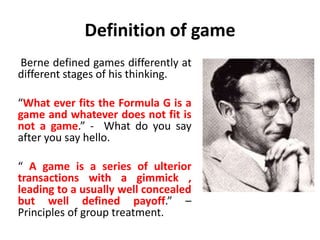
Definition of game
Berne defined games differently at
different stages of his thinking.
“What ever fits the Formula G is a
game and whatever does not fit is
not a game.” - What do you say
after you say hello.
“ A game is a series of ulterior
transactions with a gimmick ,
leading to a usually well concealed
but well defined payoff.” –
Principles of group treatment.
Typical features of games
• Games are repetitive.
• Games are played without
adult awareness.
• Games always end up with the
players experience racket
feeling.
• Games entail an exchange of
ulterior transactions between
the players.
• Games always include moment
of surprise and confusion.
Different degrees of games
Games can be played at
different degrees of intensity.
First level game – it has an
outcome which the player is
willing to share with her
social circle. These make a
big proportion of the time
structuring at parties and
social gatherings.
Different degrees of games
Second degree game bring
heavier outcomes, of a kind
which the player would
rather not make public in
her social circle.
Third degree game, in
Berne’s words is one which
is played for keeps and
which ends in surgery, the
courtroom or the morgue.
Why people play games?
• In playing games, we are following outdated
strategies.
• Game playing was one of the devices we
adopted as young children to get what we
wanted from the world.
• But in adult life, we have other, more effective
options.
Why people play games?
• People play games to further
their life script.
• Berne suggested the sequence
by which we achieve this.
• At the payoff of every game,
the player experiences a racket
feeling.
• Each time he does this, he can
store the feeling away as a
stamp.
Why people play games?
• When the game player has built up a big enough
collection of stamps, he feels justified in cashing it
in for whatever negative script payoff he decided
upon as a child.
• Thus each person chooses her games to yield the
kind of stamps that will advance her towards the
script ending she has decided upon.
• As usual with scripts, the script story may be
played through in miniature many times during
the players life.
• People chose the degree of their games to suit the
degree of their script payoff.
Advantages of Game playing
In Games people play, Eric Berne listed six
advantages of game playing.
– Internal psychological advantage – maintain
stability of my set of script beliefs.
– External psychological advantage – Avoid
situations that would challenge my frame of
reference.
– Internal social advantage –Games offer a
framework for pseudo intimate socializing indoors
or in privacy.
Advantages of Game playing
– External social advantage – Gaming gives us a
theme for gossiping in our wider social circle.
– Biological advantage – It satisfy structure and
stroke hunger.
– Existential advantage – This is the function of the
game in confirming life position.
Positive payoff of games
• John James has developed the idea that games
have real advantages as well as scripty ones.
• He points out that every game brings a
positive payoff as well as a negative payoff.
• A game represents the child’s best strategy to
getting something from the world. When we
play games in adulthood, we are attempting to
meet a genuine child need. It is just that the
means of satisfying that need are outdated
and manipulative.
Life Games
• All games have an
important and probably
decisive influence on the
destinies of the players
under ordinary social
conditions.
• But some offer more
opportunities than others
for life long careers and
are more likely to involve
relatively innocent
bystanders.
• This group may be
conveniently called Life
Games.
Alcoholic
• This is usually a three
handed game.
• The central role is that of
the Alcoholic – the one
who is it.
• The chief supporting role
is that of Persecutor,
typically played by a
member of opposite sex,
usually the spouse.
• The third role is that of
Rescuer, usually played by
someone of the same sex.
Debtor
• Debtor is more than a
game. It is a script, a
plan for a whole
lifetime.
• Try and Collect (TAC) is
a mild money game
commonly played by
married couples.
• The obvious antithesis
of TAC is to request
immediate payment in
cash.
Kick Me
• This is played by men
whose social manner is
equivalent to wearing a
sign that reads “ Please
don’t kick me”.
• The temptation is almost
irresistible and when the
natural result follows, he
cries piteously, “ But the
sign says don’t kick me.”
• Then he adds
incredulously “ Why does
this always happens to
me?”
Now I Have Got You ,You Son Of A Bitch
• NIGYSOB is a two
handed game in which
the aim is justification.
• The best antithesis is
correct behavior.
• In everyday life,
business dealings with
NIGYSOB players are
always calculated risks.
See What You Made Me Do
• In Its classical form, this is
a marital game and in fact
is a “three star marriage
buster” but it may also be
played between parents
and children and in
working life.
• The antithesis for SWYMD
is to leave the player
alone or to throw the
decision back to him.
Marital Games
• Almost any game can
form the scaffolding for
married life and family
living.
• Some of these games
are tolerated longer,
under the legal force of
contractual intimacy.
• Marital games can only
be arbitrarily separated
from sexual games .
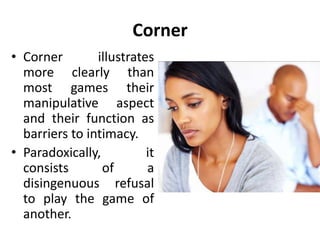
Corner
• Corner illustrates
more clearly than
most games their
manipulative aspect
and their function as
barriers to intimacy.
• Paradoxically, it
consists of a
disingenuous refusal
to play the game of
another.
Courtroom
• Courtroom is essentially
three handed, with a
plaintiff, a defendant
and a Judge,
represented by a
husband, a wife and the
therapist.
• In everyday form,
courtroom is easily
observed in children as
a three handed game
between two siblings
and a parent.
Frigid Woman
• In this game, the
husband makes
advances to his wife
and is repulsed.
• After repeated
attempts, he is told that
all men are beasts, he
doesn’t really love her
and all he is interested
is in sex.
• When he resigns, wife
tempts him and the
game continues.
Harried
• This is played by a
housewife who is
proficient in ten or
twelve different
occupations.
• The thesis of this game
is that she takes on
everything that comes
and even asks for more.
• This ultimately results
in her burn out and
being ready for
hospitalized.
If It Weren’t For You
• Briefly, a woman
marries a domineering
man so that he will
restrict her activities
and thus keep her from
getting into a situation
which frighten her.
• She takes advantage of
the situation to
complain about the
restrictions , which
makes her spouse feel
uneasy and gives her all
sorts of advantages.
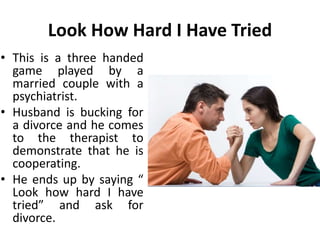
Look How Hard I Have Tried
• This is a three handed
game played by a
married couple with a
psychiatrist.
• Husband is bucking for
a divorce and he comes
to the therapist to
demonstrate that he is
cooperating.
• He ends up by saying “
Look how hard I have
tried” and ask for
divorce.
Sweet Heart
• Husband exposes the
deficiencies of the
wife and save her
from embarrassment
of having to expose
them herself.
• He ends the comment
by saying “ Isn’t that
right, sweetheart?”.
Party Games
• Parties are for
pastimes but as
acquaintance
ripens, games
begin to emerge.
• Four typical games
which are played in
social situations
are given.
Ain’t It Awful
• Nowadays is a punitive
parental pastime (Ex :
Juvenile delinquency).
• Broken Skin is an adult
variation with the
slogan “what a pity”.
• Water cooler is the
child pastime with the
slogan “ Look what they
are doing to us now”.
Blemish
• It is played from the
depressive Child
position “ I am no
good” which is
protectively
transformed into the
Parental position “
They are no good”.
• Blemish provides
negative reassurance
to the players.
Schlemiel
• The Schlemiel makes the
first move to embarrass
the other person.
• If he shows his anger,
schlemiel can feel justified
in returning the
resentment.
• If he restrains himself, he
can go on enjoying his
opportunities.
• The antithesis is not
offering the demanded
absolution.
Why Don’t You – Yes But
• It occupies a special
place in game analysis
because it was the
original stimulus for the
concept of games.
• The agent presents a
problem and others
start presenting
solutions.
• Agent objects and all
the others give up
feeling bad.
Sexual Games
• Sexual games are
played to exploit or
fight off sexual
impulses.
• These are all
perversions of the
sexual instincts in which
the satisfaction is
displaced from the
sexual act to the crucial
transactions which
constitute the payoff of
the game.
Let You And Him Fight
• This may be a
maneuver, a ritual or a
game.
• IN each case, the
psychology is
feminine.
• As a maneuver, it is
romantic. As a ritual,
it is tragic. As a game,
it is comic.
Perversion
• Heterosexual perversions
such a fetishism, sadism
and masochism are
symptomatic of a
confused child and are
treated accordingly.
• Their transactional
aspects as manifested in
actual sexual situations
can be death with by
means of game analysis.
Rapo
• This is a game played between
a man and a woman.
• First degree Rapo or kiss off is
popular at social gatherings
and consists essentially of mild
flirtation. As soon has he has
committed, the game is over.
She signs off.
• Second degree Rapo or
indignation happens when she
draws satisfaction from
rejecting him.
• Third degree Rapo is a vicious
game which ends in murder,
suicide or courtroom.
The Stocking Game
• This is a game of Rapo
family. in it the most
obvious characteristic is
exhibitionism, which is
hysterical in nature.
• Women expose
themselves to arouse
men and make other
women angry.
• Any confrontation is met
with protestation of
innocence or counter
accusations.
Uproar
• The classical game is played
between domineering
fathers and teenage
daughters, where there is a
sexually inhibited mother.
• Father comes home from
work and finds fault with
daughter, who answers
impudently.
• Their voice raise and clash
becomes more acute. The
end of a game of uproar is
marked by a slamming door.
Underworld Games
• With the infiltration of
the helping professions
into the courts, probation
departments and
correctional facilities, and
with the increasing
sophistication of
criminologist and law
enforcement officers,
those concerned should
be aware of the more
common games prevalent
in the underworld, both
in prison and out of it.
Cops and Robbers
• Because many criminals
are cope haters, they
seem to get as much
satisfaction from
outwitting the police as
from their criminal gains
often more.
• The childhood prototype
of this game is hide and
seek.
• The thesis of the game is
“see if you can catch me”.
How Do You Get Out Of Here
• Inmates who really want
to free will find out how
to comply with the
authorities so as to be
released at the earliest
possible moment.
• But at the critical point,
they sabotage themselves
so as not be released.
• This is played in prisons
and state hospitals.
Lets Pull A Fast One On Joey
• The first move is for Black to
tell White that dumb honest
Joey is just waiting to be
taken.
• If White were completely
honest, he back off or warn
Joey but he does nothing.
• Just as Joey is about to pay
off, something goes wrong
and White finds that his
investment is gone.
• Then White, who was playing
his own rules in his own
honest way, finds that he has
to play Joey’s rules ,and they
hurt.
Consulting Room Games
• Games that are
tenaciously placed
in the therapeutic
situations are the
most important
ones for the
professional analyst
to be aware of.
• They can be most
readily studies first
hand in the
consulting room.
Greenhouse
• Recent graduates
present a so called
genuine feelings to the
group.
• The reactions of the
other members are
received very
solemnly.
• A questioning
intervention by the
therapist may be
strongly resented.
I’M Only Trying To Help You
• Therapist gives some
advice to the client. He
returns and reports that
the suggestions did not
have the desired
outcome.
• The therapist shrugs off
this failure with a feeling
of resignation and tries
again.
• One day, he cries out in
rage “ But I was only
trying to help you!”.
Indigence
• Indigents go from
agency to agency
seeking welfare funds.
• Even though they are
supposed to look for
other jobs, they devote
actually little time for it
and tend to remain in
their current position.
• Antithesis consists in
withholding the
benefits.
Peasant
• Socially, peasant is
played in an innocent
and a dissembled
form, both with the
motto “Gee You are
wonderful, Mr.
Murgatroyd”.
• The antithesis for the
game is that therapist
steadfastly refuses to
give advice.
Psychiatry
• The patient carefully
picks up weak
psychoanalysts, moving
from one to another,
demonstrating that they
cannot be cured and
meanwhile learning to
play a sharper and
sharper game of
psychiatry.
• The antithesis is the
view point that “I treat
them, but God cures
them”.
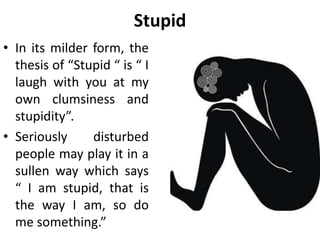
Stupid
• In its milder form, the
thesis of “Stupid “ is “ I
laugh with you at my
own clumsiness and
stupidity”.
• Seriously disturbed
people may play it in a
sullen way which says
“ I am stupid, that is
the way I am, so do
me something.”
Wooden Leg
• The thesis for wooden
leg is “What do you
expect of a man with a
wooden leg?”
• The person with real,
exaggerated or
imaginary disability is
content with his lot
and never tries to rise
above his disability.
Good Games
• A good game might be
described as one whose
social contribution
overweighs the
complexity of its
motivations, particularly
if the player has come in
terms with those
motivations without
futility or cynicism.
• A good game contributes
both to the well being of
the other players and to
the unfolding of the one
who is it.
Busman’s Holiday
• This is more of a
pastime than a game.
• It becomes a game if
work is secondary to
some ulterior motive
and is undertaken
merely as a show in
order to accomplish
something else.
• Even under those
circumstance, it keeps
its constructive quality.
Cavalier
• Upon encountering a
suitable female
subject, Mr. White
take every
opportunity to
remark upon her
good qualities, never
transgressing the
limits appropriate to
her station of life.
• The object is not to
seduce but to exhibit
his virtuosity in the
art of effective
compliment.
Happy To Help
• This game is the basis of a
large proportion of public
relations. But the
customers are glad to
become involved, and it is
perhaps the most
pleasant and constructive
of the commercial games.
• The choice of HTH
removes some of the
discredit since thee are so
many unpleasant ways of
competing available.
Homely Sage
• After retirement, people
move to small town and
hold a responsible
position.
• There it soon becomes
known that people can go
to him with their
problems of whatever
kind and he will help
them himself.
• He soon finds his place in
the new environment as
Homely Sage.
Thank You
Other TA topics available on slideshare
1. Strokes - http://www.slideshare.net/manumjoy/strokes-24081607.
2. Games People Play - http://www.slideshare.net/manumjoy/psychological-
games-people-play.
3. Structural Analysis - http://www.slideshare.net/manumjoy/the-ego-state-model.
4. What is TA? - http://www.slideshare.net/manumjoy/what-ta-is
5. Cycles of Development - http://www.slideshare.net/manumjoy/cycles-of-
developement-pamela-levin-transactional-analysis.
6. Stages of Cure - http://www.slideshare.net/manumjoy/stages-of-cure.
7. Transactions - http://www.slideshare.net/manumjoy/transactions-33677298.
8. Time Structuring - http://www.slideshare.net/manumjoy/time-structuring.
9. Life Position - http://www.slideshare.net/manumjoy/life-position.
10. Autonomy - http://www.slideshare.net/manumjoy/autonomy-33690557.
11. Structural Pathology - http://www.slideshare.net/manumjoy/structural-pathology.
12. Game Analysis - http://www.slideshare.net/manumjoy/game-analysis-33725636.
13. Integrated Adult - http://www.slideshare.net/manumjoy/integrated-adult.
14. Stroke Economy - http://www.slideshare.net/manumjoy/stroke-economy-
33826702.

Game analysis - Transactional Analysis

  • 1.
  • 2.
    Prepared By Manu MelwinJoy Research Scholar School of Management Studies CUSAT, Kerala, India. Phone – 9744551114 Mail – manu_melwinjoy@yahoo.com Kindly restrict the use of slides for personal purpose. Please seek permission to reproduce the same in public forms and presentations.
  • 3.
    Contents – PartI • Definition of games. • Typical features of games. • Different degree of games. • Why people play games? • Advantages of playing games. • Positive payoff of playing games.
  • 4.
    Contents – PartII • Life Games. • Marital Games. • Party Games. • Sexual Games. • Underworld Games. • Consulting Room Games. • Good Games.
  • 5.
    Definition of game Insimple language, “A game is a process of doing something with an ulterior motive that: – Is outside adult awareness. – Does not become explicit until the participants switch the way they are behaving and – Results in everyone feeling confused, misunderstood and wanting to blame the other person.
  • 6.
    Formula G Berne discoveredthat every game goes through a sequence of six stages. Con + Gimmick = Response Switch Cross up Payoff He called this sequence Formula G or Game formula.
  • 7.
    Formula G • Con– it is delivered non-verbally. • Gimmick – It is a scripty weak spot that leads someone to buy into someone else’s con. • Response – This stage of a game consists of a series of transactions. At social level, these transactions seem like straight forward exchange of information. But at psychological level, they repeat the Con-Gimmick exchange that opened the game.
  • 8.
    Formula G • Switch– It happens when one player changes his role. • Cross up – The confusion happening during the change of role is cross up. • Payoff – Both players collect their payoff of racket feeling.
  • 9.
    Definition of game Accordingto Ian Stewart and Vann Jones, “ A game includes those sequences that follow all stages of Formula G, including the switch of roles and moment of confusion represented by switch and cross up.”
  • 10.
    Definition of game Bernedefined games differently at different stages of his thinking. “What ever fits the Formula G is a game and whatever does not fit is not a game.” - What do you say after you say hello. “ A game is a series of ulterior transactions with a gimmick , leading to a usually well concealed but well defined payoff.” – Principles of group treatment.
  • 11.
    Typical features ofgames • Games are repetitive. • Games are played without adult awareness. • Games always end up with the players experience racket feeling. • Games entail an exchange of ulterior transactions between the players. • Games always include moment of surprise and confusion.
  • 12.
    Different degrees ofgames Games can be played at different degrees of intensity. First level game – it has an outcome which the player is willing to share with her social circle. These make a big proportion of the time structuring at parties and social gatherings.
  • 13.
    Different degrees ofgames Second degree game bring heavier outcomes, of a kind which the player would rather not make public in her social circle. Third degree game, in Berne’s words is one which is played for keeps and which ends in surgery, the courtroom or the morgue.
  • 14.
    Why people playgames? • In playing games, we are following outdated strategies. • Game playing was one of the devices we adopted as young children to get what we wanted from the world. • But in adult life, we have other, more effective options.
  • 15.
    Why people playgames? • People play games to further their life script. • Berne suggested the sequence by which we achieve this. • At the payoff of every game, the player experiences a racket feeling. • Each time he does this, he can store the feeling away as a stamp.
  • 16.
    Why people playgames? • When the game player has built up a big enough collection of stamps, he feels justified in cashing it in for whatever negative script payoff he decided upon as a child. • Thus each person chooses her games to yield the kind of stamps that will advance her towards the script ending she has decided upon. • As usual with scripts, the script story may be played through in miniature many times during the players life. • People chose the degree of their games to suit the degree of their script payoff.
  • 17.
    Advantages of Gameplaying In Games people play, Eric Berne listed six advantages of game playing. – Internal psychological advantage – maintain stability of my set of script beliefs. – External psychological advantage – Avoid situations that would challenge my frame of reference. – Internal social advantage –Games offer a framework for pseudo intimate socializing indoors or in privacy.
  • 18.
    Advantages of Gameplaying – External social advantage – Gaming gives us a theme for gossiping in our wider social circle. – Biological advantage – It satisfy structure and stroke hunger. – Existential advantage – This is the function of the game in confirming life position.
  • 19.
    Positive payoff ofgames • John James has developed the idea that games have real advantages as well as scripty ones. • He points out that every game brings a positive payoff as well as a negative payoff. • A game represents the child’s best strategy to getting something from the world. When we play games in adulthood, we are attempting to meet a genuine child need. It is just that the means of satisfying that need are outdated and manipulative.
  • 20.
    Life Games • Allgames have an important and probably decisive influence on the destinies of the players under ordinary social conditions. • But some offer more opportunities than others for life long careers and are more likely to involve relatively innocent bystanders. • This group may be conveniently called Life Games.
  • 21.
    Alcoholic • This isusually a three handed game. • The central role is that of the Alcoholic – the one who is it. • The chief supporting role is that of Persecutor, typically played by a member of opposite sex, usually the spouse. • The third role is that of Rescuer, usually played by someone of the same sex.
  • 22.
    Debtor • Debtor ismore than a game. It is a script, a plan for a whole lifetime. • Try and Collect (TAC) is a mild money game commonly played by married couples. • The obvious antithesis of TAC is to request immediate payment in cash.
  • 23.
    Kick Me • Thisis played by men whose social manner is equivalent to wearing a sign that reads “ Please don’t kick me”. • The temptation is almost irresistible and when the natural result follows, he cries piteously, “ But the sign says don’t kick me.” • Then he adds incredulously “ Why does this always happens to me?”
  • 24.
    Now I HaveGot You ,You Son Of A Bitch • NIGYSOB is a two handed game in which the aim is justification. • The best antithesis is correct behavior. • In everyday life, business dealings with NIGYSOB players are always calculated risks.
  • 25.
    See What YouMade Me Do • In Its classical form, this is a marital game and in fact is a “three star marriage buster” but it may also be played between parents and children and in working life. • The antithesis for SWYMD is to leave the player alone or to throw the decision back to him.
  • 26.
    Marital Games • Almostany game can form the scaffolding for married life and family living. • Some of these games are tolerated longer, under the legal force of contractual intimacy. • Marital games can only be arbitrarily separated from sexual games .
  • 27.
    Corner • Corner illustrates moreclearly than most games their manipulative aspect and their function as barriers to intimacy. • Paradoxically, it consists of a disingenuous refusal to play the game of another.
  • 28.
    Courtroom • Courtroom isessentially three handed, with a plaintiff, a defendant and a Judge, represented by a husband, a wife and the therapist. • In everyday form, courtroom is easily observed in children as a three handed game between two siblings and a parent.
  • 29.
    Frigid Woman • Inthis game, the husband makes advances to his wife and is repulsed. • After repeated attempts, he is told that all men are beasts, he doesn’t really love her and all he is interested is in sex. • When he resigns, wife tempts him and the game continues.
  • 30.
    Harried • This isplayed by a housewife who is proficient in ten or twelve different occupations. • The thesis of this game is that she takes on everything that comes and even asks for more. • This ultimately results in her burn out and being ready for hospitalized.
  • 31.
    If It Weren’tFor You • Briefly, a woman marries a domineering man so that he will restrict her activities and thus keep her from getting into a situation which frighten her. • She takes advantage of the situation to complain about the restrictions , which makes her spouse feel uneasy and gives her all sorts of advantages.
  • 32.
    Look How HardI Have Tried • This is a three handed game played by a married couple with a psychiatrist. • Husband is bucking for a divorce and he comes to the therapist to demonstrate that he is cooperating. • He ends up by saying “ Look how hard I have tried” and ask for divorce.
  • 33.
    Sweet Heart • Husbandexposes the deficiencies of the wife and save her from embarrassment of having to expose them herself. • He ends the comment by saying “ Isn’t that right, sweetheart?”.
  • 34.
    Party Games • Partiesare for pastimes but as acquaintance ripens, games begin to emerge. • Four typical games which are played in social situations are given.
  • 35.
    Ain’t It Awful •Nowadays is a punitive parental pastime (Ex : Juvenile delinquency). • Broken Skin is an adult variation with the slogan “what a pity”. • Water cooler is the child pastime with the slogan “ Look what they are doing to us now”.
  • 36.
    Blemish • It isplayed from the depressive Child position “ I am no good” which is protectively transformed into the Parental position “ They are no good”. • Blemish provides negative reassurance to the players.
  • 37.
    Schlemiel • The Schlemielmakes the first move to embarrass the other person. • If he shows his anger, schlemiel can feel justified in returning the resentment. • If he restrains himself, he can go on enjoying his opportunities. • The antithesis is not offering the demanded absolution.
  • 38.
    Why Don’t You– Yes But • It occupies a special place in game analysis because it was the original stimulus for the concept of games. • The agent presents a problem and others start presenting solutions. • Agent objects and all the others give up feeling bad.
  • 39.
    Sexual Games • Sexualgames are played to exploit or fight off sexual impulses. • These are all perversions of the sexual instincts in which the satisfaction is displaced from the sexual act to the crucial transactions which constitute the payoff of the game.
  • 40.
    Let You AndHim Fight • This may be a maneuver, a ritual or a game. • IN each case, the psychology is feminine. • As a maneuver, it is romantic. As a ritual, it is tragic. As a game, it is comic.
  • 41.
    Perversion • Heterosexual perversions sucha fetishism, sadism and masochism are symptomatic of a confused child and are treated accordingly. • Their transactional aspects as manifested in actual sexual situations can be death with by means of game analysis.
  • 42.
    Rapo • This isa game played between a man and a woman. • First degree Rapo or kiss off is popular at social gatherings and consists essentially of mild flirtation. As soon has he has committed, the game is over. She signs off. • Second degree Rapo or indignation happens when she draws satisfaction from rejecting him. • Third degree Rapo is a vicious game which ends in murder, suicide or courtroom.
  • 43.
    The Stocking Game •This is a game of Rapo family. in it the most obvious characteristic is exhibitionism, which is hysterical in nature. • Women expose themselves to arouse men and make other women angry. • Any confrontation is met with protestation of innocence or counter accusations.
  • 44.
    Uproar • The classicalgame is played between domineering fathers and teenage daughters, where there is a sexually inhibited mother. • Father comes home from work and finds fault with daughter, who answers impudently. • Their voice raise and clash becomes more acute. The end of a game of uproar is marked by a slamming door.
  • 45.
    Underworld Games • Withthe infiltration of the helping professions into the courts, probation departments and correctional facilities, and with the increasing sophistication of criminologist and law enforcement officers, those concerned should be aware of the more common games prevalent in the underworld, both in prison and out of it.
  • 46.
    Cops and Robbers •Because many criminals are cope haters, they seem to get as much satisfaction from outwitting the police as from their criminal gains often more. • The childhood prototype of this game is hide and seek. • The thesis of the game is “see if you can catch me”.
  • 47.
    How Do YouGet Out Of Here • Inmates who really want to free will find out how to comply with the authorities so as to be released at the earliest possible moment. • But at the critical point, they sabotage themselves so as not be released. • This is played in prisons and state hospitals.
  • 48.
    Lets Pull AFast One On Joey • The first move is for Black to tell White that dumb honest Joey is just waiting to be taken. • If White were completely honest, he back off or warn Joey but he does nothing. • Just as Joey is about to pay off, something goes wrong and White finds that his investment is gone. • Then White, who was playing his own rules in his own honest way, finds that he has to play Joey’s rules ,and they hurt.
  • 49.
    Consulting Room Games •Games that are tenaciously placed in the therapeutic situations are the most important ones for the professional analyst to be aware of. • They can be most readily studies first hand in the consulting room.
  • 50.
    Greenhouse • Recent graduates presenta so called genuine feelings to the group. • The reactions of the other members are received very solemnly. • A questioning intervention by the therapist may be strongly resented.
  • 51.
    I’M Only TryingTo Help You • Therapist gives some advice to the client. He returns and reports that the suggestions did not have the desired outcome. • The therapist shrugs off this failure with a feeling of resignation and tries again. • One day, he cries out in rage “ But I was only trying to help you!”.
  • 52.
    Indigence • Indigents gofrom agency to agency seeking welfare funds. • Even though they are supposed to look for other jobs, they devote actually little time for it and tend to remain in their current position. • Antithesis consists in withholding the benefits.
  • 53.
    Peasant • Socially, peasantis played in an innocent and a dissembled form, both with the motto “Gee You are wonderful, Mr. Murgatroyd”. • The antithesis for the game is that therapist steadfastly refuses to give advice.
  • 54.
    Psychiatry • The patientcarefully picks up weak psychoanalysts, moving from one to another, demonstrating that they cannot be cured and meanwhile learning to play a sharper and sharper game of psychiatry. • The antithesis is the view point that “I treat them, but God cures them”.
  • 55.
    Stupid • In itsmilder form, the thesis of “Stupid “ is “ I laugh with you at my own clumsiness and stupidity”. • Seriously disturbed people may play it in a sullen way which says “ I am stupid, that is the way I am, so do me something.”
  • 56.
    Wooden Leg • Thethesis for wooden leg is “What do you expect of a man with a wooden leg?” • The person with real, exaggerated or imaginary disability is content with his lot and never tries to rise above his disability.
  • 57.
    Good Games • Agood game might be described as one whose social contribution overweighs the complexity of its motivations, particularly if the player has come in terms with those motivations without futility or cynicism. • A good game contributes both to the well being of the other players and to the unfolding of the one who is it.
  • 58.
    Busman’s Holiday • Thisis more of a pastime than a game. • It becomes a game if work is secondary to some ulterior motive and is undertaken merely as a show in order to accomplish something else. • Even under those circumstance, it keeps its constructive quality.
  • 59.
    Cavalier • Upon encounteringa suitable female subject, Mr. White take every opportunity to remark upon her good qualities, never transgressing the limits appropriate to her station of life. • The object is not to seduce but to exhibit his virtuosity in the art of effective compliment.
  • 60.
    Happy To Help •This game is the basis of a large proportion of public relations. But the customers are glad to become involved, and it is perhaps the most pleasant and constructive of the commercial games. • The choice of HTH removes some of the discredit since thee are so many unpleasant ways of competing available.
  • 61.
    Homely Sage • Afterretirement, people move to small town and hold a responsible position. • There it soon becomes known that people can go to him with their problems of whatever kind and he will help them himself. • He soon finds his place in the new environment as Homely Sage.
  • 62.
  • 63.
    Other TA topicsavailable on slideshare 1. Strokes - http://www.slideshare.net/manumjoy/strokes-24081607. 2. Games People Play - http://www.slideshare.net/manumjoy/psychological- games-people-play. 3. Structural Analysis - http://www.slideshare.net/manumjoy/the-ego-state-model. 4. What is TA? - http://www.slideshare.net/manumjoy/what-ta-is 5. Cycles of Development - http://www.slideshare.net/manumjoy/cycles-of- developement-pamela-levin-transactional-analysis. 6. Stages of Cure - http://www.slideshare.net/manumjoy/stages-of-cure. 7. Transactions - http://www.slideshare.net/manumjoy/transactions-33677298. 8. Time Structuring - http://www.slideshare.net/manumjoy/time-structuring. 9. Life Position - http://www.slideshare.net/manumjoy/life-position. 10. Autonomy - http://www.slideshare.net/manumjoy/autonomy-33690557. 11. Structural Pathology - http://www.slideshare.net/manumjoy/structural-pathology. 12. Game Analysis - http://www.slideshare.net/manumjoy/game-analysis-33725636. 13. Integrated Adult - http://www.slideshare.net/manumjoy/integrated-adult. 14. Stroke Economy - http://www.slideshare.net/manumjoy/stroke-economy- 33826702.