

Strokes
Transactional Analysis
Prepared By
Manu Melwin Joy
Research Scholar
School of Management Studies
CUSAT, Kerala, India.
Phone – 9744551114
Mail – manu_melwinjoy@yahoo.com
Kindly restrict the use of slides for personal purpose.
Please seek permission to reproduce the same in public
forms and presentations.
A stroke is defined as a unit of recognition. (Berne 1971)
“A stroke is a unit of attention which provides stimulation
to an individual”. (Woollams and Brown: Transactional
Analysis 1978)
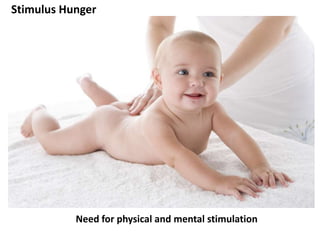
Stimulus Hunger
Need for physical and mental stimulation
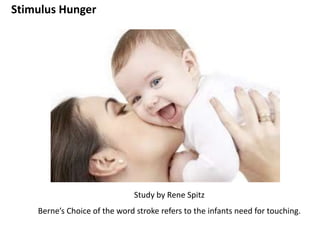
Stimulus Hunger
Study by Rene Spitz
Berne’s Choice of the word stroke refers to the infants need for touching.
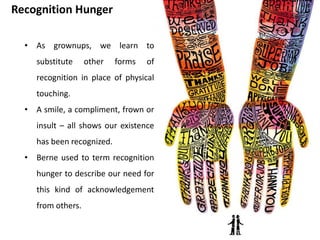
Recognition Hunger
• As grownups, we learn to
substitute other forms of
recognition in place of physical
touching.
• A smile, a compliment, frown or
insult – all shows our existence
has been recognized.
• Berne used to term recognition
hunger to describe our need for
this kind of acknowledgement
from others.
Kinds of strokes
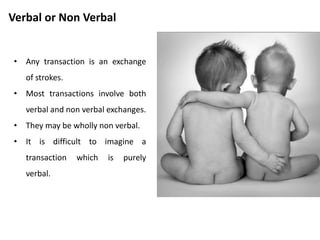
Verbal or Non Verbal
• Any transaction is an exchange
of strokes.
• Most transactions involve both
verbal and non verbal exchanges.
• They may be wholly non verbal.
• It is difficult to imagine a
transaction which is purely
verbal.
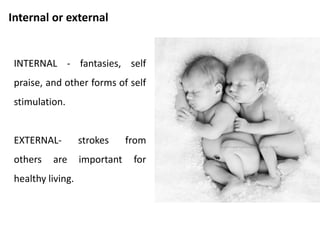
Internal or external
INTERNAL - fantasies, self
praise, and other forms of self
stimulation.
EXTERNAL- strokes from
others are important for
healthy living.
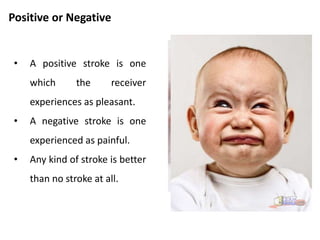
Positive or Negative
• A positive stroke is one
which the receiver
experiences as pleasant.
• A negative stroke is one
experienced as painful.
• Any kind of stroke is better
than no stroke at all.
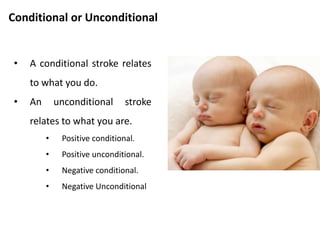
Conditional or Unconditional
• A conditional stroke relates
to what you do.
• An unconditional stroke
relates to what you are.
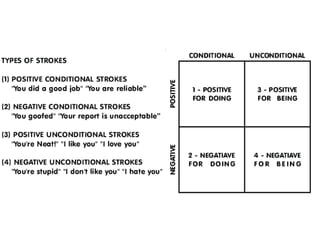
• Positive conditional.
• Positive unconditional.
• Negative conditional.
• Negative Unconditional
Activity
• Write down two strokes you gave today
• Write down two strokes you received today.
• Identify which kind of stroke it is.
• Verbal or Non verbal.
• Positive or Negative.
• Conditional or Unconditional.
• Positive conditional.
• Positive unconditional.
• Negative conditional.
• Negative Unconditional
• Internal or External.
Activity
• Give a positive conditional stroke to the person sitting to your
left.
• Give an internal positive unconditional stroke to yourself.
• Give a Non verbal stroke to the person sitting to your right.
Stroking and reinforcement of behavior
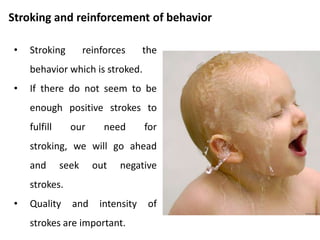
• Stroking reinforces the
behavior which is stroked.
• If there do not seem to be
enough positive strokes to
fulfill our need for stroking,
we will go ahead and seek
out negative strokes.
• Quality and intensity of
strokes are important.
Giving strokes
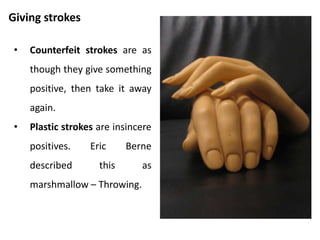
• Counterfeit strokes are as
though they give something
positive, then take it away
again.
• Plastic strokes are insincere
positives. Eric Berne
described this as
marshmallow – Throwing.
Taking strokes
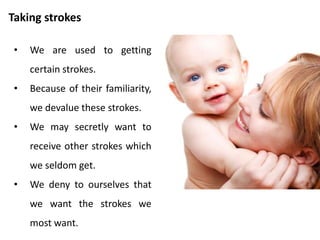
• We are used to getting
certain strokes.
• Because of their familiarity,
we devalue these strokes.
• We may secretly want to
receive other strokes which
we seldom get.
• We deny to ourselves that
we want the strokes we
most want.
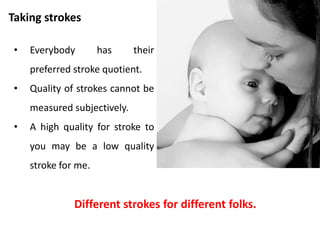
Taking strokes
• Everybody has their
preferred stroke quotient.
• Quality of strokes cannot be
measured subjectively.
• A high quality for stroke to
you may be a low quality
stroke for me.
Different strokes for different folks.
Stroke Filter / Discount
• When someone gets a stroke that
doesn’t fit in with her preferred
stroke quotient, she is likely to
ignore it or belittle it.
• Discounts are an internal
mechanism by which people
minimize or maximize
(grandiosity) an aspect of reality,
themselves or others.
• In other words they are not
accounting for the reality of
themselves or others or the
situation.
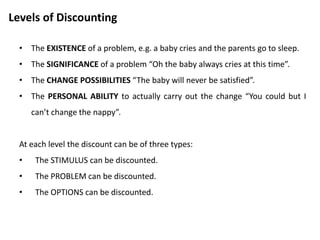
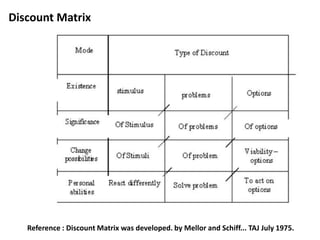
Levels of Discounting
• The EXISTENCE of a problem, e.g. a baby cries and the parents go to sleep.
• The SIGNIFICANCE of a problem “Oh the baby always cries at this time”.
• The CHANGE POSSIBILITIES “The baby will never be satisfied”.
• The PERSONAL ABILITY to actually carry out the change “You could but I
can’t change the nappy”.
At each level the discount can be of three types:
• The STIMULUS can be discounted.
• The PROBLEM can be discounted.
• The OPTIONS can be discounted.
Reference : Discount Matrix was developed. by Mellor and Schiff... TAJ July 1975.
Discount Matrix
Activity
• Think about the strokes you gave and received.
• Was it counterfeit, marshmallows, straight?
• Who received it openly, who discounted it?
• Which strokes you received and which one you discounted?
Activity
• Divide into groups of four.
• For one minute, one among the four will listen and others will
deliver verbal strokes. (Positive or Positive/Negative)
• For next one minute, it will share his/her experiences with the
others.
• Consider the following questions.
• Which of the strokes I got did I expect to get?
• Which strokes did not I expect?
• Which strokes did I like?
• Which strokes I dislike?
• Are there any strokes I did have liked to get and didn’t ?
Stroke economy
• Claude Steiner suggests that as children, we are all
indoctrinated by our parents with five restrictive rules about
stroking.
• Don’t give strokes when you have them to give.
• Don’t ask for strokes when you need them.
• Don’t accept strokes if you want them.
• Don’t reject strokes when you don’t want them.
• Don’t give yourself strokes.
The Warm Fuzzy Tale
Reference : Scripts People Live (1974) Claude Steiner
Stroke economy
• Parents use it to control children.
• Teach children that strokes are in short supply.
• Parents gains the position of a stroke monopolist.
• As grownups, we unawarely use these rules.
• We spend out lives in a state of partial stroke deprivation.
• We need to reject our restrictive basic training.
• Strokes are limitless in supply.
• We can give a stroke when we want.
• When we want, we can ask.
• We can take stroke when offered.
• If we don’t like the stroke, we can reject it openly.
• We can enjoy giving ourselves strokes.
Activity
• Think back over the stroking exercises.
• How you experienced giving, accepting and rejecting strokes.
• Which were you comfortable and uncomfortable with?
• When you were uncomfortable, do you trace that back to rules
you remember your parents setting for you as a child?
Asking for strokes
• A myth – Strokes that you have to ask for are worthless.
• Reality – Strokes that you get by asking are worth just as much
as strokes you get without asking.
• Question – “ Other person may give me stroke just be nice”
• They may be restricted by their “Don’t give stroke” messages.
• Options - You can check with the person whether it was
genuine.
• Options – If not genuine, you can ask for genuine one.
Activity
• Be in groups of four.
• Exercise is on asking strokes.
• A person “It” takes three minutes to ask the others for strokes.
• Strokers responding by giving the strokes asked for if they are
genuinely willing to give it. If not, say “I am not willing to give
you the stroke right now.”
• It shares his/her experience with others.
Home work
• Write down at least five positive strokes you want but don’t
usually ask for.
• In the following month, ask at least one person for each of these
strokes.
• If you get the stroke, thank the stroker.
• If you do not, it is ok to ask for adult information about why the
other person did not want to give the stroke asked for.
• Homework is over when you have asked for the strokes whether
or not you got all of them. When you have asked for all the
strokes on your list, give yourself a stroke for doing the exercise.
Activity
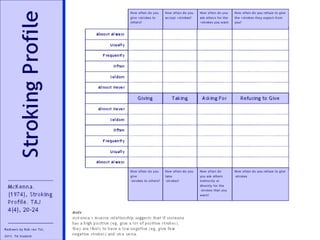
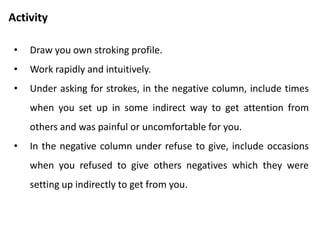
• Draw you own stroking profile.
• Work rapidly and intuitively.
• Under asking for strokes, in the negative column, include times
when you set up in some indirect way to get attention from
others and was painful or uncomfortable for you.
• In the negative column under refuse to give, include occasions
when you refused to give others negatives which they were
setting up indirectly to get from you.
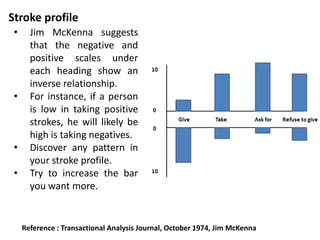
Stroke profile
• Jim McKenna suggests
that the negative and
positive scales under
each heading show an
inverse relationship.
• For instance, if a person
is low in taking positive
strokes, he will likely be
high is taking negatives.
• Discover any pattern in
your stroke profile.
• Try to increase the bar
you want more.
Reference : Transactional Analysis Journal, October 1974, Jim McKenna
Home work
• Write down five behavior designed to increase any bar you want
more of.
• Carry out these behavior in the coming month.
• For instance, if you decide you want to give more positive
strokes to others, you might note down one compliment you
could genuinely give to each of five of your friends, but have
never given.
• Go ahead and give those compliments during the month.
Activity
• Every one in group can share one good thing about himself or
herself.
• If you are not willing, you can say pass.
Activity
• Be into groups of four.
• Each person come to the center.
• Keep bragging non stop for 30 seconds.
• Rest of the group encourage the bragger by good natured
commends like “Great stuff, tell us more.”
Home work
• Write down everything good about yourself.
• If possible, pin the paper up where you can see it often.
• Each time you think of another good thing about yourself, add it
to the list on the paper.
• Make a list of at least five ways you can stroke yourself
positively.
Stroke bank.
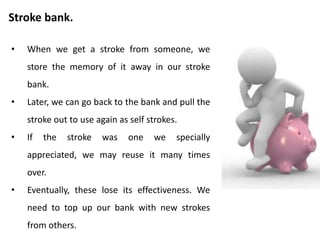
• When we get a stroke from someone, we
store the memory of it away in our stroke
bank.
• Later, we can go back to the bank and pull the
stroke out to use again as self strokes.
• If the stroke was one we specially
appreciated, we may reuse it many times
over.
• Eventually, these lose its effectiveness. We
need to top up our bank with new strokes
from others.
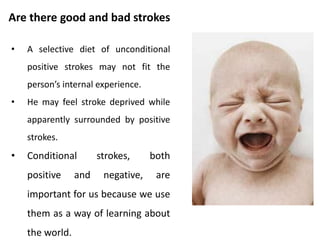
Are there good and bad strokes
• A selective diet of unconditional
positive strokes may not fit the
person’s internal experience.
• He may feel stroke deprived while
apparently surrounded by positive
strokes.
• Conditional strokes, both
positive and negative, are
important for us because we use
them as a way of learning about
the world.
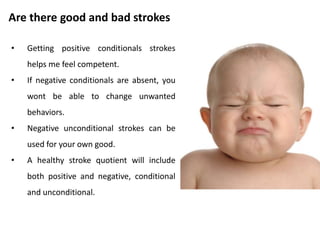
Are there good and bad strokes
• Getting positive conditionals strokes
helps me feel competent.
• If negative conditionals are absent, you
wont be able to change unwanted
behaviors.
• Negative unconditional strokes can be
used for your own good.
• A healthy stroke quotient will include
both positive and negative, conditional
and unconditional.
Strokes Vs Discounts
• A discount always entails some distortion of reality unlike a straight negative
stroke.
• NCS – You spelled the word wrong.
• Discount – I see you can’t spell
• NUCS – I hate you.
• Discount – You are hateful.
• Unlike a straight negative stroke, a discount gives me no signal on which I
can base constructive action.
Other TA topics available on slideshare
1. Strokes - http://www.slideshare.net/manumjoy/strokes-24081607.
2. Games People Play - http://www.slideshare.net/manumjoy/psychological-
games-people-play.
3. Structural Analysis - http://www.slideshare.net/manumjoy/the-ego-state-model.
4. What is TA? - http://www.slideshare.net/manumjoy/what-ta-is
5. Cycles of Development - http://www.slideshare.net/manumjoy/cycles-of-
developement-pamela-levin-transactional-analysis.
6. Stages of Cure - http://www.slideshare.net/manumjoy/stages-of-cure.
7. Transactions - http://www.slideshare.net/manumjoy/transactions-33677298.
8. Time Structuring - http://www.slideshare.net/manumjoy/time-structuring.
9. Life Position - http://www.slideshare.net/manumjoy/life-position.
10. Autonomy - http://www.slideshare.net/manumjoy/autonomy-33690557.
11. Structural Pathology - http://www.slideshare.net/manumjoy/structural-pathology.
12. Game Analysis - http://www.slideshare.net/manumjoy/game-analysis-33725636.
13. Integrated Adult - http://www.slideshare.net/manumjoy/integrated-adult.
14. Stroke Economy - http://www.slideshare.net/manumjoy/stroke-economy-
33826702.

Transactional Analysis - Strokes

  • 1.
  • 2.
    Prepared By Manu MelwinJoy Research Scholar School of Management Studies CUSAT, Kerala, India. Phone – 9744551114 Mail – manu_melwinjoy@yahoo.com Kindly restrict the use of slides for personal purpose. Please seek permission to reproduce the same in public forms and presentations.
  • 3.
    A stroke isdefined as a unit of recognition. (Berne 1971) “A stroke is a unit of attention which provides stimulation to an individual”. (Woollams and Brown: Transactional Analysis 1978)
  • 4.
    Stimulus Hunger Need forphysical and mental stimulation
  • 5.
    Stimulus Hunger Study byRene Spitz Berne’s Choice of the word stroke refers to the infants need for touching.
  • 6.
    Recognition Hunger • Asgrownups, we learn to substitute other forms of recognition in place of physical touching. • A smile, a compliment, frown or insult – all shows our existence has been recognized. • Berne used to term recognition hunger to describe our need for this kind of acknowledgement from others.
  • 7.
  • 8.
    Verbal or NonVerbal • Any transaction is an exchange of strokes. • Most transactions involve both verbal and non verbal exchanges. • They may be wholly non verbal. • It is difficult to imagine a transaction which is purely verbal.
  • 9.
    Internal or external INTERNAL- fantasies, self praise, and other forms of self stimulation. EXTERNAL- strokes from others are important for healthy living.
  • 10.
    Positive or Negative •A positive stroke is one which the receiver experiences as pleasant. • A negative stroke is one experienced as painful. • Any kind of stroke is better than no stroke at all.
  • 11.
    Conditional or Unconditional •A conditional stroke relates to what you do. • An unconditional stroke relates to what you are. • Positive conditional. • Positive unconditional. • Negative conditional. • Negative Unconditional
  • 13.
    Activity • Write downtwo strokes you gave today • Write down two strokes you received today. • Identify which kind of stroke it is. • Verbal or Non verbal. • Positive or Negative. • Conditional or Unconditional. • Positive conditional. • Positive unconditional. • Negative conditional. • Negative Unconditional • Internal or External.
  • 14.
    Activity • Give apositive conditional stroke to the person sitting to your left. • Give an internal positive unconditional stroke to yourself. • Give a Non verbal stroke to the person sitting to your right.
  • 15.
    Stroking and reinforcementof behavior • Stroking reinforces the behavior which is stroked. • If there do not seem to be enough positive strokes to fulfill our need for stroking, we will go ahead and seek out negative strokes. • Quality and intensity of strokes are important.
  • 16.
    Giving strokes • Counterfeitstrokes are as though they give something positive, then take it away again. • Plastic strokes are insincere positives. Eric Berne described this as marshmallow – Throwing.
  • 17.
    Taking strokes • Weare used to getting certain strokes. • Because of their familiarity, we devalue these strokes. • We may secretly want to receive other strokes which we seldom get. • We deny to ourselves that we want the strokes we most want.
  • 18.
    Taking strokes • Everybodyhas their preferred stroke quotient. • Quality of strokes cannot be measured subjectively. • A high quality for stroke to you may be a low quality stroke for me. Different strokes for different folks.
  • 19.
    Stroke Filter /Discount • When someone gets a stroke that doesn’t fit in with her preferred stroke quotient, she is likely to ignore it or belittle it. • Discounts are an internal mechanism by which people minimize or maximize (grandiosity) an aspect of reality, themselves or others. • In other words they are not accounting for the reality of themselves or others or the situation.
  • 20.
    Levels of Discounting •The EXISTENCE of a problem, e.g. a baby cries and the parents go to sleep. • The SIGNIFICANCE of a problem “Oh the baby always cries at this time”. • The CHANGE POSSIBILITIES “The baby will never be satisfied”. • The PERSONAL ABILITY to actually carry out the change “You could but I can’t change the nappy”. At each level the discount can be of three types: • The STIMULUS can be discounted. • The PROBLEM can be discounted. • The OPTIONS can be discounted.
  • 21.
    Reference : DiscountMatrix was developed. by Mellor and Schiff... TAJ July 1975. Discount Matrix
  • 22.
    Activity • Think aboutthe strokes you gave and received. • Was it counterfeit, marshmallows, straight? • Who received it openly, who discounted it? • Which strokes you received and which one you discounted?
  • 23.
    Activity • Divide intogroups of four. • For one minute, one among the four will listen and others will deliver verbal strokes. (Positive or Positive/Negative) • For next one minute, it will share his/her experiences with the others. • Consider the following questions. • Which of the strokes I got did I expect to get? • Which strokes did not I expect? • Which strokes did I like? • Which strokes I dislike? • Are there any strokes I did have liked to get and didn’t ?
  • 24.
    Stroke economy • ClaudeSteiner suggests that as children, we are all indoctrinated by our parents with five restrictive rules about stroking. • Don’t give strokes when you have them to give. • Don’t ask for strokes when you need them. • Don’t accept strokes if you want them. • Don’t reject strokes when you don’t want them. • Don’t give yourself strokes. The Warm Fuzzy Tale Reference : Scripts People Live (1974) Claude Steiner
  • 25.
    Stroke economy • Parentsuse it to control children. • Teach children that strokes are in short supply. • Parents gains the position of a stroke monopolist. • As grownups, we unawarely use these rules. • We spend out lives in a state of partial stroke deprivation. • We need to reject our restrictive basic training. • Strokes are limitless in supply. • We can give a stroke when we want. • When we want, we can ask. • We can take stroke when offered. • If we don’t like the stroke, we can reject it openly. • We can enjoy giving ourselves strokes.
  • 26.
    Activity • Think backover the stroking exercises. • How you experienced giving, accepting and rejecting strokes. • Which were you comfortable and uncomfortable with? • When you were uncomfortable, do you trace that back to rules you remember your parents setting for you as a child?
  • 27.
    Asking for strokes •A myth – Strokes that you have to ask for are worthless. • Reality – Strokes that you get by asking are worth just as much as strokes you get without asking. • Question – “ Other person may give me stroke just be nice” • They may be restricted by their “Don’t give stroke” messages. • Options - You can check with the person whether it was genuine. • Options – If not genuine, you can ask for genuine one.
  • 28.
    Activity • Be ingroups of four. • Exercise is on asking strokes. • A person “It” takes three minutes to ask the others for strokes. • Strokers responding by giving the strokes asked for if they are genuinely willing to give it. If not, say “I am not willing to give you the stroke right now.” • It shares his/her experience with others.
  • 29.
    Home work • Writedown at least five positive strokes you want but don’t usually ask for. • In the following month, ask at least one person for each of these strokes. • If you get the stroke, thank the stroker. • If you do not, it is ok to ask for adult information about why the other person did not want to give the stroke asked for. • Homework is over when you have asked for the strokes whether or not you got all of them. When you have asked for all the strokes on your list, give yourself a stroke for doing the exercise.
  • 31.
    Activity • Draw youown stroking profile. • Work rapidly and intuitively. • Under asking for strokes, in the negative column, include times when you set up in some indirect way to get attention from others and was painful or uncomfortable for you. • In the negative column under refuse to give, include occasions when you refused to give others negatives which they were setting up indirectly to get from you.
  • 32.
    Stroke profile • JimMcKenna suggests that the negative and positive scales under each heading show an inverse relationship. • For instance, if a person is low in taking positive strokes, he will likely be high is taking negatives. • Discover any pattern in your stroke profile. • Try to increase the bar you want more. Reference : Transactional Analysis Journal, October 1974, Jim McKenna
  • 33.
    Home work • Writedown five behavior designed to increase any bar you want more of. • Carry out these behavior in the coming month. • For instance, if you decide you want to give more positive strokes to others, you might note down one compliment you could genuinely give to each of five of your friends, but have never given. • Go ahead and give those compliments during the month.
  • 34.
    Activity • Every onein group can share one good thing about himself or herself. • If you are not willing, you can say pass.
  • 35.
    Activity • Be intogroups of four. • Each person come to the center. • Keep bragging non stop for 30 seconds. • Rest of the group encourage the bragger by good natured commends like “Great stuff, tell us more.”
  • 36.
    Home work • Writedown everything good about yourself. • If possible, pin the paper up where you can see it often. • Each time you think of another good thing about yourself, add it to the list on the paper. • Make a list of at least five ways you can stroke yourself positively.
  • 37.
    Stroke bank. • Whenwe get a stroke from someone, we store the memory of it away in our stroke bank. • Later, we can go back to the bank and pull the stroke out to use again as self strokes. • If the stroke was one we specially appreciated, we may reuse it many times over. • Eventually, these lose its effectiveness. We need to top up our bank with new strokes from others.
  • 38.
    Are there goodand bad strokes • A selective diet of unconditional positive strokes may not fit the person’s internal experience. • He may feel stroke deprived while apparently surrounded by positive strokes. • Conditional strokes, both positive and negative, are important for us because we use them as a way of learning about the world.
  • 39.
    Are there goodand bad strokes • Getting positive conditionals strokes helps me feel competent. • If negative conditionals are absent, you wont be able to change unwanted behaviors. • Negative unconditional strokes can be used for your own good. • A healthy stroke quotient will include both positive and negative, conditional and unconditional.
  • 40.
    Strokes Vs Discounts •A discount always entails some distortion of reality unlike a straight negative stroke. • NCS – You spelled the word wrong. • Discount – I see you can’t spell • NUCS – I hate you. • Discount – You are hateful. • Unlike a straight negative stroke, a discount gives me no signal on which I can base constructive action.
  • 42.
    Other TA topicsavailable on slideshare 1. Strokes - http://www.slideshare.net/manumjoy/strokes-24081607. 2. Games People Play - http://www.slideshare.net/manumjoy/psychological- games-people-play. 3. Structural Analysis - http://www.slideshare.net/manumjoy/the-ego-state-model. 4. What is TA? - http://www.slideshare.net/manumjoy/what-ta-is 5. Cycles of Development - http://www.slideshare.net/manumjoy/cycles-of- developement-pamela-levin-transactional-analysis. 6. Stages of Cure - http://www.slideshare.net/manumjoy/stages-of-cure. 7. Transactions - http://www.slideshare.net/manumjoy/transactions-33677298. 8. Time Structuring - http://www.slideshare.net/manumjoy/time-structuring. 9. Life Position - http://www.slideshare.net/manumjoy/life-position. 10. Autonomy - http://www.slideshare.net/manumjoy/autonomy-33690557. 11. Structural Pathology - http://www.slideshare.net/manumjoy/structural-pathology. 12. Game Analysis - http://www.slideshare.net/manumjoy/game-analysis-33725636. 13. Integrated Adult - http://www.slideshare.net/manumjoy/integrated-adult. 14. Stroke Economy - http://www.slideshare.net/manumjoy/stroke-economy- 33826702.