CONCEPT OF PERSONALITY
DEVELOPMENT
CHAPTER 2
1
2
3
4
5
CONCEPTS OF PERSONALITY
DEVELOPMENT
 Definitions:
 Personality:DSM-IV-TR(APA,2000) Defines
Personality as” Enduring Patterns of perceiving
,relating to, and thinking about the environment and
oneself”
 Temperament: ”Refers to inborn personality
characteristics that influence an individual’s manner
of reacting to environment and ultimately his or her
developmental progression.”(Chess &Thomas 1986)
6
7
Theories of Personality Development
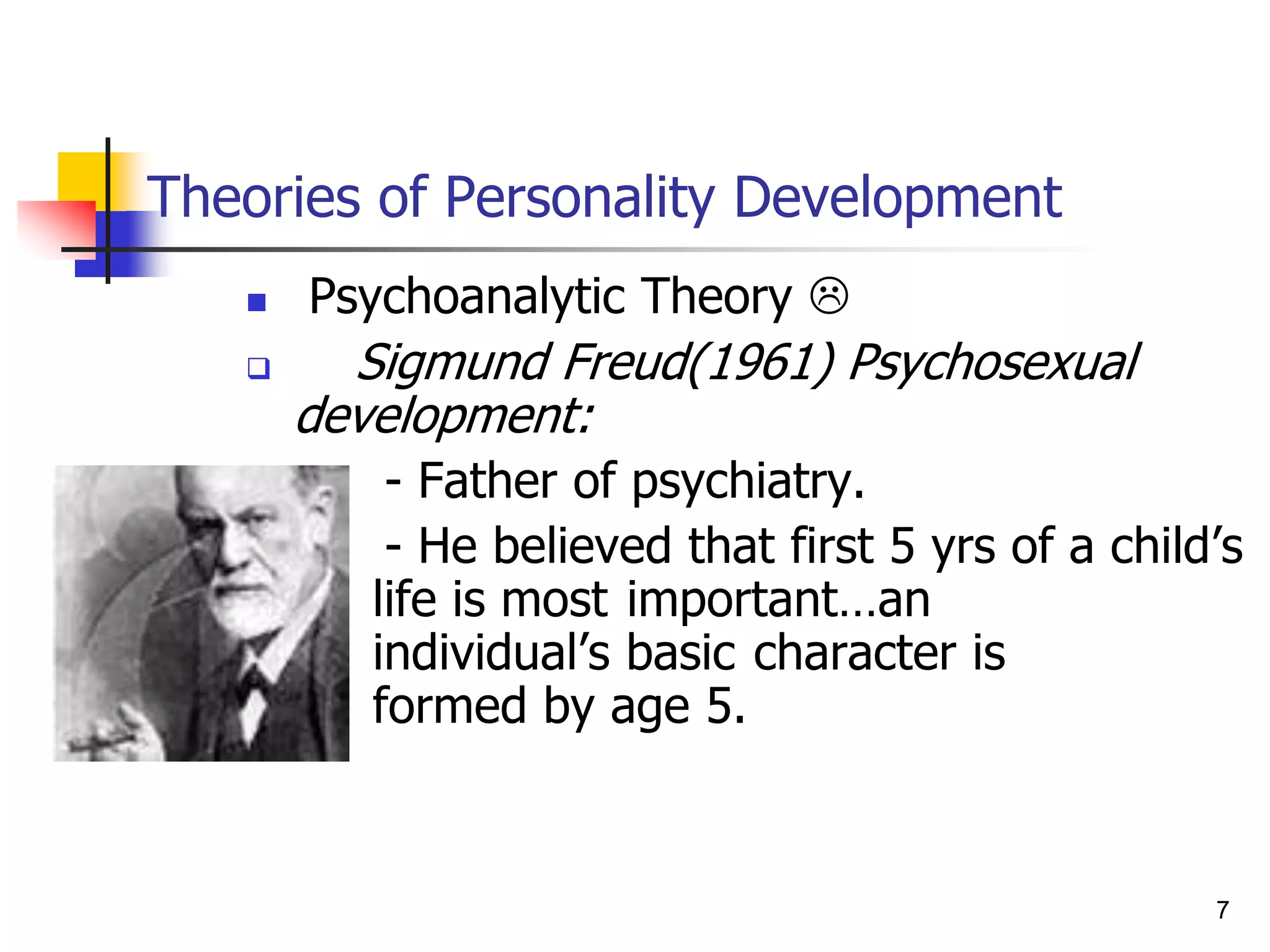
 Psychoanalytic Theory 
 Sigmund Freud(1961) Psychosexual
development:
- Father of psychiatry.
- He believed that first 5 yrs of a child’s
life is most important…an
individual’s basic character is
formed by age 5.
8
 Components of Freud’s
Psychoanalytic theory:
• Structure and dynamic of personality
• Topography of mind
• Stages(psychosexual) of personality
development.
9
 Structure and Dynamic of Personality:
3 components of personality:
- id “pleasure principle”…present at birth
- satisfy needs, & achieve
immediate gratification
- id-driven behaviors are impulsive
and may be irrational.
10
 Ego “Rational Self” or “Reality Principle”.
- Begins to develop between the age 4-6
month.
- Ego experiences the reality of external
world, adapt to it and respond to it.
11
As the ego develops and gains strength, it
seeks to bring the influences of the external
world to beer on the id to substitute the
reality principles for the pleasure principle.
- Primary function for the ego is one of
mediator …it strive to maintain harmony
among the external world, the id , and the
superego.
12
 Superego
- Perfection principle
- Development between age 3 and 6 yrs
- Internalizes the values and morals set forth
by primary caregivers
- Derives from a system of reward and
punishment.
13
 Components of superego:
- ego ideals
- conscience
e.g. .. “ when a child is consistently rewarded
for “Good behavior” …. Then self esteem
enhanced and the behavior becomes part of
the ego ideal”, that it is internalized as part of
his or her value system.
14
- The conscience is formed when the child is
consistently punished for “bad behavior”.
- the child learns that is considered morally
right or wrong from feedback received from
parental figures or from society or culture.
- When the superego becomes rigid and
punitive problems with low self-esteem arise.
15
 Topography of the Mind:
1.The conscious Mind
2. The preconscious
3. The unconscious
16
 The conscious mind:
- It includes all memories that remain within
an individual’s awareness,
- It is the smallest of the three categories.
- Events are easily remembered e.g birth
dates, Tel.No., dates of special holidays.
It is under the control of ego.
17
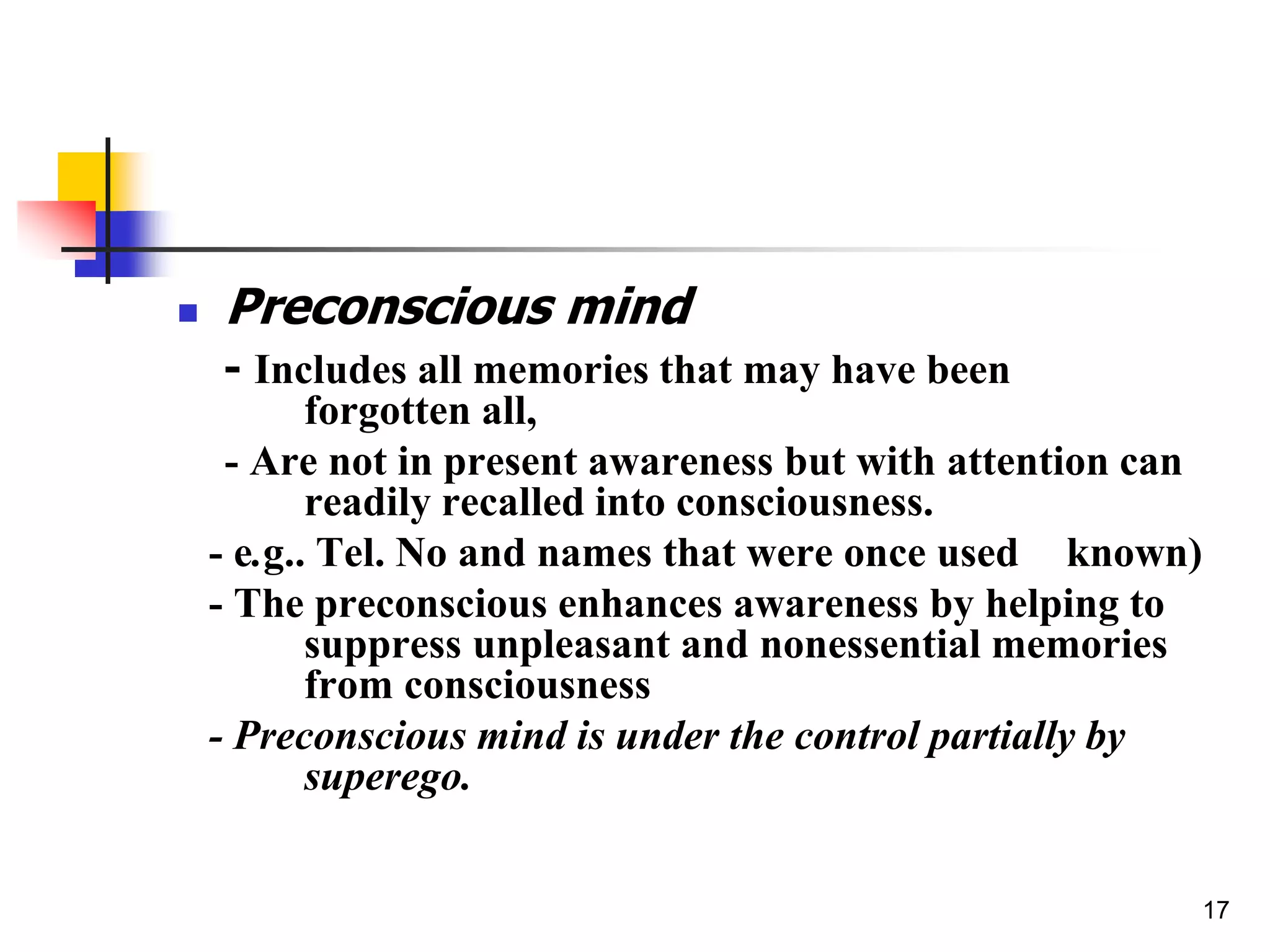
 Preconscious mind
- Includes all memories that may have been
forgotten all,
- Are not in present awareness but with attention can
readily recalled into consciousness.
- e.g.. Tel. No and names that were once used known)
- The preconscious enhances awareness by helping to
suppress unpleasant and nonessential memories
from consciousness
- Preconscious mind is under the control partially by
superego.
18
 The unconscious mind:
- Includes all memories that one is unable to
bring to consciousness.
- It is the “largest” of the 3 categories.
- Unconscious material consists of unpleasant
or nonessential memories that ,have been
“Repressed” and can be retrieved only by
or through therapy/hypnosis & with certain
substances that alter the awareness.
- Unconscious material may emerge in
Dreams & in seemingly incomprehensible
behavior
19
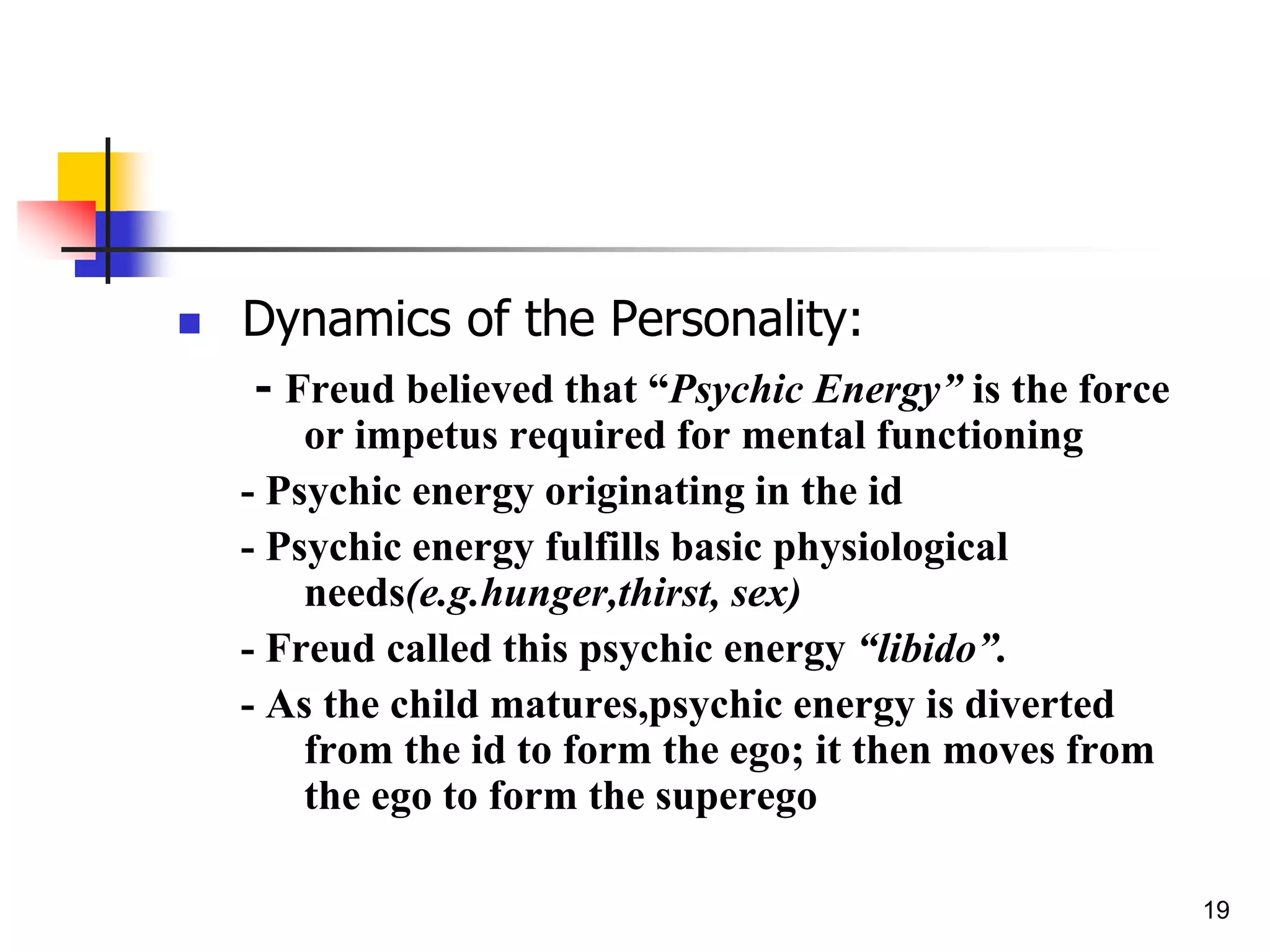
 Dynamics of the Personality:
- Freud believed that “Psychic Energy” is the force
or impetus required for mental functioning
- Psychic energy originating in the id
- Psychic energy fulfills basic physiological
needs(e.g.hunger,thirst, sex)
- Freud called this psychic energy “libido”.
- As the child matures,psychic energy is diverted
from the id to form the ego; it then moves from
the ego to form the superego
20
- Psychic energy is distributed withinid, ego,
superego, with the ego retaining the largest
share to maintain a balance between id
impulsive behavior and the idealistic
behaviors of the superego.
- If an excessive amount of psychic energy is
stored in one of personality components,
behavior will reflect that part of the
personality.
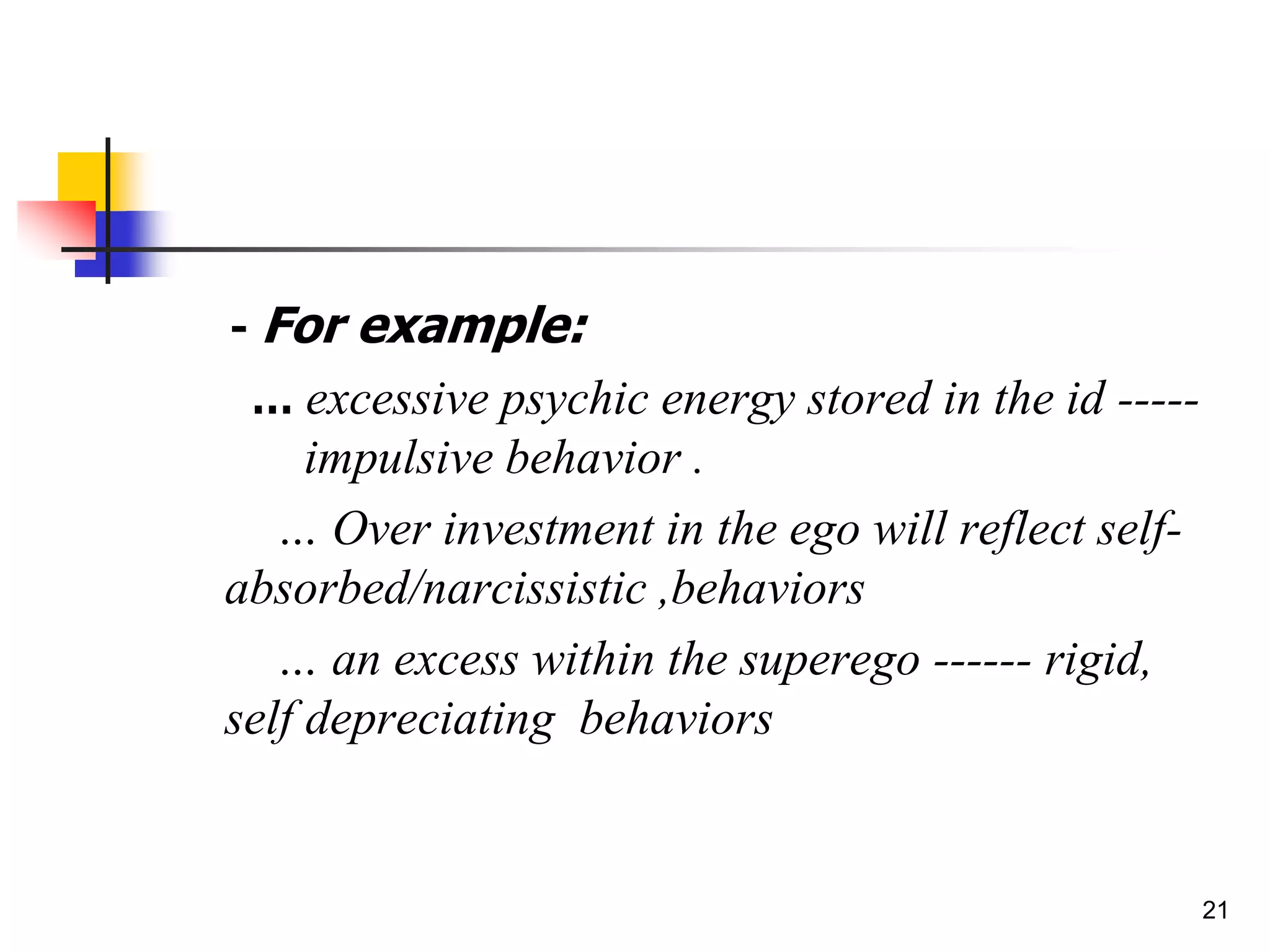
21
- For example:
… excessive psychic energy stored in the id -----
impulsive behavior .
… Over investment in the ego will reflect self-
absorbed/narcissistic ,behaviors
… an excess within the superego ------ rigid,
self depreciating behaviors
22
 Cathexis and anticathexis:
- Freud used the term cahexis and
anticathexis to describe the forces within the
id,ego,and superego.
- Cathexis: is the process by which the id
invests energy into an object in attempt to
achieve gratification .e.g a person who
instinctively turns to alcohol to relieve stress .
23
- Anticathexis: Is the use of psychic
energy by the ego and the
superego to control the use of alcohol
with rational thinking. e.g “I already
have peptic ulcer from drinking I will
not drink ,I will call my doctor .
- conflict between cathexis and
anticathexis ….. Tention and anxiety
24
 Freud’s Stages of Personality Development:
- Freud placed much emphasis on the first 5
yrs of life.
- He believed that characteristics developed
during these early years bore heavily on one’s
adaptation patterns and personality traits in
adulthood.
- Fixation in early stage of development will
almost certainly result in psychopathology.
25
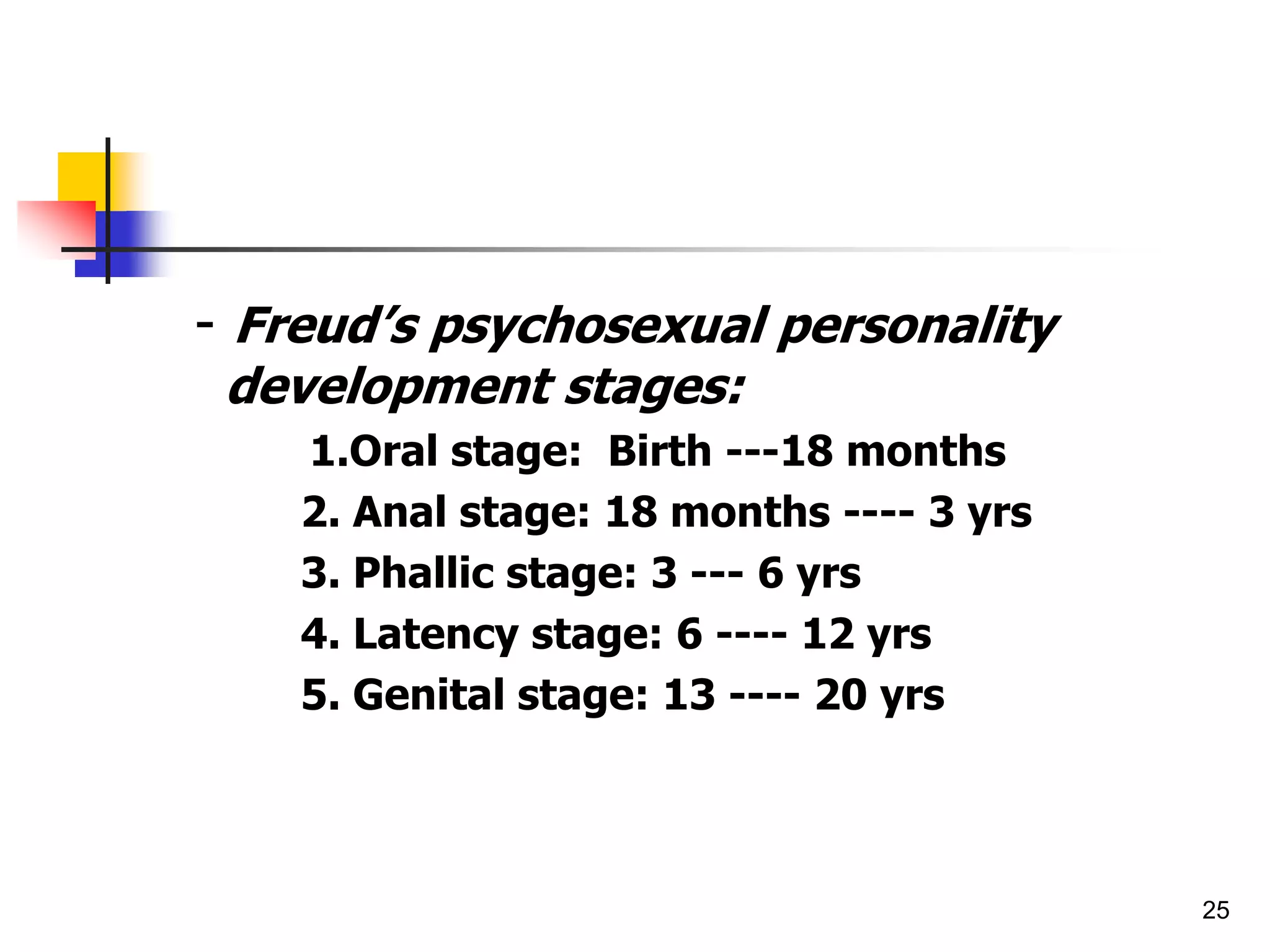
- Freud’s psychosexual personality
development stages:
1.Oral stage: Birth ---18 months
2. Anal stage: 18 months ---- 3 yrs
3. Phallic stage: 3 --- 6 yrs
4. Latency stage: 6 ---- 12 yrs
5. Genital stage: 13 ---- 20 yrs
26
27
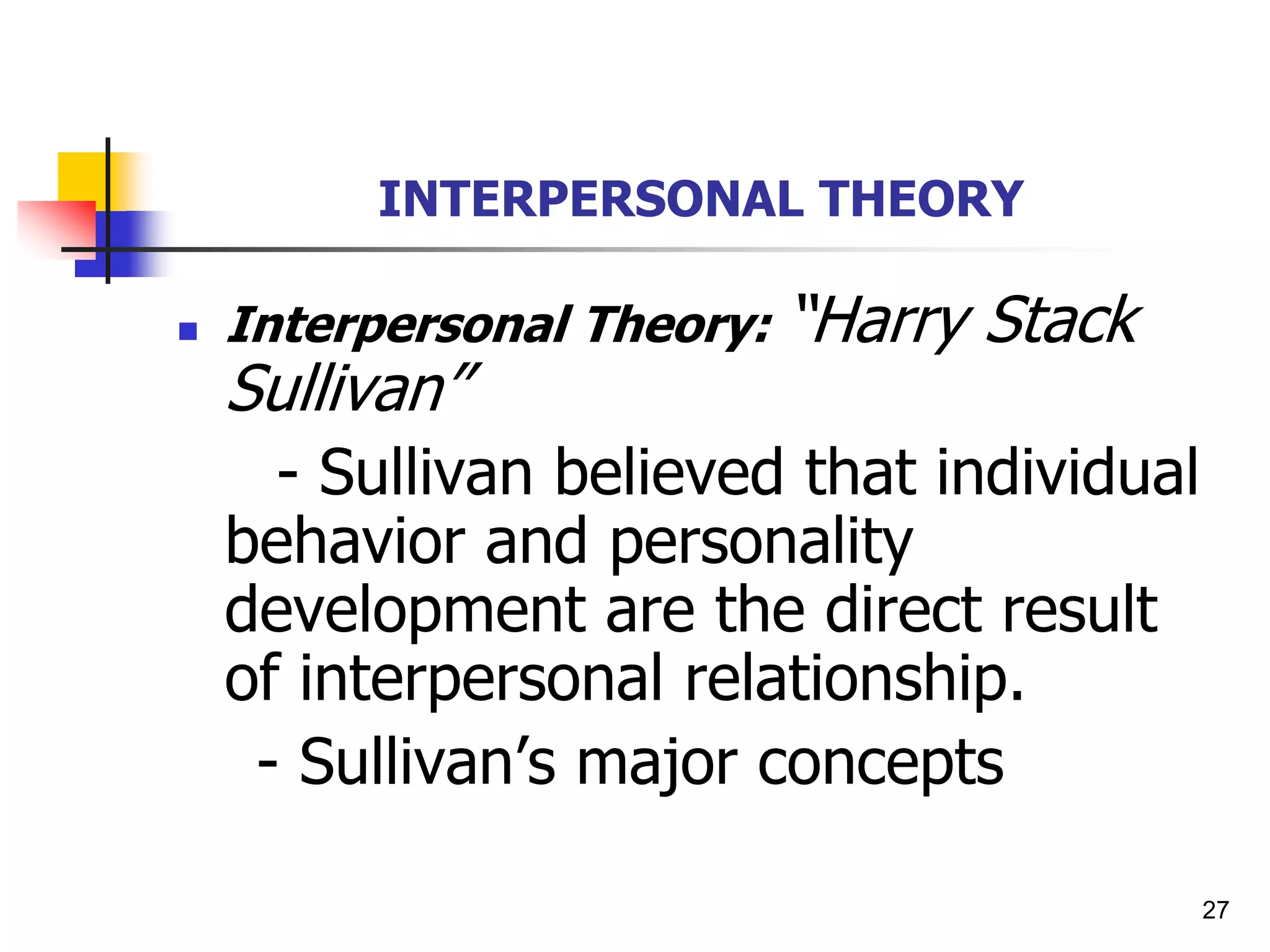
INTERPERSONAL THEORY
 Interpersonal Theory: “Harry Stack
Sullivan”
- Sullivan believed that individual
behavior and personality
development are the direct result
of interpersonal relationship.
- Sullivan’s major concepts
28
 Anxiety “is a feeling of emotional
discomfort, and all behavior is aimed
toward the relief or prevention of it”.
- Sullivan believed that anxiety is
the “chief disruptive force in
interpersonal relations and the main
factor in the development of serious
difficulties in living”.
29
- Anxiety arises out of one’s inability to satisfy needs
or achieve interpersonal security.
 Satisfaction of Needs:
 Interpersonal security
 The self –system… components..
- The “good me”
- The “bad me”
- The “not me”
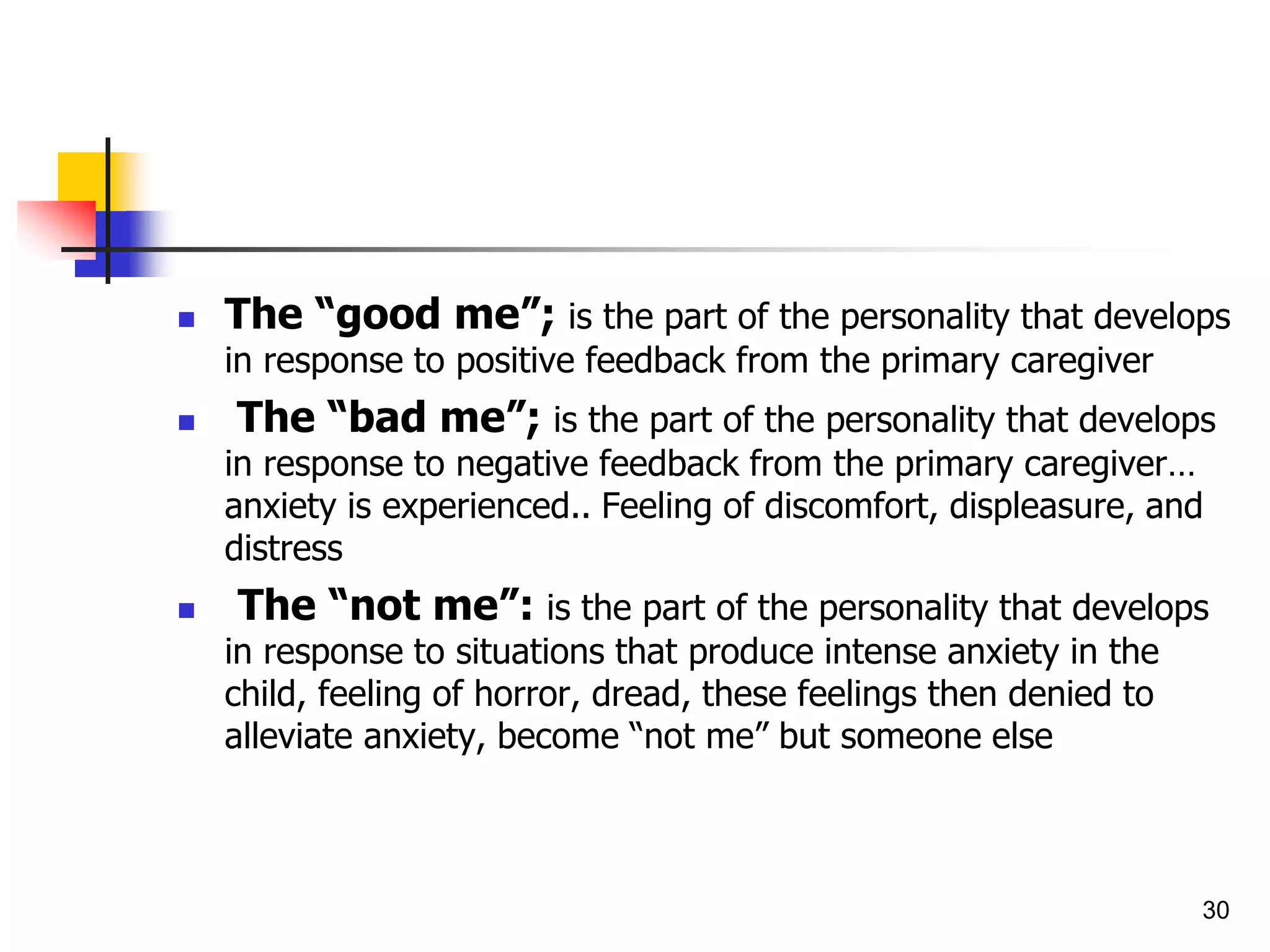
 The “good me”; is the part of the personality that develops
in response to positive feedback from the primary caregiver
 The “bad me”; is the part of the personality that develops
in response to negative feedback from the primary caregiver…
anxiety is experienced.. Feeling of discomfort, displeasure, and
distress
 The “not me”: is the part of the personality that develops
in response to situations that produce intense anxiety in the
child, feeling of horror, dread, these feelings then denied to
alleviate anxiety, become “not me” but someone else
30
31
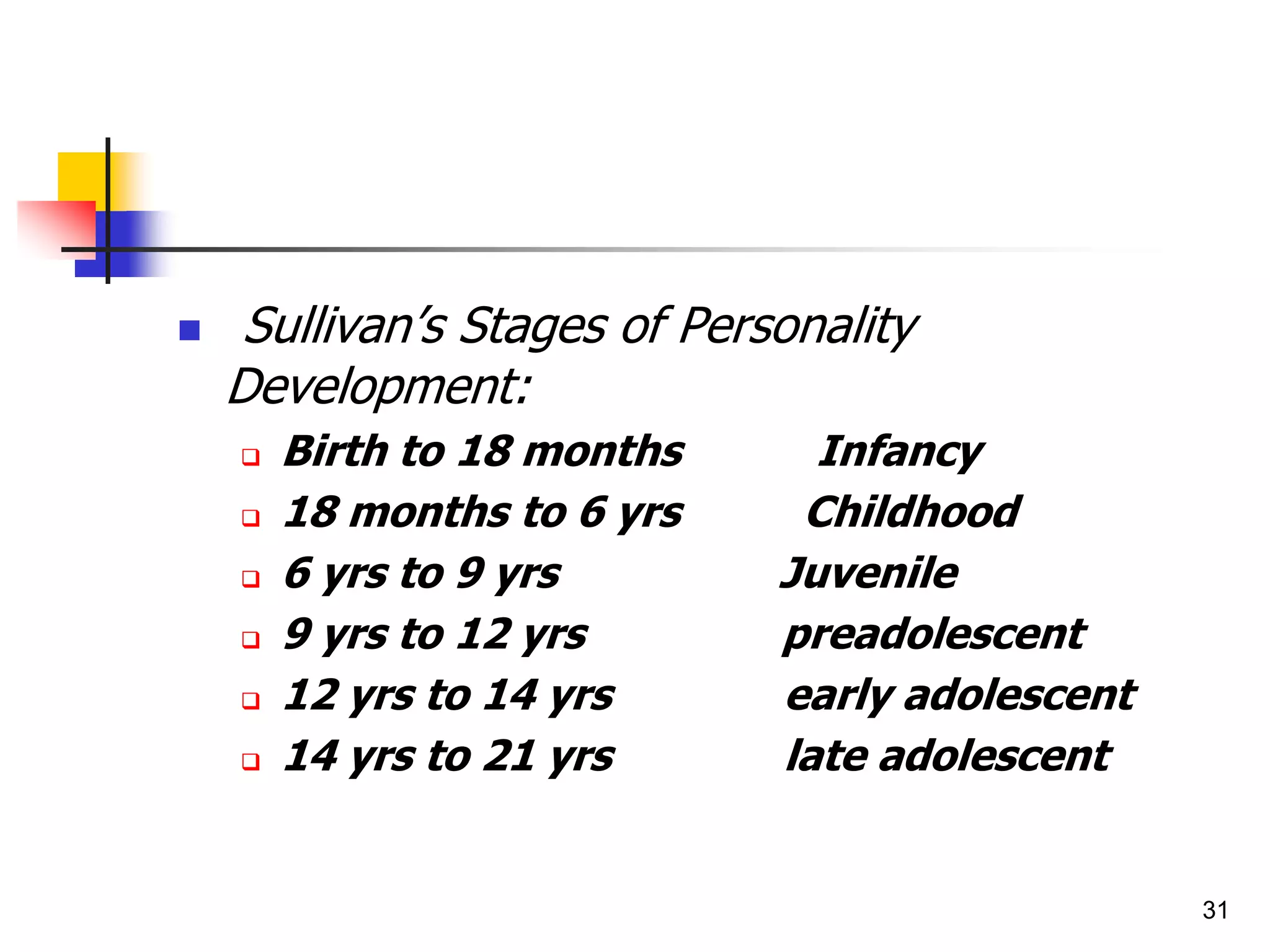
 Sullivan’s Stages of Personality
Development:
 Birth to 18 months Infancy
 18 months to 6 yrs Childhood
 6 yrs to 9 yrs Juvenile
 9 yrs to 12 yrs preadolescent
 12 yrs to 14 yrs early adolescent
 14 yrs to 21 yrs late adolescent
32
THEORY OF PSYCHOSOCIAL DEVELOPMENT
 Erikson described 8 stages of life cycle
during which individuals struggle with
developmental “crisis”
 Specific tasks associated with each stage
must be completed for resolution of the
crisis and for the occurrence of emotional
growth.
33
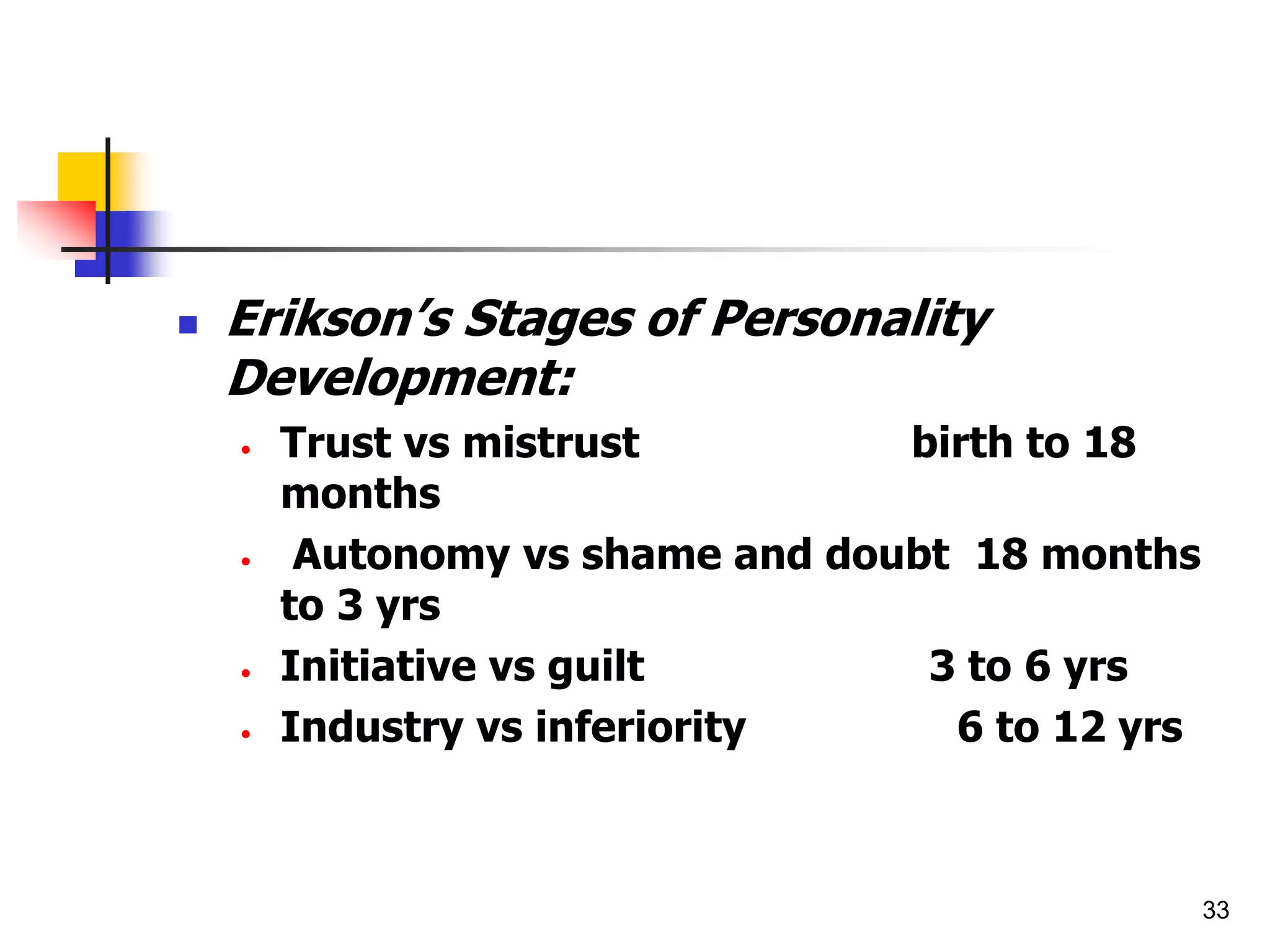
 Erikson’s Stages of Personality
Development:
• Trust vs mistrust birth to 18
months
• Autonomy vs shame and doubt 18 months
to 3 yrs
• Initiative vs guilt 3 to 6 yrs
• Industry vs inferiority 6 to 12 yrs
34
• Identity vs role confusion 12 to
20 yrs
• Intimacy vs isolation 20 to
30 yrs
• Generativity vs stagnation 30
to 65 yrs
• Ego integrity vs despair 65 to
death
35

BEED 17 TO EDIT.ppt

  • 1.
  • 2.
  • 3.
  • 4.
  • 5.
    5 CONCEPTS OF PERSONALITY DEVELOPMENT Definitions:  Personality:DSM-IV-TR(APA,2000) Defines Personality as” Enduring Patterns of perceiving ,relating to, and thinking about the environment and oneself”  Temperament: ”Refers to inborn personality characteristics that influence an individual’s manner of reacting to environment and ultimately his or her developmental progression.”(Chess &Thomas 1986)
  • 6.
  • 7.
    7 Theories of PersonalityDevelopment  Psychoanalytic Theory   Sigmund Freud(1961) Psychosexual development: - Father of psychiatry. - He believed that first 5 yrs of a child’s life is most important…an individual’s basic character is formed by age 5.
  • 8.
    8  Components ofFreud’s Psychoanalytic theory: • Structure and dynamic of personality • Topography of mind • Stages(psychosexual) of personality development.
  • 9.
    9  Structure andDynamic of Personality: 3 components of personality: - id “pleasure principle”…present at birth - satisfy needs, & achieve immediate gratification - id-driven behaviors are impulsive and may be irrational.
  • 10.
    10  Ego “RationalSelf” or “Reality Principle”. - Begins to develop between the age 4-6 month. - Ego experiences the reality of external world, adapt to it and respond to it.
  • 11.
    11 As the egodevelops and gains strength, it seeks to bring the influences of the external world to beer on the id to substitute the reality principles for the pleasure principle. - Primary function for the ego is one of mediator …it strive to maintain harmony among the external world, the id , and the superego.
  • 12.
    12  Superego - Perfectionprinciple - Development between age 3 and 6 yrs - Internalizes the values and morals set forth by primary caregivers - Derives from a system of reward and punishment.
  • 13.
    13  Components ofsuperego: - ego ideals - conscience e.g. .. “ when a child is consistently rewarded for “Good behavior” …. Then self esteem enhanced and the behavior becomes part of the ego ideal”, that it is internalized as part of his or her value system.
  • 14.
    14 - The conscienceis formed when the child is consistently punished for “bad behavior”. - the child learns that is considered morally right or wrong from feedback received from parental figures or from society or culture. - When the superego becomes rigid and punitive problems with low self-esteem arise.
  • 15.
    15  Topography ofthe Mind: 1.The conscious Mind 2. The preconscious 3. The unconscious
  • 16.
    16  The consciousmind: - It includes all memories that remain within an individual’s awareness, - It is the smallest of the three categories. - Events are easily remembered e.g birth dates, Tel.No., dates of special holidays. It is under the control of ego.
  • 17.
    17  Preconscious mind -Includes all memories that may have been forgotten all, - Are not in present awareness but with attention can readily recalled into consciousness. - e.g.. Tel. No and names that were once used known) - The preconscious enhances awareness by helping to suppress unpleasant and nonessential memories from consciousness - Preconscious mind is under the control partially by superego.
  • 18.
    18  The unconsciousmind: - Includes all memories that one is unable to bring to consciousness. - It is the “largest” of the 3 categories. - Unconscious material consists of unpleasant or nonessential memories that ,have been “Repressed” and can be retrieved only by or through therapy/hypnosis & with certain substances that alter the awareness. - Unconscious material may emerge in Dreams & in seemingly incomprehensible behavior
  • 19.
    19  Dynamics ofthe Personality: - Freud believed that “Psychic Energy” is the force or impetus required for mental functioning - Psychic energy originating in the id - Psychic energy fulfills basic physiological needs(e.g.hunger,thirst, sex) - Freud called this psychic energy “libido”. - As the child matures,psychic energy is diverted from the id to form the ego; it then moves from the ego to form the superego
  • 20.
    20 - Psychic energyis distributed withinid, ego, superego, with the ego retaining the largest share to maintain a balance between id impulsive behavior and the idealistic behaviors of the superego. - If an excessive amount of psychic energy is stored in one of personality components, behavior will reflect that part of the personality.
  • 21.
    21 - For example: …excessive psychic energy stored in the id ----- impulsive behavior . … Over investment in the ego will reflect self- absorbed/narcissistic ,behaviors … an excess within the superego ------ rigid, self depreciating behaviors
  • 22.
    22  Cathexis andanticathexis: - Freud used the term cahexis and anticathexis to describe the forces within the id,ego,and superego. - Cathexis: is the process by which the id invests energy into an object in attempt to achieve gratification .e.g a person who instinctively turns to alcohol to relieve stress .
  • 23.
    23 - Anticathexis: Isthe use of psychic energy by the ego and the superego to control the use of alcohol with rational thinking. e.g “I already have peptic ulcer from drinking I will not drink ,I will call my doctor . - conflict between cathexis and anticathexis ….. Tention and anxiety
  • 24.
    24  Freud’s Stagesof Personality Development: - Freud placed much emphasis on the first 5 yrs of life. - He believed that characteristics developed during these early years bore heavily on one’s adaptation patterns and personality traits in adulthood. - Fixation in early stage of development will almost certainly result in psychopathology.
  • 25.
    25 - Freud’s psychosexualpersonality development stages: 1.Oral stage: Birth ---18 months 2. Anal stage: 18 months ---- 3 yrs 3. Phallic stage: 3 --- 6 yrs 4. Latency stage: 6 ---- 12 yrs 5. Genital stage: 13 ---- 20 yrs
  • 26.
  • 27.
    27 INTERPERSONAL THEORY  InterpersonalTheory: “Harry Stack Sullivan” - Sullivan believed that individual behavior and personality development are the direct result of interpersonal relationship. - Sullivan’s major concepts
  • 28.
    28  Anxiety “isa feeling of emotional discomfort, and all behavior is aimed toward the relief or prevention of it”. - Sullivan believed that anxiety is the “chief disruptive force in interpersonal relations and the main factor in the development of serious difficulties in living”.
  • 29.
    29 - Anxiety arisesout of one’s inability to satisfy needs or achieve interpersonal security.  Satisfaction of Needs:  Interpersonal security  The self –system… components.. - The “good me” - The “bad me” - The “not me”
  • 30.
     The “goodme”; is the part of the personality that develops in response to positive feedback from the primary caregiver  The “bad me”; is the part of the personality that develops in response to negative feedback from the primary caregiver… anxiety is experienced.. Feeling of discomfort, displeasure, and distress  The “not me”: is the part of the personality that develops in response to situations that produce intense anxiety in the child, feeling of horror, dread, these feelings then denied to alleviate anxiety, become “not me” but someone else 30
  • 31.
    31  Sullivan’s Stagesof Personality Development:  Birth to 18 months Infancy  18 months to 6 yrs Childhood  6 yrs to 9 yrs Juvenile  9 yrs to 12 yrs preadolescent  12 yrs to 14 yrs early adolescent  14 yrs to 21 yrs late adolescent
  • 32.
    32 THEORY OF PSYCHOSOCIALDEVELOPMENT  Erikson described 8 stages of life cycle during which individuals struggle with developmental “crisis”  Specific tasks associated with each stage must be completed for resolution of the crisis and for the occurrence of emotional growth.
  • 33.
    33  Erikson’s Stagesof Personality Development: • Trust vs mistrust birth to 18 months • Autonomy vs shame and doubt 18 months to 3 yrs • Initiative vs guilt 3 to 6 yrs • Industry vs inferiority 6 to 12 yrs
  • 34.
    34 • Identity vsrole confusion 12 to 20 yrs • Intimacy vs isolation 20 to 30 yrs • Generativity vs stagnation 30 to 65 yrs • Ego integrity vs despair 65 to death
  • 35.