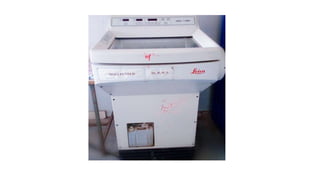
MICROTOME
Why do we preserve tissue samples ???
• For gross display in the Museum .
• For microscopic evaluation .
For Microscopic Study
The Major tissue component ,
• Is initially fixed using a suitable fixative .
• Undergoes adequate change in solutions , at adequate time - PROCESSING .
• Embedded in paraffin wax as BLOCKS .
• From the blocks , thin tissue sections are cut using specialized equipment
called MICROTOME .
• Stained & studied under a microscope
MICROTOMY
• The art of section cutting.
• This is a process of cutting thin sections of tissue embedded in
the wax block using a microtome .
MICROTOME
• Basic instrument / Mechanical device for cutting thin uniform
slices of tissue .
HISTORY
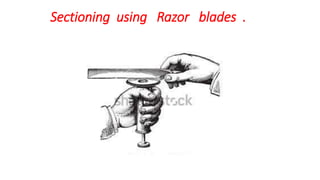
• In the beginning of microscopy , sections were made with Razor blades.
• This method failed due to the impossibility of light transmission through
thicker tissue .
• Only with proper clean reproducible cuts of 100 μm , light can be
transmitted , allowing precise observation of tissues to be carried out .
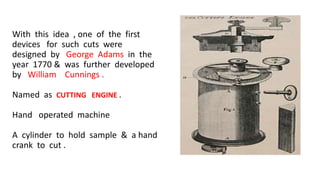
With this idea , one of the first
devices for such cuts were
designed by George Adams in the
year 1770 & was further developed
by William Cunnings .
Named as CUTTING ENGINE .
Hand operated machine
A cylinder to hold sample & a hand
crank to cut .
• Then the word Microtome was derived from Greek mikros, meaning
"small", & temnein, meaning "to cut" .
• It is a tool used to cut extremely thin slices of material, known as Sections.
• Important in science to cut sections for microscopical observation.
• Microtomes use steel , glass , or diamond blades depending upon the
specimen type & desired thickness of the sections to be cut .
• Sections can be made as thin as , breadth of a human hair , between
50 – 100 μm .
• After several modifications , today we use microtomes of
KNIFE BLOCK DESIGN.
• It has a
Changeable knife , &
Specimen holder.
• Automatic machines are also available , where the sample moves
over the knife with a precision control of tissue thickness.
Sectioning using Razor blades .
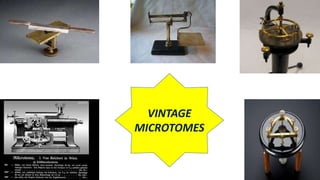
VINTAGE
MICROTOMES
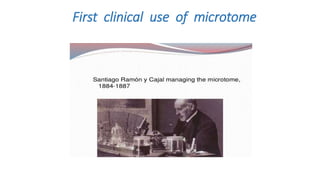
First clinical use of microtome
TYPES OF MICROTOMES
Based upon the mechanism ,
• Rotary
• Rocking
• Base sledge
• Freezing
• Vibrating
• Saw
• Sliding
• Cryostat
• Ultra-Microtome
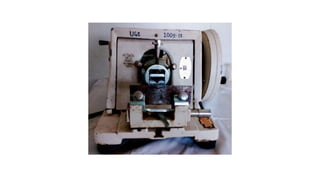
ROTARY MICROTOME
So called because of the Rotary action of hand wheel used for cutting
movement.
The block holder is mounted on a steel carriage, which moves in grooves ,
up & down.
Most ideal for routine & research work .
Excellent for cutting serial sections.
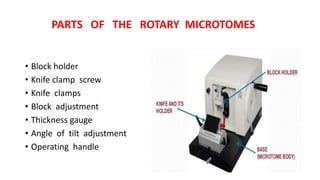
PARTS OF THE ROTARY MICROTOMES
• Block holder
• Knife clamp screw
• Knife clamps
• Block adjustment
• Thickness gauge
• Angle of tilt adjustment
• Operating handle
• The feed mechanism is activated by turning a wheel on one side of
the machine.
• The wheel operation may be electrical / manual .
• The knife is fixed with its edge fixed upwards , while the object
moves against the knife .
• 1 rotation of the operating wheel produces , 1 complete cycle with a
downward cutting stroke & an upward return.
• It is often modified to cut ultrathin sections between 50Å – 200Å.
Advantages of the Rotary microtome
• Heavy & stable.
• Used for large number of serial sections .
• Ideal for Paraffin-embedded tissues .
• Movable knife holder .
• The sections cut are flat.
• It is useful for routine & research papers .
• Currently most common type of microtome in practice.
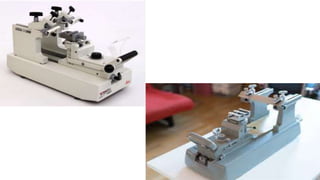
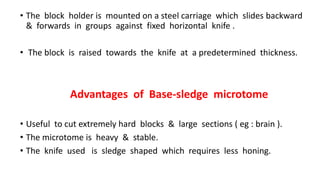
Base Sledge Microtome
• Large & heavy instrument .
• Very stable & popular for routine use .
• The feed mechanism has a fixed knife , beneath which , the object
mounted on a heavy sliding base moves .
• Mainly used for cutting sections of cellulose nitrate embedded tissues
with an obliquely set knife.
Parts of Base-sledge microtome
• Angular tilt adjustment
• Knife clamps
• Block holder
• Coarse feed adjustment
• Operating handle
• Thickness gauge
• Adjustment locking nut
• Block adjustment screw
• Split nut clasp
• The block holder is mounted on a steel carriage which slides backward
& forwards in groups against fixed horizontal knife .
• The block is raised towards the knife at a predetermined thickness.
Advantages of Base-sledge microtome
• Useful to cut extremely hard blocks & large sections ( eg : brain ).
• The microtome is heavy & stable.
• The knife used is sledge shaped which requires less honing.
CAMBRIDGE ROCKING
MICROTOME
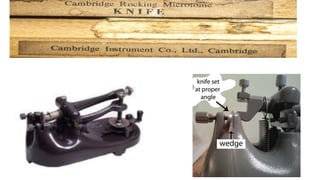
• A simple machine invented by Sir Horace Darwin in 1881 .
• Developed by Cambridge company .
• The instrument has an arm that moves in a rocking motion while cutting the
sections.
• Hence named as Cambridge rocking microtome.
• The knife is held by means of microtome thread.
• The rocking microtome was designed primarily for cutting paraffin wax sections .
• When needed , it can also be used to cut frozen section tissues .
PARTS OF THE ROCKING MICROTOME
• Knife holder
• Block holder / chuck
• Upper & lower arms
• Screw
• Lever
• Pawl
• Ratchet wheel
• Mill head microtome screw
• Sleeve
• Scale
• It cuts the sections between 1 - 20 microns.
• The knife is fixed with the edge.
• The object moves against the knife circularly , producing a sharply curved
surface to the block .
• With each stroke the tissue holder automatically moves vertically towards the
knife.
• Cutting stroke is Spring operated & is easy to handle .
• This microtome must be placed on a solid non-slippery surface to allow a
better hold .
Advantages of Cambridge rocking microtomes
• The cost of knife & microtome is low.
• Celloidin embedded tissues can be sectioned easily.
VIBRATING MICROTOMES
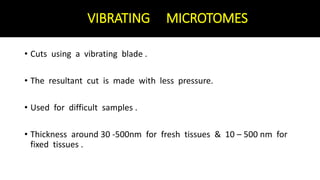
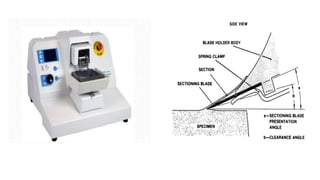
• Cuts using a vibrating blade .
• The resultant cut is made with less pressure.
• Used for difficult samples .
• Thickness around 30 -500nm for fresh tissues & 10 – 500 nm for
fixed tissues .
SAW MICROTOME
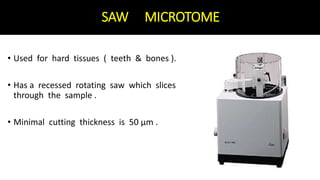
• Used for hard tissues ( teeth & bones ).
• Has a recessed rotating saw which slices
through the sample .
• Minimal cutting thickness is 50 μm .
ULTRA MICROTOMES
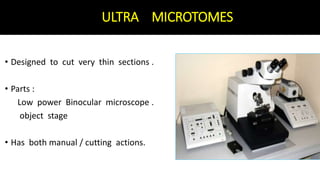
• Designed to cut very thin sections .
• Parts :
Low power Binocular microscope .
object stage
• Has both manual / cutting actions.
How does it differ from conventional
microtomes ?
• Fine and precise feedback mechanism .
• Mechanical / thermally controlled
• Thickness range 5 – 100 nm
• Special knives - plate glass / plastic
• Can cut even small blocks .
• Can be used even in hard embedding media like araldite
Freezing Microtomes
• Designed for the preparing frozen sections of fluid & non-fluid tissue .
• Preliminary embedding is not needed .
• A cylinder of compressed carbon-dioxide for rapid cooling of the tissues is
connected with the object stage .
• Provisions to cool the knife is also present .
• The knife moves horizontally across the tissue surface .
• Characterstic features - Non-movable tissue block & cooling system.
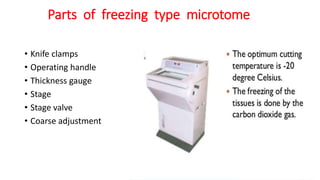
Parts of freezing type microtome
• Knife clamps
• Operating handle
• Thickness gauge
• Stage
• Stage valve
• Coarse adjustment
Advantages of Freezing Microtome
• Used to cut sections for Rapid diagnosis .
• It cuts non-dehydrated fresh tissue in a frozen state.
• Used for Rapid histopathological diagnosis during surgery .
• This type of microtome is also used when lipids, enzymes, &
neurological structures are to be demonstrated.
DRAWBACKS OF FREEZING MICROTOME
• Inactivation of some enzymes
• Ribbon sections cannot be prepared using this microtome
• An inability to prepare multiple sections of uniform thickness .
Ultimately led to the invention of CRYOSTAT.
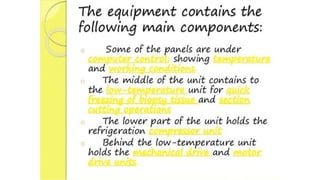
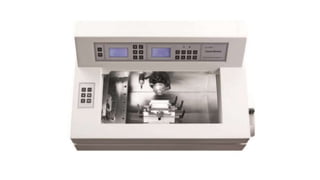
CRYOSTAT
• Pearse 1960 ; Hollands 1962 .
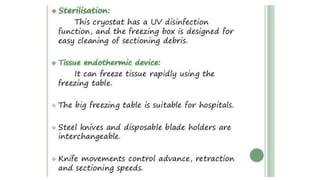
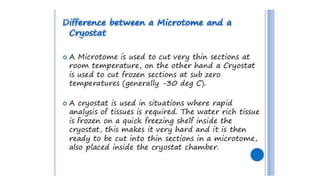
• Also called as Cold microtome / Deci-slicer in refrigerator .
• Device by which temperature can be maintained at low level .
• As described by Linderstorm – Lang and Mogeson ,
The cryostat consists of a microtome contained within a
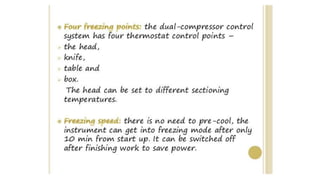
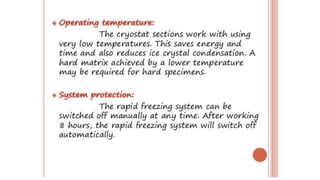
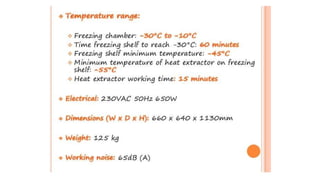
refrigerated cabinet designed to operate at - 5 to - 30 ° C .
PROCEDURE
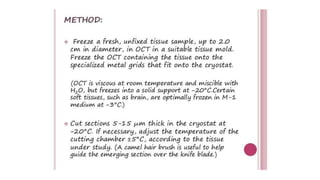
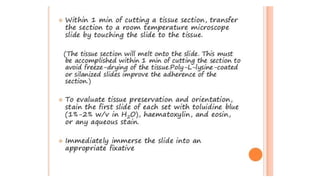
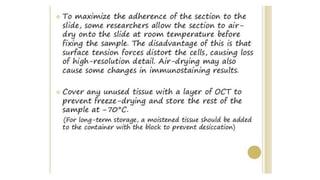
• Block tissue - up to 3 cm thick
Fresh tissue .
• Block is mounted in a small quantity of 1% glucose / water on the platform
of the chuck standing vertically on a bench .
• Immediately frozen - liquid carbon dioxide / solid carbon dioxide (dry ice).
• The chuck with frozen tissue is transferred to microtome maintained at -15 to
-20° C in the refrigerated chamber .
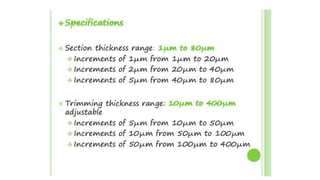
• The knife is moved & sections are cut at 4-5 μm with anti-roll guide plate
in position .
ADVANTAGES
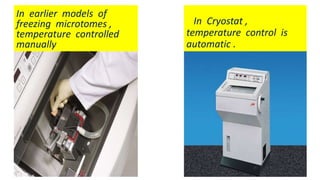
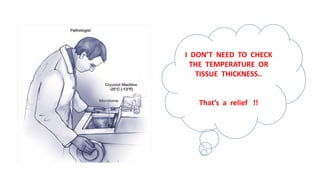
In earlier models of
freezing microtomes ,
temperature controlled
manually
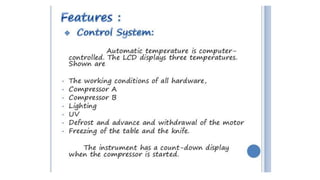
In Cryostat ,
temperature control is
automatic .
I DON’T NEED TO CHECK
THE TEMPERATURE OR
TISSUE THICKNESS..
That’s a relief !!
DISADVANTAGES
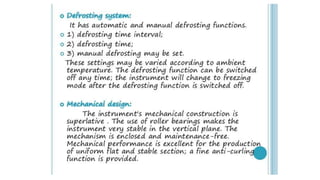
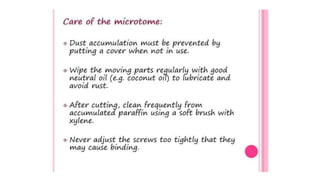
• Complete defrosting of machine is required from time to time.
• Slow fixation reaction .
• Cannot be used for fixed tissues.
• Not useful if the tissue requies lower temperature than the
setting temperature of the machine .
• Morphological details less accurate.
• Pigment formation is too prominent.
• Dermatitis of hand & irritation of nostrils to the microtomist.
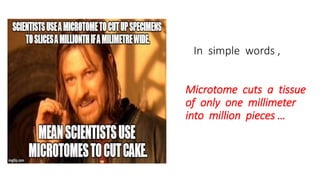
In simple words ,
Microtome cuts a tissue
of only one millimeter
into million pieces …
Thank you
Microtome (2)

Microtome (2)

  • 1.
  • 2.
    Why do wepreserve tissue samples ??? • For gross display in the Museum . • For microscopic evaluation .
  • 3.
    For Microscopic Study TheMajor tissue component , • Is initially fixed using a suitable fixative . • Undergoes adequate change in solutions , at adequate time - PROCESSING . • Embedded in paraffin wax as BLOCKS . • From the blocks , thin tissue sections are cut using specialized equipment called MICROTOME . • Stained & studied under a microscope
  • 4.
    MICROTOMY • The artof section cutting. • This is a process of cutting thin sections of tissue embedded in the wax block using a microtome . MICROTOME • Basic instrument / Mechanical device for cutting thin uniform slices of tissue .
  • 5.
    HISTORY • In thebeginning of microscopy , sections were made with Razor blades. • This method failed due to the impossibility of light transmission through thicker tissue . • Only with proper clean reproducible cuts of 100 μm , light can be transmitted , allowing precise observation of tissues to be carried out .
  • 6.
    With this idea, one of the first devices for such cuts were designed by George Adams in the year 1770 & was further developed by William Cunnings . Named as CUTTING ENGINE . Hand operated machine A cylinder to hold sample & a hand crank to cut .
  • 7.
    • Then theword Microtome was derived from Greek mikros, meaning "small", & temnein, meaning "to cut" . • It is a tool used to cut extremely thin slices of material, known as Sections. • Important in science to cut sections for microscopical observation. • Microtomes use steel , glass , or diamond blades depending upon the specimen type & desired thickness of the sections to be cut . • Sections can be made as thin as , breadth of a human hair , between 50 – 100 μm .
  • 8.
    • After severalmodifications , today we use microtomes of KNIFE BLOCK DESIGN. • It has a Changeable knife , & Specimen holder. • Automatic machines are also available , where the sample moves over the knife with a precision control of tissue thickness.
  • 9.
  • 10.
  • 11.
    First clinical useof microtome
  • 12.
    TYPES OF MICROTOMES Basedupon the mechanism , • Rotary • Rocking • Base sledge • Freezing • Vibrating • Saw • Sliding • Cryostat • Ultra-Microtome
  • 13.
    ROTARY MICROTOME So calledbecause of the Rotary action of hand wheel used for cutting movement. The block holder is mounted on a steel carriage, which moves in grooves , up & down. Most ideal for routine & research work . Excellent for cutting serial sections.
  • 14.
    PARTS OF THEROTARY MICROTOMES • Block holder • Knife clamp screw • Knife clamps • Block adjustment • Thickness gauge • Angle of tilt adjustment • Operating handle
  • 15.
    • The feedmechanism is activated by turning a wheel on one side of the machine. • The wheel operation may be electrical / manual . • The knife is fixed with its edge fixed upwards , while the object moves against the knife . • 1 rotation of the operating wheel produces , 1 complete cycle with a downward cutting stroke & an upward return. • It is often modified to cut ultrathin sections between 50Å – 200Å.
  • 16.
    Advantages of theRotary microtome • Heavy & stable. • Used for large number of serial sections . • Ideal for Paraffin-embedded tissues . • Movable knife holder . • The sections cut are flat. • It is useful for routine & research papers . • Currently most common type of microtome in practice.
  • 17.
    Base Sledge Microtome •Large & heavy instrument . • Very stable & popular for routine use . • The feed mechanism has a fixed knife , beneath which , the object mounted on a heavy sliding base moves . • Mainly used for cutting sections of cellulose nitrate embedded tissues with an obliquely set knife.
  • 18.
    Parts of Base-sledgemicrotome • Angular tilt adjustment • Knife clamps • Block holder • Coarse feed adjustment • Operating handle • Thickness gauge • Adjustment locking nut • Block adjustment screw • Split nut clasp
  • 20.
    • The blockholder is mounted on a steel carriage which slides backward & forwards in groups against fixed horizontal knife . • The block is raised towards the knife at a predetermined thickness. Advantages of Base-sledge microtome • Useful to cut extremely hard blocks & large sections ( eg : brain ). • The microtome is heavy & stable. • The knife used is sledge shaped which requires less honing.
  • 21.
  • 22.
    • A simplemachine invented by Sir Horace Darwin in 1881 . • Developed by Cambridge company . • The instrument has an arm that moves in a rocking motion while cutting the sections. • Hence named as Cambridge rocking microtome. • The knife is held by means of microtome thread. • The rocking microtome was designed primarily for cutting paraffin wax sections . • When needed , it can also be used to cut frozen section tissues .
  • 23.
    PARTS OF THEROCKING MICROTOME • Knife holder • Block holder / chuck • Upper & lower arms • Screw • Lever • Pawl • Ratchet wheel • Mill head microtome screw • Sleeve • Scale
  • 25.
    • It cutsthe sections between 1 - 20 microns. • The knife is fixed with the edge. • The object moves against the knife circularly , producing a sharply curved surface to the block . • With each stroke the tissue holder automatically moves vertically towards the knife. • Cutting stroke is Spring operated & is easy to handle . • This microtome must be placed on a solid non-slippery surface to allow a better hold .
  • 26.
    Advantages of Cambridgerocking microtomes • The cost of knife & microtome is low. • Celloidin embedded tissues can be sectioned easily.
  • 27.
    VIBRATING MICROTOMES • Cutsusing a vibrating blade . • The resultant cut is made with less pressure. • Used for difficult samples . • Thickness around 30 -500nm for fresh tissues & 10 – 500 nm for fixed tissues .
  • 29.
    SAW MICROTOME • Usedfor hard tissues ( teeth & bones ). • Has a recessed rotating saw which slices through the sample . • Minimal cutting thickness is 50 μm .
  • 30.
    ULTRA MICROTOMES • Designedto cut very thin sections . • Parts : Low power Binocular microscope . object stage • Has both manual / cutting actions.
  • 31.
    How does itdiffer from conventional microtomes ? • Fine and precise feedback mechanism . • Mechanical / thermally controlled • Thickness range 5 – 100 nm • Special knives - plate glass / plastic • Can cut even small blocks . • Can be used even in hard embedding media like araldite
  • 32.
    Freezing Microtomes • Designedfor the preparing frozen sections of fluid & non-fluid tissue . • Preliminary embedding is not needed . • A cylinder of compressed carbon-dioxide for rapid cooling of the tissues is connected with the object stage . • Provisions to cool the knife is also present . • The knife moves horizontally across the tissue surface . • Characterstic features - Non-movable tissue block & cooling system.
  • 33.
    Parts of freezingtype microtome • Knife clamps • Operating handle • Thickness gauge • Stage • Stage valve • Coarse adjustment
  • 34.
    Advantages of FreezingMicrotome • Used to cut sections for Rapid diagnosis . • It cuts non-dehydrated fresh tissue in a frozen state. • Used for Rapid histopathological diagnosis during surgery . • This type of microtome is also used when lipids, enzymes, & neurological structures are to be demonstrated.
  • 35.
    DRAWBACKS OF FREEZINGMICROTOME • Inactivation of some enzymes • Ribbon sections cannot be prepared using this microtome • An inability to prepare multiple sections of uniform thickness . Ultimately led to the invention of CRYOSTAT.
  • 36.
    CRYOSTAT • Pearse 1960; Hollands 1962 . • Also called as Cold microtome / Deci-slicer in refrigerator . • Device by which temperature can be maintained at low level . • As described by Linderstorm – Lang and Mogeson , The cryostat consists of a microtome contained within a refrigerated cabinet designed to operate at - 5 to - 30 ° C .
  • 37.
    PROCEDURE • Block tissue- up to 3 cm thick Fresh tissue . • Block is mounted in a small quantity of 1% glucose / water on the platform of the chuck standing vertically on a bench . • Immediately frozen - liquid carbon dioxide / solid carbon dioxide (dry ice). • The chuck with frozen tissue is transferred to microtome maintained at -15 to -20° C in the refrigerated chamber . • The knife is moved & sections are cut at 4-5 μm with anti-roll guide plate in position .
  • 58.
  • 59.
    In earlier modelsof freezing microtomes , temperature controlled manually In Cryostat , temperature control is automatic .
  • 60.
    I DON’T NEEDTO CHECK THE TEMPERATURE OR TISSUE THICKNESS.. That’s a relief !!
  • 61.
    DISADVANTAGES • Complete defrostingof machine is required from time to time. • Slow fixation reaction . • Cannot be used for fixed tissues. • Not useful if the tissue requies lower temperature than the setting temperature of the machine . • Morphological details less accurate. • Pigment formation is too prominent. • Dermatitis of hand & irritation of nostrils to the microtomist.
  • 62.
    In simple words, Microtome cuts a tissue of only one millimeter into million pieces …
  • 65.