1 
Welcome
2
Plant Biopharming: Importances, 
Applications and Usages 
Kalilu S. Donzo 
2013-11-199 
CPBMB 
COH, Vellanikkara 
KAU 
3
Outlines 
 Introduction 
 General strategy in biopharming 
 Different biopharming production systems 
 Applications 
 Successful reports 
 Biosafety issues in biopharming 
 Conclusion 
 Future lines 
4
Introduction 
 Biopharming 
Involves the use of transgenic plants to 
produce proteins of therapeutic value 
• Biopharming is also known as molecular farming or 
molecular pharming 
5 
(Humphreys et al.,2000)
…introduction 
 Biopharming started about 20 years ago with the 
promise to produce therapeutic molecules 
 Some therapeutic molecules are very expensive to 
produce 
 Falls under the category of green biotechnology 
6
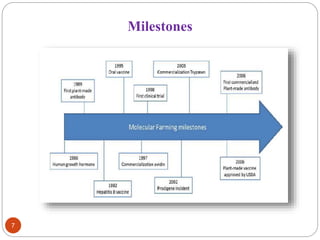
Milestones 
7
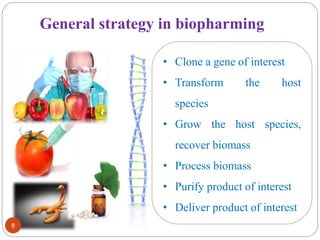
General strategy in biopharming 
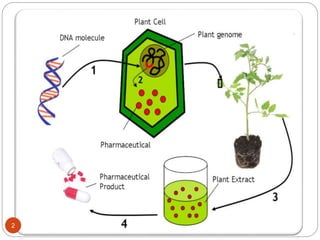
• Clone a gene of interest 
• Transform the host 
species 
• Grow the host species, 
recover biomass 
• Process biomass 
• Purify product of interest 
• Deliver product of interest 
8
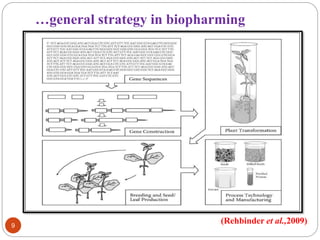
…general strategy in biopharming 
9 
(Rehbinder et al.,2009)
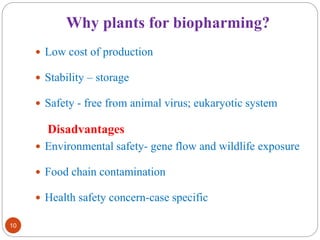
Why plants for biopharming? 
10 
 Low cost of production 
 Stability – storage 
 Safety - free from animal virus; eukaryotic system 
Disadvantages 
 Environmental safety- gene flow and wildlife exposure 
 Food chain contamination 
 Health safety concern-case specific
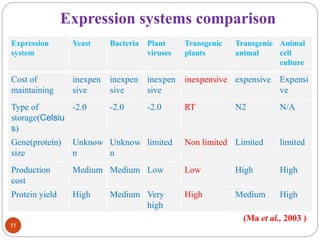
Expression 
system 
Expression systems comparison 
Yeast Bacteria Plant 
viruses 
Transgenic 
plants 
Transgenic 
animal 
Animal 
cell 
culture 
Cost of 
maintaining 
inexpen 
sive 
inexpen 
sive 
inexpen 
sive 
inexpensive expensive Expensi 
ve 
Type of 
storage(Celsiu 
s) 
-2.0 -2.0 -2.0 RT N2 N/A 
Gene(protein) 
size 
Unknow 
n 
Unknow 
n 
limited Non limited Limited limited 
Production 
cost 
Medium Medium Low Low High High 
Protein yield High Medium Very 
high 
High Medium High 
11 
(Ma et al., 2003 )
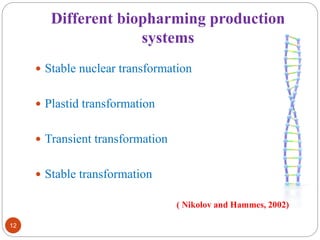
Different biopharming production 
systems 
12 
 Stable nuclear transformation 
 Plastid transformation 
 Transient transformation 
 Stable transformation 
( Nikolov and Hammes, 2002)
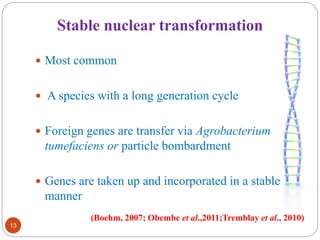
Stable nuclear transformation 
 Most common 
 A species with a long generation cycle 
 Foreign genes are transfer via Agrobacterium 
tumefaciens or particle bombardment 
 Genes are taken up and incorporated in a stable 
manner 
13 
(Boehm, 2007; Obembe et al.,2011;Tremblay et al., 2010)
…stable nuclear transformation 
Advantages Disadvantages 
 Long-term non-refrigerated 
storage the 
seed upto 2yrs 
 Large acres can be 
utilized with the lowest 
cost 
 Eg. Grains 
 Manual labor required 
 Lower yield 
 Less effective genetic 
 Outcrossing 
14
Plastid transformation 
 First described by Svab et al. (1990) 
 Tobacco only species (Daniell et al., 2002) 
 No transgenic pollen is generated 
15
…plastid transformation 
Advantages Disadvantages 
 No outcrossing 
 Protein – upto 70% on dry 
weight 
 Very high expression 
levels can be achieved 
 Protein unstable 
 Extraction and purification 
at specific time 
 Edible vaccine is not 
feasible since tobacco is 
highly regulated 
16 (Oey et al., 2009)
Transient transformation 
17 
 Depend on recombinant plant viruses to infect 
tobacco plants like TMV 
 Target protein is temporary express in the plant 
 Protein accumulate in the interstitial spaces 
 No stable transgenic plants are generated 
(Boehm, 2007; Komarova et al., 2010; Pogue et al., 2010)
…transient transformation 
Advantages Disadvantages 
18 
 Infection process is 
rapid 
 Small amounts target 
protein is obtained in 
weeks 
 Efficient for custom 
proteins needed in small 
amount 
 Not needed for protein 
in large amount 
 No long term storage 
due to tissue damage 
 Scalability and 
expression levels
Stable transformation 
19 
 Transgenic plants are grown hydroponically 
 Hydroponics is a technology for growing plants in 
nutrient solutions (water and fertilizers) for high-density 
maximum crop yield, crop production 
where no suitable soil exists 
 Desired products are released as part of root fluid 
into a hydroponic medium 
(Raskin, 2000)
…stable transformation 
Advantages Disadvantages 
20 
 Plants are contained in 
green house 
 Reduced fears of 
environmental release 
 Easier purification 
 Expensive to operate 
 Not suitable for large 
scale production
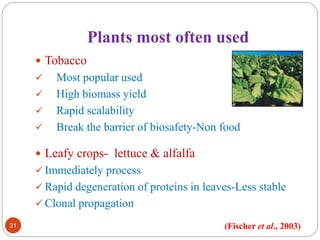
Plants most often used 
21 
 Tobacco 
 Most popular used 
 High biomass yield 
 Rapid scalability 
 Break the barrier of biosafety-Non food 
 Leafy crops- lettuce & alfalfa 
 Immediately process 
 Rapid degeneration of proteins in leaves-Less stable 
 Clonal propagation 
(Fischer et al., 2003)
…plants most often used 
22 
 Cereal grains- rice and maize 
 To avoid the problem of short shelf life 
 Easy to transform and manipulate 
 Potatoes 
 First system to be developed for Edible vaccine 
 Edible 
 Protein stable in storage tissue 
(Ma et al.,2003)
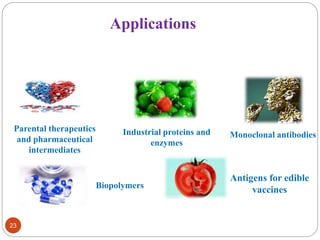
Applications 
Parental therapeutics 
and pharmaceutical 
intermediates 
Industrial proteins and 
enzymes 
Monoclonal antibodies 
Biopolymers 
Antigens for edible 
vaccines 
23
Plantibodies (mAb) 
24 
 Antibody that is produced by genetically 
engineered Plant i.e. insertion of antibodies into a 
transgenic plant 
 The term is the trademark of Biolex(North 
Carolina) 
 Have no risk of spreading diseases to humans 
 Hiatt. et al (1989) were the first to demonstrate the 
production of antibodies in tobacco plants
25 
…plantibodies (mAb) 
 Produce as therapeutic protein and plant protection 
against diseases 
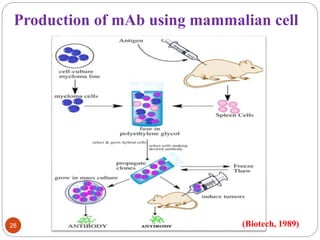
 Traditional system of production is mammalian 
cell culture 
 All current therapeutic antibodies are of the IgG 
class 
 Purification is done through processes such as 
filtration, immunofluorescence, and 
chromatography
26 
…plantibodies (mAb) 
 Chloroplast transformation ideal for single chain 
fragment(scFv) due to the lack of glycosylation 
(Daniel,2002a) 
 Agrofiltration is ideal for transient expression of 
heavy and light chain genes 
 Assembling of the full-size mAb in tobacco report 
by Scholthof et al.,(1996)
Two main approaches to produce 
plantibodies in plants 
27 
 Cross-pollination - transformed plants expressing 
light or heavy chains (Hiatt et al.,1989; Ma et 
al.,1994) 
 Co-transformation of the heavy and light chain 
genes on a single two or more expression vectors 
to produce full-size mAb (Nicholson et al., 2005)
Production of mAb using mammalian cell 
28 (Biotech, 1989)
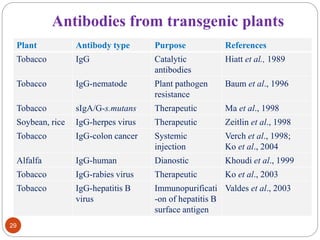
Antibodies from transgenic plants 
Plant Antibody type Purpose References 
Tobacco IgG Catalytic 
29 
antibodies 
Hiatt et al., 1989 
Tobacco IgG-nematode Plant pathogen 
resistance 
Baum et al., 1996 
Tobacco sIgA/G-s.mutans Therapeutic Ma et al., 1998 
Soybean, rice IgG-herpes virus Therapeutic Zeitlin et al., 1998 
Tobacco IgG-colon cancer Systemic 
injection 
Verch et al., 1998; 
Ko et al., 2004 
Alfalfa IgG-human Dianostic Khoudi et al., 1999 
Tobacco IgG-rabies virus Therapeutic Ko et al., 2003 
Tobacco IgG-hepatitis B 
virus 
Immunopurificati 
-on of hepatitis B 
surface antigen 
Valdes et al., 2003
Edible vaccines 
30 
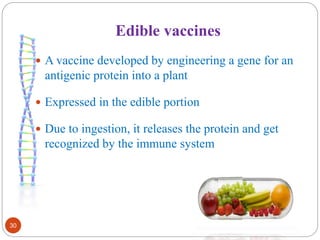
 A vaccine developed by engineering a gene for an 
antigenic protein into a plant 
 Expressed in the edible portion 
 Due to ingestion, it releases the protein and get 
recognized by the immune system
…edible vaccines 
31 
 The concept of edible vaccine got incentive after 
Arntzen et al. (1992) expressed hepatitis B antigen 
in tobacco 
 Stimulate both humoral and mucosal immunity 
 It is Feasible to administer unlike injection 
 Heat stable - no need of refrigeration
Edible vaccine production methods 
32 
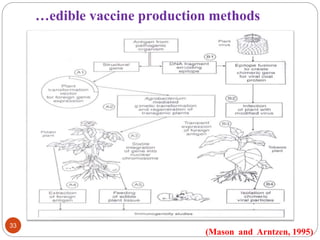
 Expression of foreign antigens in plant via 
stable transformation- agrobacterium mediated 
Delivery of vaccine epitopes via plant virus 
(Mason and Arntzen, 1995)
…edible vaccine production methods 
33 
(Mason and Arntzen, 1995)
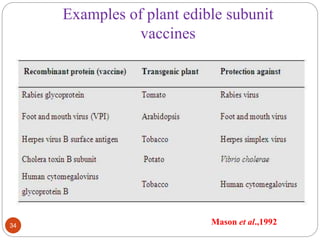
Examples of plant edible subunit 
vaccines 
34 Mason et al.,1992
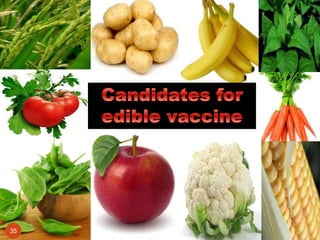
35 
Outline 
35
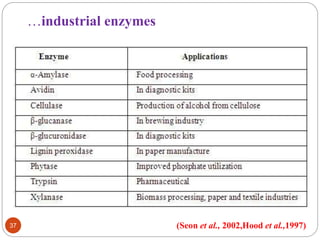
Industrial enzymes 
36 
 Avidin and β- glucuronidase first commercialized 
industrial proteins from Maize 
 ProdiGene Inc. company produce trypsin 
(proteolytic enzyme) on large scale using maize 
 Avidin was the first commercial transgenic protein 
produced via transgenic maize
…industrial enzymes 
37 (Seon et al., 2002,Hood et al.,1997)
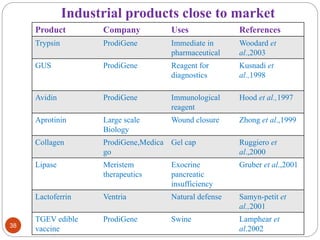
Industrial products close to market 
38 
Product Company Uses References 
Trypsin ProdiGene Immediate in 
pharmaceutical 
Woodard et 
al.,2003 
GUS ProdiGene Reagent for 
diagnostics 
Kusnadi et 
al.,1998 
Avidin ProdiGene Immunological 
reagent 
Hood et al.,1997 
Aprotinin Large scale 
Biology 
Wound closure Zhong et al.,1999 
Collagen ProdiGene,Medica 
go 
Gel cap Ruggiero et 
al.,2000 
Lipase Meristem 
therapeutics 
Exocrine 
pancreatic 
insufficiency 
Gruber et al.,2001 
Lactoferrin Ventria Natural defense Samyn-petit et 
al.,2001 
TGEV edible 
vaccine 
ProdiGene Swine Lamphear et 
al.2002
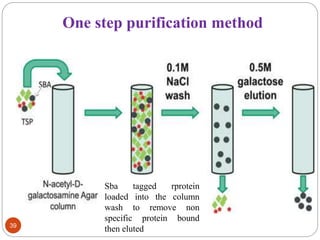
One step purification method 
39 
Sba tagged rprotein 
loaded into the column 
wash to remove non 
specific protein bound 
then eluted
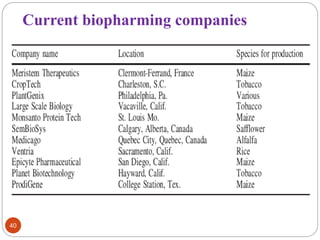
40 
Current biopharming companies
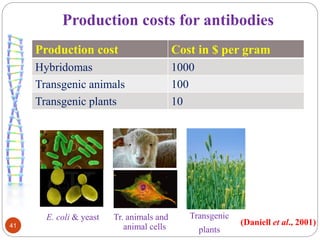
Production costs for antibodies 
41 
Production cost Cost in $ per gram 
Hybridomas 1000 
Transgenic animals 100 
Transgenic plants 10 
(Daniell et al., 2001) 
E. coli & yeast Tr. animals and 
animal cells 
Transgenic 
plants
42 
Successful reports
Neutralizing immunogenicity of transgenic 
carrot (Daucus carota L.)-derived measles virus 
hemagglutinin 
43 
 Report by Blouin et al. (2003) 
 Antigenic protein- Hemagglutinin 
 Crop-Carrot 
 Method of transformation- Agrobacterium mediated 
transformation 
 Trial - Mice 
 Result- Antibodies observed
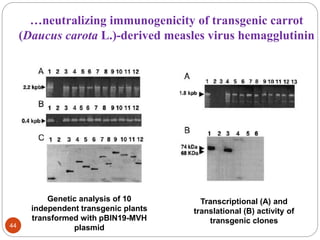
44 
…neutralizing immunogenicity of transgenic carrot 
(Daucus carota L.)-derived measles virus hemagglutinin 
Genetic analysis of 10 
independent transgenic plants 
transformed with pBIN19-MVH 
plasmid 
Transcriptional (A) and 
translational (B) activity of 
transgenic clones
Expression of Human Papillomavirus Type 16 L1 
Protein in Transgenic Tobacco Plants 
45 
 Report by Liu Hong et al., (2005) 
 Antigenic protein- HPV type 16 L1 protein 
 Crop- Tobacco 
 Method of transformation- Agrobacterium 
mediated transformation 
 Trial - Mice 
 Result- Antibodies developed in mice
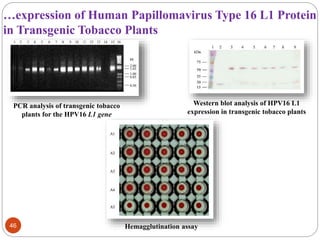
…expression of Human Papillomavirus Type 16 L1 Protein 
in Transgenic Tobacco Plants 
PCR analysis of transgenic tobacco 
46 
plants for the HPV16 L1 gene 
Western blot analysis of HPV16 L1 
expression in transgenic tobacco plants 
Hemagglutination assay
Plant derived edible vaccines against 
hepatitis B virus 
47 
 Report by Kapusta J., et al.(1999) 
 Crops- lettuce 
 Antigenic protein- HBsAg Protein 
 Method of transformation- Agrobacterium 
mediated transformation 
 Trial- In Mice 
 Result-Mice developed HB virus specific 
antibodies
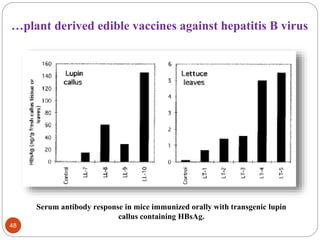
…plant derived edible vaccines against hepatitis B virus 
48 
Serum antibody response in mice immunized orally with transgenic lupin 
callus containing HBsAg.
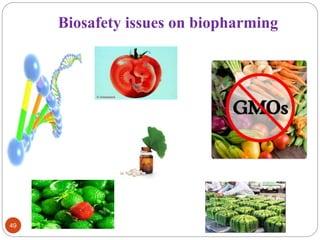
Biosafety issues on biopharming 
49
…biosafety issues in biopharming 
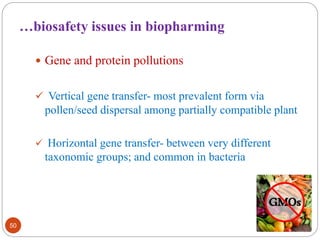
 Gene and protein pollutions 
 Vertical gene transfer- most prevalent form via 
pollen/seed dispersal among partially compatible plant 
 Horizontal gene transfer- between very different 
taxonomic groups; and common in bacteria 
50
…biosafety issues in biopharming 
51 
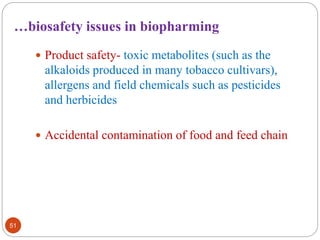
 Product safety- toxic metabolites (such as the 
alkaloids produced in many tobacco cultivars), 
allergens and field chemicals such as pesticides 
and herbicides 
 Accidental contamination of food and feed chain
Conclusion 
52 
 Plant biopharming has potential to become a major 
new method for low-cost, mass and safe 
production of biopharmaceutical 
 It has translated into rapid growth in the number of 
plant- made biopharmaceutical 
 There are several plant-based expression systems 
that are currently being explored to serve as 
production platforms, each offering specific 
benefits
...conclusion 
53 
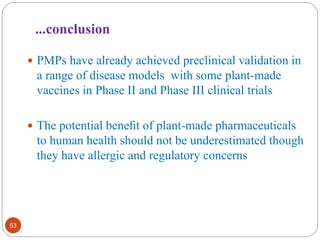
 PMPs have already achieved preclinical validation in 
a range of disease models with some plant-made 
vaccines in Phase II and Phase III clinical trials 
 The potential benefit of plant-made pharmaceuticals 
to human health should not be underestimated though 
they have allergic and regulatory concerns
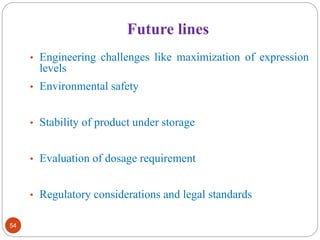
Future lines 
54 
• Engineering challenges like maximization of expression 
levels 
• Environmental safety 
• Stability of product under storage 
• Evaluation of dosage requirement 
• Regulatory considerations and legal standards
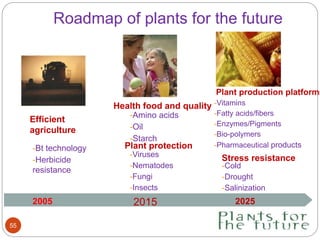
Roadmap of plants for the future 
55 
Efficient 
agriculture 
-Bt technology 
-Herbicide 
resistance 
2005 
Health food and quality 
-Amino acids 
-Oil 
-Starch 
Plant protection 
-Viruses 
-Nematodes 
-Fungi 
-Insects 
2015 
Plant production platforms 
-Vitamins 
-Fatty acids/fibers 
-Enzymes/Pigments 
-Bio-polymers 
-Pharmaceutical products 
Stress resistance 
-Cold 
-Drought 
-Salinization 
2025
56 
Thank you!!! 

Master's Seminar final

  • 1.
  • 2.
  • 3.
    Plant Biopharming: Importances, Applications and Usages Kalilu S. Donzo 2013-11-199 CPBMB COH, Vellanikkara KAU 3
  • 4.
    Outlines  Introduction  General strategy in biopharming  Different biopharming production systems  Applications  Successful reports  Biosafety issues in biopharming  Conclusion  Future lines 4
  • 5.
    Introduction  Biopharming Involves the use of transgenic plants to produce proteins of therapeutic value • Biopharming is also known as molecular farming or molecular pharming 5 (Humphreys et al.,2000)
  • 6.
    …introduction  Biopharmingstarted about 20 years ago with the promise to produce therapeutic molecules  Some therapeutic molecules are very expensive to produce  Falls under the category of green biotechnology 6
  • 7.
  • 8.
    General strategy inbiopharming • Clone a gene of interest • Transform the host species • Grow the host species, recover biomass • Process biomass • Purify product of interest • Deliver product of interest 8
  • 9.
    …general strategy inbiopharming 9 (Rehbinder et al.,2009)
  • 10.
    Why plants forbiopharming? 10  Low cost of production  Stability – storage  Safety - free from animal virus; eukaryotic system Disadvantages  Environmental safety- gene flow and wildlife exposure  Food chain contamination  Health safety concern-case specific
  • 11.
    Expression system Expressionsystems comparison Yeast Bacteria Plant viruses Transgenic plants Transgenic animal Animal cell culture Cost of maintaining inexpen sive inexpen sive inexpen sive inexpensive expensive Expensi ve Type of storage(Celsiu s) -2.0 -2.0 -2.0 RT N2 N/A Gene(protein) size Unknow n Unknow n limited Non limited Limited limited Production cost Medium Medium Low Low High High Protein yield High Medium Very high High Medium High 11 (Ma et al., 2003 )
  • 12.
    Different biopharming production systems 12  Stable nuclear transformation  Plastid transformation  Transient transformation  Stable transformation ( Nikolov and Hammes, 2002)
  • 13.
    Stable nuclear transformation  Most common  A species with a long generation cycle  Foreign genes are transfer via Agrobacterium tumefaciens or particle bombardment  Genes are taken up and incorporated in a stable manner 13 (Boehm, 2007; Obembe et al.,2011;Tremblay et al., 2010)
  • 14.
    …stable nuclear transformation Advantages Disadvantages  Long-term non-refrigerated storage the seed upto 2yrs  Large acres can be utilized with the lowest cost  Eg. Grains  Manual labor required  Lower yield  Less effective genetic  Outcrossing 14
  • 15.
    Plastid transformation First described by Svab et al. (1990)  Tobacco only species (Daniell et al., 2002)  No transgenic pollen is generated 15
  • 16.
    …plastid transformation AdvantagesDisadvantages  No outcrossing  Protein – upto 70% on dry weight  Very high expression levels can be achieved  Protein unstable  Extraction and purification at specific time  Edible vaccine is not feasible since tobacco is highly regulated 16 (Oey et al., 2009)
  • 17.
    Transient transformation 17  Depend on recombinant plant viruses to infect tobacco plants like TMV  Target protein is temporary express in the plant  Protein accumulate in the interstitial spaces  No stable transgenic plants are generated (Boehm, 2007; Komarova et al., 2010; Pogue et al., 2010)
  • 18.
    …transient transformation AdvantagesDisadvantages 18  Infection process is rapid  Small amounts target protein is obtained in weeks  Efficient for custom proteins needed in small amount  Not needed for protein in large amount  No long term storage due to tissue damage  Scalability and expression levels
  • 19.
    Stable transformation 19  Transgenic plants are grown hydroponically  Hydroponics is a technology for growing plants in nutrient solutions (water and fertilizers) for high-density maximum crop yield, crop production where no suitable soil exists  Desired products are released as part of root fluid into a hydroponic medium (Raskin, 2000)
  • 20.
    …stable transformation AdvantagesDisadvantages 20  Plants are contained in green house  Reduced fears of environmental release  Easier purification  Expensive to operate  Not suitable for large scale production
  • 21.
    Plants most oftenused 21  Tobacco  Most popular used  High biomass yield  Rapid scalability  Break the barrier of biosafety-Non food  Leafy crops- lettuce & alfalfa  Immediately process  Rapid degeneration of proteins in leaves-Less stable  Clonal propagation (Fischer et al., 2003)
  • 22.
    …plants most oftenused 22  Cereal grains- rice and maize  To avoid the problem of short shelf life  Easy to transform and manipulate  Potatoes  First system to be developed for Edible vaccine  Edible  Protein stable in storage tissue (Ma et al.,2003)
  • 23.
    Applications Parental therapeutics and pharmaceutical intermediates Industrial proteins and enzymes Monoclonal antibodies Biopolymers Antigens for edible vaccines 23
  • 24.
    Plantibodies (mAb) 24  Antibody that is produced by genetically engineered Plant i.e. insertion of antibodies into a transgenic plant  The term is the trademark of Biolex(North Carolina)  Have no risk of spreading diseases to humans  Hiatt. et al (1989) were the first to demonstrate the production of antibodies in tobacco plants
  • 25.
    25 …plantibodies (mAb)  Produce as therapeutic protein and plant protection against diseases  Traditional system of production is mammalian cell culture  All current therapeutic antibodies are of the IgG class  Purification is done through processes such as filtration, immunofluorescence, and chromatography
  • 26.
    26 …plantibodies (mAb)  Chloroplast transformation ideal for single chain fragment(scFv) due to the lack of glycosylation (Daniel,2002a)  Agrofiltration is ideal for transient expression of heavy and light chain genes  Assembling of the full-size mAb in tobacco report by Scholthof et al.,(1996)
  • 27.
    Two main approachesto produce plantibodies in plants 27  Cross-pollination - transformed plants expressing light or heavy chains (Hiatt et al.,1989; Ma et al.,1994)  Co-transformation of the heavy and light chain genes on a single two or more expression vectors to produce full-size mAb (Nicholson et al., 2005)
  • 28.
    Production of mAbusing mammalian cell 28 (Biotech, 1989)
  • 29.
    Antibodies from transgenicplants Plant Antibody type Purpose References Tobacco IgG Catalytic 29 antibodies Hiatt et al., 1989 Tobacco IgG-nematode Plant pathogen resistance Baum et al., 1996 Tobacco sIgA/G-s.mutans Therapeutic Ma et al., 1998 Soybean, rice IgG-herpes virus Therapeutic Zeitlin et al., 1998 Tobacco IgG-colon cancer Systemic injection Verch et al., 1998; Ko et al., 2004 Alfalfa IgG-human Dianostic Khoudi et al., 1999 Tobacco IgG-rabies virus Therapeutic Ko et al., 2003 Tobacco IgG-hepatitis B virus Immunopurificati -on of hepatitis B surface antigen Valdes et al., 2003
  • 30.
    Edible vaccines 30  A vaccine developed by engineering a gene for an antigenic protein into a plant  Expressed in the edible portion  Due to ingestion, it releases the protein and get recognized by the immune system
  • 31.
    …edible vaccines 31  The concept of edible vaccine got incentive after Arntzen et al. (1992) expressed hepatitis B antigen in tobacco  Stimulate both humoral and mucosal immunity  It is Feasible to administer unlike injection  Heat stable - no need of refrigeration
  • 32.
    Edible vaccine productionmethods 32  Expression of foreign antigens in plant via stable transformation- agrobacterium mediated Delivery of vaccine epitopes via plant virus (Mason and Arntzen, 1995)
  • 33.
    …edible vaccine productionmethods 33 (Mason and Arntzen, 1995)
  • 34.
    Examples of plantedible subunit vaccines 34 Mason et al.,1992
  • 35.
  • 36.
    Industrial enzymes 36  Avidin and β- glucuronidase first commercialized industrial proteins from Maize  ProdiGene Inc. company produce trypsin (proteolytic enzyme) on large scale using maize  Avidin was the first commercial transgenic protein produced via transgenic maize
  • 37.
    …industrial enzymes 37(Seon et al., 2002,Hood et al.,1997)
  • 38.
    Industrial products closeto market 38 Product Company Uses References Trypsin ProdiGene Immediate in pharmaceutical Woodard et al.,2003 GUS ProdiGene Reagent for diagnostics Kusnadi et al.,1998 Avidin ProdiGene Immunological reagent Hood et al.,1997 Aprotinin Large scale Biology Wound closure Zhong et al.,1999 Collagen ProdiGene,Medica go Gel cap Ruggiero et al.,2000 Lipase Meristem therapeutics Exocrine pancreatic insufficiency Gruber et al.,2001 Lactoferrin Ventria Natural defense Samyn-petit et al.,2001 TGEV edible vaccine ProdiGene Swine Lamphear et al.2002
  • 39.
    One step purificationmethod 39 Sba tagged rprotein loaded into the column wash to remove non specific protein bound then eluted
  • 40.
  • 41.
    Production costs forantibodies 41 Production cost Cost in $ per gram Hybridomas 1000 Transgenic animals 100 Transgenic plants 10 (Daniell et al., 2001) E. coli & yeast Tr. animals and animal cells Transgenic plants
  • 42.
  • 43.
    Neutralizing immunogenicity oftransgenic carrot (Daucus carota L.)-derived measles virus hemagglutinin 43  Report by Blouin et al. (2003)  Antigenic protein- Hemagglutinin  Crop-Carrot  Method of transformation- Agrobacterium mediated transformation  Trial - Mice  Result- Antibodies observed
  • 44.
    44 …neutralizing immunogenicityof transgenic carrot (Daucus carota L.)-derived measles virus hemagglutinin Genetic analysis of 10 independent transgenic plants transformed with pBIN19-MVH plasmid Transcriptional (A) and translational (B) activity of transgenic clones
  • 45.
    Expression of HumanPapillomavirus Type 16 L1 Protein in Transgenic Tobacco Plants 45  Report by Liu Hong et al., (2005)  Antigenic protein- HPV type 16 L1 protein  Crop- Tobacco  Method of transformation- Agrobacterium mediated transformation  Trial - Mice  Result- Antibodies developed in mice
  • 46.
    …expression of HumanPapillomavirus Type 16 L1 Protein in Transgenic Tobacco Plants PCR analysis of transgenic tobacco 46 plants for the HPV16 L1 gene Western blot analysis of HPV16 L1 expression in transgenic tobacco plants Hemagglutination assay
  • 47.
    Plant derived ediblevaccines against hepatitis B virus 47  Report by Kapusta J., et al.(1999)  Crops- lettuce  Antigenic protein- HBsAg Protein  Method of transformation- Agrobacterium mediated transformation  Trial- In Mice  Result-Mice developed HB virus specific antibodies
  • 48.
    …plant derived ediblevaccines against hepatitis B virus 48 Serum antibody response in mice immunized orally with transgenic lupin callus containing HBsAg.
  • 49.
    Biosafety issues onbiopharming 49
  • 50.
    …biosafety issues inbiopharming  Gene and protein pollutions  Vertical gene transfer- most prevalent form via pollen/seed dispersal among partially compatible plant  Horizontal gene transfer- between very different taxonomic groups; and common in bacteria 50
  • 51.
    …biosafety issues inbiopharming 51  Product safety- toxic metabolites (such as the alkaloids produced in many tobacco cultivars), allergens and field chemicals such as pesticides and herbicides  Accidental contamination of food and feed chain
  • 52.
    Conclusion 52 Plant biopharming has potential to become a major new method for low-cost, mass and safe production of biopharmaceutical  It has translated into rapid growth in the number of plant- made biopharmaceutical  There are several plant-based expression systems that are currently being explored to serve as production platforms, each offering specific benefits
  • 53.
    ...conclusion 53 PMPs have already achieved preclinical validation in a range of disease models with some plant-made vaccines in Phase II and Phase III clinical trials  The potential benefit of plant-made pharmaceuticals to human health should not be underestimated though they have allergic and regulatory concerns
  • 54.
    Future lines 54 • Engineering challenges like maximization of expression levels • Environmental safety • Stability of product under storage • Evaluation of dosage requirement • Regulatory considerations and legal standards
  • 55.
    Roadmap of plantsfor the future 55 Efficient agriculture -Bt technology -Herbicide resistance 2005 Health food and quality -Amino acids -Oil -Starch Plant protection -Viruses -Nematodes -Fungi -Insects 2015 Plant production platforms -Vitamins -Fatty acids/fibers -Enzymes/Pigments -Bio-polymers -Pharmaceutical products Stress resistance -Cold -Drought -Salinization 2025
  • 56.