Stroke                                                                                     Aim to answer 6 questions from history/ physical exam/
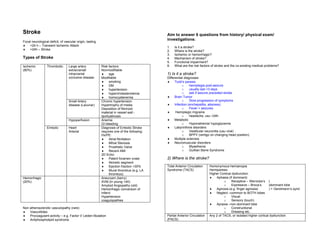
Focal neurological deficit, of vascular origin, lasting
                                                                                           investigations:
♦   <24 h – Transient Ischemic Attack
                                                                                           1.   Is it a stroke?
♦   >24h – Stroke                                                                          2.   Where is the stroke?
                                                                                           3.   Ischemic or hemorrhagic?
Types of Stroke                                                                            4.   Mechanism of stroke?
                                                                                           5.   Functional impairment?
Ischemic          Thrombotic      Large artery            Risk factors:                    6.   What are the risk factors of stroke and the co-existing medical problems?
(80%)                             extracranial/           Nonmodifiable
                                  intracranial            ♦     age                        1) Is it a stroke?
                                  occlusive disease       Modifiable                       Differential diagnoses:
                                                          ♦     smoking                    ♦     Todd’s paresis
                                                          ♦     DM                                    o     hemiplegia post-seizure
                                                          ♦     hypertension                          o     usually last <3 days
                                                          ♦     hypercholesterolemia                  o     ask if seizure preceded stroke
                                                          ♦     homocystenemia             ♦     Brain Tumor
                                  Small Artery            Chronic hypertension                        o     Slow progression of symptoms
                                  disease (Lacunar)       Hypertrophy of media             ♦     Infection (enchepalitis, abscess)
                                                          Deposition of fibrinoid                     o     Fever + seizures
                                                          material in vessel wall -        ♦      Hemiplegic migraine
                                                          lipohyalinosis                              o     headache, usu <24h
                                  Hypoperfusion           Anemia                           ♦     Metabolic
                                                          GI bleeding                                 o     Hyponatremia/ hypoglycemia
                  Embolic         Heart                   Diagnosis of Embolic Stroke      ♦     Labyrinthine disorders
                                  Arterial                requires one of the following:              o     Vestibular neuronitis (usu viral)
                                                          Hx/PE:                                      o     BPPV (vertigo on changing head position)
                                                          ♦     Atrial fibrillation        ♦     Multiple sclerosis
                                                          ♦     Mitral Stenosis            ♦     Neuromuscular disorders
                                                          ♦     Prosthetic Valve                      o     Myasthenia
                                                          ♦     Recent AMI                            o     Guillian Barre Syndrome
                                                          2D Echo:
                                                          ♦     Patent foramen ovale       2) Where is the stroke?
                                                          ♦     Akinetic segment
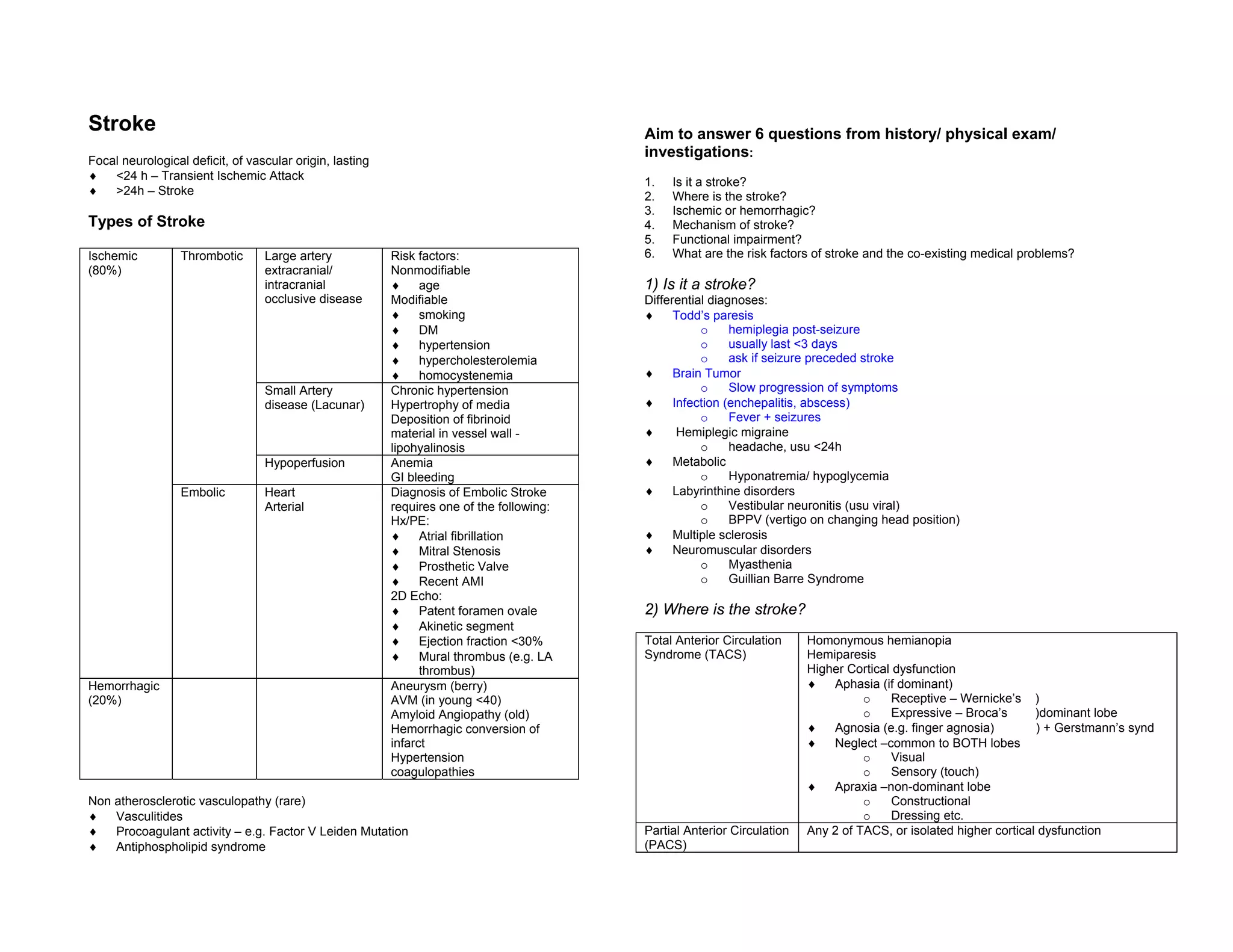
                                                          ♦     Ejection fraction <30%     Total Anterior Circulation     Homonymous hemianopia
                                                          ♦     Mural thrombus (e.g. LA    Syndrome (TACS)                Hemiparesis
                                                                thrombus)                                                 Higher Cortical dysfunction
Hemorrhagic                                               Aneurysm (berry)                                                ♦   Aphasia (if dominant)
(20%)                                                     AVM (in young <40)                                                        o    Receptive – Wernicke’s )
                                                          Amyloid Angiopathy (old)                                                  o    Expressive – Broca’s       )dominant lobe
                                                          Hemorrhagic conversion of                                       ♦   Agnosia (e.g. finger agnosia)         ) + Gerstmann’s synd
                                                          infarct                                                         ♦   Neglect –common to BOTH lobes
                                                          Hypertension                                                              o    Visual
                                                          coagulopathies                                                            o    Sensory (touch)
                                                                                                                          ♦   Apraxia –non-dominant lobe
Non atherosclerotic vasculopathy (rare)                                                                                             o    Constructional
♦   Vasculitides                                                                                                                    o    Dressing etc.
♦   Procoagulant activity – e.g. Factor V Leiden Mutation                                  Partial Anterior Circulation   Any 2 of TACS, or isolated higher cortical dysfunction
♦   Antiphospholipid syndrome                                                              (PACS)
Lacunar Syndrome             ♦     Pure motor                                                            o    Intracranial Thrombosis
(LACS)                       ♦     Pure sensory                                                                     ♦    No investigations, mainly from history, and when carotid Doppler
                             ♦     Sensorimotor                                                                          and 2D echo are unremarkable
                             ♦     Ataxia-hemiparesis
                                        o    Variant is clumsy-hand dysarthria                 5) Functional Impairment?
Posterior Circulation        Drowsiness
Syndrome (POCS)              Lower cranial nerve palsies                                       ♦    Activities of Daily Living
                             Ataxia                                                                      o      Transferring
                             Crossed neurological signs                                                  o      Feeding
                             Spastic paraparesis                                                         o      Toileting/ Continence
                             Bilateral LL sensory loss                                                   o      Bathing
                                                                                                         o      Grooming
3) Ischemic or Hemorrhagic?                                                                              o      Dressing
Ischemic                                     Hemorrhagic
♦    Thrombotic                              ♦  history of coagulopathy                        6) Risk factors of stroke?
         o    Old
         o    Hypertensive                   examination may reveal raised ICP                 ♦    Refer to investigations sections
         o    Smoking                        ♦   drowsiness
         o    Hypercholesterolemia           ♦   vomiting
         o    DM                             ♦   papilledema
♦    Embolic
         o    AF, MS, Prosthetic valve
                                                                                               History and Physical Examination
Investigations
♦    CT scan                                                                                   Concise points not to be missed in history:
           o   mainly for excluding hemorrhagic stroke, esp if thrombolysis is being           ♦   Handedness!!!
               considered                                                                      ♦   Weakness
           o   only half of infarcts seen                                                               o     duration
                                                                                               ♦   Numbness
                                                                                               ♦   Upper limb and lower limb involvement
4) Mechanism of Stroke?
                                                                                               ♦   Hemianopia
♦    Embolus, or
                                                                                                        o     Knocking into things?
♦    Extracranial thrombosis, or
                                                                                               ♦   Cranial nerves
♦    Intracranial thrombosis?                                                                           o     Diplopia
                                                                                                        o     Facial asymmetry
♦    History                                                                                            o     Dysphagia
♦    Physical Exam                                                                                      o     Dysarthria
          o     AF, MS suggest embolus                                                         ♦   Cerebellar
          o     Carotic bruit suggest thrombosis                                                        o     Gait, balance
♦    Investigations                                                                            ♦   Functional impairment
          o     Transthoracic/ transesophageal echo may give info suggesting embolus           ♦   Risk factors
                     ♦    Patent foramen ovale                                                          o     Ischemic
                     ♦    Akinetic segment                                                                          ♦   Age
                     ♦    Poor ejection fraction <30%                                                               ♦   Smoking
                     ♦    Mural thrombus                                                                            ♦   DM
          o     Duplex Doppler of carotids if suspect extracranial thrombosis                                       ♦   HTN
                     ♦    Only for patients with non-disabling PACS who is fit for operation                        ♦   Cholesterol
                          and agreeable to endarterectomy                                               o     Hemorrhagic
                     ♦    Cerebral angiogram                                                                        ♦   Family history aneurysms
                                •   To quantify degree of carotid stenosis and status of                            ♦   Personal history of coagulopathies
                                    intracranial circulation
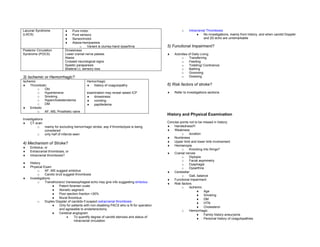
Concise points not to be missed in physical examination                                  ♦   Investigations (to answer all 6 questions)
♦   Full neurological examination                                                        Bloods      FBC                Anemia
♦   Higher cortical function assessment                                                                                 Polycythemia
          o    Receptive and expressive aphasia                                                      PT/aPTT            Coagulopathies
          o    Neglect                                                                               Fasting lipids
          o    Apraxia                                                                               Fasting glucose
          o    Gerstmann’s syndrome                                                                  HbA1c
                          Acalculia, agraphia                                                        ANA                Lupus/ APS
                          Left-right disorientation                                      Radiology CT scan              To exclude hemorrhagic stroke
                          Finger agnosia                                                                                Only 50% infarcts ever become visible
♦   CVS                                                                                                                 After 7 days, hemorrhages are indistinguishable from
          o    AF/ murmurs                                                                                              infarcts
          o    Carotid bruit                                                                         MRI                To posterior fossa lesions, esp if want to exclude tumor
                                                                                                                        For late presentation of stroke (>7 days)
REMEMBER TO TRY TO ANSWER ALL 6 QUESTIONS AFTER HISTORY AND                                          TTE/TEE            For evidence of embolic stroke
PHYSICAL EXAMINATION                                                                                 Carotid            Establish carotid thrombosis/stenosis
                                                                                                     ultrasound         There is a place for carotid endarterectomy if
                                                                                                                        ♦     Symptomatic (TIA/stroke of anterior circulation-
                                                                                                                              type), and
                                                                                                                        ♦     >70% stenosis of relevant carotid artery
                                                                                                                        No point doing if it is POCS since posterior circulation
Management and Investigations                                                                                           not by carotid
                                                                                                     Transcranial
♦     Acute management of all strokes:                                                               Doppler u/s
Vital           Hourly heart rate, respiratory rate,                                     Others      ECG                Document atrial fibrillation
parameters      conscious level
Oxygen          Supplement if indicated
IV fluids       Avoid dextrose and excessive fluid                                       ♦    Specific management:
                IV isotonic saline at 50 ml/h unless                                              o     Cerebral infarction
                otherwise indicated                                                                      Aspirin            Initiate ASAP (within 48 hrs) – safe even
Nil by mouth    NBM initially; aspiration risk is                                                                           during acute phase of stroke
                great, avoid oral swallowing until                                                                          Reduces recurrence of stroke
                swallowing assessed. 30ml sip test can be done by HO, unless                                                Reduces
                ♦     Massive hemorrhagic stroke                                                         Thrombolysis       IV r-tPA (within 3 hrs) or intra arterial
                ♦     Brainstem stroke                                                                                      prourokinase (within 6 hrs)
                ♦     Pseudobulbar palsy                                                                                    Streptokinase is contraindicated in view of
                If any of these, get speech therapy to assess swallowing                                                    lack of beneficial effect
Hyperthemia     Avoid hyperthermia, oral or rectal                                                                          However, thrombolysis runs the risk of
                acetaminophen as needed                                                                                     catastrophic ICH. Since it is difficult to
                                                                                                                            predict who is at risk of ICH and who
Hypoglycemia    Treat hypoglycemia with D50                                                                                 might benefit, thrombolysis Rx should
                Treat hyperglycemia with insulin if serum glucose >300 mg/dL                                                not be routinely used.
Hypertension    Do not lower too rapidly, or stroke may be exacerbated due to global
                hyperperfusion. Management is same as in hypertensive                              o    Haemorrhage (excluding SAH)
                urgency/emergency:                                                                              Correct coagulation defects, esp for PTs on anticoagulant /
                ♦    If SBP>220/130,                                                                            thrombolytics Rx, and those with bleeding diatheses.
                          o    IV nitroprusside or IV labetalol (avoid oral nifedipine                          Stop all thrombolytics, Antiplatelet agents and anticoagulants
                               as effect is highly unpredictable)
                          o    Aim to lower BP by 10-20% over 2 hours                              o    Neurosurgical Intervention
                          o    Then aim to lower BP to 160/100 over ~days                                        Intraparenchymal haematomas: surgical evacuation if
                                                                                                                 haematoma is causing clinical deterioration
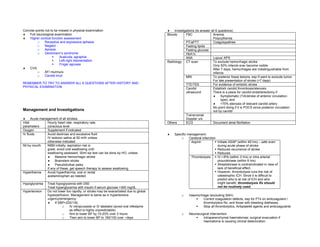
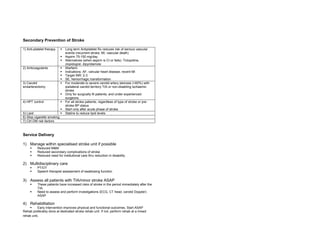
Secondary Prevention of Stroke

1) Anti-platelet therapy      Long term Antiplatelet Rx reduces risk of serious vascular
                              events (recurrent stroke, MI, vascular death)
                              Aspirin 75-150 mg/day
                              Alternatives (when aspirin is CI or fails): Ticlopidine,
                              clopidogrel, dipyridamole
2) Anticoagulants             Warfarin
                              Indications: AF, valvular heart disease, recent MI
                              Target INR: 2-3
                              SE: hemorrhagic transformation
3) Carotid                    For moderate to severe carotid artery stenosis (>60%) with
endarterectomy                ipsilateral carotid territory TIA or non-disabling ischaemic
                              stroke
                              Only for surgically fit patients, and under experienced
                              surgeons.
4) HPT control                For all stroke patients, regardless of type of stroke or pre-
                              stroke BP status
                              Start only after acute phase of stroke
5) Lipid                      Statins to reduce lipid levels
6) Stop cigarette smoking
7) Ctrl DM risk factors


Service Delivery

1) Manage within specialised stroke unit if possible
          Reduced M&M
          Reduced secondary complications of stroke
          Reduced need for institutional care thru reduction in disability.

2) Multidisciplinary care
          PT/OT
          Speech therapist assessment of swallowing function

3) Assess all patients with TIA/minor stroke ASAP
          These patients have increased risks of stroke in the period immediately after the
          TIA.
          Need to assess and perform investigations (ECG, CT head, carotid Doppler)
          ASAP

4) Rehabilitation
          Early intervention improves physical and functional outcomes. Start ASAP
Rehab preferably done at dedicated stroke rehab unit. If not, perform rehab at a mixed
rehab unit.
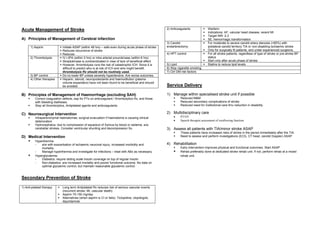
Acute Management of Stroke                                                                             2) Anticoagulants             Warfarin
                                                                                                                                     Indications: AF, valvular heart disease, recent MI
                                                                                                                                     Target INR: 2-3
A) Principles of Management of Cerebral infarction                                                                                   SE: hemorrhagic transformation
                                                                                                       3) Carotid                    For moderate to severe carotid artery stenosis (>60%) with
      1) Aspirin              Initiate ASAP (within 48 hrs) – safe even during acute phase of stroke   endarterectomy                ipsilateral carotid territory TIA or non-disabling ischaemic stroke
                              Reduces recurrence of stroke                                                                           Only for surgically fit patients, and under experienced surgeons.
                              Reduces                                                                  4) HPT control                For all stroke patients, regardless of type of stroke or pre-stroke BP
      2) Thrombolysis         IV r-tPA (within 3 hrs) or intra arterial prourokinase (within 6 hrs)                                  status
                              Streptokinase is contraindicated in view of lack of beneficial effect                                  Start only after acute phase of stroke
                              However, thrombolysis runs the risk of catastrophic ICH. Since it is     5) Lipid                      Statins to reduce lipid levels
                              difficult to predict who is at risk of ICH and who might benefit,        6) Stop cigarette smoking
                              thrombolysis Rx should not be routinely used.                            7) Ctrl DM risk factors
      3) BP control           Do no lower BP unless severely hypertensive. A/w worse outcomes.
      4) Other therapies      Heparin, steroid, neuroprotectants and haemodilution (plasma
                              volume expanders) have not been found to be beneficial and should
                              be avoided.                                                              Service Delivery

B) Principles of Management of Haemorrhage (excluding SAH)                                             1) Manage within specialised stroke unit if possible
          Correct coagulation defects, esp for PTs on anticoagulant / thrombolytics Rx, and those               Reduced M&M
          with bleeding diatheses.                                                                              Reduced secondary complications of stroke
          Stop all thrombolytics, Antiplatelet agents and anticoagulants.                                       Reduced need for institutional care thru reduction in disability.

C) Neurosurgical Intervention                                                                          2) Multidisciplinary care
          Intraparenchymal haematomas: surgical evacuation if haematoma is causing clinical                •    PT/OT
          deterioration                                                                                    •    Speech therapist assessment of swallowing function
          Hydrocephalus: due to compression of aqueduct of Sylvius by blood or oedema. a/w
          cerebellar strokes. Consider ventricular shunting and decompression Sx.                      3) Assess all patients with TIA/minor stroke ASAP
                                                                                                                These patients have increased risks of stroke in the period immediately after the TIA.
D) Medical Intervention                                                                                         Need to assess and perform investigations (ECG, CT head, carotid Doppler) ASAP
          Hyperthermia:
          -   a/w with exacerbation of ischaemic neuronal injury, increased morbidity and              4) Rehabilitation
              mortality.                                                                                        Early intervention improves physical and functional outcomes. Start ASAP
          -   Manage hyperthermia and investigate for infections – treat with ABx as necessary                  Rehab preferably done at dedicated stroke rehab unit. If not, perform rehab at a mixed
          Hyperglycaemia:                                                                                       rehab unit.
          -   Diabetics: require sliding scale insulin coverage on top of regular insulin
          -   Non-diabetics: a/w increased mortality and poorer functional outcome. No data on
              optimal glycaemic control, but maintain reasonable glycaemic control.


Secondary Prevention of Stroke
                                                                                                                                                                                Digitally signed by DR WANA HLA SHWE
1) Anti-platelet therapy      Long term Antiplatelet Rx reduces risk of serious vascular events                                                                                 DN: cn=DR WANA HLA SHWE, c=MY,
                                                                                                                                                                                o=UCSI University, School of Medicine,
                              (recurrent stroke, MI, vascular death)                                                                                                            KT-Campus, Terengganu, ou=Internal
                              Aspirin 75-150 mg/day                                                                                                                             Medicine Group, email=wunna.
                                                                                                                                                                                hlashwe@gmail.com
                              Alternatives (when aspirin is CI or fails): Ticlopidine, clopidogrel,                                                                             Reason: This document is for UCSI year 4
                              dipyridamole                                                                                                                                      students.
                                                                                                                                                                                Date: 2009.02.22 15:09:19 +08'00'

Stroke ( concise long case approach ) summary

  • 1.
    Stroke Aim to answer 6 questions from history/ physical exam/ Focal neurological deficit, of vascular origin, lasting investigations: ♦ <24 h – Transient Ischemic Attack 1. Is it a stroke? ♦ >24h – Stroke 2. Where is the stroke? 3. Ischemic or hemorrhagic? Types of Stroke 4. Mechanism of stroke? 5. Functional impairment? Ischemic Thrombotic Large artery Risk factors: 6. What are the risk factors of stroke and the co-existing medical problems? (80%) extracranial/ Nonmodifiable intracranial ♦ age 1) Is it a stroke? occlusive disease Modifiable Differential diagnoses: ♦ smoking ♦ Todd’s paresis ♦ DM o hemiplegia post-seizure ♦ hypertension o usually last <3 days ♦ hypercholesterolemia o ask if seizure preceded stroke ♦ homocystenemia ♦ Brain Tumor Small Artery Chronic hypertension o Slow progression of symptoms disease (Lacunar) Hypertrophy of media ♦ Infection (enchepalitis, abscess) Deposition of fibrinoid o Fever + seizures material in vessel wall - ♦ Hemiplegic migraine lipohyalinosis o headache, usu <24h Hypoperfusion Anemia ♦ Metabolic GI bleeding o Hyponatremia/ hypoglycemia Embolic Heart Diagnosis of Embolic Stroke ♦ Labyrinthine disorders Arterial requires one of the following: o Vestibular neuronitis (usu viral) Hx/PE: o BPPV (vertigo on changing head position) ♦ Atrial fibrillation ♦ Multiple sclerosis ♦ Mitral Stenosis ♦ Neuromuscular disorders ♦ Prosthetic Valve o Myasthenia ♦ Recent AMI o Guillian Barre Syndrome 2D Echo: ♦ Patent foramen ovale 2) Where is the stroke? ♦ Akinetic segment ♦ Ejection fraction <30% Total Anterior Circulation Homonymous hemianopia ♦ Mural thrombus (e.g. LA Syndrome (TACS) Hemiparesis thrombus) Higher Cortical dysfunction Hemorrhagic Aneurysm (berry) ♦ Aphasia (if dominant) (20%) AVM (in young <40) o Receptive – Wernicke’s ) Amyloid Angiopathy (old) o Expressive – Broca’s )dominant lobe Hemorrhagic conversion of ♦ Agnosia (e.g. finger agnosia) ) + Gerstmann’s synd infarct ♦ Neglect –common to BOTH lobes Hypertension o Visual coagulopathies o Sensory (touch) ♦ Apraxia –non-dominant lobe Non atherosclerotic vasculopathy (rare) o Constructional ♦ Vasculitides o Dressing etc. ♦ Procoagulant activity – e.g. Factor V Leiden Mutation Partial Anterior Circulation Any 2 of TACS, or isolated higher cortical dysfunction ♦ Antiphospholipid syndrome (PACS)
  • 2.
    Lacunar Syndrome ♦ Pure motor o Intracranial Thrombosis (LACS) ♦ Pure sensory ♦ No investigations, mainly from history, and when carotid Doppler ♦ Sensorimotor and 2D echo are unremarkable ♦ Ataxia-hemiparesis o Variant is clumsy-hand dysarthria 5) Functional Impairment? Posterior Circulation Drowsiness Syndrome (POCS) Lower cranial nerve palsies ♦ Activities of Daily Living Ataxia o Transferring Crossed neurological signs o Feeding Spastic paraparesis o Toileting/ Continence Bilateral LL sensory loss o Bathing o Grooming 3) Ischemic or Hemorrhagic? o Dressing Ischemic Hemorrhagic ♦ Thrombotic ♦ history of coagulopathy 6) Risk factors of stroke? o Old o Hypertensive examination may reveal raised ICP ♦ Refer to investigations sections o Smoking ♦ drowsiness o Hypercholesterolemia ♦ vomiting o DM ♦ papilledema ♦ Embolic o AF, MS, Prosthetic valve History and Physical Examination Investigations ♦ CT scan Concise points not to be missed in history: o mainly for excluding hemorrhagic stroke, esp if thrombolysis is being ♦ Handedness!!! considered ♦ Weakness o only half of infarcts seen o duration ♦ Numbness ♦ Upper limb and lower limb involvement 4) Mechanism of Stroke? ♦ Hemianopia ♦ Embolus, or o Knocking into things? ♦ Extracranial thrombosis, or ♦ Cranial nerves ♦ Intracranial thrombosis? o Diplopia o Facial asymmetry ♦ History o Dysphagia ♦ Physical Exam o Dysarthria o AF, MS suggest embolus ♦ Cerebellar o Carotic bruit suggest thrombosis o Gait, balance ♦ Investigations ♦ Functional impairment o Transthoracic/ transesophageal echo may give info suggesting embolus ♦ Risk factors ♦ Patent foramen ovale o Ischemic ♦ Akinetic segment ♦ Age ♦ Poor ejection fraction <30% ♦ Smoking ♦ Mural thrombus ♦ DM o Duplex Doppler of carotids if suspect extracranial thrombosis ♦ HTN ♦ Only for patients with non-disabling PACS who is fit for operation ♦ Cholesterol and agreeable to endarterectomy o Hemorrhagic ♦ Cerebral angiogram ♦ Family history aneurysms • To quantify degree of carotid stenosis and status of ♦ Personal history of coagulopathies intracranial circulation
  • 3.
    Concise points notto be missed in physical examination ♦ Investigations (to answer all 6 questions) ♦ Full neurological examination Bloods FBC Anemia ♦ Higher cortical function assessment Polycythemia o Receptive and expressive aphasia PT/aPTT Coagulopathies o Neglect Fasting lipids o Apraxia Fasting glucose o Gerstmann’s syndrome HbA1c Acalculia, agraphia ANA Lupus/ APS Left-right disorientation Radiology CT scan To exclude hemorrhagic stroke Finger agnosia Only 50% infarcts ever become visible ♦ CVS After 7 days, hemorrhages are indistinguishable from o AF/ murmurs infarcts o Carotid bruit MRI To posterior fossa lesions, esp if want to exclude tumor For late presentation of stroke (>7 days) REMEMBER TO TRY TO ANSWER ALL 6 QUESTIONS AFTER HISTORY AND TTE/TEE For evidence of embolic stroke PHYSICAL EXAMINATION Carotid Establish carotid thrombosis/stenosis ultrasound There is a place for carotid endarterectomy if ♦ Symptomatic (TIA/stroke of anterior circulation- type), and ♦ >70% stenosis of relevant carotid artery No point doing if it is POCS since posterior circulation Management and Investigations not by carotid Transcranial ♦ Acute management of all strokes: Doppler u/s Vital Hourly heart rate, respiratory rate, Others ECG Document atrial fibrillation parameters conscious level Oxygen Supplement if indicated IV fluids Avoid dextrose and excessive fluid ♦ Specific management: IV isotonic saline at 50 ml/h unless o Cerebral infarction otherwise indicated Aspirin Initiate ASAP (within 48 hrs) – safe even Nil by mouth NBM initially; aspiration risk is during acute phase of stroke great, avoid oral swallowing until Reduces recurrence of stroke swallowing assessed. 30ml sip test can be done by HO, unless Reduces ♦ Massive hemorrhagic stroke Thrombolysis IV r-tPA (within 3 hrs) or intra arterial ♦ Brainstem stroke prourokinase (within 6 hrs) ♦ Pseudobulbar palsy Streptokinase is contraindicated in view of If any of these, get speech therapy to assess swallowing lack of beneficial effect Hyperthemia Avoid hyperthermia, oral or rectal However, thrombolysis runs the risk of acetaminophen as needed catastrophic ICH. Since it is difficult to predict who is at risk of ICH and who Hypoglycemia Treat hypoglycemia with D50 might benefit, thrombolysis Rx should Treat hyperglycemia with insulin if serum glucose >300 mg/dL not be routinely used. Hypertension Do not lower too rapidly, or stroke may be exacerbated due to global hyperperfusion. Management is same as in hypertensive o Haemorrhage (excluding SAH) urgency/emergency: Correct coagulation defects, esp for PTs on anticoagulant / ♦ If SBP>220/130, thrombolytics Rx, and those with bleeding diatheses. o IV nitroprusside or IV labetalol (avoid oral nifedipine Stop all thrombolytics, Antiplatelet agents and anticoagulants as effect is highly unpredictable) o Aim to lower BP by 10-20% over 2 hours o Neurosurgical Intervention o Then aim to lower BP to 160/100 over ~days Intraparenchymal haematomas: surgical evacuation if haematoma is causing clinical deterioration
  • 4.
    Secondary Prevention ofStroke 1) Anti-platelet therapy Long term Antiplatelet Rx reduces risk of serious vascular events (recurrent stroke, MI, vascular death) Aspirin 75-150 mg/day Alternatives (when aspirin is CI or fails): Ticlopidine, clopidogrel, dipyridamole 2) Anticoagulants Warfarin Indications: AF, valvular heart disease, recent MI Target INR: 2-3 SE: hemorrhagic transformation 3) Carotid For moderate to severe carotid artery stenosis (>60%) with endarterectomy ipsilateral carotid territory TIA or non-disabling ischaemic stroke Only for surgically fit patients, and under experienced surgeons. 4) HPT control For all stroke patients, regardless of type of stroke or pre- stroke BP status Start only after acute phase of stroke 5) Lipid Statins to reduce lipid levels 6) Stop cigarette smoking 7) Ctrl DM risk factors Service Delivery 1) Manage within specialised stroke unit if possible Reduced M&M Reduced secondary complications of stroke Reduced need for institutional care thru reduction in disability. 2) Multidisciplinary care PT/OT Speech therapist assessment of swallowing function 3) Assess all patients with TIA/minor stroke ASAP These patients have increased risks of stroke in the period immediately after the TIA. Need to assess and perform investigations (ECG, CT head, carotid Doppler) ASAP 4) Rehabilitation Early intervention improves physical and functional outcomes. Start ASAP Rehab preferably done at dedicated stroke rehab unit. If not, perform rehab at a mixed rehab unit.
  • 5.
    Acute Management ofStroke 2) Anticoagulants Warfarin Indications: AF, valvular heart disease, recent MI Target INR: 2-3 A) Principles of Management of Cerebral infarction SE: hemorrhagic transformation 3) Carotid For moderate to severe carotid artery stenosis (>60%) with 1) Aspirin Initiate ASAP (within 48 hrs) – safe even during acute phase of stroke endarterectomy ipsilateral carotid territory TIA or non-disabling ischaemic stroke Reduces recurrence of stroke Only for surgically fit patients, and under experienced surgeons. Reduces 4) HPT control For all stroke patients, regardless of type of stroke or pre-stroke BP 2) Thrombolysis IV r-tPA (within 3 hrs) or intra arterial prourokinase (within 6 hrs) status Streptokinase is contraindicated in view of lack of beneficial effect Start only after acute phase of stroke However, thrombolysis runs the risk of catastrophic ICH. Since it is 5) Lipid Statins to reduce lipid levels difficult to predict who is at risk of ICH and who might benefit, 6) Stop cigarette smoking thrombolysis Rx should not be routinely used. 7) Ctrl DM risk factors 3) BP control Do no lower BP unless severely hypertensive. A/w worse outcomes. 4) Other therapies Heparin, steroid, neuroprotectants and haemodilution (plasma volume expanders) have not been found to be beneficial and should be avoided. Service Delivery B) Principles of Management of Haemorrhage (excluding SAH) 1) Manage within specialised stroke unit if possible Correct coagulation defects, esp for PTs on anticoagulant / thrombolytics Rx, and those Reduced M&M with bleeding diatheses. Reduced secondary complications of stroke Stop all thrombolytics, Antiplatelet agents and anticoagulants. Reduced need for institutional care thru reduction in disability. C) Neurosurgical Intervention 2) Multidisciplinary care Intraparenchymal haematomas: surgical evacuation if haematoma is causing clinical • PT/OT deterioration • Speech therapist assessment of swallowing function Hydrocephalus: due to compression of aqueduct of Sylvius by blood or oedema. a/w cerebellar strokes. Consider ventricular shunting and decompression Sx. 3) Assess all patients with TIA/minor stroke ASAP These patients have increased risks of stroke in the period immediately after the TIA. D) Medical Intervention Need to assess and perform investigations (ECG, CT head, carotid Doppler) ASAP Hyperthermia: - a/w with exacerbation of ischaemic neuronal injury, increased morbidity and 4) Rehabilitation mortality. Early intervention improves physical and functional outcomes. Start ASAP - Manage hyperthermia and investigate for infections – treat with ABx as necessary Rehab preferably done at dedicated stroke rehab unit. If not, perform rehab at a mixed Hyperglycaemia: rehab unit. - Diabetics: require sliding scale insulin coverage on top of regular insulin - Non-diabetics: a/w increased mortality and poorer functional outcome. No data on optimal glycaemic control, but maintain reasonable glycaemic control. Secondary Prevention of Stroke Digitally signed by DR WANA HLA SHWE 1) Anti-platelet therapy Long term Antiplatelet Rx reduces risk of serious vascular events DN: cn=DR WANA HLA SHWE, c=MY, o=UCSI University, School of Medicine, (recurrent stroke, MI, vascular death) KT-Campus, Terengganu, ou=Internal Aspirin 75-150 mg/day Medicine Group, email=wunna. hlashwe@gmail.com Alternatives (when aspirin is CI or fails): Ticlopidine, clopidogrel, Reason: This document is for UCSI year 4 dipyridamole students. Date: 2009.02.22 15:09:19 +08'00'