Lab. Diagnosis of Streptococcus
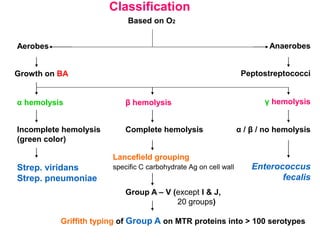
Classification
Based on O2
Aerobes Anaerobes
Peptostreptococci
Growth on BA
α hemolysis β hemolysis γ hemolysis
Incomplete hemolysis
(green color)
Complete hemolysis α / β / no hemolysis
Strep. viridans
Strep. pneumoniae
Enterococcus
fecalis
Lancefield grouping
specific C carbohydrate Ag on cell wall
Group A – V (except I & J,
20 groups)
Griffith typing of Group A on MTR proteins into > 100 serotypes
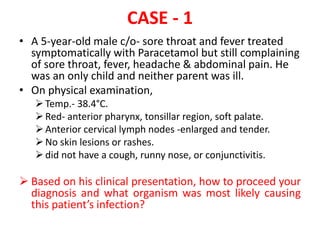
CASE - 1
• A 5-year-old male c/o- sore throat and fever treated
symptomatically with Paracetamol but still complaining
of sore throat, fever, headache & abdominal pain. He
was an only child and neither parent was ill.
• On physical examination,
Temp.- 38.4°C.
Red- anterior pharynx, tonsillar region, soft palate.
Anterior cervical lymph nodes -enlarged and tender.
No skin lesions or rashes.
did not have a cough, runny nose, or conjunctivitis.
 Based on his clinical presentation, how to proceed your
diagnosis and what organism was most likely causing
this patient’s infection?
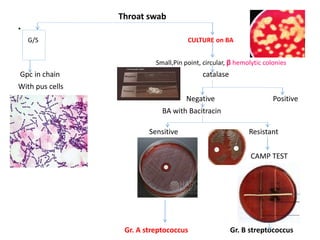
Throat swab
•
G/S CULTURE on BA
Small,Pin point, circular, β hemolytic colonies
Gpc in chain catalase
With pus cells
Negative Positive
BA with Bacitracin
Sensitive Resistant
CAMP TEST
Gr. A streptococcus Gr. B streptococcus
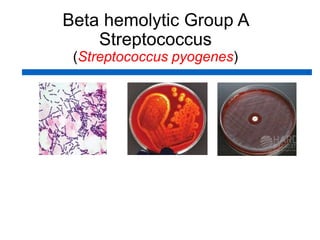
Beta hemolytic Group A
Streptococcus
(Streptococcus pyogenes)
1
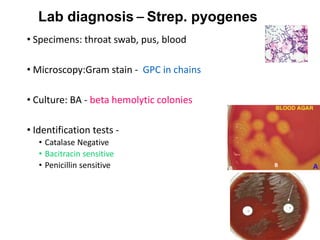
Lab diagnosis – Strep. pyogenes
• Specimens: throat swab, pus, blood
• Microscopy:Gram stain - GPC in chains
• Culture: BA - beta hemolytic colonies
• Identification tests -
• Catalase Negative
• Bacitracin sensitive
• Penicillin sensitive B
B
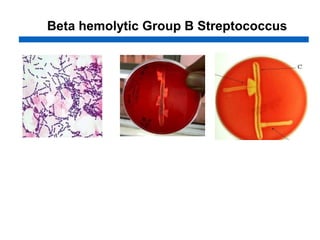
Beta hemolytic Group B Streptococcus
1
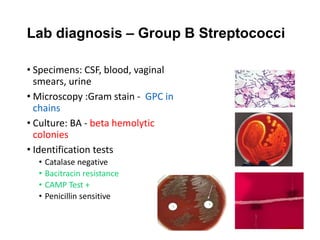
Lab diagnosis – Group B Streptococci
• Specimens: CSF, blood, vaginal
smears, urine
• Microscopy :Gram stain - GPC in
chains
• Culture: BA - beta hemolytic
colonies
• Identification tests
• Catalase negative
• Bacitracin resistance
• CAMP Test +
• Penicillin sensitive
P B
Clinical isolate-
•G/s- GPC in short chain
•BA- Pin point, β hemolytic colonies
•Catalase- negative
•Bacitracin- sensitive
•CAMP test- negative
•Isolate ????
18.05.09 Phase I/ Module VII Dr Ekta 9
CASE - 2
• 64-year-old presented with progressive shortness of breath, a
persistent productive cough, purulent sputum, and fever to 39.0°C 2
days prior to admission. He had a 30-year history of smoking.
• On physical examination
 Temp.- 37.3°C
 RR- 18/minute
 PR- 103 beats/min
 BP- 154/107 mm Hg and
 Po2- 92 mm Hg.
 On Chest auscultation- coarse breath sounds with fine crackles at the
left lower base.
 On chest radiograph -left lower lobe consolidation
• On admission- WBC count 13,600/μl with 92% N, and Hb- 9.4 g/dl.
 Based on his clinical presentation, how to proceed your diagnosis
and what organism was most likely causing this patient’s infection?
SPUTUM
•
G/S Culture on BA
Small,Pin point, circular,draughtsman shaped α hemolytic colonies
Lanceolate gram+diplococci catalase
With pus cells
Negative Positive
BA with optochin
Sensitive Resistant
Streptococcus viridans
Bile solubility
CA- bleaching effect
Pneumococcus
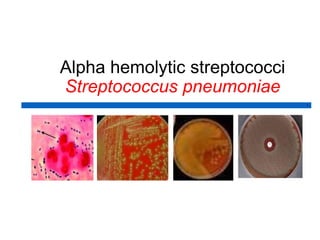
Alpha hemolytic streptococci
Streptococcus pneumoniae
1
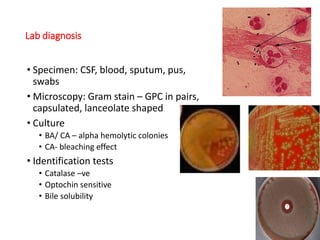
Lab diagnosis
• Specimen: CSF, blood, sputum, pus,
swabs
• Microscopy: Gram stain – GPC in pairs,
capsulated, lanceolate shaped
• Culture
• BA/ CA – alpha hemolytic colonies
• CA- bleaching effect
• Identification tests
• Catalase –ve
• Optochin sensitive
• Bile solubility
18.05.09 Phase I/ Module VII Dr Ekta 14
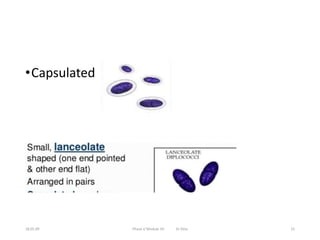
•Capsulated
18.05.09 Phase I/ Module VII Dr Ekta 15
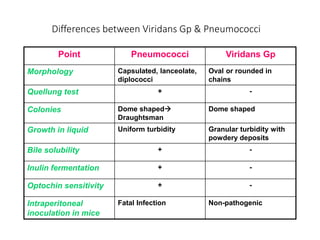
Differences between Viridans Gp & Pneumococci
Point Pneumococci Viridans Gp
Morphology Capsulated, lanceolate,
diplococci
Oval or rounded in
chains
Quellung test + -
Colonies Dome shaped
Draughtsman
Dome shaped
Growth in liquid Uniform turbidity Granular turbidity with
powdery deposits
Bile solubility + -
Inulin fermentation + -
Optochin sensitivity + -
Intraperitoneal
inoculation in mice
Fatal Infection Non-pathogenic
Clinical isolate-
•G/s- Lanceolate gram positive diplococci
•BA- Pin point, α hemolytic colonies
•Catalase- negative
•Optochin- sensitive
•Bile soluble
•Isolate ????
18.05.09 Phase I/ Module VII Dr Ekta 17
Medically Important Gram Positive, catalase negative Cocci
Family, Genus, species Characteristics Clinical manifestations
Streptococcaceae Cocci in chains and in pairs,
catalase-negative
Streptococcus pneumoniae Diplococci, α-hemolysis Pneumonia, otitis media,
sinusitis
S. viridans Cocci in chains, α-hemolysis Endocarditis, dental caries
S. pyogenes Cocci in chains, Lancefield group
A, β - hemolysis
Tonsillitis, scarlet fever,
skin infections
S. agalactiae Chain-forming cocci, group antigen
B, β-hemolysis
Meningitis/sepsis in
neonates

Streptococcus ldentification

  • 1.
    Lab. Diagnosis ofStreptococcus
  • 2.
    Classification Based on O2 AerobesAnaerobes Peptostreptococci Growth on BA α hemolysis β hemolysis γ hemolysis Incomplete hemolysis (green color) Complete hemolysis α / β / no hemolysis Strep. viridans Strep. pneumoniae Enterococcus fecalis Lancefield grouping specific C carbohydrate Ag on cell wall Group A – V (except I & J, 20 groups) Griffith typing of Group A on MTR proteins into > 100 serotypes
  • 3.
    CASE - 1 •A 5-year-old male c/o- sore throat and fever treated symptomatically with Paracetamol but still complaining of sore throat, fever, headache & abdominal pain. He was an only child and neither parent was ill. • On physical examination, Temp.- 38.4°C. Red- anterior pharynx, tonsillar region, soft palate. Anterior cervical lymph nodes -enlarged and tender. No skin lesions or rashes. did not have a cough, runny nose, or conjunctivitis.  Based on his clinical presentation, how to proceed your diagnosis and what organism was most likely causing this patient’s infection?
  • 4.
    Throat swab • G/S CULTUREon BA Small,Pin point, circular, β hemolytic colonies Gpc in chain catalase With pus cells Negative Positive BA with Bacitracin Sensitive Resistant CAMP TEST Gr. A streptococcus Gr. B streptococcus
  • 5.
    Beta hemolytic GroupA Streptococcus (Streptococcus pyogenes) 1
  • 6.
    Lab diagnosis –Strep. pyogenes • Specimens: throat swab, pus, blood • Microscopy:Gram stain - GPC in chains • Culture: BA - beta hemolytic colonies • Identification tests - • Catalase Negative • Bacitracin sensitive • Penicillin sensitive B B
  • 7.
    Beta hemolytic GroupB Streptococcus 1
  • 8.
    Lab diagnosis –Group B Streptococci • Specimens: CSF, blood, vaginal smears, urine • Microscopy :Gram stain - GPC in chains • Culture: BA - beta hemolytic colonies • Identification tests • Catalase negative • Bacitracin resistance • CAMP Test + • Penicillin sensitive P B
  • 9.
    Clinical isolate- •G/s- GPCin short chain •BA- Pin point, β hemolytic colonies •Catalase- negative •Bacitracin- sensitive •CAMP test- negative •Isolate ???? 18.05.09 Phase I/ Module VII Dr Ekta 9
  • 10.
    CASE - 2 •64-year-old presented with progressive shortness of breath, a persistent productive cough, purulent sputum, and fever to 39.0°C 2 days prior to admission. He had a 30-year history of smoking. • On physical examination  Temp.- 37.3°C  RR- 18/minute  PR- 103 beats/min  BP- 154/107 mm Hg and  Po2- 92 mm Hg.  On Chest auscultation- coarse breath sounds with fine crackles at the left lower base.  On chest radiograph -left lower lobe consolidation • On admission- WBC count 13,600/μl with 92% N, and Hb- 9.4 g/dl.  Based on his clinical presentation, how to proceed your diagnosis and what organism was most likely causing this patient’s infection?
  • 11.
    SPUTUM • G/S Culture onBA Small,Pin point, circular,draughtsman shaped α hemolytic colonies Lanceolate gram+diplococci catalase With pus cells Negative Positive BA with optochin Sensitive Resistant Streptococcus viridans Bile solubility CA- bleaching effect Pneumococcus
  • 12.
  • 13.
    Lab diagnosis • Specimen:CSF, blood, sputum, pus, swabs • Microscopy: Gram stain – GPC in pairs, capsulated, lanceolate shaped • Culture • BA/ CA – alpha hemolytic colonies • CA- bleaching effect • Identification tests • Catalase –ve • Optochin sensitive • Bile solubility
  • 14.
    18.05.09 Phase I/Module VII Dr Ekta 14
  • 15.
    •Capsulated 18.05.09 Phase I/Module VII Dr Ekta 15
  • 16.
    Differences between ViridansGp & Pneumococci Point Pneumococci Viridans Gp Morphology Capsulated, lanceolate, diplococci Oval or rounded in chains Quellung test + - Colonies Dome shaped Draughtsman Dome shaped Growth in liquid Uniform turbidity Granular turbidity with powdery deposits Bile solubility + - Inulin fermentation + - Optochin sensitivity + - Intraperitoneal inoculation in mice Fatal Infection Non-pathogenic
  • 17.
    Clinical isolate- •G/s- Lanceolategram positive diplococci •BA- Pin point, α hemolytic colonies •Catalase- negative •Optochin- sensitive •Bile soluble •Isolate ???? 18.05.09 Phase I/ Module VII Dr Ekta 17
  • 18.
    Medically Important GramPositive, catalase negative Cocci Family, Genus, species Characteristics Clinical manifestations Streptococcaceae Cocci in chains and in pairs, catalase-negative Streptococcus pneumoniae Diplococci, α-hemolysis Pneumonia, otitis media, sinusitis S. viridans Cocci in chains, α-hemolysis Endocarditis, dental caries S. pyogenes Cocci in chains, Lancefield group A, β - hemolysis Tonsillitis, scarlet fever, skin infections S. agalactiae Chain-forming cocci, group antigen B, β-hemolysis Meningitis/sepsis in neonates