BIODIVERSITY, ITS
CONSERVATION AND
CONVENTIONS
INDEX
•Introduction
•Levels of biodiversity
•Measurement of biodiversity
•Gradients of biodiversity
•Biodiversity of India
•Values of biodiversity
•Threats to biodiversity
•Mass extinctions
•Conservation of biodiversity
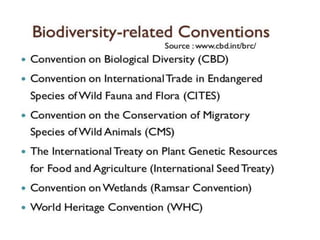
•Conventions on biodiversity
INTRODUCTION
•BIODIVERSITY - ‘Bio’ means life and ‘Diversity’ means
variety.
•According to Convention of Biodiversity (CBD), 1992
Biological Diversity means the variability among the living
organisms from all sources including terrestrial, marine and
other aquatic ecosystems. This include diversity within
species, between species and of ecosystems.
•Term ‘Biological Diversity’ – Thomas Lovejoy in 1980
•Word ‘Biodiversity’ – Walter G. Rosen in 1985
•22ND May is celebrated as International Biological
Diversity day.
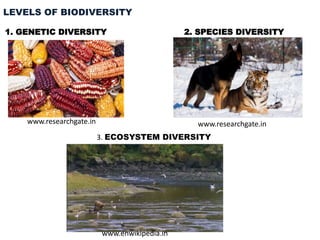
LEVELS OF BIODIVERSITY
1. GENETIC DIVERSITY 2. SPECIES DIVERSITY
3. ECOSYSTEM DIVERSITY
www.enwikipedia.in
www.researchgate.in www.researchgate.in
MEASURING BIODIVERSITY OVER SPATIAL
SCALES
This was described by Whittaker in 1972.
•Alpha Diversity- It refers to the diversity within a
particular area or ecosystem. It is expressed as
number of species per unit area (species richness).
•Beta Diversity- A comparison of diversity between
two ecosystem, usually measured as the amount of
species change between the ecosystems.
•Gamma Diversity- A measure of the overall
diversity within a large region.
GRADIENTS OF BIODIVERSITY
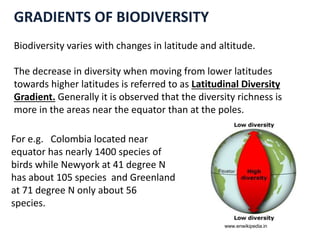
Biodiversity varies with changes in latitude and altitude.
The decrease in diversity when moving from lower latitudes
towards higher latitudes is referred to as Latitudinal Diversity
Gradient. Generally it is observed that the diversity richness is
more in the areas near the equator than at the poles.
For e.g. Colombia located near
equator has nearly 1400 species of
birds while Newyork at 41 degree N
has about 105 species and Greenland
at 71 degree N only about 56
species.
www.enwikipedia.in
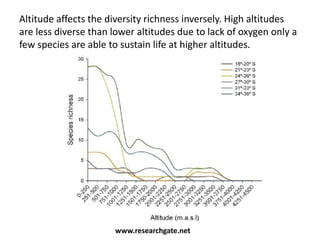
Altitude affects the diversity richness inversely. High altitudes
are less diverse than lower altitudes due to lack of oxygen only a
few species are able to sustain life at higher altitudes.
www.researchgate.net
BIODIVERSITY OF INDIA
•Known for its rich heritage
•One of 17 mega-diverse countries
•Only 2.4%of the world's area, accounts 7-8% flora and fauna
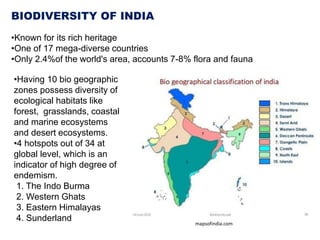
•Having 10 bio geographic
zones possess diversity of
ecological habitats like
forest, grasslands, coastal
and marine ecosystems
and desert ecosystems.
•4 hotspots out of 34 at
global level, which is an
indicator of high degree of
endemism.
1. The Indo Burma
2. Western Ghats
3. Eastern Himalayas
4. Sunderland mapsofindia.com
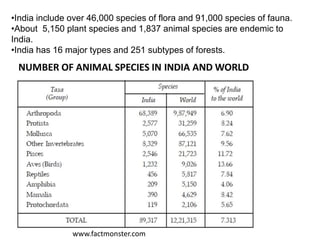
•India include over 46,000 species of flora and 91,000 species of fauna.
•About 5,150 plant species and 1,837 animal species are endemic to
India.
•India has 16 major types and 251 subtypes of forests.
www.factmonster.com
Values of biodiversity
•Consumptive value- provide requirements that can be harvested and used
directly. (cereals, pulses, timber, biodiesel)
•Productive value- sold in markets as raw or processed form. (wool, cotton, dyes,
gums)
•Social value-many plants ( banyan, peepal, tulsi, mango) and animals like cow,
snake, peacock are regarded as holy and sacred.
•Ethical value- Each species is unique and has a right to exist.
•Aesthetic value- pleasure to see and smell flowers, listen birds singing.
•Optional value- its potential ability to provide economic benefit to human society
in future.
•Ecological value- maintain ecological balance, giving pure air and prevent soil
erosion.
THREATS TO BIODIVERSITY
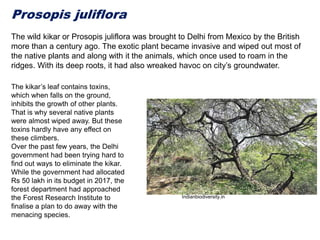
Prosopis juliflora
The wild kikar or Prosopis juliflora was brought to Delhi from Mexico by the British
more than a century ago. The exotic plant became invasive and wiped out most of
the native plants and along with it the animals, which once used to roam in the
ridges. With its deep roots, it had also wreaked havoc on city’s groundwater.
The kikar’s leaf contains toxins,
which when falls on the ground,
inhibits the growth of other plants.
That is why several native plants
were almost wiped away. But these
toxins hardly have any effect on
these climbers.
Over the past few years, the Delhi
government had been trying hard to
find out ways to eliminate the kikar.
While the government had allocated
Rs 50 lakh in its budget in 2017, the
forest department had approached
the Forest Research Institute to
finalise a plan to do away with the
menacing species.
Indianbiodiversity.in
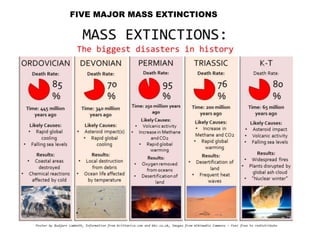
FIVE MAJOR MASS EXTINCTIONS
High carbon dioxide levels cause plants to thicken their leaves, which
could worsen climate change effects, researchers say
In a paper published online Oct. 1 by the journal Global Biogeochemical Cycles,
the researchers report that, when they incorporated this information into global
climate models under the high atmospheric carbon dioxide levels expected later
this century, the global “carbon sink” contributed by plants was less productive —
leaving about 6.39 billion tons, of carbon in the atmosphere per year. Those levels
are similar to the amount of carbon released into the atmosphere each year due to
human-generated fossil fuel emissions — 8.8 billion tons.
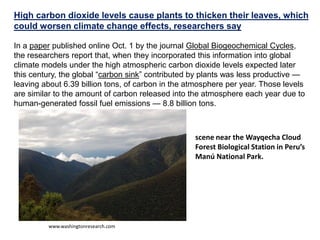
scene near the Wayqecha Cloud
Forest Biological Station in Peru’s
Manú National Park.
www.washingtonresearch.com
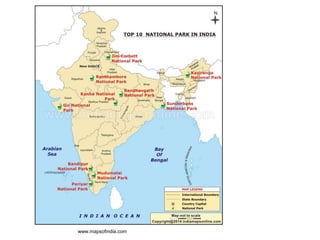
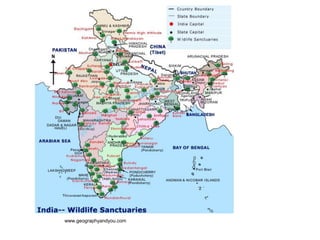
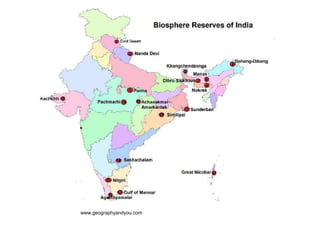
BIODIVERSITY CONSERVATION
www.mapsofindia.com
www.geographyandyou.com
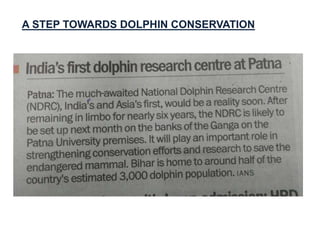
A STEP TOWARDS DOLPHIN CONSERVATION
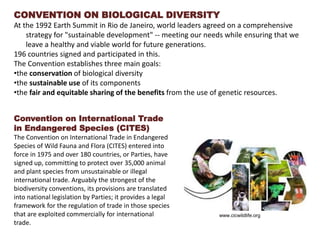
CONVENTION ON BIOLOGICAL DIVERSITY
At the 1992 Earth Summit in Rio de Janeiro, world leaders agreed on a comprehensive
strategy for "sustainable development" -- meeting our needs while ensuring that we
leave a healthy and viable world for future generations.
196 countries signed and participated in this.
The Convention establishes three main goals:
•the conservation of biological diversity
•the sustainable use of its components
•the fair and equitable sharing of the benefits from the use of genetic resources.
Convention on International Trade
in Endangered Species (CITES)
The Convention on International Trade in Endangered
Species of Wild Fauna and Flora (CITES) entered into
force in 1975 and over 180 countries, or Parties, have
signed up, committing to protect over 35,000 animal
and plant species from unsustainable or illegal
international trade. Arguably the strongest of the
biodiversity conventions, its provisions are translated
into national legislation by Parties; it provides a legal
framework for the regulation of trade in those species
that are exploited commercially for international
trade.
www.cicwildlife.org
The Convention on the
Conservation of Migratory
Species of Wild Animals
(CMS)
•The Convention was signed in 1979 in Bad
Godesberg, a suburb of Bonn (hence the
name), and entered into force in 1983.
•The Convention on the Conservation of
Migratory Species of Wild Animals (CMS;
also known as the Bonn Convention) aims
to conserve terrestrial, marine and avian
migratory species throughout their range.
The International Treaty on Plant Genetic Resources for
Food and Agriculture
•Signed in Rome in 2001, entered into force in 2004
•The objectives of the International Treaty on Plant Genetic Resources for Food and
Agriculture are the conservation and sustainable use of all plant genetic resources for food
and agriculture and the fair and equitable sharing of the benefits arising out of their use, in
harmony with the Convention on Biological Diversity, for sustainable agriculture and food
security.
www.unbonn.org
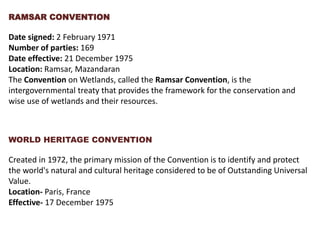
RAMSAR CONVENTION
Date signed: 2 February 1971
Number of parties: 169
Date effective: 21 December 1975
Location: Ramsar, Mazandaran
The Convention on Wetlands, called the Ramsar Convention, is the
intergovernmental treaty that provides the framework for the conservation and
wise use of wetlands and their resources.
WORLD HERITAGE CONVENTION
Created in 1972, the primary mission of the Convention is to identify and protect
the world's natural and cultural heritage considered to be of Outstanding Universal
Value.
Location- Paris, France
Effective- 17 December 1975
THANK YOU

biodiversity, conservation and conventions

  • 1.
  • 2.
    INDEX •Introduction •Levels of biodiversity •Measurementof biodiversity •Gradients of biodiversity •Biodiversity of India •Values of biodiversity •Threats to biodiversity •Mass extinctions •Conservation of biodiversity •Conventions on biodiversity
  • 3.
    INTRODUCTION •BIODIVERSITY - ‘Bio’means life and ‘Diversity’ means variety. •According to Convention of Biodiversity (CBD), 1992 Biological Diversity means the variability among the living organisms from all sources including terrestrial, marine and other aquatic ecosystems. This include diversity within species, between species and of ecosystems. •Term ‘Biological Diversity’ – Thomas Lovejoy in 1980 •Word ‘Biodiversity’ – Walter G. Rosen in 1985 •22ND May is celebrated as International Biological Diversity day.
  • 4.
    LEVELS OF BIODIVERSITY 1.GENETIC DIVERSITY 2. SPECIES DIVERSITY 3. ECOSYSTEM DIVERSITY www.enwikipedia.in www.researchgate.in www.researchgate.in
  • 5.
    MEASURING BIODIVERSITY OVERSPATIAL SCALES This was described by Whittaker in 1972. •Alpha Diversity- It refers to the diversity within a particular area or ecosystem. It is expressed as number of species per unit area (species richness). •Beta Diversity- A comparison of diversity between two ecosystem, usually measured as the amount of species change between the ecosystems. •Gamma Diversity- A measure of the overall diversity within a large region.
  • 6.
    GRADIENTS OF BIODIVERSITY Biodiversityvaries with changes in latitude and altitude. The decrease in diversity when moving from lower latitudes towards higher latitudes is referred to as Latitudinal Diversity Gradient. Generally it is observed that the diversity richness is more in the areas near the equator than at the poles. For e.g. Colombia located near equator has nearly 1400 species of birds while Newyork at 41 degree N has about 105 species and Greenland at 71 degree N only about 56 species. www.enwikipedia.in
  • 7.
    Altitude affects thediversity richness inversely. High altitudes are less diverse than lower altitudes due to lack of oxygen only a few species are able to sustain life at higher altitudes. www.researchgate.net
  • 8.
    BIODIVERSITY OF INDIA •Knownfor its rich heritage •One of 17 mega-diverse countries •Only 2.4%of the world's area, accounts 7-8% flora and fauna •Having 10 bio geographic zones possess diversity of ecological habitats like forest, grasslands, coastal and marine ecosystems and desert ecosystems. •4 hotspots out of 34 at global level, which is an indicator of high degree of endemism. 1. The Indo Burma 2. Western Ghats 3. Eastern Himalayas 4. Sunderland mapsofindia.com
  • 9.
    •India include over46,000 species of flora and 91,000 species of fauna. •About 5,150 plant species and 1,837 animal species are endemic to India. •India has 16 major types and 251 subtypes of forests. www.factmonster.com
  • 10.
    Values of biodiversity •Consumptivevalue- provide requirements that can be harvested and used directly. (cereals, pulses, timber, biodiesel) •Productive value- sold in markets as raw or processed form. (wool, cotton, dyes, gums) •Social value-many plants ( banyan, peepal, tulsi, mango) and animals like cow, snake, peacock are regarded as holy and sacred. •Ethical value- Each species is unique and has a right to exist. •Aesthetic value- pleasure to see and smell flowers, listen birds singing. •Optional value- its potential ability to provide economic benefit to human society in future. •Ecological value- maintain ecological balance, giving pure air and prevent soil erosion.
  • 11.
  • 12.
    Prosopis juliflora The wildkikar or Prosopis juliflora was brought to Delhi from Mexico by the British more than a century ago. The exotic plant became invasive and wiped out most of the native plants and along with it the animals, which once used to roam in the ridges. With its deep roots, it had also wreaked havoc on city’s groundwater. The kikar’s leaf contains toxins, which when falls on the ground, inhibits the growth of other plants. That is why several native plants were almost wiped away. But these toxins hardly have any effect on these climbers. Over the past few years, the Delhi government had been trying hard to find out ways to eliminate the kikar. While the government had allocated Rs 50 lakh in its budget in 2017, the forest department had approached the Forest Research Institute to finalise a plan to do away with the menacing species. Indianbiodiversity.in
  • 13.
    FIVE MAJOR MASSEXTINCTIONS
  • 14.
    High carbon dioxidelevels cause plants to thicken their leaves, which could worsen climate change effects, researchers say In a paper published online Oct. 1 by the journal Global Biogeochemical Cycles, the researchers report that, when they incorporated this information into global climate models under the high atmospheric carbon dioxide levels expected later this century, the global “carbon sink” contributed by plants was less productive — leaving about 6.39 billion tons, of carbon in the atmosphere per year. Those levels are similar to the amount of carbon released into the atmosphere each year due to human-generated fossil fuel emissions — 8.8 billion tons. scene near the Wayqecha Cloud Forest Biological Station in Peru’s Manú National Park. www.washingtonresearch.com
  • 15.
  • 16.
  • 17.
  • 18.
  • 19.
    A STEP TOWARDSDOLPHIN CONSERVATION
  • 21.
    CONVENTION ON BIOLOGICALDIVERSITY At the 1992 Earth Summit in Rio de Janeiro, world leaders agreed on a comprehensive strategy for "sustainable development" -- meeting our needs while ensuring that we leave a healthy and viable world for future generations. 196 countries signed and participated in this. The Convention establishes three main goals: •the conservation of biological diversity •the sustainable use of its components •the fair and equitable sharing of the benefits from the use of genetic resources. Convention on International Trade in Endangered Species (CITES) The Convention on International Trade in Endangered Species of Wild Fauna and Flora (CITES) entered into force in 1975 and over 180 countries, or Parties, have signed up, committing to protect over 35,000 animal and plant species from unsustainable or illegal international trade. Arguably the strongest of the biodiversity conventions, its provisions are translated into national legislation by Parties; it provides a legal framework for the regulation of trade in those species that are exploited commercially for international trade. www.cicwildlife.org
  • 22.
    The Convention onthe Conservation of Migratory Species of Wild Animals (CMS) •The Convention was signed in 1979 in Bad Godesberg, a suburb of Bonn (hence the name), and entered into force in 1983. •The Convention on the Conservation of Migratory Species of Wild Animals (CMS; also known as the Bonn Convention) aims to conserve terrestrial, marine and avian migratory species throughout their range. The International Treaty on Plant Genetic Resources for Food and Agriculture •Signed in Rome in 2001, entered into force in 2004 •The objectives of the International Treaty on Plant Genetic Resources for Food and Agriculture are the conservation and sustainable use of all plant genetic resources for food and agriculture and the fair and equitable sharing of the benefits arising out of their use, in harmony with the Convention on Biological Diversity, for sustainable agriculture and food security. www.unbonn.org
  • 23.
    RAMSAR CONVENTION Date signed:2 February 1971 Number of parties: 169 Date effective: 21 December 1975 Location: Ramsar, Mazandaran The Convention on Wetlands, called the Ramsar Convention, is the intergovernmental treaty that provides the framework for the conservation and wise use of wetlands and their resources. WORLD HERITAGE CONVENTION Created in 1972, the primary mission of the Convention is to identify and protect the world's natural and cultural heritage considered to be of Outstanding Universal Value. Location- Paris, France Effective- 17 December 1975
  • 24.