Govt. P.G. College, Kanker (C.G.)
Seminar
On
Conservation Strategies.
Guided By HOD Submitted By
Aarti Sinha R. Kuldeep Reshma, Kirtan,
Pushplata Kanwar Kanchu, Ravindranath
Conservation : Is the wise use of natural resources, without wasting them.
Management/Conservation Principles
• Wildlife/Plants manager’s job is to maintain number of animals in a habitat
at or below habitat’s carrying capacity, so no damage is done to the animals
or to their habitat.
• In addition to looking at the total number of a species in a habitat, wildlife
managers also monitor breeding stock correct mix of adult and young
animals/plants needed to sustain a population.
Management/Conservation Principles
(cont.)
• To manage a habitat, wildlife /plants managers must consider historical
trends, current habitat conditions, breeding population levels, long-term
projections and breeding success.
EXTINCTIONS
 In biology and ecology, extinction is the cessation of existence of a species or
group of taxa. The moment of extinction is generally considered to be the
death of the last individual of that species. Because a species' potential range
may be very large, determining this moment is difficult, and is usually done
retrospectively. This difficulty leads to phenomena such as Lazarus taxa, where
a species presumed extinct abruptly "re-appears" after a period of apparent
absence.
 Some experts have estimated that up to half of presently existing species may
become extinct by 2100.
Definition
• A species becomes extinct when the last existing member of
that species dies. Extinction therefore becomes a certainty
when there are no surviving individuals that are able to
reproduce and create a new generation.
Psuedoextinction
• Descendants may or may not exist for extinct species. Daughter
species that evolve from a parent species carry on most of the
parent species' genetic information, and even though the parent
species may become extinct, the daughter species lives on. .
• In other cases, species have produced no new variants, or none that
are able to survive the parent species' extinction. Extinction of a
parent species where daughter species or subspecies are still alive
is also called pseudoextinction.
• Pseudoextinction is difficult to demonstrate unless one has a strong
chain of evidence linking a living species to members of a pre-existing
species.
• For example, it is sometimes claimed that the extinct Hyracotherium,
which was an ancient animal similar to the horse, is pseudoextinct,
rather than extinct, because there are several extant species of
equus, including zebra and donkeys.
• Pseudoextinction is much easier to demonstrate for larger taxonomic
groups. It is said that dinosaurs are pseudoextinct, because some of
their descendants, the birds, survive today.
Causes of Extinction
• The passenger pigeon, one of several species of extinct birds,
was hunted to extinction over the course of a few decades.
• The Bali Tiger was declared extinct in 1937 due to hunting and
habitat loss.
• There are a variety of causes that can contribute directly or
indirectly to the extinction of a species or group of species. "Just as
each species is unique," write Beverly and Stephen Stearns, "so is
each extinction... the causes for each are varied — some subtle and
complex, others obvious and simple".
• Extinction of a species may come suddenly when an otherwise
healthy species is wiped out completely, as when toxic pollution
renders its entire habitat unlivable; or may occur gradually over
thousands or millions of years, such as when a species gradually
loses out in competition for food to better adapted competitors.
• Currently, environmental groups and some governments are concerned with
the extinction of species caused by humanity, and are attempting to combat
further extinctions through a variety of conservation programs.
• Humans can cause extinction of a species through overharvesting, pollution,
habitat destruction, introduction of new predators and food competitors,
overhunting, and other influences. According to the World Conservation
Union (WCU, also known as IUCN), 784 extinctions have been recorded since
the year 1500.
• Genetics and demographic phenomena
• Genetic pollution
• Habitat degradation
• Predation, competition, and disease
Coextinctions
• Coextinction refers to the loss of a species due to the extinction of another;
for example, the extinction of parasitic insects following the loss of their
hosts. Coextinction can also occur when a species loses its pollinator, or to
predators in a food chain who lose their prey.
• "Species coextinction is a manifestation of the interconnectedness of
organisms in complex ecosystems ... While coextinction may not be the most
important cause of species extinctions, it is certainly an insidious one".
In situ conservation
• In situ means in the natural, original place or position; as in
the location of the explant on the mother plant prior to
excision. In situ conservation which include conservation of
plant and animals in their native ecosystem or even in man
made ecosystem, where they naturally occur.
• Thus in-situ conservation refers to protection zones and areas
of high biological diversity.
• This type of conservation applies only to wild fauna and flora and not to the
domesticated animals and plants, because conservation is achieved by protection
of populations in nature.
• The in-situ conservation of habitats has received high priority in the world
conservation strategy programmes launched since 1980.
• In-situ conservation includes a system of protected areas of different categories
e.g. National parks, Sanctuaries, National Monument, Cultural landscapes,
Biosphere Reserves, etc. One of the best methods to save wildlife species, which is
on the road to extinction, is to put it in a special enclosure to reproduce.
Sanctuaries and National parks, whose legal definition varies from country to
country, best illustrate this.
International Efforts
• Biodiversity is the variety and variations occurring in nature,
which has sustained the harmonious existence of life on
earth.
• The components of this diversity are so interdependent that
any change in the system leads to major imbalance and
threatens the normal ecological cycle.
• In the discussion at the UN Conference on the Human
Environment held in Stockholm in 1972. The UNEP identified
conservation as priority area in 197.
• It was only towards 1980’s that systemic and concentrated
efforts to look at biodiversity conservation profile at international
level started with constitution of an Ad hoc working group of
experts on biological diversity by UNEP in 1987.
• Eventually an experts group was constituted by UNEP, which
started it’s work in 1989.
• “Convention on Biological Diversity (CBD)” was one of the
foremost issues discussed at the Earth Summit held at Rio de
Janeiro (Brazil) between June 3 and 14, 1992.
• A ceremony to mark the opening of the convention on biological
diversity took place in the afternoon on June 5. This convention
entered into force on December 29, 1993.
• Feranando Collor, the President of the Federal Republic of Brazil
was the first to sign the convention, followed by India, and 155
other nations. At present, 166 countries are parties to the
convention.
India’s Initiative for In-situ Conservation
• India is fortunately placed in a position of advantage. Ours is
tropical country with a tremendous heterogeneity of
environments ranging from tropical rain forests of Andaman and
Arunachal Pradesh to the deserts of Rajasthan and Ladakh.
• It lies at the junction of the three biogeographical provinces of
Africa, temperate Eurasia and Orient.
• As a result, it has rich biological heritage that qualifies it as one
of the 12-megadiversity nations of the world.
• Dr M S Swaminathan (1983) reviewed the scientific aspects of
conservation. He suggested that the first step in conservation
should be defining the categories of materials (plants/ genes) for
preservation and the major methods preserving them.
• In India, institutionalised management of biodiversity in situ
started with the establishment of the first National Park, the
Hailey National Park (now Jim Corbett National Park) in 1935.
Following this, more than 500 PAs were set up representing a
wide range of ecosystems.
• Institutional efforts at in-situ conservation of endangered animals
were initiated in the country about 30 years ago with the launching of
Project Tiger. An all-India tiger census conducted in 1972 revealed
that there were only 1,827 tigers in the country as against an
estimated 40,000 at the turn of the century.
• Indian holds the largest number of Asian elephants with 20,000 –
24,000 in the wild and nearly 3000 in captivity.
• Other special conservation programmes have also been initiated and
these include the Indian Rhino, Lion, certain primates (Indo-UA
Primate Project in Northeast India), and aquatic mammals especially
river dolphins.
• The Indian Council of Forestry Research and Education (ICFRE)
has identified 309 forest preservation plots of representative
forest types for conservation of variable and representative
areas of biodiversity. 187 of these plots are natural forests and
117 in plantations, covering a total area of 8500 hectares.
• There are a number of Non Government Organisation (NGO)
initiatives for in-situ conservation in the country. One of these is
the WWF-India’s Community Biodiversity Conservation
Programme.
BIOSPHERE RESERVE
• The idea of 'biosphere reserves' was initiated by UNESCO in 1973-74 under its Man and
Biosphere (MAB) programme. The MAB, launched in 1970 by UNESCO, is a broad based
ecological programme aimed to develop within the natural and social sciences a basis for
the rational use and conservation of the resources of the biosphere and for the
improvement of the relationship between man and the environment; to predict the
consequences of today's actions on tomorrows world and thereby to increase man's
ability to manage efficiently the natural resources of the biosphere reserve.
• The Indian National Man and Biosphere (MAB) committee identifies and recommends
potential sites for designation as Biosphere Reserves, following the UNESCO’s guidelines
and criteria. By 20 September 2010, 18 biosphere reserves have been established in
India and some additional sites are under consideration.
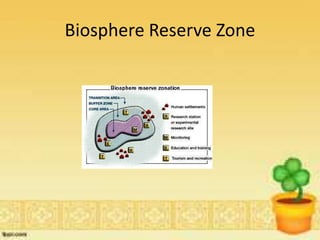
Biosphere Reserve Zone
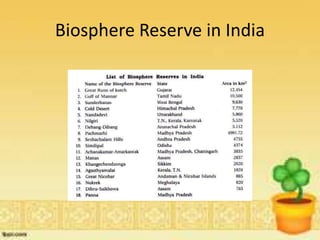
Biosphere Reserve in India
National Park
• A national park is an area dedicated to conserve the scenery (or environment)
and natural objects and the wildlife therein. In national parks, all private rights
are non-existent and all forestry operations and other usages such as grazing
of domestic animals are prohibited. However, the general public may enter it
for the purpose of observation and study.
• As per National Wildlife Database, June 2008, there are 97 existing national
parks in India covering an area of 38,199.47 km2, which is 1.16% of the
geographical area of the country (Table 4.1). In addition to the above 74
national parks covering an area of 16,630.08 km2 are proposed in the
Protected Area Network Report (Rodgers et al. 2002). The network of parks
will go up 171 after full implementation of the above report.
State/UTs Area of
State
(km2)
No. of
NPs
Area
Covered
(km2)
% of State
Area
Andhra Pradesh 275068 4 373.23 0.14
Arunachal Pradesh 83743 2 2290.82 2.74
Assam 78438 5 1977.79 2.52
Bihar 94163 1 335.65 0.36
Chhattisgarh 135194 3 2899.08 2.14
Goa 3702 1 107.00 2.89
Gujarat 196024 4 480.11 0.24
Haryana 44212 2 48.25 0.11
Himachal Pradesh 55673 2 1430.00 2.57
Jammu & Kashmir 222235 4 3930.25 1.77
Jharkhand 79714 1 231.67 0.29
Karnataka 191791 5 2472.18 1.29
Kerala 38863 6 558.16 1.44
Madhya Pradesh 308252 9 3656.36 1.19
Maharashtra 307690 6 1273.60 0.41
Manipur 22327 1 40.00 0.18
Meghalaya 22429 2 267.48 1.19
Mizoram 21081 2 150.00 0.71
Nagaland 16579 1 202.02 1.22
Orissa 155707 2 990.70 0.64
Punjab 50362 0 0.00 0.00
Rajasthan 342239 5 4122.33 1.20
Sikkim 7096 1 1784.00 25.14
Tamil Nadu 130058 5 307.84 0.24
Tripura 10486 2 199.79 1.91
Uttar Pradesh 240926 1 490.00 0.20
Uttarakhand 53485 6 4731.00 8.85
West Bengal 88752 5 1693.25 1.91
Union Territories
Andaman & Nicobar 8249 9 1156.91 14.02
Chandigarh 114 0 0.00 0.00
Dadra & Nagar Haveli 491 0 0.00 0.00
Daman & Diu 112 0 0.00 0.00
Delhi 1483 0 0.00 0.00
Lakshadweep 32 0 0.00 0.00
Pondicherry 493 0 0.00 0.00
India 3287263 97 38199.48 1.16
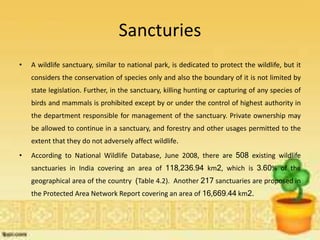
Sancturies
• A wildlife sanctuary, similar to national park, is dedicated to protect the wildlife, but it
considers the conservation of species only and also the boundary of it is not limited by
state legislation. Further, in the sanctuary, killing hunting or capturing of any species of
birds and mammals is prohibited except by or under the control of highest authority in
the department responsible for management of the sanctuary. Private ownership may
be allowed to continue in a sanctuary, and forestry and other usages permitted to the
extent that they do not adversely affect wildlife.
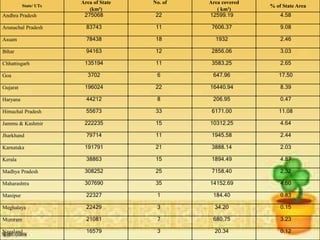
• According to National Wildlife Database, June 2008, there are 508 existing wildlife
sanctuaries in India covering an area of 118,236.94 km2, which is 3.60% of the
geographical area of the country (Table 4.2). Another 217 sanctuaries are proposed in
the Protected Area Network Report covering an area of 16,669.44 km2.
State/ UTs
Area of State
(km²)
No. of Area covered
( km²)
% of State Area
Andhra Pradesh 275068 22 12599.19 4.58
Arunachal Pradesh 83743 11 7606.37 9.08
Assam 78438 18 1932 2.46
Bihar 94163 12 2856.06 3.03
Chhattisgarh 135194 11 3583.25 2.65
Goa 3702 6 647.96 17.50
Gujarat 196024 22 16440.94 8.39
Haryana 44212 8 206.95 0.47
Himachal Pradesh 55673 33 6171.00 11.08
Jammu & Kashmir 222235 15 10312.25 4.64
Jharkhand 79714 11 1945.58 2.44
Karnataka 191791 21 3888.14 2.03
Kerala 38863 15 1894.49 4.87
Madhya Pradesh 308252 25 7158.40 2.32
Maharashtra 307690 35 14152.69 4.60
Manipur 22327 1 184.40 0.83
Meghalaya 22429 3 34.20 0.15
Mizoram 21081 7 680.75 3.23
Nagaland 16579 3 20.34 0.12
Orissa 155707 18 6969.15 4.48
Punjab 50362 12 323.80 0.64
Rajasthan 342239 23 5447.03 1.59
Sikkim 7096 7 399.10 5.62
Tamil Nadu 130058 20 2997.60 2.30
Tripura 10486 3 403.85 3.85
Uttar Pradesh 240926 23 5222.47 2.17
Uttarakhand 53485 6 2418.65 4.52
West Bengal 88752 15 1203.28 1.36
UNION TERRITORIES
Andaman & Nicobar 8249 96 389.39 4.72
Chandigarh 114 2 26.13 22.92
Dadra & Nagar Haveli 491 1 92.16 18.77
Daman & Diu 112 1 2.18 1.95
Delhi 1483 1 27.20 1.83
Lakshadweep 32 1 0.01 0.03
Pondicherry 493 0 0.00 0.00
India 3287263 508 118236.94 3.60
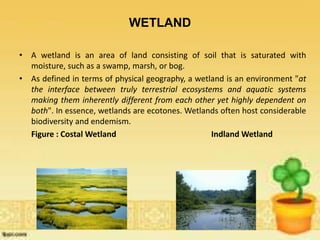
WETLAND
• A wetland is an area of land consisting of soil that is saturated with
moisture, such as a swamp, marsh, or bog.
• As defined in terms of physical geography, a wetland is an environment "at
the interface between truly terrestrial ecosystems and aquatic systems
making them inherently different from each other yet highly dependent on
both". In essence, wetlands are ecotones. Wetlands often host considerable
biodiversity and endemism.
Figure : Costal Wetland Indland Wetland
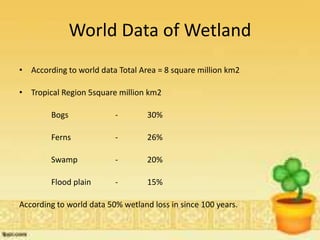
World Data of Wetland
• According to world data Total Area = 8 square million km2
• Tropical Region 5square million km2
Bogs - 30%
Ferns - 26%
Swamp - 20%
Flood plain - 15%
According to world data 50% wetland loss in since 100 years.
Wet Land in India
• In India 27,403km2 Total wetland
• 23,444km2 Inland
• 3,459km2 Costal land.
• According to Directory of Asian Wetland 1989- Total
Wetland is 18.4% which is 70% use in paddy culture.
• Area wise 4.1% total wetland in which 1.5% Natural and
2.6% men made.
• Costal wetland have 80% part of Sundarban Delta.
• Categories of Wetland in India – 8 series of wetland in India
• 1. Deccan Plateau - South-East Area
• 2. The Gulf of Kutch - Rajasthan-Gujrat
• 3. Fresh water region- Rajasthan-Gujrat
• 4. Iceland - Andman nicobar
• 5. Kashmir - Laddhakh
• 6. Ganga ghat and Bramhaputra Feild
• 7. India’s Eaxtern Pier (Chilka Lake)
• 8. North India Himalyas high heels.
Some Important Wetland in India
S.No. Wetland Place
1. Renuka Himachal
2. Yashwant Sea Madhya Pradesh
3. Bhoj Madhya Pradesh
4. Loktak Manipur
5. Chilka Odissa
6. Sundarban West Bengol
7. Khurana Chandigarh
8. Mular Jammu-Kashmir
9. Naal Lake Gujrat
10. Harike Punjab
11. Ashtamudi Keral
12. Koteru Andhra Pradesh
13. Kabra Bihar
14 Chandrataal Himachal Pradesh
15 Kajali Punjab
16. Rudra Lake Tripura
17. West Bengal East Bengal
18. Magadhi Karnatak
19. Little run of Katcha Gujrat
Threats Of Wetland
• Civilization
• Anthropogenic Activities
• Hydrologic Activities
• Defortation
• Agriculture
• Salinity
• Aqua Culture
• Climate Change
• Introduce new species – Salvia
Conservation of Wetland
• Ramsar Conservation.
• Montex record.
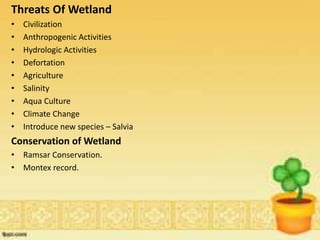
MANGROVE
• Mangrove ecosystem is a peculiar habitat found at the interface
between land and sea. The term "mangrove" is being applied to
the specific ecosystem of the intertidal world in the tropics and
subtropics and the plant community of this ecosystem is termed
as "mangrove vegetation".
Figure : Mangrove- Kannur in India
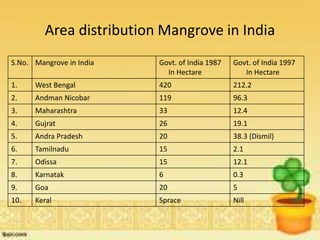
Area distribution Mangrove in India
S.No. Mangrove in India Govt. of India 1987
In Hectare
Govt. of India 1997
In Hectare
1. West Bengal 420 212.2
2. Andman Nicobar 119 96.3
3. Maharashtra 33 12.4
4. Gujrat 26 19.1
5. Andra Pradesh 20 38.3 (Dismil)
6. Tamilnadu 15 2.1
7. Odissa 15 12.1
8. Karnatak 6 0.3
9. Goa 20 5
10. Keral Sprace Nill
Need for Management and Conservation
• 1. Population
• 2. Utilization (Medicine. Wood, Fuel)
• 3. Natural Factor (Cyclone, Flood, Earthquake)
• 4. Fishing
• 5. Be-coping
• 6. Cottage Industries.
Mangrove Management in India-
1. Sunderland Bengal was taken in the Conservation Under Scientific in 1892
2. In 1976 of National Ministry of Environment Forest make National Mangrove Committee. Their
Work-
3. Meeting, 2. Survey, 3. Identification,
4. Preparation of management plan, 5. Promotion of research,
6. Adoption of multiple approach.
• Legislative council low from National Forest policy
1. Indian Forest Act 1927.
2. Wild Life Protection Act 1972.
3. Forest Conservation Act 1980.
 Mangrove in Goa.
 Mangrove in Andman Nicobar
Coral Reefs
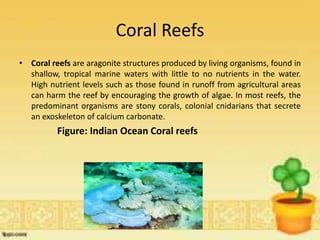
• Coral reefs are aragonite structures produced by living organisms, found in
shallow, tropical marine waters with little to no nutrients in the water.
High nutrient levels such as those found in runoff from agricultural areas
can harm the reef by encouraging the growth of algae. In most reefs, the
predominant organisms are stony corals, colonial cnidarians that secrete
an exoskeleton of calcium carbonate.
Figure: Indian Ocean Coral reefs
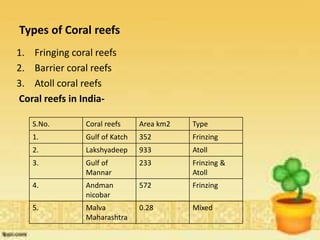
Types of Coral reefs
1. Fringing coral reefs
2. Barrier coral reefs
3. Atoll coral reefs
Coral reefs in India-
S.No. Coral reefs Area km2 Type
1. Gulf of Katch 352 Frinzing
2. Lakshyadeep 933 Atoll
3. Gulf of
Mannar
233 Frinzing &
Atoll
4. Andman
nicobar
572 Frinzing
5. Malva
Maharashtra
0.28 Mixed
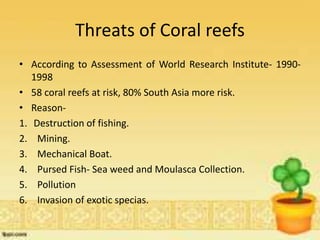
Threats of Coral reefs
• According to Assessment of World Research Institute- 1990-
1998
• 58 coral reefs at risk, 80% South Asia more risk.
• Reason-
1. Destruction of fishing.
2. Mining.
3. Mechanical Boat.
4. Pursed Fish- Sea weed and Moulasca Collection.
5. Pollution
6. Invasion of exotic specias.
EX-SITU CONSERVATION
Introduction –
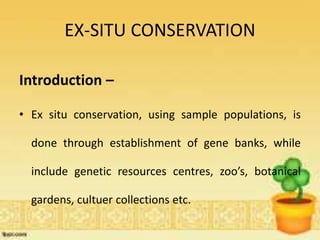
• Ex situ conservation, using sample populations, is
done through establishment of gene banks, while
include genetic resources centres, zoo’s, botanical
gardens, cultuer collections etc.
Definition
• Ex-situ conservation literally means, "off-site conservation". It
is the process of protecting an endangered species of plant or
animal by removing part of the population from a threatened
habitat and placing it in a new location, which may be a wild
area or within the care of humans. While ex-situ conservation
comprises some of the oldest and best known conservation
methods, it also involves newer, sometimes controversial
laboratory methods.
Types of Ex-situ Conservation
1. Natural Ex-situ Conservation
1. National Bureau of plant Genetic resources (NBPGR)
2. Botanical Garden
3. Botanical survey of India (BSI)
4. India Council of agriculture research (ICAR)
5. Council of scientific and industrial research(CSIR)
6. Department of Biotechnology (DBT)
2. Laboratory
1. Gene Bank
2. Field Gene Bank
3. Cryo Bank
4. In Vitro Conservation
Natural Ex-situ Conservation
NBPGR
• The National Bureau of Plant Genetic Resources has its
Headquarters at New Delhi, located at latitude of 28° 35’
N, longitude of 70° 18’ E and an altitude of 226 m above
mean sea level. NBPGR functions under the
administrative control of the Crop Science Division of the
ICAR.
• The Bureau draws guidelines from the Crop Science
Division of ICAR, Bureau’s Management Committee,
Research Advisory Committee and Germplasm Advisory
Committees.
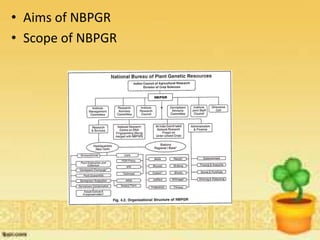
• Aims of NBPGR
• Scope of NBPGR
• Management of NBPGR-
• International corporation & Agreements-
1. 1989- The International under taking on PGR.
2. International Code of product for Collection & Transfer of PGR.
3. Global System for the Conservation & utilization of PGR.
• Future Activity of NBPGR.
• Functions of NBPGR.
Botanical Gardens
• Botanical gardens and zoos are the most conventional methods of ex-situ
conservation, all of which house whole, protected specimens for breeding
and reintroduction into the wild when necessary and possible. These
facilities provide not only housing and care for specimens of endangered
species, but also have an educational value.
• They inform the public of the threatened status of endangered species and
of those factors which cause the threat, with the hope of creating public
interest in stopping and reversing those factors which jeopardize a species'
survival in the first place.
History
• The history of botanic gardens can be traced as far back as the Hanging
Gardens of Babylon, built by Nebuchadnezzar in 570 BC as a gift to his
wife. Early botanic gardens were designed mainly for the purpose of
recreation. By the 16th Century, however, they had also become
important centers for research.
• They promoted the study of taxonomy and became a focal point for the
study of aromatic and medicinal plants. More recently, they have taken on
significant conservation responsibilities and they often have conservation
facilities, such as seed banks and tissue culture units.
Some famous botanic gardens/ research centers/ institutes
INTERNATIONAL
• Royal Botanical Garden, Kew, England : Largest botanical garden in world
and its herbarium is also largest in world, having 6 million specimen.
• CIAT : International Center for Tropical Agriculture located at Palmira,
Columbia
• ICARDA : International Center for Agriculture Research in Dry Areas
located at Allepo, Syria
• ICRISAT : International Center for Agriculture Research for Semi Arid
Tropics located at Patencheru, (Hyderabad) India.
• IRRI : International Rice Research Institute located at Manila, Philippines.
• CITES : Convention on International Trade in Endangered Species of Wild
Fauna and Flora.
NATIONAL
• Indian Botanical Garden, Calcutta : Largest Botanical Garden
in India and its herbarium is largest in India, having 1 million
specimen
• NBRI : National Botanical Research Institute located at
Lucknow (UP) formally known as National Botanical Garden.
• BSI : Botanical Survey of India started working in 1890 and is
connected with plant exploration and writing up of regional
floras and also preparation of flora of India.
• IARI : Indian Agricultural Research Institute or Pusa Institute located at New
Delhi. It was initially established at village Pusa in Darbhanga District of Bihar
in 1905 under the name Imperial Agricultural Research Institute. After a
severe earthquake, this institute was shifted to New Delhi in 1936 under the
same name. But after independence, it was renamed as Indian Agricultural
Research Institute.
• FRI : Forest Research Institute located at Dehradun (Uttarakhand),
established in 1906 under name Imperial Forest Research Institute (IFRI), but
after independence, name was changed to FI. This institute is connected
with researchers on different aspects of forest trees and also provides
training to forest officers.
BSI
• Botanical Survey of India (BSI) was established in 1890 with the basic
objectives of carrying out floristic surveys of the Indian empire. It was
reviewed and reorganised in 1954. During the successive plan periods
its functions have been gradually expanded. After reorganisation and
establishment of 10 different regional centres throughout the country,
the aims and objectives of the Survey were redefined in 1976 with a
view to encourage taxonomic research and to accelerate the scientific
expertise for the preparation of a comprehensive flora of the country.
Research Center/ Circle
• To cope up with this enormous task assigned to the Survey, the
following 4 circles were established after independence, in different
Botanical regions to cover the vast stretches of the country :
• Botanical Survey of India, Southern Circle at Coimbatore on 10th
October 1955.
• Botanical Survey of India, Eastern Circle at Shillong on 1st April
1956.
• Botanical Survey of India, Western Circle at Pune on 12th December
1955.
• Botanical Survey of India, Northern Circle at Dehra Dun on 1st
August 1956.
• Botanical Survey of India, Central Circle at Allahabad in 1962
• Botanical Survey of India, Arid Zone Circle at Jodhpur in 1972
• Botanical Survey of India, Andaman & Nicobar Circle at Port Blair
in 1972
• Botanical Survey of India, Arunachal Pradesh Circle at Itanagar in
1977
• Botanical Survey of India, Sikkim Himalayan Circle at Gangtok in
1979
• Botanic Garden of Indian Republic at Noida in 2002
• Botanical Survey of India, Deccan Circle at Hyderabad in 2005
ICAR
• Agriculture in India is the means of livelihood of almost two thirds
of the workforce in the country. It employs nearly 62% of the
country’s total population and occupies 42% of its total
geographical area. From a nation dependent on food imports to
feed its population, India today is not only self-sufficient in grain
production, but also has a substantial reserve. The progress made
by agriculture in the last four decades has been one of the biggest
success stories of free India. Agriculture and allied activities
constitute one of the main contributors to the Gross Domestic
Product of the nation.
Function
• The Indian Agricultural Research Institute (IARI) is India's premier
institution in the field of agricultural research, higher education in
agriculture (post-graduate programme) and extension education. The
primary functions of the Institute are
• Basic and applied research in the various branches of agricultural
sciences,
• Teaching at the post-graduate level and organisation of special short-
term training programmes in several aspects of agricultural sciences,
both at the national and international levels and
• Extension advisory work for improving farm productivity and socio-
economic conditions of the farming community.
Centers
• Presently the research, education, and extension activities of the
Institute are carried out through a network of 20 discipline-based
divisions, 5 multidisciplinary centers situated in Delhi, 8 regional
stations, 2 off-season nurseries, 10 centres of All India
Coordinated Research Projects and a common set of service units.
• The Institute also serves as the headquarters of 3 All India
Coordinated Research Projects.
• In addition, some of the institutes like National Research Centre
on Plant Biotechnology, NCIPM and Directorate of Maize Research
are located in the campus.
• CSIR
The Council of Scientific & Industrial Research (CSIR) is the
premier industrial research and development (R&D)
organization in India. It was founded on 26 September 1942, by
a resolution of the then Central Legislative Assembly. It is
funded mainly by the India Ministry of Science and Technology
and it is one of the world’s largest publicly funded (R&D)
organisations, having linkages to academia, other R&D
organisations and industry.
Research Laboratories under CSIR
• C-MMACS - CSIR Centre for Mathematical Modelling and Computer
Simulation, Bangalore
• CBRI - Central Building Research Institute, Roorkee
• CCMB- Centre for Cellular and Molecular Biology, Hyderabad
• CDRI - Central Drug Research Institute, Lucknow
• CECRI- Central Electro Chemical Research Institute, Karaikudi
• CEERI - Central Electronics Engineering Research Institute, Pilani
• CFRI - Central Fuel Research Institute, Dhanbad
• CFTRI - Central Food Technological Research Institute, Mysore
• CGCRI - Central Glass and Ceramic research Institute, Calcutta
• CIMAP - Central Institute of Medicinal and Aromatic Plants, Lucknow
• DBT
The setting up of a separate Department of Biotechnology (DBT),
under the Ministry of Science and Technology in 1986 gave a new
impetus to the development of the field of modern biology and
biotechnology in India. In more than a decade of its existence, the
department has promoted and accelerated the pace of
development of biotechnology in the country. Through several
Research & Development projects, demonstrations and creation
of infrastructural facilities a clear visible impact of this field has
been seen.
Mandate
• Promote large scale use of Biotechnology
• Support R&D and manufacturing in Biology
• Responsibility for Autonomous Institutions
• Promote University and Industry Interaction
• Identify and Set up Centres of Excellence for R&D
• Integrated Programme for Human Resource Development
• To serve as Nodal Point for specific International Collaborations
• Establishment of Infrastructure Facilities to support R&D and production
• Evolve Bio Safety Guidelines, manufacture and application of cell based
vaccines
• Serve as nodal point for the collection and dissemination of information
relating to biotechnology.
National Biotechnology Development Strategy
2015–2020 Programme
• In December 2015, the Department of Biotechnology launched the National
Biotechnology Development Strategy 2015–2020 programme. The stated aim of
the programme is to intensify research in the fields of vaccines, humane
genome, infectious and chronic diseases, crop science, animal agriculture and
aqua culture, food and nutrition, environmental management and technologies
for clean energy. The mission, through stakeholders in the biotechnology and
technology domains is backed with significant investments to create new
products, creating a strong infrastructure for research and development,
commercialization, and empowering human resources scientifically and
technologically.[2]
Institutes:
• Autonomous InstitutesCentre for DNA Fingerprinting and Diagnostics, Hyderabad
• National Institute of Animal Biotechnology, Hyderabad
• National Centre for Cell Science, Pune
• National Brain Research Centre, Manesar
• Rajiv Gandhi Centre for Biotechnology, Thiruvananthapuram
• National Institute of Immunology Delhi
• Institute of Plant Genome Research Delhi
• Institute of Life Sciences, Bhubaneswar
• Institute of Bioresources and Sustainable Development Imphal
• National Agri-Food Biotechnology Institute, Mohali
• Public Sector UndertakingsBharat Immunologicals and Biologicals Corporation
Limited, Bulandshahr
• Indian Vaccine Corporation Limited Delhi
• Biotech Consortium India Limited, New Delhi
•
Laboratory Ex-situ Conservation
• Gene Banks
Plant genetic resources gene banks store, maintain and
reproduce living samples of the world's huge diversity of crop
varieties and their wild relatives. They ensure that the
varieties and landraces of the crops and their wild relatives
that underpin our food supply are both secure in the long
term and available for use by farmers, plant breeders and
researchers.
Types of Gene Bank
1. Seed Bank-
2. Tissue Bank
• Field Gene banks
• Field gene banks or living collections are the main conservation
strategy for long-lived perennials, recalcitrant species and
vegetative propagated species. Their main limitation is that they
take a great deal of space and are difficult to maintain and protect
from natural disasters. They are susceptible to the spread of
diseases and may suffer from neglect. Furthermore, out-breeders
require controlled pollination for regeneration from seed. In many
circumstances they are the only available option for the
conservation of important germplasm. When displayed, the plants
have an important educational value and can easily be accessed
for research purposes.
• The conservation of germplasm in field gene banks involves the collecting of
materials and planting in the orchard or field in another location. Field gene
banks have traditionally been used for perennial plants, including:
• species producing recalcitrant seeds;
• species producing little or no seeds;
• species that are preferably stored as clonal material; and
• species that have a long life cycle to generate breeding and/or planting
material.
• Field gene banks are commonly used for such species as cocoa, rubber,
coconut, coffee, sugarcane, banana, tuber crops, tropical and temperate
fruits, vegetatively propagated crops, such as wild onion and garlic, and
forage grasses.
• CryoBank
• In this system stability is imposed by ultra low temperature and
storage is at, or close to -1960C using liquid Nitrogen (or the vapour
immediately above it), as practical and convenient oxygen. At such
temperature normal cellular chemical reactions do not occur as
energy level are too low to allow sufficient molecular motion to
complete the reaction. Water exists either in a crystalline or glassy
state under these conditions and such high viscosity (> 1013 poises)
that rates of diffusion are insignificant over time spans measured at
least as decades. The majority of the chemical changes that might
occur in a cell are therefore; effectively prevented and so the cell is
stabilized the maximum extent that is practically possible.
• In-vitro Conservation
• Conservation in-vitro is wholly dependent upon the
techniques of plant cell, tissue and organ culture, and is
appropriate in situations where conventional seed
storage cannot or is not to be employed.
• Mode of propagation
• There is large number of threatened/ rare/
endangered plant species on which in-vitro
propagation of threatened plants could be achieved by
the following methods.
• Clonal propagation
• Somatic embryogenesis
• Organogenesis
• Callus differentiation
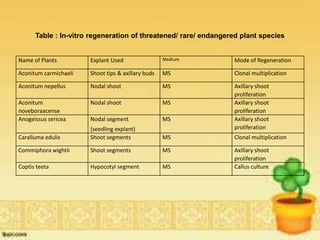
Name of Plants Explant Used Medium Mode of Regeneration
Aconitum carmichaeli Shoot tips & axillary buds MS Clonal multiplication
Aconitum nepellus Nodal shoot MS Axillary shoot
proliferation
Aconitum
noveboraacense
Nodal shoot MS Axillary shoot
proliferation
Anogeissus sericea Nodal segment
(seedling explant)
MS Axillary shoot
proliferation
Caralluma edulis Shoot segments MS Clonal multiplication
Commiphora wightii Shoot segments MS Axillary shoot
proliferation
Coptis teeta Hypocotyl segment MS Callus culture
Table : In-vitro regeneration of threatened/ rare/ endangered plant species
• Conclusion
• Reference : www.google.com
Conservation Strategies

Conservation Strategies

  • 1.
    Govt. P.G. College,Kanker (C.G.) Seminar On Conservation Strategies. Guided By HOD Submitted By Aarti Sinha R. Kuldeep Reshma, Kirtan, Pushplata Kanwar Kanchu, Ravindranath
  • 2.
    Conservation : Isthe wise use of natural resources, without wasting them. Management/Conservation Principles • Wildlife/Plants manager’s job is to maintain number of animals in a habitat at or below habitat’s carrying capacity, so no damage is done to the animals or to their habitat. • In addition to looking at the total number of a species in a habitat, wildlife managers also monitor breeding stock correct mix of adult and young animals/plants needed to sustain a population.
  • 3.
    Management/Conservation Principles (cont.) • Tomanage a habitat, wildlife /plants managers must consider historical trends, current habitat conditions, breeding population levels, long-term projections and breeding success.
  • 4.
    EXTINCTIONS  In biologyand ecology, extinction is the cessation of existence of a species or group of taxa. The moment of extinction is generally considered to be the death of the last individual of that species. Because a species' potential range may be very large, determining this moment is difficult, and is usually done retrospectively. This difficulty leads to phenomena such as Lazarus taxa, where a species presumed extinct abruptly "re-appears" after a period of apparent absence.  Some experts have estimated that up to half of presently existing species may become extinct by 2100.
  • 5.
    Definition • A speciesbecomes extinct when the last existing member of that species dies. Extinction therefore becomes a certainty when there are no surviving individuals that are able to reproduce and create a new generation.
  • 6.
    Psuedoextinction • Descendants mayor may not exist for extinct species. Daughter species that evolve from a parent species carry on most of the parent species' genetic information, and even though the parent species may become extinct, the daughter species lives on. . • In other cases, species have produced no new variants, or none that are able to survive the parent species' extinction. Extinction of a parent species where daughter species or subspecies are still alive is also called pseudoextinction.
  • 7.
    • Pseudoextinction isdifficult to demonstrate unless one has a strong chain of evidence linking a living species to members of a pre-existing species. • For example, it is sometimes claimed that the extinct Hyracotherium, which was an ancient animal similar to the horse, is pseudoextinct, rather than extinct, because there are several extant species of equus, including zebra and donkeys. • Pseudoextinction is much easier to demonstrate for larger taxonomic groups. It is said that dinosaurs are pseudoextinct, because some of their descendants, the birds, survive today.
  • 8.
    Causes of Extinction •The passenger pigeon, one of several species of extinct birds, was hunted to extinction over the course of a few decades. • The Bali Tiger was declared extinct in 1937 due to hunting and habitat loss.
  • 9.
    • There area variety of causes that can contribute directly or indirectly to the extinction of a species or group of species. "Just as each species is unique," write Beverly and Stephen Stearns, "so is each extinction... the causes for each are varied — some subtle and complex, others obvious and simple". • Extinction of a species may come suddenly when an otherwise healthy species is wiped out completely, as when toxic pollution renders its entire habitat unlivable; or may occur gradually over thousands or millions of years, such as when a species gradually loses out in competition for food to better adapted competitors.
  • 10.
    • Currently, environmentalgroups and some governments are concerned with the extinction of species caused by humanity, and are attempting to combat further extinctions through a variety of conservation programs. • Humans can cause extinction of a species through overharvesting, pollution, habitat destruction, introduction of new predators and food competitors, overhunting, and other influences. According to the World Conservation Union (WCU, also known as IUCN), 784 extinctions have been recorded since the year 1500. • Genetics and demographic phenomena • Genetic pollution • Habitat degradation • Predation, competition, and disease
  • 11.
    Coextinctions • Coextinction refersto the loss of a species due to the extinction of another; for example, the extinction of parasitic insects following the loss of their hosts. Coextinction can also occur when a species loses its pollinator, or to predators in a food chain who lose their prey. • "Species coextinction is a manifestation of the interconnectedness of organisms in complex ecosystems ... While coextinction may not be the most important cause of species extinctions, it is certainly an insidious one".
  • 12.
    In situ conservation •In situ means in the natural, original place or position; as in the location of the explant on the mother plant prior to excision. In situ conservation which include conservation of plant and animals in their native ecosystem or even in man made ecosystem, where they naturally occur. • Thus in-situ conservation refers to protection zones and areas of high biological diversity.
  • 13.
    • This typeof conservation applies only to wild fauna and flora and not to the domesticated animals and plants, because conservation is achieved by protection of populations in nature. • The in-situ conservation of habitats has received high priority in the world conservation strategy programmes launched since 1980. • In-situ conservation includes a system of protected areas of different categories e.g. National parks, Sanctuaries, National Monument, Cultural landscapes, Biosphere Reserves, etc. One of the best methods to save wildlife species, which is on the road to extinction, is to put it in a special enclosure to reproduce. Sanctuaries and National parks, whose legal definition varies from country to country, best illustrate this.
  • 14.
    International Efforts • Biodiversityis the variety and variations occurring in nature, which has sustained the harmonious existence of life on earth. • The components of this diversity are so interdependent that any change in the system leads to major imbalance and threatens the normal ecological cycle.
  • 15.
    • In thediscussion at the UN Conference on the Human Environment held in Stockholm in 1972. The UNEP identified conservation as priority area in 197. • It was only towards 1980’s that systemic and concentrated efforts to look at biodiversity conservation profile at international level started with constitution of an Ad hoc working group of experts on biological diversity by UNEP in 1987. • Eventually an experts group was constituted by UNEP, which started it’s work in 1989.
  • 16.
    • “Convention onBiological Diversity (CBD)” was one of the foremost issues discussed at the Earth Summit held at Rio de Janeiro (Brazil) between June 3 and 14, 1992. • A ceremony to mark the opening of the convention on biological diversity took place in the afternoon on June 5. This convention entered into force on December 29, 1993. • Feranando Collor, the President of the Federal Republic of Brazil was the first to sign the convention, followed by India, and 155 other nations. At present, 166 countries are parties to the convention.
  • 17.
    India’s Initiative forIn-situ Conservation • India is fortunately placed in a position of advantage. Ours is tropical country with a tremendous heterogeneity of environments ranging from tropical rain forests of Andaman and Arunachal Pradesh to the deserts of Rajasthan and Ladakh. • It lies at the junction of the three biogeographical provinces of Africa, temperate Eurasia and Orient. • As a result, it has rich biological heritage that qualifies it as one of the 12-megadiversity nations of the world.
  • 18.
    • Dr MS Swaminathan (1983) reviewed the scientific aspects of conservation. He suggested that the first step in conservation should be defining the categories of materials (plants/ genes) for preservation and the major methods preserving them. • In India, institutionalised management of biodiversity in situ started with the establishment of the first National Park, the Hailey National Park (now Jim Corbett National Park) in 1935. Following this, more than 500 PAs were set up representing a wide range of ecosystems.
  • 19.
    • Institutional effortsat in-situ conservation of endangered animals were initiated in the country about 30 years ago with the launching of Project Tiger. An all-India tiger census conducted in 1972 revealed that there were only 1,827 tigers in the country as against an estimated 40,000 at the turn of the century. • Indian holds the largest number of Asian elephants with 20,000 – 24,000 in the wild and nearly 3000 in captivity. • Other special conservation programmes have also been initiated and these include the Indian Rhino, Lion, certain primates (Indo-UA Primate Project in Northeast India), and aquatic mammals especially river dolphins.
  • 20.
    • The IndianCouncil of Forestry Research and Education (ICFRE) has identified 309 forest preservation plots of representative forest types for conservation of variable and representative areas of biodiversity. 187 of these plots are natural forests and 117 in plantations, covering a total area of 8500 hectares. • There are a number of Non Government Organisation (NGO) initiatives for in-situ conservation in the country. One of these is the WWF-India’s Community Biodiversity Conservation Programme.
  • 21.
    BIOSPHERE RESERVE • Theidea of 'biosphere reserves' was initiated by UNESCO in 1973-74 under its Man and Biosphere (MAB) programme. The MAB, launched in 1970 by UNESCO, is a broad based ecological programme aimed to develop within the natural and social sciences a basis for the rational use and conservation of the resources of the biosphere and for the improvement of the relationship between man and the environment; to predict the consequences of today's actions on tomorrows world and thereby to increase man's ability to manage efficiently the natural resources of the biosphere reserve. • The Indian National Man and Biosphere (MAB) committee identifies and recommends potential sites for designation as Biosphere Reserves, following the UNESCO’s guidelines and criteria. By 20 September 2010, 18 biosphere reserves have been established in India and some additional sites are under consideration.
  • 22.
  • 23.
  • 24.
    National Park • Anational park is an area dedicated to conserve the scenery (or environment) and natural objects and the wildlife therein. In national parks, all private rights are non-existent and all forestry operations and other usages such as grazing of domestic animals are prohibited. However, the general public may enter it for the purpose of observation and study. • As per National Wildlife Database, June 2008, there are 97 existing national parks in India covering an area of 38,199.47 km2, which is 1.16% of the geographical area of the country (Table 4.1). In addition to the above 74 national parks covering an area of 16,630.08 km2 are proposed in the Protected Area Network Report (Rodgers et al. 2002). The network of parks will go up 171 after full implementation of the above report.
  • 25.
    State/UTs Area of State (km2) No.of NPs Area Covered (km2) % of State Area Andhra Pradesh 275068 4 373.23 0.14 Arunachal Pradesh 83743 2 2290.82 2.74 Assam 78438 5 1977.79 2.52 Bihar 94163 1 335.65 0.36 Chhattisgarh 135194 3 2899.08 2.14 Goa 3702 1 107.00 2.89 Gujarat 196024 4 480.11 0.24 Haryana 44212 2 48.25 0.11 Himachal Pradesh 55673 2 1430.00 2.57 Jammu & Kashmir 222235 4 3930.25 1.77 Jharkhand 79714 1 231.67 0.29 Karnataka 191791 5 2472.18 1.29 Kerala 38863 6 558.16 1.44 Madhya Pradesh 308252 9 3656.36 1.19 Maharashtra 307690 6 1273.60 0.41 Manipur 22327 1 40.00 0.18 Meghalaya 22429 2 267.48 1.19 Mizoram 21081 2 150.00 0.71 Nagaland 16579 1 202.02 1.22
  • 26.
    Orissa 155707 2990.70 0.64 Punjab 50362 0 0.00 0.00 Rajasthan 342239 5 4122.33 1.20 Sikkim 7096 1 1784.00 25.14 Tamil Nadu 130058 5 307.84 0.24 Tripura 10486 2 199.79 1.91 Uttar Pradesh 240926 1 490.00 0.20 Uttarakhand 53485 6 4731.00 8.85 West Bengal 88752 5 1693.25 1.91 Union Territories Andaman & Nicobar 8249 9 1156.91 14.02 Chandigarh 114 0 0.00 0.00 Dadra & Nagar Haveli 491 0 0.00 0.00 Daman & Diu 112 0 0.00 0.00 Delhi 1483 0 0.00 0.00 Lakshadweep 32 0 0.00 0.00 Pondicherry 493 0 0.00 0.00 India 3287263 97 38199.48 1.16
  • 27.
    Sancturies • A wildlifesanctuary, similar to national park, is dedicated to protect the wildlife, but it considers the conservation of species only and also the boundary of it is not limited by state legislation. Further, in the sanctuary, killing hunting or capturing of any species of birds and mammals is prohibited except by or under the control of highest authority in the department responsible for management of the sanctuary. Private ownership may be allowed to continue in a sanctuary, and forestry and other usages permitted to the extent that they do not adversely affect wildlife. • According to National Wildlife Database, June 2008, there are 508 existing wildlife sanctuaries in India covering an area of 118,236.94 km2, which is 3.60% of the geographical area of the country (Table 4.2). Another 217 sanctuaries are proposed in the Protected Area Network Report covering an area of 16,669.44 km2.
  • 28.
    State/ UTs Area ofState (km²) No. of Area covered ( km²) % of State Area Andhra Pradesh 275068 22 12599.19 4.58 Arunachal Pradesh 83743 11 7606.37 9.08 Assam 78438 18 1932 2.46 Bihar 94163 12 2856.06 3.03 Chhattisgarh 135194 11 3583.25 2.65 Goa 3702 6 647.96 17.50 Gujarat 196024 22 16440.94 8.39 Haryana 44212 8 206.95 0.47 Himachal Pradesh 55673 33 6171.00 11.08 Jammu & Kashmir 222235 15 10312.25 4.64 Jharkhand 79714 11 1945.58 2.44 Karnataka 191791 21 3888.14 2.03 Kerala 38863 15 1894.49 4.87 Madhya Pradesh 308252 25 7158.40 2.32 Maharashtra 307690 35 14152.69 4.60 Manipur 22327 1 184.40 0.83 Meghalaya 22429 3 34.20 0.15 Mizoram 21081 7 680.75 3.23 Nagaland 16579 3 20.34 0.12
  • 29.
    Orissa 155707 186969.15 4.48 Punjab 50362 12 323.80 0.64 Rajasthan 342239 23 5447.03 1.59 Sikkim 7096 7 399.10 5.62 Tamil Nadu 130058 20 2997.60 2.30 Tripura 10486 3 403.85 3.85 Uttar Pradesh 240926 23 5222.47 2.17 Uttarakhand 53485 6 2418.65 4.52 West Bengal 88752 15 1203.28 1.36 UNION TERRITORIES Andaman & Nicobar 8249 96 389.39 4.72 Chandigarh 114 2 26.13 22.92 Dadra & Nagar Haveli 491 1 92.16 18.77 Daman & Diu 112 1 2.18 1.95 Delhi 1483 1 27.20 1.83 Lakshadweep 32 1 0.01 0.03 Pondicherry 493 0 0.00 0.00 India 3287263 508 118236.94 3.60
  • 30.
    WETLAND • A wetlandis an area of land consisting of soil that is saturated with moisture, such as a swamp, marsh, or bog. • As defined in terms of physical geography, a wetland is an environment "at the interface between truly terrestrial ecosystems and aquatic systems making them inherently different from each other yet highly dependent on both". In essence, wetlands are ecotones. Wetlands often host considerable biodiversity and endemism. Figure : Costal Wetland Indland Wetland
  • 31.
    World Data ofWetland • According to world data Total Area = 8 square million km2 • Tropical Region 5square million km2 Bogs - 30% Ferns - 26% Swamp - 20% Flood plain - 15% According to world data 50% wetland loss in since 100 years.
  • 32.
    Wet Land inIndia • In India 27,403km2 Total wetland • 23,444km2 Inland • 3,459km2 Costal land. • According to Directory of Asian Wetland 1989- Total Wetland is 18.4% which is 70% use in paddy culture. • Area wise 4.1% total wetland in which 1.5% Natural and 2.6% men made. • Costal wetland have 80% part of Sundarban Delta.
  • 33.
    • Categories ofWetland in India – 8 series of wetland in India • 1. Deccan Plateau - South-East Area • 2. The Gulf of Kutch - Rajasthan-Gujrat • 3. Fresh water region- Rajasthan-Gujrat • 4. Iceland - Andman nicobar • 5. Kashmir - Laddhakh • 6. Ganga ghat and Bramhaputra Feild • 7. India’s Eaxtern Pier (Chilka Lake) • 8. North India Himalyas high heels.
  • 34.
    Some Important Wetlandin India S.No. Wetland Place 1. Renuka Himachal 2. Yashwant Sea Madhya Pradesh 3. Bhoj Madhya Pradesh 4. Loktak Manipur 5. Chilka Odissa 6. Sundarban West Bengol 7. Khurana Chandigarh 8. Mular Jammu-Kashmir 9. Naal Lake Gujrat 10. Harike Punjab 11. Ashtamudi Keral 12. Koteru Andhra Pradesh 13. Kabra Bihar 14 Chandrataal Himachal Pradesh 15 Kajali Punjab 16. Rudra Lake Tripura 17. West Bengal East Bengal 18. Magadhi Karnatak 19. Little run of Katcha Gujrat
  • 35.
    Threats Of Wetland •Civilization • Anthropogenic Activities • Hydrologic Activities • Defortation • Agriculture • Salinity • Aqua Culture • Climate Change • Introduce new species – Salvia Conservation of Wetland • Ramsar Conservation. • Montex record.
  • 36.
    MANGROVE • Mangrove ecosystemis a peculiar habitat found at the interface between land and sea. The term "mangrove" is being applied to the specific ecosystem of the intertidal world in the tropics and subtropics and the plant community of this ecosystem is termed as "mangrove vegetation". Figure : Mangrove- Kannur in India
  • 37.
    Area distribution Mangrovein India S.No. Mangrove in India Govt. of India 1987 In Hectare Govt. of India 1997 In Hectare 1. West Bengal 420 212.2 2. Andman Nicobar 119 96.3 3. Maharashtra 33 12.4 4. Gujrat 26 19.1 5. Andra Pradesh 20 38.3 (Dismil) 6. Tamilnadu 15 2.1 7. Odissa 15 12.1 8. Karnatak 6 0.3 9. Goa 20 5 10. Keral Sprace Nill
  • 38.
    Need for Managementand Conservation • 1. Population • 2. Utilization (Medicine. Wood, Fuel) • 3. Natural Factor (Cyclone, Flood, Earthquake) • 4. Fishing • 5. Be-coping • 6. Cottage Industries. Mangrove Management in India- 1. Sunderland Bengal was taken in the Conservation Under Scientific in 1892 2. In 1976 of National Ministry of Environment Forest make National Mangrove Committee. Their Work- 3. Meeting, 2. Survey, 3. Identification, 4. Preparation of management plan, 5. Promotion of research, 6. Adoption of multiple approach.
  • 39.
    • Legislative councillow from National Forest policy 1. Indian Forest Act 1927. 2. Wild Life Protection Act 1972. 3. Forest Conservation Act 1980.  Mangrove in Goa.  Mangrove in Andman Nicobar
  • 40.
    Coral Reefs • Coralreefs are aragonite structures produced by living organisms, found in shallow, tropical marine waters with little to no nutrients in the water. High nutrient levels such as those found in runoff from agricultural areas can harm the reef by encouraging the growth of algae. In most reefs, the predominant organisms are stony corals, colonial cnidarians that secrete an exoskeleton of calcium carbonate. Figure: Indian Ocean Coral reefs
  • 41.
    Types of Coralreefs 1. Fringing coral reefs 2. Barrier coral reefs 3. Atoll coral reefs Coral reefs in India- S.No. Coral reefs Area km2 Type 1. Gulf of Katch 352 Frinzing 2. Lakshyadeep 933 Atoll 3. Gulf of Mannar 233 Frinzing & Atoll 4. Andman nicobar 572 Frinzing 5. Malva Maharashtra 0.28 Mixed
  • 42.
    Threats of Coralreefs • According to Assessment of World Research Institute- 1990- 1998 • 58 coral reefs at risk, 80% South Asia more risk. • Reason- 1. Destruction of fishing. 2. Mining. 3. Mechanical Boat. 4. Pursed Fish- Sea weed and Moulasca Collection. 5. Pollution 6. Invasion of exotic specias.
  • 43.
    EX-SITU CONSERVATION Introduction – •Ex situ conservation, using sample populations, is done through establishment of gene banks, while include genetic resources centres, zoo’s, botanical gardens, cultuer collections etc.
  • 44.
    Definition • Ex-situ conservationliterally means, "off-site conservation". It is the process of protecting an endangered species of plant or animal by removing part of the population from a threatened habitat and placing it in a new location, which may be a wild area or within the care of humans. While ex-situ conservation comprises some of the oldest and best known conservation methods, it also involves newer, sometimes controversial laboratory methods.
  • 45.
    Types of Ex-situConservation 1. Natural Ex-situ Conservation 1. National Bureau of plant Genetic resources (NBPGR) 2. Botanical Garden 3. Botanical survey of India (BSI) 4. India Council of agriculture research (ICAR) 5. Council of scientific and industrial research(CSIR) 6. Department of Biotechnology (DBT) 2. Laboratory 1. Gene Bank 2. Field Gene Bank 3. Cryo Bank 4. In Vitro Conservation
  • 46.
    Natural Ex-situ Conservation NBPGR •The National Bureau of Plant Genetic Resources has its Headquarters at New Delhi, located at latitude of 28° 35’ N, longitude of 70° 18’ E and an altitude of 226 m above mean sea level. NBPGR functions under the administrative control of the Crop Science Division of the ICAR. • The Bureau draws guidelines from the Crop Science Division of ICAR, Bureau’s Management Committee, Research Advisory Committee and Germplasm Advisory Committees.
  • 47.
    • Aims ofNBPGR • Scope of NBPGR
  • 48.
    • Management ofNBPGR- • International corporation & Agreements- 1. 1989- The International under taking on PGR. 2. International Code of product for Collection & Transfer of PGR. 3. Global System for the Conservation & utilization of PGR. • Future Activity of NBPGR. • Functions of NBPGR.
  • 49.
    Botanical Gardens • Botanicalgardens and zoos are the most conventional methods of ex-situ conservation, all of which house whole, protected specimens for breeding and reintroduction into the wild when necessary and possible. These facilities provide not only housing and care for specimens of endangered species, but also have an educational value. • They inform the public of the threatened status of endangered species and of those factors which cause the threat, with the hope of creating public interest in stopping and reversing those factors which jeopardize a species' survival in the first place.
  • 50.
    History • The historyof botanic gardens can be traced as far back as the Hanging Gardens of Babylon, built by Nebuchadnezzar in 570 BC as a gift to his wife. Early botanic gardens were designed mainly for the purpose of recreation. By the 16th Century, however, they had also become important centers for research. • They promoted the study of taxonomy and became a focal point for the study of aromatic and medicinal plants. More recently, they have taken on significant conservation responsibilities and they often have conservation facilities, such as seed banks and tissue culture units.
  • 51.
    Some famous botanicgardens/ research centers/ institutes INTERNATIONAL • Royal Botanical Garden, Kew, England : Largest botanical garden in world and its herbarium is also largest in world, having 6 million specimen. • CIAT : International Center for Tropical Agriculture located at Palmira, Columbia • ICARDA : International Center for Agriculture Research in Dry Areas located at Allepo, Syria • ICRISAT : International Center for Agriculture Research for Semi Arid Tropics located at Patencheru, (Hyderabad) India. • IRRI : International Rice Research Institute located at Manila, Philippines. • CITES : Convention on International Trade in Endangered Species of Wild Fauna and Flora.
  • 52.
    NATIONAL • Indian BotanicalGarden, Calcutta : Largest Botanical Garden in India and its herbarium is largest in India, having 1 million specimen • NBRI : National Botanical Research Institute located at Lucknow (UP) formally known as National Botanical Garden. • BSI : Botanical Survey of India started working in 1890 and is connected with plant exploration and writing up of regional floras and also preparation of flora of India.
  • 53.
    • IARI :Indian Agricultural Research Institute or Pusa Institute located at New Delhi. It was initially established at village Pusa in Darbhanga District of Bihar in 1905 under the name Imperial Agricultural Research Institute. After a severe earthquake, this institute was shifted to New Delhi in 1936 under the same name. But after independence, it was renamed as Indian Agricultural Research Institute. • FRI : Forest Research Institute located at Dehradun (Uttarakhand), established in 1906 under name Imperial Forest Research Institute (IFRI), but after independence, name was changed to FI. This institute is connected with researchers on different aspects of forest trees and also provides training to forest officers.
  • 54.
    BSI • Botanical Surveyof India (BSI) was established in 1890 with the basic objectives of carrying out floristic surveys of the Indian empire. It was reviewed and reorganised in 1954. During the successive plan periods its functions have been gradually expanded. After reorganisation and establishment of 10 different regional centres throughout the country, the aims and objectives of the Survey were redefined in 1976 with a view to encourage taxonomic research and to accelerate the scientific expertise for the preparation of a comprehensive flora of the country.
  • 55.
    Research Center/ Circle •To cope up with this enormous task assigned to the Survey, the following 4 circles were established after independence, in different Botanical regions to cover the vast stretches of the country : • Botanical Survey of India, Southern Circle at Coimbatore on 10th October 1955. • Botanical Survey of India, Eastern Circle at Shillong on 1st April 1956. • Botanical Survey of India, Western Circle at Pune on 12th December 1955. • Botanical Survey of India, Northern Circle at Dehra Dun on 1st August 1956.
  • 56.
    • Botanical Surveyof India, Central Circle at Allahabad in 1962 • Botanical Survey of India, Arid Zone Circle at Jodhpur in 1972 • Botanical Survey of India, Andaman & Nicobar Circle at Port Blair in 1972 • Botanical Survey of India, Arunachal Pradesh Circle at Itanagar in 1977 • Botanical Survey of India, Sikkim Himalayan Circle at Gangtok in 1979 • Botanic Garden of Indian Republic at Noida in 2002 • Botanical Survey of India, Deccan Circle at Hyderabad in 2005
  • 57.
    ICAR • Agriculture inIndia is the means of livelihood of almost two thirds of the workforce in the country. It employs nearly 62% of the country’s total population and occupies 42% of its total geographical area. From a nation dependent on food imports to feed its population, India today is not only self-sufficient in grain production, but also has a substantial reserve. The progress made by agriculture in the last four decades has been one of the biggest success stories of free India. Agriculture and allied activities constitute one of the main contributors to the Gross Domestic Product of the nation.
  • 58.
    Function • The IndianAgricultural Research Institute (IARI) is India's premier institution in the field of agricultural research, higher education in agriculture (post-graduate programme) and extension education. The primary functions of the Institute are • Basic and applied research in the various branches of agricultural sciences, • Teaching at the post-graduate level and organisation of special short- term training programmes in several aspects of agricultural sciences, both at the national and international levels and • Extension advisory work for improving farm productivity and socio- economic conditions of the farming community.
  • 59.
    Centers • Presently theresearch, education, and extension activities of the Institute are carried out through a network of 20 discipline-based divisions, 5 multidisciplinary centers situated in Delhi, 8 regional stations, 2 off-season nurseries, 10 centres of All India Coordinated Research Projects and a common set of service units. • The Institute also serves as the headquarters of 3 All India Coordinated Research Projects. • In addition, some of the institutes like National Research Centre on Plant Biotechnology, NCIPM and Directorate of Maize Research are located in the campus.
  • 60.
    • CSIR The Councilof Scientific & Industrial Research (CSIR) is the premier industrial research and development (R&D) organization in India. It was founded on 26 September 1942, by a resolution of the then Central Legislative Assembly. It is funded mainly by the India Ministry of Science and Technology and it is one of the world’s largest publicly funded (R&D) organisations, having linkages to academia, other R&D organisations and industry.
  • 61.
    Research Laboratories underCSIR • C-MMACS - CSIR Centre for Mathematical Modelling and Computer Simulation, Bangalore • CBRI - Central Building Research Institute, Roorkee • CCMB- Centre for Cellular and Molecular Biology, Hyderabad • CDRI - Central Drug Research Institute, Lucknow • CECRI- Central Electro Chemical Research Institute, Karaikudi • CEERI - Central Electronics Engineering Research Institute, Pilani • CFRI - Central Fuel Research Institute, Dhanbad • CFTRI - Central Food Technological Research Institute, Mysore • CGCRI - Central Glass and Ceramic research Institute, Calcutta • CIMAP - Central Institute of Medicinal and Aromatic Plants, Lucknow
  • 62.
    • DBT The settingup of a separate Department of Biotechnology (DBT), under the Ministry of Science and Technology in 1986 gave a new impetus to the development of the field of modern biology and biotechnology in India. In more than a decade of its existence, the department has promoted and accelerated the pace of development of biotechnology in the country. Through several Research & Development projects, demonstrations and creation of infrastructural facilities a clear visible impact of this field has been seen.
  • 63.
    Mandate • Promote largescale use of Biotechnology • Support R&D and manufacturing in Biology • Responsibility for Autonomous Institutions • Promote University and Industry Interaction • Identify and Set up Centres of Excellence for R&D • Integrated Programme for Human Resource Development • To serve as Nodal Point for specific International Collaborations • Establishment of Infrastructure Facilities to support R&D and production • Evolve Bio Safety Guidelines, manufacture and application of cell based vaccines • Serve as nodal point for the collection and dissemination of information relating to biotechnology.
  • 64.
    National Biotechnology DevelopmentStrategy 2015–2020 Programme • In December 2015, the Department of Biotechnology launched the National Biotechnology Development Strategy 2015–2020 programme. The stated aim of the programme is to intensify research in the fields of vaccines, humane genome, infectious and chronic diseases, crop science, animal agriculture and aqua culture, food and nutrition, environmental management and technologies for clean energy. The mission, through stakeholders in the biotechnology and technology domains is backed with significant investments to create new products, creating a strong infrastructure for research and development, commercialization, and empowering human resources scientifically and technologically.[2]
  • 65.
    Institutes: • Autonomous InstitutesCentrefor DNA Fingerprinting and Diagnostics, Hyderabad • National Institute of Animal Biotechnology, Hyderabad • National Centre for Cell Science, Pune • National Brain Research Centre, Manesar • Rajiv Gandhi Centre for Biotechnology, Thiruvananthapuram • National Institute of Immunology Delhi • Institute of Plant Genome Research Delhi • Institute of Life Sciences, Bhubaneswar • Institute of Bioresources and Sustainable Development Imphal • National Agri-Food Biotechnology Institute, Mohali • Public Sector UndertakingsBharat Immunologicals and Biologicals Corporation Limited, Bulandshahr • Indian Vaccine Corporation Limited Delhi • Biotech Consortium India Limited, New Delhi •
  • 66.
    Laboratory Ex-situ Conservation •Gene Banks Plant genetic resources gene banks store, maintain and reproduce living samples of the world's huge diversity of crop varieties and their wild relatives. They ensure that the varieties and landraces of the crops and their wild relatives that underpin our food supply are both secure in the long term and available for use by farmers, plant breeders and researchers.
  • 67.
    Types of GeneBank 1. Seed Bank- 2. Tissue Bank
  • 68.
    • Field Genebanks • Field gene banks or living collections are the main conservation strategy for long-lived perennials, recalcitrant species and vegetative propagated species. Their main limitation is that they take a great deal of space and are difficult to maintain and protect from natural disasters. They are susceptible to the spread of diseases and may suffer from neglect. Furthermore, out-breeders require controlled pollination for regeneration from seed. In many circumstances they are the only available option for the conservation of important germplasm. When displayed, the plants have an important educational value and can easily be accessed for research purposes.
  • 69.
    • The conservationof germplasm in field gene banks involves the collecting of materials and planting in the orchard or field in another location. Field gene banks have traditionally been used for perennial plants, including: • species producing recalcitrant seeds; • species producing little or no seeds; • species that are preferably stored as clonal material; and • species that have a long life cycle to generate breeding and/or planting material. • Field gene banks are commonly used for such species as cocoa, rubber, coconut, coffee, sugarcane, banana, tuber crops, tropical and temperate fruits, vegetatively propagated crops, such as wild onion and garlic, and forage grasses.
  • 70.
    • CryoBank • Inthis system stability is imposed by ultra low temperature and storage is at, or close to -1960C using liquid Nitrogen (or the vapour immediately above it), as practical and convenient oxygen. At such temperature normal cellular chemical reactions do not occur as energy level are too low to allow sufficient molecular motion to complete the reaction. Water exists either in a crystalline or glassy state under these conditions and such high viscosity (> 1013 poises) that rates of diffusion are insignificant over time spans measured at least as decades. The majority of the chemical changes that might occur in a cell are therefore; effectively prevented and so the cell is stabilized the maximum extent that is practically possible.
  • 71.
    • In-vitro Conservation •Conservation in-vitro is wholly dependent upon the techniques of plant cell, tissue and organ culture, and is appropriate in situations where conventional seed storage cannot or is not to be employed.
  • 72.
    • Mode ofpropagation • There is large number of threatened/ rare/ endangered plant species on which in-vitro propagation of threatened plants could be achieved by the following methods. • Clonal propagation • Somatic embryogenesis • Organogenesis • Callus differentiation
  • 73.
    Name of PlantsExplant Used Medium Mode of Regeneration Aconitum carmichaeli Shoot tips & axillary buds MS Clonal multiplication Aconitum nepellus Nodal shoot MS Axillary shoot proliferation Aconitum noveboraacense Nodal shoot MS Axillary shoot proliferation Anogeissus sericea Nodal segment (seedling explant) MS Axillary shoot proliferation Caralluma edulis Shoot segments MS Clonal multiplication Commiphora wightii Shoot segments MS Axillary shoot proliferation Coptis teeta Hypocotyl segment MS Callus culture Table : In-vitro regeneration of threatened/ rare/ endangered plant species
  • 74.