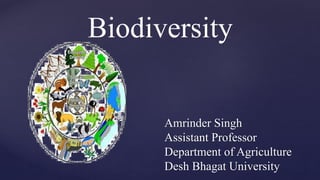
Biodiversity
Amrinder Singh
Assistant Professor
Department of Agriculture
Desh Bhagat University
BIODIVERSITY
•Bio means “life” and diversity means “variety”. Hence
biodiversity refers wide variety of life on the earth.
•Diversification in the species is influenced by various
physical and chemical, climatic factors, resulting in the
production of new species, the new species which are
unable to adjust with the new environment gradually
become extinct.
•Definition:- Biodiversity is defined as the variety and
variability among all groups of living organisms and the
ecosystem in which they live.
SIGNIFICANCE OF BIODIVERSITY:-
•Biodiversity protects the fresh air, clean water and productive
land.
•It is also important for forestry, fisheries and agriculture
which depend on rich water variety of various biological
resources available in nature.
•Loss of biodiversity has series economic and social costs
for any country.
•It is very important for human life, we depend on plants,
microorganisms, earth’s animals for our food, medicine and
industrial products.
BIODIVERSITY IS USUALLY CONSIDERED AS
3 DIFFERENT LEVELS.
1) Genetic diversity
2) Species diversity
3) Ecosystem diversity
1) GENETIC DIVERSITY:-
•Within individual species there are number of varieties which are
slightly different from one another. These differences are due to
difference in the combination of genes.
•Genes are the basic unit of hereditary information,
transmitted from one generation to the other.
• A discrete group of organisms of the same kinds is known
as species.
• Species diversity is the diversity between different species.
• The sum of varieties of all the living organisms at the
species level is known as species of diversity.
2) SPECIES DIVERSITY:-
3) ECOSYSTEM DIVERSITY:-
•It is set of biotic components plants, animals and micro
organisms interacting with one another and with one a biotic
components like soil, air, water etc.
•The diversity at the ecological (or) habitual level is known as
“eco system diversity”.
•A large region with different ecosystems can be considered
as ecosystem diversity.
•The ecosystem also shows variation with respect to physical
parameters like moisture, temperature, altitude, precipitation etc.,
CONSERVATION OF BIODIVERSITY:-
• To preserve and protect the species of their habitat.
• To maintain essential ecological process. So that there is no ecological
imbalance created.
• To use the species and ecosystem sustainably without exploiting them.
• The creation of natural parks, sanctuaries biosphere reverses etc., to
preserve flora and fauna.
• Conservation of genetic biodiversity by establishing zoo’s botanical
gardens, nurseries etc.,
• Proper planning of land use and other natural resources affecting the
biodiversity.
There are two approaches of biodiversity
conservation:-
•In-situ conservation[With in habitat]:-
•This is achieved by protection of wild flora and fauna in
nature itself. Example:- biosphere reserves, national parks,
sanctuaries reserve forest.
•Ex-situ conservation[outside habitats] :-
•This is done by establishing of gene banks, seed banks, zoo,
botanical gardens, culture correction etc.,
1. NATIONAL PARKS:
•A national park is an area which is strictly reserved for the
betterment of the wildlife and where activities like forestry,
grazing on cultivation are not permitted. In these parks, even
private ownership rights are not allowed.
•Their boundaries are well marked and circumscribed. They are
usually small reserves spreading in an area of 100 Sq. km. to
500 sq. km. In national parks, the emphasis is on the
preservation of a single plant or animal species.
2. WILDLIFE SANCTUARIES:
•A sanctuary is a protected area which is reserved for the
conservation of only animals and human activities like
harvesting of timber, collecting minor forest products and
private ownership rights are allowed as long as they do not
interfere with well-being of animals.
•Boundaries of sanctuaries are not well defined and
controlled biotic interference is permitted, e.g., tourist
activity.
3. BIOSPHERE RESERVES:
• It is a special category of protected areas where human
population also forms a part of the system. They are large
protected area of usually more than 5000 sq.km.
• A biosphere reserves has 3 parts-
Core
Buffer
Transition zone.
4. SCARED FOREST AREAS:
• India has a history of religious/cultural traditions that
emphasised protection of nature.
• In many cultures, tracts of forest were set aside, and all the
trees and wildlife within were venerated and given total
protection.
• Such sacred groves are found in Khasi and Jaintia Hills in
Meghalaya, Aravalli Hills of Rajasthan, Western Ghat regions of
Karnataka and Maharashtra and the Sarguja, Chanda and Bastar
areas of Madhya Pradesh.
1. SEED GENE BANK:
•These are cold storages where seeds are kept under controlled
temperature and humidity for storage and this is easiest way to
store the germ plasma of plants at low temperature. Seeds
preserved under controlled conditions (minus temperature)
remain viable for long durations of time.
2. GENE BANK:
•Genetic variability also is preserved by gene bank under normal
growing conditions. These are cold storages where germ are kept
under controlled temperature and humidity for storage; this is an
important way of preserving the genetic resources.
3. TISSUE CULTURE BANK:
•Cryopreservation of disease free meristems is very helpful.
Long term culture of excised roots and shoots are maintained.
Meristem culture is very popular in plant
propagation as it’s a virus and disease free method of
multiplication.
4. BOTANICAL GARDENS:
•A botanical garden is a place where flowers, fruits and
vegetables are grown. The botanical gardens provide beauty and
calm environment. Most of them have started keeping exotic
plants for educational and research purposes.
5. ZOOLOGICAL GARDENS:
•In zoos wild animals are maintained in captivity and
conservation of wild animals (rare, endangered species). The
oldest zoo, the Schonbrum zoo which exists today also, was
established in VIENNA in 1759.
•In India, the 1st zoo came into existence at BARRACKPORE in
1800. In world there are about 800 zoos. Such zoos have about
3000 species of vertebrates. Some zoos have undertaken captive
breeding programmes.
THANK YOU

Biodiversity

  • 1.
  • 2.
    BIODIVERSITY •Bio means “life”and diversity means “variety”. Hence biodiversity refers wide variety of life on the earth. •Diversification in the species is influenced by various physical and chemical, climatic factors, resulting in the production of new species, the new species which are unable to adjust with the new environment gradually become extinct. •Definition:- Biodiversity is defined as the variety and variability among all groups of living organisms and the ecosystem in which they live.
  • 3.
    SIGNIFICANCE OF BIODIVERSITY:- •Biodiversityprotects the fresh air, clean water and productive land. •It is also important for forestry, fisheries and agriculture which depend on rich water variety of various biological resources available in nature. •Loss of biodiversity has series economic and social costs for any country. •It is very important for human life, we depend on plants, microorganisms, earth’s animals for our food, medicine and industrial products.
  • 4.
    BIODIVERSITY IS USUALLYCONSIDERED AS 3 DIFFERENT LEVELS. 1) Genetic diversity 2) Species diversity 3) Ecosystem diversity
  • 5.
    1) GENETIC DIVERSITY:- •Withinindividual species there are number of varieties which are slightly different from one another. These differences are due to difference in the combination of genes. •Genes are the basic unit of hereditary information, transmitted from one generation to the other.
  • 6.
    • A discretegroup of organisms of the same kinds is known as species. • Species diversity is the diversity between different species. • The sum of varieties of all the living organisms at the species level is known as species of diversity. 2) SPECIES DIVERSITY:-
  • 7.
    3) ECOSYSTEM DIVERSITY:- •Itis set of biotic components plants, animals and micro organisms interacting with one another and with one a biotic components like soil, air, water etc. •The diversity at the ecological (or) habitual level is known as “eco system diversity”. •A large region with different ecosystems can be considered as ecosystem diversity. •The ecosystem also shows variation with respect to physical parameters like moisture, temperature, altitude, precipitation etc.,
  • 8.
    CONSERVATION OF BIODIVERSITY:- •To preserve and protect the species of their habitat. • To maintain essential ecological process. So that there is no ecological imbalance created. • To use the species and ecosystem sustainably without exploiting them. • The creation of natural parks, sanctuaries biosphere reverses etc., to preserve flora and fauna. • Conservation of genetic biodiversity by establishing zoo’s botanical gardens, nurseries etc., • Proper planning of land use and other natural resources affecting the biodiversity.
  • 9.
    There are twoapproaches of biodiversity conservation:- •In-situ conservation[With in habitat]:- •This is achieved by protection of wild flora and fauna in nature itself. Example:- biosphere reserves, national parks, sanctuaries reserve forest. •Ex-situ conservation[outside habitats] :- •This is done by establishing of gene banks, seed banks, zoo, botanical gardens, culture correction etc.,
  • 10.
    1. NATIONAL PARKS: •Anational park is an area which is strictly reserved for the betterment of the wildlife and where activities like forestry, grazing on cultivation are not permitted. In these parks, even private ownership rights are not allowed. •Their boundaries are well marked and circumscribed. They are usually small reserves spreading in an area of 100 Sq. km. to 500 sq. km. In national parks, the emphasis is on the preservation of a single plant or animal species.
  • 11.
    2. WILDLIFE SANCTUARIES: •Asanctuary is a protected area which is reserved for the conservation of only animals and human activities like harvesting of timber, collecting minor forest products and private ownership rights are allowed as long as they do not interfere with well-being of animals. •Boundaries of sanctuaries are not well defined and controlled biotic interference is permitted, e.g., tourist activity.
  • 12.
    3. BIOSPHERE RESERVES: •It is a special category of protected areas where human population also forms a part of the system. They are large protected area of usually more than 5000 sq.km. • A biosphere reserves has 3 parts- Core Buffer Transition zone.
  • 13.
    4. SCARED FORESTAREAS: • India has a history of religious/cultural traditions that emphasised protection of nature. • In many cultures, tracts of forest were set aside, and all the trees and wildlife within were venerated and given total protection. • Such sacred groves are found in Khasi and Jaintia Hills in Meghalaya, Aravalli Hills of Rajasthan, Western Ghat regions of Karnataka and Maharashtra and the Sarguja, Chanda and Bastar areas of Madhya Pradesh.
  • 14.
    1. SEED GENEBANK: •These are cold storages where seeds are kept under controlled temperature and humidity for storage and this is easiest way to store the germ plasma of plants at low temperature. Seeds preserved under controlled conditions (minus temperature) remain viable for long durations of time.
  • 15.
    2. GENE BANK: •Geneticvariability also is preserved by gene bank under normal growing conditions. These are cold storages where germ are kept under controlled temperature and humidity for storage; this is an important way of preserving the genetic resources.
  • 16.
    3. TISSUE CULTUREBANK: •Cryopreservation of disease free meristems is very helpful. Long term culture of excised roots and shoots are maintained. Meristem culture is very popular in plant propagation as it’s a virus and disease free method of multiplication.
  • 17.
    4. BOTANICAL GARDENS: •Abotanical garden is a place where flowers, fruits and vegetables are grown. The botanical gardens provide beauty and calm environment. Most of them have started keeping exotic plants for educational and research purposes.
  • 18.
    5. ZOOLOGICAL GARDENS: •Inzoos wild animals are maintained in captivity and conservation of wild animals (rare, endangered species). The oldest zoo, the Schonbrum zoo which exists today also, was established in VIENNA in 1759. •In India, the 1st zoo came into existence at BARRACKPORE in 1800. In world there are about 800 zoos. Such zoos have about 3000 species of vertebrates. Some zoos have undertaken captive breeding programmes.
  • 19.