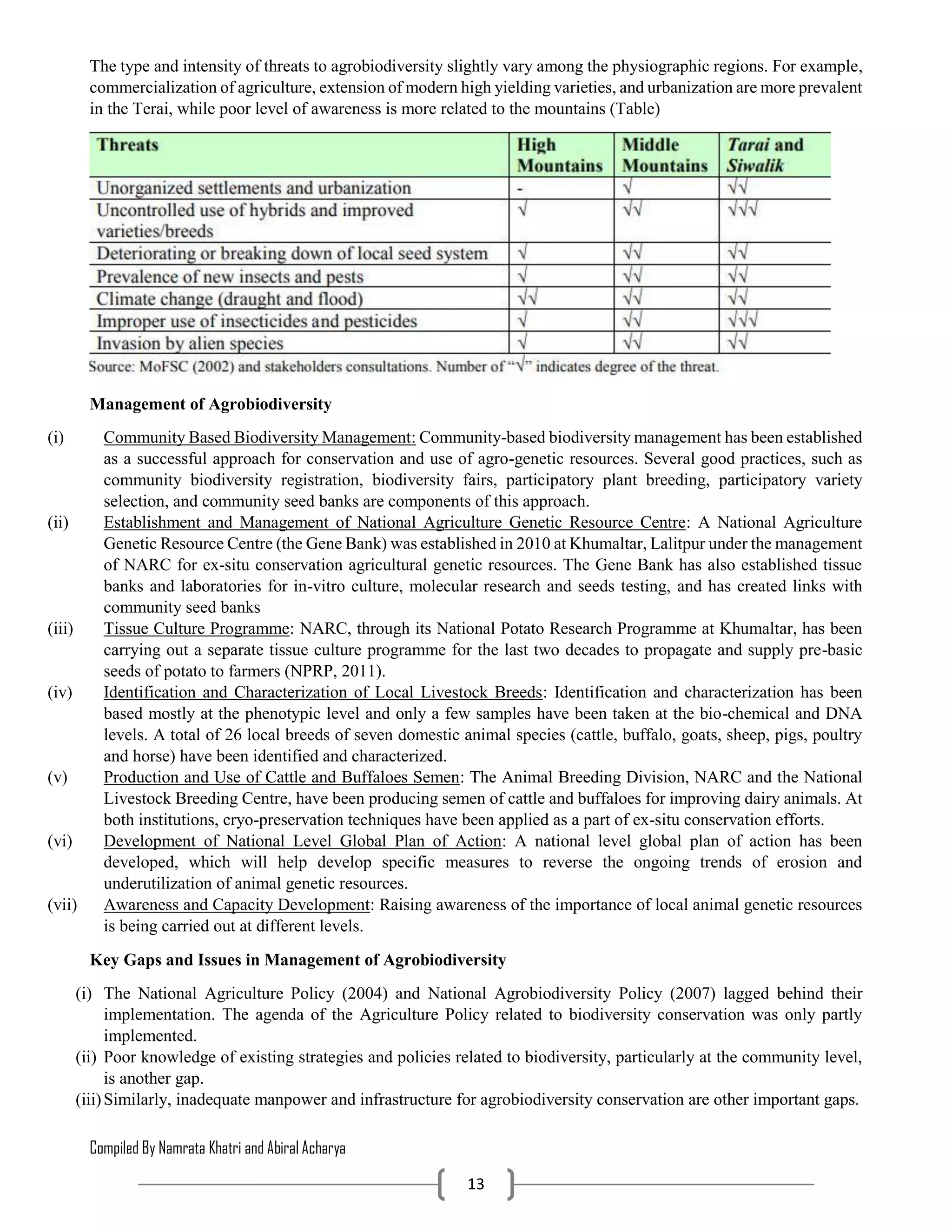
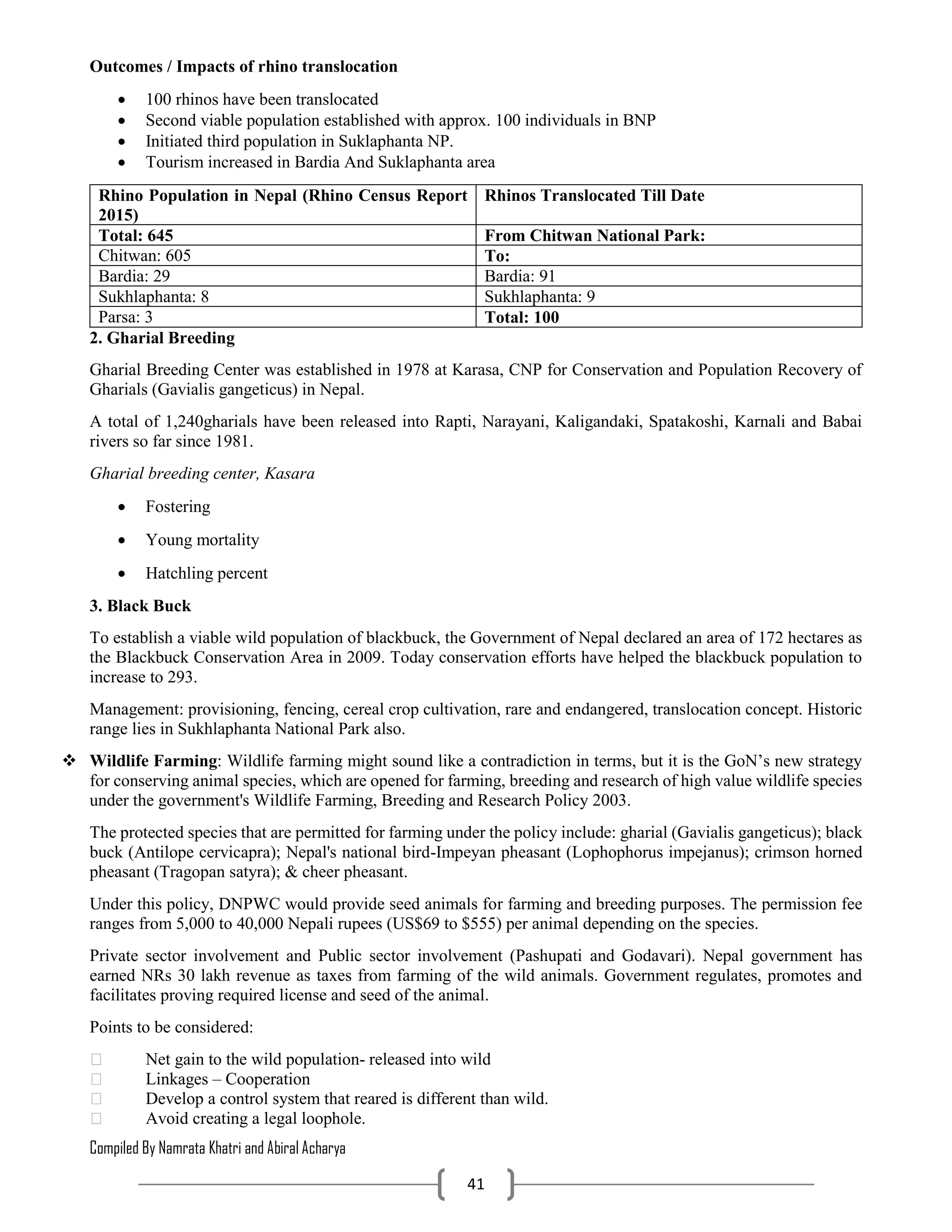
WILDLIFE AND
PROTECTED AREA
MANAGEMENT
PWM 703
JANUARY 1, 2020
COMPILED BY: NAMRATA KHATRI & ABIRAL ACHARYA
Masters in Forestry, IOF, TU
Compiled By Namrata Khatri and Abiral Acharya
1
Unit 1: Introduction (6) ........................................................................................................................................... 2
1.1 Concept and significance of biodiversity:..................................................................................................... 2
1.2 Status of biodiversity at global, HKH and Nepal.......................................................................................... 3
1.3 Biodiversity, ecosystem services and poverty alleviation:............................................................................ 6
1.4 Status and importance of major wildlife species (fauna) in Nepal................................................................ 7
1.5 History of PAM (global and Nepalese Context) ........................................................................................... 8
1.6 Different global and Nepalese approaches/models of landscape conservation............................................. 9
Unit 2: Concepts, Threats, Management, Key Gaps and Issues in Biodiversity Conservation in Nepal.............. 10
2.1 Forest Biodiversity:..................................................................................................................................... 10
2.2 Rangeland Biodiversity:.............................................................................................................................. 11
2.3 Agro-biodiversity........................................................................................................................................ 12
2.4 Wetland Biodiversity: ................................................................................................................................. 14
2.5 Mountain Biodiversity ................................................................................................................................ 15
Unit 3: Policy, legislation and multilateral environmental agreements at global and national level (7)............... 16
3.1 Salient features of global and regional treaties and conventions: ................................................................... 16
3.2 National level strategies:............................................................................................................................. 23
3.3 Critical analysis of Acts and Regulations related to environment, biodiversity, PA and Forest................. 33
UNIT 4: Wildlife And Habitat Management (7)................................................................................................... 35
4.1 Population management: Meta population, island biogeography, species recovery plans, Ex-situ and in-
situ conservation for example, translocation/reintroduction, wildlife farming, measures to curb poaching (role
of the army, community based anti-poaching operations, park-based anti-poaching units, wildlife crime
investigation)..................................................................................................................................................... 35
4.2 Habitat management: Landscape ecology (eco-region, biomes, biodiversity hotspots, corridor and
connectivity, habitat restoration plans, grazing and fire management, management of rangeland, wetland,
invasive species)................................................................................................................................................ 42
4.3 Island Biogeography theory with emphasis on its practical implications ................................................... 51
UNIT 5: Monitoring Biodiversity (7).................................................................................................................... 53
5.1 Population monitoring (mammals, birds, herpeto-fauna, fishes, insects) ................................................... 53
5.2 Habitat monitoring - habitat selection/resource selection, habitat suitability assessment techniques,
carrying capacity assessment, animal food habit studies, habitat occupancy modeling ................................... 59
5.3 Data management (archiving) in policy making ......................................................................................... 61
UNIT 6: Protected Area Management (8)............................................................................................................. 63
6.1 Development of PA..................................................................................................................................... 63
6.2 Human wildlife interface............................................................................................................................. 71
Unit 7 – Planning and Sustainability of PAs Management................................................................................... 76
7.1 Planning model: conventional planning and modern planning................................................................... 76
7.2 Management Plan of PA ............................................................................................................................. 78
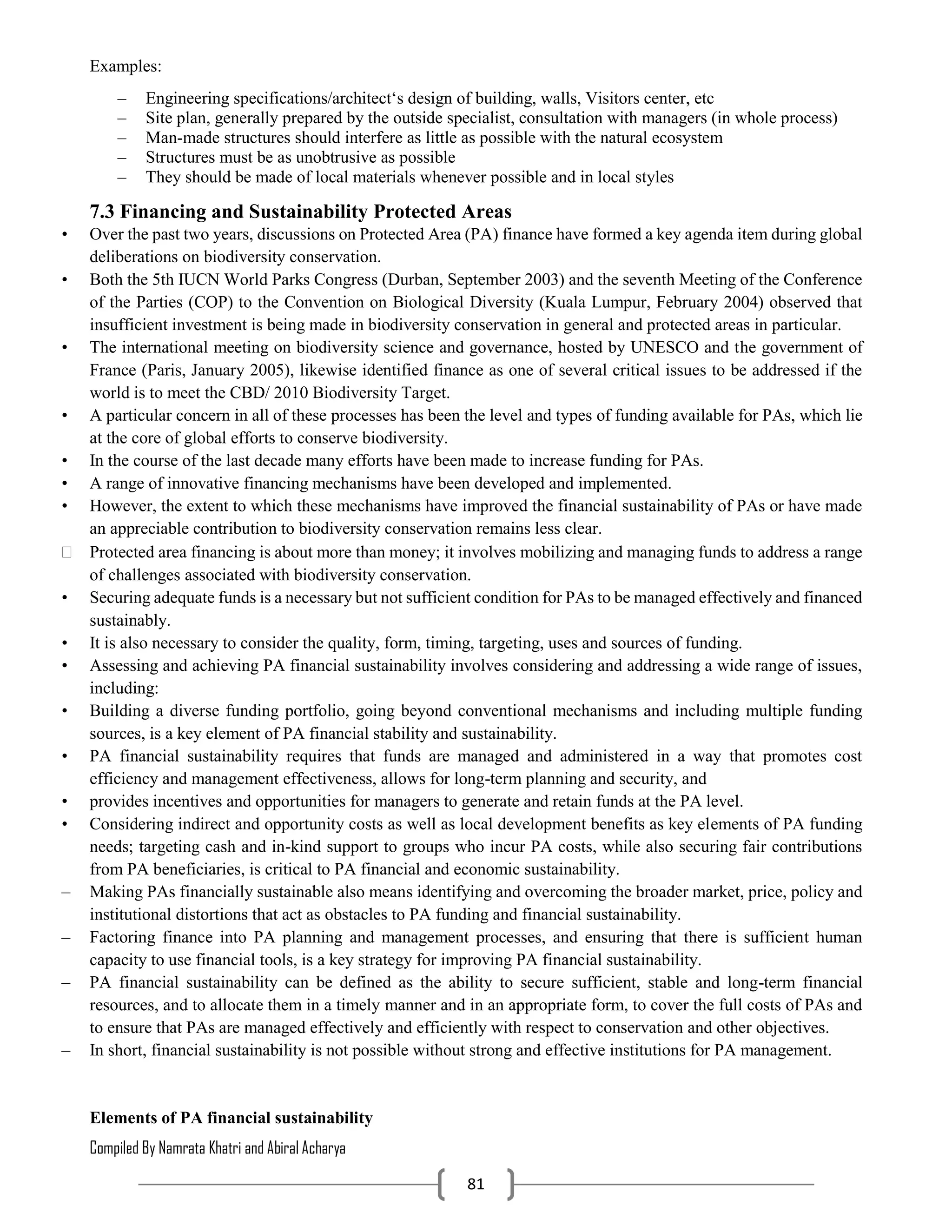
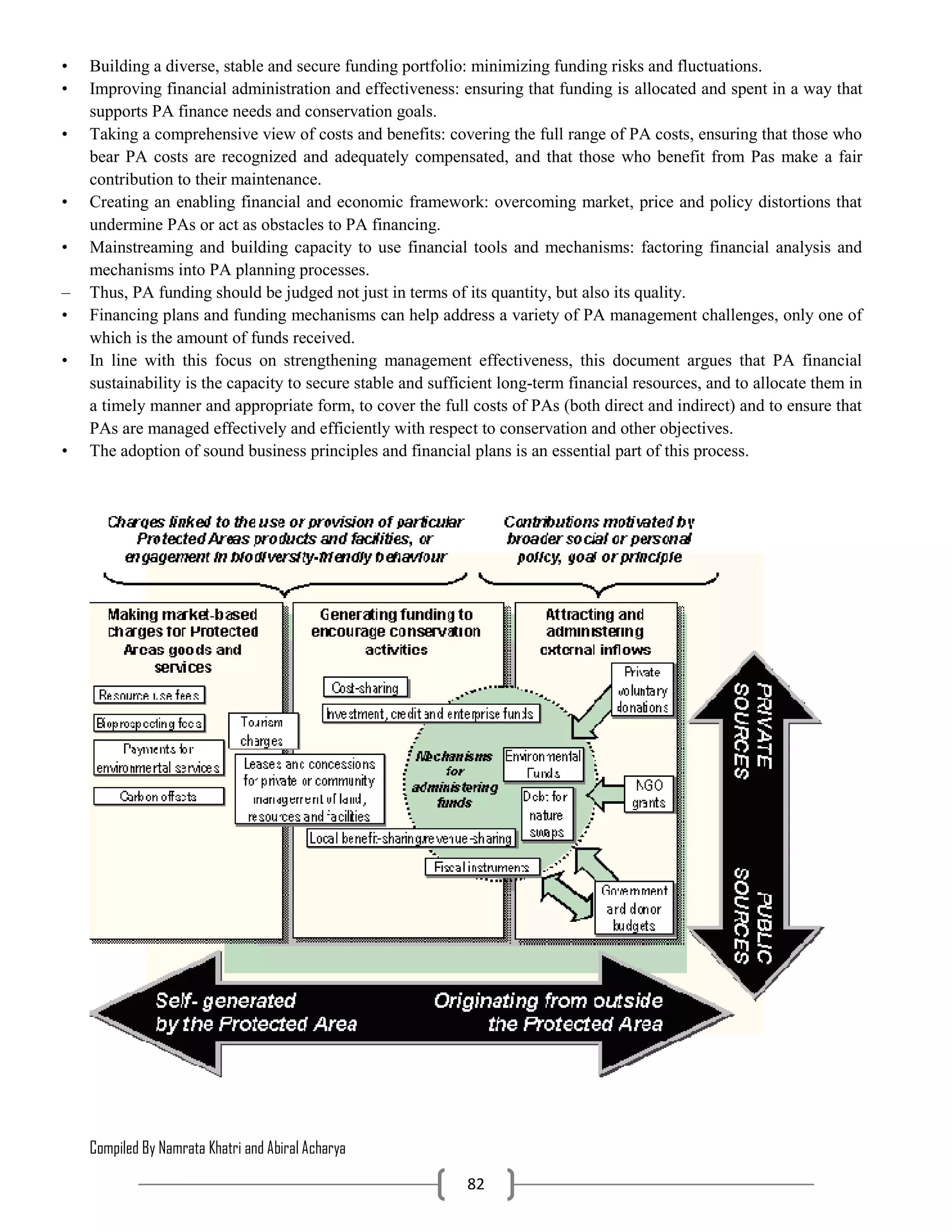
7.3 Financing and Sustainability Protected Areas............................................................................................. 81
Compiled By Namrata Khatri and Abiral Acharya
2
Unit 1: Introduction (6)
1.1 Concept and significance of biodiversity:
Simply, Biodiversity is termed as the “Extraordinary variety of life on Earth”
 from genes and species to ecosystems and valuable function they perform
 E.O. Wilson, Biologist coined the word “Biodiversity” and explain it as “the very stuff of life.”
The sum of genetic diversity among living organisms, their abundance, and their evenness within a specific study
area‘-Wilson (1988).
The Convention on Biological Diversity (CBD) defines it as “the variability among living organisms from all
sources including, among others, terrestrial, marine and other aquatic ecosystems and the ecological complexes
of which they are part”. The term generally refers to all aspects of variability evident within the living world,
including diversity within and between individuals, population, species, communities, and ecosystems.
Biodiversity refers to all the living things on Earth and the ecological processes associated with them.
The concept of biodiversity is linked primarily to the idea of biological variation, which still comprises a vast
amount of knowledge and projected future value that is unknown to science. Biodiversity, which occurs in both
terrestrial and aquatic environments, is constantly changing. It can be increased by natural evolutionary processes
and genetic change or reduced by threats which lead to population decline and species extinction.
Functional diversity: the biological and chemical processes such as energy flow and matter recycling needed for
the survival of species, communities, and ecosystem.
Biodiversity is important in a number of ways:
(i) Species have utilitarian (subsistence and commercial) value to human,
(ii) Biodiversity represents the natural balance within an ecosystem that provides a number of ecological
services, including nutrient cycling and pollination of plants, and
(iii) Species have intrinsic value. Conserving biodiversity is thus an essential part of safeguarding the
biological life support systems on Earth.
Three levels of biodiversity (UNEP):
- Species diversity
- Genetic diversity
- Ecosystem diversity
The United Nations designated 2011–2020 as the "United Nations Decade on Biodiversity".
If we keep losing biodiversity, eventually ecosystems (farms, forests, grasslands, rangelands, gardens,…) collapse
and:
• become less efficient,
• exhibit lower levels of functioning,
• deliver fewer services,
• become less reliable (more unpredictable, more variable),
• less resilient, and eventually the pillars of human well-being decline
• With the poor and vulnerable being the first to experience the adverse consequences biotic
impoverishment.
Threats to biodiversity conservation:
• Increasing Human Population and Poverty and Demands for Natural Resources
Compiled By Namrata Khatri and Abiral Acharya
3
• Over exploitation/unsustainable use of biological resources
• Habitat destruction/fragmentation
• Introduced and invasive species
• Climate change
• Lack of awareness & insufficient public support
• Pollution
• Lack of data
• Inadequate Institutional Framework and Capabilities: Poor Inter-agency Co-ordination, Limited
• Inadequate political commitment
1.2 Status of biodiversity at global, HKH and Nepal
Global scenario of species decline
• Global wildlife population status (WWF/ZSL-Living Planet
Report 2016)
• 58% declined vertebrate population abundance during 1970-
2012
• Further decline by 67% until 2020
• Freshwater 81%, terrestrial 38% and marine 36% declined
- Main causes of decline: - Habitat loss & degradation,
overexploitation, pollution, invasive species, and climate change
- Many species/sub-species including tiger (Bali, Caspian, Javan),
some European bison–extinct, and some bison came-back in the
natural habitats.
- Good news of increasing
– Bears and wolves in Europe
- Tigers in Asia
- 133 plants, 39 invertebrates, 26 fish, 10 amphibians, 1 reptile, 1
bird, 1 Mammal discovered in the Eastern Himalayas in 5 years.
(2009-2014) (WWF Living Himalayas Initiatives 2015)
Observed Patterns of Biodiversity
1. Species diversity tends to increase as we move toward the equator, systems at lower latitudes tend to have
both higher local, or alpha, diversity and higher between-system, or beta, diversity
2. Diversity on islands, on mountaintops, & in other isolated systems, species diversity tends to increase with
area and decrease with isolation
3. Endemicity, or the relative number of unique species, tends to be higher for larger & more isolated regions.
Hotspots: The term ‘hotspot’ can refer either to the simple geographic co-occurrence of many species or, more
specifically, to a site or region with an unusually high number of local endemics, also termed as restricted-area
species.
Two criteria
– species endemism: to qualify as a hotspot, an area must contain at least 0.5% or 1,500 of the world's
300,000 plant species as endemics
– degree of threat: to qualify, a hotspot should have lost 70% or more of its primary vegetation, this being
the form of habitat that usually contains the most species, especially endemics
Hotspots & Endemic Plants
• Total number of plants that are endemic to an area is one of the two primary criteria for determining
biodiversity hotspot status
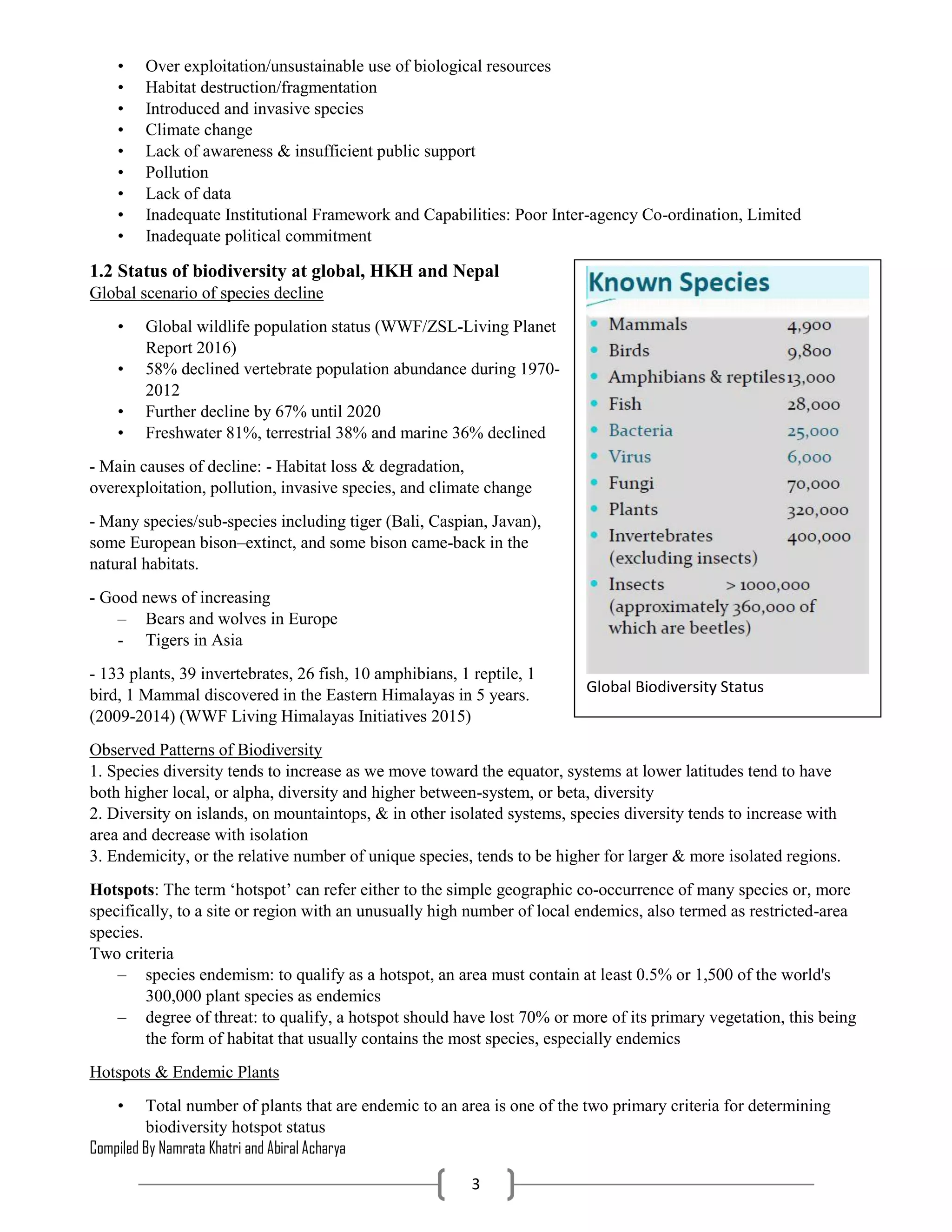
Global Biodiversity Status
Compiled By Namrata Khatri and Abiral Acharya
4
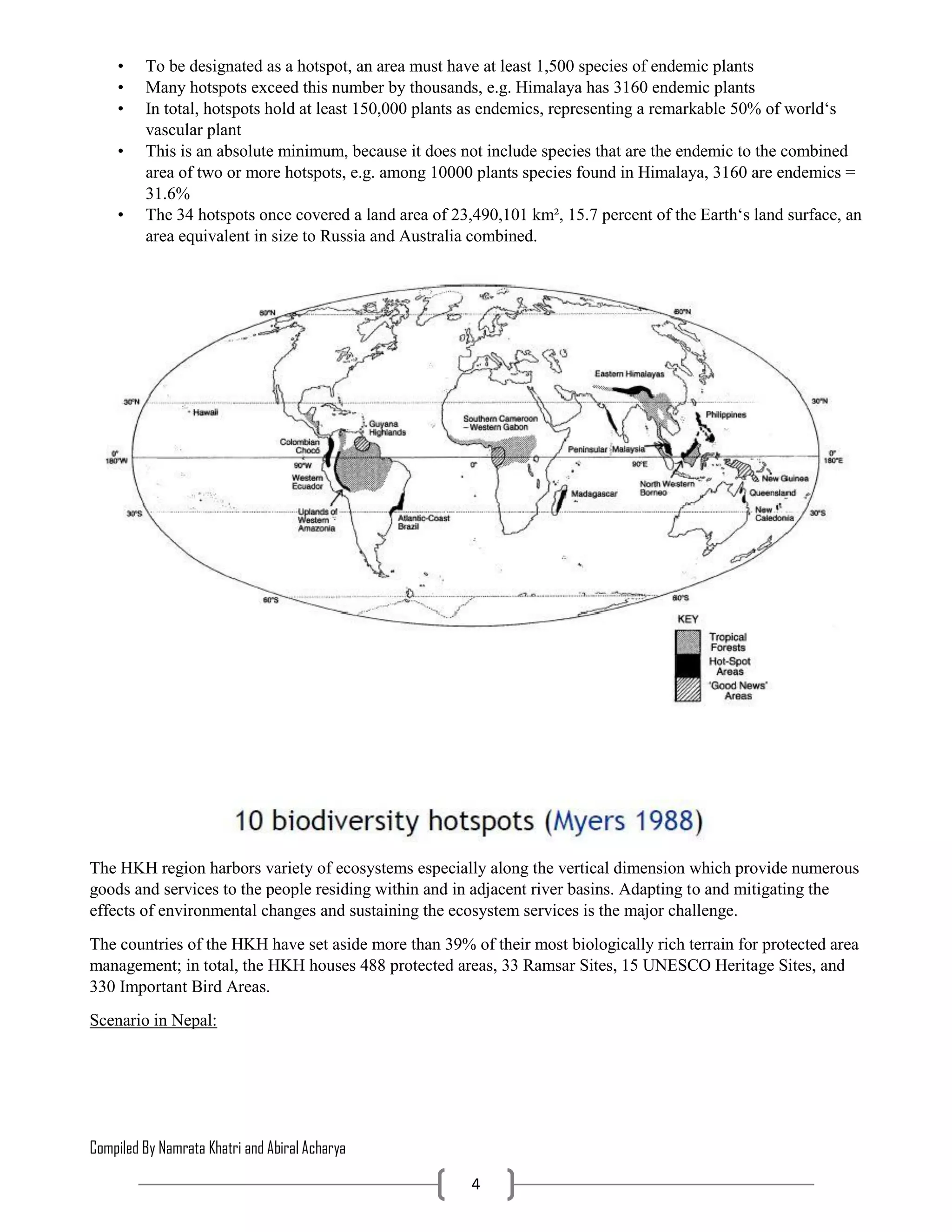
• To be designated as a hotspot, an area must have at least 1,500 species of endemic plants
• Many hotspots exceed this number by thousands, e.g. Himalaya has 3160 endemic plants
• In total, hotspots hold at least 150,000 plants as endemics, representing a remarkable 50% of world‘s
vascular plant
• This is an absolute minimum, because it does not include species that are the endemic to the combined
area of two or more hotspots, e.g. among 10000 plants species found in Himalaya, 3160 are endemics =
31.6%
• The 34 hotspots once covered a land area of 23,490,101 km², 15.7 percent of the Earth‘s land surface, an
area equivalent in size to Russia and Australia combined.
The HKH region harbors variety of ecosystems especially along the vertical dimension which provide numerous
goods and services to the people residing within and in adjacent river basins. Adapting to and mitigating the
effects of environmental changes and sustaining the ecosystem services is the major challenge.
The countries of the HKH have set aside more than 39% of their most biologically rich terrain for protected area
management; in total, the HKH houses 488 protected areas, 33 Ramsar Sites, 15 UNESCO Heritage Sites, and
330 Important Bird Areas.
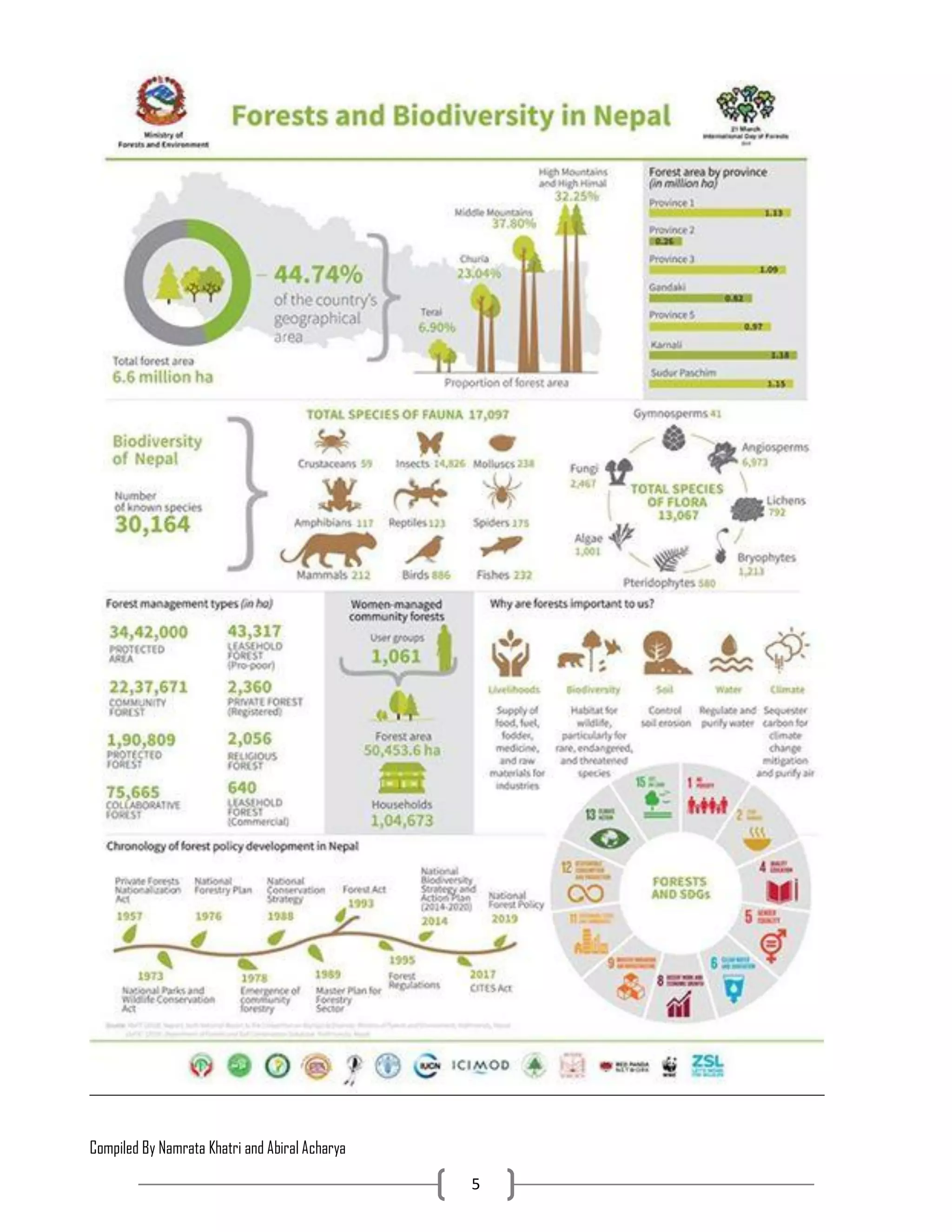
Scenario in Nepal:
Compiled By Namrata Khatri and Abiral Acharya
5
Compiled By Namrata Khatri and Abiral Acharya
6
The HKH region is highly heterogeneous with wide range of habitats, varied micro-climates, and ecological
conditions. It is home to some of the world’s most threatened and endemic species. Overall there are approximately
25,000 known species of angiosperms, 75,000 species of insects, 1,200 species of birds, and many wild relatives
of modern day crops.
o All or part of 4 of the 34 Global Biodiversity Hotspots
o 6 UNESCO Natural Heritage Sites
o 330 Important Bird Areas
o 53 Important Plant Areas
o 60 eco-regions (including Global 200 eco-regions)
o 29 Ramsar sites, and
o 488 protected areas (IUCN categories I-VI)
1.3 Biodiversity, ecosystem services and poverty alleviation:
Ecosystem Diversity:
• Populations and non-living environmental components- such as water or minerals surrounding them
interact dynamically to form an ecosystem.
• Includes: predators consuming prey, pollinators selecting flowers and species responding to physical
processes such as heavy rain
• Plant and Animal communities make up many kinds of ecosystems (forest, wetlands, rangelands,
mountains, deserts, terrestrial ecosystems.
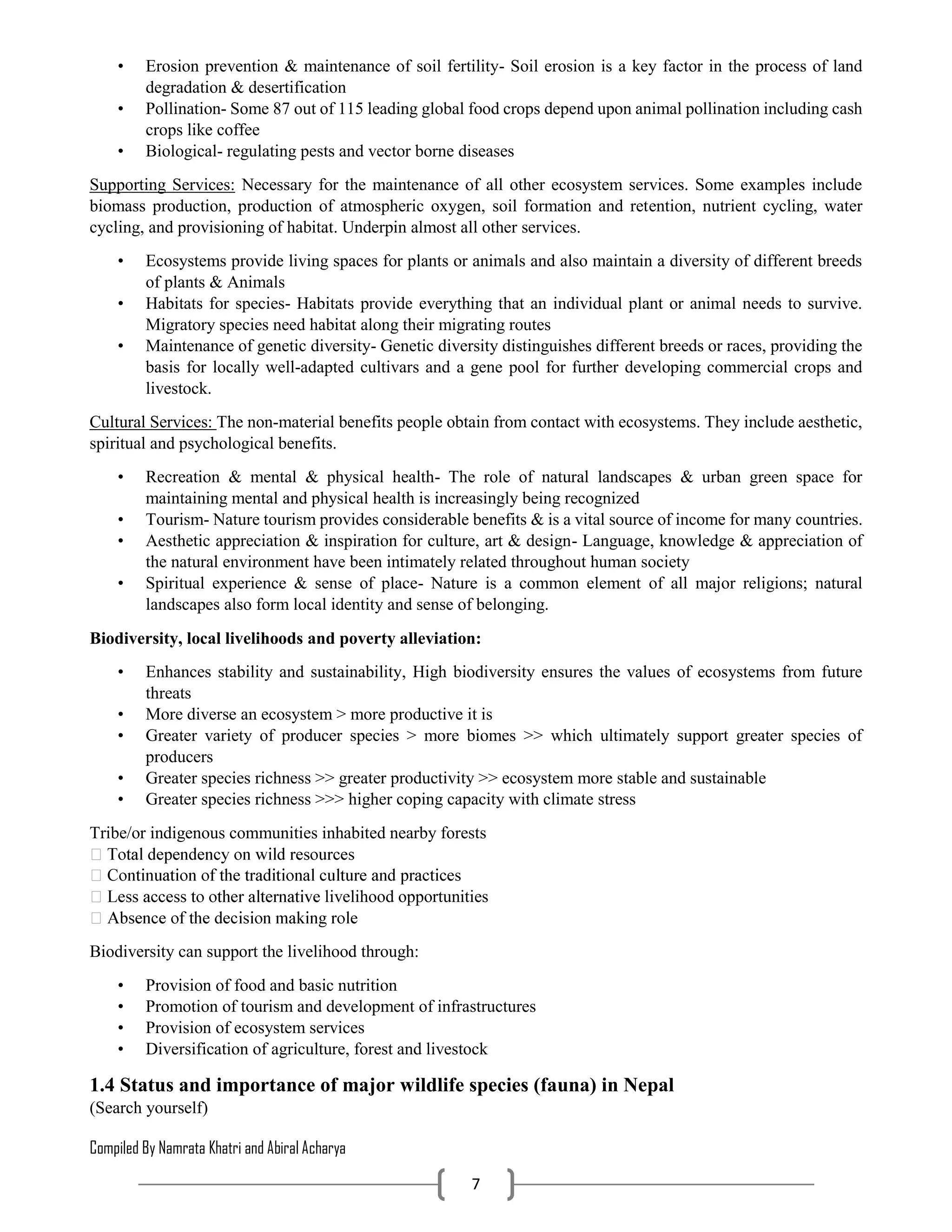
Ecosystem services are the conditions and processes through which natural ecosystems, and the species that
make them up, sustain and fulfill human life (Daily, 1997). Millennium Ecosystem Assessment (2005) followed
a broad definition but distinguished between:
• Supportive,
• Provisioning,
• Regulating, and
• Cultural services
Provisioning Services: That describes the
material outputs from ecosystems, they
include food, water and other resources.
- provide conditions for growing
food in wild and managed agro-ecosystem
- great diversity of raw
materials for construction and fuel
- surface & ground water
- provide many plants
for traditional medicines and input to the
pharmaceutical industry.
Regulating Services: The benefits obtained
from the regulation of ecosystem processes, including, for example, the regulation of climate, water, and some
human diseases (MA, 2005)
• By acting as regulators (regulating the quality of air and soil or by providing flood and disease control
• Local climate & air quality regulation- Trees provide shade & remove pollutants from the atmosphere
• Forests influence rainfall, Carbon sequestration & storage- As trees & plants grow, they remove O2 from
the atmosphere & effectively lock it away in their tissues.
• Moderation of extreme events- Ecosystems and living organisms create buffers against natural hazards
such as floods, storms and landslides
• Waste-water treatment- Micro-organisms in soil & in wetlands decompose human & animal waste, as
well as many pollutants
Compiled By Namrata Khatri and Abiral Acharya
7
• Erosion prevention & maintenance of soil fertility- Soil erosion is a key factor in the process of land
degradation & desertification
• Pollination- Some 87 out of 115 leading global food crops depend upon animal pollination including cash
crops like coffee
• Biological- regulating pests and vector borne diseases
Supporting Services: Necessary for the maintenance of all other ecosystem services. Some examples include
biomass production, production of atmospheric oxygen, soil formation and retention, nutrient cycling, water
cycling, and provisioning of habitat. Underpin almost all other services.
• Ecosystems provide living spaces for plants or animals and also maintain a diversity of different breeds
of plants & Animals
• Habitats for species- Habitats provide everything that an individual plant or animal needs to survive.
Migratory species need habitat along their migrating routes
• Maintenance of genetic diversity- Genetic diversity distinguishes different breeds or races, providing the
basis for locally well-adapted cultivars and a gene pool for further developing commercial crops and
livestock.
Cultural Services: The non-material benefits people obtain from contact with ecosystems. They include aesthetic,
spiritual and psychological benefits.
• Recreation & mental & physical health- The role of natural landscapes & urban green space for
maintaining mental and physical health is increasingly being recognized
• Tourism- Nature tourism provides considerable benefits & is a vital source of income for many countries.
• Aesthetic appreciation & inspiration for culture, art & design- Language, knowledge & appreciation of
the natural environment have been intimately related throughout human society
• Spiritual experience & sense of place- Nature is a common element of all major religions; natural
landscapes also form local identity and sense of belonging.
Biodiversity, local livelihoods and poverty alleviation:
• Enhances stability and sustainability, High biodiversity ensures the values of ecosystems from future
threats
• More diverse an ecosystem > more productive it is
• Greater variety of producer species > more biomes >> which ultimately support greater species of
producers
• Greater species richness >> greater productivity >> ecosystem more stable and sustainable
• Greater species richness >>> higher coping capacity with climate stress
Tribe/or indigenous communities inhabited nearby forests
livelihood opportunities
Biodiversity can support the livelihood through:
• Provision of food and basic nutrition
• Promotion of tourism and development of infrastructures
• Provision of ecosystem services
• Diversification of agriculture, forest and livestock
1.4 Status and importance of major wildlife species (fauna) in Nepal
(Search yourself)
Compiled By Namrata Khatri and Abiral Acharya
8
1.5 History of PAM (global and Nepalese Context)
Protected area means a geographically defined area which is designated or regulated and managed to achieve
specific conservation objectives. (CBD / Rio Earth Summit, 1992)
Concept and Management Paradigms
The "First World Conference on National Parks" was held in Seattle from 30 June to 7 July 1962. The purpose
of this conference was to establish a more effective international understanding of national parks and to encourage
further development of the national park movement on a worldwide scale. The overall consensus was that national
parks were of international significance.
The "Second World Conference on National Parks" was held in and around the world's oldest national park,
Yellowstone National Park, from 18 - 27 September 1972. Issues discussed at the conference included: the effects
of tourism on protected areas; broad aspects of park planning and management;
The "Third World Congress on National Parks" was held in Bali from 11 - 22 October 1982 and focused on
the role of protected areas in sustaining society. Ten major areas of concern were recognized by the congress.
Mainly focused on the inadequacy of the existing worldwide network of terrestrial PAs and the global need for
more marine, coastal and freshwater PAs.
The 5th
World Park Congress, Durban, South Africa, 8-17 September 2003. The challenge before the 2003
Congress was to demonstrate how protected areas are relevant to the broader economic, social and environmental
agenda for humankind in the 21st Century. The theme of the Congress responded to this challenge: "Benefits
beyond Boundaries".
Convention of Biological diversity: The objectives are
(1) the conservation of biological diversity
(2) the sustainable use of its components, and
(3) the fair and equitable sharing of the benefits arising out of the utilization of genetic resources.
The eighth meeting of the Conference of the Parties to the Convention on Biological Diversity (COP 8) was held
in Curitiba, Brazil from 20 to 31 March 2006.
Stages of development of PAs:
A. Conservation of scenery
-Yellow stone National Park, USA 1872 began the theme of scenery concept in conservation
-Canada, Australia and New Zealand were the first follower Nations
-The new nations were unable to provide such resources (scenery) as they lacked historical and cultural
assets including art, treasurers, museum, and university.
B. Conservation of Wildlife
-Due to un matching habitat (due to maximum cold/ cool environment the site only suitable for scenic value, no
any types of flora and fauna diversity, if presence they out migrated frequently due to the most parks were
mountain top parks) the area should be preserved for scenic without regard to flora and fauna
-Situation pressed to create new parks and other protected areas for wildlife conservation
C. Conservation of Large Ecosystem
-Great American Advocate of conservation Aldo Leopold included game management in his land ethics, idea of
conserving larger area and therefore managing species from 1933.
- Canada and USA pioneered several other new conservation movements independently and jointly.
 1960, first migratory bird treaty
 Creation of first international park at 1932
-India evolved in cross country reserve
-India signed migratory bird with USSR and established PAs near or adjacent to Nepalese Reserve.
-In 50s and 60s, after world war second, population increased -industrialization- pollution increased-loss of
natural reserves.
- USA hosted first world conference on national parks in Sealtle in 1962; concerns about pollution and survival
of endangered species
Compiled By Namrata Khatri and Abiral Acharya
9
-CITES was established and also signed by different countries
-Second World conference in Yellow stone National Park in 1972 was primarily focused on Conservation of
Large Ecosystem
Nepalese Context:
• 1970s-More focus on species or strict protection
• 1980s-Participatory approach (CA)
• 1990s-BZ concept (revenue sharing)
• 2000s-Landscape level conservation (partnership)
 Started from the Gaida Gasti in1961
 Chitwan as Rhino Century in 1964
 Establishment of CNP in 1973 and formulation of NPWC act 1973
 Establishment of National Parks, WR, HR, BZ, CA therefore after
 Formulation of different policies and legislatives relating to the Wildlife and Protected area management.
1.6 Different global and Nepalese approaches/models of landscape conservation
Species know no boundary but their fundamental requirements to exist and proliferate. The ecological intricacies
as revealed by scientific understanding of organisms living in the natural environs have called for conservation
beyond species and/or their protected habitat. Landscape level conservation, thus, has been a realized management
practice today.
Landscape Ecology emerged as a sophisticated applied science that can capture processes higher than ecosystems
to global processes. Landscape ecology emphasizes the interaction between spatial pattern and ecological process,
that is, the causes and consequences of spatial heterogeneity across a range of scales.
In the landscape conservation approach in Nepal, the key approach is to relieve the bottlenecks to migration and
movement of animals so that a minimum viable population can be maintained with genetic diversity and stability.
(Explain about TAL, CHAL, SHL…)
…
…
…
Compiled By Namrata Khatri and Abiral Acharya
10
Unit 2: Concepts, Threats, Management, Key Gaps and
Issues in Biodiversity Conservation in Nepal
(From NBSAP)
Nepal’s biodiversity is threatened by multiple factors. Loss and degradation of natural habitats, such as forests,
grasslands and wetlands due to expansion of settlements, agriculture and infrastructure; over exploitation; invasion
by alien species; and pollution of water bodies remain the predominant threats to natural ecosystems. Rapid
expansion of hybrid varieties and improper use of insecticides and pesticides are the major threats to
agrobiodiversity. Climate change can have profound impacts in future, particularly in the mountains. Most threats
continue to increase. Moreover, interaction of multiple threats is speculated to have increased pressures thereby
leading to further decline, degradation and loss of habitats.
2.1 Forest Biodiversity:
The threats to forest biodiversity can be categorized into two broad groups:
(i) loss and degradation of natural habitats, and
(ii) Over exploitation and illegal exploitation of biological resources.
Threats
(i) Loss of Habitat: Continuous loss of forest area is a major threat to forest biodiversity. According to the Global
Forest Resources Assessment by FAO, Nepal lost forest area by 2.1 percent and 1.4 percent during 1990-2000
and 2000-2005, respectively. During 1990-2000, the country lost 700 hectares of primary forest per year, but this
figure rose by 10 times to 7,000 hectares per year during 2000-2005 (FAO, 2010). The factors driving loss of
forest habitat slightly vary among the physiographic zones and include mainly the followings:
(a) Encroachment of forest areas for settlements is a major cause of deforestation in the Terai and Siwalik.
(b) Expansion of cultivation into forest areas is taking place to meet increasing demands for agricultural land.
(c) Development of infrastructure inside forestland is an important factor causing forest loss and degradation.
(d) Planned conversion of forestland by the government for implementing economic development priority
projects
(ii) Degradation of Habitat: Degradation of forest habitats is a major threat to biodiversity. The World Bank (2008)
estimated that one quarter of Nepal’s forest area is heavily degraded, which has led to loss of biodiversity,
increased landslides, and soil erosion. The following are the major causes of forest habitat degradation.
(a) Unsustainable overharvesting
(b) Uncontrolled forest fire is a serious threat, particularly in the Siwalik region and high altitude areas.
(c) Overgrazing in forests has negatively affected regeneration and growth of seedlings and ultimately caused
forest degradation in many places.
(iii) Poaching and Illegal Wildlife Trade: Illegal hunting and trade of important wildlife species is a major problem
in the management of protected area biodiversity. The threat is particularly severe for some vertebrates driven in
particular by demand for wildlife products in international markets. Rhino (Rhinoceros unicornis), tiger (Panthera
tigris tigris), musk deer (Moschus chrysogaster), pangolin (Manis spp) are some of the species that are especially
at risk from poaching. Around 43 nationally threatened bird species (29% of the total threatened) are affected to
some degree by hunting or trapping (BCN and DNPWC, 2011).
(iv) Human-Wildlife Conflict: Human-wildlife conflict is related to crop raids and livestock depredation by wild
animals, which is common in all protected areas. This is a major threat to wild fauna particularly large predators
(e.g. snow leopard). Wild animals, such as wild boars, elephants, rhinos, deer, and monkeys destroy crops, which
cause retaliation from human communities.
Compiled By Namrata Khatri and Abiral Acharya
11
(v) Invasion by Alien Plant Species: Invasive alien species affect native species mainly through predation,
competition and habitat modification (McGeoch et al., 2010). Invasion and rapid expansion of some alien species,
such as Mikania micrantha, Ageratina adenophora (syn Eupatorium adenophorum), Chromolaena odorata and
Lantana camara has emerged as a major threat to forest biodiversity.
(vi) Stone, gravel and sand mining: Excessive extraction of boulders, gravel and sand from rivers and streams is
a localized cause of deforestation in some areas, which has posed a direct threat to biodiversity.
(vii) Other Threats: There are some location-specific threats. For example, crossbreeding of wild water buffalo
(Bubalus arnee) with domestic buffalo (Bubalus bubalis) is a major problem in Koshi Tappu Wildlife Reserve
(the only habitat of wild water buffalo), which is speculated to have caused substantial genetic degradation of the
endangered wild species.
Management of Forest Biodiversity:
1. Establishment and Management of Protected Areas: Nepal has established 20 protected areas, covering 23.39
percent of the country’s total area. Preparation and implementation of species conservation plans, controlling
poaching and illegal trade in wild animal parts, Increase in populations of important wildlife species, Translocation
of wild animals to new areas, Monitoring of wildlife populations, Linking communities to benefits of protected
areas, Increased revenue from protected area tourism contributing to biodiversity are the key management
interventions made for the conservation of forest biodiversity inside PAs.
2. Management of Forest Biodiversity outside Protected Area: Implementation of participatory forest management
programmes (CF, LF, RF, CoF), Establishment of Protection forests, Implementation of Chure Conservation
Programme, Afforestation and Reforestation, Reclamation of Encroached Forest Area, Conservation of MAPs,
Establishment and Management of Public land Agroforestry, Initiatives to implementing REDD+, Increase in
Private Forests and Tress Outside Forests are the main practices outside PAs.
3. Establishment of Elephant Breeding Center, Gharial Breeding Center, Vulture conservation center, Central zoo,
Botanical Garden, National Herberium, Conservation of Forest Genetic Resources, Plant Propagation by Tissue
Culture, Documentation of Flora, etc.
Key Gaps, Challenges and issues:
(1) Inadequate Representation of the Middle Mountains in Country’s Protected Area System
(2) Gaps in Conservation of Biodiversity Rich Natural Forest Ecosystems and Corridors
(3) Gaps in Species Conservation
(4) Inadequate Human Resources and Technical Capacities
(5) Financial Constraints
(6) Wide Variations in the Success of Community Forestry Programme
(7) Inadequate attention to Conservation of Biodiversity in Community Forests
(8) Contention between Protected Area and Participatory Approaches to Conservation
(9) Limited Participation of Women and Other Disadvantaged Social Groups
(10) Challenge in Managing Human-Wildlife Conflict
(11) Challenge in Controlling Forest Encroachment and Illegal Logging
(12) Challenges in Implementation of REDD+
(13) Inadequate Knowledge and Capacity to Control Invasive Alien Species
2.2 Rangeland Biodiversity:
Threats to rangelands biodiversity differ with the location and type of rangelands. The following are the major
threats.
(i) Overgrazing and trampling by large herds of livestock is a main threat to biodiversity, especially in high
altitude pastures, as it affects regeneration and development of ground flora.
Compiled By Namrata Khatri and Abiral Acharya
12
(ii) Conversion of grasslands and savannas to agriculture and other use is a major threat to the Terai-Duar
savannas, grasslands and marshlands. The loss and fragmentation has greatly affected grassland-dependent
wild animals (such as rhino and deer) and bird species (e.g. Bengal florican).
(iii) Intrusion of woody species has caused declines in quality and the surface area of some grassland habitats,
including grasslands in Chitwan National Park. Intrusions by tree and shrub species have also been reported
in subalpine and alpine grasslands, which pose threats to the diversity of rangelands, although the total
richness of flora may be unaffected (see e.g. Sharma et al., 2013).
(iv) Invasion of alien plant species is a threat to many Tarai, Siwalik and Middle Mountains grasslands.
(v) Unregulated commercial harvest of medicinal plants is a main threat to biodiversity in alpine and subalpine
meadows.
(vi) Inappropriate management of protected area grasslands, including untimely and intensive annual cutting,
has posed a serious threat to the country’s specialist grassland birds, many of which are now almost
confined entirely to protected areas (BCN and DNPWC, 2011).
(vii) Fire, which is an essential component of management tools used to maintain lowland grassland ecosystems
and biodiversity (especially in protected areas), is also a serious threat to biodiversity. Fires during the
breeding season can be extremely damaging to grassland birds and reptiles as they destroy the nests and
eggs. Comprehensive burning can also be harmful to other wildlife.
Management and issues in conserving Rangeland Biodiversity
There have been only limited efforts to assess, monitor and manage rangeland biodiversity in Nepal. Formulation
of the Rangeland Policy in 2012 was a major milestone. Nepal Agriculture Research Council, in cooperation with
the Department of Livestock Services and Ministry of Agriculture Development, has been conducting some
research on forage development in high altitude pastures, including the introduction and evaluation of legume
species (NARC, 2011). A few research studies on different aspects of rangeland ecology were conducted in recent
years (see e.g. Limbu et al., 2012).
One of the major issues in management of rangeland biodiversity relates to unclear management responsibility
for rangelands. In Nepal, rangelands are legally owned by the Ministry of Forests and Soil Conservation while
their utilisation by local communities implicitly associates them with the Ministry of Agriculture Development.
Unclear administrative jurisdiction and management responsibilities of different agencies coupled with inadequate
coordination and cooperation between them has created confusion and complexity in the management of
rangelands located outside protected areas.
2.3 Agro-biodiversity
Agrobiodiversity is under threat mainly due to:
(i) commercialization of agriculture and widespread use of modern high yielding varieties,
(ii) improper use of insecticides and pesticides, and
(iii) conversion of farmlands into semi-permanent and permanent settlements.
Further gaps include poor level of awareness about the importance of biodiversity, inadequate incentives for
conservation of local land races, and inadequate knowledge. Uncontrolled use of hybrids and improved varieties
has caused rapid erosion of landraces of some food crops, particularly in the Terai.
Livestock diversity is threatened by:
(i) decline of local breeds, mainly due to inadequate incentives to continue keeping less productive local
breeds, (ii) weak quarantine
(ii) limited ex-situ conservation of local breeds,
(iv) limited access to good quality seed of local breeds (live or semen), and
(v) lack of incentives to continue keeping less productive local breeds.
Compiled By Namrata Khatri and Abiral Acharya
13
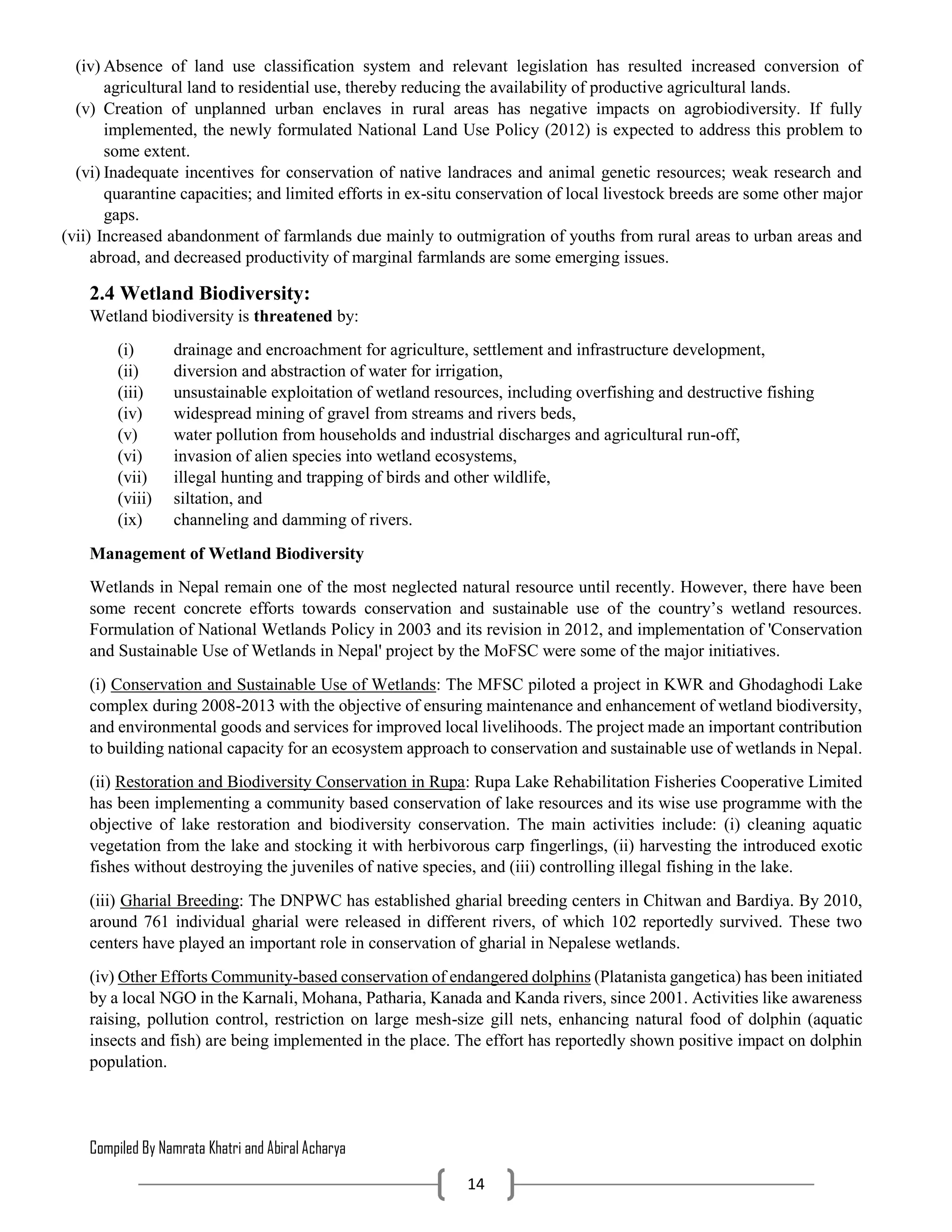
The type and intensity of threats to agrobiodiversity slightly vary among the physiographic regions. For example,
commercialization of agriculture, extension of modern high yielding varieties, and urbanization are more prevalent
in the Terai, while poor level of awareness is more related to the mountains (Table)
Management of Agrobiodiversity
(i) Community Based Biodiversity Management: Community-based biodiversity management has been established
as a successful approach for conservation and use of agro-genetic resources. Several good practices, such as
community biodiversity registration, biodiversity fairs, participatory plant breeding, participatory variety
selection, and community seed banks are components of this approach.
(ii) Establishment and Management of National Agriculture Genetic Resource Centre: A National Agriculture
Genetic Resource Centre (the Gene Bank) was established in 2010 at Khumaltar, Lalitpur under the management
of NARC for ex-situ conservation agricultural genetic resources. The Gene Bank has also established tissue
banks and laboratories for in-vitro culture, molecular research and seeds testing, and has created links with
community seed banks
(iii) Tissue Culture Programme: NARC, through its National Potato Research Programme at Khumaltar, has been
carrying out a separate tissue culture programme for the last two decades to propagate and supply pre-basic
seeds of potato to farmers (NPRP, 2011).
(iv) Identification and Characterization of Local Livestock Breeds: Identification and characterization has been
based mostly at the phenotypic level and only a few samples have been taken at the bio-chemical and DNA
levels. A total of 26 local breeds of seven domestic animal species (cattle, buffalo, goats, sheep, pigs, poultry
and horse) have been identified and characterized.
(v) Production and Use of Cattle and Buffaloes Semen: The Animal Breeding Division, NARC and the National
Livestock Breeding Centre, have been producing semen of cattle and buffaloes for improving dairy animals. At
both institutions, cryo-preservation techniques have been applied as a part of ex-situ conservation efforts.
(vi) Development of National Level Global Plan of Action: A national level global plan of action has been
developed, which will help develop specific measures to reverse the ongoing trends of erosion and
underutilization of animal genetic resources.
(vii) Awareness and Capacity Development: Raising awareness of the importance of local animal genetic resources
is being carried out at different levels.
Key Gaps and Issues in Management of Agrobiodiversity
(i) The National Agriculture Policy (2004) and National Agrobiodiversity Policy (2007) lagged behind their
implementation. The agenda of the Agriculture Policy related to biodiversity conservation was only partly
implemented.
(ii) Poor knowledge of existing strategies and policies related to biodiversity, particularly at the community level,
is another gap.
(iii)Similarly, inadequate manpower and infrastructure for agrobiodiversity conservation are other important gaps.
Compiled By Namrata Khatri and Abiral Acharya
14
(iv) Absence of land use classification system and relevant legislation has resulted increased conversion of
agricultural land to residential use, thereby reducing the availability of productive agricultural lands.
(v) Creation of unplanned urban enclaves in rural areas has negative impacts on agrobiodiversity. If fully
implemented, the newly formulated National Land Use Policy (2012) is expected to address this problem to
some extent.
(vi) Inadequate incentives for conservation of native landraces and animal genetic resources; weak research and
quarantine capacities; and limited efforts in ex-situ conservation of local livestock breeds are some other major
gaps.
(vii) Increased abandonment of farmlands due mainly to outmigration of youths from rural areas to urban areas and
abroad, and decreased productivity of marginal farmlands are some emerging issues.
2.4 Wetland Biodiversity:
Wetland biodiversity is threatened by:
(i) drainage and encroachment for agriculture, settlement and infrastructure development,
(ii) diversion and abstraction of water for irrigation,
(iii) unsustainable exploitation of wetland resources, including overfishing and destructive fishing
(iv) widespread mining of gravel from streams and rivers beds,
(v) water pollution from households and industrial discharges and agricultural run-off,
(vi) invasion of alien species into wetland ecosystems,
(vii) illegal hunting and trapping of birds and other wildlife,
(viii) siltation, and
(ix) channeling and damming of rivers.
Management of Wetland Biodiversity
Wetlands in Nepal remain one of the most neglected natural resource until recently. However, there have been
some recent concrete efforts towards conservation and sustainable use of the country’s wetland resources.
Formulation of National Wetlands Policy in 2003 and its revision in 2012, and implementation of 'Conservation
and Sustainable Use of Wetlands in Nepal' project by the MoFSC were some of the major initiatives.
(i) Conservation and Sustainable Use of Wetlands: The MFSC piloted a project in KWR and Ghodaghodi Lake
complex during 2008-2013 with the objective of ensuring maintenance and enhancement of wetland biodiversity,
and environmental goods and services for improved local livelihoods. The project made an important contribution
to building national capacity for an ecosystem approach to conservation and sustainable use of wetlands in Nepal.
(ii) Restoration and Biodiversity Conservation in Rupa: Rupa Lake Rehabilitation Fisheries Cooperative Limited
has been implementing a community based conservation of lake resources and its wise use programme with the
objective of lake restoration and biodiversity conservation. The main activities include: (i) cleaning aquatic
vegetation from the lake and stocking it with herbivorous carp fingerlings, (ii) harvesting the introduced exotic
fishes without destroying the juveniles of native species, and (iii) controlling illegal fishing in the lake.
(iii) Gharial Breeding: The DNPWC has established gharial breeding centers in Chitwan and Bardiya. By 2010,
around 761 individual gharial were released in different rivers, of which 102 reportedly survived. These two
centers have played an important role in conservation of gharial in Nepalese wetlands.
(iv) Other Efforts Community-based conservation of endangered dolphins (Platanista gangetica) has been initiated
by a local NGO in the Karnali, Mohana, Patharia, Kanada and Kanda rivers, since 2001. Activities like awareness
raising, pollution control, restriction on large mesh-size gill nets, enhancing natural food of dolphin (aquatic
insects and fish) are being implemented in the place. The effort has reportedly shown positive impact on dolphin
population.
Compiled By Namrata Khatri and Abiral Acharya
15
2.5 Mountain Biodiversity
Mountain ecosystems are fragile and vulnerable to natural disasters, such as landslides, glacial lake outburst floods
and drought, which cause considerable damage to the ecosystems and people living in those areas.
Some of the main threats to mountain biodiversity include:
(i) unplanned and unregulated construction of rural roads and other infrastructure,
(ii) inappropriate management of natural resources, including overexploitation of non-wood and wood
products, and
(iii) inappropriate farming practices.
Management of Mountain Biodiversity
Efforts to manage mountain biodiversity overlap with other thematic efforts, particularly with those related to
protected areas, landscape management, and community based forest management. Of the 20 protected areas, 13
are located in the mountains, which cover 84 percent of the total protected area in the country. Similarly, two
biodiversity-rich mountain sites (i.e. Madhane and Panchase) have been declared as protection forests by the
government. The MoFSC has been implemented landscape-specific programmes in two important mountain
landscapes, namely the Sacred Himalayan Landscape, and the Kailash Sacred Landscape.
There are a few other initiatives that have been exclusively designed and implemented to conserve mountain
biodiversity and ecosystems. These include:
(i) promulgation of long-term policies and programmes, and
(ii) Integrated water resource management in two sub-basins in the Koshi River.
Following the Global Mountain Summit held during 29 October to 01 November 2002 in Bishkek, the MoFSC
has increased its efforts to management of mountain biodiversity.
Gaps and issues: Insufficient knowledge and understanding of mountain ecosystems, lack of long-term vision,
and inadequate financial resources and technical capacity are some of the major gaps and constraints in sustainable
management of Nepal’s mountain ecosystems. In-depth understanding and incorporation of the value of mountain
ecosystem services in national development planning, GDP accounting, and decision-making is one of the key
requirements for sustainable management of mountain biodiversity.
Compiled By Namrata Khatri and Abiral Acharya
16
Unit 3: Policy, legislation and multilateral environmental
agreements at global and national level (7)
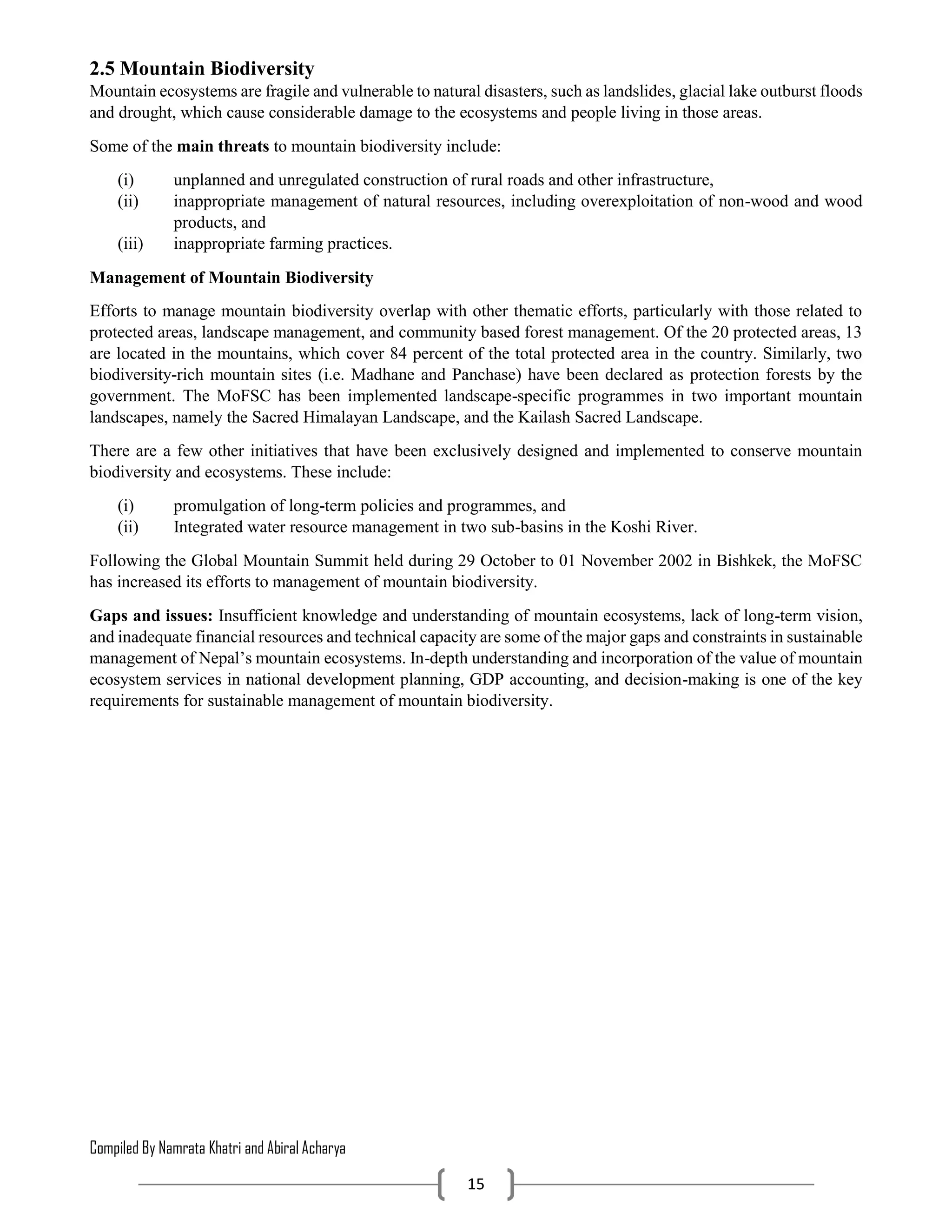
3.1 Salient features of global and regional treaties and conventions:
CBD (Convention on Biological Diversity)
• Earth Summit (Rio Conference 1992)
• Effective: 29 December 1993
• Articles -42
• No. of Member States: 196
• Member (Nepal): 1993(1994-02-21)
• Focal Point: MoFE (Biodiversity and
Environment Division)
Objectives of CBD:
• Conservation of biological diversity
• Sustainable Use of its component
• Fair and Equitable Sharing of Benefits arising out
of the utilization of genetic resources
Main Principle: States have the sovereign right to exploit their own resources pursuant to their own environmental
policies, and the responsibility to ensure that activities within their jurisdiction or control do not cause damage to
the environment of other States or of areas beyond the limits of national jurisdiction.
Convention protocols
Cartagena protocol on bio-safety
• On 29 January 2000, - adopted a supplementary agreement to the CBD.
• To protect biological diversity from the potential risks posed by living modified organisms resulting
from modern biotechnology.
Nagoya protocol on access and benefit sharing
• On 29 October 2010 - a supplementary agreement to the CBD.
• Provides a transparent legal framework for the effective implementation of one of the three objectives of
the CBD: the fair and equitable sharing of benefits arising out of the utilization of genetic resources.
• Nepal- Party since 2019-03-28 (Accession on28 Dec 2018).
Strategic plan for biological diversity (2011 to 2020) 5 Strategies:
Compiled By Namrata Khatri and Abiral Acharya
17
(i) Strategy A: Address the underlying causes of biodiversity loss by mainstreaming biodiversity sectors
(Targets 1-4).
(ii) Strategy B: Reduce direct pressure on biodiversity and promote sustainable use (Targets 5-10).
(iii)Strategy C: Improve the status of biodiversity by safe guarding ecosystems, species and genetic
diversity (Targets 11-13).
(iv) Strategy D: Enhance the benefits to all from biodiversity and ecosystem services (Targets 14-16).
(v) Strategy E: Enhance implementation through participatory planning, knowledge sharing and capacity
building
Convention Bodies:
• Conference of the Parties- every two years
• Scientific Bodies- SBSTTA (Subsidiary Body on Scientific, Technical, Technological Advice)
• Subsidiary bodies on Implementation
• Working Groups
Implementation mechanism
• National Biodiversity Strategy and Action Plan (NBSAP)
• National Report
• Cooperation and Partnerships
• Financial resources and mechanism
Conference of Parties
• COP 14 – Fourteen Meeting of COP to the Convention, Sharm El-Sheikh, Egypt, 17-29 November 2018
• COP 13 - Thirteenth meeting of the Conference of the Parties to the Convention on Biological Diversity
Cancun, Mexico, 4 - 17 December 2016
• COP 12 - Twelfth meeting of the Conference of the Parties to the Convention on Biological Diversity
Pyeongchang, Republic of Korea, 6 - 17 October 2014
• COP 1 - First Ordinary Meeting of the Conference of the Parties to the Convention on Biological
Diversity Nassau, Bahamas, 28 November - 9 December 1994
IUCN (International Union for Conservation of Nature and Natural Resources)
• Is a membership union uniquely composed of both government and civil society organizations.
• World’s largest and most diverse environmental network.
• Over 1,300 Member organizations over 160 countries and the input of some 15,000 experts.
• Is the global authority on the status of the natural world and the measures needed to safeguard it.
• Nepal - 1974
• IUCN’s headquarters – Switzerland
IUCN was founded in October 1948 as the International Union for the Protection of Nature (or IUPN) following
an international conference in Fontainebleau, France. The organisation changed its name to the International
Union for Conservation of Nature and Natural Resources in 1956 with the acronym IUCN (or UICN in French
and Spanish).
• Use of the name “World Conservation Union”, in conjunction with IUCN, began in 1990.
• From March 2008 this name is no longer commonly used.
Union Bodies
• World Conservation Congress – every four years - 2016 (USA) -2020 (France)
• Regional Committees
• National Committees (Country Office in Nepal)
Compiled By Namrata Khatri and Abiral Acharya
18
Expert Commission on:
• Education and Communication
• Environmental Economics and Social Policy
• Environmental Laws
• Ecosystem Management
• Species Survival Commission
• World Commission on Protected Areas
Status of Nepal’s mammal: Of the 208 known species of mammal in Nepal, one is considered Regionally
Extinct, eight are considered Critically Endangered, twenty-six are considered Endangered, fourteen are
considered Vulnerable and seven are considered Near Threatened.
Status of Nepal’s Birds: Of the 878 bird species recorded, 168 species (19%) were assessed as nationally
threatened. These comprise 68 (40%) Critically Endangered species, 38 (23%) Endangered species and 62
(37%) Vulnerable species. A total of 62 species was considered Near Threatened and 22 species Data Deficient.
UNESCO World Heritage Convention:
• 1972- Conservation of Natural and Cultural Heritage
(Shared Legacy, Common Responsibility)
• Articles - 38
• State Parties- 193
• Nepal’s Membership- 1978 (20 June 1978)
• No. of Properties- 1121
• Focal Point - Ministry of Education
• Authorities:
 Cultural sites: Dept. of Archeology
 Natural sites: DNPWC
Strategic Objectives the "Five Cs“
- Credibility
- Conservation
- Capacity-building
- Communication
- Communities
Categories (Natural, cultural or mixed):
Criteria of the Properties (Natural): (Be an
outstanding examples)
Vii. Superlative natural phenomena or areas of
exceptional natural beauty and aesthetic
importance
Viii. Major stages of earth history (record of life,
significant on-going geological processes in the
development of landforms, or significant
geomorphic or physiographic features
Ix. On-going ecological and biological processes
in the evolution and development of terrestrial,
fresh water, coastal and marine ecosystems and
communities of plants and animals
Properties under UNESCO WHS:
Compiled By Namrata Khatri and Abiral Acharya
19
X. Important and significant natural habitats for in-situ conservation of biological diversity containing
threatened species
Convention Bodies
- General Assembly – every two year (21 GA-2017-France)
- World Heritage Committee – every year (43 COM- Azerbaijan- 30 June- 10 July, 2019; 44 COM- 29
June-9 July China)
- World Heritage Bureau
- Advisory Bodies- IUCN, ICOMOS (International Council on Monuments and Sites), ICCROM
(International Centre for the study of the Preservation and Restoration of Cultural Property)
- Operational Guidelines
- Periodic Report (6 years)
- Reactive Monitoring Mission/Advisory Mission : CNP/SNP
Convention on Wetlands of International Importance (Ramsar Convention) (1971)
An intergovernmental treaty that provides the framework for national action and international cooperation for the
conservation and wise use of wetlands and their resources.
- Number of contracting Parties: 170
- Number of Ramsar Sites: 2,370
- Total surface of designated sites: 252, 562,111 ha
- Articles- 12
- Nepal - 17 April 1988
- Nepal -10 sites (surface area of 60,561 hectares)
- Administrative Authority – DNPWC
Convention Bodies
- Conference of Parties – every three year (COP 12- June 2015-Uruguay, COP13-October 2018-Dubai)
- Standing Committee - yearly
- Two advisory bodies
 Scientific and Technical Review Panel (STRP)
 Communication, Education, Participation and Awareness (CEPA)
Three pillars of the convention
 work towards the wise use of all their wetlands;
 designate suitable wetlands for the list of Wetlands of International Importance (the “Ramsar List”) and
ensure their effective management;
 Cooperate internationally on trans-boundary wetlands, shared wetland systems and shared species.
The Ramsar Sites Criteria – nine criteria
A wetland should be considered internationally important if:
1. It contains a representative, rare, or unique example of a natural or near-natural wetland type found within
the appropriate biogeographic region.
2. It supports vulnerable, endangered, or critically endangered species or threatened ecological communities.
3. It supports populations of plant and/or animal species important for maintaining the biological diversity
of a particular biogeographic region.
Compiled By Namrata Khatri and Abiral Acharya
20
4. It supports plant and/or animal species at a critical stage in their life cycles, or provides refuge during
adverse conditions.
5. It regularly supports 20,000 or more waterbirds.
6. It regularly supports 1% of the individuals in a population of one species or subspecies of waterbird.
7. It supports a significant proportion of indigenous fish subspecies, species or families, life-history stages,
species interactions and/or populations that are representative of wetland benefits and/or values and
thereby contributes to global biological diversity.
8. It is an important source of food for fishes, and/or migration path on which fish stocks, either within the
wetland or elsewhere, depend.
9. It regularly supports 1% of the individuals in a population of one species or subspecies of wetland
dependent non-avian animal species.
The Strategic Plan for 2016-2024
 The Contracting Parties approved the Fourth Ramsar Strategic Plan for 2016-2024 at COP 12.
 Implementing the Ramsar Strategic Plan and its goals and targets will also contribute to the achievement
of the Sustainable Development Goals (SDGs) and targets.
 Nepal has prepared National Ramsar Strategy and Action Plan (2018-2024)
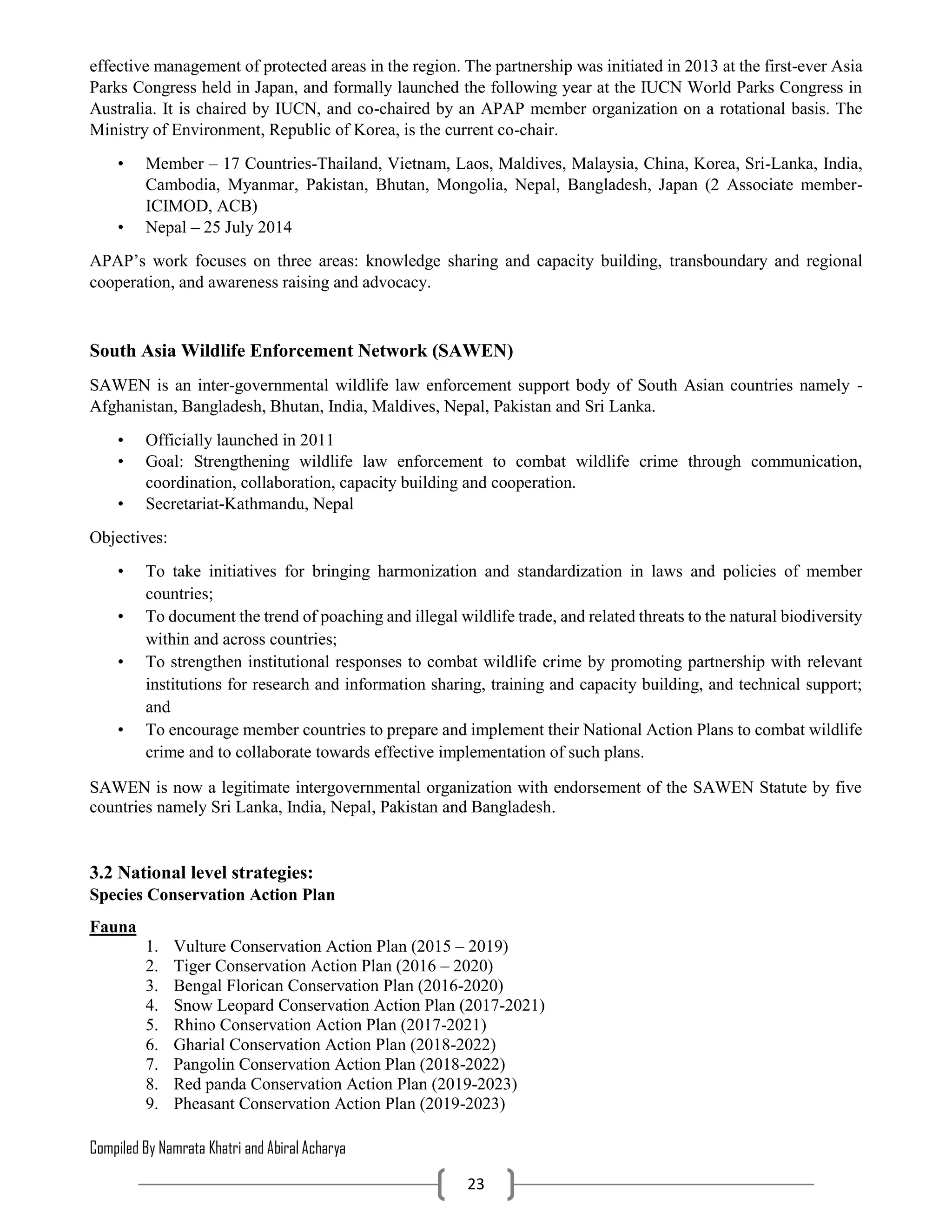
Convention on International Trade in Endangered Species of Wild Fauna and Flora (CITES)
• 1973 – effective from 1 July 1975, Nepal – 1975
• is an international agreement between governments.
• aim is to ensure that international trade in specimens of wild animals and plants does not threaten their survival.
• Articles -25 and appendix – 3
• State parties – 183
Compiled By Namrata Khatri and Abiral Acharya
21
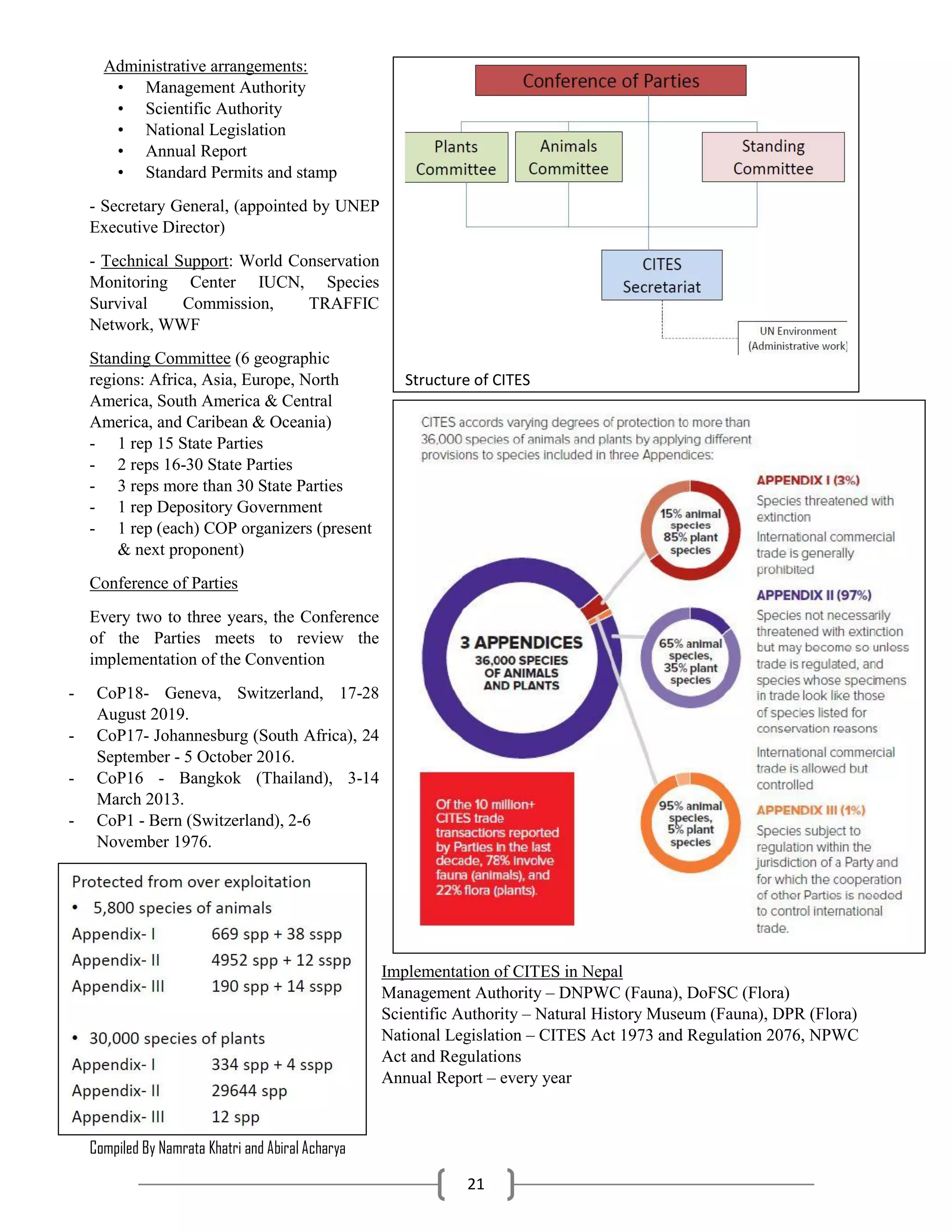
Administrative arrangements:
• Management Authority
• Scientific Authority
• National Legislation
• Annual Report
• Standard Permits and stamp
- Secretary General, (appointed by UNEP
Executive Director)
- Technical Support: World Conservation
Monitoring Center IUCN, Species
Survival Commission, TRAFFIC
Network, WWF
Standing Committee (6 geographic
regions: Africa, Asia, Europe, North
America, South America & Central
America, and Caribean & Oceania)
- 1 rep 15 State Parties
- 2 reps 16-30 State Parties
- 3 reps more than 30 State Parties
- 1 rep Depository Government
- 1 rep (each) COP organizers (present
& next proponent)
Conference of Parties
Every two to three years, the Conference
of the Parties meets to review the
implementation of the Convention
- CoP18- Geneva, Switzerland, 17-28
August 2019.
- CoP17- Johannesburg (South Africa), 24
September - 5 October 2016.
- CoP16 - Bangkok (Thailand), 3-14
March 2013.
- CoP1 - Bern (Switzerland), 2-6
November 1976.
Implementation of CITES in Nepal
Management Authority – DNPWC (Fauna), DoFSC (Flora)
Scientific Authority – Natural History Museum (Fauna), DPR (Flora)
National Legislation – CITES Act 1973 and Regulation 2076, NPWC
Act and Regulations
Annual Report – every year
Structure of CITES
Compiled By Namrata Khatri and Abiral Acharya
22
CITES MIKE: Monitoring the Illegal Killing of Elephants
The overall goal of MIKE is to provide information needed for elephant range States to make appropriate
management and enforcement decisions, and to build institutional capacity within the range States for the long-
term management of their elephant populations.
The MIKE programme operates in some 60 sites in 30 range states of the African elephant and in 27 sites in 13
range states of the Asian elephant.
CITESMIKE Programme – ShNP, BNP, BaNP, Nepal
GTF (Global Tiger Forum)
• Forum be set up to embark on a worldwide campaign to save the wild tiger.
• Initiated in 1993 and formalized in 1994
• Secretariat at New Delhi, India
• Nepal- 22 July 2002
• Tiger Range Countries, viz – Bangladesh, Bhutan, Cambodia, China, India, Indonesia, Laos, Malaysia,
Myanmar, Nepal, Russia, Thailand, Vietnam.
• Forum bodies
– General Assembly (every 3 years)
– Executive Committee
Five Categories of GTF membership
• Category A : Tiger range countries
• Category B : Non tiger range countries
• Category C : International NGOs and Inter-Governmental Organisations
• Category D : Honorary individual members
• Category E : National NGOs
Executive Committee
• four members from Category A,
• two members from Category B and
• One member from Category C.
•
Global Tiger Initiative (GTI)
• An alliance of governments, international agencies, civil society, and the private sector united to save
the wild tigers from extinction.
• Launched in 2008 by founding partners the World Bank, GEF, Smithsonian Institution, Save the Tiger
Fund, International Tiger Coalition.
• Work – protecting habitat, fighting wildlife crime, building capacity, reducing demand (tiger parts),
engaging community
Asia Protected Area Partnership (APAP)
APAP is an informal network of government protected area agencies from Asia working at national or sub-national
level. APAP has been designed as a key platform to help governments and other stakeholders collaborate for more
Compiled By Namrata Khatri and Abiral Acharya
23
effective management of protected areas in the region. The partnership was initiated in 2013 at the first-ever Asia
Parks Congress held in Japan, and formally launched the following year at the IUCN World Parks Congress in
Australia. It is chaired by IUCN, and co-chaired by an APAP member organization on a rotational basis. The
Ministry of Environment, Republic of Korea, is the current co-chair.
• Member – 17 Countries-Thailand, Vietnam, Laos, Maldives, Malaysia, China, Korea, Sri-Lanka, India,
Cambodia, Myanmar, Pakistan, Bhutan, Mongolia, Nepal, Bangladesh, Japan (2 Associate member-
ICIMOD, ACB)
• Nepal – 25 July 2014
APAP’s work focuses on three areas: knowledge sharing and capacity building, transboundary and regional
cooperation, and awareness raising and advocacy.
South Asia Wildlife Enforcement Network (SAWEN)
SAWEN is an inter-governmental wildlife law enforcement support body of South Asian countries namely -
Afghanistan, Bangladesh, Bhutan, India, Maldives, Nepal, Pakistan and Sri Lanka.
• Officially launched in 2011
• Goal: Strengthening wildlife law enforcement to combat wildlife crime through communication,
coordination, collaboration, capacity building and cooperation.
• Secretariat-Kathmandu, Nepal
Objectives:
• To take initiatives for bringing harmonization and standardization in laws and policies of member
countries;
• To document the trend of poaching and illegal wildlife trade, and related threats to the natural biodiversity
within and across countries;
• To strengthen institutional responses to combat wildlife crime by promoting partnership with relevant
institutions for research and information sharing, training and capacity building, and technical support;
and
• To encourage member countries to prepare and implement their National Action Plans to combat wildlife
crime and to collaborate towards effective implementation of such plans.
SAWEN is now a legitimate intergovernmental organization with endorsement of the SAWEN Statute by five
countries namely Sri Lanka, India, Nepal, Pakistan and Bangladesh.
3.2 National level strategies:
Species Conservation Action Plan
Fauna
1. Vulture Conservation Action Plan (2015 – 2019)
2. Tiger Conservation Action Plan (2016 – 2020)
3. Bengal Florican Conservation Plan (2016-2020)
4. Snow Leopard Conservation Action Plan (2017-2021)
5. Rhino Conservation Action Plan (2017-2021)
6. Gharial Conservation Action Plan (2018-2022)
7. Pangolin Conservation Action Plan (2018-2022)
8. Red panda Conservation Action Plan (2019-2023)
9. Pheasant Conservation Action Plan (2019-2023)
Compiled By Namrata Khatri and Abiral Acharya
24
Flora
1. Bijaysal Conservation Action Plan (2018-2022)
2. Gurans Conservation Action Plan (2018-2022)
Process initiated:
• Fauna: Arna, Bear, Dolphin, Sarus, Musk deer
• Flora: Satisal, Rudraksha, Okhar
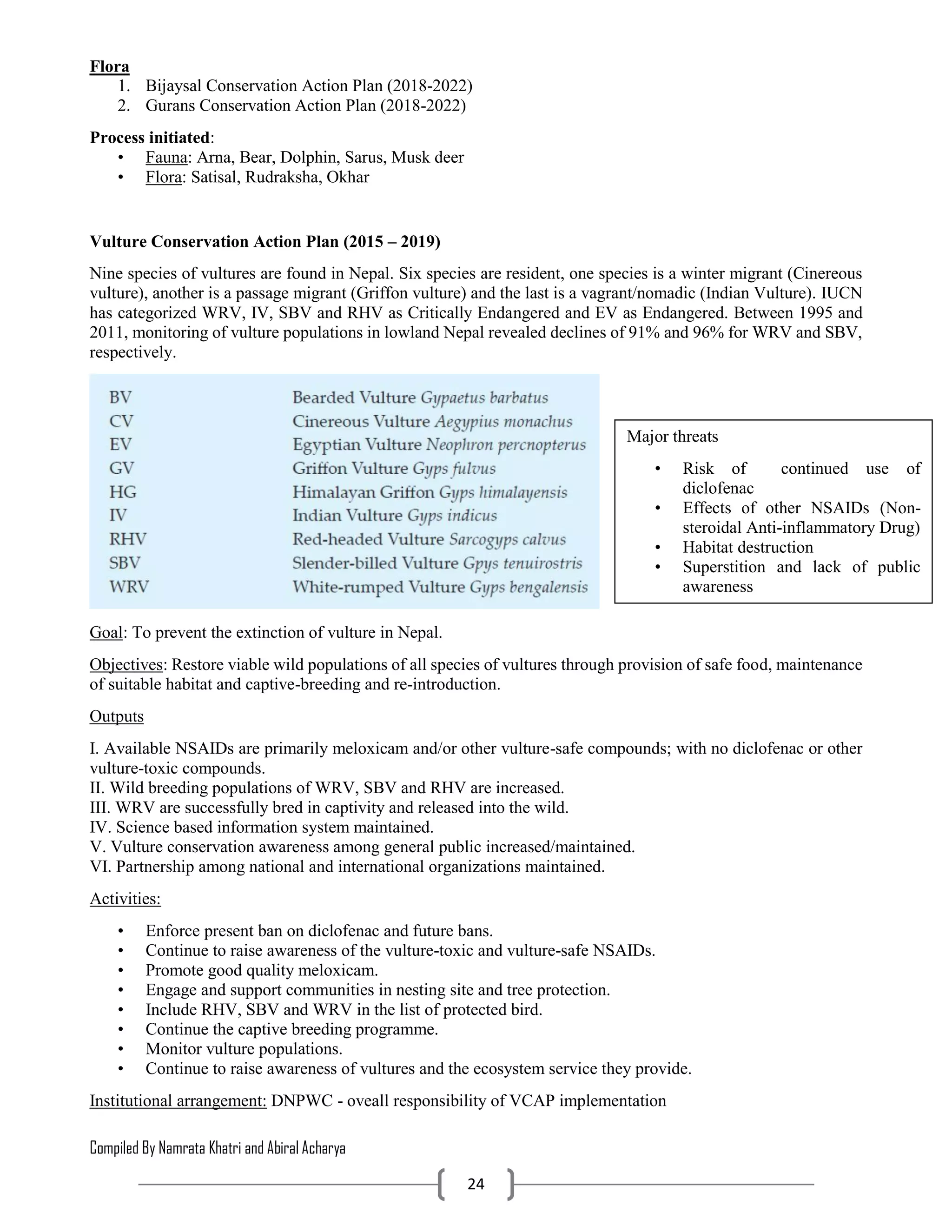
Vulture Conservation Action Plan (2015 – 2019)
Nine species of vultures are found in Nepal. Six species are resident, one species is a winter migrant (Cinereous
vulture), another is a passage migrant (Griffon vulture) and the last is a vagrant/nomadic (Indian Vulture). IUCN
has categorized WRV, IV, SBV and RHV as Critically Endangered and EV as Endangered. Between 1995 and
2011, monitoring of vulture populations in lowland Nepal revealed declines of 91% and 96% for WRV and SBV,
respectively.
Goal: To prevent the extinction of vulture in Nepal.
Objectives: Restore viable wild populations of all species of vultures through provision of safe food, maintenance
of suitable habitat and captive-breeding and re-introduction.
Outputs
I. Available NSAIDs are primarily meloxicam and/or other vulture-safe compounds; with no diclofenac or other
vulture-toxic compounds.
II. Wild breeding populations of WRV, SBV and RHV are increased.
III. WRV are successfully bred in captivity and released into the wild.
IV. Science based information system maintained.
V. Vulture conservation awareness among general public increased/maintained.
VI. Partnership among national and international organizations maintained.
Activities:
• Enforce present ban on diclofenac and future bans.
• Continue to raise awareness of the vulture-toxic and vulture-safe NSAIDs.
• Promote good quality meloxicam.
• Engage and support communities in nesting site and tree protection.
• Include RHV, SBV and WRV in the list of protected bird.
• Continue the captive breeding programme.
• Monitor vulture populations.
• Continue to raise awareness of vultures and the ecosystem service they provide.
Institutional arrangement: DNPWC - oveall responsibility of VCAP implementation
Major threats
• Risk of continued use of
diclofenac
• Effects of other NSAIDs (Non-
steroidal Anti-inflammatory Drug)
• Habitat destruction
• Superstition and lack of public
awareness
Compiled By Namrata Khatri and Abiral Acharya
25
• Central level – National Vulture recovery committee
• Mid-level – Vulture Conservation Core Team
• Local level – Project implementation committee
• Proposed Budget – NRs. 11,11,26,000 (for five years) – at least 5 % from government
• Monitoring and evaluation – DNPWC
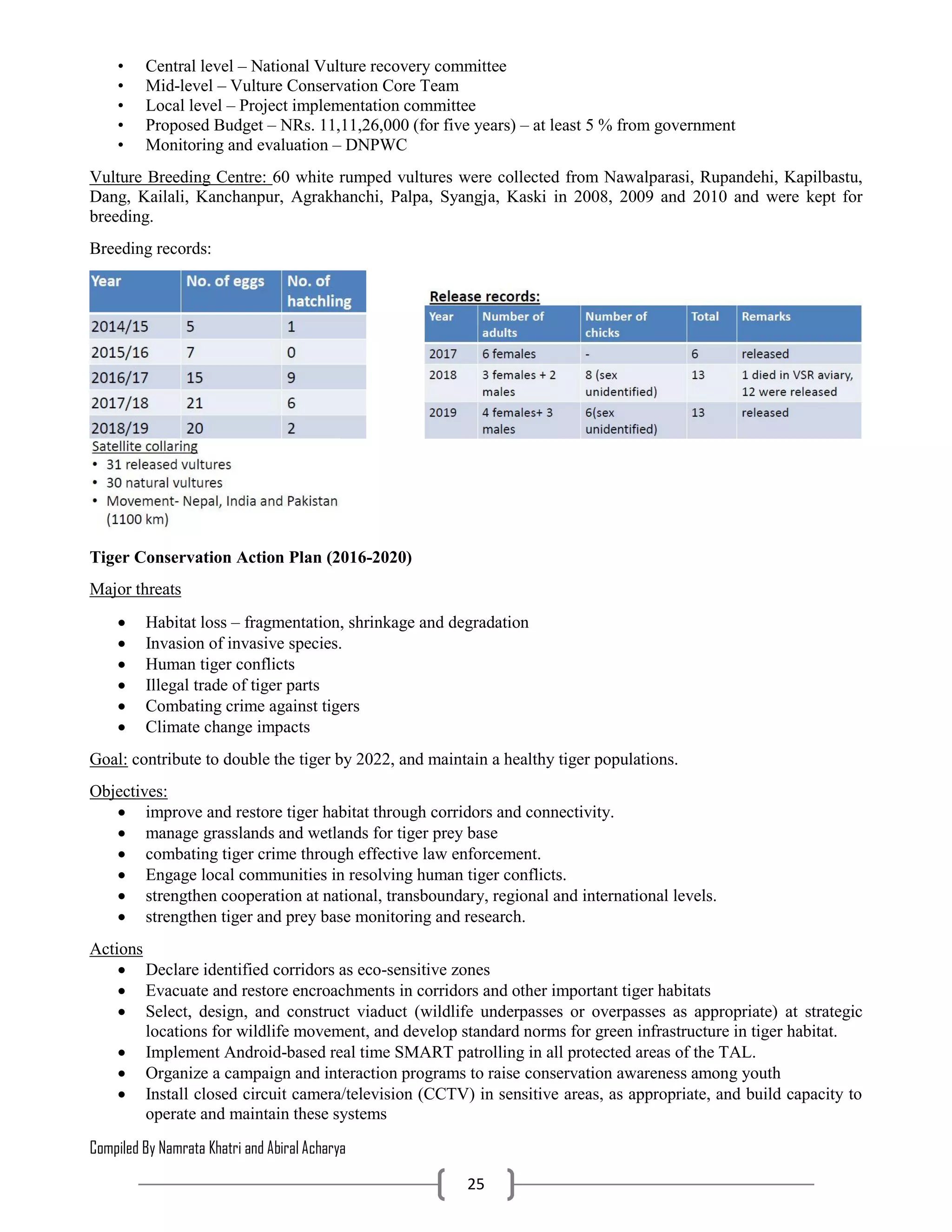
Vulture Breeding Centre: 60 white rumped vultures were collected from Nawalparasi, Rupandehi, Kapilbastu,
Dang, Kailali, Kanchanpur, Agrakhanchi, Palpa, Syangja, Kaski in 2008, 2009 and 2010 and were kept for
breeding.
Breeding records:
Tiger Conservation Action Plan (2016-2020)
Major threats
 Habitat loss – fragmentation, shrinkage and degradation
 Invasion of invasive species.
 Human tiger conflicts
 Illegal trade of tiger parts
 Combating crime against tigers
 Climate change impacts
Goal: contribute to double the tiger by 2022, and maintain a healthy tiger populations.
Objectives:
 improve and restore tiger habitat through corridors and connectivity.
 manage grasslands and wetlands for tiger prey base
 combating tiger crime through effective law enforcement.
 Engage local communities in resolving human tiger conflicts.
 strengthen cooperation at national, transboundary, regional and international levels.
 strengthen tiger and prey base monitoring and research.
Actions
 Declare identified corridors as eco-sensitive zones
 Evacuate and restore encroachments in corridors and other important tiger habitats
 Select, design, and construct viaduct (wildlife underpasses or overpasses as appropriate) at strategic
locations for wildlife movement, and develop standard norms for green infrastructure in tiger habitat.
 Implement Android-based real time SMART patrolling in all protected areas of the TAL.
 Organize a campaign and interaction programs to raise conservation awareness among youth
 Install closed circuit camera/television (CCTV) in sensitive areas, as appropriate, and build capacity to
operate and maintain these systems
Compiled By Namrata Khatri and Abiral Acharya
26
 Revise wildlife relief guidelines
 Establish research stations at Chitwan-Parsa Complex, Banke-Bardia Complex and Kailali-Kanchanpur
Complex
 Continue upgrading forensic capacity at national level
 Undertake research on invasive species control
 Institutional arrangement for implementation - DNPWC, DoF and conservation partners
 Proposed Budget: NRs. 405,475,000.
 Monitoring and Evaluation – DNPWC and DoF
Bengal Florican Conservation Action Plan (2016 -2020)
The Bengal Florican - a grassland dependent bird listed as critically endangered by the IUCN and protected birds
by laws in Nepal. Historically it occurred throughout the Terai grassland, one of the most threatened ecosystems
in the Indian subcontinent. In Nepal, it is recorded in SWR, BNP, CNP, KTWR and Koshi barrage area with a
combined total of fewer than 100 individuals.
Major threats
 Grassland Habitat Loss, Degradation and Isolation
 Lack of Protection in non-breeding areas
 Overgrazing and disturbance
 Invasive alien species and natural predators
Goal: To ensure the Bengal Florican and its habitat are fully protected and its national status is improved.
Objectives: maintain viable populations of Bengal Florican through increasing the area of high quality habitat,
and gain a better understanding of its ecology and reduce threats.
Outputs
1. Traditional breeding and non-breeding sites and habitat are restored and managed
2. Science based knowledge on Bengal Florican is increased
3. Bengal Florican conservation awareness among community members and other key stakeholders increased
4. Partnership among national and international organizations established and maintained
Activities
- Develop appropriate protocols for grassland management within PAs and outside PAs.
- Manage habitat in previously known sites for Bengal Florican.
- Continue tracking of satellite fitted birds at CNP and other sites.
- Conduct regular survey of Bengal Florican
- Conduct conservation campaign for local communities, tourist guides and lodge owners.
- Continue co-operation over research work with all relevant organizations.
Proposed Budget - NRs 50,000,000 (for five years)
Institutional arrangement - DNPWC will take a lead role in overall implementation of the BFCAP.
Bengal florican conservation expert group at central level.
Monitoring and Evaluation – DNPWC will be responsible for M & E.
Snow Leopard Conservation Action Plan (2017-2021)
The snow leopard (Panthera uncia) is an elusive native cat of the high mountains of Central and South Asia. They
are found in 12 countries (Afghanistan, Bhutan, China, India, Kazakhstan, Kyrgyzstan, Mongolia, Nepal,
Pakistan, Russia, Tajikistan, Uzbekistan). The species is an indicator of healthy high mountain ecosystems.
• Population in Nepal – 301-400 (2009)
Threats
Compiled By Namrata Khatri and Abiral Acharya
27
Persisting threats
–Loss of prey
–habitat loss and degradation
–wildlife crime
–human snow leopard conflict
Emerging threats
–adverse impact of climate change
–rapid development of illegal wildlife market centers
–unplanned infrastructure development
Goal: Maintain viable populations in each of the three snow leopard landscapes in Nepal.
Objectives
• Enhancing Knowledge on Snow Leopard’s Ecology, their Prey and Habitats through Research and Monitoring
• Improving Habitats and Corridors
• Mitigating Human-Snow Leopard Conflict through Community Engagement
• Reducing Wildlife Crime on Snow Leopard and their Prey through Effective Law Enforcement
• Strengthening Transboundary, Regional and International Cooperation and Support
Actions
•Estimate nation-wide snow leopard population using cutting-edge technologies and best available science.
•Research on snow leopard use of habitats with respect to climatic and anthropogenic disturbances
•Initiate study to identify critical corridors and key areas used by snow leopards.
•Identify, inventory and map different types of habitat (rangelands, forets, wetlands etc.).
•Identify important Snow leopard habitats with respect to climate and human-caused stressors.
•Assess status of, and maintain wetlands.
•Identify, inventory and map different types of habitat (rangelands, forests, wetlands etc).
•Identify important snow leopard habitats with respect to climate and human-caused stressors.
•Assess status of, and maintain wetlands.
•Promote citizen scientists and build capacity to undertake snow leopard and prey study and other conservation
initiatives.
•Capacitate herders in managing livestock more effectively and reward best practices.
Proposed Budget- 346,500,000 NPR (3.15 million USD) for its implementation.
The Greater One-horned Rhinoceros Conservation Action Plan (2017-2021)
Only five species of rhinoceros are surviving in the world of which three species namely - the greater one-horned
rhinoceros (Rhinoceros unicornis), Javan rhinoceros (Rhinoceros sondaicus) and Sumatran rhinoceros
(Dicerorhinus sumatrensis) are confined in Asia and two species namely - the black rhinoceros (Diceros bicornis)
and white rhinoceros (Ceratotherium simum) in African continent.
The greater one-horned rhinoceros (Rhinoceros unicornis) are found only in Nepal and India. A total of 645 (CNP-
605, BNP -29, ShNP-8, PNP-3) are in Nepal.
Threats:
• Poaching and Illegal Trade in Rhino Horns
• Habitat Loss, Fragmentation and Degradation
• Infrastructure Development
• Human-Rhinoceros Conflict
• Climate Change/natural Disasters
• Small Populations
Goal: three viable populations of rhinoceros managed and maintained in Nepal.
Objectives
• Strengthen national and local institutional capacity to curb poaching and illegal trade of rhinoceros
• Minimize habitat loss, degradation and fragmentation
• Manage human rhinoceros conflict through community engagements
Compiled By Namrata Khatri and Abiral Acharya
28
• Policy advocacy to safeguard prime rhinoceros habitats from large infrastructure development and urbanization
• Strengthen support and cooperation for rhinoceros conservation at national and international level
• Enhance research, monitoring and documentation
• Manage rhinoceros populations in a meta-population approach
Actions
• Grassland management focused to rhinoceros
• Construction and maintenance of waterholes
• Protection of rhinoceros and their habitat in priority areas outside PAs
• Establishment of wildlife forensic and genetic lab to strengthen crime investigation
• Capacity building-training and exposure visit
• Support rhino affected families for education and livelihood
• Educate locals on rhinoceros behavior to avoid the risks of possible confrontation
• Develop national standards for wildlife friendly infrastructures
• Engage academic institutions in rhinoceros research and monitoring
Proposed Budget- NPR. 646,150,000
Gharial Conservation Action Plan (2018-2022)
The Gharial (Gavialis gangeticus) is the sole member of the family Gavialidae and is listed as a “Critically
Endangered” species in IUCN Red Data Book, 2007. Gharial is an indicator species of healthy freshwater
ecosystems. It is only found in India and Nepal (possibly extinct from Bangladesh, Bhutan, Myanmar and
Pakistan). Breeding program was initiated in Chitwan National Park (CNP) in the year 1978. Total of 1246
Gharials have been released till 2017 to different River systems of Nepal. There are 84 Gharials in Narayani River,
82 Rapti River, 31 in Babai and 1 in Karnali River, totaling 198 Gharials in Nepal.
Threats
• Habitat loss and degradation - Dams and barrages, intensive mining of sand and gravel, floods and
pollution, encroachment of sand banks
• Prey Depletion and Incidental Killing of Gharials
• Climate Induced Impact
Goal-maintain and manage viable population of Gharial in Nepal
Objectives
• Enhance scientific knowledge through research on Gharial, its prey base and habitat
• Strengthen in-situ conservation of Gharials by reducing anthropogenic pressures
• Maintain ex-situ conservation to secure future breeding stock and systematize reintroduction of the Gharials
Actions
• Prepare standard monitoring Protocol for Gharial Conservation in Nepal.
• Conduct nationwide periodic survey of Gharial.
• Conduct research on Gharial ecology, behavior, movement, habitat dynamics, and prey-predator
relationship using new technology such as satellite transmitters, genetic studies.
• Prepare and implement site specific River conservation plan for managing Gharials and its habitat
• Facilitate to declare “No-Go Zones” / Restricted zone for all the critical stretches of Rivers
• Regulate fishing, mining and other activities (tourism) in the designated “Utility Areas”
• Conduct joint monitoring of Gharials in trans-border River system of Nepal and India.
• Strengthen laboratory facilities equipped with artificial incubator and other accessories in breeding centers
and deploy required technicians
• Conduct post monitoring of the released Gharials
• Maintain sanitation of pools, regular water flow with proper inlet and outlet at GCBC
• Engage community based organizations to monitor Gharial, its nests /eggs and habitat
• Awareness program
Budget-NPR 147,885,505.
Compiled By Namrata Khatri and Abiral Acharya
29
Pangolin Conservation Action Plan (2018-2022)
Two species of pangolins i.e. Chinese Pangolin (Manis pentadactyla) and Indian Pangolin (M. crassicaudata)
occur in Nepal. Distribution of Chinese Pangolin in 25 districts and Indian Pangolin in 7 districts of Nepal.
Major threats and challenges
• poaching and illegal trade for skins, scales, and meat;
• Habitat loss, degradation, shrinkage and fragmentation
• Climate Change Impacts
• low conservation priority and poor knowledge on the species
Goal - secure pangolin populations from emerging threats so that the species can be recovered in the wild
Objectives
• Enhance understanding and knowledge on conservation status, ecology and habitat dynamics of
pangolins.
• Curb poaching and control illegal trade of pangolins.
• Identify and manage the habitat for pangolins conservation.
• Develop local stewardship for conservation of pangolins
Actions
• Prepare standard monitoring Protocol for Pangolin Conservation in Nepal
• Conduct training on pangolin habitat and population monitoring techniques
• Design and conduct scientific studies on population status, distribution, space use, behavior and habitat
requirement of pangolins in potential and priority areas
• Conduct periodic nation-wide occupancy surveys focusing on pangolin distribution
• Conduct awareness campaigns
• Conduct capacity building program
• Identify critical pangolin habitat and map the priority sites
• Control human and livestock pressure in pangolin habitats
• Engage communities to restore and manage forests, open areas and wetlands in potential habitats
• Protect available termite mound to the extent possible
• Design and develop community-based ecotourism plans for key pangolin conservation sites
Proposed budget - NPR 111,650,000
Red Panda Conservation Action Plan (2019-2023)
The national red panda survey 2016 documented the potential red panda habitat available across 23,977 km2,
out of which, almost 70% of the total habitat lies outside the PAs network. The national population size of red
panda has been estimated to be 317-582 individuals.
Threats
• Habitat loss and degradation
• Poaching and illegal trade
• Small and isolated populations
• Pathogen and zoonotic diseases
• Infrastructure development
• Inadequate awareness
• Climate change
Goal: Red panda populations protected and managed in Nepal
Objectives
• Enhance understanding and knowledge on conservation status, ecology and habitat dynamics of red
panda
• Curb poaching and illicit trade of red panda.
Compiled By Namrata Khatri and Abiral Acharya
30
• Protect and manage the red panda habitats.
• Strengthen and extend community based red panda conservation initiative
• Strengthen cooperation and coordination on red panda conservation at national and International level
Actions
• Carry out the studies on red panda occupancy, population status, distribution and habitat suitability.
• Conduct regular monitoring of red panda in identified important areas.
• Conduct researches on poaching and illicit trade of red panda.
• Conduct awareness campaigns on red panda, anti-poaching and conservation laws.
• Identify bottle necks, hotspots, priority areas and site-specific conservation threats.
• Prepare site-specific management plan for identified priority areas.
• Evaluate effectiveness of ongoing community based conservation program.
• Sensitize and aware local forest users/herders, school children and other stakeholders.
• Establish information/resource centre in support of CFUGs.
• Organize transboundary meetings at local and national levels.
• Organize sharing meeting at local, state and federation levels.
Implementing Agency: DNPWC and DoFSC
Proposed budget: NPR 303,050,000
Pheasant Conservation Action Plan (2019-2023)
Threats
• Habitat loss, degradation and fragmentation
• Illegal hunting, trade and nest picking
• Anthropogenic disturbance: forest fire, NTFPs harvesting, livestock grazing, Tourism, stray dogs,
• Climate change and disaster
• Genetic depression
Goal: Populations of all the species of pheasant increased and their habitats protected
Objectives
• Enhance Knowledge on the Ecology and Threats to Pheasant Species
• Implement Conservation Initiatives to Reduce Threats to Pheasant and their Habitat
• Explore the Possibility of Local Livelihood Enhancement
• Enhance Partnership and Capacity
Compiled By Namrata Khatri and Abiral Acharya
31
Actions
• Assess distribution, status and threats of all pheasant species.
• Conduct species distribution modelling of all pheasant species.
• Identify priority sites for all pheasant species
• Manage the quality of degraded grassland and forest habitats.
• Control forest fires and overgrazing.
• Monitor the trend of land use change and development practices and advocate sustainable practices.
• Coordinate with law enforcement agencies to discourage poaching and illegal trade.
• Organize forest fire control training for PA staff, CF, BZCF members.
• Provide sustainable NTFP harvesting training for PA staff, DFO staff, CF, BZCF members.
• Conduct regular coordination meetings between stakeholders (Federal, Provincial and Local) on
pheasant conservation issues.
Implementing agencies: DNPWC, DoFSC
Financial plan: NPR 73,850,000
Monitoring of the implementation plan: DNPWC, DoFSC, PAs and DFOs
Site Specific Conservation Action Plan for Blackbuck
28 Blackbucks were re-introduced in Hirapur phanta from Central Zoo & Nepalgunj zoo 2012 to establish
second population in an area of 37 ha.
National Biodiversity Strategy and Action Plan (NBSAP) 2014-2020
• Prepared and implemented NBS in 2002 and NBSIP in 2006.
• Useful experience and lessons have been learnt from the implementation of the strategy and the plan
• Substantial changes have taken place in the socio-political and environmental contexts of the country
over the last decade.Several new themes and issues have emerged or gained prominence since 2002.In
light of these changes, GoN/MoFSC has prepared this revised NBSAP.
The NBSAP provides a guiding framework for the management of Nepal’s biodiversity. It has been prepared to
meet the national needs for managing biodiversity on a sustainable basis for the benefit of present and future
generations, and also to fulfill the country’s international obligations. It has a long-term (i.e. 35 years) vision,
and includes specific short-term (up to 2020) strategies and priorities for action.
Salient features of NBSAP:
• Adoption of program based approach to management of biodiversity.
• Builds on and aims at consolidating the successful past efforts and achievements.
• Broad-based participation of stakeholders in its development.
• Comprehensive and balanced in terms of thematic and sectoral coverage.
• Provides a clear analytical account of the past efforts, achievements and gaps.
• Gives due considerations to gender and social inclusion and emerging issues, such as Indigenous and
local communities, climate change and invasive alien species.
Compiled By Namrata Khatri and Abiral Acharya
32
• Thematic strategies and targets are directly linked to priority actions, and performance indicators. This
will make implementation of the strategies and monitoring of the progress easier.
• Includes strategies to minimize the current contentions and enhance complementarities between the
protected area and participatory approaches to biodiversity conservation.
• Identifies the current gaps in coverage and connectivity of existing protected area network and
recommends the ways to fill those gaps.
• Includes a plan and framework for managing biodiversity at the local level.
Vision -“conservation of biodiversity for sound and resilient ecosystems and national prosperity”.
Goal -to significantly enhance the integrity of Nepal’s ecological systems by 2020, thereby contributing to
human well-being and sustainable development of the country.
Strategy
The specific strategies and associated actions are grouped into the six biodiversity themes and 15 and cross-
cutting subjects.
Thematic strategy
• Management of Protected Areas
• Management of forest biodiversity outside PAs
• Management of Rangeland biodiversity
• Management of wetland biodiversity
• Management of agrobiodiversity
• Management of mountain biodiversity
Cross-sectoral strategy
• Addressing the Policy and Legislative Gaps
• Institutional Strengthening
• Mainstreaming Biodiversity across the
Government, Society and Economy
• Harmonization of Biodiversity related
International Conventions
• Enhancement of National Capacity for
Improved Management of Biodiversity
• Landscapes Management
• Management of Invasive Alien Species
• Integrating Gender and Social Inclusion
Perspectives
• Conservation of and Respect to
Traditional Knowledge, Innovations and
Practices of Indigenous and Local
Communities
• Knowledge Generation and
Management
• Technology Development, Acquisition
and Use
• Communication, Extension and
Outreach
• Fund Generation and Mobilization
• Monitoring, Evaluation and Reporting
• Adaptation to and Mitigation of the
Effects of Climate Change
• Cross-sectoral strategy
Institutional arrangement for implementation
Monitoring and Evaluation
Compiled By Namrata Khatri and Abiral Acharya
33
There are 51 strategies developed with 226 priority actions for an effective implementation of the NBSAP.
Similarly, 81 national targets and its indicators have been developed through participatory and consultative
process for monitoring and evaluation of the NBSAP (GoN-MoFSC 2014a) as well as implementation of the Aichi
Biodiversity Targets (ABT).
National Targets in NBSAB
• Conservation plans for 20 additional priority species (10 animals and 10 plants) developed and implemented by
2020.
• Plans for sustainable management of at least five grasslands and five wetlands inside protected area prepared and
implemented by 2020.
• “Overpass” and/or “underpass” built in at least three key locations (including one at the highway in Barandabhar
corridor) to allow free movement of wild animals across adjacent habitats, by 2020.
• By 2020, additional five wetlands of international importance enlisted as Ramsar sites.
• By 2020, conservation plans (in-situ and ex-situ) for at least 10 threatened and economically valuable native fish
and other aquatic species developed and implemented.
• At least 50 percent of the production forests come under sustainable management by 2020.
• At least 10 percent of the remaining government managed forests come under community based management by
2020.
• The rate of forest loss and degradation reduced by at least 75 percent of the current rate by 2020.
• At least 10,000 ha of the encroached forestland reclaimed by 2020.
• The National REDD Strategy finalized and approved by 2016.
• Development, by 2015, and effective implementation of Chure conservation strategy
Implementation status of Nepal Biodiversity Strategy (2002)
NBS was partially successful in achieving its goal of providing a strategic planning framework for managing
biodiversity in the country. A subjective evaluation indicated that implementation of around 30 percent of the
NBS strategies related to the six thematic areas was 'very good', 30 percent 'good' and 41 percent 'poor'. Of the 17
cross-sectoral strategies, four were almost fully implemented and two were not implemented. Implementation
status of the rest of the strategies remained medium. Of the 13 priority projects planned by the NBSIP (2006),
three were successfully implemented, and four were partially implemented.
The successfully implemented projects include: (i) integrated wetlands management, (ii) landscape level
biodiversity conservation, and (iii) conservation and management of pollinators for sustainable agriculture through
ecosystem approach.
3.3 Critical analysis of Acts and Regulations related to environment, biodiversity, protected area
and forest of Nepal
Forest Act
• Forest act 2019 in a new federal set up
• Protected forests to Forest conservation area
• National forest: Inter-provincial forests and forest within province
• Forest land ownership – GoN
• Forest land not to be registered for personal use
• Strategic plan of national forest – GoN
• Province to manage national forest based on strategic plan
• Strategic plan of national forest within division – DFO (participatory manner)
• National forest project – GoN (Sagarnath)
• Forest conservation area = biological corridor by GoN
• CFOP – Forest use group in consultation with local Govt.
• CF area to be given to poor users for livelihood improvement
Compiled By Namrata Khatri and Abiral Acharya
34
• CF area remained CF always (FUG can be reformed)
• CFUG fund: 25% forest dev., mgmt. and cons., 50% of remaining – poverty reduction, women
empowerment and enterprise development
• ColF: DFO+local level+forest users; operation plan approved by forest director
• Forest products and benefits sharing – priority for internal consumption
• ColF Fund = same as CF
• LHF = Poor or commercial lease
• Agroforestry + medicinal plant plantation + wildlife farming
• Public land forestry – local Govt
• Urban forestry – local Govt.
• Landuse change in national forest – GoN
• Environmental services and FDF
• Armed Forest Guard
• Case hearing for upto 1 yr imprisonment and 200K punishment – DFO by GoN
• Investigation: investigation of cases upto one yr imprisonment – provincial officer specified in province
gazette , > one yr – officer from GoN
• Import and export points for forest products can be notified by GoN
• Inter-governmental coordination committee
NPWC Act
5th amendment
• Biological corridors and zoos/zoological garden
• Dept. to approve the management plan
• Deployment of security forces
• Compensation for wildlife damage
• Recognize and respect traditional practices
• Wildlife farming practices
• Establishment of rescue centre/wildlife hospital
• Cases filing: >I year
• Organized crime: Investigation period
• Reward system not in implementation
• 30-50% revenue sharing for buffer zone
program
• Green tribunal?
(Please refer other reference materials for this section!!)
Compiled By Namrata Khatri and Abiral Acharya
35
UNIT 4: WILDLIFE AND HABITAT MANAGEMENT (7)
4.1 Population management: Meta population, island biogeography, species recovery plans, Ex-
situ and in-situ conservation for example, translocation/reintroduction, wildlife farming,
measures to curb poaching (role of the army, community based anti-poaching operations, park-
based anti-poaching units, wildlife crime investigation)
Wildlife management, on the other hand, is the art of producing desired population of wild animals. In other
words, it is the art of making land produce valuable populations of wildlife. It involves direct population
management (census, control of harvest, in-situ and ex-situ conservation, etc.) and indirect management of
populations through habitat manipulation to favor or inhibit larger species. It is the management of wild animal
populations and their habitat and can involve total protection of wildlife for aesthetic and preservationist reasons
to wildlife utilization. History of wildlife management is very old, but the first textbook on game management
was published in 1933 by Aldo Leopold. However, wildlife management requires good planning with the
availability of adequate human, capital and time resources.
1. ISLAND BIOGEOGRAPHY THEORY
Ecologists Robert MacArthur of Princeton University and E.O. Wilson of Harvard developed a theory of "island
biogeography". Island biogeography theory is concerned with the distribution of plants and animals on island and
island like areas. Theory says, “the diversity on island is a function of species properties, viz; colonization and
extinction. The number of species is highly predictable and dependent on the size of the island and its relative
remoteness from colonizing sources. The number of species stabilizes when the rate of local extinction equals the
rate of new immigration. Extinction is the disappearance of a species in a community while immigration is the
appearance of a species in a community. Extinction is related to island size while the immigration depends on the
proximity and richness of the colonizer land mass.
For microbiota, the theory has been applied to the distribution of ectomycorrihzal fungi on trees, the distribution
of bacteria in water-filled treeholes, and the distribution of fungi among shrubs. While for flora and fauna, the
theory's predictions have been realized with the species richness of plants on mountain and with the species
richness of aquatic snails in bodies of water. MacArthur and Wilson's work has been used as a basis in other
ecological theories and has been foundational for the fields of landscape ecology, invasion biology,
and conservation biology.
i.e. SLN > SLF ~ SSN > SSF where L = large, S = small, N = near, F = far
Compiled By Namrata Khatri and Abiral Acharya
36
2. METAPOPULATION:
A set of local population linked together through dispersal. Or, Individuals live in separated clumps or demes (the
whole being a metapopulation). Or, a network of extinction-prone subpopulations occupying a mosaic of habitat
patches. Or, a network of semi-isolated populations with some level of regular or intermittent migration and gene
flow among them, in which individual population may go extinct but then be recolonized from other population.
Or, a model of population structures whereby each patch of habitat contains a different subpopulation of a species,
and a group of different patch population is collectively called meta-population. In meta-population, each sub
population inhabit identical patches and are unstable i.e. subject to random extinction and colonization. Individual
subpopulations may go extinct though the overall population persists because some sub populations are doing
well while others are performing poorly.
Metapopulation Theory
 Population of populations (Levins, 1970)
 Dynamics of sets of semi-independent populations connected by dispersal
 Spatial ecological theory
Metapopulation Persistence
 Colonization must be above critical threshold then average extinction rate of subpopulation in patches
 Extinction must be below a critical threshold than colonization rate
 So, corridors or other means of dispersal among patches is important
Types of Metapopulation structures
Compiled By Namrata Khatri and Abiral Acharya
37
The two theories (Island Biogeography and Metapopulation) are closely linked by the processes of colonization
and extinction. The fundamental difference between the two is that Island Biogeography Theory includes a
mainland source of colonists not threatened by extinction while Metapopulation Theory assumes the contrary:
there is no larger whole, only fragments (Hanski and Gilpin 1991, Quammen 1996).
3. SPECIES RECOVERY PLANS
Recovery plans contain details about the conservation of certain threatened species and are used to manage their
recovery. It outlines a specific species’ life history, its population and distribution, threats to survival – such as
habitat loss, fire, disease and predators and actions that can be taken to recover the species including the cost, time
frame and agency responsible for carrying out these actions. It help us safeguard the future survival of threatened
species. The documents are usually developed by the government authority and often include the cost estimate of
management actions for individual species. The government can also draft separate recovery plans for certain
species that are listed as threatened at a state level. In Nepal, forest and environment minister has the power to
determine whether a threatened animal, plant or ecological community should have a recovery plan. Recovery
program had been carried out for Rhinoceros, Wild Buffalo, Black buck, Swamp deer, Vulture, Tiger and gharial.
A case study of Gharial
Before 1960s, Gharials were abundant in the major river systems of Nepal. During early 1950s, about 235 gharials
occurred along the river between Narayanghat and Triveni. However, it was on the verge of extinction during
1970s due to loss of habitat, hunting and intensive fishing by nylon nets which causes gharial mortalities due to
entanglement and drowning. With the realization of the conservation of the Gharial Crocodile that were limited
to a number of less than 200 in 1970s both in Nepal and India, it was felt necessary to establish a conservation
and breeding centre. In 2006, 200 individuals in India and just 35 in Nepal and extinct in other countries (Whittaker
& member of GMTF 2007). Thus, gharial reintroduction program initiated in late 1970s in Nepal to restock
gharial population in the major river systems of the country and the Gharial Breeding Centre was established in
Kasara, Chitwan in 1978. If not, possibly gharials would have disappeared from Nepal long time ago. As per the
latest census of gharials in 2016, a total 198 gharials—166 in Chitwan National Park and 32 in Bardiya National
Park were found.
Why species recovery necessary?
The Species Restoration Project exists to restore ecosystems to their natural state through habitat restoration and
wildlife reintroduction. It is essential to collaborate with government organizations, zoos, universities, animal
rescue groups, private breeding programs, habitat restoration organizations and volunteer groups to accomplish
the goal of species reintroduction. This may include activities from coordinating the habitat restoration and
Compiled By Namrata Khatri and Abiral Acharya
38
wildlife introduction for a breeding program to providing funding for a post-doctoral student who can conduct
research in wildlife reintroduction techniques. It is equally important to provide the conservation community with
what is needed, which includes expertise in habitat restoration, wildlife reintroductions and genetic population
management, and monetary needs such as funding and volunteer recruitment.
Captive breeding and animal re-introduction programs have existed since the 1980’s, and several have shown
positive results. For instance, in 1982 only 23 wild California condors (vulture) remained. Due to a captive
breeding-reintroduction program at the San Diego Zoo, there are now 405 condors in the wild. But there are so
many endangered species needing similar boosts, zoos cannot do it all, and SRP’s exclusive dedication to carefully
planned re-introduction offers the best chances of giving these animals a new beginning. A problem of this
magnitude requires cooperation and collaboration between many disciplines.
4. EXSITU AND INSITU CONSERVATION
Conservation is the management for the benefit of all life including human-kind of the biosphere so that it may
yield sustainable benefit to the present generation while maintaining its potential to meet the need and aspiration
of future generations. There are two types of conservation:
 Ex-situ conservation: Ex-situ conservation involves maintenance and breeding of endangered plants and animal
species under partially or wholly controlled conditions in zoos, gardens, nurseries and laboratories. Today captive
breeding and maintenance of wild animals and plants have become a very important method of conservation,
some of the characteristic and important life forms. Eg. in Nepal: Central zoo, gharial breeding centre, elephant
breeding centre, vulture breeding centre, etc.
 In-situ conservation: In-situ conservation involves conservation of species in its natural habitat- in places where
the species normally occurs (e.g. NP, WR). It is a cheap and convenient way of conserving biological diversity
but it requires large areas of earth’s surface if we have to preserve the full complement of biotic diversity of a
region.
 Reintroduction/ Translocation
1. Introduction:
Simply introduction of species into wild, generally, outside its range but into suitable habitat.
ConservationDesign Introduction: An attempt to establish a species for the purpose of conservation outside its
recorded distribution but within an appropriate habitat and eco-geographical area. This is a feasible conservation
tool when there is no remaining area left within a species historic range.
Introduction may be useful in stocking new or artificially altered habitats for example where dams or irrigation
projects have created new lakes or swamps.
2. Reintroduction:
Reintroduction is defined as an attempt to establish a species in an area which was once part of its historic
range but from which it has been extracted or become extinct. Reestablishment is a synonym but implies
that the reintroduction has been successful. Simply it is an introduction of species back into the wild area
that has been used by the species previously.
3. Translocation:
Translocation is defined as the deliberate movement of individuals to an existing population of conspecifics.
It is a deliberate and mediated movement of wild individuals or populations from one part of the range to
another. Reinforcement Supplementation is the addition of individuals to an existing population.
Translocation is considered in 3 main circumstances, first, where land development is about to destroy
wildlife habitat and translocation is seen as a possible way, secondly, where a wild population is not faring
well and the manager wishes to boost its numbers and thirdly, where a manager decides to split a population
to reduce the risk of losing the entire population.
Aims and objectives of Reintroduction:
Compiled By Namrata Khatri and Abiral Acharya
39
The principle aim of any reintroduction should be to establish a viable free ranging population in the wild, of a
species, which has become locally or globally extinct or extricated in the wild. It should be reintroduced within
the species former natural habitat or range.
The objective of a reintroduction may include enhancing the long term survival of a species to re-establish a key
stone species (in an ecological or cultural sense) in an ecosystem, maintain and /or restore biodiversity, to provide
long term economic benefits to the local and/ or national economy to promote conservation awareness, or a
combination of these.
Why Introduction, reintroduction and translocations?
 Habitat of the species is going to be destroyed (by disease or parasites or other causes).
 Population is not growing well.
 Minimize risk of poaching.
 Establish second viable population.
 For reducing the probable risk of losing entire population (population split is best option, e.g. Rhino from
CNP to BNP and ShNP)
A. Pre project activities of the introduction:
Biological requirements
 Feasibility studies
 Background history
 Previous reintroduction
 Choice of release site type
 Availability of suitable stock
Socio-economic requirements:
 Financial commitments
 Socio-economic impacts
 Accepted support by local people
Legal requirements:
 Decision from government
B. Planning, Preparation and release stage:
 Resources collection and mobilization
 Captureless social destruction, whole social unit can be caught
 Examination-quarantine
 Transportation-appropriate design and care
 Release-intact site, where the resident population is low, provisioning too if needed
C. Post release stage:
 Monitoring
 Studies
 Record and analysis of mortality
 Intervention (supplementary feeding, veterinary aid etc.)
 Habitat
 Public
 Publication and literature
Successful criteria for reintroduction:
 Choose common and less sensitive animals
 Better habitat quality
 Release into core area
 Herbivores than Carnivores/omnivores
Compiled By Namrata Khatri and Abiral Acharya
40
 Early breeders with large clutches
 Wild caught animals than captive bred
 Scarcity of competitors
 More individuals
CASE STUDIES
1. Rhino Translocation
Why do we translocate rhinos?
 Population increasing (minimize human wildlife conflict) –over 600 individuals in CNP
 Minimize risk of poaching
 Establish second viable population and initiate third population of rhino in Nepal
 Distribute tourism in addition to Bardia National Park and Sukhlaphanta National Park
Steps of rhino translocation
Phase1: Data collection: each sighting of the Rhino the following data were recorded.
 Date and time
 GPS location
 Standardized age class (adult, sub-adult or calf)
 Sex (male, female or unidentified sex)
 Habitat type (tall grassland, short grassland, Sal forest, riverine forest, wetland, other)
 Distinct rhino identification features (ears and horn, body and tail features)
 Body condition (good, average, poor)
 Group composition
 Activity (resting, wallowing, feeding, moving)
Phase 2: Preparation & planning
 Resources
 Site selection–capture and release
 Team formation–technical and logistic team
 Equipment–darting
 Human resources
 Logistics–elephants, drugs, darting equipment
 Accessories–water, cotton cloth and first aid kits
Phase 3: Capturing
 Search for suitable individual (using over 50 elephants)
 Darting of suitable individual
 Drugs: Etorphine Hydrochloride, an opium derivative, commercially known as M99 mixed with
Acepromazine used to tranquilize rhinoceros.
The quantity ranges from 1.25-1.75 ml
Approx. 10 minutes.
 Capturing and checking up
 Radio collar for future monitoring
 Capturing, checking up and loading in a truck
Phase 4: Transporting and releasing:
 Transport in a truck during the night time
 Release
 Monitoring
Compiled By Namrata Khatri and Abiral Acharya
41
Outcomes / Impacts of rhino translocation
 100 rhinos have been translocated
 Second viable population established with approx. 100 individuals in BNP
 Initiated third population in Suklaphanta NP.
 Tourism increased in Bardia And Suklaphanta area
Rhino Population in Nepal (Rhino Census Report
2015)
Rhinos Translocated Till Date
Total: 645 From Chitwan National Park:
Chitwan: 605 To:
Bardia: 29 Bardia: 91
Sukhlaphanta: 8 Sukhlaphanta: 9
Parsa: 3 Total: 100
2. Gharial Breeding
Gharial Breeding Center was established in 1978 at Karasa, CNP for Conservation and Population Recovery of
Gharials (Gavialis gangeticus) in Nepal.
A total of 1,240gharials have been released into Rapti, Narayani, Kaligandaki, Spatakoshi, Karnali and Babai
rivers so far since 1981.
Gharial breeding center, Kasara
 Fostering
 Young mortality
 Hatchling percent
3. Black Buck
To establish a viable wild population of blackbuck, the Government of Nepal declared an area of 172 hectares as
the Blackbuck Conservation Area in 2009. Today conservation efforts have helped the blackbuck population to
increase to 293.
Management: provisioning, fencing, cereal crop cultivation, rare and endangered, translocation concept. Historic
range lies in Sukhlaphanta National Park also.
 Wildlife Farming: Wildlife farming might sound like a contradiction in terms, but it is the GoN’s new strategy
for conserving animal species, which are opened for farming, breeding and research of high value wildlife species
under the government's Wildlife Farming, Breeding and Research Policy 2003.
The protected species that are permitted for farming under the policy include: gharial (Gavialis gangeticus); black
buck (Antilope cervicapra); Nepal's national bird-Impeyan pheasant (Lophophorus impejanus); crimson horned
pheasant (Tragopan satyra); & cheer pheasant.
Under this policy, DNPWC would provide seed animals for farming and breeding purposes. The permission fee
ranges from 5,000 to 40,000 Nepali rupees (US$69 to $555) per animal depending on the species.
Private sector involvement and Public sector involvement (Pashupati and Godavari). Nepal government has
earned NRs 30 lakh revenue as taxes from farming of the wild animals. Government regulates, promotes and
facilitates proving required license and seed of the animal.
Points to be considered:
Net gain to the wild population- released into wild
Linkages – Cooperation
Develop a control system that reared is different than wild.
Avoid creating a legal loophole.
Compiled By Namrata Khatri and Abiral Acharya
42
Government of Nepal has endorsed working Policy on Wild Animal Farming, Breeding and Research in
2003 and the objective of that policy are:
Objective: to adopt process and programme in order to improve the living condition of the women, poor and
disadvantaged section of the society from biodiversity conservation by encouraging individuals, groups, and
institutions in farming and research of high value wild flora and fauna such as spotted deer, musk deer, sambar
deer, wild boar etc., and also to increase opportunities for employment and income through conservation,
enhancement and sustainable utilization of wildlife.
Policies were
1. Involvement of private sector in farming, breeding and carrying out scientific research and studies of
endangered and high-value wild animal species will be encouraged.
2. Rare and endangered, and species that are at the verge of extinction will be conserved in natural habitat (In-situ
conservation) and ex-situ conservation will also be promoted.
3. A policy will be adopted for gradually reducing the rural poverty by linking farming, breeding and scientific
research and studies with income and employment opportunities to the local people.
4. The role of government will be developed as a Regulator, Promoter and Facilitator rather than a Controller in
wild animal farming, breeding and scientific research and studies.
5. Appropriate legal and institutional framework will be developed to promote private sector participation in
farming, breeding and scientific research and study of endangered and other wild animal species while remaining
committed to regulate international trade on wildlife and plant species as well as to biodiversity conservation as
per the prevailing international laws.
6. Utmost attentions shall be given to the national interest and welfare in wild animal farming, breeding, scientific
research and study.
 Measures to curb poaching (role of the army, community based anti-poaching operations, park-based anti-
poaching units, wildlife crime investigation)
(Refer BSc Notes)
4.2 Habitat management: Landscape ecology (eco-region, biomes, biodiversity hotspots, corridor
and connectivity, habitat restoration plans, grazing and fire management, management of
rangeland, wetland, invasive species)
Habitat is the sum total of environmental factors: food, cover and water that a given wildlife species needs to
survive and reproduce in a given area. Habitat requirements of wildlife species vary from species to species. In
other words, Habitat is the combination of food resources, environmental variables, that promotes occupancy by
individual of a given species allows them to survive and reproduce.
Habitat Types
Halo biotic (Salt water)- aquatic
Limno biotic (Fresh water)- aquatic
Geo biotic- terrestrial
Habitat Management
The art and science of creating, maintaining or enhancing conditions on landscapes to meet specified objective
for population of wildlife. The stability, increase or decline of wildlife species or population depends directly on
the quality and extent of available habitat. Some of the key issues of habitat management are:
 Habitat related: fragmentation, degradation, forest fire, grazing
 Management related: poaching, man-animal conflict, enclave-settlement (refugees), top sided tourism
Compiled By Namrata Khatri and Abiral Acharya
43
 Legal Aspects: weakness /flow in wildlife protection act, disposal of wildlife stock, use of fire arms, delay
justice, lack of knowledge of other acts
 Administrative: infrastructural constraints, vacancy of frontline staff, lack of co-ordination with others, lack
of training/trained staff, lack of physical fitness/motivation level amongst staff, Constraint of release of fund
Habitat components: The four basic environmental components of habitat (food, cover, water and space) are
basic necessities for the survival and reproduction of any wild animal species. Every wild animal has its own type
of habitat requirement and hence, their distribution and number depends on the quality and quantity of the habitat.
Therefore a habitat suitable for one species might be worthless for another species.
 Food: Food is the most important critical component of any wildlife habitat. The availability of food changes with
seasons. Food may be plentiful in one season and critically short in another. For carnivores or predators, food
availability simply means prey availability.
Carnivores expend energy searching for, chasing, capturing, and killing prey, but these extra expenditures are
offset by the higher concentration of the energy contained in the animal matter of their food. Because animal
matter is nutritionally complete and easy to digest, predators seldom experience qualitative food deficiencies from
natural diets.
Herbivores, on the other hand, depend upon foods that require no active pursuit but that are lower in energy and
more variables in protein and nutrient composition. Thus, they must spend more time actually eating than do
carnivores. For herbivores, food can become critical in 2 ways: an overall shortage (quantitative food stress) or an
unbalanced diet (qualitative food stress) such as one deficient in proteins. Animals do not feed randomly but
instead show clear and predictable preferences for certain plants over others. This selective behavior leads to
preferences from digestibility, palatability or taste.
The usual classifications are preferred –first choice and always taken more frequently, staple – second choice but
still providing all nutritional needs, emergency – able to furnish only short term nutritional needs and staffers –
useless nutritionally and ingested apparently to relieve hunger pangs.
 Cover: Any variation in the habitat that provides protection from weather or predators or that offers a vantage
point is termed cover. In a terrestrial habitat vegetation provides food and cover for different species inhabiting it.
The different layers of vegetation and their structure act as a resource for cover which is crucial for species to
survive and perform various activities.
Types of cover
Escape cover: required for most of the prey species to hide or escape during predators attacks. For example, many
ungulates rush from open areas to dense vegetation and/or remain motionless in dense shrubs or ground layer
vegetation to avoid detection by predators. Escape terrain- cliff in mountain to escape from predators.
Ambush cover: Stalking predators use dense shrubs and ground layer vegetation to ambush their prey. For
example, Tiger, Leopard, Snow leopard etc.
Resting /Thermal cover: Protection against severe weather, high temperature (during day, relief from wind and
precipitation). For example, use of high tree and canopy cover or high shrub cover areas by elephant, deer to
escape from heat.
Escape and resting cover for fawn: Most of the deer are hiders. Mothers conceal their new born fawns in dense
grass/shrub cover sites and nurse them regularly while feeding nearby. Sometimes also called as fawning cover.
Nesting/Roosting cover: can be critical for many kinds of birds.
 Water: Water is the most critical component of a habitat. Animals fulfill the water need by drinking, ingesting
the water contained in succulent plants and metabolism Some are purely aquatic and some are dependent on water.
For aquatic animals, water is the habitat, and the water is must while all other organisms depends on water. Water
systems are mainly lotic and lentic. Lotic system includes rivers and streams (flowing water) and lentic means
stagnant water for e.g., ponds, lakes etc. Water is mostly available everywhere in rainy season and can be scarce
in dry season. Waterhole constructed or remained in a habitat act as a hub of many wild animals during pinch
period. Source (temporary or permanent) and area (size: small or large) of waterhole are important. Water needs
differs with species and with individuals. For example, deer take water twice a day, tiger once in a day. Rhino
Compiled By Namrata Khatri and Abiral Acharya
44
spends about 10-20% day time in water - Rhino wallowing. Riparian habitats occur naturally along rivers and
streams. Vegetation changes with changes in rainfall pattern and affects obviously the faunal distribution.
 Space: Space is the habitat where an animal or group of animals find food, cover, and water and locate mates.
The amount of space or suitable habitat depends upon the size of the population desired. Size of species- In
general, the larger animal, the larger the area required. Its diet- carnivores require larger areas than herbivores.
Space depends on productivity and diversity of the habitat in relation to habitat requirements. One habitat may
be shared by many individuals and even by many species. Protected area is the better space for many wild
animals.
 LANDSCAPE ECOLOGY:
A landscape is a mosaic of habitat patches across which organism move, settle, reproduce and eventually die. In
order words, landscapes are the spatially heterogeneous geographic areas characterized by diverse interacting
patches or ecosystems. It is an area containing two or more ecosystems in close proximity. Chitwan Annapurna
Landscape (CHAL), Terai Arc Landscape (TAL), Scared Himalayan Landscape (SHL) are few examples of
landscape of Nepal.
Landscape ecology is the science of studying and improving relationships between ecological processes in the
environment and particular ecosystems.
Commonly used terms in landscape ecology:
Configuration: The arrangement of elements
Connectivity: Continuity of a habitat across a landscape
Fragmentation: The breakup of a landscape in to patches or spots
Patch: An area that differs in some way from the surrounding landscape
Tools used:
Landscape ecology uses many tools that aid in the visual and statistical analysis of spatial patterns across a stretch
of land. The following is a list of various tools that landscape ecologists use:
Models: a model is an abstract representation of a particular system, process, or occurrence. In order to simplify
very complex systems of relationships, mathematical models predict and explain patterns and phenomena.
Remote Sensing: Very simply, remote sensing is the gathering of information without physically contacting with
the object of study. Photographic, optical, thermal, and microwave are the most common types. The main purpose
of this tool is to understand spatial patterns by the differences in reflectance values of subjects.
Geographic Information Systems (GIS): GIS uses software to compare layers of spatial information and can
run analysis on patterns and other data. Often the information gathered from remote sensing can be converted and
provide the data input for GIS.
Uses of landscape ecology
 There are a wide variety of problems that landscape ecology can address, ranging from the effects of global
climate change to the management of forests for species conservation. The demand for ecosystem analysis is
growing rapidly as information gathering and analysis options are increasing.
 The identification and analysis of land use is one area that landscape ecology focuses. Human use of land in
the form of agriculture and urban development plays a vital role in the interactions of landscape and
ecosystems. How land is used may affect the migration of certain animal species as well as what land will be
available for future use.
 Forest management is also a field that landscape ecologists study. Landscape ecology has also helped forest
managers decide how to use prescribed burns to help certain tree species survive.
Compiled By Namrata Khatri and Abiral Acharya
45
 Invasive species is also a concern of landscape ecology. Using mathematical models, remote sensing, and
GIS, researchers are able to predict where invasive species such as the Asian long-horned beetle, or honey
suckle are most likely to appear next.
 Generally, landscape ecology gives environment managers and administrators the information necessary to
formulate effective environmental policies and programs.
 ECO-REGION
An ecoregion (ecological region) is an ecologically and geographically defined area that is smaller than bio-
geographical realms. They cover relatively large areas of land or water, and contain characteristic, geographically
distinct assemblages of natural communities and species. The biodiversity of flora, fauna and ecosystems that
characterize an ecoregion tends to be distinct from that of other ecoregions. In theory, biodiversity or conservation
ecoregions are relatively large areas of land or water where the probability of encountering different species and
communities at any given point remains relatively constant, within an acceptable range of variation.
The Global 200 is the list of ecoregions identified by WWF, the global conservation organization, as priorities for
conservation. According to WWF, an ecoregion is defined as a "relatively large unit of land or water containing a
characteristic set of natural communities that share a large majority of their species dynamics, and environmental
conditions The WWF has identified 867 terrestrial ecoregions across the Earth's land surface, , as well
as freshwater and marine ecoregions. The selection of the ecoregions was based on analyses of species richness,
species endemism, unique higher taxa, unusual ecological or evolutionary phenomena, and global rarity of major
habitat type. Of these ecoregions, the WWF selected the Global 200 as the ecoregions most crucial to
the conservation of global biodiversity.
The Global 200 list actually contains 238 ecoregions, made up of 142 terrestrial, 53 freshwater, and 43 marine
ecoregions. It includes all major habitat types (biomes), all ecosystem types, and species from every major habitat
type and focuses on each major habitat type of every continent (such as tropical forests or coral reefs). It
uses ecoregions as the unit of scale for comparison. WWF say ecoregions could be considered as conservation
units at regional scale because they meet similar biological communities.
In terms of Global 200 Ecoregions, Nepal includes 12 of the 867 terrestrial eco-regions in the world (NBSAP,
2014-2020). These include:
(i) The Eastern Himalayan Broadleaf Forests, (ii) Eastern Himalayan Conifer Forests,
(iii) Eastern Himalayan Alpine Shrub and Meadows, (iv) Himalayan Subtropical Broadleaf Forests,
(v) Himalayan Subtropical Pine Forests, (vi) Western Himalayan Subalpine Conifer Forests,
(vii) Western Himalayan Broadleaf Forests, (viii) Western Himalayan Alpine Shrub and Meadows,
(ix) Upper Gangetic Plains Moist Deciduous Forests, (x) Lower Gangetic Plains Moist Deciduous Forests,
(xi) Terai-Duar Savannas and Grasslands, and (xii) Rock and Ice
Compiled By Namrata Khatri and Abiral Acharya
46
BIOMES
 BIODIVERSITY HOTSPOTS
A biodiversity hotspot is a biogeographic region with significant levels of biodiversity that is threatened with
destruction. They are earth’s biologically richest regions that harbor a great diversity of endemic species and have
been significantly impacted and altered by human activities. Plant diversity is the biological basis for hotspot
designation. Norman Myers wrote about the concept in two articles in “The Environmentalist” (1988) & 1990
revised after thorough analysis by Myers and others in “Hotspots: Earth’s Biologically Richest and Most
Endangered Terrestrial Ecoregions” and a paper published in the journal Nature. To qualify as a biodiversity
hotspot on Myers 2000 edition of the hotspot-map, a region must meet two strict criteria: it must contain at least
0.5% or 1,500 species of vascular plants as endemics, and it has to have lost at least 70% of its primary vegetation.
Around the world, 36 areas qualify under this definition. These sites support nearly 60% of the world's plant, bird,
mammal, reptile, and amphibian species, with a very high share of those species as endemics. Only a small
percentage of the total land area within biodiversity hotspots is now protected.
International organizations working to conserve biodiversity hotspots
A biome is a community of plants and
animals that have common characteristics
for the environment they exist in. They can
be found over a range of continents. They
are distinct biological communities that
have formed in response to a shared
physical climate. Biome" is a broader term
than "habitat"; any biome can comprise a
variety of habitats. While a biome can cover
large areas, a microbiome is a mix of
organisms that coexist in a defined space on
a much smaller scale. For example,
the human microbiome is the collection of
bacteria, viruses, and other microorganisms
that are present on a human body
Compiled By Namrata Khatri and Abiral Acharya
47
 Critical Ecosystem Partnership Fund (CEPF) is a global program that provides funding and technical assistance
to nongovernmental organizations and participation to protect the Earth's richest regions of plant and animal
diversity including: biodiversity hotspots, high-biodiversity wilderness areas and important marine regions.
 The World Wide Fund for Nature has derived a system called the "Global 200 Ecoregions", the aim of which
is to select priority Ecoregions for on the basis of species richness, endemism, taxonomic uniqueness, unusual
ecological or evolutionary phenomena, and global rarity. All biodiversity hotspots contain at least one Global
200 Ecoregion.
 Birdlife International has identified 218 “Endemic Bird Areas” (EBAs) each of which hold two or more bird
species found nowhere else. Birdlife International has identified more than 11,000 Important Bird Areas all
over the world.
 Plant life International coordinates several the world aiming to identify Important Plant Areas.
 Alliance for Zero Extinction is an initiative of a large number of scientific organizations and conservation
groups who co-operate to focus on the most threatened endemic species of the world. They have identified 595
sites, including a large number of Birdlife’ s Important Bird Areas.
 The National Geographic Society has prepared a world map of the hotspots and ArcView shapefile and
metadata for the Biodiversity Hotspots including details of the individual endangered fauna in each hotspot,
which is available from Conservation International.
Critiques of "Hotspots
 The high profile of the biodiversity hotspots approach has resulted in some criticism. Papers such as Kareiva
& Marvier (2003) have argued that the biodiversity hotspots:
 Do not adequately represent other forms of species richness (e.g. total species richness or threatened species
richness).
 Do not adequately represent taxa other than vascular plants (e.g. vertebrates, or fungi).
 Do not protect smaller scale richness hotspots.
 Do not make allowances for changing land use patterns. Hotspots represent regions that have experienced
considerable habitat loss, but this does not mean they are experiencing ongoing habitat loss. On the other hand,
regions that are relatively intact (e.g. the Amazon Basin) have experienced relatively little land loss, but are
currently losing habitat at tremendous rates.
 Do not protect ecosystem services.
 Do not consider phylogenetic diversity
 CORRIDOR AND CONNECTIVITY
A linear strip of vegetation that provides a continuous or near continue pathway between 2 habitats is called
corridor whereas the degree to which the landscape facilitates or impedes movement among resource is called
connectivity. It is an important part of a landscape connecting two or more similar habitats. Natural Corridors
typically follow geographic features, like mountain ranges or rivers. Most Large-scale Corridors incorporate
Natural Corridors, and were once large continuous blocks of habitat. Whereas, wildlife overpasses or underpasses
are key examples of human-created corridors. Other corridors through urban areas such as greenways or riparian
buffers may also constitute man-made corridors.
Biological connectivity is an area of suitable habitat, or habitat that is being restored, linking or connecting two
or more protected areas (or linking important habitat that is not protected) to allow interchange of species,
migration, gene exchange, etc. They are designated forest areas that link two existing protected forests or protected
areas, that is a woodland area connecting two protected areas and which is voluntarily managed for wildlife
management. E.g. Barandabhar Corridor Forest– Chitwan National Park
Importance: This allows an exchange of individuals between populations, which may help prevent the negative
effects of inbreeding and reduced genetic diversity (via genetic drift) that often occur within isolated populations.
They may also help facilitate the re-establishment of populations that have been reduced or eliminated due
to random events (such as fires or disease). This may potentially moderate some of the worst effects of habitat
fragmentation, wherein urbanization can split up habitat areas, causing animals to lose both their natural habitat
Compiled By Namrata Khatri and Abiral Acharya
48
and the ability to move between regions to use all of the resources they need to survive. Habitat fragmentation
due to human development is an ever-increasing threat to biodiversity, and habitat corridors are a possible
mitigation.
Recognizing the conservation values of biological corridors, the Government of Nepal has recently declared five
landscapes: (i) Sacred Himalayan Landscape; (ii) Chitwan-Annapurna Landscape (CHAL); (iii) Kailash Sacred
Landscape; (iv) Kangchenjunga Landscape; and (v) Terai Arc Landscape. These landscapes are also facilitating
transboundary cooperation for conservation of wildlife, particularly the rhinoceros, tigers and elephants that
regularly move across the national borders.
 HABITAT RESTORATION PLANS
Habitat restoration techniques:
1. Food production
All plant materials consumed by herbivores are collectively known as forage. This includes grasses, leaves, buds,
twigs, fruits etc. Hence, improvement of food production is the most frequently used technique to manipulate the
habitat of wildlife. This can be accomplished by:
 Production of edible fruits and seeds: The fruits and seeds of many plant species are eaten as preferred food by
so many herbivorous wild animals including birds. Therefore, conservation and propagation of such plants are
very essential by removing unwanted competitive vegetation found around them
 Production of grazing and browsing food: The choice of food is different for different kinds of wild animals as
well as there are some particular foods which are not preferred by them. The plant species which have good quality
as food for wildlife in the habitat should be accessed and judged very carefully. The suitable plant species should
be retained and propagated for grazing and browsing wild animals.
 Production/creation of pasture land: The areas inside the forest or neighboring the forest which are suitable for
pasture lands should be created for the purpose as well as the pasture lands which have become damaged due to
over-grazing should also be improved. In such areas, seeding of suitable grass species and plantation of browsing
species should be done as per the need of wildlife.
 Control-grazing: The practices of control-grazing must be preferred area-wise, phase-wise and period-wise. Such
periodical grazing will be helpful in proper growth of the vegetation and germination of the seeds and production
of the sufficient food quality
 Control-burning: Mostly herbivorous wild animals prefer new delicate succulent parts of the vegetation. It is
more nutritive to the animals and also liked too much. In such condition, control-burning is essential to regain
new delicate plants. But in such practices, care should be taken to avoid burning of wild animals and other valuable
plant species
 Insect-control: Insects are also the essential component of food chain, so their population should be retained to
certain ratio that help to keep ecological balance in the nature. However, some insects may grow enormously and
then epidemic condition will arise So, insecticides should be used to control them which is disastrous to the
wildlife as well as to the environment. Thus, Integrated pest management (IPM) technique is preferred.
 Artificial-feeding: Though the artificial-feeding to the wild animals should not be preferred because the animals
lose their wilderness characters in getting such food and become like pets; but sometime in pinch-period or in
adverse natural condition, artificial-feeding becomes essential to save them, specially the target species and
enhance their population. For e.g., artificial salt-licks are made by mixing the normal salt (Nacl) with the licking
soil in the form of balls or in rectangular shape and sun dried in the wildlife habitat areas.
2. Waterhole development
The requirement of water is one of the basic needs of wild animals, though its consumption varies in accordance
with the species concerned. The availability of water source (waterholes) in the habitat is very essential throughout
the year. Water affects density of the animal’s population and therefore the management and maintenance of
waterholes is an important tool in habitat-improvement in the field of wildlife management. There should be at
least one waterhole in each home-range for the animals which require water daily or regularly; for others, it may
be at distinct places serving their requirement. The proper management of waterholes in sufficient number
Compiled By Namrata Khatri and Abiral Acharya
49
increases the carrying-capacity of habitat and its proper utilization as a whole. For the purpose, maintenance of
natural waterholes and development of artificial waterholes are must. Following are the methods of improving
waterholes for wildlife:
 Maintenance of Natural waterholes: Natural waterholes can be maintained and improved as follows:
i.) Natural waterholes: Natural waterholes are often found in nallas and rocky areas where run-off water is
accumulated in depressions. At times, such hole can be improved by deepening the catchments or by trenching
run-off water directly to the basin. The arrangement should be done to make it available to the wildlife.
ii) Seeping: Somewhere in natural condition, it is seen that water is coming out drop by drop through a particular
space. Such water cannot be utilized by the wildlife. Such water can be collected in a artificially made ditch/tank
by applying devices like through hollow bamboo or pipe catching those seeping water for wildlife.
 Development of Artificial waterholes
i. Reservoirs and ponds: These may be formed by building a dam directly across a drainage/nallah or by enclosing
a depression on one side of the drainage and also by constructing a diversion-ditch into the resulting basin
ii. Water catchments: Many type of self-filling watering devices may be designed and developed for the use of
wildlife called as “water-catchments” in general. These are designed differently as per the need of the different
species of wild animals
iii. Other water developments: The habitat manager may construct water-development devices such as tanks,
wells, tube-wells, hand pumps, etc. with the connection of water reservoirs according to the requirement and
suitability of the habitat
 Soil and water conservation: From habitat improvement point of view, it is important to take care simultaneously
for soil-conservation and water-conservation. It is essential to maintain eco-balance of the habitat as soil is the
prime natural base for the development of vegetation. Soil is one of the factors determining the kinds and growth
of the plant of a palace as stated for which water is also essential. Hence their conservation is the conservation
and propagation of forest plants and all types of vegetation, and ultimately to the wild animals. By planting
suitable tree, fodder, grass and other species in the habitat; soil and water should be conserved. This will play dual
purposes such as conservation of soil and water as well as solving water and food problem of wildlife. In addition,
formation of check dams and other suitable devices are also necessary to prevent soil erosion and runoff of water.
3. Wetland improvement
Wet land is known as the kidney of nature and a very important determinant of habitat quality. It may be Static or
Flowing (Pond/lake and river stream), Permanent or Temporary, Natural or Manmade. It is also called as the
biological supermarket whereas it was previously considered as the wastelands. Wetland form part of many
wildlife areas that require special techniques for improvements. They can be manipulated for improving the
physical and biological status of the ecosystem. The package of techniques adopted for improving wetlands
depend upon:
i. Existing structure and its development of the area
ii. Water & its management level
iii. Topography & soil
iv. Climatic condition (rain & flood) that affect it
v. Existing and future use of the area
Management Options:
 New wetland construction: May be more relevant in drier part, size differs according to species for which the
management is intended for.
 Wetland maintenance- siltation and sedimentation
 Removal of weeds- Eichornia
 Water level management: Pumping in dry season.
 Monitoring- Fishing/ Poisoning
 Water quality testing- pollution level- minerals
 Flowing is considered to be better then static water
 Watch tower near to wetland for tourist purposes
Compiled By Namrata Khatri and Abiral Acharya
50
 The no. of wetlands is decreasing and the size is also shrinking
 Flooding may be a good tool for removal of water weeds on one hand and in other hand it may reduce the size
and sometimes small wetlands will be completely washed away from flooding.
Community ponds- Fish pond, rice fields have hydric soil and thus regarded as wetlands.
4. Cover management: Shelter or cover is also a basic fundamental need like food and water for wildlife and acts
as a limiting factor. The cover management technique should be assessed and applied as per the need of the target
species
i. Natural cover management can be done by:
-If the plant succession is in favorable direction for the target species, then it should be enhanced in the habitat by
applying measures such as fire-protection, control-grazing, plantation of suitable species, if required and so on.
-If a particular stage of succession itself is beneficial for target species, then measures for manipulation should be
applied to retain that particular stage of the succession such as felling, grazing, control-burning, changes in
silvicultural operations, etc.
ii. Artificial measures being applied in general for cover improvement are:
-Plantation of Trees (Afforestation/reforestation)
-Caves and Rock-cliff shelters
-Development of Brush-piles
-Development of Travel-route cover
-Artificial nesting
-Modification of silvicultural operations (e.g plantation of mixed-species, no clear felling)
5. Grassland management: Grassland management is the manipulation of natural vegetation in order to achieve
some predetermined goals. Grasslands are often managed to improve productivity and to maximize benefits for
human use.
 The major benefits of grassland agriculture include the following.
-Protects soil from wind and water erosion.
-Provides high quality, relatively inexpensive feed for livestock and wildlife.
-Provides wildlife habitat.
-Helps maintain soil fertility because it encourages higher levels of soil organic matter than row crops.
 Human Impact on the Grasslands. *Grasslands are sadly being threatened byhuman impacts. They are
disappearing due to dividing up the land for farming and urban development. Dividing up the land for farming
is bad because the animals of the grasslands don't have any way to move around.
 If wildlife habitat is a priority than try to maintain the grassland in the community managed areas. Plant a
combination of grasses (variety of grass, orchard grass, perennial ryegrass, redtop, switch grass, or timothy) with
clover, annual lespedeza (southern Indiana only), or partridge pea.
The capacity of some grazed lands may be sufficient only to keep the animals alive during a part of the year. A
relatively small proportion of the lands grazed by livestock is highly productive range, whereas forage production
on extensive areas is low. Some wildlife species may have received negative impacts due to the activities of
grassland management: hispid hare (Caprologus hispidicus), Bengal florican (Eupadotis benghalensis) and swamp
deer (Cervus duvauceli) may have received negative impacts due to unplanned management of the grasslands.
Short open grasslands are necessary to maintain the obligate grassland species such as Bengal florican and lesser
florican.
6. Fire management:
-Prolonged and marked effects on vegetation.
Compiled By Namrata Khatri and Abiral Acharya
51
- Prevents tree regeneration and maintains grasslands.
- Create artificial grazing area (Mosaic)-Artificial/late /early/patch /intentional/deliberate/control.
- Attract higher density of ungulates.
- Fast way of clearing scrubs vegetation before replanting.
- Fire breaks-burnt strips.
- Effects of fire vary climate, fertility, moisture.
- Too frequent burning-composition of grass may change rooty grass-Imperata will come.
Guidelines for using fire as a management tool
- Not use in drought.
- Not use in windy condition.
- Ensure that no wildlife trapped by fire.
- First in a small area.
- If possible, cut than burn.
- Have firefighting equipment
- Monitor and record all burning
Beneficial effects of fire
- Cheapest option for creating early successional habitat
- Breaking the seed dormancy, increased regeneration, reduce diseases, prevents large fires
- Burnt area-animals’ hub due to new sprouts
-Remove accumulated, inedible phyto-mass
-Stimulate the growth of fresh shoot
- Reduce fire hazards
-Prepares seed bed for desired forage species
-Increase inflorescence production eg indigofera
-Reduce insect population
4.3 Island Biogeography theory with emphasis on its practical implications
According to the theory, small PAs are isolated by modified habitats behave like “ISLAND” and will lose some
of their original species until equilibrium is reached, dependent on: size of island, degree of isolation from other
similar habitats and richness and diversity of the area. As, larger area lose fewer sps at a slower rate, protected
areas should be as large as possible and preferably include many individuals of even the least abundant species.
A PA should include the year round habitat requirements of as many of the native animals as possible. PA should
encompass as wide as contiguous range of ecological communities as possible. PA should be located in clusters
rather than dispersed, or they may be joined by corridors. Diamond (1975) proposed that preserves were
functionally islands in a sea of human dominated land use. He proposed 6 principles:
 Large preserve holds more than small
 Single large preferable to several small totaling same area
Compiled By Namrata Khatri and Abiral Acharya
52
 If small reserves; should be grouped closely
 Arrange in cluster rather than linear
 Corridor connection to aid dispersal
 Make circular to reduce edge effects
Hence, PAs should be large, rounded and minimally isolated.
Suggested geometric principles, derived from IB studies for the PA selection:
Compiled By Namrata Khatri and Abiral Acharya
53
UNIT 5: MONITORING BIODIVERSITY (7)
5.1 Population monitoring (mammals, birds, herpeto-fauna, fishes, insects)
5.1.1 Direct method: direct counts, vantage point sampling, sweeping techniques, flushing
1. Direct count:
The area is divided into blocks and counting is done in individual blocks. Different counters can count
simultaneously in different sections,
Assumptions:
 All animals are found
 Area of the site is clearly definable (if density is required, rather than abundance)
Disadvantages
 In large areas hard to discount double counting – how can you be sure you are accurate?
 Near impossible for elusive, secretive or those species in difficult habitats e.g. forest, caves
 Expensive
2. Vantage point sampling: Vantage point counts are usually carried out in Daylight. There are many different
methods, a number of them are compared in the “Methods” table. The method which yields the most
information and is least prone to error is 3, the “simultaneous vantage point count”
• This sampling is used for large and distance visible species. For e.g. data on parrots and a hornbill
species are collected from a vantage point
• There are morning and late evening peaks of activity with many fewer movements in the middle of
the day.
• Many forest birds will show similar trends, and singing and calling can be even more strongly biased
towards the early morning activity peak (e.g. pheasant).
• The aim of a census may be to record as many as possible of the birds that are actually present, and
usually as quickly as possible, so collecting data at the peak of bird activity can be fundamental to
good study design.
• A common study design is to begin data collection about 30 minutes after dawn and continue to mid-
morning, when bird activity declines and before dusk
Compiled By Namrata Khatri and Abiral Acharya
54
3. Sweeping technique- Rhino block count method
 Carried out with help of 30-40 elephants
 Parallel strip transects surveyed simultaneously from elephant back.
 Use of observers with different skills for standardization of data
4. Flushing
5.1.2 Indirect method: camera trapping surveys, DNA- based surveys, sign- based surveys, telemetry
studies
1. Camera trap survey: Camera trap method is one of the most widely used methods to observe animal behavior
and faunal diversity. With species like tigers, leopards and any other species that have distinct individual physical
markings (e.g. stripes on tigers and spots on leopards) camera trap data can also provide their population
estimation, density and distribution. It is an efficient means of detecting rare species, conducting species
inventories and biodiversity assessments.
TOOLS
a) Cameras
 Active cameras: Used traditionally. Two cameras are connected. One continuously emits a laser beam
which is detected by another camera. When an animal passes in between, the laser is obstructed and the
cameras snap pictures. Time consuming while setting up. If the cameras are moved by animals, the
cameras will lose the alignment and the cameras wont operate.
 Passive cameras: No active connection between two cameras. Uses thermal sensor that detects the
difference between ambience and the animal passing by to trigger the cameras.
Examples: Cuddeback with infrared led, Cuddeback with flash, Bushnell with infrared led, Cuddeback
survelliance
SURVEY METHOD
 Survey grid design:
 Grid distribution: According to the target species habitat and habitat suitability
 Grid size: According to the target species (e .g . for tigers 2km*2km is regarded as standard size) and objectives
Compiled By Namrata Khatri and Abiral Acharya
55
A pair of camera is installed within each grid at same point for individual identification. For occupancy survey
just one camera in a single point is enough but there are more than one camera in a grid to cover different habitat
types, vegetation types, terrain types, etc.
 Survey Duration: According to the objectives and grid size. For occupancy survey the cameras can be installed
for a duration of 7-10 nights. For population estimation the standard period for a grid of 2km*2km is 15 nights.
 Camera installation: Within each grid, cameras are placed in a location where there is the highest probability of
the target species or animal’s frequent movement (mostly in animal trails, human trails or near water bodies).
Cameras are usually tied to poles or trees along trails. The distance and height of the camera depends on the
target species (e.g. for tigers distance = >4m and height = 40-45 cm from ground level whereas for a jungle cat
the values can be decreased). In simple way the cameras are set in the height and distance that is appropriate for
capturing the whole image of the target species. GPS location, date & time of installation, habitat type, terrain,
slope, aspect and other data are documented as per the objective of the study. The cameras are checked every 3-
4 days until un- installation. Area in front of the camera is cleared of vegetation in order to avoid unwanted
triggers and clear pictures of target species.
Advantages and efficiency of camera trapping
 Records, or evidence of presence/absence, and identity
 Non-invasive method: minimum disturbance
 Ideally suited for studying rare, elusive and nocturnal/crepuscular animals
 Record medium sized to large terrestrial mammals
 Information on activity patterns: date, time contained in the image, movement Behavior
 Pelage characteristics: individual identification
Individual Identification: body stripes; facial marking; tail marking
Data Analysis: Using SECR (Spa0ally explicit Capture Recapture) software (R package) which estimate
population density and size. It requires 3 different input data format in excel
• Habitat File
• Camera details
• Sampling occasion
2. Sign based survey: Visual, aural/hearing, fresh droppings, and signs (scats, tracks, feeding sign, etc.) are used
to detect the presence of species. The use of sign survey to detect the species bring high detection probability. So,
target the trails and roads (where possible) to minimize the likelihood of false absences.
3. Radio telemetry
RT is one of the research tools, process of creating, and measuring or transforming information form source to the
distance location via radio waves in the form of electro-magnetic energy. Since its inception in the 1960s, wildlife
radio telemetry has become a valuable tool to track the movement and behavior of animals. This technique uses
the transmission of radio signals to locate a transmitter attached to the animal of interest. It is often used to obtain
location data on the animal's preferred habitat, home range, and to understand population dynamics. The different
types of radio telemetry techniques include very high frequency (VHF) transmitters, global positioning
system (GPS) tracking, and GPS-satellite tracking. Recent advances in technology have improved radio telemetry
techniques by increasing the efficacy of data collection. However, studies involving radio telemetry should be
reviewed in order to determine if newer techniques, such as collars that transmit the location to the operator via
satellites, are actually required to accomplish the goals of the study.
It is frequently used by wildlife biologists to study animal movements. Animals wear a radio transmitter that gives
off a silent signal which can be received by using a special antenna. By reading the signal, wildlife biologists can
pin point which animal’s radio is signaling, determine its exact location and follow its movements. These
information from WL to another location are conveyed through use of carrier frequencies.
Types of information conveyed:
Compiled By Namrata Khatri and Abiral Acharya
56
 Location
 Motion sensing
 Transmitter temperature (indicates body temperature of animal if internal)
 Side temperature (transmitter or sensor external)
 Bio-physiological data (heart beat, eye movement, defection, urination)
In WL biology, it has been used in two primary implications:
 To provide information about the location of animals that area not readily seen
 To measure and transfer information about events at distance location
Purpose of use:
 To locate animal;
 Identification of home range/movement territory;
 Activity around the clock;
 Used by researchers and management.
Essential components (VHF technology):
 Source of signal-Radio collar
 Detector-Receiver
 Antenna
 Head phone
Most used frequencies for Bio-telemetry:
 Fish at lower end = 47 MHZ
 Most effective for terrestrial WL = 148-158 MHZ
 For birds = 200-220 MHZ
 To penetrate dense vegetation = 30-50 MHZ
 Under rain forest canopy = 150 MHZ
Limitations of radio telemetry
 Studies utilizing radio/satellite transmitters make the assumption that data collected from tagged animals
reflects the natural state of the organism being studied. This is not always the case.
 For e.g. researchers utilizing radio/satellite transmitters to study birds should consider the effects the
transmitters may have on a bird’s natural behavior and measure these effects during the study.
Compiled By Namrata Khatri and Abiral Acharya
57
 Many studies have examined the impacts of external and implanted radio transmitters on survival, reproductive
success, various aspects of behavior, and physiological indicators of stress on a wide variety of species in
captivity and in the wild.
4. DNA-based survey
5.1.3 Data analysis: capture/recapture techniques, presence/absence analysis, ecological niche factor
analysis
1. Capture/recapture techniques
While selecting the techniques of animal count by Mark and Recaptures methods, we should know the targets
population and its nature. Mainly there are two types of populations which we will deal in this technique:
a. Closed populations: no individuals enter or leave the populations between the surveys
b. Open populations: individuals enter or leave the populations between surveys
Objectives
To estimate the population of the study area
Assumptions:
 The population is closed (no births, deaths, immigration or emigration)
 Marked and unmarked animals mix randomly between samples
 All animals are equally likely to be caught in both samples (beware trap happy/ shy individuals)
 There is no loss or misidentification of marks
 The mark does not affect the animal (it will not be more visible to predators).
Procedures:
 Whole area is divided into smaller plots
 Randomly or systematically, samples are drawn from among the plots
 From these plots animals are trapped, they are marked and released
 After a certain time interval, another trapping is conducted in the same plots or different plots and then the
marked and unmarked trapped animals are counted separately.
 The populations id estimated by the ratio of marked to unmarked animals as follows;
Marking in Mark-recaptured Techniques;
 Must be able to recognize individuals you have captured before
Compiled By Namrata Khatri and Abiral Acharya
58
 Some species may have unique marking you can use (can be applied to camera trapping)
 Mammals-clip fur
 Amphibians and reptiles-number of methods each with their pros and cons
Advantages
 This method is applied all reptiles, all species of birds (preferred), widely used in fish, rabbits but large animals
difficult to handled.
Disadvantages
 Very time consuming, costly, risk more, requires trained manpower, harder to catch large animals and
difficult. If marked do affect the animal population estimates are seriously biased. It needs more than 30%
captured for precise estimate (SE of 10%). rarely possible except with small mammals. Hibernating or
aestivating during the studying time does not represent actual population. One-caught animals may become
either trap-shy reluctant (lower estimate) or trap happy (higher estimate)
2. Presence/absence survey
It is important to understand the changes or differences in the proportion of sites occupied by the species of interest
because the imperfect detection hampers the interest and increases the errors by the result of the absence of species
where it is actually present and vice versa. In such case, occupancy model is the solution to produce an unbiased
estimate of the presence and absence of the species.
The occupancy method has a long history of successful use in ecological and wildlife studies. They are widely
used in the habitat modelling via knowing the species distribution and range, and meta-population dynamics where
patch occupancy is related to patch or site-specific characteristics. Occupancy monitoring reveals changes in the
status of species over broad areas and fluctuations over short time. For example, the result for the worldwide
decrease in the amphibians came from the occupancy studies.
Occupancy models are developed to solve the problems created by imperfect detectability by using the repeated
observations at each site. Repeated observation means surveying each site repeatedly. Transects, traps, etc. can be
treated as repeated observations. The technique is similar to estimating abundance from mark-recapture but the
marking of animals is not required. Simply, the presence and absence of the species, also called as the detection
histories, in each survey site are recorded.
Detection histories:
 The sequence of detection (1) and non-detection (0) for target species from the K survey of site‘i’ is recorded
as a detection history (hi)
i.e. if there are 4 surveys (K=4) conducted in site ‘i’ and the species are detected in first, second, and third survey
in that site, the detection history for that site can be expressed as hi=1110.
If no species detected the detection history hi=0000.
Assumptions
• Occupancy state is closed and sites are independent.
• The closed occupancy state means the occupancy does not change at a site within the same sampling
season but can be changed within the sampling seasons. The sites are independent represents the detection
of target species is independent of detecting the species at other sites.
• No unexplained heterogeneity (probability of occupancy is same across the site) and detectability
(detectability at the occupied site is the same across all surveys and sites)
Advantages:
 The collection of the data is easy and relatively inexpensive but should consider experts in the field for the
detection and identification of the species and associated signs.
Compiled By Namrata Khatri and Abiral Acharya
59
 The availability of free software is a huge relief for the investigators for occupancy estimation
 The recognizing of the distribution and abundance patterns are necessary for studying wildlife populations.
 Estimating abundance is costly and alternative methods like occupancy estimation is more appropriate and
less expensive.
 Occupancy monitoring reveals changes in the status of species over broad areas and fluctuations over short
time.
For example, the result for the worldwide decrease in the amphibians came from the occupancy studies
Data analysis
 With these assumptions, the detection histories are converted to mathematical statements and the product of
all mathematical statements are combined into model likelihood, and maximum likelihood are then used to
estimate the model parameters (refer MacKenzie et al. 2002, 2003, 2004 for details).
 The maximum likelihood methods are incorporated in program PRESENCE or MARK and are used to
estimate occupancy.
 PRESENCE is used for the occupancy modeling, i.e. to estimate the proportion of the area or suitable habitat
within the area inhabited by the species. For this we have to detect the presence (occupied) and absence
(unoccupied) of the species.
 MacKenzie et al 2006 mentioned that it is usually impossible to confirm the absence of the species. To
minimize this error, multiple surveys in each grid to reduce the possibility of declaring the “falsely absent” of
species and to maximize the detection probability. Multiple surveys, eg: divide the grids into X sub-grids (eg:
each of possible km*possible km, make it fit perfect) and within each grid survey continuous Y km, i.e. the
data are collapsed to every Y km.
 The PRESENCE generates the numerous logistic regression equations using this logit-link function. The
models developed from numerous logistic regression equations are ranked in order of parsimony using Akaike
Information Criterion (AIC) by the software PRESENCE.
3. Ecological Niche Factor Analysis
The Ecological Niche Factor Analysis (ENFA) is a multivariate approach based on Hutchinson’s niche theory to
study species distribution based on predictor variables using presence-only data without the need of absence data.
The ENFA’s principle is to compare the distributions of the EGV between the presence data set (species
distribution) and the whole area (global distribution). The ENFA needs two types of input data:
• The Ecogeographical variables (EGV) - describe environmental, topographical and anthropic parameters of the
study area.(Rock frequency, Elevation, Distance to towns
• Only presence data are needed- make the ENFA an analysis particularly robust to the quality of data.
It is the central part of Biomapper. Its modules are conceived either to prepare ENFA input data or to evaluate and
transform its output data. The classical methods (e.g. logistic regression, discriminant analysis, GLM, etc.) need
both species presence and absence data; presences attest a good habitat and absences attest a bad habitat.An
absence (=lack of observation) may have three causes:
1. The species is present but are not detected- FALSE ABSENCE
2. The habitat is suitable, but the species is not yet/no more present- FALSE ABSENCE
3 The habitat is actually not suitable- TRUE ABSENCE
5.2 Habitat monitoring - habitat selection/resource selection, habitat suitability assessment
techniques, carrying capacity assessment, animal food habit studies, habitat occupancy modeling
Habitat occupancy is the population limit of a given habitat.
Habitat preference is the habitat most likely to be chosen by a species given the opportunity or which habitat the
species is best suited for.
Compiled By Namrata Khatri and Abiral Acharya
60
Habitat usage is how a species manipulates its surroundings to better its odds of survival, how it interacts with
its habitat.
1. Habitat selection is the process by which a species chooses its habitat. The investigation of animal habitat
selection aims at the detection of selective usage of habitat types and the identification of covariates influencing
their selection. The results not only allow for a better understanding of the habitat selection process but are also
intended to help improve the conservation of animals. Usually, habitat selection by larger animals is assessed by
radio-tracking or visual observation studies, where the chosen habitat is determined for some animals at a set of
specific points in time. Hence the resulting data often have the following structure: a categorical variable
indicating the habitat type selected by an animal at a specific point in time is repeatedly observed and will be
explained by covariates. These may either describe properties of the habitat types currently available and/or
properties of the animal.
2. Habitat suitability analysis: Wildlife habitat suitability analysis is considered as most important criteria for
the conservation and management of wildlife and its habitat Such suitability analysis includes a wide variety of
factors like habitat pattern, habitat quality, distance from road, availability of water, topography, and land cover
characteristics including human interferences. It is very essential to understand the relationship between these
controlling factors and the species distribution, to make an assessment of the species habitat suitability in a
landscape. A variety of analytical techniques have been used to investigate species-environment relationships.
These include logistic regression, discriminant analysis, classification and regression trees, correlation analysis,
and artificial neuron network. For example correlation analysis method can be used to understand the relationship
between rhino and their habitat. Based upon the direct monitoring of rhino and its relations with habitat types,
some habitat parameters will be identified. These are habitat types, availability of water, location of human
settlement, elevation, distance from roads, and their impacts on distribution of rhinoceros.
3. Carrying capacity assessment: Quantitative evaluations of habitat have become increasingly important in
forest, range, and wildlife management in recent years. Many procedures for evaluating habitat have been
suggested, but few have been based on nutritional relations between animals and their habitat. Carrying capacity
(the number of animals that can be supported per unit area of habitat) is usually of principal concern and, by
definition, is strongly dependent on both the quantity and nutritional quality of available food. Quantitative
evaluations of habitat have become increasingly important in forest, range, and wildlife management in recent
years. Many procedures for evaluating habitat have been suggested, but few have been based on nutritional
relations between animals and their habitat.Animals in natural habitats have access to many forages differing
greatly in their abundance and nutritional quality.
Diets selected by animals vary accordingly. The problem of simultaneously accounting for nutritional
requirements and behavior of animals as well as a variety of forages differing greatly in abundance and quality
has stymied attempts to derive nutritionally based estimates of carrying capacity. Wallmo and others (1977)
suggested a way to estimate carrying capacity based on forage quantity and then evaluating that estimate relative
to nutritional requirements. Moen (1978) modeled nutritional requirements and dietary intake needed to meet
them and, by incorporating food availability in the habitat into the model, provided a way to estimate carrying
capacity. But both these procedures require that diet composition and quality be specified, and diet composition
is not usually known. Even when it is known, it should be expected to change as the availability of various forages
changes. In other words, it should be expected to be dependent, in part, on animal density, thus complicating the
problem of estimating carrying capacity.
Recently, Hobbs and Swift (1985) proposed a way to estimate carrying capacity explicitly incorporating
nutritional requirements and not requiring diet composition to be specified. Their procedure solves for the
maximum amount of biomass (kilograms per hectare) obtainable from a mixture of all forages in the habitat such
that the biomass meets or exceeds a specified mean nutritional concentration (for example, of digestible energy
or protein). This solution is theoretically equivalent to the amount of food consumed by the maximum number of
animals the habitat could support if all the animals selected a nutritionally optimal diet meeting the given
nutritional constraint. Dividing this food amount by the average daily intake of dry matter of, for example, a deer
(kilograms per day per deer) yields an estimate of carrying capacity (deer days per hectare). This is clearly an
upper limit and does not include other factors affecting food quality, intake, and processing or long-term effects
of overgrazing. But it does provide a way to compare the relative capacities of various habitats to support animals
Compiled By Namrata Khatri and Abiral Acharya
61
given their present specified food resources and specified nutritional requirements. In this sense, it is a major
advance over earlier methods. Like earlier methods, though, the procedure of Hobbs and Swift (1985) considers
one nutritional factor at a time; for example, energy independent of protein and then protein independent of energy.
A more satisfactory solution would be to consider all factors simultaneously, because nutritional constraints
operate simultaneously.
4. Animal food habit studies:
For example, to study the food habits of swamp deer, a scan sampling method can be employed. Observations are
made from selected vantage points in the area using a pair of 8 × 40 binoculars and 15 × 45 spotting scope. Since
the animals are observed in groups, a scan can be taken once in 15 minutes. Study time can be for two years and
is divided into four-month period corresponding to summer, monsoon, and winter. A total of 100 hours of
observation per season are compared. The diurnal cycle was divided into 5 periods: (1) 0700–0900, (2) 0900–
1100, (3) 1100–1300, (4) 1300–1500, and (5) 1500–1700 hours. The number of individuals and age-sex
composition of groups of swamp deer are also recorded. Individuals in the group are classified into different age
and sex classes following Martin with appropriate modifications. For e.g., Over 250 detections of swamp deer
groups are made. Chi-square test is performed to see the variation in frequency distribution of different food plants
selected among different age and sex categories and among seasons within categories.
Quantification of Feeding: The feeding sites are examined, after the animal left the location, for plants with fresh
feeding signs. Identification of plants in the field was done with the help of floras, research papers, and reports.
Proportionate food consumption is estimated through feeding quadrat method. The plots (1 × 1 m for grass and
herbs and 5 × 5 m for shrubs) are laid at random, and the number varied depending upon the size of the area used
by the animal at the time of observation. The numbers of food species, the percentage cover of each species, and
the phenology of available and utilized species are recorded. The principal food are worked out for grass, herb,
and sedge, separately.
Faecal Analysis: The method involves two major steps: first, the preparation of reference material of the food
plant species; second, the microhistological examination of faecal material to estimate the frequency of fragments
of various plant species. Identification of plant fragments are based on reference keys given the researchers. The
results are compared with field observations.
5.3 Data management (archiving) in policy making
Compiled By Namrata Khatri and Abiral Acharya
62
Compiled By Namrata Khatri and Abiral Acharya
63
UNIT 6: PROTECTED AREA MANAGEMENT (8)
6.1 Development of PA
Paradigm Shift in PA management:
• Strict protection to active people participation,
• Species focus to ecosystem focus,
• Control in resource use to resource and revenue sharing,
• Ecosystem to landscape level (core/buffer/corridor),
• Preservation to conservation,
• Island to integrated concept (Isolated to holistic approach),
• Linking with people (People cantered approach),
• Eco centric to anthropocentric approach,
• Conservation in isolation to conservation in collaboration and partnership,
• Conflicts to coexistence,
• Participatory protected area management,
• Community based biodiversity conservation,
• Livelihood approach
Evolutionary changes in Conservation:
• 1970s-More focus on species or strict protection
• 1980s-Participatory approach (CA)
• 1990s-BZ concept (revenue sharing)
• 2000s-Landscape level conservation (partnership)
6.1.1 Classification and extent of PA coverage (regional and Nepal)
Protected areas are divided into following six categories in Nepal:
Strict Nature Reserve
This is an area of unusual ecological or other significance, set aside for the purpose of scientific study. The
inaccessible lower Barun Valley, fed by the Saldima River, a glacier-fed tributary of the Arun River, is the most
pristine area in the Makalu-Barun National Park, and thus has been designated as a Strict Nature Reserve, the first
in Nepal.
National Park
The NPWC Act defines a national park as an area set-aside for the conservation and management of the natural
environment, including the ecological, biological and geomorphologic associations of aesthetic importance. To
develop the area for eco-tourism is the second objective, provided that this is compatible with sustainable
conservation. There are 12 National parks in Nepal.
Wildlife Reserve
The Wildlife Reserve is an area established for the conservation and management of plants and wildlife and their
habitat. There is 1wildlife reserve in Nepal.
Hunting Reserve
This is an area set aside for the conservation and management of wildlife to provide opportunities for legal
recreational hunting. There is only one hunting reserve in Nepal.
Conservation Area
This type of protected area is managed according to an integrated plan for the conservation of the natural
environment and the sustainable use of the natural resources contained within it. There are six conservation areas
in Nepal.
Compiled By Namrata Khatri and Abiral Acharya
64
Buffer Zone
A buffer zone is a designated area surrounding a national park or a reserve within which the use of forest products
by local people is regulated to ensure sustainability. . There are 13 buffer zones in Nepal.
Protected Areas and their unique features
S.N Protected Area Established
Year
Area
(Sq. km)
IUCN
category
BZ
declared
year
BZ
Area
(Sq.km
)
Special Feature
National Parks
1. Chitwan
National Park
1973 952.63 II 1996 729.37 Oldest National Park in Nepal,
World heritage site (1984), Rhino (372 )
2. Bardia National
Park
1976/ 1988 968 II 1996 507 Elephant, dolphins
Translocated rhino
Gift to the Earth
3. Langtang
National Park
1976 1710 II 1998 420 Famous for Red Panda,
4. Shey-
Phoksundo
National Park
1984 3555 II 1998 1349 Famous for snow leopard,
Trans Himalayan species found
5. Makalu- Barun
National Park
1992 1500 II 1999 830 Different types of birds, Sub tropical
to high alpine vegetation found
6. Sagarmatha
National Park
1976 1148 II 2002 275 Highest Park in the world, world
heritage site (1979), Musk deer habitat.
7. Rara National
Park
1976 106 II 2006 198 Smallest park in Nepal, Largest Rara
Lake lies (10.5 Sq. km. area).
8. Khaptad
National Park
1985 225 II 2006 225 Core area of Khaptad is
religious importance after Khaptad
Baba Ashram.
Compiled By Namrata Khatri and Abiral Acharya
65
9. Shivapuri
National Park
2002 144 II 2016 118.61 Youngest park in Nepal, Protect
water source of Kathmandu valley.
10. Banke NP 2010 550 II 2010 343 Supports the expandable habitat
of Bengal tiger as well other species
11. Suklaphanta NP 1976/ 2017 305 II 2004 243.5 Home of Swamp deer (Largest herd in
the world), large tiger population
density.
12. Parsa NP 1984/ 2017 627.39 II 2005 298.17 Good population of wild elephant
and gaur.
Wildlife Reserves
1. KoshiTappu
Wildlife
Reserve
1976 175 IV 2004 173 Habitat of last surviving population
of Wild buffalo in Nepal, Ramsar
Site (1987). Paradise for Bird watchers.
Hunting Reserve
1. Dhorpatan
Hunting
Reserve
1987 1325 IV Not yet - For the purpose of sport hunting.
Conservation Area
1. Annapurna
Conservation
Area
1990 7629 VI - - Managed by NTNC (then KMTNC),
Largest protected area in Nepal, Famous
trekking route lies.
2. Manaslu
Conservation
Area
1998 1663 VI - - Managed by NTNC, Natural &
cultural importance.
3. Kanchenjungha
Conservation
Area
1997 2035 VI - - Managed by Govt. as a part of
WWF’s Living Planet Campaign and
declared as “Gift to the earth” in 1997.
4. Khairapur
(Black Buck)
Conservation
Area
2009 16.95 VI - - Remaining natural habitat of blackbuck
in Nepal. Being managed by Govt.
with the help of Bardia National Park
at field level. Some staff and
mgmt. interventions have been done
from beginning. Youngest CA of
Nepal.
5. Api Nampa CA 2010 1903 VI - -
6. Gaurishankar
CA
2010 2179 VI - -
6.1.2 International and national criteria, guidelines, categories and practices for PA design
Objectives for selecting PAs:
Compiled By Namrata Khatri and Abiral Acharya
66
 Conserve BD and integrity within the natural ecosystem
 Safeguard the genetic diversity of sps on which their continuing evolution depends
 Protect scenic and aesthetic value
 Maintain hydrological regime
 Provide areas for multi-faceted research and monitoring
 Provide opportunity to enjoy and appreciate natural and cultural heritage
 Provide facilities for education and training
 Ensure sustainable utilization of natural resources through most appropriate technology
 Retain in wild state for human welfare
Protected areas can be located and managed to protect biological diversity at three levels:
(ecosystem, species and genetic levels)
1. at the ecosystem level: by protecting unique ecosystems, representative areas for each main type of ecosystem
in a nation or region, and species-rich ecosystems and centers of endemic species;
e.g. Representative /unique/characteristic ecosystem-eg Tropical rain forest, subtropical broadleaved forest, Terai
Floodplain, Savanna Grassland, Riverine forest, Temperate Larix himalaica forest, Mt. Everest ecosystem for
SNP, biotic pressure on Babai valley of BNP.
2. at the species level: by giving priority to the genetically most distinct species (e.g., families with few species
or genera with only one species), and to culturally important species and endemic genera and species; e.g. special
species of interest, value, rarity or under threat – Swamp deer for SWR, Wild water buffalo for KTWR, One-
horned rhino for CNP, Bison for Siwalik hills etc.
3. at the gene level: by giving priority to plant and animal types that have been or are being domesticated, to
populations of wild relatives of domesticated species, and to wild resource species (those used for food, fuel, fiber,
medicine, construction material, ornament, etc.).
Different criteria for selecting PAs:
1. Bio-geographical principle
The emphasis is on conservation of representative samples of the worlds' natural ecosystems. In Global context,
Udvardy (1975) classifies world's biogeography into 8 bio geographical realms (Climatic), 14 biomes (vegetation)
and 230 provinces (place). In Nepal, there are 5 physiographic zones viz, high himal, high mountain, mid-
mountain, siwalik and terai. Now the protected area represents only 80 ecosystems out of 118 Dobremez's
ecosystems of Nepal.
Zone Total ecosystems Representation in PA
Terai 10 10
Siwalik 13 5
Mid-mountain 52 33
High lands 38 30
Others 5 2
Total 118 80
2. Genetic and species conservation considerations
 Select large areas that is less isolated and expected to be richer in terms of species.
 Selection will also tend to favor areas of high endemism or distinctiveness.
Compiled By Namrata Khatri and Abiral Acharya
67
 Selection the basis of representative coverage of habitat types to meet the needs of all species of the
ecosystems.
Imminence of loss
Rare Vulnerable Endangered
Family 4 2 1
Genus 7 5 3
Species 10 8 6
1, 2 and 3: highest priority
4, 5 and 6: Intermediate priority
7, 8 and 9: lowest priority
3. Implication of island biogeography theory: Ecologists Robert MacArthur of Princeton University and E.O.
Wilson of Harvard developed a theory of "island biogeography". Island biogeography theory is concerned with
the distribution of plants and animals on island and island like areas. The number of species is highly predictable
and dependent on the size of the island and its relative remoteness from colonizing sources. The number of species
stabilizes when the rate of local extinction equals the rate of new immigration. Extinction is the disappearance of
a species in a community. Immigration is the appearance of a species in a community. Extinction is related to
island size while the immigration depends on the proximity and richness of the colonizer land mass.
Protected areas should be as large as possible and preferably include many individuals of even the least abundant
species. A PA should include the year round habitat requirements of as many of the native animals as possible.
PA should encompass as wide as contiguous range of ecological communities as possible. PA should be located
in clusters rather than dispersed, or they may be joined by corridors.
4. Tourism consideration
Select tourism potential area considering following points.
 Nearness to the city/capital
 Easy accessibility
 Charismatic animals
 Reliability of sightings
 Unique and spectacular attraction/resources
Sizeofloss
Small
Far Large
Rateofextinction
RateofImmigration
Number of species on an island
Close
Compiled By Namrata Khatri and Abiral Acharya
68
 Standards of food and accommodation
 Surrounding areas/places
5. Hydrological criteria
Consider susceptibility to erosion, flooding, seasonability of water availability, socio-economic importance of
particular watersheds.
6. Geological aspects
 Very remote and inaccessible location is ideal for strict nature reserve,
 Easy access road if recreation and tourism promotion is one of the objectives of area management,
 Use of meaningful geographical features in delineating boundaries
7. Political considerations
• Strong local government support can be a justification.
• National, regional and district pride
• Trans-boundary protected areas
• Peoples’ sentiment
8. Migratory birds
• Migrant population as a bonus or free resources for exploitation
• Responsibility for migrants that visit their areas only in passage or for a few months
• Wintering ground/non-breeding season (Domesile crane-ACAP)
6.1.3 PA and community development
Globally, the rate of growth of ecotourism is 5 percent where as conventional tourism has only 4.1 percent.
• Biodiversity a major attraction for eco-tourists
• PAs are the main destination for eco-tourists.
• PAs hold:
– Rare or endemic species of flora and fauna, abundant wildlife, high indices of species diversity,
– Unusual or spectacular geomorphological formations/ landscape
– Unique historic or contemporary cultural manifestations in a natural context.
• Presently, biodiversity is destructed by various human activities such as settlement, plantation, poaching, and
infrastructure development activities.
• Conserving the biodiversity is a major phenomenon to any country to keep the balance of environment.
• The human interference causes loss of biodiversity in all fields. Tourism is not except for it.
• Ecotourism is a sub-component of the field of sustainable tourism.
• In order to conserve the environment, the conservation of biodiversity is vital and its conservation is a major
concern for any country.
• Nature gives the life of all living things. For the biodiversity conservation, ecotourism supports significantly.
• In case of Nepal, major portion of the tourism receipt should come from natural areas.
• More than 60% of tourists who come to visit Nepal visit protected areas of Nepal
• Protected areas are natural ecosystem that offers economic and environmental benefits to the associated
communities. They have played a significant role in driving tourism industry in Nepal.
• For example, Chitwan National Park (CNP) established in 1973 is the oldest PAs of Nepal which is famous for
the community based ecotourism practices.
• Ecotourism is best defined as "responsible travel to natural areas that conserve the environment, sustains the
well being of the local people, and involves interpretation and education‖
Compiled By Namrata Khatri and Abiral Acharya
69
• Despite the absence of comprehensive studies on the conservation outcomes of BZCFs in Nepal, available
evidences underscore and suggest contribution of BZCFs in forest and biodiversity conservation.
• For instance, local communities are conserving biodiversity in BZCFs (e.g., Jana 2009; Jana and Paudel 2010);
significant forest recovery (e.g., Stapp et al. 2015) and improved forest condition is occurred in the BZCFs
(Pokharel 2009).
• Likewise, there is increased species richness of vegetation, density of forests, regeneration of plants, and wildlife
in BZCFs (Timalsina 2007).
• After the establishment of Buffer Zone Community Forest, Bagmara BZCF became the resting place for
frequently visiting large mammals. Wild ungulates, including different species of deer are found in Bagmara
(Sharma et al. 2013).
• As an example, Kumroj municipality at buffer zone of CNP established in 1998, provides four major ecotourism
services inside its community forest i.e Elephant safari, Jungle walk, Tower night and Boating in collaboration
of Janakauli and Kumroj municipalities
• Outside forest, the municipality provides services like homestay, cultural show, museum, etc. to promote
ecotourism
• The basis for ecotourism is the biodiversity in a given area.
• So, care must be taken to ensure that the existing biodiversity is maintained and enhanced over time for
ecotourism to be sustainable
Conclusion
In developing countries like Nepal with inadequate conservation fund, ecotourism seems to have greater scope to
develop inducement system for better resource conservation and improve socio-economic perspective of
livelihood.
Ecotourism is the form of sustainable tourism by which community, environment and local economy gets
benefited through employment for community people, monetary support and involving in community and
conservation activities by tourists themselves.
Ecotourism development as placed for the preservation of biodiversity by the World Summit on Sustainable
Development can provide a fruitful satisfaction to the need for income generation through jobs and other activities
for economic uplift in remote areas whose needs cannot be contented by traditional industries and practices
anymore
6.1.4 Buffer zone and conservation area management
6.1.5 Management effectiveness of protected areas
Protected area management effectiveness is the assessment of how well a protected area is being managed–
primarily the extent to which it is protecting values and achieving goals and objectives (WCPA
Guidelines, 2006). It includes assessment of
• design of the protected area
• the adequacy and appropriateness of management systems and processes
• the delivery of protected area objectives including conservation of values
The Convention on Biological Diversity (CBD) and UNESCO’s World Heritage Centre have both placed a
priority on management effectiveness evaluation and are setting concrete targets for member states. Nations have
committed to develop systems of assessing management effectiveness and to report on 30 percent of their
protected areas by 2010 (Hockings et al, 2000). IUCN-WCPA provides a framework for evaluating management
effectiveness by incorporating six important elements: context, planning, inputs, processes, outputs, outcomes.
These six elements reflect three broad themes of management: design (context and planning), appropriateness and
adequacy (inputs and processes) and delivery (outputs and outcomes).
Compiled By Namrata Khatri and Abiral Acharya
70
Since the development of WCPA framework in 2000, technical experience increased rapidly resulting in a range
of assessment systems based upon the framework. There are now three basic approaches ;
 In-depth, evidence based assessments aimed at building monitoring systems and long-term understanding of
management in an individual protected area, such as the Enhancing our Heritage system being developed for
World Heritage sites.
 System-wide peer–based assessment developed specifically for use on a system-wide scale such as the WWF
RAPPAM system and the systems developed in Finland, Catalonia (Spain) and New South Wales (Australia).
 Scorecard expert–based assessments
Management effectiveness evaluation was carried out for Chitwan National Park in 2003 and 2007 by
UNESCO/IUCN project: Enhancing Our Heritage- Managing and Monitoring for Success in Natural World
Heritage Sites
Compiled By Namrata Khatri and Abiral Acharya
71
6.2 Human wildlife interface
6.2.1 Different incidents of human-wildlife conflict (www.google.com, www.dnpwc.gov.np )
6.2.2 Human-wildlife conflict mitigation approaches (BZ, conservation areas, community forests)
 Traditional techniques which aim to stop, reduce or minimize conflict by controlling animal populations in different
ways
 Modern and ethological understanding of the wildlife and its environment to prevent or minimize conflict
 Conflict management strategies earlier comprised lethal control, translocation, regulation of population size and
preservation of endangered species.
 Recent management approaches attempt to use scientific research for better management outcomes, such as
behavior modification and reducing interaction.
Human-Wildlife Conflict Indicators
 Species Distribution
Species shift away from human activity may indicate displacement
Species shift towards human activity may indicate attraction of opportunistic species
 Abundance
Increased abundance may indicate attraction of opportunistic species
Decreased abundance may indicate displacement of species
 Population Trends
Increasing population trends may indicate attraction for opportunistic species
Decreasing population trends may indicate displacement
 Species Diversity
Diversity measures combine information on the number of species and abundance
A decrease in diversity may indicate some species have been displaced or eliminated
Does not reflect replacement of one species with another
 Species composition
Change in composition may indicate displacement of species sensitive to human presence
May also indicate attraction if the species present are opportunistic
 Species Richness
A decrease may indicate displacement of
species sensitive to human presence
An increase may indicate that opportunistic
species have moved into an area
Does not reflect the replacement of one
species by another
Coexistence between wildlife and human
Compiled By Namrata Khatri and Abiral Acharya
72
Management for Nepal….K. P. Acharya
Pros and cons of mitigating tools
Fencing: Fencing and trenches have been important activities of the BZ programme since its inception in mid
1990s. To date approx. 170 km electric fencing, and a similar length of barbed wire fencing and trenches, have
been constructed in the periphery of Chitwan National Park.
Guarding: Wooden or bamboo platforms are traditional animal preventive infrastructures to protect lives and
crops from wild animals. So far, 24 wooden platforms (machans) have been erected in the various parts of the BZ
areas where local farmers spend many sleepless nights during crop harvesting seasons. Villagers stay in the
machan to chase away wild animals coming to farmlands and settlements using various means such as setting
fires, making noise by hitting on tin, throwing stones on wild animals, exploding fire crackers, etc (Nakarmi,
2009).
Voluntary resettlement: In order to resolve human - wildlife conflict and to create more habitat for wildlife,
recently one village having 1740 households was relocated to the area far from the park boundary.
Land-use strategies: Local people have been encouraged to cultivate crops that are less preferred by wild animal.
The park has also been initiating community forestry programme in the buffer zone in order create alternative
forestry resource base for local people and also to protect corridors and connectivity forests for the dispersal of
wild animals.
Others Through their BZ management programme, the park has been implementing various programmes such as
community plantations, micro enterprise creation and installation of biogas plants to reduce people‘s dependence
on park resources for their subsistence livelihood and thereby reduction of human-wildlife conflicts.
Compensations schemes
Nepal‘s initiatives of HWC management
Concept of Buffer Zone Management-According to an influential book emerged from the 1982 World Parks
Congress, MacKinnon and others (Wells, 1992) offered the following definition of buffer zone: ―Areas adjacent
Compiled By Namrata Khatri and Abiral Acharya
73
to protected areas, on which land is partially restricted to give an added layer of protection area itself while
providing valued benefits to neighboring rural communities‖
where restrictions are placed upon resource use or special development measures are undertaken to enhance
conservation value of the area‖ .
nature, ignorance to traditional use rights as well as social and economic interests of local people and lack of local
involvement in decision making activities (Paudel, 2002).
protected area as well as to bridge the gap between the immediate needs of local people and the long-term objective
of protected area system (Aryal, 2008).
political, economic, social, cultural, ecological and intrinsic value of resources.
Major project interventions- short term, mid- term and long term
• Handing over and management of buffer zone community forests
• Capacity building linking to income generation and conservation efforts
• HWC mitigating tools and mechanisms such as Machans, electric fences, trenches, improved corals in the
mountains, non -edible plants introduction etc
• Community capital mobilization
• Compensation of 30-50% to the buffer zone by the government
• Conservation awareness and orientation
• Community based antipoaching teams formation
• Infrastructure built
• Ecotourism benefits
• Habitat management for example water holes, grass land management
• Relief distribution to the wildlife victims
• Initiate community participation and ownership of management
• Adoption of Human Wildlife Conflict mitigation policies and compensation policesRahat Nirdesika 069
10 2.doc
• Problem Animal Control units (PAC units)
• Record keeping and database
• Problem mitigation strategies- dfgj jGohGt' åGb Go"gLs/0f, 3fOt] tyf ;d:ofu|:t jGohGt'sf] p4f/ ;DaGwL sfo{x? ug]{ .
• Problem Animal Control units (PAC units)
• Species status surveys
• Landuse planning
• Long term planning….
• Capacity building
• Scholarship to the victims kids
Buffer zone HWC mitigation commitments
Compiled By Namrata Khatri and Abiral Acharya
74
Interventions through community forests
• Revise the community forest policies
• Compensation mechanism
• Capacity building
• Afforestation and reforestation practices
• Conservation awareness programs
• Building fences and machans along the boundaries
• Having better cages for the goats and cattles
• Community based groups
• Mentha: the fence that produces money
• Watchtowers for an early warning
• Catching a man-eater
6.2.3 Compensation schemes for wildlife damages in Nepal
• Relief Mechanism in Nepal
• Implementation of Wildlife damage relief Guideline, 2069(2nd Amendment 2074)
6.2.4 Wildlife rescue and orphanage management
This is one of the most neglected issue in Nepal
• Ignoring, bad handling and insufficient efforts are very common
• Each PAs have some facilities but very rudimentary.
• Some NGOs has been working to establish rescue centre in Chitwan
• WCN has been initiating some works
• ZOO is a main actor so far
3 Rs
• Rescue –
– Personal safety is the most
– Safety of the animal as well as spectators
– After locating the animal: wait, watch and evaluate, formulate plan and approach to rescue.
• Rehabilitation – stress management, treatment, keeping in near natural environment (avoid human imprints)
• Release - a species-appropriate and protected release site.
Compiled By Namrata Khatri and Abiral Acharya
75
Rescuing wild animals requires a unique set of skills
• Most of the animals: sick, injured and orphaned, many times juvenile wildlife.
• Confiscated wildlife
The goodwill and trust of people especially in rural areas are vital to dealing with crisis situations arising out of
loss of life and livestock
• Team work
• Public cooperation
Animal rescue works are getting serious
• Fawns
– Fearing her scent may attract predators, a mother deer leaves her fawn alone most of the day. If lying quietly
by itself and it looks healthy – leave it alone!
• Leopard cub:
– A cub without its mother usually does not need ―rescue‖ as the mother leaves the cubs when she goes
hunting.
Equipments
• Glove, towel, dust mask
• Net, throw net
• Use hoop, net for dangerous animal
• Net gun
• Trap
• Cage and carrier
• Dart gun & tranquilizer
Few steps in animal handling
• AWARENESS GENERATION AND INVOLVEMENT OF PEOPLE
– Central Conflict Mitigation Command Centre with 24/7 helpline facility
• TEAMWORK IN TACKLING CONFLICT
• PRIMARY RESPONSE TEAM (PR)
• Emergency Response Team (ER)
• MANAGEMENT OF CROWD
• MANAGEMENT OF THE ANIMAL
– Allow animal to escape to forest as far as possible
– if in a confined area then only tranquilize and transport
– Rehabilitate animals with minimum human contacts
Expensive, exhaustive and uncertain but necessary
• About 5,500 pounds of meat a year to sustain a tiger.
• In most of the cases animals would either die or difficult to release back to nature
Compiled By Namrata Khatri and Abiral Acharya
76
Unit 7 – Planning and Sustainability of PAs Management
7.1 Planning model: conventional planning and modern planning
• Plan: A plan is an image or vision to represent the form and feature of desired situation.
• PA plan: It is defined as a set of organized objectives with the provision of the means of achieving those
objectives.
• A plan tells about the state of resources, trends in the state of resources, objectives of resource management,
problems, different strategies and monitoring resources.
Definitions
• Planning: Planning is the process of selecting objectives and then determining the means by which those
objectives will be achieved.
• Planning is the bridging activities that take us from where we are to where we want to be in some future
desired time.
• It is deciding in advance what to do, how to do it, when to do it and who is to do it.
• Planning is in line with objectives, actions and time. Planning is the continuous process of selecting and
developing the best course of action to accomplish an objective. Planning includes what we have (gathering
background information), what we want (state the goal and objectives) and how we do it (create realistic
programs)
• Good planning leads to good management. Good planning is central to good protected areas management
• Plan should be as simple as possible. The simpler the plan, the easier it will be to develop and implement
• It should not be compendium of all existing biological information and scientific descriptions about a given
park
• It should be published in the official language of the country
Compiled By Namrata Khatri and Abiral Acharya
77
Protected Area Management (PAM) Systems / Cycle
Detail PA Planning process
1. Form the planning team- 3 to 6 members of different disciplines
2. Gather basic ground information- from offices, literatures, maps
3. Field inventory- gathering new information from fieldworks
4. Assess limitations and assets- limitation should be recognized and identified
5. Review regional inter-relationship- integrate with regional development plans
6. State the objectives of the area- define clear and specific objectives
7. Divide the area into management zones- Different zones for different objectives and uses
8. Review boundaries of the area- review adjoining park areas
9. Design the management programs- zoning as basis process for designing management program
10. Prepare the integrated development options- integrated way
11. Outline financial implications- costing essential for all kind of plan
12. Prepare and distribute a draft plan- before finalizing to get feedbacks
13. Analyze and evaluate the plans- Final draft reviewed and analyzed by senior manager
14. Design schedules and priorities- finalized plan ready to be put in motion
15. Prepare and publish a finalized plan- To know for all concerned authorities
16. Monitoring and revise the plan- can be done at any stage of program implementation
Major components of planning
• Teams
• Targets and goals
Compiled By Namrata Khatri and Abiral Acharya
78
• Ecological information
• Human context information
• Threats
• Stakeholders
• Conservation Strategies
• Conservation zones
• Implementation
• Feasibility
• Measure of progress
7.2 Management Plan of PA
• Management Plan is a document that guides and controls the management of protected area resources, the uses
of the area and the development of facilities needed to support that management and use.
• Thus, a Management Plan is a working document to guide and facilitate all development activities and all
management activities to be implemented in an area.
• A PA Management Plan tells about the state of resources, trends in the state of resources, objectives of
resource management, problems, different strategies and monitoring resources.
• Good planning is central to good PA management.
• It is now basically as a principle of protected area management that every protected area should have a
management plan.
The management plan guides and controls the management of PA resources, the uses of area and development
of facilities needed to support that management and facilities
• The management plan provides guidance for a specified time, typically 5 years. Annual operation plans are
developed during implementation phase based on the guidance of longer-term management plan.
• To the manager, the plan advices the management steps and resources needed and help to allocate and make
best use of limited staff, funding, equipment and materials.
• Management planning is a continuous process – a ‗circle‘ with three main elements:
• Preparation of a Management Plan
• Implementation of the plan
• Monitoring and review of the plan.
Compiled By Namrata Khatri and Abiral Acharya
79
Successful Mgt Plan (Thomas and Middleton, 2003)
-determined,
Benefits of Mgt Plan
 get away from ad hoc approach or Mgt plan is flexible,
 outline the goals, objectives, strategies, outcomes and activities
 reflect the current state of management,
 assess values and conservation significance ,
 identify program gaps, challenges, issues and threats,
 figure-out resources required,
 identify possible stakeholders and their role,
 build consensus and seek review,
 define scope and boundaries,
 direct and control the management,
 facilitate to monitor changes and track progresses,
PA Management Plan…
 Broader guidelines provided by the Strategic/Master Plan and developed for a specified time generally
4-5 years to 10 years.
 sets out the desired future for protected areas
 the road map to guide and control PA efforts
 assess the accomplishments against the targets
 the basis for guiding and reporting PA works
 Is not a wish-list of all the work
 Plan should be as simple as possible. The simpler the plan the easier it will be to develop and
implement.
 It should be published in the official language of the country.
Contents
 In any mgt plan document, it includes existing condition (description) & the proposed management
(prescription) followed by required forms, lists, maps in appendix.
 It also includes tourism plan, buffer zone plan and research monitoring and training plan.
 Values for which the PAs are established
 Objectives of management
 Problems in achieving those objectives
 Guiding Principles: Policies and ecological principles
 Issues, strategies and activities
 Zone plan, theme plan
 Budget and time schedule
 Organization and administration
Compiled By Namrata Khatri and Abiral Acharya
80
PA Management Plan Formulation Process:
 Formulation of a team (Socio-economist, Biologist, Legal expert, Park Manager, Representative from
partner organization, Field Assistants)
 Preparation of TOR
 Approval of TOR by DNPWC
 Literature review by the team
 Preparation of draft outline (contents)
 Meeting with experts in the outline
 Finalization of the outline
 Approval by DNPWC
PA Management Plan Formulation Process….contd:
 Data collection (Literature review, Field visit, Interview/HH survey, Interaction meetings with
stakeholders, etc)
 Data analysis (GIS, socio-economic, etc.)
 Zoning
 Preparation of the draft
 Workshops on the Draft
 Circulation of the draft for comments
 Presentation in DNPWC
 Final draft
 Environmental impact assessments (through service provider)
 Submission of the draft for Approval
 Approved by MoFE
 Under implementation
Annual Operation Plan (AOP) of PA
AOP should be based on the management plan
 The routine maintenance activities of most park, reserve and conservation areas are predictable and can
be planned well in advance through AOP
 AOP is a schedule activities package with required personnel, budget and other requirements
In general, an AOP provides the following information:
 Brief description of the area and its resources
 Major management problems
 Resources limitation on effective mgt (material, personnel and administrative)
 Availability and condition of existing infrastructure and equipment
 List of personnel and structural power
 Statement of progress of previous AOP
 Work to be carried out in coming year, listed under 4 heading (resources, visitor use, research,
administration)
 Required tools and supplies (priority wise)
 Personnel and their skill required
 Annual budget and suggesting outside source of funding
 Support from the central office needed
 Time schedule and distribution of work load
Site Plan of PA
Compiled By Namrata Khatri and Abiral Acharya
81
Examples:
– Engineering specifications/architect‘s design of building, walls, Visitors center, etc
– Site plan, generally prepared by the outside specialist, consultation with managers (in whole process)
– Man-made structures should interfere as little as possible with the natural ecosystem
– Structures must be as unobtrusive as possible
– They should be made of local materials whenever possible and in local styles
7.3 Financing and Sustainability Protected Areas
• Over the past two years, discussions on Protected Area (PA) finance have formed a key agenda item during global
deliberations on biodiversity conservation.
• Both the 5th IUCN World Parks Congress (Durban, September 2003) and the seventh Meeting of the Conference
of the Parties (COP) to the Convention on Biological Diversity (Kuala Lumpur, February 2004) observed that
insufficient investment is being made in biodiversity conservation in general and protected areas in particular.
• The international meeting on biodiversity science and governance, hosted by UNESCO and the government of
France (Paris, January 2005), likewise identified finance as one of several critical issues to be addressed if the
world is to meet the CBD/ 2010 Biodiversity Target.
• A particular concern in all of these processes has been the level and types of funding available for PAs, which lie
at the core of global efforts to conserve biodiversity.
• In the course of the last decade many efforts have been made to increase funding for PAs.
• A range of innovative financing mechanisms have been developed and implemented.
• However, the extent to which these mechanisms have improved the financial sustainability of PAs or have made
an appreciable contribution to biodiversity conservation remains less clear.
 Protected area financing is about more than money; it involves mobilizing and managing funds to address a range
of challenges associated with biodiversity conservation.
• Securing adequate funds is a necessary but not sufficient condition for PAs to be managed effectively and financed
sustainably.
• It is also necessary to consider the quality, form, timing, targeting, uses and sources of funding.
• Assessing and achieving PA financial sustainability involves considering and addressing a wide range of issues,
including:
• Building a diverse funding portfolio, going beyond conventional mechanisms and including multiple funding
sources, is a key element of PA financial stability and sustainability.
• PA financial sustainability requires that funds are managed and administered in a way that promotes cost
efficiency and management effectiveness, allows for long-term planning and security, and
• provides incentives and opportunities for managers to generate and retain funds at the PA level.
• Considering indirect and opportunity costs as well as local development benefits as key elements of PA funding
needs; targeting cash and in-kind support to groups who incur PA costs, while also securing fair contributions
from PA beneficiaries, is critical to PA financial and economic sustainability.
– Making PAs financially sustainable also means identifying and overcoming the broader market, price, policy and
institutional distortions that act as obstacles to PA funding and financial sustainability.
– Factoring finance into PA planning and management processes, and ensuring that there is sufficient human
capacity to use financial tools, is a key strategy for improving PA financial sustainability.
– PA financial sustainability can be defined as the ability to secure sufficient, stable and long-term financial
resources, and to allocate them in a timely manner and in an appropriate form, to cover the full costs of PAs and
to ensure that PAs are managed effectively and efficiently with respect to conservation and other objectives.
– In short, financial sustainability is not possible without strong and effective institutions for PA management.
Elements of PA financial sustainability
Compiled By Namrata Khatri and Abiral Acharya
82
• Building a diverse, stable and secure funding portfolio: minimizing funding risks and fluctuations.
• Improving financial administration and effectiveness: ensuring that funding is allocated and spent in a way that
supports PA finance needs and conservation goals.
• Taking a comprehensive view of costs and benefits: covering the full range of PA costs, ensuring that those who
bear PA costs are recognized and adequately compensated, and that those who benefit from Pas make a fair
contribution to their maintenance.
• Creating an enabling financial and economic framework: overcoming market, price and policy distortions that
undermine PAs or act as obstacles to PA financing.
• Mainstreaming and building capacity to use financial tools and mechanisms: factoring financial analysis and
mechanisms into PA planning processes.
– Thus, PA funding should be judged not just in terms of its quantity, but also its quality.
• Financing plans and funding mechanisms can help address a variety of PA management challenges, only one of
which is the amount of funds received.
• In line with this focus on strengthening management effectiveness, this document argues that PA financial
sustainability is the capacity to secure stable and sufficient long-term financial resources, and to allocate them in
a timely manner and appropriate form, to cover the full costs of PAs (both direct and indirect) and to ensure that
PAs are managed effectively and efficiently with respect to conservation and other objectives.
• The adoption of sound business principles and financial plans is an essential part of this process.
Compiled By Namrata Khatri and Abiral Acharya
83
• In context of Nepal
• Most of the conservation projects and protected areas around the world face significant economic shortage to
launch the conservation activities and to manage the protected areas effectively.
• They have to rely entirely on (national) government funding.
• In the case of Nepal, too, many protected areas are fully dependent on regular government budget which often
reports the lack of funding to carry out effective conservation activities.
• This has become the major challenges for most of the protected areas to carry out effective park management
activities and therefore limited to normal administrative jobs.
• Conventional source of park finance comes from governmental regular budget allocations, multilateral, bilateral
and non- government organizations (NGOs), grants and borrowings from banks and other commercial lending
organizations.
• Although, these financial sources are the important source of financing, they are not sustainable and often
limited in scope and amount.
• Protected areas in developing countries receive less than 30% of actual expenditure required for basic
conservation.
• In Nepal, Department of National Parks and Wildlife Conservation (DNPWC) has the sole responsibility of
managing protected areas both from financially and technically, except Annapurna Conservation Area (ACA),
Manaslu Conservation Area (MCA) and Gauri Shankar Conservation Area (GCA).
• For example, DNPWC invested US$ 2.7234 million (NPRs. 240.75 million) whereas the revenue generated was
US$1.588million (NPRs. 140.38 million) in fiscal year 2009/2010 with an annual budget deficit of US$
1.1354million.
• The expenditure figure goes up if the investment incurred in deploying Nepalese army is added. Every protected
area in Nepal that can be categorized as IUCN PA category of II and IV have army presence that is mandated to
curb the poaching and control illegal activities inside the park boundary.
• Study from Bardia National Park (Nepal) revealed that total annual expenditure is NRs 27.13 million (US$
306,923), revenue generation of NRs. 10.65 million (US$ 120,464) while the total economic value of the park is
more than NRs. 379 million (US$ 4,288,066).
• This proves that Nepalese authority are not able to tap the value of resources offered by the protected areas in
one hand and in the other hand it is experiencing the budget deficit to carry out park management activities.
Conclusion and Recommendation
• Ecosystem services are currently being provided by almost every protected areas in Nepal.
• If the PES mechanism is brought into practice through policy changes, the provisional services will be
improved and enhanced.
• Though, it would be additional cost to current protected area management cost, protected areas can generate
sufficient income if the park resources and its ecosystem services are brought to the market mechanism which
can be traded at the prevailing market prices.
• This approach have win-win situation for both the users (beneficiaries) and providers (conservers).
• Formulation of appropriate legal and policy frameworks is recommended to tap this potential financial source
to sustain the protected areas in Nepal.

Wildlife and Protected Area Management

  • 1.
    WILDLIFE AND PROTECTED AREA MANAGEMENT PWM703 JANUARY 1, 2020 COMPILED BY: NAMRATA KHATRI & ABIRAL ACHARYA Masters in Forestry, IOF, TU
  • 2.
    Compiled By NamrataKhatri and Abiral Acharya 1 Unit 1: Introduction (6) ........................................................................................................................................... 2 1.1 Concept and significance of biodiversity:..................................................................................................... 2 1.2 Status of biodiversity at global, HKH and Nepal.......................................................................................... 3 1.3 Biodiversity, ecosystem services and poverty alleviation:............................................................................ 6 1.4 Status and importance of major wildlife species (fauna) in Nepal................................................................ 7 1.5 History of PAM (global and Nepalese Context) ........................................................................................... 8 1.6 Different global and Nepalese approaches/models of landscape conservation............................................. 9 Unit 2: Concepts, Threats, Management, Key Gaps and Issues in Biodiversity Conservation in Nepal.............. 10 2.1 Forest Biodiversity:..................................................................................................................................... 10 2.2 Rangeland Biodiversity:.............................................................................................................................. 11 2.3 Agro-biodiversity........................................................................................................................................ 12 2.4 Wetland Biodiversity: ................................................................................................................................. 14 2.5 Mountain Biodiversity ................................................................................................................................ 15 Unit 3: Policy, legislation and multilateral environmental agreements at global and national level (7)............... 16 3.1 Salient features of global and regional treaties and conventions: ................................................................... 16 3.2 National level strategies:............................................................................................................................. 23 3.3 Critical analysis of Acts and Regulations related to environment, biodiversity, PA and Forest................. 33 UNIT 4: Wildlife And Habitat Management (7)................................................................................................... 35 4.1 Population management: Meta population, island biogeography, species recovery plans, Ex-situ and in- situ conservation for example, translocation/reintroduction, wildlife farming, measures to curb poaching (role of the army, community based anti-poaching operations, park-based anti-poaching units, wildlife crime investigation)..................................................................................................................................................... 35 4.2 Habitat management: Landscape ecology (eco-region, biomes, biodiversity hotspots, corridor and connectivity, habitat restoration plans, grazing and fire management, management of rangeland, wetland, invasive species)................................................................................................................................................ 42 4.3 Island Biogeography theory with emphasis on its practical implications ................................................... 51 UNIT 5: Monitoring Biodiversity (7).................................................................................................................... 53 5.1 Population monitoring (mammals, birds, herpeto-fauna, fishes, insects) ................................................... 53 5.2 Habitat monitoring - habitat selection/resource selection, habitat suitability assessment techniques, carrying capacity assessment, animal food habit studies, habitat occupancy modeling ................................... 59 5.3 Data management (archiving) in policy making ......................................................................................... 61 UNIT 6: Protected Area Management (8)............................................................................................................. 63 6.1 Development of PA..................................................................................................................................... 63 6.2 Human wildlife interface............................................................................................................................. 71 Unit 7 – Planning and Sustainability of PAs Management................................................................................... 76 7.1 Planning model: conventional planning and modern planning................................................................... 76 7.2 Management Plan of PA ............................................................................................................................. 78 7.3 Financing and Sustainability Protected Areas............................................................................................. 81
  • 3.
    Compiled By NamrataKhatri and Abiral Acharya 2 Unit 1: Introduction (6) 1.1 Concept and significance of biodiversity: Simply, Biodiversity is termed as the “Extraordinary variety of life on Earth”  from genes and species to ecosystems and valuable function they perform  E.O. Wilson, Biologist coined the word “Biodiversity” and explain it as “the very stuff of life.” The sum of genetic diversity among living organisms, their abundance, and their evenness within a specific study area‘-Wilson (1988). The Convention on Biological Diversity (CBD) defines it as “the variability among living organisms from all sources including, among others, terrestrial, marine and other aquatic ecosystems and the ecological complexes of which they are part”. The term generally refers to all aspects of variability evident within the living world, including diversity within and between individuals, population, species, communities, and ecosystems. Biodiversity refers to all the living things on Earth and the ecological processes associated with them. The concept of biodiversity is linked primarily to the idea of biological variation, which still comprises a vast amount of knowledge and projected future value that is unknown to science. Biodiversity, which occurs in both terrestrial and aquatic environments, is constantly changing. It can be increased by natural evolutionary processes and genetic change or reduced by threats which lead to population decline and species extinction. Functional diversity: the biological and chemical processes such as energy flow and matter recycling needed for the survival of species, communities, and ecosystem. Biodiversity is important in a number of ways: (i) Species have utilitarian (subsistence and commercial) value to human, (ii) Biodiversity represents the natural balance within an ecosystem that provides a number of ecological services, including nutrient cycling and pollination of plants, and (iii) Species have intrinsic value. Conserving biodiversity is thus an essential part of safeguarding the biological life support systems on Earth. Three levels of biodiversity (UNEP): - Species diversity - Genetic diversity - Ecosystem diversity The United Nations designated 2011–2020 as the "United Nations Decade on Biodiversity". If we keep losing biodiversity, eventually ecosystems (farms, forests, grasslands, rangelands, gardens,…) collapse and: • become less efficient, • exhibit lower levels of functioning, • deliver fewer services, • become less reliable (more unpredictable, more variable), • less resilient, and eventually the pillars of human well-being decline • With the poor and vulnerable being the first to experience the adverse consequences biotic impoverishment. Threats to biodiversity conservation: • Increasing Human Population and Poverty and Demands for Natural Resources
  • 4.
    Compiled By NamrataKhatri and Abiral Acharya 3 • Over exploitation/unsustainable use of biological resources • Habitat destruction/fragmentation • Introduced and invasive species • Climate change • Lack of awareness & insufficient public support • Pollution • Lack of data • Inadequate Institutional Framework and Capabilities: Poor Inter-agency Co-ordination, Limited • Inadequate political commitment 1.2 Status of biodiversity at global, HKH and Nepal Global scenario of species decline • Global wildlife population status (WWF/ZSL-Living Planet Report 2016) • 58% declined vertebrate population abundance during 1970- 2012 • Further decline by 67% until 2020 • Freshwater 81%, terrestrial 38% and marine 36% declined - Main causes of decline: - Habitat loss & degradation, overexploitation, pollution, invasive species, and climate change - Many species/sub-species including tiger (Bali, Caspian, Javan), some European bison–extinct, and some bison came-back in the natural habitats. - Good news of increasing – Bears and wolves in Europe - Tigers in Asia - 133 plants, 39 invertebrates, 26 fish, 10 amphibians, 1 reptile, 1 bird, 1 Mammal discovered in the Eastern Himalayas in 5 years. (2009-2014) (WWF Living Himalayas Initiatives 2015) Observed Patterns of Biodiversity 1. Species diversity tends to increase as we move toward the equator, systems at lower latitudes tend to have both higher local, or alpha, diversity and higher between-system, or beta, diversity 2. Diversity on islands, on mountaintops, & in other isolated systems, species diversity tends to increase with area and decrease with isolation 3. Endemicity, or the relative number of unique species, tends to be higher for larger & more isolated regions. Hotspots: The term ‘hotspot’ can refer either to the simple geographic co-occurrence of many species or, more specifically, to a site or region with an unusually high number of local endemics, also termed as restricted-area species. Two criteria – species endemism: to qualify as a hotspot, an area must contain at least 0.5% or 1,500 of the world's 300,000 plant species as endemics – degree of threat: to qualify, a hotspot should have lost 70% or more of its primary vegetation, this being the form of habitat that usually contains the most species, especially endemics Hotspots & Endemic Plants • Total number of plants that are endemic to an area is one of the two primary criteria for determining biodiversity hotspot status Global Biodiversity Status
  • 5.
    Compiled By NamrataKhatri and Abiral Acharya 4 • To be designated as a hotspot, an area must have at least 1,500 species of endemic plants • Many hotspots exceed this number by thousands, e.g. Himalaya has 3160 endemic plants • In total, hotspots hold at least 150,000 plants as endemics, representing a remarkable 50% of world‘s vascular plant • This is an absolute minimum, because it does not include species that are the endemic to the combined area of two or more hotspots, e.g. among 10000 plants species found in Himalaya, 3160 are endemics = 31.6% • The 34 hotspots once covered a land area of 23,490,101 km², 15.7 percent of the Earth‘s land surface, an area equivalent in size to Russia and Australia combined. The HKH region harbors variety of ecosystems especially along the vertical dimension which provide numerous goods and services to the people residing within and in adjacent river basins. Adapting to and mitigating the effects of environmental changes and sustaining the ecosystem services is the major challenge. The countries of the HKH have set aside more than 39% of their most biologically rich terrain for protected area management; in total, the HKH houses 488 protected areas, 33 Ramsar Sites, 15 UNESCO Heritage Sites, and 330 Important Bird Areas. Scenario in Nepal:
  • 6.
    Compiled By NamrataKhatri and Abiral Acharya 5
  • 7.
    Compiled By NamrataKhatri and Abiral Acharya 6 The HKH region is highly heterogeneous with wide range of habitats, varied micro-climates, and ecological conditions. It is home to some of the world’s most threatened and endemic species. Overall there are approximately 25,000 known species of angiosperms, 75,000 species of insects, 1,200 species of birds, and many wild relatives of modern day crops. o All or part of 4 of the 34 Global Biodiversity Hotspots o 6 UNESCO Natural Heritage Sites o 330 Important Bird Areas o 53 Important Plant Areas o 60 eco-regions (including Global 200 eco-regions) o 29 Ramsar sites, and o 488 protected areas (IUCN categories I-VI) 1.3 Biodiversity, ecosystem services and poverty alleviation: Ecosystem Diversity: • Populations and non-living environmental components- such as water or minerals surrounding them interact dynamically to form an ecosystem. • Includes: predators consuming prey, pollinators selecting flowers and species responding to physical processes such as heavy rain • Plant and Animal communities make up many kinds of ecosystems (forest, wetlands, rangelands, mountains, deserts, terrestrial ecosystems. Ecosystem services are the conditions and processes through which natural ecosystems, and the species that make them up, sustain and fulfill human life (Daily, 1997). Millennium Ecosystem Assessment (2005) followed a broad definition but distinguished between: • Supportive, • Provisioning, • Regulating, and • Cultural services Provisioning Services: That describes the material outputs from ecosystems, they include food, water and other resources. - provide conditions for growing food in wild and managed agro-ecosystem - great diversity of raw materials for construction and fuel - surface & ground water - provide many plants for traditional medicines and input to the pharmaceutical industry. Regulating Services: The benefits obtained from the regulation of ecosystem processes, including, for example, the regulation of climate, water, and some human diseases (MA, 2005) • By acting as regulators (regulating the quality of air and soil or by providing flood and disease control • Local climate & air quality regulation- Trees provide shade & remove pollutants from the atmosphere • Forests influence rainfall, Carbon sequestration & storage- As trees & plants grow, they remove O2 from the atmosphere & effectively lock it away in their tissues. • Moderation of extreme events- Ecosystems and living organisms create buffers against natural hazards such as floods, storms and landslides • Waste-water treatment- Micro-organisms in soil & in wetlands decompose human & animal waste, as well as many pollutants
  • 8.
    Compiled By NamrataKhatri and Abiral Acharya 7 • Erosion prevention & maintenance of soil fertility- Soil erosion is a key factor in the process of land degradation & desertification • Pollination- Some 87 out of 115 leading global food crops depend upon animal pollination including cash crops like coffee • Biological- regulating pests and vector borne diseases Supporting Services: Necessary for the maintenance of all other ecosystem services. Some examples include biomass production, production of atmospheric oxygen, soil formation and retention, nutrient cycling, water cycling, and provisioning of habitat. Underpin almost all other services. • Ecosystems provide living spaces for plants or animals and also maintain a diversity of different breeds of plants & Animals • Habitats for species- Habitats provide everything that an individual plant or animal needs to survive. Migratory species need habitat along their migrating routes • Maintenance of genetic diversity- Genetic diversity distinguishes different breeds or races, providing the basis for locally well-adapted cultivars and a gene pool for further developing commercial crops and livestock. Cultural Services: The non-material benefits people obtain from contact with ecosystems. They include aesthetic, spiritual and psychological benefits. • Recreation & mental & physical health- The role of natural landscapes & urban green space for maintaining mental and physical health is increasingly being recognized • Tourism- Nature tourism provides considerable benefits & is a vital source of income for many countries. • Aesthetic appreciation & inspiration for culture, art & design- Language, knowledge & appreciation of the natural environment have been intimately related throughout human society • Spiritual experience & sense of place- Nature is a common element of all major religions; natural landscapes also form local identity and sense of belonging. Biodiversity, local livelihoods and poverty alleviation: • Enhances stability and sustainability, High biodiversity ensures the values of ecosystems from future threats • More diverse an ecosystem > more productive it is • Greater variety of producer species > more biomes >> which ultimately support greater species of producers • Greater species richness >> greater productivity >> ecosystem more stable and sustainable • Greater species richness >>> higher coping capacity with climate stress Tribe/or indigenous communities inhabited nearby forests livelihood opportunities Biodiversity can support the livelihood through: • Provision of food and basic nutrition • Promotion of tourism and development of infrastructures • Provision of ecosystem services • Diversification of agriculture, forest and livestock 1.4 Status and importance of major wildlife species (fauna) in Nepal (Search yourself)
  • 9.
    Compiled By NamrataKhatri and Abiral Acharya 8 1.5 History of PAM (global and Nepalese Context) Protected area means a geographically defined area which is designated or regulated and managed to achieve specific conservation objectives. (CBD / Rio Earth Summit, 1992) Concept and Management Paradigms The "First World Conference on National Parks" was held in Seattle from 30 June to 7 July 1962. The purpose of this conference was to establish a more effective international understanding of national parks and to encourage further development of the national park movement on a worldwide scale. The overall consensus was that national parks were of international significance. The "Second World Conference on National Parks" was held in and around the world's oldest national park, Yellowstone National Park, from 18 - 27 September 1972. Issues discussed at the conference included: the effects of tourism on protected areas; broad aspects of park planning and management; The "Third World Congress on National Parks" was held in Bali from 11 - 22 October 1982 and focused on the role of protected areas in sustaining society. Ten major areas of concern were recognized by the congress. Mainly focused on the inadequacy of the existing worldwide network of terrestrial PAs and the global need for more marine, coastal and freshwater PAs. The 5th World Park Congress, Durban, South Africa, 8-17 September 2003. The challenge before the 2003 Congress was to demonstrate how protected areas are relevant to the broader economic, social and environmental agenda for humankind in the 21st Century. The theme of the Congress responded to this challenge: "Benefits beyond Boundaries". Convention of Biological diversity: The objectives are (1) the conservation of biological diversity (2) the sustainable use of its components, and (3) the fair and equitable sharing of the benefits arising out of the utilization of genetic resources. The eighth meeting of the Conference of the Parties to the Convention on Biological Diversity (COP 8) was held in Curitiba, Brazil from 20 to 31 March 2006. Stages of development of PAs: A. Conservation of scenery -Yellow stone National Park, USA 1872 began the theme of scenery concept in conservation -Canada, Australia and New Zealand were the first follower Nations -The new nations were unable to provide such resources (scenery) as they lacked historical and cultural assets including art, treasurers, museum, and university. B. Conservation of Wildlife -Due to un matching habitat (due to maximum cold/ cool environment the site only suitable for scenic value, no any types of flora and fauna diversity, if presence they out migrated frequently due to the most parks were mountain top parks) the area should be preserved for scenic without regard to flora and fauna -Situation pressed to create new parks and other protected areas for wildlife conservation C. Conservation of Large Ecosystem -Great American Advocate of conservation Aldo Leopold included game management in his land ethics, idea of conserving larger area and therefore managing species from 1933. - Canada and USA pioneered several other new conservation movements independently and jointly.  1960, first migratory bird treaty  Creation of first international park at 1932 -India evolved in cross country reserve -India signed migratory bird with USSR and established PAs near or adjacent to Nepalese Reserve. -In 50s and 60s, after world war second, population increased -industrialization- pollution increased-loss of natural reserves. - USA hosted first world conference on national parks in Sealtle in 1962; concerns about pollution and survival of endangered species
  • 10.
    Compiled By NamrataKhatri and Abiral Acharya 9 -CITES was established and also signed by different countries -Second World conference in Yellow stone National Park in 1972 was primarily focused on Conservation of Large Ecosystem Nepalese Context: • 1970s-More focus on species or strict protection • 1980s-Participatory approach (CA) • 1990s-BZ concept (revenue sharing) • 2000s-Landscape level conservation (partnership)  Started from the Gaida Gasti in1961  Chitwan as Rhino Century in 1964  Establishment of CNP in 1973 and formulation of NPWC act 1973  Establishment of National Parks, WR, HR, BZ, CA therefore after  Formulation of different policies and legislatives relating to the Wildlife and Protected area management. 1.6 Different global and Nepalese approaches/models of landscape conservation Species know no boundary but their fundamental requirements to exist and proliferate. The ecological intricacies as revealed by scientific understanding of organisms living in the natural environs have called for conservation beyond species and/or their protected habitat. Landscape level conservation, thus, has been a realized management practice today. Landscape Ecology emerged as a sophisticated applied science that can capture processes higher than ecosystems to global processes. Landscape ecology emphasizes the interaction between spatial pattern and ecological process, that is, the causes and consequences of spatial heterogeneity across a range of scales. In the landscape conservation approach in Nepal, the key approach is to relieve the bottlenecks to migration and movement of animals so that a minimum viable population can be maintained with genetic diversity and stability. (Explain about TAL, CHAL, SHL…) … … …
  • 11.
    Compiled By NamrataKhatri and Abiral Acharya 10 Unit 2: Concepts, Threats, Management, Key Gaps and Issues in Biodiversity Conservation in Nepal (From NBSAP) Nepal’s biodiversity is threatened by multiple factors. Loss and degradation of natural habitats, such as forests, grasslands and wetlands due to expansion of settlements, agriculture and infrastructure; over exploitation; invasion by alien species; and pollution of water bodies remain the predominant threats to natural ecosystems. Rapid expansion of hybrid varieties and improper use of insecticides and pesticides are the major threats to agrobiodiversity. Climate change can have profound impacts in future, particularly in the mountains. Most threats continue to increase. Moreover, interaction of multiple threats is speculated to have increased pressures thereby leading to further decline, degradation and loss of habitats. 2.1 Forest Biodiversity: The threats to forest biodiversity can be categorized into two broad groups: (i) loss and degradation of natural habitats, and (ii) Over exploitation and illegal exploitation of biological resources. Threats (i) Loss of Habitat: Continuous loss of forest area is a major threat to forest biodiversity. According to the Global Forest Resources Assessment by FAO, Nepal lost forest area by 2.1 percent and 1.4 percent during 1990-2000 and 2000-2005, respectively. During 1990-2000, the country lost 700 hectares of primary forest per year, but this figure rose by 10 times to 7,000 hectares per year during 2000-2005 (FAO, 2010). The factors driving loss of forest habitat slightly vary among the physiographic zones and include mainly the followings: (a) Encroachment of forest areas for settlements is a major cause of deforestation in the Terai and Siwalik. (b) Expansion of cultivation into forest areas is taking place to meet increasing demands for agricultural land. (c) Development of infrastructure inside forestland is an important factor causing forest loss and degradation. (d) Planned conversion of forestland by the government for implementing economic development priority projects (ii) Degradation of Habitat: Degradation of forest habitats is a major threat to biodiversity. The World Bank (2008) estimated that one quarter of Nepal’s forest area is heavily degraded, which has led to loss of biodiversity, increased landslides, and soil erosion. The following are the major causes of forest habitat degradation. (a) Unsustainable overharvesting (b) Uncontrolled forest fire is a serious threat, particularly in the Siwalik region and high altitude areas. (c) Overgrazing in forests has negatively affected regeneration and growth of seedlings and ultimately caused forest degradation in many places. (iii) Poaching and Illegal Wildlife Trade: Illegal hunting and trade of important wildlife species is a major problem in the management of protected area biodiversity. The threat is particularly severe for some vertebrates driven in particular by demand for wildlife products in international markets. Rhino (Rhinoceros unicornis), tiger (Panthera tigris tigris), musk deer (Moschus chrysogaster), pangolin (Manis spp) are some of the species that are especially at risk from poaching. Around 43 nationally threatened bird species (29% of the total threatened) are affected to some degree by hunting or trapping (BCN and DNPWC, 2011). (iv) Human-Wildlife Conflict: Human-wildlife conflict is related to crop raids and livestock depredation by wild animals, which is common in all protected areas. This is a major threat to wild fauna particularly large predators (e.g. snow leopard). Wild animals, such as wild boars, elephants, rhinos, deer, and monkeys destroy crops, which cause retaliation from human communities.
  • 12.
    Compiled By NamrataKhatri and Abiral Acharya 11 (v) Invasion by Alien Plant Species: Invasive alien species affect native species mainly through predation, competition and habitat modification (McGeoch et al., 2010). Invasion and rapid expansion of some alien species, such as Mikania micrantha, Ageratina adenophora (syn Eupatorium adenophorum), Chromolaena odorata and Lantana camara has emerged as a major threat to forest biodiversity. (vi) Stone, gravel and sand mining: Excessive extraction of boulders, gravel and sand from rivers and streams is a localized cause of deforestation in some areas, which has posed a direct threat to biodiversity. (vii) Other Threats: There are some location-specific threats. For example, crossbreeding of wild water buffalo (Bubalus arnee) with domestic buffalo (Bubalus bubalis) is a major problem in Koshi Tappu Wildlife Reserve (the only habitat of wild water buffalo), which is speculated to have caused substantial genetic degradation of the endangered wild species. Management of Forest Biodiversity: 1. Establishment and Management of Protected Areas: Nepal has established 20 protected areas, covering 23.39 percent of the country’s total area. Preparation and implementation of species conservation plans, controlling poaching and illegal trade in wild animal parts, Increase in populations of important wildlife species, Translocation of wild animals to new areas, Monitoring of wildlife populations, Linking communities to benefits of protected areas, Increased revenue from protected area tourism contributing to biodiversity are the key management interventions made for the conservation of forest biodiversity inside PAs. 2. Management of Forest Biodiversity outside Protected Area: Implementation of participatory forest management programmes (CF, LF, RF, CoF), Establishment of Protection forests, Implementation of Chure Conservation Programme, Afforestation and Reforestation, Reclamation of Encroached Forest Area, Conservation of MAPs, Establishment and Management of Public land Agroforestry, Initiatives to implementing REDD+, Increase in Private Forests and Tress Outside Forests are the main practices outside PAs. 3. Establishment of Elephant Breeding Center, Gharial Breeding Center, Vulture conservation center, Central zoo, Botanical Garden, National Herberium, Conservation of Forest Genetic Resources, Plant Propagation by Tissue Culture, Documentation of Flora, etc. Key Gaps, Challenges and issues: (1) Inadequate Representation of the Middle Mountains in Country’s Protected Area System (2) Gaps in Conservation of Biodiversity Rich Natural Forest Ecosystems and Corridors (3) Gaps in Species Conservation (4) Inadequate Human Resources and Technical Capacities (5) Financial Constraints (6) Wide Variations in the Success of Community Forestry Programme (7) Inadequate attention to Conservation of Biodiversity in Community Forests (8) Contention between Protected Area and Participatory Approaches to Conservation (9) Limited Participation of Women and Other Disadvantaged Social Groups (10) Challenge in Managing Human-Wildlife Conflict (11) Challenge in Controlling Forest Encroachment and Illegal Logging (12) Challenges in Implementation of REDD+ (13) Inadequate Knowledge and Capacity to Control Invasive Alien Species 2.2 Rangeland Biodiversity: Threats to rangelands biodiversity differ with the location and type of rangelands. The following are the major threats. (i) Overgrazing and trampling by large herds of livestock is a main threat to biodiversity, especially in high altitude pastures, as it affects regeneration and development of ground flora.
  • 13.
    Compiled By NamrataKhatri and Abiral Acharya 12 (ii) Conversion of grasslands and savannas to agriculture and other use is a major threat to the Terai-Duar savannas, grasslands and marshlands. The loss and fragmentation has greatly affected grassland-dependent wild animals (such as rhino and deer) and bird species (e.g. Bengal florican). (iii) Intrusion of woody species has caused declines in quality and the surface area of some grassland habitats, including grasslands in Chitwan National Park. Intrusions by tree and shrub species have also been reported in subalpine and alpine grasslands, which pose threats to the diversity of rangelands, although the total richness of flora may be unaffected (see e.g. Sharma et al., 2013). (iv) Invasion of alien plant species is a threat to many Tarai, Siwalik and Middle Mountains grasslands. (v) Unregulated commercial harvest of medicinal plants is a main threat to biodiversity in alpine and subalpine meadows. (vi) Inappropriate management of protected area grasslands, including untimely and intensive annual cutting, has posed a serious threat to the country’s specialist grassland birds, many of which are now almost confined entirely to protected areas (BCN and DNPWC, 2011). (vii) Fire, which is an essential component of management tools used to maintain lowland grassland ecosystems and biodiversity (especially in protected areas), is also a serious threat to biodiversity. Fires during the breeding season can be extremely damaging to grassland birds and reptiles as they destroy the nests and eggs. Comprehensive burning can also be harmful to other wildlife. Management and issues in conserving Rangeland Biodiversity There have been only limited efforts to assess, monitor and manage rangeland biodiversity in Nepal. Formulation of the Rangeland Policy in 2012 was a major milestone. Nepal Agriculture Research Council, in cooperation with the Department of Livestock Services and Ministry of Agriculture Development, has been conducting some research on forage development in high altitude pastures, including the introduction and evaluation of legume species (NARC, 2011). A few research studies on different aspects of rangeland ecology were conducted in recent years (see e.g. Limbu et al., 2012). One of the major issues in management of rangeland biodiversity relates to unclear management responsibility for rangelands. In Nepal, rangelands are legally owned by the Ministry of Forests and Soil Conservation while their utilisation by local communities implicitly associates them with the Ministry of Agriculture Development. Unclear administrative jurisdiction and management responsibilities of different agencies coupled with inadequate coordination and cooperation between them has created confusion and complexity in the management of rangelands located outside protected areas. 2.3 Agro-biodiversity Agrobiodiversity is under threat mainly due to: (i) commercialization of agriculture and widespread use of modern high yielding varieties, (ii) improper use of insecticides and pesticides, and (iii) conversion of farmlands into semi-permanent and permanent settlements. Further gaps include poor level of awareness about the importance of biodiversity, inadequate incentives for conservation of local land races, and inadequate knowledge. Uncontrolled use of hybrids and improved varieties has caused rapid erosion of landraces of some food crops, particularly in the Terai. Livestock diversity is threatened by: (i) decline of local breeds, mainly due to inadequate incentives to continue keeping less productive local breeds, (ii) weak quarantine (ii) limited ex-situ conservation of local breeds, (iv) limited access to good quality seed of local breeds (live or semen), and (v) lack of incentives to continue keeping less productive local breeds.
  • 14.
    Compiled By NamrataKhatri and Abiral Acharya 13 The type and intensity of threats to agrobiodiversity slightly vary among the physiographic regions. For example, commercialization of agriculture, extension of modern high yielding varieties, and urbanization are more prevalent in the Terai, while poor level of awareness is more related to the mountains (Table) Management of Agrobiodiversity (i) Community Based Biodiversity Management: Community-based biodiversity management has been established as a successful approach for conservation and use of agro-genetic resources. Several good practices, such as community biodiversity registration, biodiversity fairs, participatory plant breeding, participatory variety selection, and community seed banks are components of this approach. (ii) Establishment and Management of National Agriculture Genetic Resource Centre: A National Agriculture Genetic Resource Centre (the Gene Bank) was established in 2010 at Khumaltar, Lalitpur under the management of NARC for ex-situ conservation agricultural genetic resources. The Gene Bank has also established tissue banks and laboratories for in-vitro culture, molecular research and seeds testing, and has created links with community seed banks (iii) Tissue Culture Programme: NARC, through its National Potato Research Programme at Khumaltar, has been carrying out a separate tissue culture programme for the last two decades to propagate and supply pre-basic seeds of potato to farmers (NPRP, 2011). (iv) Identification and Characterization of Local Livestock Breeds: Identification and characterization has been based mostly at the phenotypic level and only a few samples have been taken at the bio-chemical and DNA levels. A total of 26 local breeds of seven domestic animal species (cattle, buffalo, goats, sheep, pigs, poultry and horse) have been identified and characterized. (v) Production and Use of Cattle and Buffaloes Semen: The Animal Breeding Division, NARC and the National Livestock Breeding Centre, have been producing semen of cattle and buffaloes for improving dairy animals. At both institutions, cryo-preservation techniques have been applied as a part of ex-situ conservation efforts. (vi) Development of National Level Global Plan of Action: A national level global plan of action has been developed, which will help develop specific measures to reverse the ongoing trends of erosion and underutilization of animal genetic resources. (vii) Awareness and Capacity Development: Raising awareness of the importance of local animal genetic resources is being carried out at different levels. Key Gaps and Issues in Management of Agrobiodiversity (i) The National Agriculture Policy (2004) and National Agrobiodiversity Policy (2007) lagged behind their implementation. The agenda of the Agriculture Policy related to biodiversity conservation was only partly implemented. (ii) Poor knowledge of existing strategies and policies related to biodiversity, particularly at the community level, is another gap. (iii)Similarly, inadequate manpower and infrastructure for agrobiodiversity conservation are other important gaps.
  • 15.
    Compiled By NamrataKhatri and Abiral Acharya 14 (iv) Absence of land use classification system and relevant legislation has resulted increased conversion of agricultural land to residential use, thereby reducing the availability of productive agricultural lands. (v) Creation of unplanned urban enclaves in rural areas has negative impacts on agrobiodiversity. If fully implemented, the newly formulated National Land Use Policy (2012) is expected to address this problem to some extent. (vi) Inadequate incentives for conservation of native landraces and animal genetic resources; weak research and quarantine capacities; and limited efforts in ex-situ conservation of local livestock breeds are some other major gaps. (vii) Increased abandonment of farmlands due mainly to outmigration of youths from rural areas to urban areas and abroad, and decreased productivity of marginal farmlands are some emerging issues. 2.4 Wetland Biodiversity: Wetland biodiversity is threatened by: (i) drainage and encroachment for agriculture, settlement and infrastructure development, (ii) diversion and abstraction of water for irrigation, (iii) unsustainable exploitation of wetland resources, including overfishing and destructive fishing (iv) widespread mining of gravel from streams and rivers beds, (v) water pollution from households and industrial discharges and agricultural run-off, (vi) invasion of alien species into wetland ecosystems, (vii) illegal hunting and trapping of birds and other wildlife, (viii) siltation, and (ix) channeling and damming of rivers. Management of Wetland Biodiversity Wetlands in Nepal remain one of the most neglected natural resource until recently. However, there have been some recent concrete efforts towards conservation and sustainable use of the country’s wetland resources. Formulation of National Wetlands Policy in 2003 and its revision in 2012, and implementation of 'Conservation and Sustainable Use of Wetlands in Nepal' project by the MoFSC were some of the major initiatives. (i) Conservation and Sustainable Use of Wetlands: The MFSC piloted a project in KWR and Ghodaghodi Lake complex during 2008-2013 with the objective of ensuring maintenance and enhancement of wetland biodiversity, and environmental goods and services for improved local livelihoods. The project made an important contribution to building national capacity for an ecosystem approach to conservation and sustainable use of wetlands in Nepal. (ii) Restoration and Biodiversity Conservation in Rupa: Rupa Lake Rehabilitation Fisheries Cooperative Limited has been implementing a community based conservation of lake resources and its wise use programme with the objective of lake restoration and biodiversity conservation. The main activities include: (i) cleaning aquatic vegetation from the lake and stocking it with herbivorous carp fingerlings, (ii) harvesting the introduced exotic fishes without destroying the juveniles of native species, and (iii) controlling illegal fishing in the lake. (iii) Gharial Breeding: The DNPWC has established gharial breeding centers in Chitwan and Bardiya. By 2010, around 761 individual gharial were released in different rivers, of which 102 reportedly survived. These two centers have played an important role in conservation of gharial in Nepalese wetlands. (iv) Other Efforts Community-based conservation of endangered dolphins (Platanista gangetica) has been initiated by a local NGO in the Karnali, Mohana, Patharia, Kanada and Kanda rivers, since 2001. Activities like awareness raising, pollution control, restriction on large mesh-size gill nets, enhancing natural food of dolphin (aquatic insects and fish) are being implemented in the place. The effort has reportedly shown positive impact on dolphin population.
  • 16.
    Compiled By NamrataKhatri and Abiral Acharya 15 2.5 Mountain Biodiversity Mountain ecosystems are fragile and vulnerable to natural disasters, such as landslides, glacial lake outburst floods and drought, which cause considerable damage to the ecosystems and people living in those areas. Some of the main threats to mountain biodiversity include: (i) unplanned and unregulated construction of rural roads and other infrastructure, (ii) inappropriate management of natural resources, including overexploitation of non-wood and wood products, and (iii) inappropriate farming practices. Management of Mountain Biodiversity Efforts to manage mountain biodiversity overlap with other thematic efforts, particularly with those related to protected areas, landscape management, and community based forest management. Of the 20 protected areas, 13 are located in the mountains, which cover 84 percent of the total protected area in the country. Similarly, two biodiversity-rich mountain sites (i.e. Madhane and Panchase) have been declared as protection forests by the government. The MoFSC has been implemented landscape-specific programmes in two important mountain landscapes, namely the Sacred Himalayan Landscape, and the Kailash Sacred Landscape. There are a few other initiatives that have been exclusively designed and implemented to conserve mountain biodiversity and ecosystems. These include: (i) promulgation of long-term policies and programmes, and (ii) Integrated water resource management in two sub-basins in the Koshi River. Following the Global Mountain Summit held during 29 October to 01 November 2002 in Bishkek, the MoFSC has increased its efforts to management of mountain biodiversity. Gaps and issues: Insufficient knowledge and understanding of mountain ecosystems, lack of long-term vision, and inadequate financial resources and technical capacity are some of the major gaps and constraints in sustainable management of Nepal’s mountain ecosystems. In-depth understanding and incorporation of the value of mountain ecosystem services in national development planning, GDP accounting, and decision-making is one of the key requirements for sustainable management of mountain biodiversity.
  • 17.
    Compiled By NamrataKhatri and Abiral Acharya 16 Unit 3: Policy, legislation and multilateral environmental agreements at global and national level (7) 3.1 Salient features of global and regional treaties and conventions: CBD (Convention on Biological Diversity) • Earth Summit (Rio Conference 1992) • Effective: 29 December 1993 • Articles -42 • No. of Member States: 196 • Member (Nepal): 1993(1994-02-21) • Focal Point: MoFE (Biodiversity and Environment Division) Objectives of CBD: • Conservation of biological diversity • Sustainable Use of its component • Fair and Equitable Sharing of Benefits arising out of the utilization of genetic resources Main Principle: States have the sovereign right to exploit their own resources pursuant to their own environmental policies, and the responsibility to ensure that activities within their jurisdiction or control do not cause damage to the environment of other States or of areas beyond the limits of national jurisdiction. Convention protocols Cartagena protocol on bio-safety • On 29 January 2000, - adopted a supplementary agreement to the CBD. • To protect biological diversity from the potential risks posed by living modified organisms resulting from modern biotechnology. Nagoya protocol on access and benefit sharing • On 29 October 2010 - a supplementary agreement to the CBD. • Provides a transparent legal framework for the effective implementation of one of the three objectives of the CBD: the fair and equitable sharing of benefits arising out of the utilization of genetic resources. • Nepal- Party since 2019-03-28 (Accession on28 Dec 2018). Strategic plan for biological diversity (2011 to 2020) 5 Strategies:
  • 18.
    Compiled By NamrataKhatri and Abiral Acharya 17 (i) Strategy A: Address the underlying causes of biodiversity loss by mainstreaming biodiversity sectors (Targets 1-4). (ii) Strategy B: Reduce direct pressure on biodiversity and promote sustainable use (Targets 5-10). (iii)Strategy C: Improve the status of biodiversity by safe guarding ecosystems, species and genetic diversity (Targets 11-13). (iv) Strategy D: Enhance the benefits to all from biodiversity and ecosystem services (Targets 14-16). (v) Strategy E: Enhance implementation through participatory planning, knowledge sharing and capacity building Convention Bodies: • Conference of the Parties- every two years • Scientific Bodies- SBSTTA (Subsidiary Body on Scientific, Technical, Technological Advice) • Subsidiary bodies on Implementation • Working Groups Implementation mechanism • National Biodiversity Strategy and Action Plan (NBSAP) • National Report • Cooperation and Partnerships • Financial resources and mechanism Conference of Parties • COP 14 – Fourteen Meeting of COP to the Convention, Sharm El-Sheikh, Egypt, 17-29 November 2018 • COP 13 - Thirteenth meeting of the Conference of the Parties to the Convention on Biological Diversity Cancun, Mexico, 4 - 17 December 2016 • COP 12 - Twelfth meeting of the Conference of the Parties to the Convention on Biological Diversity Pyeongchang, Republic of Korea, 6 - 17 October 2014 • COP 1 - First Ordinary Meeting of the Conference of the Parties to the Convention on Biological Diversity Nassau, Bahamas, 28 November - 9 December 1994 IUCN (International Union for Conservation of Nature and Natural Resources) • Is a membership union uniquely composed of both government and civil society organizations. • World’s largest and most diverse environmental network. • Over 1,300 Member organizations over 160 countries and the input of some 15,000 experts. • Is the global authority on the status of the natural world and the measures needed to safeguard it. • Nepal - 1974 • IUCN’s headquarters – Switzerland IUCN was founded in October 1948 as the International Union for the Protection of Nature (or IUPN) following an international conference in Fontainebleau, France. The organisation changed its name to the International Union for Conservation of Nature and Natural Resources in 1956 with the acronym IUCN (or UICN in French and Spanish). • Use of the name “World Conservation Union”, in conjunction with IUCN, began in 1990. • From March 2008 this name is no longer commonly used. Union Bodies • World Conservation Congress – every four years - 2016 (USA) -2020 (France) • Regional Committees • National Committees (Country Office in Nepal)
  • 19.
    Compiled By NamrataKhatri and Abiral Acharya 18 Expert Commission on: • Education and Communication • Environmental Economics and Social Policy • Environmental Laws • Ecosystem Management • Species Survival Commission • World Commission on Protected Areas Status of Nepal’s mammal: Of the 208 known species of mammal in Nepal, one is considered Regionally Extinct, eight are considered Critically Endangered, twenty-six are considered Endangered, fourteen are considered Vulnerable and seven are considered Near Threatened. Status of Nepal’s Birds: Of the 878 bird species recorded, 168 species (19%) were assessed as nationally threatened. These comprise 68 (40%) Critically Endangered species, 38 (23%) Endangered species and 62 (37%) Vulnerable species. A total of 62 species was considered Near Threatened and 22 species Data Deficient. UNESCO World Heritage Convention: • 1972- Conservation of Natural and Cultural Heritage (Shared Legacy, Common Responsibility) • Articles - 38 • State Parties- 193 • Nepal’s Membership- 1978 (20 June 1978) • No. of Properties- 1121 • Focal Point - Ministry of Education • Authorities:  Cultural sites: Dept. of Archeology  Natural sites: DNPWC Strategic Objectives the "Five Cs“ - Credibility - Conservation - Capacity-building - Communication - Communities Categories (Natural, cultural or mixed): Criteria of the Properties (Natural): (Be an outstanding examples) Vii. Superlative natural phenomena or areas of exceptional natural beauty and aesthetic importance Viii. Major stages of earth history (record of life, significant on-going geological processes in the development of landforms, or significant geomorphic or physiographic features Ix. On-going ecological and biological processes in the evolution and development of terrestrial, fresh water, coastal and marine ecosystems and communities of plants and animals Properties under UNESCO WHS:
  • 20.
    Compiled By NamrataKhatri and Abiral Acharya 19 X. Important and significant natural habitats for in-situ conservation of biological diversity containing threatened species Convention Bodies - General Assembly – every two year (21 GA-2017-France) - World Heritage Committee – every year (43 COM- Azerbaijan- 30 June- 10 July, 2019; 44 COM- 29 June-9 July China) - World Heritage Bureau - Advisory Bodies- IUCN, ICOMOS (International Council on Monuments and Sites), ICCROM (International Centre for the study of the Preservation and Restoration of Cultural Property) - Operational Guidelines - Periodic Report (6 years) - Reactive Monitoring Mission/Advisory Mission : CNP/SNP Convention on Wetlands of International Importance (Ramsar Convention) (1971) An intergovernmental treaty that provides the framework for national action and international cooperation for the conservation and wise use of wetlands and their resources. - Number of contracting Parties: 170 - Number of Ramsar Sites: 2,370 - Total surface of designated sites: 252, 562,111 ha - Articles- 12 - Nepal - 17 April 1988 - Nepal -10 sites (surface area of 60,561 hectares) - Administrative Authority – DNPWC Convention Bodies - Conference of Parties – every three year (COP 12- June 2015-Uruguay, COP13-October 2018-Dubai) - Standing Committee - yearly - Two advisory bodies  Scientific and Technical Review Panel (STRP)  Communication, Education, Participation and Awareness (CEPA) Three pillars of the convention  work towards the wise use of all their wetlands;  designate suitable wetlands for the list of Wetlands of International Importance (the “Ramsar List”) and ensure their effective management;  Cooperate internationally on trans-boundary wetlands, shared wetland systems and shared species. The Ramsar Sites Criteria – nine criteria A wetland should be considered internationally important if: 1. It contains a representative, rare, or unique example of a natural or near-natural wetland type found within the appropriate biogeographic region. 2. It supports vulnerable, endangered, or critically endangered species or threatened ecological communities. 3. It supports populations of plant and/or animal species important for maintaining the biological diversity of a particular biogeographic region.
  • 21.
    Compiled By NamrataKhatri and Abiral Acharya 20 4. It supports plant and/or animal species at a critical stage in their life cycles, or provides refuge during adverse conditions. 5. It regularly supports 20,000 or more waterbirds. 6. It regularly supports 1% of the individuals in a population of one species or subspecies of waterbird. 7. It supports a significant proportion of indigenous fish subspecies, species or families, life-history stages, species interactions and/or populations that are representative of wetland benefits and/or values and thereby contributes to global biological diversity. 8. It is an important source of food for fishes, and/or migration path on which fish stocks, either within the wetland or elsewhere, depend. 9. It regularly supports 1% of the individuals in a population of one species or subspecies of wetland dependent non-avian animal species. The Strategic Plan for 2016-2024  The Contracting Parties approved the Fourth Ramsar Strategic Plan for 2016-2024 at COP 12.  Implementing the Ramsar Strategic Plan and its goals and targets will also contribute to the achievement of the Sustainable Development Goals (SDGs) and targets.  Nepal has prepared National Ramsar Strategy and Action Plan (2018-2024) Convention on International Trade in Endangered Species of Wild Fauna and Flora (CITES) • 1973 – effective from 1 July 1975, Nepal – 1975 • is an international agreement between governments. • aim is to ensure that international trade in specimens of wild animals and plants does not threaten their survival. • Articles -25 and appendix – 3 • State parties – 183
  • 22.
    Compiled By NamrataKhatri and Abiral Acharya 21 Administrative arrangements: • Management Authority • Scientific Authority • National Legislation • Annual Report • Standard Permits and stamp - Secretary General, (appointed by UNEP Executive Director) - Technical Support: World Conservation Monitoring Center IUCN, Species Survival Commission, TRAFFIC Network, WWF Standing Committee (6 geographic regions: Africa, Asia, Europe, North America, South America & Central America, and Caribean & Oceania) - 1 rep 15 State Parties - 2 reps 16-30 State Parties - 3 reps more than 30 State Parties - 1 rep Depository Government - 1 rep (each) COP organizers (present & next proponent) Conference of Parties Every two to three years, the Conference of the Parties meets to review the implementation of the Convention - CoP18- Geneva, Switzerland, 17-28 August 2019. - CoP17- Johannesburg (South Africa), 24 September - 5 October 2016. - CoP16 - Bangkok (Thailand), 3-14 March 2013. - CoP1 - Bern (Switzerland), 2-6 November 1976. Implementation of CITES in Nepal Management Authority – DNPWC (Fauna), DoFSC (Flora) Scientific Authority – Natural History Museum (Fauna), DPR (Flora) National Legislation – CITES Act 1973 and Regulation 2076, NPWC Act and Regulations Annual Report – every year Structure of CITES
  • 23.
    Compiled By NamrataKhatri and Abiral Acharya 22 CITES MIKE: Monitoring the Illegal Killing of Elephants The overall goal of MIKE is to provide information needed for elephant range States to make appropriate management and enforcement decisions, and to build institutional capacity within the range States for the long- term management of their elephant populations. The MIKE programme operates in some 60 sites in 30 range states of the African elephant and in 27 sites in 13 range states of the Asian elephant. CITESMIKE Programme – ShNP, BNP, BaNP, Nepal GTF (Global Tiger Forum) • Forum be set up to embark on a worldwide campaign to save the wild tiger. • Initiated in 1993 and formalized in 1994 • Secretariat at New Delhi, India • Nepal- 22 July 2002 • Tiger Range Countries, viz – Bangladesh, Bhutan, Cambodia, China, India, Indonesia, Laos, Malaysia, Myanmar, Nepal, Russia, Thailand, Vietnam. • Forum bodies – General Assembly (every 3 years) – Executive Committee Five Categories of GTF membership • Category A : Tiger range countries • Category B : Non tiger range countries • Category C : International NGOs and Inter-Governmental Organisations • Category D : Honorary individual members • Category E : National NGOs Executive Committee • four members from Category A, • two members from Category B and • One member from Category C. • Global Tiger Initiative (GTI) • An alliance of governments, international agencies, civil society, and the private sector united to save the wild tigers from extinction. • Launched in 2008 by founding partners the World Bank, GEF, Smithsonian Institution, Save the Tiger Fund, International Tiger Coalition. • Work – protecting habitat, fighting wildlife crime, building capacity, reducing demand (tiger parts), engaging community Asia Protected Area Partnership (APAP) APAP is an informal network of government protected area agencies from Asia working at national or sub-national level. APAP has been designed as a key platform to help governments and other stakeholders collaborate for more
  • 24.
    Compiled By NamrataKhatri and Abiral Acharya 23 effective management of protected areas in the region. The partnership was initiated in 2013 at the first-ever Asia Parks Congress held in Japan, and formally launched the following year at the IUCN World Parks Congress in Australia. It is chaired by IUCN, and co-chaired by an APAP member organization on a rotational basis. The Ministry of Environment, Republic of Korea, is the current co-chair. • Member – 17 Countries-Thailand, Vietnam, Laos, Maldives, Malaysia, China, Korea, Sri-Lanka, India, Cambodia, Myanmar, Pakistan, Bhutan, Mongolia, Nepal, Bangladesh, Japan (2 Associate member- ICIMOD, ACB) • Nepal – 25 July 2014 APAP’s work focuses on three areas: knowledge sharing and capacity building, transboundary and regional cooperation, and awareness raising and advocacy. South Asia Wildlife Enforcement Network (SAWEN) SAWEN is an inter-governmental wildlife law enforcement support body of South Asian countries namely - Afghanistan, Bangladesh, Bhutan, India, Maldives, Nepal, Pakistan and Sri Lanka. • Officially launched in 2011 • Goal: Strengthening wildlife law enforcement to combat wildlife crime through communication, coordination, collaboration, capacity building and cooperation. • Secretariat-Kathmandu, Nepal Objectives: • To take initiatives for bringing harmonization and standardization in laws and policies of member countries; • To document the trend of poaching and illegal wildlife trade, and related threats to the natural biodiversity within and across countries; • To strengthen institutional responses to combat wildlife crime by promoting partnership with relevant institutions for research and information sharing, training and capacity building, and technical support; and • To encourage member countries to prepare and implement their National Action Plans to combat wildlife crime and to collaborate towards effective implementation of such plans. SAWEN is now a legitimate intergovernmental organization with endorsement of the SAWEN Statute by five countries namely Sri Lanka, India, Nepal, Pakistan and Bangladesh. 3.2 National level strategies: Species Conservation Action Plan Fauna 1. Vulture Conservation Action Plan (2015 – 2019) 2. Tiger Conservation Action Plan (2016 – 2020) 3. Bengal Florican Conservation Plan (2016-2020) 4. Snow Leopard Conservation Action Plan (2017-2021) 5. Rhino Conservation Action Plan (2017-2021) 6. Gharial Conservation Action Plan (2018-2022) 7. Pangolin Conservation Action Plan (2018-2022) 8. Red panda Conservation Action Plan (2019-2023) 9. Pheasant Conservation Action Plan (2019-2023)
  • 25.
    Compiled By NamrataKhatri and Abiral Acharya 24 Flora 1. Bijaysal Conservation Action Plan (2018-2022) 2. Gurans Conservation Action Plan (2018-2022) Process initiated: • Fauna: Arna, Bear, Dolphin, Sarus, Musk deer • Flora: Satisal, Rudraksha, Okhar Vulture Conservation Action Plan (2015 – 2019) Nine species of vultures are found in Nepal. Six species are resident, one species is a winter migrant (Cinereous vulture), another is a passage migrant (Griffon vulture) and the last is a vagrant/nomadic (Indian Vulture). IUCN has categorized WRV, IV, SBV and RHV as Critically Endangered and EV as Endangered. Between 1995 and 2011, monitoring of vulture populations in lowland Nepal revealed declines of 91% and 96% for WRV and SBV, respectively. Goal: To prevent the extinction of vulture in Nepal. Objectives: Restore viable wild populations of all species of vultures through provision of safe food, maintenance of suitable habitat and captive-breeding and re-introduction. Outputs I. Available NSAIDs are primarily meloxicam and/or other vulture-safe compounds; with no diclofenac or other vulture-toxic compounds. II. Wild breeding populations of WRV, SBV and RHV are increased. III. WRV are successfully bred in captivity and released into the wild. IV. Science based information system maintained. V. Vulture conservation awareness among general public increased/maintained. VI. Partnership among national and international organizations maintained. Activities: • Enforce present ban on diclofenac and future bans. • Continue to raise awareness of the vulture-toxic and vulture-safe NSAIDs. • Promote good quality meloxicam. • Engage and support communities in nesting site and tree protection. • Include RHV, SBV and WRV in the list of protected bird. • Continue the captive breeding programme. • Monitor vulture populations. • Continue to raise awareness of vultures and the ecosystem service they provide. Institutional arrangement: DNPWC - oveall responsibility of VCAP implementation Major threats • Risk of continued use of diclofenac • Effects of other NSAIDs (Non- steroidal Anti-inflammatory Drug) • Habitat destruction • Superstition and lack of public awareness
  • 26.
    Compiled By NamrataKhatri and Abiral Acharya 25 • Central level – National Vulture recovery committee • Mid-level – Vulture Conservation Core Team • Local level – Project implementation committee • Proposed Budget – NRs. 11,11,26,000 (for five years) – at least 5 % from government • Monitoring and evaluation – DNPWC Vulture Breeding Centre: 60 white rumped vultures were collected from Nawalparasi, Rupandehi, Kapilbastu, Dang, Kailali, Kanchanpur, Agrakhanchi, Palpa, Syangja, Kaski in 2008, 2009 and 2010 and were kept for breeding. Breeding records: Tiger Conservation Action Plan (2016-2020) Major threats  Habitat loss – fragmentation, shrinkage and degradation  Invasion of invasive species.  Human tiger conflicts  Illegal trade of tiger parts  Combating crime against tigers  Climate change impacts Goal: contribute to double the tiger by 2022, and maintain a healthy tiger populations. Objectives:  improve and restore tiger habitat through corridors and connectivity.  manage grasslands and wetlands for tiger prey base  combating tiger crime through effective law enforcement.  Engage local communities in resolving human tiger conflicts.  strengthen cooperation at national, transboundary, regional and international levels.  strengthen tiger and prey base monitoring and research. Actions  Declare identified corridors as eco-sensitive zones  Evacuate and restore encroachments in corridors and other important tiger habitats  Select, design, and construct viaduct (wildlife underpasses or overpasses as appropriate) at strategic locations for wildlife movement, and develop standard norms for green infrastructure in tiger habitat.  Implement Android-based real time SMART patrolling in all protected areas of the TAL.  Organize a campaign and interaction programs to raise conservation awareness among youth  Install closed circuit camera/television (CCTV) in sensitive areas, as appropriate, and build capacity to operate and maintain these systems
  • 27.
    Compiled By NamrataKhatri and Abiral Acharya 26  Revise wildlife relief guidelines  Establish research stations at Chitwan-Parsa Complex, Banke-Bardia Complex and Kailali-Kanchanpur Complex  Continue upgrading forensic capacity at national level  Undertake research on invasive species control  Institutional arrangement for implementation - DNPWC, DoF and conservation partners  Proposed Budget: NRs. 405,475,000.  Monitoring and Evaluation – DNPWC and DoF Bengal Florican Conservation Action Plan (2016 -2020) The Bengal Florican - a grassland dependent bird listed as critically endangered by the IUCN and protected birds by laws in Nepal. Historically it occurred throughout the Terai grassland, one of the most threatened ecosystems in the Indian subcontinent. In Nepal, it is recorded in SWR, BNP, CNP, KTWR and Koshi barrage area with a combined total of fewer than 100 individuals. Major threats  Grassland Habitat Loss, Degradation and Isolation  Lack of Protection in non-breeding areas  Overgrazing and disturbance  Invasive alien species and natural predators Goal: To ensure the Bengal Florican and its habitat are fully protected and its national status is improved. Objectives: maintain viable populations of Bengal Florican through increasing the area of high quality habitat, and gain a better understanding of its ecology and reduce threats. Outputs 1. Traditional breeding and non-breeding sites and habitat are restored and managed 2. Science based knowledge on Bengal Florican is increased 3. Bengal Florican conservation awareness among community members and other key stakeholders increased 4. Partnership among national and international organizations established and maintained Activities - Develop appropriate protocols for grassland management within PAs and outside PAs. - Manage habitat in previously known sites for Bengal Florican. - Continue tracking of satellite fitted birds at CNP and other sites. - Conduct regular survey of Bengal Florican - Conduct conservation campaign for local communities, tourist guides and lodge owners. - Continue co-operation over research work with all relevant organizations. Proposed Budget - NRs 50,000,000 (for five years) Institutional arrangement - DNPWC will take a lead role in overall implementation of the BFCAP. Bengal florican conservation expert group at central level. Monitoring and Evaluation – DNPWC will be responsible for M & E. Snow Leopard Conservation Action Plan (2017-2021) The snow leopard (Panthera uncia) is an elusive native cat of the high mountains of Central and South Asia. They are found in 12 countries (Afghanistan, Bhutan, China, India, Kazakhstan, Kyrgyzstan, Mongolia, Nepal, Pakistan, Russia, Tajikistan, Uzbekistan). The species is an indicator of healthy high mountain ecosystems. • Population in Nepal – 301-400 (2009) Threats
  • 28.
    Compiled By NamrataKhatri and Abiral Acharya 27 Persisting threats –Loss of prey –habitat loss and degradation –wildlife crime –human snow leopard conflict Emerging threats –adverse impact of climate change –rapid development of illegal wildlife market centers –unplanned infrastructure development Goal: Maintain viable populations in each of the three snow leopard landscapes in Nepal. Objectives • Enhancing Knowledge on Snow Leopard’s Ecology, their Prey and Habitats through Research and Monitoring • Improving Habitats and Corridors • Mitigating Human-Snow Leopard Conflict through Community Engagement • Reducing Wildlife Crime on Snow Leopard and their Prey through Effective Law Enforcement • Strengthening Transboundary, Regional and International Cooperation and Support Actions •Estimate nation-wide snow leopard population using cutting-edge technologies and best available science. •Research on snow leopard use of habitats with respect to climatic and anthropogenic disturbances •Initiate study to identify critical corridors and key areas used by snow leopards. •Identify, inventory and map different types of habitat (rangelands, forets, wetlands etc.). •Identify important Snow leopard habitats with respect to climate and human-caused stressors. •Assess status of, and maintain wetlands. •Identify, inventory and map different types of habitat (rangelands, forests, wetlands etc). •Identify important snow leopard habitats with respect to climate and human-caused stressors. •Assess status of, and maintain wetlands. •Promote citizen scientists and build capacity to undertake snow leopard and prey study and other conservation initiatives. •Capacitate herders in managing livestock more effectively and reward best practices. Proposed Budget- 346,500,000 NPR (3.15 million USD) for its implementation. The Greater One-horned Rhinoceros Conservation Action Plan (2017-2021) Only five species of rhinoceros are surviving in the world of which three species namely - the greater one-horned rhinoceros (Rhinoceros unicornis), Javan rhinoceros (Rhinoceros sondaicus) and Sumatran rhinoceros (Dicerorhinus sumatrensis) are confined in Asia and two species namely - the black rhinoceros (Diceros bicornis) and white rhinoceros (Ceratotherium simum) in African continent. The greater one-horned rhinoceros (Rhinoceros unicornis) are found only in Nepal and India. A total of 645 (CNP- 605, BNP -29, ShNP-8, PNP-3) are in Nepal. Threats: • Poaching and Illegal Trade in Rhino Horns • Habitat Loss, Fragmentation and Degradation • Infrastructure Development • Human-Rhinoceros Conflict • Climate Change/natural Disasters • Small Populations Goal: three viable populations of rhinoceros managed and maintained in Nepal. Objectives • Strengthen national and local institutional capacity to curb poaching and illegal trade of rhinoceros • Minimize habitat loss, degradation and fragmentation • Manage human rhinoceros conflict through community engagements
  • 29.
    Compiled By NamrataKhatri and Abiral Acharya 28 • Policy advocacy to safeguard prime rhinoceros habitats from large infrastructure development and urbanization • Strengthen support and cooperation for rhinoceros conservation at national and international level • Enhance research, monitoring and documentation • Manage rhinoceros populations in a meta-population approach Actions • Grassland management focused to rhinoceros • Construction and maintenance of waterholes • Protection of rhinoceros and their habitat in priority areas outside PAs • Establishment of wildlife forensic and genetic lab to strengthen crime investigation • Capacity building-training and exposure visit • Support rhino affected families for education and livelihood • Educate locals on rhinoceros behavior to avoid the risks of possible confrontation • Develop national standards for wildlife friendly infrastructures • Engage academic institutions in rhinoceros research and monitoring Proposed Budget- NPR. 646,150,000 Gharial Conservation Action Plan (2018-2022) The Gharial (Gavialis gangeticus) is the sole member of the family Gavialidae and is listed as a “Critically Endangered” species in IUCN Red Data Book, 2007. Gharial is an indicator species of healthy freshwater ecosystems. It is only found in India and Nepal (possibly extinct from Bangladesh, Bhutan, Myanmar and Pakistan). Breeding program was initiated in Chitwan National Park (CNP) in the year 1978. Total of 1246 Gharials have been released till 2017 to different River systems of Nepal. There are 84 Gharials in Narayani River, 82 Rapti River, 31 in Babai and 1 in Karnali River, totaling 198 Gharials in Nepal. Threats • Habitat loss and degradation - Dams and barrages, intensive mining of sand and gravel, floods and pollution, encroachment of sand banks • Prey Depletion and Incidental Killing of Gharials • Climate Induced Impact Goal-maintain and manage viable population of Gharial in Nepal Objectives • Enhance scientific knowledge through research on Gharial, its prey base and habitat • Strengthen in-situ conservation of Gharials by reducing anthropogenic pressures • Maintain ex-situ conservation to secure future breeding stock and systematize reintroduction of the Gharials Actions • Prepare standard monitoring Protocol for Gharial Conservation in Nepal. • Conduct nationwide periodic survey of Gharial. • Conduct research on Gharial ecology, behavior, movement, habitat dynamics, and prey-predator relationship using new technology such as satellite transmitters, genetic studies. • Prepare and implement site specific River conservation plan for managing Gharials and its habitat • Facilitate to declare “No-Go Zones” / Restricted zone for all the critical stretches of Rivers • Regulate fishing, mining and other activities (tourism) in the designated “Utility Areas” • Conduct joint monitoring of Gharials in trans-border River system of Nepal and India. • Strengthen laboratory facilities equipped with artificial incubator and other accessories in breeding centers and deploy required technicians • Conduct post monitoring of the released Gharials • Maintain sanitation of pools, regular water flow with proper inlet and outlet at GCBC • Engage community based organizations to monitor Gharial, its nests /eggs and habitat • Awareness program Budget-NPR 147,885,505.
  • 30.
    Compiled By NamrataKhatri and Abiral Acharya 29 Pangolin Conservation Action Plan (2018-2022) Two species of pangolins i.e. Chinese Pangolin (Manis pentadactyla) and Indian Pangolin (M. crassicaudata) occur in Nepal. Distribution of Chinese Pangolin in 25 districts and Indian Pangolin in 7 districts of Nepal. Major threats and challenges • poaching and illegal trade for skins, scales, and meat; • Habitat loss, degradation, shrinkage and fragmentation • Climate Change Impacts • low conservation priority and poor knowledge on the species Goal - secure pangolin populations from emerging threats so that the species can be recovered in the wild Objectives • Enhance understanding and knowledge on conservation status, ecology and habitat dynamics of pangolins. • Curb poaching and control illegal trade of pangolins. • Identify and manage the habitat for pangolins conservation. • Develop local stewardship for conservation of pangolins Actions • Prepare standard monitoring Protocol for Pangolin Conservation in Nepal • Conduct training on pangolin habitat and population monitoring techniques • Design and conduct scientific studies on population status, distribution, space use, behavior and habitat requirement of pangolins in potential and priority areas • Conduct periodic nation-wide occupancy surveys focusing on pangolin distribution • Conduct awareness campaigns • Conduct capacity building program • Identify critical pangolin habitat and map the priority sites • Control human and livestock pressure in pangolin habitats • Engage communities to restore and manage forests, open areas and wetlands in potential habitats • Protect available termite mound to the extent possible • Design and develop community-based ecotourism plans for key pangolin conservation sites Proposed budget - NPR 111,650,000 Red Panda Conservation Action Plan (2019-2023) The national red panda survey 2016 documented the potential red panda habitat available across 23,977 km2, out of which, almost 70% of the total habitat lies outside the PAs network. The national population size of red panda has been estimated to be 317-582 individuals. Threats • Habitat loss and degradation • Poaching and illegal trade • Small and isolated populations • Pathogen and zoonotic diseases • Infrastructure development • Inadequate awareness • Climate change Goal: Red panda populations protected and managed in Nepal Objectives • Enhance understanding and knowledge on conservation status, ecology and habitat dynamics of red panda • Curb poaching and illicit trade of red panda.
  • 31.
    Compiled By NamrataKhatri and Abiral Acharya 30 • Protect and manage the red panda habitats. • Strengthen and extend community based red panda conservation initiative • Strengthen cooperation and coordination on red panda conservation at national and International level Actions • Carry out the studies on red panda occupancy, population status, distribution and habitat suitability. • Conduct regular monitoring of red panda in identified important areas. • Conduct researches on poaching and illicit trade of red panda. • Conduct awareness campaigns on red panda, anti-poaching and conservation laws. • Identify bottle necks, hotspots, priority areas and site-specific conservation threats. • Prepare site-specific management plan for identified priority areas. • Evaluate effectiveness of ongoing community based conservation program. • Sensitize and aware local forest users/herders, school children and other stakeholders. • Establish information/resource centre in support of CFUGs. • Organize transboundary meetings at local and national levels. • Organize sharing meeting at local, state and federation levels. Implementing Agency: DNPWC and DoFSC Proposed budget: NPR 303,050,000 Pheasant Conservation Action Plan (2019-2023) Threats • Habitat loss, degradation and fragmentation • Illegal hunting, trade and nest picking • Anthropogenic disturbance: forest fire, NTFPs harvesting, livestock grazing, Tourism, stray dogs, • Climate change and disaster • Genetic depression Goal: Populations of all the species of pheasant increased and their habitats protected Objectives • Enhance Knowledge on the Ecology and Threats to Pheasant Species • Implement Conservation Initiatives to Reduce Threats to Pheasant and their Habitat • Explore the Possibility of Local Livelihood Enhancement • Enhance Partnership and Capacity
  • 32.
    Compiled By NamrataKhatri and Abiral Acharya 31 Actions • Assess distribution, status and threats of all pheasant species. • Conduct species distribution modelling of all pheasant species. • Identify priority sites for all pheasant species • Manage the quality of degraded grassland and forest habitats. • Control forest fires and overgrazing. • Monitor the trend of land use change and development practices and advocate sustainable practices. • Coordinate with law enforcement agencies to discourage poaching and illegal trade. • Organize forest fire control training for PA staff, CF, BZCF members. • Provide sustainable NTFP harvesting training for PA staff, DFO staff, CF, BZCF members. • Conduct regular coordination meetings between stakeholders (Federal, Provincial and Local) on pheasant conservation issues. Implementing agencies: DNPWC, DoFSC Financial plan: NPR 73,850,000 Monitoring of the implementation plan: DNPWC, DoFSC, PAs and DFOs Site Specific Conservation Action Plan for Blackbuck 28 Blackbucks were re-introduced in Hirapur phanta from Central Zoo & Nepalgunj zoo 2012 to establish second population in an area of 37 ha. National Biodiversity Strategy and Action Plan (NBSAP) 2014-2020 • Prepared and implemented NBS in 2002 and NBSIP in 2006. • Useful experience and lessons have been learnt from the implementation of the strategy and the plan • Substantial changes have taken place in the socio-political and environmental contexts of the country over the last decade.Several new themes and issues have emerged or gained prominence since 2002.In light of these changes, GoN/MoFSC has prepared this revised NBSAP. The NBSAP provides a guiding framework for the management of Nepal’s biodiversity. It has been prepared to meet the national needs for managing biodiversity on a sustainable basis for the benefit of present and future generations, and also to fulfill the country’s international obligations. It has a long-term (i.e. 35 years) vision, and includes specific short-term (up to 2020) strategies and priorities for action. Salient features of NBSAP: • Adoption of program based approach to management of biodiversity. • Builds on and aims at consolidating the successful past efforts and achievements. • Broad-based participation of stakeholders in its development. • Comprehensive and balanced in terms of thematic and sectoral coverage. • Provides a clear analytical account of the past efforts, achievements and gaps. • Gives due considerations to gender and social inclusion and emerging issues, such as Indigenous and local communities, climate change and invasive alien species.
  • 33.
    Compiled By NamrataKhatri and Abiral Acharya 32 • Thematic strategies and targets are directly linked to priority actions, and performance indicators. This will make implementation of the strategies and monitoring of the progress easier. • Includes strategies to minimize the current contentions and enhance complementarities between the protected area and participatory approaches to biodiversity conservation. • Identifies the current gaps in coverage and connectivity of existing protected area network and recommends the ways to fill those gaps. • Includes a plan and framework for managing biodiversity at the local level. Vision -“conservation of biodiversity for sound and resilient ecosystems and national prosperity”. Goal -to significantly enhance the integrity of Nepal’s ecological systems by 2020, thereby contributing to human well-being and sustainable development of the country. Strategy The specific strategies and associated actions are grouped into the six biodiversity themes and 15 and cross- cutting subjects. Thematic strategy • Management of Protected Areas • Management of forest biodiversity outside PAs • Management of Rangeland biodiversity • Management of wetland biodiversity • Management of agrobiodiversity • Management of mountain biodiversity Cross-sectoral strategy • Addressing the Policy and Legislative Gaps • Institutional Strengthening • Mainstreaming Biodiversity across the Government, Society and Economy • Harmonization of Biodiversity related International Conventions • Enhancement of National Capacity for Improved Management of Biodiversity • Landscapes Management • Management of Invasive Alien Species • Integrating Gender and Social Inclusion Perspectives • Conservation of and Respect to Traditional Knowledge, Innovations and Practices of Indigenous and Local Communities • Knowledge Generation and Management • Technology Development, Acquisition and Use • Communication, Extension and Outreach • Fund Generation and Mobilization • Monitoring, Evaluation and Reporting • Adaptation to and Mitigation of the Effects of Climate Change • Cross-sectoral strategy Institutional arrangement for implementation Monitoring and Evaluation
  • 34.
    Compiled By NamrataKhatri and Abiral Acharya 33 There are 51 strategies developed with 226 priority actions for an effective implementation of the NBSAP. Similarly, 81 national targets and its indicators have been developed through participatory and consultative process for monitoring and evaluation of the NBSAP (GoN-MoFSC 2014a) as well as implementation of the Aichi Biodiversity Targets (ABT). National Targets in NBSAB • Conservation plans for 20 additional priority species (10 animals and 10 plants) developed and implemented by 2020. • Plans for sustainable management of at least five grasslands and five wetlands inside protected area prepared and implemented by 2020. • “Overpass” and/or “underpass” built in at least three key locations (including one at the highway in Barandabhar corridor) to allow free movement of wild animals across adjacent habitats, by 2020. • By 2020, additional five wetlands of international importance enlisted as Ramsar sites. • By 2020, conservation plans (in-situ and ex-situ) for at least 10 threatened and economically valuable native fish and other aquatic species developed and implemented. • At least 50 percent of the production forests come under sustainable management by 2020. • At least 10 percent of the remaining government managed forests come under community based management by 2020. • The rate of forest loss and degradation reduced by at least 75 percent of the current rate by 2020. • At least 10,000 ha of the encroached forestland reclaimed by 2020. • The National REDD Strategy finalized and approved by 2016. • Development, by 2015, and effective implementation of Chure conservation strategy Implementation status of Nepal Biodiversity Strategy (2002) NBS was partially successful in achieving its goal of providing a strategic planning framework for managing biodiversity in the country. A subjective evaluation indicated that implementation of around 30 percent of the NBS strategies related to the six thematic areas was 'very good', 30 percent 'good' and 41 percent 'poor'. Of the 17 cross-sectoral strategies, four were almost fully implemented and two were not implemented. Implementation status of the rest of the strategies remained medium. Of the 13 priority projects planned by the NBSIP (2006), three were successfully implemented, and four were partially implemented. The successfully implemented projects include: (i) integrated wetlands management, (ii) landscape level biodiversity conservation, and (iii) conservation and management of pollinators for sustainable agriculture through ecosystem approach. 3.3 Critical analysis of Acts and Regulations related to environment, biodiversity, protected area and forest of Nepal Forest Act • Forest act 2019 in a new federal set up • Protected forests to Forest conservation area • National forest: Inter-provincial forests and forest within province • Forest land ownership – GoN • Forest land not to be registered for personal use • Strategic plan of national forest – GoN • Province to manage national forest based on strategic plan • Strategic plan of national forest within division – DFO (participatory manner) • National forest project – GoN (Sagarnath) • Forest conservation area = biological corridor by GoN • CFOP – Forest use group in consultation with local Govt. • CF area to be given to poor users for livelihood improvement
  • 35.
    Compiled By NamrataKhatri and Abiral Acharya 34 • CF area remained CF always (FUG can be reformed) • CFUG fund: 25% forest dev., mgmt. and cons., 50% of remaining – poverty reduction, women empowerment and enterprise development • ColF: DFO+local level+forest users; operation plan approved by forest director • Forest products and benefits sharing – priority for internal consumption • ColF Fund = same as CF • LHF = Poor or commercial lease • Agroforestry + medicinal plant plantation + wildlife farming • Public land forestry – local Govt • Urban forestry – local Govt. • Landuse change in national forest – GoN • Environmental services and FDF • Armed Forest Guard • Case hearing for upto 1 yr imprisonment and 200K punishment – DFO by GoN • Investigation: investigation of cases upto one yr imprisonment – provincial officer specified in province gazette , > one yr – officer from GoN • Import and export points for forest products can be notified by GoN • Inter-governmental coordination committee NPWC Act 5th amendment • Biological corridors and zoos/zoological garden • Dept. to approve the management plan • Deployment of security forces • Compensation for wildlife damage • Recognize and respect traditional practices • Wildlife farming practices • Establishment of rescue centre/wildlife hospital • Cases filing: >I year • Organized crime: Investigation period • Reward system not in implementation • 30-50% revenue sharing for buffer zone program • Green tribunal? (Please refer other reference materials for this section!!)
  • 36.
    Compiled By NamrataKhatri and Abiral Acharya 35 UNIT 4: WILDLIFE AND HABITAT MANAGEMENT (7) 4.1 Population management: Meta population, island biogeography, species recovery plans, Ex- situ and in-situ conservation for example, translocation/reintroduction, wildlife farming, measures to curb poaching (role of the army, community based anti-poaching operations, park- based anti-poaching units, wildlife crime investigation) Wildlife management, on the other hand, is the art of producing desired population of wild animals. In other words, it is the art of making land produce valuable populations of wildlife. It involves direct population management (census, control of harvest, in-situ and ex-situ conservation, etc.) and indirect management of populations through habitat manipulation to favor or inhibit larger species. It is the management of wild animal populations and their habitat and can involve total protection of wildlife for aesthetic and preservationist reasons to wildlife utilization. History of wildlife management is very old, but the first textbook on game management was published in 1933 by Aldo Leopold. However, wildlife management requires good planning with the availability of adequate human, capital and time resources. 1. ISLAND BIOGEOGRAPHY THEORY Ecologists Robert MacArthur of Princeton University and E.O. Wilson of Harvard developed a theory of "island biogeography". Island biogeography theory is concerned with the distribution of plants and animals on island and island like areas. Theory says, “the diversity on island is a function of species properties, viz; colonization and extinction. The number of species is highly predictable and dependent on the size of the island and its relative remoteness from colonizing sources. The number of species stabilizes when the rate of local extinction equals the rate of new immigration. Extinction is the disappearance of a species in a community while immigration is the appearance of a species in a community. Extinction is related to island size while the immigration depends on the proximity and richness of the colonizer land mass. For microbiota, the theory has been applied to the distribution of ectomycorrihzal fungi on trees, the distribution of bacteria in water-filled treeholes, and the distribution of fungi among shrubs. While for flora and fauna, the theory's predictions have been realized with the species richness of plants on mountain and with the species richness of aquatic snails in bodies of water. MacArthur and Wilson's work has been used as a basis in other ecological theories and has been foundational for the fields of landscape ecology, invasion biology, and conservation biology. i.e. SLN > SLF ~ SSN > SSF where L = large, S = small, N = near, F = far
  • 37.
    Compiled By NamrataKhatri and Abiral Acharya 36 2. METAPOPULATION: A set of local population linked together through dispersal. Or, Individuals live in separated clumps or demes (the whole being a metapopulation). Or, a network of extinction-prone subpopulations occupying a mosaic of habitat patches. Or, a network of semi-isolated populations with some level of regular or intermittent migration and gene flow among them, in which individual population may go extinct but then be recolonized from other population. Or, a model of population structures whereby each patch of habitat contains a different subpopulation of a species, and a group of different patch population is collectively called meta-population. In meta-population, each sub population inhabit identical patches and are unstable i.e. subject to random extinction and colonization. Individual subpopulations may go extinct though the overall population persists because some sub populations are doing well while others are performing poorly. Metapopulation Theory  Population of populations (Levins, 1970)  Dynamics of sets of semi-independent populations connected by dispersal  Spatial ecological theory Metapopulation Persistence  Colonization must be above critical threshold then average extinction rate of subpopulation in patches  Extinction must be below a critical threshold than colonization rate  So, corridors or other means of dispersal among patches is important Types of Metapopulation structures
  • 38.
    Compiled By NamrataKhatri and Abiral Acharya 37 The two theories (Island Biogeography and Metapopulation) are closely linked by the processes of colonization and extinction. The fundamental difference between the two is that Island Biogeography Theory includes a mainland source of colonists not threatened by extinction while Metapopulation Theory assumes the contrary: there is no larger whole, only fragments (Hanski and Gilpin 1991, Quammen 1996). 3. SPECIES RECOVERY PLANS Recovery plans contain details about the conservation of certain threatened species and are used to manage their recovery. It outlines a specific species’ life history, its population and distribution, threats to survival – such as habitat loss, fire, disease and predators and actions that can be taken to recover the species including the cost, time frame and agency responsible for carrying out these actions. It help us safeguard the future survival of threatened species. The documents are usually developed by the government authority and often include the cost estimate of management actions for individual species. The government can also draft separate recovery plans for certain species that are listed as threatened at a state level. In Nepal, forest and environment minister has the power to determine whether a threatened animal, plant or ecological community should have a recovery plan. Recovery program had been carried out for Rhinoceros, Wild Buffalo, Black buck, Swamp deer, Vulture, Tiger and gharial. A case study of Gharial Before 1960s, Gharials were abundant in the major river systems of Nepal. During early 1950s, about 235 gharials occurred along the river between Narayanghat and Triveni. However, it was on the verge of extinction during 1970s due to loss of habitat, hunting and intensive fishing by nylon nets which causes gharial mortalities due to entanglement and drowning. With the realization of the conservation of the Gharial Crocodile that were limited to a number of less than 200 in 1970s both in Nepal and India, it was felt necessary to establish a conservation and breeding centre. In 2006, 200 individuals in India and just 35 in Nepal and extinct in other countries (Whittaker & member of GMTF 2007). Thus, gharial reintroduction program initiated in late 1970s in Nepal to restock gharial population in the major river systems of the country and the Gharial Breeding Centre was established in Kasara, Chitwan in 1978. If not, possibly gharials would have disappeared from Nepal long time ago. As per the latest census of gharials in 2016, a total 198 gharials—166 in Chitwan National Park and 32 in Bardiya National Park were found. Why species recovery necessary? The Species Restoration Project exists to restore ecosystems to their natural state through habitat restoration and wildlife reintroduction. It is essential to collaborate with government organizations, zoos, universities, animal rescue groups, private breeding programs, habitat restoration organizations and volunteer groups to accomplish the goal of species reintroduction. This may include activities from coordinating the habitat restoration and
  • 39.
    Compiled By NamrataKhatri and Abiral Acharya 38 wildlife introduction for a breeding program to providing funding for a post-doctoral student who can conduct research in wildlife reintroduction techniques. It is equally important to provide the conservation community with what is needed, which includes expertise in habitat restoration, wildlife reintroductions and genetic population management, and monetary needs such as funding and volunteer recruitment. Captive breeding and animal re-introduction programs have existed since the 1980’s, and several have shown positive results. For instance, in 1982 only 23 wild California condors (vulture) remained. Due to a captive breeding-reintroduction program at the San Diego Zoo, there are now 405 condors in the wild. But there are so many endangered species needing similar boosts, zoos cannot do it all, and SRP’s exclusive dedication to carefully planned re-introduction offers the best chances of giving these animals a new beginning. A problem of this magnitude requires cooperation and collaboration between many disciplines. 4. EXSITU AND INSITU CONSERVATION Conservation is the management for the benefit of all life including human-kind of the biosphere so that it may yield sustainable benefit to the present generation while maintaining its potential to meet the need and aspiration of future generations. There are two types of conservation:  Ex-situ conservation: Ex-situ conservation involves maintenance and breeding of endangered plants and animal species under partially or wholly controlled conditions in zoos, gardens, nurseries and laboratories. Today captive breeding and maintenance of wild animals and plants have become a very important method of conservation, some of the characteristic and important life forms. Eg. in Nepal: Central zoo, gharial breeding centre, elephant breeding centre, vulture breeding centre, etc.  In-situ conservation: In-situ conservation involves conservation of species in its natural habitat- in places where the species normally occurs (e.g. NP, WR). It is a cheap and convenient way of conserving biological diversity but it requires large areas of earth’s surface if we have to preserve the full complement of biotic diversity of a region.  Reintroduction/ Translocation 1. Introduction: Simply introduction of species into wild, generally, outside its range but into suitable habitat. ConservationDesign Introduction: An attempt to establish a species for the purpose of conservation outside its recorded distribution but within an appropriate habitat and eco-geographical area. This is a feasible conservation tool when there is no remaining area left within a species historic range. Introduction may be useful in stocking new or artificially altered habitats for example where dams or irrigation projects have created new lakes or swamps. 2. Reintroduction: Reintroduction is defined as an attempt to establish a species in an area which was once part of its historic range but from which it has been extracted or become extinct. Reestablishment is a synonym but implies that the reintroduction has been successful. Simply it is an introduction of species back into the wild area that has been used by the species previously. 3. Translocation: Translocation is defined as the deliberate movement of individuals to an existing population of conspecifics. It is a deliberate and mediated movement of wild individuals or populations from one part of the range to another. Reinforcement Supplementation is the addition of individuals to an existing population. Translocation is considered in 3 main circumstances, first, where land development is about to destroy wildlife habitat and translocation is seen as a possible way, secondly, where a wild population is not faring well and the manager wishes to boost its numbers and thirdly, where a manager decides to split a population to reduce the risk of losing the entire population. Aims and objectives of Reintroduction:
  • 40.
    Compiled By NamrataKhatri and Abiral Acharya 39 The principle aim of any reintroduction should be to establish a viable free ranging population in the wild, of a species, which has become locally or globally extinct or extricated in the wild. It should be reintroduced within the species former natural habitat or range. The objective of a reintroduction may include enhancing the long term survival of a species to re-establish a key stone species (in an ecological or cultural sense) in an ecosystem, maintain and /or restore biodiversity, to provide long term economic benefits to the local and/ or national economy to promote conservation awareness, or a combination of these. Why Introduction, reintroduction and translocations?  Habitat of the species is going to be destroyed (by disease or parasites or other causes).  Population is not growing well.  Minimize risk of poaching.  Establish second viable population.  For reducing the probable risk of losing entire population (population split is best option, e.g. Rhino from CNP to BNP and ShNP) A. Pre project activities of the introduction: Biological requirements  Feasibility studies  Background history  Previous reintroduction  Choice of release site type  Availability of suitable stock Socio-economic requirements:  Financial commitments  Socio-economic impacts  Accepted support by local people Legal requirements:  Decision from government B. Planning, Preparation and release stage:  Resources collection and mobilization  Captureless social destruction, whole social unit can be caught  Examination-quarantine  Transportation-appropriate design and care  Release-intact site, where the resident population is low, provisioning too if needed C. Post release stage:  Monitoring  Studies  Record and analysis of mortality  Intervention (supplementary feeding, veterinary aid etc.)  Habitat  Public  Publication and literature Successful criteria for reintroduction:  Choose common and less sensitive animals  Better habitat quality  Release into core area  Herbivores than Carnivores/omnivores
  • 41.
    Compiled By NamrataKhatri and Abiral Acharya 40  Early breeders with large clutches  Wild caught animals than captive bred  Scarcity of competitors  More individuals CASE STUDIES 1. Rhino Translocation Why do we translocate rhinos?  Population increasing (minimize human wildlife conflict) –over 600 individuals in CNP  Minimize risk of poaching  Establish second viable population and initiate third population of rhino in Nepal  Distribute tourism in addition to Bardia National Park and Sukhlaphanta National Park Steps of rhino translocation Phase1: Data collection: each sighting of the Rhino the following data were recorded.  Date and time  GPS location  Standardized age class (adult, sub-adult or calf)  Sex (male, female or unidentified sex)  Habitat type (tall grassland, short grassland, Sal forest, riverine forest, wetland, other)  Distinct rhino identification features (ears and horn, body and tail features)  Body condition (good, average, poor)  Group composition  Activity (resting, wallowing, feeding, moving) Phase 2: Preparation & planning  Resources  Site selection–capture and release  Team formation–technical and logistic team  Equipment–darting  Human resources  Logistics–elephants, drugs, darting equipment  Accessories–water, cotton cloth and first aid kits Phase 3: Capturing  Search for suitable individual (using over 50 elephants)  Darting of suitable individual  Drugs: Etorphine Hydrochloride, an opium derivative, commercially known as M99 mixed with Acepromazine used to tranquilize rhinoceros. The quantity ranges from 1.25-1.75 ml Approx. 10 minutes.  Capturing and checking up  Radio collar for future monitoring  Capturing, checking up and loading in a truck Phase 4: Transporting and releasing:  Transport in a truck during the night time  Release  Monitoring
  • 42.
    Compiled By NamrataKhatri and Abiral Acharya 41 Outcomes / Impacts of rhino translocation  100 rhinos have been translocated  Second viable population established with approx. 100 individuals in BNP  Initiated third population in Suklaphanta NP.  Tourism increased in Bardia And Suklaphanta area Rhino Population in Nepal (Rhino Census Report 2015) Rhinos Translocated Till Date Total: 645 From Chitwan National Park: Chitwan: 605 To: Bardia: 29 Bardia: 91 Sukhlaphanta: 8 Sukhlaphanta: 9 Parsa: 3 Total: 100 2. Gharial Breeding Gharial Breeding Center was established in 1978 at Karasa, CNP for Conservation and Population Recovery of Gharials (Gavialis gangeticus) in Nepal. A total of 1,240gharials have been released into Rapti, Narayani, Kaligandaki, Spatakoshi, Karnali and Babai rivers so far since 1981. Gharial breeding center, Kasara  Fostering  Young mortality  Hatchling percent 3. Black Buck To establish a viable wild population of blackbuck, the Government of Nepal declared an area of 172 hectares as the Blackbuck Conservation Area in 2009. Today conservation efforts have helped the blackbuck population to increase to 293. Management: provisioning, fencing, cereal crop cultivation, rare and endangered, translocation concept. Historic range lies in Sukhlaphanta National Park also.  Wildlife Farming: Wildlife farming might sound like a contradiction in terms, but it is the GoN’s new strategy for conserving animal species, which are opened for farming, breeding and research of high value wildlife species under the government's Wildlife Farming, Breeding and Research Policy 2003. The protected species that are permitted for farming under the policy include: gharial (Gavialis gangeticus); black buck (Antilope cervicapra); Nepal's national bird-Impeyan pheasant (Lophophorus impejanus); crimson horned pheasant (Tragopan satyra); & cheer pheasant. Under this policy, DNPWC would provide seed animals for farming and breeding purposes. The permission fee ranges from 5,000 to 40,000 Nepali rupees (US$69 to $555) per animal depending on the species. Private sector involvement and Public sector involvement (Pashupati and Godavari). Nepal government has earned NRs 30 lakh revenue as taxes from farming of the wild animals. Government regulates, promotes and facilitates proving required license and seed of the animal. Points to be considered: Net gain to the wild population- released into wild Linkages – Cooperation Develop a control system that reared is different than wild. Avoid creating a legal loophole.
  • 43.
    Compiled By NamrataKhatri and Abiral Acharya 42 Government of Nepal has endorsed working Policy on Wild Animal Farming, Breeding and Research in 2003 and the objective of that policy are: Objective: to adopt process and programme in order to improve the living condition of the women, poor and disadvantaged section of the society from biodiversity conservation by encouraging individuals, groups, and institutions in farming and research of high value wild flora and fauna such as spotted deer, musk deer, sambar deer, wild boar etc., and also to increase opportunities for employment and income through conservation, enhancement and sustainable utilization of wildlife. Policies were 1. Involvement of private sector in farming, breeding and carrying out scientific research and studies of endangered and high-value wild animal species will be encouraged. 2. Rare and endangered, and species that are at the verge of extinction will be conserved in natural habitat (In-situ conservation) and ex-situ conservation will also be promoted. 3. A policy will be adopted for gradually reducing the rural poverty by linking farming, breeding and scientific research and studies with income and employment opportunities to the local people. 4. The role of government will be developed as a Regulator, Promoter and Facilitator rather than a Controller in wild animal farming, breeding and scientific research and studies. 5. Appropriate legal and institutional framework will be developed to promote private sector participation in farming, breeding and scientific research and study of endangered and other wild animal species while remaining committed to regulate international trade on wildlife and plant species as well as to biodiversity conservation as per the prevailing international laws. 6. Utmost attentions shall be given to the national interest and welfare in wild animal farming, breeding, scientific research and study.  Measures to curb poaching (role of the army, community based anti-poaching operations, park-based anti- poaching units, wildlife crime investigation) (Refer BSc Notes) 4.2 Habitat management: Landscape ecology (eco-region, biomes, biodiversity hotspots, corridor and connectivity, habitat restoration plans, grazing and fire management, management of rangeland, wetland, invasive species) Habitat is the sum total of environmental factors: food, cover and water that a given wildlife species needs to survive and reproduce in a given area. Habitat requirements of wildlife species vary from species to species. In other words, Habitat is the combination of food resources, environmental variables, that promotes occupancy by individual of a given species allows them to survive and reproduce. Habitat Types Halo biotic (Salt water)- aquatic Limno biotic (Fresh water)- aquatic Geo biotic- terrestrial Habitat Management The art and science of creating, maintaining or enhancing conditions on landscapes to meet specified objective for population of wildlife. The stability, increase or decline of wildlife species or population depends directly on the quality and extent of available habitat. Some of the key issues of habitat management are:  Habitat related: fragmentation, degradation, forest fire, grazing  Management related: poaching, man-animal conflict, enclave-settlement (refugees), top sided tourism
  • 44.
    Compiled By NamrataKhatri and Abiral Acharya 43  Legal Aspects: weakness /flow in wildlife protection act, disposal of wildlife stock, use of fire arms, delay justice, lack of knowledge of other acts  Administrative: infrastructural constraints, vacancy of frontline staff, lack of co-ordination with others, lack of training/trained staff, lack of physical fitness/motivation level amongst staff, Constraint of release of fund Habitat components: The four basic environmental components of habitat (food, cover, water and space) are basic necessities for the survival and reproduction of any wild animal species. Every wild animal has its own type of habitat requirement and hence, their distribution and number depends on the quality and quantity of the habitat. Therefore a habitat suitable for one species might be worthless for another species.  Food: Food is the most important critical component of any wildlife habitat. The availability of food changes with seasons. Food may be plentiful in one season and critically short in another. For carnivores or predators, food availability simply means prey availability. Carnivores expend energy searching for, chasing, capturing, and killing prey, but these extra expenditures are offset by the higher concentration of the energy contained in the animal matter of their food. Because animal matter is nutritionally complete and easy to digest, predators seldom experience qualitative food deficiencies from natural diets. Herbivores, on the other hand, depend upon foods that require no active pursuit but that are lower in energy and more variables in protein and nutrient composition. Thus, they must spend more time actually eating than do carnivores. For herbivores, food can become critical in 2 ways: an overall shortage (quantitative food stress) or an unbalanced diet (qualitative food stress) such as one deficient in proteins. Animals do not feed randomly but instead show clear and predictable preferences for certain plants over others. This selective behavior leads to preferences from digestibility, palatability or taste. The usual classifications are preferred –first choice and always taken more frequently, staple – second choice but still providing all nutritional needs, emergency – able to furnish only short term nutritional needs and staffers – useless nutritionally and ingested apparently to relieve hunger pangs.  Cover: Any variation in the habitat that provides protection from weather or predators or that offers a vantage point is termed cover. In a terrestrial habitat vegetation provides food and cover for different species inhabiting it. The different layers of vegetation and their structure act as a resource for cover which is crucial for species to survive and perform various activities. Types of cover Escape cover: required for most of the prey species to hide or escape during predators attacks. For example, many ungulates rush from open areas to dense vegetation and/or remain motionless in dense shrubs or ground layer vegetation to avoid detection by predators. Escape terrain- cliff in mountain to escape from predators. Ambush cover: Stalking predators use dense shrubs and ground layer vegetation to ambush their prey. For example, Tiger, Leopard, Snow leopard etc. Resting /Thermal cover: Protection against severe weather, high temperature (during day, relief from wind and precipitation). For example, use of high tree and canopy cover or high shrub cover areas by elephant, deer to escape from heat. Escape and resting cover for fawn: Most of the deer are hiders. Mothers conceal their new born fawns in dense grass/shrub cover sites and nurse them regularly while feeding nearby. Sometimes also called as fawning cover. Nesting/Roosting cover: can be critical for many kinds of birds.  Water: Water is the most critical component of a habitat. Animals fulfill the water need by drinking, ingesting the water contained in succulent plants and metabolism Some are purely aquatic and some are dependent on water. For aquatic animals, water is the habitat, and the water is must while all other organisms depends on water. Water systems are mainly lotic and lentic. Lotic system includes rivers and streams (flowing water) and lentic means stagnant water for e.g., ponds, lakes etc. Water is mostly available everywhere in rainy season and can be scarce in dry season. Waterhole constructed or remained in a habitat act as a hub of many wild animals during pinch period. Source (temporary or permanent) and area (size: small or large) of waterhole are important. Water needs differs with species and with individuals. For example, deer take water twice a day, tiger once in a day. Rhino
  • 45.
    Compiled By NamrataKhatri and Abiral Acharya 44 spends about 10-20% day time in water - Rhino wallowing. Riparian habitats occur naturally along rivers and streams. Vegetation changes with changes in rainfall pattern and affects obviously the faunal distribution.  Space: Space is the habitat where an animal or group of animals find food, cover, and water and locate mates. The amount of space or suitable habitat depends upon the size of the population desired. Size of species- In general, the larger animal, the larger the area required. Its diet- carnivores require larger areas than herbivores. Space depends on productivity and diversity of the habitat in relation to habitat requirements. One habitat may be shared by many individuals and even by many species. Protected area is the better space for many wild animals.  LANDSCAPE ECOLOGY: A landscape is a mosaic of habitat patches across which organism move, settle, reproduce and eventually die. In order words, landscapes are the spatially heterogeneous geographic areas characterized by diverse interacting patches or ecosystems. It is an area containing two or more ecosystems in close proximity. Chitwan Annapurna Landscape (CHAL), Terai Arc Landscape (TAL), Scared Himalayan Landscape (SHL) are few examples of landscape of Nepal. Landscape ecology is the science of studying and improving relationships between ecological processes in the environment and particular ecosystems. Commonly used terms in landscape ecology: Configuration: The arrangement of elements Connectivity: Continuity of a habitat across a landscape Fragmentation: The breakup of a landscape in to patches or spots Patch: An area that differs in some way from the surrounding landscape Tools used: Landscape ecology uses many tools that aid in the visual and statistical analysis of spatial patterns across a stretch of land. The following is a list of various tools that landscape ecologists use: Models: a model is an abstract representation of a particular system, process, or occurrence. In order to simplify very complex systems of relationships, mathematical models predict and explain patterns and phenomena. Remote Sensing: Very simply, remote sensing is the gathering of information without physically contacting with the object of study. Photographic, optical, thermal, and microwave are the most common types. The main purpose of this tool is to understand spatial patterns by the differences in reflectance values of subjects. Geographic Information Systems (GIS): GIS uses software to compare layers of spatial information and can run analysis on patterns and other data. Often the information gathered from remote sensing can be converted and provide the data input for GIS. Uses of landscape ecology  There are a wide variety of problems that landscape ecology can address, ranging from the effects of global climate change to the management of forests for species conservation. The demand for ecosystem analysis is growing rapidly as information gathering and analysis options are increasing.  The identification and analysis of land use is one area that landscape ecology focuses. Human use of land in the form of agriculture and urban development plays a vital role in the interactions of landscape and ecosystems. How land is used may affect the migration of certain animal species as well as what land will be available for future use.  Forest management is also a field that landscape ecologists study. Landscape ecology has also helped forest managers decide how to use prescribed burns to help certain tree species survive.
  • 46.
    Compiled By NamrataKhatri and Abiral Acharya 45  Invasive species is also a concern of landscape ecology. Using mathematical models, remote sensing, and GIS, researchers are able to predict where invasive species such as the Asian long-horned beetle, or honey suckle are most likely to appear next.  Generally, landscape ecology gives environment managers and administrators the information necessary to formulate effective environmental policies and programs.  ECO-REGION An ecoregion (ecological region) is an ecologically and geographically defined area that is smaller than bio- geographical realms. They cover relatively large areas of land or water, and contain characteristic, geographically distinct assemblages of natural communities and species. The biodiversity of flora, fauna and ecosystems that characterize an ecoregion tends to be distinct from that of other ecoregions. In theory, biodiversity or conservation ecoregions are relatively large areas of land or water where the probability of encountering different species and communities at any given point remains relatively constant, within an acceptable range of variation. The Global 200 is the list of ecoregions identified by WWF, the global conservation organization, as priorities for conservation. According to WWF, an ecoregion is defined as a "relatively large unit of land or water containing a characteristic set of natural communities that share a large majority of their species dynamics, and environmental conditions The WWF has identified 867 terrestrial ecoregions across the Earth's land surface, , as well as freshwater and marine ecoregions. The selection of the ecoregions was based on analyses of species richness, species endemism, unique higher taxa, unusual ecological or evolutionary phenomena, and global rarity of major habitat type. Of these ecoregions, the WWF selected the Global 200 as the ecoregions most crucial to the conservation of global biodiversity. The Global 200 list actually contains 238 ecoregions, made up of 142 terrestrial, 53 freshwater, and 43 marine ecoregions. It includes all major habitat types (biomes), all ecosystem types, and species from every major habitat type and focuses on each major habitat type of every continent (such as tropical forests or coral reefs). It uses ecoregions as the unit of scale for comparison. WWF say ecoregions could be considered as conservation units at regional scale because they meet similar biological communities. In terms of Global 200 Ecoregions, Nepal includes 12 of the 867 terrestrial eco-regions in the world (NBSAP, 2014-2020). These include: (i) The Eastern Himalayan Broadleaf Forests, (ii) Eastern Himalayan Conifer Forests, (iii) Eastern Himalayan Alpine Shrub and Meadows, (iv) Himalayan Subtropical Broadleaf Forests, (v) Himalayan Subtropical Pine Forests, (vi) Western Himalayan Subalpine Conifer Forests, (vii) Western Himalayan Broadleaf Forests, (viii) Western Himalayan Alpine Shrub and Meadows, (ix) Upper Gangetic Plains Moist Deciduous Forests, (x) Lower Gangetic Plains Moist Deciduous Forests, (xi) Terai-Duar Savannas and Grasslands, and (xii) Rock and Ice
  • 47.
    Compiled By NamrataKhatri and Abiral Acharya 46 BIOMES  BIODIVERSITY HOTSPOTS A biodiversity hotspot is a biogeographic region with significant levels of biodiversity that is threatened with destruction. They are earth’s biologically richest regions that harbor a great diversity of endemic species and have been significantly impacted and altered by human activities. Plant diversity is the biological basis for hotspot designation. Norman Myers wrote about the concept in two articles in “The Environmentalist” (1988) & 1990 revised after thorough analysis by Myers and others in “Hotspots: Earth’s Biologically Richest and Most Endangered Terrestrial Ecoregions” and a paper published in the journal Nature. To qualify as a biodiversity hotspot on Myers 2000 edition of the hotspot-map, a region must meet two strict criteria: it must contain at least 0.5% or 1,500 species of vascular plants as endemics, and it has to have lost at least 70% of its primary vegetation. Around the world, 36 areas qualify under this definition. These sites support nearly 60% of the world's plant, bird, mammal, reptile, and amphibian species, with a very high share of those species as endemics. Only a small percentage of the total land area within biodiversity hotspots is now protected. International organizations working to conserve biodiversity hotspots A biome is a community of plants and animals that have common characteristics for the environment they exist in. They can be found over a range of continents. They are distinct biological communities that have formed in response to a shared physical climate. Biome" is a broader term than "habitat"; any biome can comprise a variety of habitats. While a biome can cover large areas, a microbiome is a mix of organisms that coexist in a defined space on a much smaller scale. For example, the human microbiome is the collection of bacteria, viruses, and other microorganisms that are present on a human body
  • 48.
    Compiled By NamrataKhatri and Abiral Acharya 47  Critical Ecosystem Partnership Fund (CEPF) is a global program that provides funding and technical assistance to nongovernmental organizations and participation to protect the Earth's richest regions of plant and animal diversity including: biodiversity hotspots, high-biodiversity wilderness areas and important marine regions.  The World Wide Fund for Nature has derived a system called the "Global 200 Ecoregions", the aim of which is to select priority Ecoregions for on the basis of species richness, endemism, taxonomic uniqueness, unusual ecological or evolutionary phenomena, and global rarity. All biodiversity hotspots contain at least one Global 200 Ecoregion.  Birdlife International has identified 218 “Endemic Bird Areas” (EBAs) each of which hold two or more bird species found nowhere else. Birdlife International has identified more than 11,000 Important Bird Areas all over the world.  Plant life International coordinates several the world aiming to identify Important Plant Areas.  Alliance for Zero Extinction is an initiative of a large number of scientific organizations and conservation groups who co-operate to focus on the most threatened endemic species of the world. They have identified 595 sites, including a large number of Birdlife’ s Important Bird Areas.  The National Geographic Society has prepared a world map of the hotspots and ArcView shapefile and metadata for the Biodiversity Hotspots including details of the individual endangered fauna in each hotspot, which is available from Conservation International. Critiques of "Hotspots  The high profile of the biodiversity hotspots approach has resulted in some criticism. Papers such as Kareiva & Marvier (2003) have argued that the biodiversity hotspots:  Do not adequately represent other forms of species richness (e.g. total species richness or threatened species richness).  Do not adequately represent taxa other than vascular plants (e.g. vertebrates, or fungi).  Do not protect smaller scale richness hotspots.  Do not make allowances for changing land use patterns. Hotspots represent regions that have experienced considerable habitat loss, but this does not mean they are experiencing ongoing habitat loss. On the other hand, regions that are relatively intact (e.g. the Amazon Basin) have experienced relatively little land loss, but are currently losing habitat at tremendous rates.  Do not protect ecosystem services.  Do not consider phylogenetic diversity  CORRIDOR AND CONNECTIVITY A linear strip of vegetation that provides a continuous or near continue pathway between 2 habitats is called corridor whereas the degree to which the landscape facilitates or impedes movement among resource is called connectivity. It is an important part of a landscape connecting two or more similar habitats. Natural Corridors typically follow geographic features, like mountain ranges or rivers. Most Large-scale Corridors incorporate Natural Corridors, and were once large continuous blocks of habitat. Whereas, wildlife overpasses or underpasses are key examples of human-created corridors. Other corridors through urban areas such as greenways or riparian buffers may also constitute man-made corridors. Biological connectivity is an area of suitable habitat, or habitat that is being restored, linking or connecting two or more protected areas (or linking important habitat that is not protected) to allow interchange of species, migration, gene exchange, etc. They are designated forest areas that link two existing protected forests or protected areas, that is a woodland area connecting two protected areas and which is voluntarily managed for wildlife management. E.g. Barandabhar Corridor Forest– Chitwan National Park Importance: This allows an exchange of individuals between populations, which may help prevent the negative effects of inbreeding and reduced genetic diversity (via genetic drift) that often occur within isolated populations. They may also help facilitate the re-establishment of populations that have been reduced or eliminated due to random events (such as fires or disease). This may potentially moderate some of the worst effects of habitat fragmentation, wherein urbanization can split up habitat areas, causing animals to lose both their natural habitat
  • 49.
    Compiled By NamrataKhatri and Abiral Acharya 48 and the ability to move between regions to use all of the resources they need to survive. Habitat fragmentation due to human development is an ever-increasing threat to biodiversity, and habitat corridors are a possible mitigation. Recognizing the conservation values of biological corridors, the Government of Nepal has recently declared five landscapes: (i) Sacred Himalayan Landscape; (ii) Chitwan-Annapurna Landscape (CHAL); (iii) Kailash Sacred Landscape; (iv) Kangchenjunga Landscape; and (v) Terai Arc Landscape. These landscapes are also facilitating transboundary cooperation for conservation of wildlife, particularly the rhinoceros, tigers and elephants that regularly move across the national borders.  HABITAT RESTORATION PLANS Habitat restoration techniques: 1. Food production All plant materials consumed by herbivores are collectively known as forage. This includes grasses, leaves, buds, twigs, fruits etc. Hence, improvement of food production is the most frequently used technique to manipulate the habitat of wildlife. This can be accomplished by:  Production of edible fruits and seeds: The fruits and seeds of many plant species are eaten as preferred food by so many herbivorous wild animals including birds. Therefore, conservation and propagation of such plants are very essential by removing unwanted competitive vegetation found around them  Production of grazing and browsing food: The choice of food is different for different kinds of wild animals as well as there are some particular foods which are not preferred by them. The plant species which have good quality as food for wildlife in the habitat should be accessed and judged very carefully. The suitable plant species should be retained and propagated for grazing and browsing wild animals.  Production/creation of pasture land: The areas inside the forest or neighboring the forest which are suitable for pasture lands should be created for the purpose as well as the pasture lands which have become damaged due to over-grazing should also be improved. In such areas, seeding of suitable grass species and plantation of browsing species should be done as per the need of wildlife.  Control-grazing: The practices of control-grazing must be preferred area-wise, phase-wise and period-wise. Such periodical grazing will be helpful in proper growth of the vegetation and germination of the seeds and production of the sufficient food quality  Control-burning: Mostly herbivorous wild animals prefer new delicate succulent parts of the vegetation. It is more nutritive to the animals and also liked too much. In such condition, control-burning is essential to regain new delicate plants. But in such practices, care should be taken to avoid burning of wild animals and other valuable plant species  Insect-control: Insects are also the essential component of food chain, so their population should be retained to certain ratio that help to keep ecological balance in the nature. However, some insects may grow enormously and then epidemic condition will arise So, insecticides should be used to control them which is disastrous to the wildlife as well as to the environment. Thus, Integrated pest management (IPM) technique is preferred.  Artificial-feeding: Though the artificial-feeding to the wild animals should not be preferred because the animals lose their wilderness characters in getting such food and become like pets; but sometime in pinch-period or in adverse natural condition, artificial-feeding becomes essential to save them, specially the target species and enhance their population. For e.g., artificial salt-licks are made by mixing the normal salt (Nacl) with the licking soil in the form of balls or in rectangular shape and sun dried in the wildlife habitat areas. 2. Waterhole development The requirement of water is one of the basic needs of wild animals, though its consumption varies in accordance with the species concerned. The availability of water source (waterholes) in the habitat is very essential throughout the year. Water affects density of the animal’s population and therefore the management and maintenance of waterholes is an important tool in habitat-improvement in the field of wildlife management. There should be at least one waterhole in each home-range for the animals which require water daily or regularly; for others, it may be at distinct places serving their requirement. The proper management of waterholes in sufficient number
  • 50.
    Compiled By NamrataKhatri and Abiral Acharya 49 increases the carrying-capacity of habitat and its proper utilization as a whole. For the purpose, maintenance of natural waterholes and development of artificial waterholes are must. Following are the methods of improving waterholes for wildlife:  Maintenance of Natural waterholes: Natural waterholes can be maintained and improved as follows: i.) Natural waterholes: Natural waterholes are often found in nallas and rocky areas where run-off water is accumulated in depressions. At times, such hole can be improved by deepening the catchments or by trenching run-off water directly to the basin. The arrangement should be done to make it available to the wildlife. ii) Seeping: Somewhere in natural condition, it is seen that water is coming out drop by drop through a particular space. Such water cannot be utilized by the wildlife. Such water can be collected in a artificially made ditch/tank by applying devices like through hollow bamboo or pipe catching those seeping water for wildlife.  Development of Artificial waterholes i. Reservoirs and ponds: These may be formed by building a dam directly across a drainage/nallah or by enclosing a depression on one side of the drainage and also by constructing a diversion-ditch into the resulting basin ii. Water catchments: Many type of self-filling watering devices may be designed and developed for the use of wildlife called as “water-catchments” in general. These are designed differently as per the need of the different species of wild animals iii. Other water developments: The habitat manager may construct water-development devices such as tanks, wells, tube-wells, hand pumps, etc. with the connection of water reservoirs according to the requirement and suitability of the habitat  Soil and water conservation: From habitat improvement point of view, it is important to take care simultaneously for soil-conservation and water-conservation. It is essential to maintain eco-balance of the habitat as soil is the prime natural base for the development of vegetation. Soil is one of the factors determining the kinds and growth of the plant of a palace as stated for which water is also essential. Hence their conservation is the conservation and propagation of forest plants and all types of vegetation, and ultimately to the wild animals. By planting suitable tree, fodder, grass and other species in the habitat; soil and water should be conserved. This will play dual purposes such as conservation of soil and water as well as solving water and food problem of wildlife. In addition, formation of check dams and other suitable devices are also necessary to prevent soil erosion and runoff of water. 3. Wetland improvement Wet land is known as the kidney of nature and a very important determinant of habitat quality. It may be Static or Flowing (Pond/lake and river stream), Permanent or Temporary, Natural or Manmade. It is also called as the biological supermarket whereas it was previously considered as the wastelands. Wetland form part of many wildlife areas that require special techniques for improvements. They can be manipulated for improving the physical and biological status of the ecosystem. The package of techniques adopted for improving wetlands depend upon: i. Existing structure and its development of the area ii. Water & its management level iii. Topography & soil iv. Climatic condition (rain & flood) that affect it v. Existing and future use of the area Management Options:  New wetland construction: May be more relevant in drier part, size differs according to species for which the management is intended for.  Wetland maintenance- siltation and sedimentation  Removal of weeds- Eichornia  Water level management: Pumping in dry season.  Monitoring- Fishing/ Poisoning  Water quality testing- pollution level- minerals  Flowing is considered to be better then static water  Watch tower near to wetland for tourist purposes
  • 51.
    Compiled By NamrataKhatri and Abiral Acharya 50  The no. of wetlands is decreasing and the size is also shrinking  Flooding may be a good tool for removal of water weeds on one hand and in other hand it may reduce the size and sometimes small wetlands will be completely washed away from flooding. Community ponds- Fish pond, rice fields have hydric soil and thus regarded as wetlands. 4. Cover management: Shelter or cover is also a basic fundamental need like food and water for wildlife and acts as a limiting factor. The cover management technique should be assessed and applied as per the need of the target species i. Natural cover management can be done by: -If the plant succession is in favorable direction for the target species, then it should be enhanced in the habitat by applying measures such as fire-protection, control-grazing, plantation of suitable species, if required and so on. -If a particular stage of succession itself is beneficial for target species, then measures for manipulation should be applied to retain that particular stage of the succession such as felling, grazing, control-burning, changes in silvicultural operations, etc. ii. Artificial measures being applied in general for cover improvement are: -Plantation of Trees (Afforestation/reforestation) -Caves and Rock-cliff shelters -Development of Brush-piles -Development of Travel-route cover -Artificial nesting -Modification of silvicultural operations (e.g plantation of mixed-species, no clear felling) 5. Grassland management: Grassland management is the manipulation of natural vegetation in order to achieve some predetermined goals. Grasslands are often managed to improve productivity and to maximize benefits for human use.  The major benefits of grassland agriculture include the following. -Protects soil from wind and water erosion. -Provides high quality, relatively inexpensive feed for livestock and wildlife. -Provides wildlife habitat. -Helps maintain soil fertility because it encourages higher levels of soil organic matter than row crops.  Human Impact on the Grasslands. *Grasslands are sadly being threatened byhuman impacts. They are disappearing due to dividing up the land for farming and urban development. Dividing up the land for farming is bad because the animals of the grasslands don't have any way to move around.  If wildlife habitat is a priority than try to maintain the grassland in the community managed areas. Plant a combination of grasses (variety of grass, orchard grass, perennial ryegrass, redtop, switch grass, or timothy) with clover, annual lespedeza (southern Indiana only), or partridge pea. The capacity of some grazed lands may be sufficient only to keep the animals alive during a part of the year. A relatively small proportion of the lands grazed by livestock is highly productive range, whereas forage production on extensive areas is low. Some wildlife species may have received negative impacts due to the activities of grassland management: hispid hare (Caprologus hispidicus), Bengal florican (Eupadotis benghalensis) and swamp deer (Cervus duvauceli) may have received negative impacts due to unplanned management of the grasslands. Short open grasslands are necessary to maintain the obligate grassland species such as Bengal florican and lesser florican. 6. Fire management: -Prolonged and marked effects on vegetation.
  • 52.
    Compiled By NamrataKhatri and Abiral Acharya 51 - Prevents tree regeneration and maintains grasslands. - Create artificial grazing area (Mosaic)-Artificial/late /early/patch /intentional/deliberate/control. - Attract higher density of ungulates. - Fast way of clearing scrubs vegetation before replanting. - Fire breaks-burnt strips. - Effects of fire vary climate, fertility, moisture. - Too frequent burning-composition of grass may change rooty grass-Imperata will come. Guidelines for using fire as a management tool - Not use in drought. - Not use in windy condition. - Ensure that no wildlife trapped by fire. - First in a small area. - If possible, cut than burn. - Have firefighting equipment - Monitor and record all burning Beneficial effects of fire - Cheapest option for creating early successional habitat - Breaking the seed dormancy, increased regeneration, reduce diseases, prevents large fires - Burnt area-animals’ hub due to new sprouts -Remove accumulated, inedible phyto-mass -Stimulate the growth of fresh shoot - Reduce fire hazards -Prepares seed bed for desired forage species -Increase inflorescence production eg indigofera -Reduce insect population 4.3 Island Biogeography theory with emphasis on its practical implications According to the theory, small PAs are isolated by modified habitats behave like “ISLAND” and will lose some of their original species until equilibrium is reached, dependent on: size of island, degree of isolation from other similar habitats and richness and diversity of the area. As, larger area lose fewer sps at a slower rate, protected areas should be as large as possible and preferably include many individuals of even the least abundant species. A PA should include the year round habitat requirements of as many of the native animals as possible. PA should encompass as wide as contiguous range of ecological communities as possible. PA should be located in clusters rather than dispersed, or they may be joined by corridors. Diamond (1975) proposed that preserves were functionally islands in a sea of human dominated land use. He proposed 6 principles:  Large preserve holds more than small  Single large preferable to several small totaling same area
  • 53.
    Compiled By NamrataKhatri and Abiral Acharya 52  If small reserves; should be grouped closely  Arrange in cluster rather than linear  Corridor connection to aid dispersal  Make circular to reduce edge effects Hence, PAs should be large, rounded and minimally isolated. Suggested geometric principles, derived from IB studies for the PA selection:
  • 54.
    Compiled By NamrataKhatri and Abiral Acharya 53 UNIT 5: MONITORING BIODIVERSITY (7) 5.1 Population monitoring (mammals, birds, herpeto-fauna, fishes, insects) 5.1.1 Direct method: direct counts, vantage point sampling, sweeping techniques, flushing 1. Direct count: The area is divided into blocks and counting is done in individual blocks. Different counters can count simultaneously in different sections, Assumptions:  All animals are found  Area of the site is clearly definable (if density is required, rather than abundance) Disadvantages  In large areas hard to discount double counting – how can you be sure you are accurate?  Near impossible for elusive, secretive or those species in difficult habitats e.g. forest, caves  Expensive 2. Vantage point sampling: Vantage point counts are usually carried out in Daylight. There are many different methods, a number of them are compared in the “Methods” table. The method which yields the most information and is least prone to error is 3, the “simultaneous vantage point count” • This sampling is used for large and distance visible species. For e.g. data on parrots and a hornbill species are collected from a vantage point • There are morning and late evening peaks of activity with many fewer movements in the middle of the day. • Many forest birds will show similar trends, and singing and calling can be even more strongly biased towards the early morning activity peak (e.g. pheasant). • The aim of a census may be to record as many as possible of the birds that are actually present, and usually as quickly as possible, so collecting data at the peak of bird activity can be fundamental to good study design. • A common study design is to begin data collection about 30 minutes after dawn and continue to mid- morning, when bird activity declines and before dusk
  • 55.
    Compiled By NamrataKhatri and Abiral Acharya 54 3. Sweeping technique- Rhino block count method  Carried out with help of 30-40 elephants  Parallel strip transects surveyed simultaneously from elephant back.  Use of observers with different skills for standardization of data 4. Flushing 5.1.2 Indirect method: camera trapping surveys, DNA- based surveys, sign- based surveys, telemetry studies 1. Camera trap survey: Camera trap method is one of the most widely used methods to observe animal behavior and faunal diversity. With species like tigers, leopards and any other species that have distinct individual physical markings (e.g. stripes on tigers and spots on leopards) camera trap data can also provide their population estimation, density and distribution. It is an efficient means of detecting rare species, conducting species inventories and biodiversity assessments. TOOLS a) Cameras  Active cameras: Used traditionally. Two cameras are connected. One continuously emits a laser beam which is detected by another camera. When an animal passes in between, the laser is obstructed and the cameras snap pictures. Time consuming while setting up. If the cameras are moved by animals, the cameras will lose the alignment and the cameras wont operate.  Passive cameras: No active connection between two cameras. Uses thermal sensor that detects the difference between ambience and the animal passing by to trigger the cameras. Examples: Cuddeback with infrared led, Cuddeback with flash, Bushnell with infrared led, Cuddeback survelliance SURVEY METHOD  Survey grid design:  Grid distribution: According to the target species habitat and habitat suitability  Grid size: According to the target species (e .g . for tigers 2km*2km is regarded as standard size) and objectives
  • 56.
    Compiled By NamrataKhatri and Abiral Acharya 55 A pair of camera is installed within each grid at same point for individual identification. For occupancy survey just one camera in a single point is enough but there are more than one camera in a grid to cover different habitat types, vegetation types, terrain types, etc.  Survey Duration: According to the objectives and grid size. For occupancy survey the cameras can be installed for a duration of 7-10 nights. For population estimation the standard period for a grid of 2km*2km is 15 nights.  Camera installation: Within each grid, cameras are placed in a location where there is the highest probability of the target species or animal’s frequent movement (mostly in animal trails, human trails or near water bodies). Cameras are usually tied to poles or trees along trails. The distance and height of the camera depends on the target species (e.g. for tigers distance = >4m and height = 40-45 cm from ground level whereas for a jungle cat the values can be decreased). In simple way the cameras are set in the height and distance that is appropriate for capturing the whole image of the target species. GPS location, date & time of installation, habitat type, terrain, slope, aspect and other data are documented as per the objective of the study. The cameras are checked every 3- 4 days until un- installation. Area in front of the camera is cleared of vegetation in order to avoid unwanted triggers and clear pictures of target species. Advantages and efficiency of camera trapping  Records, or evidence of presence/absence, and identity  Non-invasive method: minimum disturbance  Ideally suited for studying rare, elusive and nocturnal/crepuscular animals  Record medium sized to large terrestrial mammals  Information on activity patterns: date, time contained in the image, movement Behavior  Pelage characteristics: individual identification Individual Identification: body stripes; facial marking; tail marking Data Analysis: Using SECR (Spa0ally explicit Capture Recapture) software (R package) which estimate population density and size. It requires 3 different input data format in excel • Habitat File • Camera details • Sampling occasion 2. Sign based survey: Visual, aural/hearing, fresh droppings, and signs (scats, tracks, feeding sign, etc.) are used to detect the presence of species. The use of sign survey to detect the species bring high detection probability. So, target the trails and roads (where possible) to minimize the likelihood of false absences. 3. Radio telemetry RT is one of the research tools, process of creating, and measuring or transforming information form source to the distance location via radio waves in the form of electro-magnetic energy. Since its inception in the 1960s, wildlife radio telemetry has become a valuable tool to track the movement and behavior of animals. This technique uses the transmission of radio signals to locate a transmitter attached to the animal of interest. It is often used to obtain location data on the animal's preferred habitat, home range, and to understand population dynamics. The different types of radio telemetry techniques include very high frequency (VHF) transmitters, global positioning system (GPS) tracking, and GPS-satellite tracking. Recent advances in technology have improved radio telemetry techniques by increasing the efficacy of data collection. However, studies involving radio telemetry should be reviewed in order to determine if newer techniques, such as collars that transmit the location to the operator via satellites, are actually required to accomplish the goals of the study. It is frequently used by wildlife biologists to study animal movements. Animals wear a radio transmitter that gives off a silent signal which can be received by using a special antenna. By reading the signal, wildlife biologists can pin point which animal’s radio is signaling, determine its exact location and follow its movements. These information from WL to another location are conveyed through use of carrier frequencies. Types of information conveyed:
  • 57.
    Compiled By NamrataKhatri and Abiral Acharya 56  Location  Motion sensing  Transmitter temperature (indicates body temperature of animal if internal)  Side temperature (transmitter or sensor external)  Bio-physiological data (heart beat, eye movement, defection, urination) In WL biology, it has been used in two primary implications:  To provide information about the location of animals that area not readily seen  To measure and transfer information about events at distance location Purpose of use:  To locate animal;  Identification of home range/movement territory;  Activity around the clock;  Used by researchers and management. Essential components (VHF technology):  Source of signal-Radio collar  Detector-Receiver  Antenna  Head phone Most used frequencies for Bio-telemetry:  Fish at lower end = 47 MHZ  Most effective for terrestrial WL = 148-158 MHZ  For birds = 200-220 MHZ  To penetrate dense vegetation = 30-50 MHZ  Under rain forest canopy = 150 MHZ Limitations of radio telemetry  Studies utilizing radio/satellite transmitters make the assumption that data collected from tagged animals reflects the natural state of the organism being studied. This is not always the case.  For e.g. researchers utilizing radio/satellite transmitters to study birds should consider the effects the transmitters may have on a bird’s natural behavior and measure these effects during the study.
  • 58.
    Compiled By NamrataKhatri and Abiral Acharya 57  Many studies have examined the impacts of external and implanted radio transmitters on survival, reproductive success, various aspects of behavior, and physiological indicators of stress on a wide variety of species in captivity and in the wild. 4. DNA-based survey 5.1.3 Data analysis: capture/recapture techniques, presence/absence analysis, ecological niche factor analysis 1. Capture/recapture techniques While selecting the techniques of animal count by Mark and Recaptures methods, we should know the targets population and its nature. Mainly there are two types of populations which we will deal in this technique: a. Closed populations: no individuals enter or leave the populations between the surveys b. Open populations: individuals enter or leave the populations between surveys Objectives To estimate the population of the study area Assumptions:  The population is closed (no births, deaths, immigration or emigration)  Marked and unmarked animals mix randomly between samples  All animals are equally likely to be caught in both samples (beware trap happy/ shy individuals)  There is no loss or misidentification of marks  The mark does not affect the animal (it will not be more visible to predators). Procedures:  Whole area is divided into smaller plots  Randomly or systematically, samples are drawn from among the plots  From these plots animals are trapped, they are marked and released  After a certain time interval, another trapping is conducted in the same plots or different plots and then the marked and unmarked trapped animals are counted separately.  The populations id estimated by the ratio of marked to unmarked animals as follows; Marking in Mark-recaptured Techniques;  Must be able to recognize individuals you have captured before
  • 59.
    Compiled By NamrataKhatri and Abiral Acharya 58  Some species may have unique marking you can use (can be applied to camera trapping)  Mammals-clip fur  Amphibians and reptiles-number of methods each with their pros and cons Advantages  This method is applied all reptiles, all species of birds (preferred), widely used in fish, rabbits but large animals difficult to handled. Disadvantages  Very time consuming, costly, risk more, requires trained manpower, harder to catch large animals and difficult. If marked do affect the animal population estimates are seriously biased. It needs more than 30% captured for precise estimate (SE of 10%). rarely possible except with small mammals. Hibernating or aestivating during the studying time does not represent actual population. One-caught animals may become either trap-shy reluctant (lower estimate) or trap happy (higher estimate) 2. Presence/absence survey It is important to understand the changes or differences in the proportion of sites occupied by the species of interest because the imperfect detection hampers the interest and increases the errors by the result of the absence of species where it is actually present and vice versa. In such case, occupancy model is the solution to produce an unbiased estimate of the presence and absence of the species. The occupancy method has a long history of successful use in ecological and wildlife studies. They are widely used in the habitat modelling via knowing the species distribution and range, and meta-population dynamics where patch occupancy is related to patch or site-specific characteristics. Occupancy monitoring reveals changes in the status of species over broad areas and fluctuations over short time. For example, the result for the worldwide decrease in the amphibians came from the occupancy studies. Occupancy models are developed to solve the problems created by imperfect detectability by using the repeated observations at each site. Repeated observation means surveying each site repeatedly. Transects, traps, etc. can be treated as repeated observations. The technique is similar to estimating abundance from mark-recapture but the marking of animals is not required. Simply, the presence and absence of the species, also called as the detection histories, in each survey site are recorded. Detection histories:  The sequence of detection (1) and non-detection (0) for target species from the K survey of site‘i’ is recorded as a detection history (hi) i.e. if there are 4 surveys (K=4) conducted in site ‘i’ and the species are detected in first, second, and third survey in that site, the detection history for that site can be expressed as hi=1110. If no species detected the detection history hi=0000. Assumptions • Occupancy state is closed and sites are independent. • The closed occupancy state means the occupancy does not change at a site within the same sampling season but can be changed within the sampling seasons. The sites are independent represents the detection of target species is independent of detecting the species at other sites. • No unexplained heterogeneity (probability of occupancy is same across the site) and detectability (detectability at the occupied site is the same across all surveys and sites) Advantages:  The collection of the data is easy and relatively inexpensive but should consider experts in the field for the detection and identification of the species and associated signs.
  • 60.
    Compiled By NamrataKhatri and Abiral Acharya 59  The availability of free software is a huge relief for the investigators for occupancy estimation  The recognizing of the distribution and abundance patterns are necessary for studying wildlife populations.  Estimating abundance is costly and alternative methods like occupancy estimation is more appropriate and less expensive.  Occupancy monitoring reveals changes in the status of species over broad areas and fluctuations over short time. For example, the result for the worldwide decrease in the amphibians came from the occupancy studies Data analysis  With these assumptions, the detection histories are converted to mathematical statements and the product of all mathematical statements are combined into model likelihood, and maximum likelihood are then used to estimate the model parameters (refer MacKenzie et al. 2002, 2003, 2004 for details).  The maximum likelihood methods are incorporated in program PRESENCE or MARK and are used to estimate occupancy.  PRESENCE is used for the occupancy modeling, i.e. to estimate the proportion of the area or suitable habitat within the area inhabited by the species. For this we have to detect the presence (occupied) and absence (unoccupied) of the species.  MacKenzie et al 2006 mentioned that it is usually impossible to confirm the absence of the species. To minimize this error, multiple surveys in each grid to reduce the possibility of declaring the “falsely absent” of species and to maximize the detection probability. Multiple surveys, eg: divide the grids into X sub-grids (eg: each of possible km*possible km, make it fit perfect) and within each grid survey continuous Y km, i.e. the data are collapsed to every Y km.  The PRESENCE generates the numerous logistic regression equations using this logit-link function. The models developed from numerous logistic regression equations are ranked in order of parsimony using Akaike Information Criterion (AIC) by the software PRESENCE. 3. Ecological Niche Factor Analysis The Ecological Niche Factor Analysis (ENFA) is a multivariate approach based on Hutchinson’s niche theory to study species distribution based on predictor variables using presence-only data without the need of absence data. The ENFA’s principle is to compare the distributions of the EGV between the presence data set (species distribution) and the whole area (global distribution). The ENFA needs two types of input data: • The Ecogeographical variables (EGV) - describe environmental, topographical and anthropic parameters of the study area.(Rock frequency, Elevation, Distance to towns • Only presence data are needed- make the ENFA an analysis particularly robust to the quality of data. It is the central part of Biomapper. Its modules are conceived either to prepare ENFA input data or to evaluate and transform its output data. The classical methods (e.g. logistic regression, discriminant analysis, GLM, etc.) need both species presence and absence data; presences attest a good habitat and absences attest a bad habitat.An absence (=lack of observation) may have three causes: 1. The species is present but are not detected- FALSE ABSENCE 2. The habitat is suitable, but the species is not yet/no more present- FALSE ABSENCE 3 The habitat is actually not suitable- TRUE ABSENCE 5.2 Habitat monitoring - habitat selection/resource selection, habitat suitability assessment techniques, carrying capacity assessment, animal food habit studies, habitat occupancy modeling Habitat occupancy is the population limit of a given habitat. Habitat preference is the habitat most likely to be chosen by a species given the opportunity or which habitat the species is best suited for.
  • 61.
    Compiled By NamrataKhatri and Abiral Acharya 60 Habitat usage is how a species manipulates its surroundings to better its odds of survival, how it interacts with its habitat. 1. Habitat selection is the process by which a species chooses its habitat. The investigation of animal habitat selection aims at the detection of selective usage of habitat types and the identification of covariates influencing their selection. The results not only allow for a better understanding of the habitat selection process but are also intended to help improve the conservation of animals. Usually, habitat selection by larger animals is assessed by radio-tracking or visual observation studies, where the chosen habitat is determined for some animals at a set of specific points in time. Hence the resulting data often have the following structure: a categorical variable indicating the habitat type selected by an animal at a specific point in time is repeatedly observed and will be explained by covariates. These may either describe properties of the habitat types currently available and/or properties of the animal. 2. Habitat suitability analysis: Wildlife habitat suitability analysis is considered as most important criteria for the conservation and management of wildlife and its habitat Such suitability analysis includes a wide variety of factors like habitat pattern, habitat quality, distance from road, availability of water, topography, and land cover characteristics including human interferences. It is very essential to understand the relationship between these controlling factors and the species distribution, to make an assessment of the species habitat suitability in a landscape. A variety of analytical techniques have been used to investigate species-environment relationships. These include logistic regression, discriminant analysis, classification and regression trees, correlation analysis, and artificial neuron network. For example correlation analysis method can be used to understand the relationship between rhino and their habitat. Based upon the direct monitoring of rhino and its relations with habitat types, some habitat parameters will be identified. These are habitat types, availability of water, location of human settlement, elevation, distance from roads, and their impacts on distribution of rhinoceros. 3. Carrying capacity assessment: Quantitative evaluations of habitat have become increasingly important in forest, range, and wildlife management in recent years. Many procedures for evaluating habitat have been suggested, but few have been based on nutritional relations between animals and their habitat. Carrying capacity (the number of animals that can be supported per unit area of habitat) is usually of principal concern and, by definition, is strongly dependent on both the quantity and nutritional quality of available food. Quantitative evaluations of habitat have become increasingly important in forest, range, and wildlife management in recent years. Many procedures for evaluating habitat have been suggested, but few have been based on nutritional relations between animals and their habitat.Animals in natural habitats have access to many forages differing greatly in their abundance and nutritional quality. Diets selected by animals vary accordingly. The problem of simultaneously accounting for nutritional requirements and behavior of animals as well as a variety of forages differing greatly in abundance and quality has stymied attempts to derive nutritionally based estimates of carrying capacity. Wallmo and others (1977) suggested a way to estimate carrying capacity based on forage quantity and then evaluating that estimate relative to nutritional requirements. Moen (1978) modeled nutritional requirements and dietary intake needed to meet them and, by incorporating food availability in the habitat into the model, provided a way to estimate carrying capacity. But both these procedures require that diet composition and quality be specified, and diet composition is not usually known. Even when it is known, it should be expected to change as the availability of various forages changes. In other words, it should be expected to be dependent, in part, on animal density, thus complicating the problem of estimating carrying capacity. Recently, Hobbs and Swift (1985) proposed a way to estimate carrying capacity explicitly incorporating nutritional requirements and not requiring diet composition to be specified. Their procedure solves for the maximum amount of biomass (kilograms per hectare) obtainable from a mixture of all forages in the habitat such that the biomass meets or exceeds a specified mean nutritional concentration (for example, of digestible energy or protein). This solution is theoretically equivalent to the amount of food consumed by the maximum number of animals the habitat could support if all the animals selected a nutritionally optimal diet meeting the given nutritional constraint. Dividing this food amount by the average daily intake of dry matter of, for example, a deer (kilograms per day per deer) yields an estimate of carrying capacity (deer days per hectare). This is clearly an upper limit and does not include other factors affecting food quality, intake, and processing or long-term effects of overgrazing. But it does provide a way to compare the relative capacities of various habitats to support animals
  • 62.
    Compiled By NamrataKhatri and Abiral Acharya 61 given their present specified food resources and specified nutritional requirements. In this sense, it is a major advance over earlier methods. Like earlier methods, though, the procedure of Hobbs and Swift (1985) considers one nutritional factor at a time; for example, energy independent of protein and then protein independent of energy. A more satisfactory solution would be to consider all factors simultaneously, because nutritional constraints operate simultaneously. 4. Animal food habit studies: For example, to study the food habits of swamp deer, a scan sampling method can be employed. Observations are made from selected vantage points in the area using a pair of 8 × 40 binoculars and 15 × 45 spotting scope. Since the animals are observed in groups, a scan can be taken once in 15 minutes. Study time can be for two years and is divided into four-month period corresponding to summer, monsoon, and winter. A total of 100 hours of observation per season are compared. The diurnal cycle was divided into 5 periods: (1) 0700–0900, (2) 0900– 1100, (3) 1100–1300, (4) 1300–1500, and (5) 1500–1700 hours. The number of individuals and age-sex composition of groups of swamp deer are also recorded. Individuals in the group are classified into different age and sex classes following Martin with appropriate modifications. For e.g., Over 250 detections of swamp deer groups are made. Chi-square test is performed to see the variation in frequency distribution of different food plants selected among different age and sex categories and among seasons within categories. Quantification of Feeding: The feeding sites are examined, after the animal left the location, for plants with fresh feeding signs. Identification of plants in the field was done with the help of floras, research papers, and reports. Proportionate food consumption is estimated through feeding quadrat method. The plots (1 × 1 m for grass and herbs and 5 × 5 m for shrubs) are laid at random, and the number varied depending upon the size of the area used by the animal at the time of observation. The numbers of food species, the percentage cover of each species, and the phenology of available and utilized species are recorded. The principal food are worked out for grass, herb, and sedge, separately. Faecal Analysis: The method involves two major steps: first, the preparation of reference material of the food plant species; second, the microhistological examination of faecal material to estimate the frequency of fragments of various plant species. Identification of plant fragments are based on reference keys given the researchers. The results are compared with field observations. 5.3 Data management (archiving) in policy making
  • 63.
    Compiled By NamrataKhatri and Abiral Acharya 62
  • 64.
    Compiled By NamrataKhatri and Abiral Acharya 63 UNIT 6: PROTECTED AREA MANAGEMENT (8) 6.1 Development of PA Paradigm Shift in PA management: • Strict protection to active people participation, • Species focus to ecosystem focus, • Control in resource use to resource and revenue sharing, • Ecosystem to landscape level (core/buffer/corridor), • Preservation to conservation, • Island to integrated concept (Isolated to holistic approach), • Linking with people (People cantered approach), • Eco centric to anthropocentric approach, • Conservation in isolation to conservation in collaboration and partnership, • Conflicts to coexistence, • Participatory protected area management, • Community based biodiversity conservation, • Livelihood approach Evolutionary changes in Conservation: • 1970s-More focus on species or strict protection • 1980s-Participatory approach (CA) • 1990s-BZ concept (revenue sharing) • 2000s-Landscape level conservation (partnership) 6.1.1 Classification and extent of PA coverage (regional and Nepal) Protected areas are divided into following six categories in Nepal: Strict Nature Reserve This is an area of unusual ecological or other significance, set aside for the purpose of scientific study. The inaccessible lower Barun Valley, fed by the Saldima River, a glacier-fed tributary of the Arun River, is the most pristine area in the Makalu-Barun National Park, and thus has been designated as a Strict Nature Reserve, the first in Nepal. National Park The NPWC Act defines a national park as an area set-aside for the conservation and management of the natural environment, including the ecological, biological and geomorphologic associations of aesthetic importance. To develop the area for eco-tourism is the second objective, provided that this is compatible with sustainable conservation. There are 12 National parks in Nepal. Wildlife Reserve The Wildlife Reserve is an area established for the conservation and management of plants and wildlife and their habitat. There is 1wildlife reserve in Nepal. Hunting Reserve This is an area set aside for the conservation and management of wildlife to provide opportunities for legal recreational hunting. There is only one hunting reserve in Nepal. Conservation Area This type of protected area is managed according to an integrated plan for the conservation of the natural environment and the sustainable use of the natural resources contained within it. There are six conservation areas in Nepal.
  • 65.
    Compiled By NamrataKhatri and Abiral Acharya 64 Buffer Zone A buffer zone is a designated area surrounding a national park or a reserve within which the use of forest products by local people is regulated to ensure sustainability. . There are 13 buffer zones in Nepal. Protected Areas and their unique features S.N Protected Area Established Year Area (Sq. km) IUCN category BZ declared year BZ Area (Sq.km ) Special Feature National Parks 1. Chitwan National Park 1973 952.63 II 1996 729.37 Oldest National Park in Nepal, World heritage site (1984), Rhino (372 ) 2. Bardia National Park 1976/ 1988 968 II 1996 507 Elephant, dolphins Translocated rhino Gift to the Earth 3. Langtang National Park 1976 1710 II 1998 420 Famous for Red Panda, 4. Shey- Phoksundo National Park 1984 3555 II 1998 1349 Famous for snow leopard, Trans Himalayan species found 5. Makalu- Barun National Park 1992 1500 II 1999 830 Different types of birds, Sub tropical to high alpine vegetation found 6. Sagarmatha National Park 1976 1148 II 2002 275 Highest Park in the world, world heritage site (1979), Musk deer habitat. 7. Rara National Park 1976 106 II 2006 198 Smallest park in Nepal, Largest Rara Lake lies (10.5 Sq. km. area). 8. Khaptad National Park 1985 225 II 2006 225 Core area of Khaptad is religious importance after Khaptad Baba Ashram.
  • 66.
    Compiled By NamrataKhatri and Abiral Acharya 65 9. Shivapuri National Park 2002 144 II 2016 118.61 Youngest park in Nepal, Protect water source of Kathmandu valley. 10. Banke NP 2010 550 II 2010 343 Supports the expandable habitat of Bengal tiger as well other species 11. Suklaphanta NP 1976/ 2017 305 II 2004 243.5 Home of Swamp deer (Largest herd in the world), large tiger population density. 12. Parsa NP 1984/ 2017 627.39 II 2005 298.17 Good population of wild elephant and gaur. Wildlife Reserves 1. KoshiTappu Wildlife Reserve 1976 175 IV 2004 173 Habitat of last surviving population of Wild buffalo in Nepal, Ramsar Site (1987). Paradise for Bird watchers. Hunting Reserve 1. Dhorpatan Hunting Reserve 1987 1325 IV Not yet - For the purpose of sport hunting. Conservation Area 1. Annapurna Conservation Area 1990 7629 VI - - Managed by NTNC (then KMTNC), Largest protected area in Nepal, Famous trekking route lies. 2. Manaslu Conservation Area 1998 1663 VI - - Managed by NTNC, Natural & cultural importance. 3. Kanchenjungha Conservation Area 1997 2035 VI - - Managed by Govt. as a part of WWF’s Living Planet Campaign and declared as “Gift to the earth” in 1997. 4. Khairapur (Black Buck) Conservation Area 2009 16.95 VI - - Remaining natural habitat of blackbuck in Nepal. Being managed by Govt. with the help of Bardia National Park at field level. Some staff and mgmt. interventions have been done from beginning. Youngest CA of Nepal. 5. Api Nampa CA 2010 1903 VI - - 6. Gaurishankar CA 2010 2179 VI - - 6.1.2 International and national criteria, guidelines, categories and practices for PA design Objectives for selecting PAs:
  • 67.
    Compiled By NamrataKhatri and Abiral Acharya 66  Conserve BD and integrity within the natural ecosystem  Safeguard the genetic diversity of sps on which their continuing evolution depends  Protect scenic and aesthetic value  Maintain hydrological regime  Provide areas for multi-faceted research and monitoring  Provide opportunity to enjoy and appreciate natural and cultural heritage  Provide facilities for education and training  Ensure sustainable utilization of natural resources through most appropriate technology  Retain in wild state for human welfare Protected areas can be located and managed to protect biological diversity at three levels: (ecosystem, species and genetic levels) 1. at the ecosystem level: by protecting unique ecosystems, representative areas for each main type of ecosystem in a nation or region, and species-rich ecosystems and centers of endemic species; e.g. Representative /unique/characteristic ecosystem-eg Tropical rain forest, subtropical broadleaved forest, Terai Floodplain, Savanna Grassland, Riverine forest, Temperate Larix himalaica forest, Mt. Everest ecosystem for SNP, biotic pressure on Babai valley of BNP. 2. at the species level: by giving priority to the genetically most distinct species (e.g., families with few species or genera with only one species), and to culturally important species and endemic genera and species; e.g. special species of interest, value, rarity or under threat – Swamp deer for SWR, Wild water buffalo for KTWR, One- horned rhino for CNP, Bison for Siwalik hills etc. 3. at the gene level: by giving priority to plant and animal types that have been or are being domesticated, to populations of wild relatives of domesticated species, and to wild resource species (those used for food, fuel, fiber, medicine, construction material, ornament, etc.). Different criteria for selecting PAs: 1. Bio-geographical principle The emphasis is on conservation of representative samples of the worlds' natural ecosystems. In Global context, Udvardy (1975) classifies world's biogeography into 8 bio geographical realms (Climatic), 14 biomes (vegetation) and 230 provinces (place). In Nepal, there are 5 physiographic zones viz, high himal, high mountain, mid- mountain, siwalik and terai. Now the protected area represents only 80 ecosystems out of 118 Dobremez's ecosystems of Nepal. Zone Total ecosystems Representation in PA Terai 10 10 Siwalik 13 5 Mid-mountain 52 33 High lands 38 30 Others 5 2 Total 118 80 2. Genetic and species conservation considerations  Select large areas that is less isolated and expected to be richer in terms of species.  Selection will also tend to favor areas of high endemism or distinctiveness.
  • 68.
    Compiled By NamrataKhatri and Abiral Acharya 67  Selection the basis of representative coverage of habitat types to meet the needs of all species of the ecosystems. Imminence of loss Rare Vulnerable Endangered Family 4 2 1 Genus 7 5 3 Species 10 8 6 1, 2 and 3: highest priority 4, 5 and 6: Intermediate priority 7, 8 and 9: lowest priority 3. Implication of island biogeography theory: Ecologists Robert MacArthur of Princeton University and E.O. Wilson of Harvard developed a theory of "island biogeography". Island biogeography theory is concerned with the distribution of plants and animals on island and island like areas. The number of species is highly predictable and dependent on the size of the island and its relative remoteness from colonizing sources. The number of species stabilizes when the rate of local extinction equals the rate of new immigration. Extinction is the disappearance of a species in a community. Immigration is the appearance of a species in a community. Extinction is related to island size while the immigration depends on the proximity and richness of the colonizer land mass. Protected areas should be as large as possible and preferably include many individuals of even the least abundant species. A PA should include the year round habitat requirements of as many of the native animals as possible. PA should encompass as wide as contiguous range of ecological communities as possible. PA should be located in clusters rather than dispersed, or they may be joined by corridors. 4. Tourism consideration Select tourism potential area considering following points.  Nearness to the city/capital  Easy accessibility  Charismatic animals  Reliability of sightings  Unique and spectacular attraction/resources Sizeofloss Small Far Large Rateofextinction RateofImmigration Number of species on an island Close
  • 69.
    Compiled By NamrataKhatri and Abiral Acharya 68  Standards of food and accommodation  Surrounding areas/places 5. Hydrological criteria Consider susceptibility to erosion, flooding, seasonability of water availability, socio-economic importance of particular watersheds. 6. Geological aspects  Very remote and inaccessible location is ideal for strict nature reserve,  Easy access road if recreation and tourism promotion is one of the objectives of area management,  Use of meaningful geographical features in delineating boundaries 7. Political considerations • Strong local government support can be a justification. • National, regional and district pride • Trans-boundary protected areas • Peoples’ sentiment 8. Migratory birds • Migrant population as a bonus or free resources for exploitation • Responsibility for migrants that visit their areas only in passage or for a few months • Wintering ground/non-breeding season (Domesile crane-ACAP) 6.1.3 PA and community development Globally, the rate of growth of ecotourism is 5 percent where as conventional tourism has only 4.1 percent. • Biodiversity a major attraction for eco-tourists • PAs are the main destination for eco-tourists. • PAs hold: – Rare or endemic species of flora and fauna, abundant wildlife, high indices of species diversity, – Unusual or spectacular geomorphological formations/ landscape – Unique historic or contemporary cultural manifestations in a natural context. • Presently, biodiversity is destructed by various human activities such as settlement, plantation, poaching, and infrastructure development activities. • Conserving the biodiversity is a major phenomenon to any country to keep the balance of environment. • The human interference causes loss of biodiversity in all fields. Tourism is not except for it. • Ecotourism is a sub-component of the field of sustainable tourism. • In order to conserve the environment, the conservation of biodiversity is vital and its conservation is a major concern for any country. • Nature gives the life of all living things. For the biodiversity conservation, ecotourism supports significantly. • In case of Nepal, major portion of the tourism receipt should come from natural areas. • More than 60% of tourists who come to visit Nepal visit protected areas of Nepal • Protected areas are natural ecosystem that offers economic and environmental benefits to the associated communities. They have played a significant role in driving tourism industry in Nepal. • For example, Chitwan National Park (CNP) established in 1973 is the oldest PAs of Nepal which is famous for the community based ecotourism practices. • Ecotourism is best defined as "responsible travel to natural areas that conserve the environment, sustains the well being of the local people, and involves interpretation and education‖
  • 70.
    Compiled By NamrataKhatri and Abiral Acharya 69 • Despite the absence of comprehensive studies on the conservation outcomes of BZCFs in Nepal, available evidences underscore and suggest contribution of BZCFs in forest and biodiversity conservation. • For instance, local communities are conserving biodiversity in BZCFs (e.g., Jana 2009; Jana and Paudel 2010); significant forest recovery (e.g., Stapp et al. 2015) and improved forest condition is occurred in the BZCFs (Pokharel 2009). • Likewise, there is increased species richness of vegetation, density of forests, regeneration of plants, and wildlife in BZCFs (Timalsina 2007). • After the establishment of Buffer Zone Community Forest, Bagmara BZCF became the resting place for frequently visiting large mammals. Wild ungulates, including different species of deer are found in Bagmara (Sharma et al. 2013). • As an example, Kumroj municipality at buffer zone of CNP established in 1998, provides four major ecotourism services inside its community forest i.e Elephant safari, Jungle walk, Tower night and Boating in collaboration of Janakauli and Kumroj municipalities • Outside forest, the municipality provides services like homestay, cultural show, museum, etc. to promote ecotourism • The basis for ecotourism is the biodiversity in a given area. • So, care must be taken to ensure that the existing biodiversity is maintained and enhanced over time for ecotourism to be sustainable Conclusion In developing countries like Nepal with inadequate conservation fund, ecotourism seems to have greater scope to develop inducement system for better resource conservation and improve socio-economic perspective of livelihood. Ecotourism is the form of sustainable tourism by which community, environment and local economy gets benefited through employment for community people, monetary support and involving in community and conservation activities by tourists themselves. Ecotourism development as placed for the preservation of biodiversity by the World Summit on Sustainable Development can provide a fruitful satisfaction to the need for income generation through jobs and other activities for economic uplift in remote areas whose needs cannot be contented by traditional industries and practices anymore 6.1.4 Buffer zone and conservation area management 6.1.5 Management effectiveness of protected areas Protected area management effectiveness is the assessment of how well a protected area is being managed– primarily the extent to which it is protecting values and achieving goals and objectives (WCPA Guidelines, 2006). It includes assessment of • design of the protected area • the adequacy and appropriateness of management systems and processes • the delivery of protected area objectives including conservation of values The Convention on Biological Diversity (CBD) and UNESCO’s World Heritage Centre have both placed a priority on management effectiveness evaluation and are setting concrete targets for member states. Nations have committed to develop systems of assessing management effectiveness and to report on 30 percent of their protected areas by 2010 (Hockings et al, 2000). IUCN-WCPA provides a framework for evaluating management effectiveness by incorporating six important elements: context, planning, inputs, processes, outputs, outcomes. These six elements reflect three broad themes of management: design (context and planning), appropriateness and adequacy (inputs and processes) and delivery (outputs and outcomes).
  • 71.
    Compiled By NamrataKhatri and Abiral Acharya 70 Since the development of WCPA framework in 2000, technical experience increased rapidly resulting in a range of assessment systems based upon the framework. There are now three basic approaches ;  In-depth, evidence based assessments aimed at building monitoring systems and long-term understanding of management in an individual protected area, such as the Enhancing our Heritage system being developed for World Heritage sites.  System-wide peer–based assessment developed specifically for use on a system-wide scale such as the WWF RAPPAM system and the systems developed in Finland, Catalonia (Spain) and New South Wales (Australia).  Scorecard expert–based assessments Management effectiveness evaluation was carried out for Chitwan National Park in 2003 and 2007 by UNESCO/IUCN project: Enhancing Our Heritage- Managing and Monitoring for Success in Natural World Heritage Sites
  • 72.
    Compiled By NamrataKhatri and Abiral Acharya 71 6.2 Human wildlife interface 6.2.1 Different incidents of human-wildlife conflict (www.google.com, www.dnpwc.gov.np ) 6.2.2 Human-wildlife conflict mitigation approaches (BZ, conservation areas, community forests)  Traditional techniques which aim to stop, reduce or minimize conflict by controlling animal populations in different ways  Modern and ethological understanding of the wildlife and its environment to prevent or minimize conflict  Conflict management strategies earlier comprised lethal control, translocation, regulation of population size and preservation of endangered species.  Recent management approaches attempt to use scientific research for better management outcomes, such as behavior modification and reducing interaction. Human-Wildlife Conflict Indicators  Species Distribution Species shift away from human activity may indicate displacement Species shift towards human activity may indicate attraction of opportunistic species  Abundance Increased abundance may indicate attraction of opportunistic species Decreased abundance may indicate displacement of species  Population Trends Increasing population trends may indicate attraction for opportunistic species Decreasing population trends may indicate displacement  Species Diversity Diversity measures combine information on the number of species and abundance A decrease in diversity may indicate some species have been displaced or eliminated Does not reflect replacement of one species with another  Species composition Change in composition may indicate displacement of species sensitive to human presence May also indicate attraction if the species present are opportunistic  Species Richness A decrease may indicate displacement of species sensitive to human presence An increase may indicate that opportunistic species have moved into an area Does not reflect the replacement of one species by another Coexistence between wildlife and human
  • 73.
    Compiled By NamrataKhatri and Abiral Acharya 72 Management for Nepal….K. P. Acharya Pros and cons of mitigating tools Fencing: Fencing and trenches have been important activities of the BZ programme since its inception in mid 1990s. To date approx. 170 km electric fencing, and a similar length of barbed wire fencing and trenches, have been constructed in the periphery of Chitwan National Park. Guarding: Wooden or bamboo platforms are traditional animal preventive infrastructures to protect lives and crops from wild animals. So far, 24 wooden platforms (machans) have been erected in the various parts of the BZ areas where local farmers spend many sleepless nights during crop harvesting seasons. Villagers stay in the machan to chase away wild animals coming to farmlands and settlements using various means such as setting fires, making noise by hitting on tin, throwing stones on wild animals, exploding fire crackers, etc (Nakarmi, 2009). Voluntary resettlement: In order to resolve human - wildlife conflict and to create more habitat for wildlife, recently one village having 1740 households was relocated to the area far from the park boundary. Land-use strategies: Local people have been encouraged to cultivate crops that are less preferred by wild animal. The park has also been initiating community forestry programme in the buffer zone in order create alternative forestry resource base for local people and also to protect corridors and connectivity forests for the dispersal of wild animals. Others Through their BZ management programme, the park has been implementing various programmes such as community plantations, micro enterprise creation and installation of biogas plants to reduce people‘s dependence on park resources for their subsistence livelihood and thereby reduction of human-wildlife conflicts. Compensations schemes Nepal‘s initiatives of HWC management Concept of Buffer Zone Management-According to an influential book emerged from the 1982 World Parks Congress, MacKinnon and others (Wells, 1992) offered the following definition of buffer zone: ―Areas adjacent
  • 74.
    Compiled By NamrataKhatri and Abiral Acharya 73 to protected areas, on which land is partially restricted to give an added layer of protection area itself while providing valued benefits to neighboring rural communities‖ where restrictions are placed upon resource use or special development measures are undertaken to enhance conservation value of the area‖ . nature, ignorance to traditional use rights as well as social and economic interests of local people and lack of local involvement in decision making activities (Paudel, 2002). protected area as well as to bridge the gap between the immediate needs of local people and the long-term objective of protected area system (Aryal, 2008). political, economic, social, cultural, ecological and intrinsic value of resources. Major project interventions- short term, mid- term and long term • Handing over and management of buffer zone community forests • Capacity building linking to income generation and conservation efforts • HWC mitigating tools and mechanisms such as Machans, electric fences, trenches, improved corals in the mountains, non -edible plants introduction etc • Community capital mobilization • Compensation of 30-50% to the buffer zone by the government • Conservation awareness and orientation • Community based antipoaching teams formation • Infrastructure built • Ecotourism benefits • Habitat management for example water holes, grass land management • Relief distribution to the wildlife victims • Initiate community participation and ownership of management • Adoption of Human Wildlife Conflict mitigation policies and compensation policesRahat Nirdesika 069 10 2.doc • Problem Animal Control units (PAC units) • Record keeping and database • Problem mitigation strategies- dfgj jGohGt' åGb Go"gLs/0f, 3fOt] tyf ;d:ofu|:t jGohGt'sf] p4f/ ;DaGwL sfo{x? ug]{ . • Problem Animal Control units (PAC units) • Species status surveys • Landuse planning • Long term planning…. • Capacity building • Scholarship to the victims kids Buffer zone HWC mitigation commitments
  • 75.
    Compiled By NamrataKhatri and Abiral Acharya 74 Interventions through community forests • Revise the community forest policies • Compensation mechanism • Capacity building • Afforestation and reforestation practices • Conservation awareness programs • Building fences and machans along the boundaries • Having better cages for the goats and cattles • Community based groups • Mentha: the fence that produces money • Watchtowers for an early warning • Catching a man-eater 6.2.3 Compensation schemes for wildlife damages in Nepal • Relief Mechanism in Nepal • Implementation of Wildlife damage relief Guideline, 2069(2nd Amendment 2074) 6.2.4 Wildlife rescue and orphanage management This is one of the most neglected issue in Nepal • Ignoring, bad handling and insufficient efforts are very common • Each PAs have some facilities but very rudimentary. • Some NGOs has been working to establish rescue centre in Chitwan • WCN has been initiating some works • ZOO is a main actor so far 3 Rs • Rescue – – Personal safety is the most – Safety of the animal as well as spectators – After locating the animal: wait, watch and evaluate, formulate plan and approach to rescue. • Rehabilitation – stress management, treatment, keeping in near natural environment (avoid human imprints) • Release - a species-appropriate and protected release site.
  • 76.
    Compiled By NamrataKhatri and Abiral Acharya 75 Rescuing wild animals requires a unique set of skills • Most of the animals: sick, injured and orphaned, many times juvenile wildlife. • Confiscated wildlife The goodwill and trust of people especially in rural areas are vital to dealing with crisis situations arising out of loss of life and livestock • Team work • Public cooperation Animal rescue works are getting serious • Fawns – Fearing her scent may attract predators, a mother deer leaves her fawn alone most of the day. If lying quietly by itself and it looks healthy – leave it alone! • Leopard cub: – A cub without its mother usually does not need ―rescue‖ as the mother leaves the cubs when she goes hunting. Equipments • Glove, towel, dust mask • Net, throw net • Use hoop, net for dangerous animal • Net gun • Trap • Cage and carrier • Dart gun & tranquilizer Few steps in animal handling • AWARENESS GENERATION AND INVOLVEMENT OF PEOPLE – Central Conflict Mitigation Command Centre with 24/7 helpline facility • TEAMWORK IN TACKLING CONFLICT • PRIMARY RESPONSE TEAM (PR) • Emergency Response Team (ER) • MANAGEMENT OF CROWD • MANAGEMENT OF THE ANIMAL – Allow animal to escape to forest as far as possible – if in a confined area then only tranquilize and transport – Rehabilitate animals with minimum human contacts Expensive, exhaustive and uncertain but necessary • About 5,500 pounds of meat a year to sustain a tiger. • In most of the cases animals would either die or difficult to release back to nature
  • 77.
    Compiled By NamrataKhatri and Abiral Acharya 76 Unit 7 – Planning and Sustainability of PAs Management 7.1 Planning model: conventional planning and modern planning • Plan: A plan is an image or vision to represent the form and feature of desired situation. • PA plan: It is defined as a set of organized objectives with the provision of the means of achieving those objectives. • A plan tells about the state of resources, trends in the state of resources, objectives of resource management, problems, different strategies and monitoring resources. Definitions • Planning: Planning is the process of selecting objectives and then determining the means by which those objectives will be achieved. • Planning is the bridging activities that take us from where we are to where we want to be in some future desired time. • It is deciding in advance what to do, how to do it, when to do it and who is to do it. • Planning is in line with objectives, actions and time. Planning is the continuous process of selecting and developing the best course of action to accomplish an objective. Planning includes what we have (gathering background information), what we want (state the goal and objectives) and how we do it (create realistic programs) • Good planning leads to good management. Good planning is central to good protected areas management • Plan should be as simple as possible. The simpler the plan, the easier it will be to develop and implement • It should not be compendium of all existing biological information and scientific descriptions about a given park • It should be published in the official language of the country
  • 78.
    Compiled By NamrataKhatri and Abiral Acharya 77 Protected Area Management (PAM) Systems / Cycle Detail PA Planning process 1. Form the planning team- 3 to 6 members of different disciplines 2. Gather basic ground information- from offices, literatures, maps 3. Field inventory- gathering new information from fieldworks 4. Assess limitations and assets- limitation should be recognized and identified 5. Review regional inter-relationship- integrate with regional development plans 6. State the objectives of the area- define clear and specific objectives 7. Divide the area into management zones- Different zones for different objectives and uses 8. Review boundaries of the area- review adjoining park areas 9. Design the management programs- zoning as basis process for designing management program 10. Prepare the integrated development options- integrated way 11. Outline financial implications- costing essential for all kind of plan 12. Prepare and distribute a draft plan- before finalizing to get feedbacks 13. Analyze and evaluate the plans- Final draft reviewed and analyzed by senior manager 14. Design schedules and priorities- finalized plan ready to be put in motion 15. Prepare and publish a finalized plan- To know for all concerned authorities 16. Monitoring and revise the plan- can be done at any stage of program implementation Major components of planning • Teams • Targets and goals
  • 79.
    Compiled By NamrataKhatri and Abiral Acharya 78 • Ecological information • Human context information • Threats • Stakeholders • Conservation Strategies • Conservation zones • Implementation • Feasibility • Measure of progress 7.2 Management Plan of PA • Management Plan is a document that guides and controls the management of protected area resources, the uses of the area and the development of facilities needed to support that management and use. • Thus, a Management Plan is a working document to guide and facilitate all development activities and all management activities to be implemented in an area. • A PA Management Plan tells about the state of resources, trends in the state of resources, objectives of resource management, problems, different strategies and monitoring resources. • Good planning is central to good PA management. • It is now basically as a principle of protected area management that every protected area should have a management plan. The management plan guides and controls the management of PA resources, the uses of area and development of facilities needed to support that management and facilities • The management plan provides guidance for a specified time, typically 5 years. Annual operation plans are developed during implementation phase based on the guidance of longer-term management plan. • To the manager, the plan advices the management steps and resources needed and help to allocate and make best use of limited staff, funding, equipment and materials. • Management planning is a continuous process – a ‗circle‘ with three main elements: • Preparation of a Management Plan • Implementation of the plan • Monitoring and review of the plan.
  • 80.
    Compiled By NamrataKhatri and Abiral Acharya 79 Successful Mgt Plan (Thomas and Middleton, 2003) -determined, Benefits of Mgt Plan  get away from ad hoc approach or Mgt plan is flexible,  outline the goals, objectives, strategies, outcomes and activities  reflect the current state of management,  assess values and conservation significance ,  identify program gaps, challenges, issues and threats,  figure-out resources required,  identify possible stakeholders and their role,  build consensus and seek review,  define scope and boundaries,  direct and control the management,  facilitate to monitor changes and track progresses, PA Management Plan…  Broader guidelines provided by the Strategic/Master Plan and developed for a specified time generally 4-5 years to 10 years.  sets out the desired future for protected areas  the road map to guide and control PA efforts  assess the accomplishments against the targets  the basis for guiding and reporting PA works  Is not a wish-list of all the work  Plan should be as simple as possible. The simpler the plan the easier it will be to develop and implement.  It should be published in the official language of the country. Contents  In any mgt plan document, it includes existing condition (description) & the proposed management (prescription) followed by required forms, lists, maps in appendix.  It also includes tourism plan, buffer zone plan and research monitoring and training plan.  Values for which the PAs are established  Objectives of management  Problems in achieving those objectives  Guiding Principles: Policies and ecological principles  Issues, strategies and activities  Zone plan, theme plan  Budget and time schedule  Organization and administration
  • 81.
    Compiled By NamrataKhatri and Abiral Acharya 80 PA Management Plan Formulation Process:  Formulation of a team (Socio-economist, Biologist, Legal expert, Park Manager, Representative from partner organization, Field Assistants)  Preparation of TOR  Approval of TOR by DNPWC  Literature review by the team  Preparation of draft outline (contents)  Meeting with experts in the outline  Finalization of the outline  Approval by DNPWC PA Management Plan Formulation Process….contd:  Data collection (Literature review, Field visit, Interview/HH survey, Interaction meetings with stakeholders, etc)  Data analysis (GIS, socio-economic, etc.)  Zoning  Preparation of the draft  Workshops on the Draft  Circulation of the draft for comments  Presentation in DNPWC  Final draft  Environmental impact assessments (through service provider)  Submission of the draft for Approval  Approved by MoFE  Under implementation Annual Operation Plan (AOP) of PA AOP should be based on the management plan  The routine maintenance activities of most park, reserve and conservation areas are predictable and can be planned well in advance through AOP  AOP is a schedule activities package with required personnel, budget and other requirements In general, an AOP provides the following information:  Brief description of the area and its resources  Major management problems  Resources limitation on effective mgt (material, personnel and administrative)  Availability and condition of existing infrastructure and equipment  List of personnel and structural power  Statement of progress of previous AOP  Work to be carried out in coming year, listed under 4 heading (resources, visitor use, research, administration)  Required tools and supplies (priority wise)  Personnel and their skill required  Annual budget and suggesting outside source of funding  Support from the central office needed  Time schedule and distribution of work load Site Plan of PA
  • 82.
    Compiled By NamrataKhatri and Abiral Acharya 81 Examples: – Engineering specifications/architect‘s design of building, walls, Visitors center, etc – Site plan, generally prepared by the outside specialist, consultation with managers (in whole process) – Man-made structures should interfere as little as possible with the natural ecosystem – Structures must be as unobtrusive as possible – They should be made of local materials whenever possible and in local styles 7.3 Financing and Sustainability Protected Areas • Over the past two years, discussions on Protected Area (PA) finance have formed a key agenda item during global deliberations on biodiversity conservation. • Both the 5th IUCN World Parks Congress (Durban, September 2003) and the seventh Meeting of the Conference of the Parties (COP) to the Convention on Biological Diversity (Kuala Lumpur, February 2004) observed that insufficient investment is being made in biodiversity conservation in general and protected areas in particular. • The international meeting on biodiversity science and governance, hosted by UNESCO and the government of France (Paris, January 2005), likewise identified finance as one of several critical issues to be addressed if the world is to meet the CBD/ 2010 Biodiversity Target. • A particular concern in all of these processes has been the level and types of funding available for PAs, which lie at the core of global efforts to conserve biodiversity. • In the course of the last decade many efforts have been made to increase funding for PAs. • A range of innovative financing mechanisms have been developed and implemented. • However, the extent to which these mechanisms have improved the financial sustainability of PAs or have made an appreciable contribution to biodiversity conservation remains less clear.  Protected area financing is about more than money; it involves mobilizing and managing funds to address a range of challenges associated with biodiversity conservation. • Securing adequate funds is a necessary but not sufficient condition for PAs to be managed effectively and financed sustainably. • It is also necessary to consider the quality, form, timing, targeting, uses and sources of funding. • Assessing and achieving PA financial sustainability involves considering and addressing a wide range of issues, including: • Building a diverse funding portfolio, going beyond conventional mechanisms and including multiple funding sources, is a key element of PA financial stability and sustainability. • PA financial sustainability requires that funds are managed and administered in a way that promotes cost efficiency and management effectiveness, allows for long-term planning and security, and • provides incentives and opportunities for managers to generate and retain funds at the PA level. • Considering indirect and opportunity costs as well as local development benefits as key elements of PA funding needs; targeting cash and in-kind support to groups who incur PA costs, while also securing fair contributions from PA beneficiaries, is critical to PA financial and economic sustainability. – Making PAs financially sustainable also means identifying and overcoming the broader market, price, policy and institutional distortions that act as obstacles to PA funding and financial sustainability. – Factoring finance into PA planning and management processes, and ensuring that there is sufficient human capacity to use financial tools, is a key strategy for improving PA financial sustainability. – PA financial sustainability can be defined as the ability to secure sufficient, stable and long-term financial resources, and to allocate them in a timely manner and in an appropriate form, to cover the full costs of PAs and to ensure that PAs are managed effectively and efficiently with respect to conservation and other objectives. – In short, financial sustainability is not possible without strong and effective institutions for PA management. Elements of PA financial sustainability
  • 83.
    Compiled By NamrataKhatri and Abiral Acharya 82 • Building a diverse, stable and secure funding portfolio: minimizing funding risks and fluctuations. • Improving financial administration and effectiveness: ensuring that funding is allocated and spent in a way that supports PA finance needs and conservation goals. • Taking a comprehensive view of costs and benefits: covering the full range of PA costs, ensuring that those who bear PA costs are recognized and adequately compensated, and that those who benefit from Pas make a fair contribution to their maintenance. • Creating an enabling financial and economic framework: overcoming market, price and policy distortions that undermine PAs or act as obstacles to PA financing. • Mainstreaming and building capacity to use financial tools and mechanisms: factoring financial analysis and mechanisms into PA planning processes. – Thus, PA funding should be judged not just in terms of its quantity, but also its quality. • Financing plans and funding mechanisms can help address a variety of PA management challenges, only one of which is the amount of funds received. • In line with this focus on strengthening management effectiveness, this document argues that PA financial sustainability is the capacity to secure stable and sufficient long-term financial resources, and to allocate them in a timely manner and appropriate form, to cover the full costs of PAs (both direct and indirect) and to ensure that PAs are managed effectively and efficiently with respect to conservation and other objectives. • The adoption of sound business principles and financial plans is an essential part of this process.
  • 84.
    Compiled By NamrataKhatri and Abiral Acharya 83 • In context of Nepal • Most of the conservation projects and protected areas around the world face significant economic shortage to launch the conservation activities and to manage the protected areas effectively. • They have to rely entirely on (national) government funding. • In the case of Nepal, too, many protected areas are fully dependent on regular government budget which often reports the lack of funding to carry out effective conservation activities. • This has become the major challenges for most of the protected areas to carry out effective park management activities and therefore limited to normal administrative jobs. • Conventional source of park finance comes from governmental regular budget allocations, multilateral, bilateral and non- government organizations (NGOs), grants and borrowings from banks and other commercial lending organizations. • Although, these financial sources are the important source of financing, they are not sustainable and often limited in scope and amount. • Protected areas in developing countries receive less than 30% of actual expenditure required for basic conservation. • In Nepal, Department of National Parks and Wildlife Conservation (DNPWC) has the sole responsibility of managing protected areas both from financially and technically, except Annapurna Conservation Area (ACA), Manaslu Conservation Area (MCA) and Gauri Shankar Conservation Area (GCA). • For example, DNPWC invested US$ 2.7234 million (NPRs. 240.75 million) whereas the revenue generated was US$1.588million (NPRs. 140.38 million) in fiscal year 2009/2010 with an annual budget deficit of US$ 1.1354million. • The expenditure figure goes up if the investment incurred in deploying Nepalese army is added. Every protected area in Nepal that can be categorized as IUCN PA category of II and IV have army presence that is mandated to curb the poaching and control illegal activities inside the park boundary. • Study from Bardia National Park (Nepal) revealed that total annual expenditure is NRs 27.13 million (US$ 306,923), revenue generation of NRs. 10.65 million (US$ 120,464) while the total economic value of the park is more than NRs. 379 million (US$ 4,288,066). • This proves that Nepalese authority are not able to tap the value of resources offered by the protected areas in one hand and in the other hand it is experiencing the budget deficit to carry out park management activities. Conclusion and Recommendation • Ecosystem services are currently being provided by almost every protected areas in Nepal. • If the PES mechanism is brought into practice through policy changes, the provisional services will be improved and enhanced. • Though, it would be additional cost to current protected area management cost, protected areas can generate sufficient income if the park resources and its ecosystem services are brought to the market mechanism which can be traded at the prevailing market prices. • This approach have win-win situation for both the users (beneficiaries) and providers (conservers). • Formulation of appropriate legal and policy frameworks is recommended to tap this potential financial source to sustain the protected areas in Nepal.