Exotic Species - Impacts on
Biodiversity
G. KANTHARAJAN
ICAR-CIFE
The second worst threat (CBD, 2005)
Before the 1970s Lake Victoria contained 350 - 500+ cichlid species; introduction
of Nile perch led to the extinction of 200 species of fish (IUCN)
since the 17th century IAS contributed to nearly 40% of all animal
extinctions (CBD)
Annual environmental losses by IAS in the US, UK, Australia, S. Africa,
India and Brazil - calculated at over US$ 100 billion (CBD)
IAS – Cause of Extinction???
 All species in the IUCN Red List, aliens directly affect 882 terrestrial species (of
15504 species total, 5.7%), 59 of 3042 freshwater species (2.0%, mostly birds)
and 87 of 737 marine species (11.8%, mostly sea birds).
 Marine species are considered to have very low risks of extinction because -
large continuous habitats - open nature of marine habitats – life history
characteristics - result in extensive dispersal potential to recolonize and
repopulate areas
(Gurevitch and Padilla, 2004)
(Based on 2003 IUCN Red List)
Exotic to Invasive : Concept
 Exotic species: ‘’any organism that happens to live outside its
natural distribution range as a consequence of anthropogenic
activity, or activities through deliberate or accidental
introduction to a new habitat’’
 non-native or non-indigenous in its new location
 a native species of one particular habitat could become an
exotic species in another (Zebra mussel native to Caspian
sea, non-native to great lakes)
• exotic species becomes invasive when the population starts to
increase through reproduction if no natural enemies in the new
habitat
EXOTIC
Introduction
Survival
Reproduction
Thriving
Invading
INVASIVE
Exotic to Invasive
Both are non-native species - but exotic species may or may not raise
concerns, while invasive species always raise serious concerns
Exotic species may or may not have natural competitors and enemies,
whereas invasive species do not have any danger of such barriers
IAS are also commonly referred to as invasives, aliens, exotics or non-
indigenous Species (CBD, 1992).
Exotic VS Invasive
PATHWAY vs VECTOR
- the means,
purpose or
activity, or a
commodity
Eg: tourism and
international
flights
PATHWAY the actual physical
means, agent or
mechanism which
facilitates the
transfer
- tourist carrying
seeds in muddy
boots
VECTOR
Types of Alien species introduction
Introduction and
spread of IAS
conflict and reconstruction
economics and trade climate change
tourism
regulatory regimes
biological control of pests
Eg. Mosquito fish
economics and trade
• Openness of a country’s economy and the composition of
its trade route
• Globalization - faster trade - increased trade in livestock,
pets, nursery stock, agricultural produce and forest
- In Washington – IAS introduced via aquarium trade
(weather fish, Amur goby, red-bellied pacu, goldfish, red
swamp crayfish and Eurasian watermilfoil)
climate change
1. changes in species distributions and in their abundance within
existing distributions as a result of direct physiological impacts on
individual species and changes in abiotic factors, reproduction and
recruitment opportunities, and interspecific interactions
2. Conducive environment for AS
- Gambusia holbrooki, which is native to the US - climate
change will extend the current distribution area to the North.
Conflict and reconstruction
• Conflict and civil unrest can contribute to the
introduction and spread of alien invasive species in
a variety of ways
• breakdown of phytosanitary and animal health
controls and management systems, the loss of
supply lines for materials as well as to the
displacement of substantial numbers of people.
• vulnerable to the entry of pests and diseases
- lack of inspections and border controls
- increased unregulated movement of
military personnel and refugees
• Displaced people and their belongings
• Increased smuggling
• Inflows of food aid may be contaminated with
pests and diseases
Regulatory regimes
A country’s lack of regulatory regimes, including
resources for prevention and enforcement measures
Actions of both the government and private sectors
Since countries are linked to others by the
transboundary movement of people, goods and
services, the level of control applied by one country
will in turn affect the vulnerability of other countries
 The DAHDF (MoA&FW) has formulated these guidelines in consultation with
NBFGR, CMFRI and CIBA
 Listed 92 Ornamental fishes for Import to India.
Tourism
• apprx. 650 million tourists crossing international borders/ year
• Travellers can intentionally transport living plant and animal species that can
become invasive or they can carry fruits and other living or preserved plant
materials that contain potentially invasive insects and diseases that can have
profound effects on agriculture, forestry and other sectors
• Travellers themselves can also be the vectors for parasites and diseases b/w
countries
• Only pathways introducing IAS to remote parts of the world., i.e., oceanic
islands and the poles
• Results revealed more than 2,600 seeds and other detachable plant
structures, or propagules, had hitched a ride to Antarctica
• On average, tourists each carried two to three seeds, while scientists each
carried six
• Parks and protected areas have experienced increased biological invasions
due to human activities.
http://news.nationalgeographic.com/news/2012/03/120305-antarctica-invasive-species-environment-science-tourists/
the intentional importation and release of insects, snails, plant
pathogens and nematodes for biological control of pests
Such species can escape into other unintended areas
The United States Office of Technology Assessment (OTA)
(1993) noted that of a total of 722 non-indigenous species
imported for biological control, 237 species had become
established in the United States, some of which have become
detrimental
Biological control of pests
Source for Aquatic Invasive species
MARINE
o Ballast water operations
o Bio-fouling of ship hulls
o Release of unwanted pets and fishing
bait
o Release or escape of classroom and
laboratory animals
o Escape from aquaculture facilities,
nurseries, or water gardens
o Intentionally stocked as food or
recreational sources
o Release as biological control of existing
an existing invader
o Introduction for habitat restoration or
erosion control efforts
FRESHWATER
 improving local fishery
potential and for
broadening species
diversity
 sport fishing
 for aquarium keeping
 controlling of unwanted
organisms (mosquitoes)
Characteristics of Invasive Species
o Fast growth
o Rapid reproduction
o High dispersal ability
o survive in a wide range of environmental conditions
o wide range of food
o mature rapidly
o High adaptability and tolerance
o Small size - making removal diff.
o widespread distribution and abundance in their native rang
o utilizing limited resources more efficiently
o Lack of natural predators
Fish Native Year Purpose
BrownTrout(Salmotruttafario)
U.K. 1863-1900
Forplantingstreams,lakes
LochLevenTrout(Salmolevensis) U.K. 1863
Forplantingstreams,lakes
Rainbow Trout(Salmogairdneri)
SriLanka&
Germany
1907
Forplantingstreams,lakes
Eastern Brook Trout (Salvelinus
fontinalis)
U.K. 1911
Forplantingstreams,lakes
SockeyeSalmon(Oncorhynchusnerka)
Japan 1968
Forplantingstreams,lakes
AtlanticSalmon(Salmosalar)
U.S.A 1968
Forplantingstreams,lakes
Exotics in INDIA
Game fishes
Fish Native Year Purpose
GoldenCarp(Carassiuscarassius) U.K. 1870 Experimental culture
Tench (Tincatinca) U.K. 1870 Experimental culture
Gourami (Osphronemus goramy)
Java&
Mauritius
1916 Experimental culture
CommonCarp(Cyprinuscarpio) SriLanka 1939 Experimental culture
Tilapia(Oreochromismossambicus) Africa 1952 Experimental culture
Grass Carp Japan 1957
Experimentalculture and
weed
SilverCarp(Hypophthalmichthysmolitrix) HongKong 1959 Experimental culture
Tawes(Puntiusjavanicus)
Indonesia 1972 Experimental culture
Food fishes
Fish Native Year Purpose
Guppy (Poecilia reticulata) South America 1908 Mosquito control
Top Minnow (Gambusia affinis) Italy 1928 Mosquito control
Larvicidal fishes
Ornamental fishes
Live bearers (27 species) From various countries Aquarium keeping
Egg layers ( 261 speceis) From various countries Aquarium keeping
Bighead Carp (Aristichthys
nobilis)
- Aquaculture
African Catfish (Clarias
gariepinus)
- Aquaculture
Nile Tilapia (Oreochromis
niloticus)
- Aquaculture
Red Tilapia (Oreochromis sp.) - Aquaculture
Red Piranha (Serrasalmus
nattereri)
-
Aquaculture
keeping
Un-authorised introductions
(Singh and Lakra, 2011)
MECHANISM OF EXOTIC SPECIES IMPACT ON BIODIVERSITY
Impact on
Biodiversity
Competition
Toxin
Hybridization
Predation
Competition: Lake Jaisamand, India
Catch(%)
Man made lake - Gomati
River- Rajasthan
Past… IMC, L. calbasu, C. reba, Puntius sophore, P. ticto, P. ranga, Channa
striatus, Mystus tengra, Notopterus notopterus, Mastacembelus armatus, Gudusia
chapra, Chanda nama, Glossogobius giuris, Parambassis ranga
NOW… Tilapia (Ujjania et al., 2015)
Tilapia noticed in 1991 -
ACCIDENTAL intro…
Toxin: Golden Algae – Fish kills
Releases at least two chemical compounds called prymnesins
that combine with cations [Mg++] and [Ca++]) in the water to
make toxins
Fish-killing have occurred in south-
central USA for at least 30 years
Form dormant cysts during stressed /unfavorable conditions
Species: Prymnesium parvum
Distribution: World wide
(Roelke et al., 2011)
As a aid…
Hybridization: C. macrocephalus×C. gariepinus –
Genetic pollution
o Genetic pollution when escaped fish breed in the wild
o The Thai walking catfish, C. microcephalus - severely
endangered
Cause:
o Natural populations are thought to be suffering from
massive back-crossing with the C. macrocephalus×C.
gariepinus hybrids
Study results:
o 25 – populations (24 from Nat. envt, 1 from Dept.
hatchery) all over Thailand
o Alleles peculiar to the African catfish genome were
observed in 12 out of the 25 natural populations.
o No significant genotype disequilibrium between
the macrocephalus and gariepinus alleles.
(Na-nakorn et al., 2004)
X
Predation: LION FISH – Atlantic Ocean
Native: Indo-Pacific
Established along the southeast coast of the U.S., the
Caribbean, and in parts of the Gulf of Mexico
Cause: Dumping unwanted lionfish from home
aquariums (25 years back)
Concern: Adult lionfish are primarily fish-eaters and have
very few predators
Consumes > 70 species of native fish
presence could negatively affect the well-being of
valuable commercial and recreational fisheries
Can tolerate brackish coastal zones - mangrove and
estuarine habitats may also be at risk of invasion
Researchers have discovered that a single lionfish residing on a coral reef can reduce
recruitment of native reef fishes by 79 percent. Because lionfish feed on prey
normally consumed by snappers, groupers, and other commercially important native
species (NOAA, 2014)
Engineering
Process
Impacts on
Ecosystem
Anoxia
Bioturbation
Creation of Novel
Habitat
MECHANISM OF EXOTIC SPECIES IMPACT ON
ECOSYSTEM
Intro. Of
Pathogens
Food web
alteration
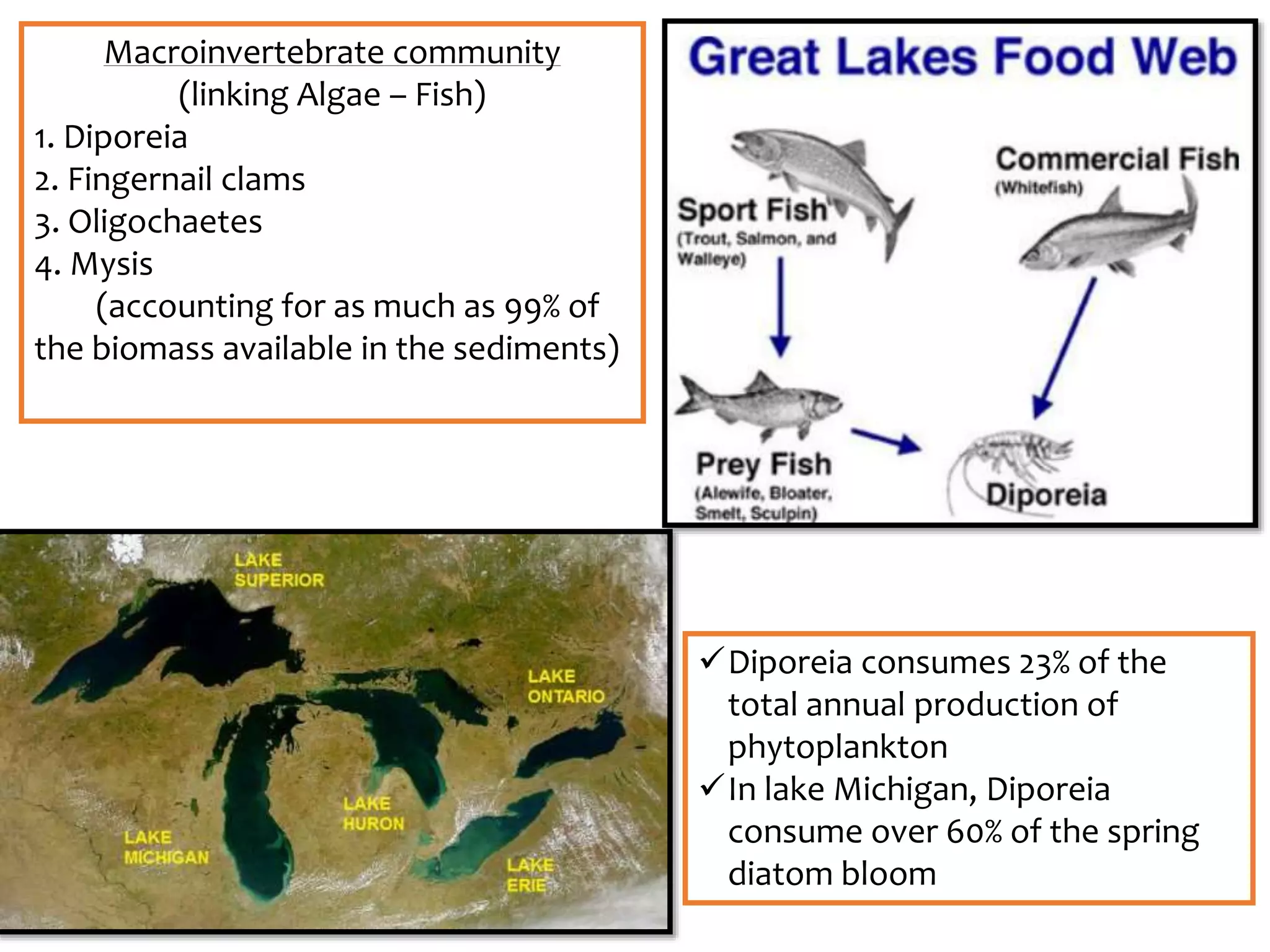
Food web Alteration: Great lakes - Bottom  Up
approach
• food web is a complex interrelationship in which each plant and animal
benefits from and contributes to the success of the ecosystem.
• Begins with the tiniest creatures
• Moving up the food web, the animals become larger and their populations
become fewer dependent on the health of all of the lower levels.
• The Great Lakes are interconnected freshwater lakes located primarily in
the upper mid west region of North America
Macroinvertebrate community
(linking Algae – Fish)
1. Diporeia
2. Fingernail clams
3. Oligochaetes
4. Mysis
(accounting for as much as 99% of
the biomass available in the sediments)
Diporeia consumes 23% of the
total annual production of
phytoplankton
In lake Michigan, Diporeia
consume over 60% of the spring
diatom bloom
Problem starts HERE…
• Zebra and quagga mussels have colonized underwater surfaces to depths of 130
meters - densities of up to 340,000 /m2 after the intro. In 1989.
• Diporeia population declined - over 10,000 organisms /m2 to virtually zero.
• Observed impacts on fish that depend on ' Diporeia as a food source:
In Lake Erie, smelt stocks have declined
In Lake Ontario, slimy sculpin and young lake trout
In Lake Michigan, whitefish have shifted from eating ‘Diporeia to the more
abundant, but less nutritious zebra mussel, leading to leaner, smaller whitefish.
Fingernailclams
Zebra Mussel
(Ecosystem Shock: The Devastating Impacts of Invasive
Species on the Great Lakes Food Web NWF, 2004)
Pathogen Introduction: ias AS vector
• Aprx. 61% of all known human infectious pathogens are zoonotic, and 75% of
emerging human pathogens are zoonotic.
• Many are vectorborne, relying on transmission by mosquitoes and biting flies
that are aquatic for much of their lifespan.
• Others rely on aquatic molluscs, fishes, or other aquatic animals for completion
of their transmission cycles
• such diseases remain firmly endemic in many areas - Introduction of aquatic
vectors into locations
• Waterborne zoonotic diarrheal protists, Cryptosporidium and Giardia, and the
agents of zoonotic microsporidiosis, Encephalitozoon and Enterocytozoon - they
can exist in their dormant oocyst, cyst, or spore forms not only in water or
aquatic sediments, but sequestered within invasive molluscs such as Dreissena
mussels and Corbicula clams.
(Conn, 2013)
Bio-turbation
• Bioturbators are benthic organisms that rework bottom sediments in aquatic
ecosystems through their daily activities, and can contribute to HABS by stirring
up and re-suspending nutrients and cyanobacteria cells.
• The rusty crayfish (Orconectes rusticus) - freshwater bio-turbator that has
established itself as an invasive species in central Ohio
• Five gallon plastic aquaria served as artificial habitats - manipulating crayfish
density and presence of sediment.
Treatments included: a high density (3 crayfish), with sediment; a low density (1
crayfish), with sediment; a control (0 crayfish), with sediment;
a high density (3 crayfish), without sediment; a low density (1 crayfish), without
sediment; a control (0 crayfish), without sediment
• Experimental study results indicates that, O. rusticus is causing an increase in
turbidity in the water column -turbidity increased with increasing crayfish density
(Welch, 2014)
Creation of Novel Habitat: + OR -
• Facilitation (interaction between two species that results in an
increase in the density or biomass of at least one of the species)
• Introducing novel physical structure by an IAS, can change abiotic
conditions (temperature, shading, fluid flow, etc.), or provide
refugia or substrata.
• Facilitative interactions between invasive habitat engineers and
native species develop when the novel habitats created are
persistent and stable, and native species use the habitat with
increasing frequency and dependence
• For example the invasive ‘reef’ building polychaete Ficopomatus
enigmaticus provides refuge for a native crab species. Also, in its
invaded range the seagrass, Zostera japonica, is associated with
increased abundance of benthic invertebrates that find refuge
within its extensive root matrices.
• Zebra mussel – Provide habitat for 700% more taxa than bare
bottom
Engineering Process: Alteration in Abiotic
components
• Ecosystem engineers (also termed habitat modifiers or bioconstructors) are
defined as organisms that affect other biota via alterations to the abiotic
environment either directly with their bodies (e.g., add structure) or their
activities (e.g., dig a hole) or indirectly through their biotic interactions (e.g., eat
the canopy and let more light in the forest).
• Caulerpa taxifolia, killer algae now carpets many square kilometers of seafloor in
the Mediterranean suffocating other species
• Caulerpa racemosa increases sedimentation and creates an anoxic sediment
layer underneath its roots thus causing the degradation of seagrass (Posidinia
oceanica) meadows
(Rilov et al., 2012)
Kappaphycus effect on ecosystem – coral
reef
Kappaphycus alvarezii in Palk Bay in Mandapam coast - Introduced in
2005 without adequate EIA
invasion into coral reef areas in the northern Islands (Shingle, Krusadai and
Poomarichan) of GoM
In March 2011 it spreads over 1.24 km2 reef area in Krusadai Island
The most affected coral species are Acropora nobilis, A. formosa, A.
cytherea, Monipora digitata, M. foliosa and Porites lutea with coral
colony sizes 20-160cm. Out of the total live coral area of 5.4 km2 in
Krusadai Island in 2009, over 23% reef area are now fully covered and
destroyed by Kappaphycus.
non-affected site - Lujanus sp., Lethrinus sp., Siganus sp., Scarus sp.,
Chaetodon sp., and Upeneus sp. (0.71 to 3.21 per 50 m2) were common
in the non-affected reef area, while
affected sites - Siganus sp., Chaetodon sp. and Upeneus sp. (0 to 1.1
per 50 m2)
(MoEF&CC, 2015)
SILENT INVASION…
The spread of marine invasive species via
ships’ ballast Water
• > 90% of international trade
• Every day, every hour, an estimated 7,000 marine and coastal
species travel unnoticed across the world’s oceans
• Over 10 billion tonnes of ballast water are estimated to be moved
around the world in ballast tanks each year.
• marine invasive species have been reported for at least 84% of
the world’s 232 marine ecoregionS
(WWF, 2009)
BALLAST WATER CYCLE…
http://www.seos-project.eu/modules/marinepollution/images/ballast_water_tanks.png
Worst Invaders via Ballast water…
Round goby
Zebra mussel Asian kelpNorth pacific sea star
European green crab Mitten crab
V. Cholerae
Cladoceron water fleaToxic algae (Alexandrium)
NA comb jellyfish
Common
name
Species Native of Introduced to
Alga
Monostroma
oxyspermum
North east Atlantic, North west
Pacific
West coast of India
Hydroid Mercierella enigmata Australia Indian Ocean
Anemone Eugymnanthea ----- East coast of India
Mussel
Mytilopsis sallei Atlantic waters East & west coast
India
Barnacles
Balanus Amphitrite var
stutsburi
West coast of Africa West coast of India
Barnacles
B. amphitrite hawaiiensis Malay Archipelago and
Persian Gulf
Mumbai
Wood-borer
Nausitora dunlopei Cochin Goa
Teredo fulleri Gulf of Mannar Okha
Lyrodus medilobata Indo-Pacific, Hawaiian Islands West coast of India
Isopod
Cilicaea lateraillei Indonesia, the Philippines, Sri
Lanka, S. Africa, Red Sea
Arabian Sea
Amphipod
Stenatho gallensis East coast of India West coast of India
Maera pasifica East coast of India West coast of India
Phallusia nigra Bermuda, Brazil, Red Sea, Gulf
of Eden
Tuticorin harbour
INDIAN SCENARIO
(Anil et al., 2002)
Managing the IAS
International Convention for the Control and Management of
Ships' Ballast Water and Sediments (BWM)
(Adoption: 13 February 2004; Entry into force: 8 September 2017)
As per the convention,
various ballast water management Options
mid-oceanic exchange
ballast water risk assessment
ballast water treatment technologies
establishment of data bases through port biological surveys
locating appropriate site(s) for ballast water discharge in
emergency situation will also help in managing ballast water
http://www.imo.org/
NIO - identified by the Ministry of Shipping, GoI as a lead R&D agency for
addressing BWM
Initial study: ports of Mumbai, Jawaharlal Nehru, Mormugao and
Visakhapatnam (2010 – ’16)
Service extended to remaining 8 major ports (Mangalore, Cochin, Chennai,
Haldia, Kandla, Tuticorin, Paradeep and Kolkata) (2013-16)
Preparing comprehensive port specific management plans for the country
(during 2010 to 2016)
NIO also developed a user friendly and self validating e-form for reporting
ships' ballast water history, which is an essential requirement for conducting
ballast water risk analysis
Indian Scenario…
http://www.nio.org/index/option/com_newsdisplay/task/view/nid/267/tid/4/sid/24
"Globallast" & "Government of India initiative"
programs
REFERENCES
• http://www.fao.org/docrep/008/j6854e/J6854E03.html
• http://www.habitat.noaa.gov/pdf/best_management_practices/fact_sheets/
Aquatic%20Invasive%20Species%20Overview.pdf
• http://www.fisheries.noaa.gov/stories/2014/12/12_01_14impacts_of_invasive_
lionfish.html
• https://www.wwf.de/fileadmin/fm-wwf/Publikationen-
PDF/Study_Silent_Invasion.pdf
• Anil, C., Venkat, K., Sawant, S. S., Dileepkumar, M., Dhargalkar, V. K.,
Ramaiah, N., Harkantra, S. N and Ansari, Z. N. 2002. Marine bioinvasion:
Concern for ecology and Shipping. Current science, vol. 83, no. 3, 10.
THANK YOU

Exotic species - impact on biodiversity

  • 1.
    Exotic Species -Impacts on Biodiversity G. KANTHARAJAN ICAR-CIFE
  • 3.
    The second worstthreat (CBD, 2005) Before the 1970s Lake Victoria contained 350 - 500+ cichlid species; introduction of Nile perch led to the extinction of 200 species of fish (IUCN) since the 17th century IAS contributed to nearly 40% of all animal extinctions (CBD) Annual environmental losses by IAS in the US, UK, Australia, S. Africa, India and Brazil - calculated at over US$ 100 billion (CBD)
  • 4.
    IAS – Causeof Extinction???  All species in the IUCN Red List, aliens directly affect 882 terrestrial species (of 15504 species total, 5.7%), 59 of 3042 freshwater species (2.0%, mostly birds) and 87 of 737 marine species (11.8%, mostly sea birds).  Marine species are considered to have very low risks of extinction because - large continuous habitats - open nature of marine habitats – life history characteristics - result in extensive dispersal potential to recolonize and repopulate areas (Gurevitch and Padilla, 2004) (Based on 2003 IUCN Red List)
  • 5.
    Exotic to Invasive: Concept  Exotic species: ‘’any organism that happens to live outside its natural distribution range as a consequence of anthropogenic activity, or activities through deliberate or accidental introduction to a new habitat’’  non-native or non-indigenous in its new location  a native species of one particular habitat could become an exotic species in another (Zebra mussel native to Caspian sea, non-native to great lakes) • exotic species becomes invasive when the population starts to increase through reproduction if no natural enemies in the new habitat
  • 6.
  • 7.
    Both are non-nativespecies - but exotic species may or may not raise concerns, while invasive species always raise serious concerns Exotic species may or may not have natural competitors and enemies, whereas invasive species do not have any danger of such barriers IAS are also commonly referred to as invasives, aliens, exotics or non- indigenous Species (CBD, 1992). Exotic VS Invasive
  • 8.
    PATHWAY vs VECTOR -the means, purpose or activity, or a commodity Eg: tourism and international flights PATHWAY the actual physical means, agent or mechanism which facilitates the transfer - tourist carrying seeds in muddy boots VECTOR
  • 9.
    Types of Alienspecies introduction
  • 10.
    Introduction and spread ofIAS conflict and reconstruction economics and trade climate change tourism regulatory regimes biological control of pests Eg. Mosquito fish
  • 11.
    economics and trade •Openness of a country’s economy and the composition of its trade route • Globalization - faster trade - increased trade in livestock, pets, nursery stock, agricultural produce and forest - In Washington – IAS introduced via aquarium trade (weather fish, Amur goby, red-bellied pacu, goldfish, red swamp crayfish and Eurasian watermilfoil)
  • 12.
    climate change 1. changesin species distributions and in their abundance within existing distributions as a result of direct physiological impacts on individual species and changes in abiotic factors, reproduction and recruitment opportunities, and interspecific interactions 2. Conducive environment for AS - Gambusia holbrooki, which is native to the US - climate change will extend the current distribution area to the North.
  • 13.
    Conflict and reconstruction •Conflict and civil unrest can contribute to the introduction and spread of alien invasive species in a variety of ways • breakdown of phytosanitary and animal health controls and management systems, the loss of supply lines for materials as well as to the displacement of substantial numbers of people. • vulnerable to the entry of pests and diseases - lack of inspections and border controls - increased unregulated movement of military personnel and refugees • Displaced people and their belongings • Increased smuggling • Inflows of food aid may be contaminated with pests and diseases
  • 14.
    Regulatory regimes A country’slack of regulatory regimes, including resources for prevention and enforcement measures Actions of both the government and private sectors Since countries are linked to others by the transboundary movement of people, goods and services, the level of control applied by one country will in turn affect the vulnerability of other countries  The DAHDF (MoA&FW) has formulated these guidelines in consultation with NBFGR, CMFRI and CIBA  Listed 92 Ornamental fishes for Import to India.
  • 15.
    Tourism • apprx. 650million tourists crossing international borders/ year • Travellers can intentionally transport living plant and animal species that can become invasive or they can carry fruits and other living or preserved plant materials that contain potentially invasive insects and diseases that can have profound effects on agriculture, forestry and other sectors • Travellers themselves can also be the vectors for parasites and diseases b/w countries • Only pathways introducing IAS to remote parts of the world., i.e., oceanic islands and the poles • Results revealed more than 2,600 seeds and other detachable plant structures, or propagules, had hitched a ride to Antarctica • On average, tourists each carried two to three seeds, while scientists each carried six • Parks and protected areas have experienced increased biological invasions due to human activities. http://news.nationalgeographic.com/news/2012/03/120305-antarctica-invasive-species-environment-science-tourists/
  • 16.
    the intentional importationand release of insects, snails, plant pathogens and nematodes for biological control of pests Such species can escape into other unintended areas The United States Office of Technology Assessment (OTA) (1993) noted that of a total of 722 non-indigenous species imported for biological control, 237 species had become established in the United States, some of which have become detrimental Biological control of pests
  • 17.
    Source for AquaticInvasive species MARINE o Ballast water operations o Bio-fouling of ship hulls o Release of unwanted pets and fishing bait o Release or escape of classroom and laboratory animals o Escape from aquaculture facilities, nurseries, or water gardens o Intentionally stocked as food or recreational sources o Release as biological control of existing an existing invader o Introduction for habitat restoration or erosion control efforts FRESHWATER  improving local fishery potential and for broadening species diversity  sport fishing  for aquarium keeping  controlling of unwanted organisms (mosquitoes)
  • 19.
    Characteristics of InvasiveSpecies o Fast growth o Rapid reproduction o High dispersal ability o survive in a wide range of environmental conditions o wide range of food o mature rapidly o High adaptability and tolerance o Small size - making removal diff. o widespread distribution and abundance in their native rang o utilizing limited resources more efficiently o Lack of natural predators
  • 20.
    Fish Native YearPurpose BrownTrout(Salmotruttafario) U.K. 1863-1900 Forplantingstreams,lakes LochLevenTrout(Salmolevensis) U.K. 1863 Forplantingstreams,lakes Rainbow Trout(Salmogairdneri) SriLanka& Germany 1907 Forplantingstreams,lakes Eastern Brook Trout (Salvelinus fontinalis) U.K. 1911 Forplantingstreams,lakes SockeyeSalmon(Oncorhynchusnerka) Japan 1968 Forplantingstreams,lakes AtlanticSalmon(Salmosalar) U.S.A 1968 Forplantingstreams,lakes Exotics in INDIA Game fishes
  • 21.
    Fish Native YearPurpose GoldenCarp(Carassiuscarassius) U.K. 1870 Experimental culture Tench (Tincatinca) U.K. 1870 Experimental culture Gourami (Osphronemus goramy) Java& Mauritius 1916 Experimental culture CommonCarp(Cyprinuscarpio) SriLanka 1939 Experimental culture Tilapia(Oreochromismossambicus) Africa 1952 Experimental culture Grass Carp Japan 1957 Experimentalculture and weed SilverCarp(Hypophthalmichthysmolitrix) HongKong 1959 Experimental culture Tawes(Puntiusjavanicus) Indonesia 1972 Experimental culture Food fishes
  • 22.
    Fish Native YearPurpose Guppy (Poecilia reticulata) South America 1908 Mosquito control Top Minnow (Gambusia affinis) Italy 1928 Mosquito control Larvicidal fishes Ornamental fishes Live bearers (27 species) From various countries Aquarium keeping Egg layers ( 261 speceis) From various countries Aquarium keeping Bighead Carp (Aristichthys nobilis) - Aquaculture African Catfish (Clarias gariepinus) - Aquaculture Nile Tilapia (Oreochromis niloticus) - Aquaculture Red Tilapia (Oreochromis sp.) - Aquaculture Red Piranha (Serrasalmus nattereri) - Aquaculture keeping Un-authorised introductions (Singh and Lakra, 2011)
  • 23.
    MECHANISM OF EXOTICSPECIES IMPACT ON BIODIVERSITY Impact on Biodiversity Competition Toxin Hybridization Predation
  • 24.
    Competition: Lake Jaisamand,India Catch(%) Man made lake - Gomati River- Rajasthan Past… IMC, L. calbasu, C. reba, Puntius sophore, P. ticto, P. ranga, Channa striatus, Mystus tengra, Notopterus notopterus, Mastacembelus armatus, Gudusia chapra, Chanda nama, Glossogobius giuris, Parambassis ranga NOW… Tilapia (Ujjania et al., 2015) Tilapia noticed in 1991 - ACCIDENTAL intro…
  • 25.
    Toxin: Golden Algae– Fish kills Releases at least two chemical compounds called prymnesins that combine with cations [Mg++] and [Ca++]) in the water to make toxins Fish-killing have occurred in south- central USA for at least 30 years Form dormant cysts during stressed /unfavorable conditions Species: Prymnesium parvum Distribution: World wide (Roelke et al., 2011) As a aid…
  • 26.
    Hybridization: C. macrocephalus×C.gariepinus – Genetic pollution o Genetic pollution when escaped fish breed in the wild o The Thai walking catfish, C. microcephalus - severely endangered Cause: o Natural populations are thought to be suffering from massive back-crossing with the C. macrocephalus×C. gariepinus hybrids Study results: o 25 – populations (24 from Nat. envt, 1 from Dept. hatchery) all over Thailand o Alleles peculiar to the African catfish genome were observed in 12 out of the 25 natural populations. o No significant genotype disequilibrium between the macrocephalus and gariepinus alleles. (Na-nakorn et al., 2004) X
  • 27.
    Predation: LION FISH– Atlantic Ocean Native: Indo-Pacific Established along the southeast coast of the U.S., the Caribbean, and in parts of the Gulf of Mexico Cause: Dumping unwanted lionfish from home aquariums (25 years back) Concern: Adult lionfish are primarily fish-eaters and have very few predators Consumes > 70 species of native fish presence could negatively affect the well-being of valuable commercial and recreational fisheries Can tolerate brackish coastal zones - mangrove and estuarine habitats may also be at risk of invasion Researchers have discovered that a single lionfish residing on a coral reef can reduce recruitment of native reef fishes by 79 percent. Because lionfish feed on prey normally consumed by snappers, groupers, and other commercially important native species (NOAA, 2014)
  • 28.
    Engineering Process Impacts on Ecosystem Anoxia Bioturbation Creation ofNovel Habitat MECHANISM OF EXOTIC SPECIES IMPACT ON ECOSYSTEM Intro. Of Pathogens Food web alteration
  • 29.
    Food web Alteration:Great lakes - Bottom  Up approach • food web is a complex interrelationship in which each plant and animal benefits from and contributes to the success of the ecosystem. • Begins with the tiniest creatures • Moving up the food web, the animals become larger and their populations become fewer dependent on the health of all of the lower levels. • The Great Lakes are interconnected freshwater lakes located primarily in the upper mid west region of North America
  • 30.
    Macroinvertebrate community (linking Algae– Fish) 1. Diporeia 2. Fingernail clams 3. Oligochaetes 4. Mysis (accounting for as much as 99% of the biomass available in the sediments) Diporeia consumes 23% of the total annual production of phytoplankton In lake Michigan, Diporeia consume over 60% of the spring diatom bloom
  • 31.
    Problem starts HERE… •Zebra and quagga mussels have colonized underwater surfaces to depths of 130 meters - densities of up to 340,000 /m2 after the intro. In 1989. • Diporeia population declined - over 10,000 organisms /m2 to virtually zero. • Observed impacts on fish that depend on ' Diporeia as a food source: In Lake Erie, smelt stocks have declined In Lake Ontario, slimy sculpin and young lake trout In Lake Michigan, whitefish have shifted from eating ‘Diporeia to the more abundant, but less nutritious zebra mussel, leading to leaner, smaller whitefish. Fingernailclams Zebra Mussel (Ecosystem Shock: The Devastating Impacts of Invasive Species on the Great Lakes Food Web NWF, 2004)
  • 32.
    Pathogen Introduction: iasAS vector • Aprx. 61% of all known human infectious pathogens are zoonotic, and 75% of emerging human pathogens are zoonotic. • Many are vectorborne, relying on transmission by mosquitoes and biting flies that are aquatic for much of their lifespan. • Others rely on aquatic molluscs, fishes, or other aquatic animals for completion of their transmission cycles • such diseases remain firmly endemic in many areas - Introduction of aquatic vectors into locations • Waterborne zoonotic diarrheal protists, Cryptosporidium and Giardia, and the agents of zoonotic microsporidiosis, Encephalitozoon and Enterocytozoon - they can exist in their dormant oocyst, cyst, or spore forms not only in water or aquatic sediments, but sequestered within invasive molluscs such as Dreissena mussels and Corbicula clams. (Conn, 2013)
  • 33.
    Bio-turbation • Bioturbators arebenthic organisms that rework bottom sediments in aquatic ecosystems through their daily activities, and can contribute to HABS by stirring up and re-suspending nutrients and cyanobacteria cells. • The rusty crayfish (Orconectes rusticus) - freshwater bio-turbator that has established itself as an invasive species in central Ohio • Five gallon plastic aquaria served as artificial habitats - manipulating crayfish density and presence of sediment. Treatments included: a high density (3 crayfish), with sediment; a low density (1 crayfish), with sediment; a control (0 crayfish), with sediment; a high density (3 crayfish), without sediment; a low density (1 crayfish), without sediment; a control (0 crayfish), without sediment • Experimental study results indicates that, O. rusticus is causing an increase in turbidity in the water column -turbidity increased with increasing crayfish density (Welch, 2014)
  • 34.
    Creation of NovelHabitat: + OR - • Facilitation (interaction between two species that results in an increase in the density or biomass of at least one of the species) • Introducing novel physical structure by an IAS, can change abiotic conditions (temperature, shading, fluid flow, etc.), or provide refugia or substrata. • Facilitative interactions between invasive habitat engineers and native species develop when the novel habitats created are persistent and stable, and native species use the habitat with increasing frequency and dependence • For example the invasive ‘reef’ building polychaete Ficopomatus enigmaticus provides refuge for a native crab species. Also, in its invaded range the seagrass, Zostera japonica, is associated with increased abundance of benthic invertebrates that find refuge within its extensive root matrices. • Zebra mussel – Provide habitat for 700% more taxa than bare bottom
  • 35.
    Engineering Process: Alterationin Abiotic components • Ecosystem engineers (also termed habitat modifiers or bioconstructors) are defined as organisms that affect other biota via alterations to the abiotic environment either directly with their bodies (e.g., add structure) or their activities (e.g., dig a hole) or indirectly through their biotic interactions (e.g., eat the canopy and let more light in the forest). • Caulerpa taxifolia, killer algae now carpets many square kilometers of seafloor in the Mediterranean suffocating other species • Caulerpa racemosa increases sedimentation and creates an anoxic sediment layer underneath its roots thus causing the degradation of seagrass (Posidinia oceanica) meadows (Rilov et al., 2012)
  • 36.
    Kappaphycus effect onecosystem – coral reef Kappaphycus alvarezii in Palk Bay in Mandapam coast - Introduced in 2005 without adequate EIA invasion into coral reef areas in the northern Islands (Shingle, Krusadai and Poomarichan) of GoM In March 2011 it spreads over 1.24 km2 reef area in Krusadai Island The most affected coral species are Acropora nobilis, A. formosa, A. cytherea, Monipora digitata, M. foliosa and Porites lutea with coral colony sizes 20-160cm. Out of the total live coral area of 5.4 km2 in Krusadai Island in 2009, over 23% reef area are now fully covered and destroyed by Kappaphycus. non-affected site - Lujanus sp., Lethrinus sp., Siganus sp., Scarus sp., Chaetodon sp., and Upeneus sp. (0.71 to 3.21 per 50 m2) were common in the non-affected reef area, while affected sites - Siganus sp., Chaetodon sp. and Upeneus sp. (0 to 1.1 per 50 m2) (MoEF&CC, 2015)
  • 37.
    SILENT INVASION… The spreadof marine invasive species via ships’ ballast Water • > 90% of international trade • Every day, every hour, an estimated 7,000 marine and coastal species travel unnoticed across the world’s oceans • Over 10 billion tonnes of ballast water are estimated to be moved around the world in ballast tanks each year. • marine invasive species have been reported for at least 84% of the world’s 232 marine ecoregionS (WWF, 2009)
  • 38.
  • 39.
    Worst Invaders viaBallast water… Round goby Zebra mussel Asian kelpNorth pacific sea star European green crab Mitten crab V. Cholerae Cladoceron water fleaToxic algae (Alexandrium) NA comb jellyfish
  • 40.
    Common name Species Native ofIntroduced to Alga Monostroma oxyspermum North east Atlantic, North west Pacific West coast of India Hydroid Mercierella enigmata Australia Indian Ocean Anemone Eugymnanthea ----- East coast of India Mussel Mytilopsis sallei Atlantic waters East & west coast India Barnacles Balanus Amphitrite var stutsburi West coast of Africa West coast of India Barnacles B. amphitrite hawaiiensis Malay Archipelago and Persian Gulf Mumbai Wood-borer Nausitora dunlopei Cochin Goa Teredo fulleri Gulf of Mannar Okha Lyrodus medilobata Indo-Pacific, Hawaiian Islands West coast of India Isopod Cilicaea lateraillei Indonesia, the Philippines, Sri Lanka, S. Africa, Red Sea Arabian Sea Amphipod Stenatho gallensis East coast of India West coast of India Maera pasifica East coast of India West coast of India Phallusia nigra Bermuda, Brazil, Red Sea, Gulf of Eden Tuticorin harbour INDIAN SCENARIO (Anil et al., 2002)
  • 41.
    Managing the IAS InternationalConvention for the Control and Management of Ships' Ballast Water and Sediments (BWM) (Adoption: 13 February 2004; Entry into force: 8 September 2017) As per the convention, various ballast water management Options mid-oceanic exchange ballast water risk assessment ballast water treatment technologies establishment of data bases through port biological surveys locating appropriate site(s) for ballast water discharge in emergency situation will also help in managing ballast water http://www.imo.org/
  • 42.
    NIO - identifiedby the Ministry of Shipping, GoI as a lead R&D agency for addressing BWM Initial study: ports of Mumbai, Jawaharlal Nehru, Mormugao and Visakhapatnam (2010 – ’16) Service extended to remaining 8 major ports (Mangalore, Cochin, Chennai, Haldia, Kandla, Tuticorin, Paradeep and Kolkata) (2013-16) Preparing comprehensive port specific management plans for the country (during 2010 to 2016) NIO also developed a user friendly and self validating e-form for reporting ships' ballast water history, which is an essential requirement for conducting ballast water risk analysis Indian Scenario… http://www.nio.org/index/option/com_newsdisplay/task/view/nid/267/tid/4/sid/24 "Globallast" & "Government of India initiative" programs
  • 43.
    REFERENCES • http://www.fao.org/docrep/008/j6854e/J6854E03.html • http://www.habitat.noaa.gov/pdf/best_management_practices/fact_sheets/ Aquatic%20Invasive%20Species%20Overview.pdf •http://www.fisheries.noaa.gov/stories/2014/12/12_01_14impacts_of_invasive_ lionfish.html • https://www.wwf.de/fileadmin/fm-wwf/Publikationen- PDF/Study_Silent_Invasion.pdf • Anil, C., Venkat, K., Sawant, S. S., Dileepkumar, M., Dhargalkar, V. K., Ramaiah, N., Harkantra, S. N and Ansari, Z. N. 2002. Marine bioinvasion: Concern for ecology and Shipping. Current science, vol. 83, no. 3, 10.
  • 45.

Editor's Notes

  • #6 Exotic species could be defined as any organism that happens to live outside its natural distribution range as a consequence of anthropogenic activity, or activities through deliberate or accidental introduction to a new habitat. it is a non-native or non-indigenous in its new location a native species of one particular habitat could become an exotic species in another. Alien species are capable of successfully competing for the natural resources with the native species mostly due the lack of natural predators in the new habitat, and they could become invasive if the reproduction could take place. According to the definition, an exotic species becomes invasive when the population starts to increase through reproduction that happens because there are no natural enemies in the new habitat.
  • #7  1. Introduction Species coming from another place must survive during and after the journey. Many species fail to survive unless they are cared for (e.g. aquarium fish). However, almost all invasive plants spread as seeds which do not require special care while being transported 2. Establishment and reproduction of the introduced species The survivors must persist and reproduce successfully (i.e. there usually needs to be more than one individual) until they establish a self-sustaining population. 3. Spread In certain cases, established populations will multiply rapidly and spread across the landscape. This is the explosion phase (Figure 1.9), and may only happen after a considerable lag phase.
  • #9 A pathway is broadly defined as the means (e.g. aircraft, vessel or person), purpose or activity (e.g. farming, shipping or pet trade), or a commodity (e.g. fisheries) by which an alien species may be transported to a new location, either intentionally or unintentionally. This differs from a vector, which is the actual physical means, agent or mechanism which facilitates the transfer of organisms or their propagules from one place to another. So a tourist carrying seeds in muddy boots is a vector, whereas tourism and international flights are the pathways.
  • #14 Conflict and civil unrest can contribute to the introduction and spread of alien invasive species in a variety of ways Civil unrest leads to the breakdown of phytosanitary and animal health controls and management systems, the loss of supply lines for materials as well as to the displacement of substantial numbers of people. vulnerable to the entry of pests and diseases - lack of inspections and border controls - increased unregulated movement of military personnel and refugees Displaced people and their belongings can be a dispersal mechanism for, or the source of, alien invasive species. Increased smuggling can relocate alien species to new regions. Inflows of food aid may be contaminated with pests and diseases.
  • #15 A country’s lack of regulatory regimes, including resources for prevention and enforcement measures (i.e. a sustainable institutional framework) as well as attitudes and views regarding risks, make it more vulnerable to invasions. Regulatory systems for managing alien invasive species are heavily dependent on the actions of both the government and private sectors and the effectiveness of such systems is determined by the level of resources that governments can provide as well as the technical capacity that exists nationally (FAO, 2001a). Countries vary in their tolerance of the risk of alien species. Since countries are linked to others by the transboundary movement of people, goods and services, the level of control applied by one country will in turn affect the vulnerability of other countries (Perrings et al., 2002). Regulatory systems can also break down, or when faced with new challenges in alien species control can become inadequate to respond effectively either because of systemic deficiencies or because safety measures are evaded (FAO, 2001a).
  • #16 apprx. 650 million tourists crossing international borders every year, Travellers can intentionally transport living plant and animal species that can become invasive or they can carry fruits and other living or preserved plant materials that contain potentially invasive insects and diseases that can have profound effects on agriculture, forestry and other sectors (McNeely et al., 2001). Travellers themselves can also be the vectors for parasites and diseases between countries. Parks and protected areas have experienced increased biological invasions due to human activities.
  • #37 The introduction of exotic seaweed, Kappaphycus alvarezii in South Palk Bay in Mandapam coast in 2005 without adequate environmental impact assessment facilitated its invasion into coral reef areas in the northern Islands (Shingle, Krusadai and Poomarichan) of GoM. It was observed in March 2011 that the exotic seaweed spreads over 1.24 km2 reef area in Krusadai Island. The most affected coral species are Acropora nobilis, A. formosa, A. cytherea, Monipora digitata, M. foliosa and Porites lutea with coral colony sizes 20-160cm. Out of the total live coral area of 5.4 km2 in Krusadai Island in 2009, over 23% reef area are now fully covered and destroyed by Kappaphycus. The abundance of benthic communities and fish were significantly less in the affected sites than the non-affected site. The fishes, Lujanus sp., Lethrinus sp., Siganus sp., Scarus sp., Chaetodon sp., and Upeneus sp. (0.71 to 3.21 per 50 m2) were common in the non-affected reef area, while Siganus sp., Chaetodon sp. and Upeneus sp. were the only genera seen rarely (0 to 1.1 per 50 m2) in affected sites (Patterson et al., 2012).