BIODIVERSITY
    PROTECTION

 Speaker : Rajdeep Jadeja
    M.Sc(Agri.Economics)
Department of Agri.Ecomonics
Biodiversity:

WHO CARE???


                2
Bio =


      Diversity =           Variety

Biodiversity is the variety of life on Earth and the
essential interdependence of all living things.
• Scientists have identified more than 2
million species. Tens of millions --
remain unknown

•The tremendous variety of life on
Earth is made possible by complex
interactions among all living things
including microscopic species like algae
and mites.
Should we be concerned about biodiversity???

                   What we know:
  The Earth is losing species at an alarming rate

  The Earth is losing species at an
  alarming rate
   Some scientists estimate that as many as
  3 species per hour are going extinct and
  20,000 extinctions occur each year.
  when species of plants and animals go
  extinct, many other species are affected
Benefits of Biodiversity
•Ecosystem functions
•Ecosystem services
  •Cleaning water,
  •Cleaning air,
  •Habitat & breeding
  areas for wildlife, …
•Aesthetic and cultural
benefits
Why Conserve Biodiversity?


  As we all know by now, Biodiversity is
essential for maintaining the ecological
functions, including stabilizing of the water
cycle, maintenance and replenishment of soil
fertility, pollination and cross-fertilization
of crops and other vegetation, protection
against soil erosion and stability of food
producing and other ecosystems.
Conservation of biological diversity leads to
conservation of essential ecological diversity
to preserve the continuity of food chains.
Cont..........
       Biodiversity provides the base for the livelihoods,
  cultures and economies of several hundred millions of
  people, including farmers, fisher folk, forest dwellers
  and artisans.

            It provides raw material for a diverse
  medicinal and health care systems. It also provides the
  genetic base for the continuous up-gradation of
  agriculture, fisheries, and for critical discoveries in
  scientific, industrial and other sectors.
        The rapid erosion of biodiversity in the last few
  decades has impacted on the health of the land, water
  bodies and people.
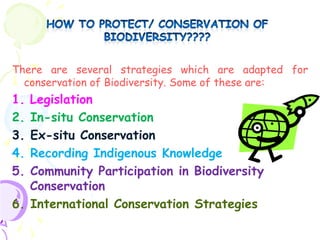
There are several strategies which are adapted for
  conservation of Biodiversity. Some of these are:
1. Legislation
2. In-situ Conservation
3. Ex-situ Conservation
4. Recording Indigenous Knowledge
5. Community Participation in Biodiversity
   Conservation
6. International Conservation Strategies
1. Legislation
     Formal policies and programmes for conservation and
sustainable utilization of biodiversity resources dates back to
several decades. The concept of environmental protection is
enshrined in the Indian constitution in articles 48a and 51a(g).
Major central acts relevant to biodiversity include:

· Environment Protection Act, 1986
· Fisheries Act, 1897
· Forest Act, 1927
· Forest (Conservation) Act, 1980
· Wildlife (Protection) Act 1972 and Wildlife (Protection)
Amendment Act 1991
2. In-situ Conservation
       Conserving the animals and plants in their
natural habitats is known as in situ conservation.
The established natural habitats are:

· National parks and sanctuaries
· Biosphere reserves
· Nature reserves
· Reserved and protected forests
· Preservation plots
· Reserved forests
3. Ex-situ Conservation
Ex-situ conservation of plants and animals preserve/ or
protect them away from their natural habitat. This could
be in zoological parks and botanical gardens or through
the forestry institutions and agricultural research
centers. A lot of effort is under way to collect and
preserve the genetic material of crops, animal, bird and
fish species. This work is being done by institutions such
as the National Bureau of Plant Genetic Resources, New
Delhi, the National Bureau of Animal Genetic Resources,
etc.
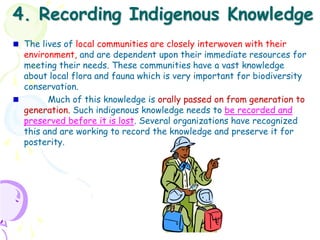
4. Recording Indigenous Knowledge
 The lives of local communities are closely interwoven with their
 environment, and are dependent upon their immediate resources for
 meeting their needs. These communities have a vast knowledge
 about local flora and fauna which is very important for biodiversity
 conservation.
       Much of this knowledge is orally passed on from generation to
 generation. Such indigenous knowledge needs to be recorded and
 preserved before it is lost. Several organizations have recognized
 this and are working to record the knowledge and preserve it for
 posterity.
5.   Community Participation in Biodiversity
                Conservation

It is being recognized that no legal provisions can be
effective unless local communities are involved in
planning, management and monitoring conservation
programmes. There are several initiatives to do this,
both by government as well as non-governmental
organizations.
For example, the Joint Forest Management philosophy
stresses involvement of village communities in
regenerating and protecting degraded forest land in the
vicinity of villages.
Successful conservation strategies will have to have the
confidence and participation of the local communities.
6. International Conservation
               Strategies
Conserving biodiversity is not an issue confined to any one country or community. It is a
   crucial global concern. Several international treaties and agreements are in place in
   the attempt to strengthen international participation and commitment towards
   conserving biodiversity. Some of these are:
   · The Convention on Biological Diversity: This was signed during the Earth
Summit in 1992. It focuses not only on conserving biodiversity but also on sustainable
   use of biological resources and equitable sharing of benefits arising from its use.

   · The Convention on International Trade in Endangered Species of Wild Flora and
   Fauna (CITES): This is an international treaty which is designed to protect wild
   plants and animals affected by international trade. The treaty, in force since 1975,
   controls the export, import and re-export of endangered and threatened wildlife.

   · The Convention on Wetlands of International Importance: This Convention, also
   known as the Ramsar Convention, was signed in Ramsar (Iran) in 1971 and came into
   force in December 1975. It provides a framework for international cooperation for
   the conservation of wetland habitats which have been designated to the 'List of
   Wetlands of International Importance'
Saving biodiversity -Saving life
  Following are some conservation actions that we can take up:

 Plant trees. Grow native species of plants (trees, shrubs and climber)
 where possible, this would attract local wildlife such as birds, butterflies
 and insects.
  Grow local vegetables in your hostel garden that are not usually available
 in the markets. This would allow help conserve them for generations to
 come.

  Initiate, organize and participate in responsible citizen action against
 existing or proposed activities that harm or are likely to harm local
 biodiversity.

  Make a list of different kinds of trees in your campus or locality. For
 each one find out the names, uses, flowering season, animals and birds that
 depends on it. Present this information in an interesting way, and put it up
 by the tree. Many people will stop by to read this information and know
 more about the tree.
·Adopt vegetarianism which would require fewer
animals to be fattened for slaughtering and more
plants to be grown for food.   
· Paper and cloth should replace non-biodegradable
plastic and polyester which damage the ecosystem.
· Make children aware of their surroundings and the
need for biodiversity.
· Promote bio-farming which is less intensive and
environmental-friendly.
· Make use of sustainable technologies like smokeless
chulhas, ground water recharging unit, wind
energy, solar power, etc.
· Set up ‘Community Sanctuaries’ for free
ranging animals, migratory birds and endemic
species. Establish voluntary ‘Village Reserves’
for plants and animals.
· Assist National level Bodies in recording and
preserving rare and endemic species
· Create ‘Biodiversity Registers’ in communities,
schools, villages.
Biodiversity:
WHO CARE...????
     
Biodiversity protection

Biodiversity protection

  • 1.
    BIODIVERSITY PROTECTION Speaker : Rajdeep Jadeja M.Sc(Agri.Economics) Department of Agri.Ecomonics
  • 2.
  • 3.
    Bio = Diversity = Variety Biodiversity is the variety of life on Earth and the essential interdependence of all living things.
  • 4.
    • Scientists haveidentified more than 2 million species. Tens of millions -- remain unknown •The tremendous variety of life on Earth is made possible by complex interactions among all living things including microscopic species like algae and mites.
  • 5.
    Should we beconcerned about biodiversity??? What we know: The Earth is losing species at an alarming rate  The Earth is losing species at an alarming rate Some scientists estimate that as many as 3 species per hour are going extinct and 20,000 extinctions occur each year. when species of plants and animals go extinct, many other species are affected
  • 6.
    Benefits of Biodiversity •Ecosystemfunctions •Ecosystem services •Cleaning water, •Cleaning air, •Habitat & breeding areas for wildlife, … •Aesthetic and cultural benefits
  • 7.
    Why Conserve Biodiversity? As we all know by now, Biodiversity is essential for maintaining the ecological functions, including stabilizing of the water cycle, maintenance and replenishment of soil fertility, pollination and cross-fertilization of crops and other vegetation, protection against soil erosion and stability of food producing and other ecosystems. Conservation of biological diversity leads to conservation of essential ecological diversity to preserve the continuity of food chains.
  • 8.
    Cont.......... Biodiversity provides the base for the livelihoods, cultures and economies of several hundred millions of people, including farmers, fisher folk, forest dwellers and artisans. It provides raw material for a diverse medicinal and health care systems. It also provides the genetic base for the continuous up-gradation of agriculture, fisheries, and for critical discoveries in scientific, industrial and other sectors. The rapid erosion of biodiversity in the last few decades has impacted on the health of the land, water bodies and people.
  • 9.
    There are severalstrategies which are adapted for conservation of Biodiversity. Some of these are: 1. Legislation 2. In-situ Conservation 3. Ex-situ Conservation 4. Recording Indigenous Knowledge 5. Community Participation in Biodiversity Conservation 6. International Conservation Strategies
  • 10.
    1. Legislation Formal policies and programmes for conservation and sustainable utilization of biodiversity resources dates back to several decades. The concept of environmental protection is enshrined in the Indian constitution in articles 48a and 51a(g). Major central acts relevant to biodiversity include: · Environment Protection Act, 1986 · Fisheries Act, 1897 · Forest Act, 1927 · Forest (Conservation) Act, 1980 · Wildlife (Protection) Act 1972 and Wildlife (Protection) Amendment Act 1991
  • 11.
    2. In-situ Conservation Conserving the animals and plants in their natural habitats is known as in situ conservation. The established natural habitats are: · National parks and sanctuaries · Biosphere reserves · Nature reserves · Reserved and protected forests · Preservation plots · Reserved forests
  • 12.
    3. Ex-situ Conservation Ex-situconservation of plants and animals preserve/ or protect them away from their natural habitat. This could be in zoological parks and botanical gardens or through the forestry institutions and agricultural research centers. A lot of effort is under way to collect and preserve the genetic material of crops, animal, bird and fish species. This work is being done by institutions such as the National Bureau of Plant Genetic Resources, New Delhi, the National Bureau of Animal Genetic Resources, etc.
  • 13.
    4. Recording IndigenousKnowledge The lives of local communities are closely interwoven with their environment, and are dependent upon their immediate resources for meeting their needs. These communities have a vast knowledge about local flora and fauna which is very important for biodiversity conservation. Much of this knowledge is orally passed on from generation to generation. Such indigenous knowledge needs to be recorded and preserved before it is lost. Several organizations have recognized this and are working to record the knowledge and preserve it for posterity.
  • 14.
    5. Community Participation in Biodiversity Conservation It is being recognized that no legal provisions can be effective unless local communities are involved in planning, management and monitoring conservation programmes. There are several initiatives to do this, both by government as well as non-governmental organizations. For example, the Joint Forest Management philosophy stresses involvement of village communities in regenerating and protecting degraded forest land in the vicinity of villages. Successful conservation strategies will have to have the confidence and participation of the local communities.
  • 15.
    6. International Conservation Strategies Conserving biodiversity is not an issue confined to any one country or community. It is a crucial global concern. Several international treaties and agreements are in place in the attempt to strengthen international participation and commitment towards conserving biodiversity. Some of these are: · The Convention on Biological Diversity: This was signed during the Earth Summit in 1992. It focuses not only on conserving biodiversity but also on sustainable use of biological resources and equitable sharing of benefits arising from its use. · The Convention on International Trade in Endangered Species of Wild Flora and Fauna (CITES): This is an international treaty which is designed to protect wild plants and animals affected by international trade. The treaty, in force since 1975, controls the export, import and re-export of endangered and threatened wildlife. · The Convention on Wetlands of International Importance: This Convention, also known as the Ramsar Convention, was signed in Ramsar (Iran) in 1971 and came into force in December 1975. It provides a framework for international cooperation for the conservation of wetland habitats which have been designated to the 'List of Wetlands of International Importance'
  • 16.
    Saving biodiversity -Savinglife Following are some conservation actions that we can take up: Plant trees. Grow native species of plants (trees, shrubs and climber) where possible, this would attract local wildlife such as birds, butterflies and insects. Grow local vegetables in your hostel garden that are not usually available in the markets. This would allow help conserve them for generations to come. Initiate, organize and participate in responsible citizen action against existing or proposed activities that harm or are likely to harm local biodiversity. Make a list of different kinds of trees in your campus or locality. For each one find out the names, uses, flowering season, animals and birds that depends on it. Present this information in an interesting way, and put it up by the tree. Many people will stop by to read this information and know more about the tree.
  • 17.
    ·Adopt vegetarianism whichwould require fewer animals to be fattened for slaughtering and more plants to be grown for food.    · Paper and cloth should replace non-biodegradable plastic and polyester which damage the ecosystem. · Make children aware of their surroundings and the need for biodiversity. · Promote bio-farming which is less intensive and environmental-friendly. · Make use of sustainable technologies like smokeless chulhas, ground water recharging unit, wind energy, solar power, etc.
  • 18.
    · Set up‘Community Sanctuaries’ for free ranging animals, migratory birds and endemic species. Establish voluntary ‘Village Reserves’ for plants and animals. · Assist National level Bodies in recording and preserving rare and endemic species · Create ‘Biodiversity Registers’ in communities, schools, villages.
  • 19.