Course: Electromagnetic Theory
paper code: EI 503
Course Coordinator: Arpan Deyasi
Department of Electronics and Communication Engineering
RCC Institute of Information Technology
Kolkata, India
Topics: Vector Integration
29-09-2021 Arpan Deyasi, EM Theory 1
Arpan Deyasi
Electromagnetic
Theory
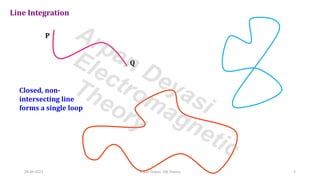
Line Integration
P
Q
Closed, non-
intersecting line
forms a single loop
29-09-2021 Arpan Deyasi, EM Theory 2
Arpan Deyasi
Electromagnetic
Theory
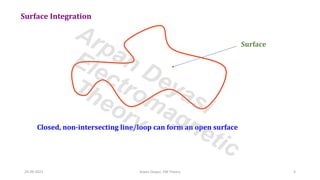
Surface Integration
Surface
Closed, non-intersecting line/loop can form an open surface
29-09-2021 Arpan Deyasi, EM Theory 3
Arpan Deyasi
Electromagnetic
Theory
Volume Integration
Closed, non-intersecting
surface forms volume
29-09-2021 Arpan Deyasi, EM Theory 4
Arpan Deyasi
Electromagnetic
Theory
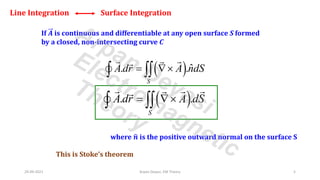
Line Integration Surface Integration
If 𝑨 is continuous and differentiable at any open surface S formed
by a closed, non-intersecting curve C
( ) ˆ
. .
S
A dr A ndS
= 
 
( )
. .
S
A dr A dS
= 
 
This is Stoke’s theorem
where ෝ
𝒏 is the positive outward normal on the surface S
29-09-2021 Arpan Deyasi, EM Theory 5
Arpan Deyasi
Electromagnetic
Theory
Statement of Stoke’s theorem
( )
. .
S
A dr A dS
= 
 
Closed line integration of any continuous and differentiable vector is
numerically equal to the surface integration of curl of that vector where
surface is formed by that non-intersecting closed curve
29-09-2021 Arpan Deyasi, EM Theory 6
Arpan Deyasi
Electromagnetic
Theory
Proof of Stoke’s theorem
X
Y
Z
A (x, y) B (x+Δx, y)
C (x+Δx, y+Δy)
D (x, y+Δy)
Open surface formed by the closed path
Closed path ABCDA
𝑷 is continuous and differentiable
at the surface
29-09-2021 Arpan Deyasi, EM Theory 7
Arpan Deyasi
Electromagnetic
Theory
Proof of Stoke’s theorem
Value of the vector from A to B  
x
P x
= 
Value of the vector from B to C
y
y
P
P x y
x

 
 
= +  
 
 

 
 
y
y
P
P y x y
x

 
 
 
=  +  
 
 
  
 
 
29-09-2021 Arpan Deyasi, EM Theory 8
Arpan Deyasi
Electromagnetic
Theory
Proof of Stoke’s theorem
Value of the vector from C to D
  x
x
P
P x y x
y
 
 

= −  −  
 
 

 
 
x
x
P
P y x
y
 
 

= − +  
 
 

 
 
Value of the vector from C to D
Value of the vector from D to A
y
P y
 
= − 
 
29-09-2021 Arpan Deyasi, EM Theory 9
Arpan Deyasi
Electromagnetic
Theory
Proof of Stoke’s theorem
Value of the vector over ABCDA
y x
P P
x y
x y

 
   

= −  
 
   
 
 
 
 
( ) .
z
P dS
= 
( ) y x
z
P P
P
x y

 
   

 = −
 
   
 
 
 
 
29-09-2021 Arpan Deyasi, EM Theory 10
Arpan Deyasi
Electromagnetic
Theory
Proof of Stoke’s theorem
X
Y
O
For plane XOY
( )
. .
XOY z
S
P dr P dS
= 
 
For plane YOZ
( )
. .
YOZ x
S
P dr P dS
= 
 
For plane ZOX
( )
. .
ZOX y
S
P dr P dS
= 
 
29-09-2021 Arpan Deyasi, EM Theory 11
Arpan Deyasi
Electromagnetic
Theory
Proof of Stoke’s theorem
Combining all the planes
( )
. .
S
P dr P dS
= 
 
29-09-2021 Arpan Deyasi, EM Theory 12
Arpan Deyasi
Electromagnetic
Theory
Stoke’s theorem
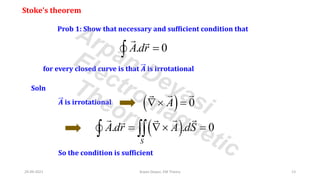
for every closed curve is that 𝑨 is irrotational
. 0
Adr =

Prob 1: Show that necessary and sufficient condition that
Soln
𝑨 is irrotational ( ) 0
A
 =
( )
. . 0
S
A dr A dS
=  =
 
So the condition is sufficient
29-09-2021 Arpan Deyasi, EM Theory 13
Arpan Deyasi
Electromagnetic
Theory
Stoke’s theorem
Let
( ) ˆ
A n

 = β is positive constant
( )
ˆ ˆ
. . 0
S
Adr n n dS

 = 
 
This contradicts the hypothesis
( ) 0
A
 = is the necessary condition also
29-09-2021 Arpan Deyasi, EM Theory 14
Arpan Deyasi
Electromagnetic
Theory
Conservative Vector Field
If 𝑷 is irrotational, then the vector field is conservative
0
P
 =
If
Then 𝑷 is conservative vector field
P 
 = 
We know that
0

 =
29-09-2021 Arpan Deyasi, EM Theory 15
Arpan Deyasi
Electromagnetic
Theory
Conservative Vector Field
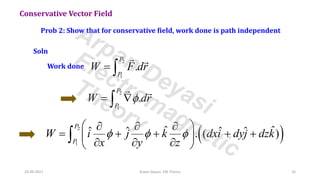
Prob 2: Show that for conservative field, work done is path independent
Soln
Work done
2
1
.
P
P
W F dr
= 
2
1
.
P
P
W dr

= 

( )
2
1
ˆ ˆ
ˆ ˆ ˆ ˆ
. ( )
P
P
W i j k dxi dyj dzk
x y z
  
 
  
= + + + +
 
  
 

29-09-2021 Arpan Deyasi, EM Theory 16
Arpan Deyasi
Electromagnetic
Theory
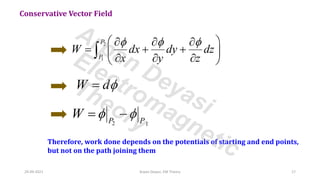
Conservative Vector Field
2
1
P
P
W dx dy dz
x y z
  
 
  
= + +
 
  
 

W d
=
2 1
P P
W  
= −
Therefore, work done depends on the potentials of starting and end points,
but not on the path joining them
29-09-2021 Arpan Deyasi, EM Theory 17
Arpan Deyasi
Electromagnetic
Theory
If 𝑨 is continuous and differentiable at any volume V formed by a
closed, non-intersecting surface S
( ) ˆ
. .
V
S
A dV A ndS
 =
 
( )
. .
V
S
A dV A dS
 =
 
where ෝ
𝒏 is the positive outward normal on the surface S
This is Divergence theorem
Volume Integration Surface Integration
29-09-2021 Arpan Deyasi, EM Theory 18
Arpan Deyasi
Electromagnetic
Theory
Statement of Divergence theorem
( )
. .
V
S
A dV A dS
 =
 
Volume integration of divergence of any continuous and differentiable
vector over any closed surface is numerically equal to the surface
integration of that vector where volume is formed by the non-intersecting
closed surface
29-09-2021 Arpan Deyasi, EM Theory 19
Arpan Deyasi
Electromagnetic
Theory
Proof of Divergence theorem
Z
X
Y
O
A (x, y) B (x+Δx, y)
C (x+Δx,
y+Δy)
Net outward flux while moving From A to B
1
2
x
x
P
P dx dydz
x

 
 
+  
 

 
 
Net outward flux while moving From B to C
1
2
y
y
P
P dy dzdx
y

 
 
+
 
 

 
 
29-09-2021 Arpan Deyasi, EM Theory 20
Arpan Deyasi
Electromagnetic
Theory
Proof of Divergence theorem
A (x, y) B (x+Δx, y)
C (x+Δx,
y+Δy)
O
Z
X
Y
Net outward flux while moving From C to D
1
2
x
x
P
P dx dydz
x

 
 
−  
 

 
 
Net outward flux while moving From D to A
1
2
y
y
P
P dy dzdx
y

 
 
−
 
 

 
 
29-09-2021 Arpan Deyasi, EM Theory 21
Arpan Deyasi
Electromagnetic
Theory
Proof of Divergence theorem
Net outward flux along X-direction
1
2.
2
x x
P P
dxdydz dxdydz
x x
 
   
=
   
 
   
Net outward flux along Y-direction
1
2.
2
y y
P P
dydzdx dydzdx
y y
 
   
=
   
 
   
Net outward flux along Z-direction
1
2.
2
z z
P P
dzdxdy dzdxdy
z z
 
   
=
   
 
   
29-09-2021 Arpan Deyasi, EM Theory 22
Arpan Deyasi
Electromagnetic
Theory
Proof of Divergence theorem
Total outward flux
. y
x z
S
P
P P
P dS dxdydz
x y z

 
 
= + +
 
  
 
 
( )
. .
V
S
P dS P dV
= 
 
29-09-2021 Arpan Deyasi, EM Theory 23
Arpan Deyasi
Electromagnetic
Theory
Prob 3: Evaluate
Divergence theorem
( )
. .
V
S
r dS r dV
= 
 
.
S
r dS

Soln
Using Divergence theorem
ˆ ˆ
ˆ ˆ ˆ ˆ
. .( )
V
S
r dS i j k xi yj zk dV
x y z
 
  
= + + + +
 
  
 
 
29-09-2021 Arpan Deyasi, EM Theory 24
Arpan Deyasi
Electromagnetic
Theory
Divergence theorem
.
V
S
r dS x y z dV
x y z
 
  
= + +
 
  
 
 
. 3
V
S
r dS dV
=
 
. 3
S
r dS V
=

29-09-2021 Arpan Deyasi, EM Theory 25
Arpan Deyasi
Electromagnetic
Theory
Divergence theorem
Prob 4: Show that
( ) ˆ.
V
S
dV n dS
 
 =
 
Soln
Using Divergence theorem
( )
. .
V
S
A dV A dS
 =
 
Let
A B

= 𝑩 is constant
Let
A B

=
29-09-2021 Arpan Deyasi, EM Theory 26
Arpan Deyasi
Electromagnetic
Theory
Divergence theorem
( )
. .
V
S
B dV B dS
 
 =
 
( ) ˆ
. .
V
S
B dV B ndS
 
 =
 
( ) ˆ
. ( . )
V
S
B dV B n dS
 
 =
 
29-09-2021 Arpan Deyasi, EM Theory 27
Arpan Deyasi
Electromagnetic
Theory
Divergence theorem
( ) ˆ
. . ( )
V
S
B dV B n dS
 
 =
 
( ) ˆ
( )
V
S
dV n dS
 
 =
 
29-09-2021 Arpan Deyasi, EM Theory 28
Arpan Deyasi
Electromagnetic
Theory
Divergence theorem
Prob 5: Show that ( ) ˆ
( )
V
S
A dV n A dS
 = 
 
Soln
Using Divergence theorem ( )
. .
V
S
P dV P dS
 =
 
Let
P A B
= 
29-09-2021 Arpan Deyasi, EM Theory 29
Arpan Deyasi
Electromagnetic
Theory
Divergence theorem
( )
.[ ] [ ].
V
S
A B dV A B dS
  = 
 
( ) ˆ
. . [ ]
V
S
B A dV B n A dS
 = 
 
( ) ˆ
[ ]
V
S
A dV n A dS
 = 
 
29-09-2021 Arpan Deyasi, EM Theory 30
Arpan Deyasi
Electromagnetic
Theory
Green’s theorem
Let
( )
. .
V
S
P dV P dS
 =
 
From Divergence theorem
P  
= 
( )
. .
V
S
dV dS
   
  = 
 
29-09-2021 Arpan Deyasi, EM Theory 31
Arpan Deyasi
Electromagnetic
Theory
Green’s theorem
( )
2
. .
V
S
dV dS
     
 +   = 
 
………. (2)
This is Green’s First Identity
Interchanging φ and ψ
( )
2
. .
V
S
dV dS
     
 +   = 
 
………. (1)
29-09-2021 Arpan Deyasi, EM Theory 32
Arpan Deyasi
Electromagnetic
Theory
Green’s theorem
This is Green’s Second Identity
Substituting (2) from (1)
( ) ( )
2 2
.
V
S
dV dS
       
 −  =  − 
 
29-09-2021 Arpan Deyasi, EM Theory 33
Arpan Deyasi
Electromagnetic
Theory
Helmhotz’s theorem
A vector field can be uniquely defined by its divergence and curl
Proof
We consider two vectors 𝑷 and 𝑸 defined, continuous and differentiable
In a closed, non-intersecting surface S which forms the volume V
ˆ ˆ
. .
P n Q n
=
ˆ
( ). 0
P Q n
− = ………. (1)
29-09-2021 Arpan Deyasi, EM Theory 34
Arpan Deyasi
Electromagnetic
Theory
Helmhotz’s theorem
At any arbitrary point
. .
P Q
 = 
.( ) 0
P Q
 − = ………. (2)
Again, at that point
P Q
 = 
( ) 0
P Q
 − = ………. (3)
29-09-2021 Arpan Deyasi, EM Theory 35
Arpan Deyasi
Electromagnetic
Theory
Helmhotz’s theorem
Let
( )
R P Q
= −
Since 𝑹 is both solenoidal and irrotational
R 
= 
where φ is arbitrary scalar function
………. (4)
. 0

  =
From (2)
29-09-2021 Arpan Deyasi, EM Theory 36
Arpan Deyasi
Electromagnetic
Theory
Helmhotz’s theorem
2
0

 =
Using Green’s First Identity
( )
2
. .
V
S
dV dS
     
 +   = 
 
For φ = ψ
( )
2
. .
V
S
dV dS
     
 +   = 
 
29-09-2021 Arpan Deyasi, EM Theory 37
Arpan Deyasi
Electromagnetic
Theory
Helmhotz’s theorem
( )
2
.
V
S
dV dS
  
 = 
 
( )
2
.
V
S
dV R dS
 
 =
 
ˆ
( ). 0
P Q n
− =
From (1)
ˆ
. 0
R ndS =
29-09-2021 Arpan Deyasi, EM Theory 38
Arpan Deyasi
Electromagnetic
Theory
Helmhotz’s theorem
ˆ
. 0
R ndS =

( )
2
0
V
dV

  =

0

 =
0
P Q
− =
29-09-2021 Arpan Deyasi, EM Theory 39
Arpan Deyasi
Electromagnetic
Theory
Helmhotz’s theorem
P Q
=
Therefore, the vector is unique which can be defined
by its divergence and curl
29-09-2021 Arpan Deyasi, EM Theory 40
Arpan Deyasi
Electromagnetic
Theory

Vector Integration

  • 1.
    Course: Electromagnetic Theory papercode: EI 503 Course Coordinator: Arpan Deyasi Department of Electronics and Communication Engineering RCC Institute of Information Technology Kolkata, India Topics: Vector Integration 29-09-2021 Arpan Deyasi, EM Theory 1 Arpan Deyasi Electromagnetic Theory
  • 2.
    Line Integration P Q Closed, non- intersectingline forms a single loop 29-09-2021 Arpan Deyasi, EM Theory 2 Arpan Deyasi Electromagnetic Theory
  • 3.
    Surface Integration Surface Closed, non-intersectingline/loop can form an open surface 29-09-2021 Arpan Deyasi, EM Theory 3 Arpan Deyasi Electromagnetic Theory
  • 4.
    Volume Integration Closed, non-intersecting surfaceforms volume 29-09-2021 Arpan Deyasi, EM Theory 4 Arpan Deyasi Electromagnetic Theory
  • 5.
    Line Integration SurfaceIntegration If 𝑨 is continuous and differentiable at any open surface S formed by a closed, non-intersecting curve C ( ) ˆ . . S A dr A ndS =    ( ) . . S A dr A dS =    This is Stoke’s theorem where ෝ 𝒏 is the positive outward normal on the surface S 29-09-2021 Arpan Deyasi, EM Theory 5 Arpan Deyasi Electromagnetic Theory
  • 6.
    Statement of Stoke’stheorem ( ) . . S A dr A dS =    Closed line integration of any continuous and differentiable vector is numerically equal to the surface integration of curl of that vector where surface is formed by that non-intersecting closed curve 29-09-2021 Arpan Deyasi, EM Theory 6 Arpan Deyasi Electromagnetic Theory
  • 7.
    Proof of Stoke’stheorem X Y Z A (x, y) B (x+Δx, y) C (x+Δx, y+Δy) D (x, y+Δy) Open surface formed by the closed path Closed path ABCDA 𝑷 is continuous and differentiable at the surface 29-09-2021 Arpan Deyasi, EM Theory 7 Arpan Deyasi Electromagnetic Theory
  • 8.
    Proof of Stoke’stheorem Value of the vector from A to B   x P x =  Value of the vector from B to C y y P P x y x      = +            y y P P y x y x        =  +              29-09-2021 Arpan Deyasi, EM Theory 8 Arpan Deyasi Electromagnetic Theory
  • 9.
    Proof of Stoke’stheorem Value of the vector from C to D   x x P P x y x y      = −  −            x x P P y x y      = − +            Value of the vector from C to D Value of the vector from D to A y P y   = −    29-09-2021 Arpan Deyasi, EM Theory 9 Arpan Deyasi Electromagnetic Theory
  • 10.
    Proof of Stoke’stheorem Value of the vector over ABCDA y x P P x y x y         = −                 ( ) . z P dS =  ( ) y x z P P P x y          = −               29-09-2021 Arpan Deyasi, EM Theory 10 Arpan Deyasi Electromagnetic Theory
  • 11.
    Proof of Stoke’stheorem X Y O For plane XOY ( ) . . XOY z S P dr P dS =    For plane YOZ ( ) . . YOZ x S P dr P dS =    For plane ZOX ( ) . . ZOX y S P dr P dS =    29-09-2021 Arpan Deyasi, EM Theory 11 Arpan Deyasi Electromagnetic Theory
  • 12.
    Proof of Stoke’stheorem Combining all the planes ( ) . . S P dr P dS =    29-09-2021 Arpan Deyasi, EM Theory 12 Arpan Deyasi Electromagnetic Theory
  • 13.
    Stoke’s theorem for everyclosed curve is that 𝑨 is irrotational . 0 Adr =  Prob 1: Show that necessary and sufficient condition that Soln 𝑨 is irrotational ( ) 0 A  = ( ) . . 0 S A dr A dS =  =   So the condition is sufficient 29-09-2021 Arpan Deyasi, EM Theory 13 Arpan Deyasi Electromagnetic Theory
  • 14.
    Stoke’s theorem Let ( )ˆ A n   = β is positive constant ( ) ˆ ˆ . . 0 S Adr n n dS   =    This contradicts the hypothesis ( ) 0 A  = is the necessary condition also 29-09-2021 Arpan Deyasi, EM Theory 14 Arpan Deyasi Electromagnetic Theory
  • 15.
    Conservative Vector Field If𝑷 is irrotational, then the vector field is conservative 0 P  = If Then 𝑷 is conservative vector field P   =  We know that 0   = 29-09-2021 Arpan Deyasi, EM Theory 15 Arpan Deyasi Electromagnetic Theory
  • 16.
    Conservative Vector Field Prob2: Show that for conservative field, work done is path independent Soln Work done 2 1 . P P W F dr =  2 1 . P P W dr  =   ( ) 2 1 ˆ ˆ ˆ ˆ ˆ ˆ . ( ) P P W i j k dxi dyj dzk x y z         = + + + +         29-09-2021 Arpan Deyasi, EM Theory 16 Arpan Deyasi Electromagnetic Theory
  • 17.
    Conservative Vector Field 2 1 P P Wdx dy dz x y z         = + +         W d = 2 1 P P W   = − Therefore, work done depends on the potentials of starting and end points, but not on the path joining them 29-09-2021 Arpan Deyasi, EM Theory 17 Arpan Deyasi Electromagnetic Theory
  • 18.
    If 𝑨 iscontinuous and differentiable at any volume V formed by a closed, non-intersecting surface S ( ) ˆ . . V S A dV A ndS  =   ( ) . . V S A dV A dS  =   where ෝ 𝒏 is the positive outward normal on the surface S This is Divergence theorem Volume Integration Surface Integration 29-09-2021 Arpan Deyasi, EM Theory 18 Arpan Deyasi Electromagnetic Theory
  • 19.
    Statement of Divergencetheorem ( ) . . V S A dV A dS  =   Volume integration of divergence of any continuous and differentiable vector over any closed surface is numerically equal to the surface integration of that vector where volume is formed by the non-intersecting closed surface 29-09-2021 Arpan Deyasi, EM Theory 19 Arpan Deyasi Electromagnetic Theory
  • 20.
    Proof of Divergencetheorem Z X Y O A (x, y) B (x+Δx, y) C (x+Δx, y+Δy) Net outward flux while moving From A to B 1 2 x x P P dx dydz x      +          Net outward flux while moving From B to C 1 2 y y P P dy dzdx y      +          29-09-2021 Arpan Deyasi, EM Theory 20 Arpan Deyasi Electromagnetic Theory
  • 21.
    Proof of Divergencetheorem A (x, y) B (x+Δx, y) C (x+Δx, y+Δy) O Z X Y Net outward flux while moving From C to D 1 2 x x P P dx dydz x      −          Net outward flux while moving From D to A 1 2 y y P P dy dzdx y      −          29-09-2021 Arpan Deyasi, EM Theory 21 Arpan Deyasi Electromagnetic Theory
  • 22.
    Proof of Divergencetheorem Net outward flux along X-direction 1 2. 2 x x P P dxdydz dxdydz x x       =           Net outward flux along Y-direction 1 2. 2 y y P P dydzdx dydzdx y y       =           Net outward flux along Z-direction 1 2. 2 z z P P dzdxdy dzdxdy z z       =           29-09-2021 Arpan Deyasi, EM Theory 22 Arpan Deyasi Electromagnetic Theory
  • 23.
    Proof of Divergencetheorem Total outward flux . y x z S P P P P dS dxdydz x y z      = + +          ( ) . . V S P dS P dV =    29-09-2021 Arpan Deyasi, EM Theory 23 Arpan Deyasi Electromagnetic Theory
  • 24.
    Prob 3: Evaluate Divergencetheorem ( ) . . V S r dS r dV =    . S r dS  Soln Using Divergence theorem ˆ ˆ ˆ ˆ ˆ ˆ . .( ) V S r dS i j k xi yj zk dV x y z      = + + + +          29-09-2021 Arpan Deyasi, EM Theory 24 Arpan Deyasi Electromagnetic Theory
  • 25.
    Divergence theorem . V S r dSx y z dV x y z      = + +          . 3 V S r dS dV =   . 3 S r dS V =  29-09-2021 Arpan Deyasi, EM Theory 25 Arpan Deyasi Electromagnetic Theory
  • 26.
    Divergence theorem Prob 4:Show that ( ) ˆ. V S dV n dS    =   Soln Using Divergence theorem ( ) . . V S A dV A dS  =   Let A B  = 𝑩 is constant Let A B  = 29-09-2021 Arpan Deyasi, EM Theory 26 Arpan Deyasi Electromagnetic Theory
  • 27.
    Divergence theorem ( ) .. V S B dV B dS    =   ( ) ˆ . . V S B dV B ndS    =   ( ) ˆ . ( . ) V S B dV B n dS    =   29-09-2021 Arpan Deyasi, EM Theory 27 Arpan Deyasi Electromagnetic Theory
  • 28.
    Divergence theorem ( )ˆ . . ( ) V S B dV B n dS    =   ( ) ˆ ( ) V S dV n dS    =   29-09-2021 Arpan Deyasi, EM Theory 28 Arpan Deyasi Electromagnetic Theory
  • 29.
    Divergence theorem Prob 5:Show that ( ) ˆ ( ) V S A dV n A dS  =    Soln Using Divergence theorem ( ) . . V S P dV P dS  =   Let P A B =  29-09-2021 Arpan Deyasi, EM Theory 29 Arpan Deyasi Electromagnetic Theory
  • 30.
    Divergence theorem ( ) .[] [ ]. V S A B dV A B dS   =    ( ) ˆ . . [ ] V S B A dV B n A dS  =    ( ) ˆ [ ] V S A dV n A dS  =    29-09-2021 Arpan Deyasi, EM Theory 30 Arpan Deyasi Electromagnetic Theory
  • 31.
    Green’s theorem Let ( ) .. V S P dV P dS  =   From Divergence theorem P   =  ( ) . . V S dV dS       =    29-09-2021 Arpan Deyasi, EM Theory 31 Arpan Deyasi Electromagnetic Theory
  • 32.
    Green’s theorem ( ) 2 .. V S dV dS        +   =    ………. (2) This is Green’s First Identity Interchanging φ and ψ ( ) 2 . . V S dV dS        +   =    ………. (1) 29-09-2021 Arpan Deyasi, EM Theory 32 Arpan Deyasi Electromagnetic Theory
  • 33.
    Green’s theorem This isGreen’s Second Identity Substituting (2) from (1) ( ) ( ) 2 2 . V S dV dS          −  =  −    29-09-2021 Arpan Deyasi, EM Theory 33 Arpan Deyasi Electromagnetic Theory
  • 34.
    Helmhotz’s theorem A vectorfield can be uniquely defined by its divergence and curl Proof We consider two vectors 𝑷 and 𝑸 defined, continuous and differentiable In a closed, non-intersecting surface S which forms the volume V ˆ ˆ . . P n Q n = ˆ ( ). 0 P Q n − = ………. (1) 29-09-2021 Arpan Deyasi, EM Theory 34 Arpan Deyasi Electromagnetic Theory
  • 35.
    Helmhotz’s theorem At anyarbitrary point . . P Q  =  .( ) 0 P Q  − = ………. (2) Again, at that point P Q  =  ( ) 0 P Q  − = ………. (3) 29-09-2021 Arpan Deyasi, EM Theory 35 Arpan Deyasi Electromagnetic Theory
  • 36.
    Helmhotz’s theorem Let ( ) RP Q = − Since 𝑹 is both solenoidal and irrotational R  =  where φ is arbitrary scalar function ………. (4) . 0    = From (2) 29-09-2021 Arpan Deyasi, EM Theory 36 Arpan Deyasi Electromagnetic Theory
  • 37.
    Helmhotz’s theorem 2 0   = UsingGreen’s First Identity ( ) 2 . . V S dV dS        +   =    For φ = ψ ( ) 2 . . V S dV dS        +   =    29-09-2021 Arpan Deyasi, EM Theory 37 Arpan Deyasi Electromagnetic Theory
  • 38.
    Helmhotz’s theorem ( ) 2 . V S dVdS     =    ( ) 2 . V S dV R dS    =   ˆ ( ). 0 P Q n − = From (1) ˆ . 0 R ndS = 29-09-2021 Arpan Deyasi, EM Theory 38 Arpan Deyasi Electromagnetic Theory
  • 39.
    Helmhotz’s theorem ˆ . 0 RndS =  ( ) 2 0 V dV    =  0   = 0 P Q − = 29-09-2021 Arpan Deyasi, EM Theory 39 Arpan Deyasi Electromagnetic Theory
  • 40.
    Helmhotz’s theorem P Q = Therefore,the vector is unique which can be defined by its divergence and curl 29-09-2021 Arpan Deyasi, EM Theory 40 Arpan Deyasi Electromagnetic Theory