STERILIZATION &
DISINFECTION
DR R SATHYAJITH
19:09 PMDR R SATHYAJITH
STERILIZATION
• Latin sterilis means unable to produce offspring or
barren
• Process by which an “article, surface or medium is
freed of all living organisms either in vegetative or
spore state”
• When done using a chemical agent, it is referred to as
‘Sterilant’
• Generally, it implies physical process rather than
29:09 PMDR R SATHYAJITH
DISINFECTION & ANTISEPTICS
• Disinfection is the killing, inhibition or removal of all
pathogenic organisms or organisms capable of
causing infections.
• Antiseptics are chemical disinfectants that can be
safely applied to the skin & mucous membrane. They
are used to prevent infections by killing or inhibiting
pathogenic growth.
• Antiseptics also reduce total microbial population and
are less toxic as disinfectants.
39:09 PMDR R SATHYAJITH
COMMON TERMS
• Bactericidal agents or germicides are those that can
kill bacteria.
• Bacteriostatic agents – prevent multiplication of
bacteria, which may remain alive. A chemical which is
bactericidal at a particular concentration may only be
bacteriostatic at higher dilutions
• Decontamination is the process of rendering an article
or area free of danger from contaminants, including
microbial, chemical, radioactive & other hazards.
• Cleaning - A process that removes foreign material
49:09 PMDR R SATHYAJITH
STERILIZATION AND DISINFECTION
• Importance -
Safety in the laboratory.
The patient safety depends on using proper methods
of sterilization to prepare instruments, needles, IV
fluids.
The accuracy and validity of microbiological tests.
9:09 PM 5DR R SATHYAJITH
METHODS OF STERILIZATION
• Physical methods
1.Sunlight
2.Drying
3.Heat
4.Filtration
5.Radiation
6.Ultrasonic & sonic
vibrations
• Dry heat
a)Incineration
b)Red heat
c)Flaming
d)Hot air sterilizers
e)Microwave ovens
• Moist heat
a)Pasteurization
b)Boiling
c)Steam under normal pressure
d)Steam under pressure69:09 PMDR R SATHYAJITH
SUNLIGHT
• Role in spontaneous sterilization under natural
conditions
• Has appreciable bactericidal properties
• Bacteria suspended in water are readily destroyed on
exposure.
• Disinfectant action primarily due to UV rays & also
heat rays.
• Under natural conditions sterilizing power varies
according to circumstances.
• UV rays are screened out by glass or impurities/
79:09 PMDR R SATHYAJITH
DRYING
• Moisture is essential for growth of bacteria
• 80% of bacterial cell weight is water
• Drying hence has a deleterious effect
• Unreliable & of theoretical interest only
• Spores are not affected
89:09 PMDR R SATHYAJITH
REFRIGERATION
• Refrigeration 5o C
• Freezing -20o C
• Ordinary refrigeration has a bacteriostatic effect, but
does not kill, metabolic rate of some microbes is so
reduced that they cannot reproduce or synthesize
toxins
• Growth of pathogenic bacteria slows down at
refrigerator temperature & can be used to preserve
microorganisms 99:09 PMDR R SATHYAJITH
FILTRATION
• Filtration is commonly the mechanical operation which
is used for the separation of microbes from fluids
(liquids or gases) by interposing a medium through
which only the fluid can pass.
• Different from Sieving/ Adsorption 109:09 PMDR R SATHYAJITH
FILTRATION - USES
• Heat sensitive solutions – For sterilization of
pharmaceuticals, ophthalmic solutions, culture media,
oils, antibiotics etc.
• Separation of bacteriophages & bacterial toxins from
bacteria
• Isolating organisms which are scanty in fluids
• Concentration of bacteria from liquids
• Isolation of viruses – pore size of 0.22mcm most virus
& Mycoplasma pass through.
119:09 PMDR R SATHYAJITH
FILTERS - TYPES
•Earthware filters
•Asbestos filters
•Sintered glass filters
•Membrane filters
•Syringe filters
•Vacuum & ‘In-line’
filters
• Pressure filters
• Air filters
129:09 PMDR R SATHYAJITH
EARTHWARE/CANDLE FILTERS
• Available in different grades of porosity
• Used for purification of water – Industrial & Drinking
• Fluid is forced by suction or pressure from inside to
outside or vice versa
• After use sterilized by scrubbing with stiff brush -
boiling – autoclaving
Unglazed ceramic filters (Chamberland & Doulton)
Compressed diatomaceous earth filters (Berkefeld &
Mandler)
139:09 PMDR R SATHYAJITH
EARTHWARE/CANDLE FILTERS
149:09 PMDR R SATHYAJITH
EARTHWARE/CANDLE FILTERS
159:09 PMDR R SATHYAJITH
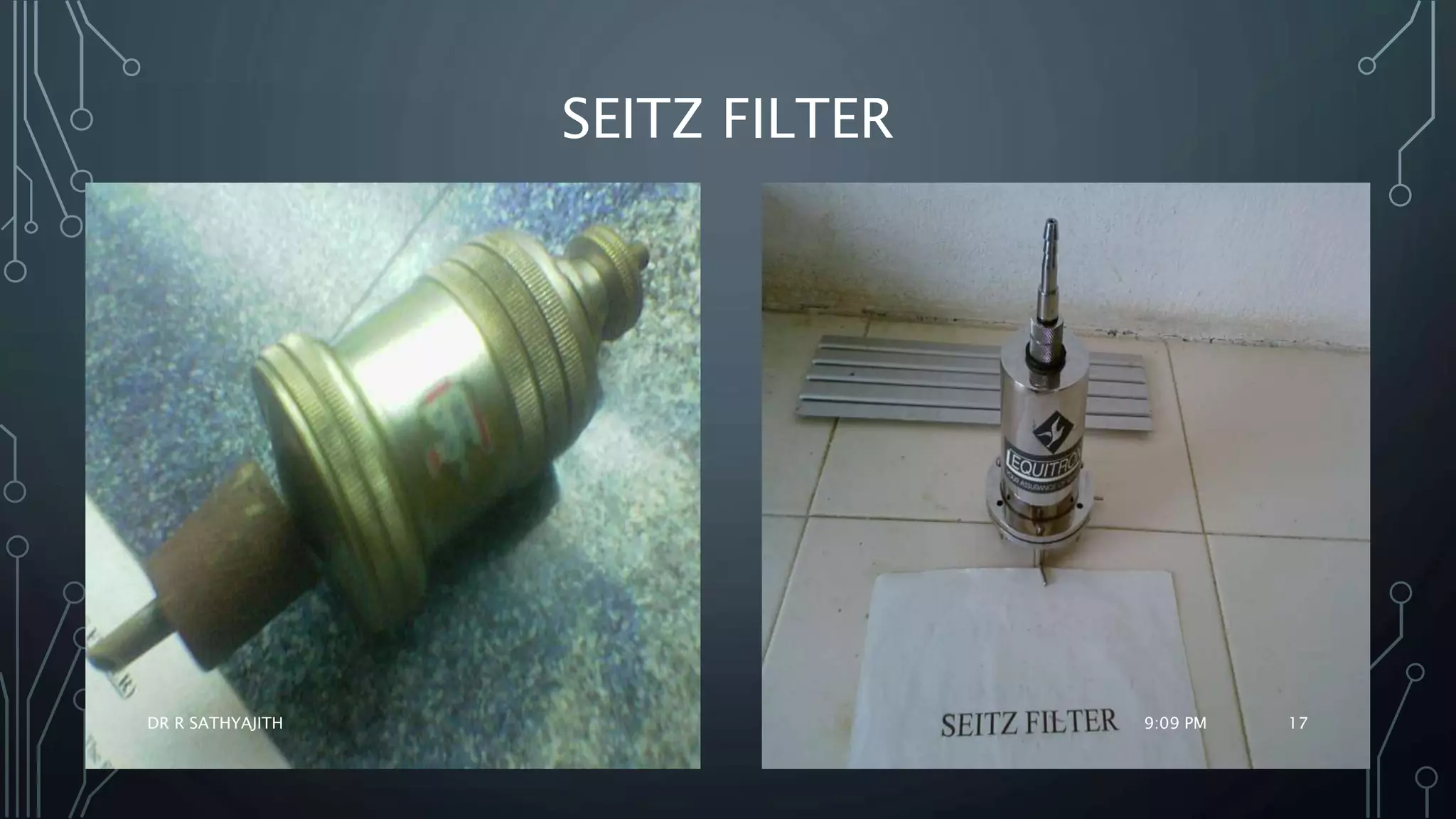
ASBESTOS FILTER
• Disposable, single use discs
• Filter disk is made up of asbestos (Mg trisilicate)
• High adsorbing capacity
• Alkalinize filtered fluid.
• Carcinogenic potential of asbestos has discouraged its
use
• E.g. Seitz filter, Carlson & Sterimat 169:09 PMDR R SATHYAJITH
SEITZ FILTER
179:09 PMDR R SATHYAJITH
SINTERED GLASS FILTER
• Sintered glass is a glass mesh used for filtration
• Prepared by heat fusing finely powdered glass
particles
• Pore size can be controlled by particle size of the
glass powder
• Easy to clean
• Low absorption properties
• Cons - Fragile & expensive
189:09 PMDR R SATHYAJITH
SINTERED GLASS FILTER
199:09 PMDR R SATHYAJITH
MEMBRANE FILTER
• Consists of polymeric material like cellulose nitrate,
cellulose diacetate, polycarbonate & polyester.
• Made as disks from 13-293mm diameter & 0.015-
12mcm porosities
• Average pore diameter (APD) 0.22mcm MC used in
sterilization
209:09 PMDR R SATHYAJITH
MEMBRANE FILTER
219:09 PMDR R SATHYAJITH
MEMBRANE FILTER
229:09 PMDR R SATHYAJITH
MEMBRANE FILTER
• Uses
Water purification & analysis
Sterilization & sterility testing
Preparation of sterile solutions for parenteral use
Bacterial count of water – Known amount of water is
filtered & the membrane disk is placed upside down
on a culture medium & incubated & colonies are
counted to know the viable count 239:09 PMDR R SATHYAJITH
SYRINGE FILTERS
• Membrane of 13-25mm diameter is fitted into syringe
like holders of stainless steel or polycarbonate
• For sterilization, the fluid is forced through the disk
membrane by pressing the piston of the syringe.
249:09 PMDR R SATHYAJITH
SYRINGE FILTERS
259:09 PMDR R SATHYAJITH
VACUUM & IN-LINE FILTERS
• Membrane diameter of 25 & 45mm are used
• In-line filter holder of Teflon or stainless steel &
aluminium
• Vacuum holders of borosilicate glass, polycarbonate
or stainless steel
• Used for sterilizing large volumes of liquids
269:09 PMDR R SATHYAJITH
VACUUM FILTERS
279:09 PMDR R SATHYAJITH
IN-LINE FILTERS
289:09 PMDR R SATHYAJITH
PRESSURE FILTERS
• Large membranes 100-293mm in diameter or filter
cartridges are used
• Housed in pressure filter holders
• Used for very pure water for lab use
• If fitted with Teflon filter, then autoclavable with filter
in situ
299:09 PMDR R SATHYAJITH
PRESSURE FILTERS
309:09 PMDR R SATHYAJITH
AIR FILTERS
• HEPA – High efficiency particulate filters
Large volumes of air can be rapidly freed from
infection by passage through them
Remove fine particles of size 0.3mcm or larger
Widely used in laminar air flow (LAF)
cabinets/chambers
Available in different efficiencies from 95.0% to
99.997% depending on the need
Do not filter out gasses, chemical vapors and odor
molecules
319:09 PMDR R SATHYAJITH
HEPA IN LAF SAFETY CABINET
9:09 PM 32
Supply
HEPA
filter
Exhaust
HEPA
filter
High-velocity
air barrier
Safety
glass
viewscree
n
DR R SATHYAJITH
HEPA
• First used to remove radioactive contaminants from
the air in the development of the atomic bomb
• Working with hazardous items such as the HIV virus,
TB bacilli & other lethal bacteria and viruses for the
sake of research requires HEPA filtration
• Medical-use HEPA filtration systems also incorporate
high-energy ultra-violet light units to kill off the live
bacteria and viruses trapped by the filter media
339:09 PMDR R SATHYAJITH
HEPA
349:09 PMDR R SATHYAJITH
HEPA
359:09 PMDR R SATHYAJITH
RADIATION - NONIONIZING
• 2 types – IR & UV
• Effectiveness of UV related to its wavelength
• Most effective is 240-280nm range
• Produced artificially by mercury vapor lamp
• Unlike ionizing radiation, energy of UV is lower &
penetration power is poor
• Does not penetrate glass, dirt films, water etc.
369:09 PMDR R SATHYAJITH
RADIATION – NONIONIZING UV
379:09 PMDR R SATHYAJITH
RADIATION – NONIONIZING UV
• Microbial sensitivity to UV radiation
 Bacterial spores are more resistant than vegetative
cells
 Viruses are inactivated & are more sensitive than
spores
 HIV not inactivated
• Practical uses
Disinfect water
Disinfect closed areas like OT, wards, labs &
389:09 PMDR R SATHYAJITH
RADIATION – NONIONIZING UV
399:09 PMDR R SATHYAJITH
RADIATION – NONIONIZING UV
UV light sterilization offers great potential for
tackling HAI’s or Healthcare Associated Infections
transmitted through the surrounding environments of
the healthcare institutions.
 Effective against – MRSA, VRE, C. difficile, A.
baumannii, ESBL, Influenza virus A.
 Disadvantages – Uninterrupted line of sight required
– Production of ozone
409:09 PMDR R SATHYAJITH
RADIATION – NONIONIZING UV
419:09 PMDR R SATHYAJITH
RADIATION - NONIONIZING
• Hazards of UV – Burns skin & damages eyes
– Human exposure should be avoided
• Infrared
IR can be considered a form of hot air sterilization
Used for rapid mass sterilization of prepacked items
like syringes & catheters
429:09 PMDR R SATHYAJITH
RADIATION – NONIONIZING IR
• Bacti – Cinerator (IR
Sterilizer)
• Sterilizes needles, loops,
and mouth of culture tube,
small bottle in 5-7 seconds
at optimum sterilizing
temperature above 800° C
• Maximum temperature
towards 930º C.
439:09 PMDR R SATHYAJITH
RADIATION – NONIONIZING IR
449:09 PMDR R SATHYAJITH
RADIATION – IONISING
• Very high penetrating power
• Highly lethal to all cells – Humans/ Bacteria
• Causes structural defects in microbial DNA synthesis
leading to cell death
• Bacterial spores are resistant
• E.g. X-rays, Gamma rays & cosmic rays.
459:09 PMDR R SATHYAJITH
RADIATION – IONISING GAMMA
469:09 PMDR R SATHYAJITH
RADIATION – IONISING RADIATION
• Cold sterilization
No appreciable increase in temperature
Commercial plants use gamma rays emitted from
radioactive elements like Cobalt 60
• Uses – Sterilizing in pharmacy & medicine (Abx,
hormones, sutures, vaccines) / packaged disposable
articles ( IV lines, catheter, syringes, Gloves)
479:09 PMDR R SATHYAJITH
ULTRASONIC & SONIC VIBRATIONS
• Have bactericidal properties
• Effects variable on different bacteria
• Unreliable & of no practical value in medicine
• Sometimes used for fine cleaning to remove
soil from joints, crevices, lumens and other
difficult to clean areas
489:09 PMDR R SATHYAJITH
ULTRASONIC STERILIZERS
499:09 PMDR R SATHYAJITH
HEAT
• Most reliable
• Universally applicable
• Method of choice – whenever applicable
• 2 types – Dry & Moist
• Materials damaged by heat – Sterilized at low
temperature or longer periods or repeated cycles
• Recommended minimum holding time does not
include the time taken to reach the specified
temperature 509:09 PMDR R SATHYAJITH
DECIMAL REDUCTION TIME (DRT)
• DRT also called D-value refers to the time required at
a certain temperature to kill 90% of the organisms
being studied
• Thus after a colony is reduced by 1 D, only 10% of the
original organisms remain.
• E.g. if a organism is reduced by 90% after exposure to
temperatures of 300° F for 20 minutes, the D-value
would be written as D300F = 20 minutes
• Sterilization-resistant organism are given a unique D-
value
519:09 PMDR R SATHYAJITH
DRT
9:09 PM 52DR R SATHYAJITH
Z VALUE
• Used in thermal death time calculations
• The z-value of an organism is the temperature, in
degrees (Fahrenheit or Celsius), that is required for
the thermal destruction curve to move one log cycle
• Simply, temperature required for one log reduction in
the D-value
539:09 PMDR R SATHYAJITH
Z VALUE
549:09 PMDR R SATHYAJITH
D-VALUE & Z-VALUE
• The Z-value is 10, D-value is 4.5 minutes at 150°F,
what is the D-value for 160°F ?
• The new D-value is 0.45 minutes
• This means that each 10°F increase in temperature will
reduce our D-value by 1 log.
• Conversely, a 10°F decrease in temperature will
increase our D-value by 1 log. So, the D-value for a
temperature of 140°F would be 45 minutes.
559:09 PMDR R SATHYAJITH
HEAT – FACTORS INFLUENCING
• Nature of heat
 Dry or Moist
• Temperature & Time
 Time required is inversely proportional to
temperature
 Thermal death time (TDT) – Minimum time required
to kill a suspension of organisms at a predetermined
temperature in a specified environment 569:09 PMDR R SATHYAJITH
HEAT – FACTORS INFLUENCING
• Number of microbes
 More number of microbes there are to begin with, longer
it takes to eliminate the entire population
• Characteristics of organisms
 Vegetative bacteria & virus are more susceptible & spores
are more resistant.
• Nature of contaminated material
 Presence of organic substances, proteins, nucleic acid,
starch, fats & oils, increase the TDT
 High acid/ alkaline pH increases bacterial killing 579:09 PMDR R SATHYAJITH
HEAT - MOA
• Dry heat
 Protein denaturation
 Oxidative damage
 High electrolyte level toxicity
• Moist heat
 Coagulation & Denaturation of enzymes/ structural
proteins
589:09 PMDR R SATHYAJITH
RED HEAT - FLAMING
• Red heat - Item to sterilized are held almost vertically
in a Bunsen flame until red hot along their whole
length, almost up to the tip of their metal holder.
• Items sterilized by red heat –
 Inoculating wire loops
 Points of forceps
• Flaming – Only exposed to the flame for a few
seconds & not heating to red hot. E.g Scalpel blades,
glass slides, mouth of culture tubes 599:09 PMDR R SATHYAJITH
RED HEAT
609:09 PMDR R SATHYAJITH
FLAMING
619:09 PMDR R SATHYAJITH
DRY HEAT - INCINERATION
• Excellent & safe method
• Material destroyed completely – reduced to ashes
• Very high temperatures reached
• Used for – Pathological wastes, surgical dressing,
animal carcasses, plastics like PVC/ polythene
• Avoid – Materials made of polystyrene as they emit
black dense smoke
629:09 PMDR R SATHYAJITH
INCINERATOR
639:09 PMDR R SATHYAJITH
DRY HEAT – HOT AIR OVEN
649:09 PMDR R SATHYAJITH
DRY HEAT – HOT AIR OVEN
• Most widely used method by dry heat
• Used - When can withstand high temperatures & when
affected by contact with steam
• Parts – Electric heater, Fan to provide forced air
circulation, Temperature indicator, Control thermostat
& timer, Open mesh shelving, Heating coils on
wall/floor & adequate wall insulation – Inner layer
poor conductor & outer metallic
659:09 PMDR R SATHYAJITH
DRY HEAT – HOT AIR OVEN
669:09 PMDR R SATHYAJITH
DRY HEAT – HOT AIR OVEN
• Preparation of load
 No overloading – to allow free circulation of air
 Articles should be thoroughly clean & perfectly dry
 Test tubes & flasks – Should be wrapped in paper
 Avoid – Rubber except silicon, Cotton plugs, Plastics
679:09 PMDR R SATHYAJITH
DRY HEAT – HOT AIR OVEN
• Sterilizing cycle
 Sterilization hold time – It is set to 160o C for 2hours
or 170o C for 1hour or 180o C for 30min
 Cutting instruments like used in ophthalmic surgery
should be sterilized at 150o C for 2hours
 Oils, glycerols & dusting powder holding time
recommended is 150o C for 1hour.
689:09 PMDR R SATHYAJITH
HOT AIR OVEN - USES
• Cooling takes several hours – Open the door after
chamber & load have cooled below 80o C or else
glassware will crack
 Glassware such as tubes, flasks, all glass syringes,
petri dishes, pipettes.
 Metal instruments like forceps, scissors & scalpels
 Nonaqueous materials & powders, oils & greases in
sealed containers, swab sticks placed in test tubes 699:09 PMDR R SATHYAJITH
HOT AIR OVEN - STERILIZATION CONTROLS
• Biological control
An envelope containing filter paper strip impregnated
with 106 spores of Bacillus atrophaeus (formerly
Bacillus subtilis subsp niger) is inserted
 Non toxigenic strains of Clostridium tetani can be
also used
 After sterilization, strips are removed & inoculated
into tryptone soy broth/Cooked Meat media
 Incubated anaerobically at 37o C for 5days 709:09 PMDR R SATHYAJITH
BACILLUS ATROPHAEUS
9:09 PM 71DR R SATHYAJITH
HOT AIR OVEN - STERILIZATION CONTROLS
• Chemical indicators
 Browne’s tubes No. 3 containing red solution is
inserted
 Color change from red to green indicates proper
sterilization
• Thermocouples
 May be used periodically
729:09 PMDR R SATHYAJITH
HOT AIR OVEN - STERILIZATION CONTROLS
739:09 PMDR R SATHYAJITH
HOT AIR OVEN VS AUTOCLAVE
• Safe – No water used & no pressure build up inside
• Smaller – But as effective as autoclave
• Cheaper – Suitable for small laboratory
• Rapid – also higher temperatures reached
• Dry heat penetrates more slowly
749:09 PMDR R SATHYAJITH
DRY HEAT – MICROWAVE OVEN
• Heating effect if not uniform
• Not reliable method for strerilization
759:09 PMDR R SATHYAJITH
MOIST HEAT
• Temp below 100o C
 Pasteurization
 Inspissation
 Water bath
 Vaccine preparation
• Temp at 100o C
Boiling
Koch & Arnold
steamer
Tyndallization
• Temp above 100oC
 Autoclave
769:09 PMDR R SATHYAJITH
PASTEURIZATION
• Used in dairy industry for milk
• All non sporing pathogens like Mycobacteria, Brucella
& Salmonella are destroyed
• Coxiella burnetii is relatively heat resistant & may
survive holder method
• All f/b rapid cooling to <13o C
779:09 PMDR R SATHYAJITH
PASTEURIZATION
9:09 PM 78DR R SATHYAJITH
PASTEURIZATION
• Holder method – 60o C for 30min
• Flash method/ High temperature short term (HTST) –
72o C for 15-20sec
• Higher-Heat Shorter Time (HHST) – 90o C for 0.5sec
• Ultra high temperature (UHT) sterilization – 140-150o
C for 1-3sec, Shelf stable
Source - International dairy food association (IDFA) guidelines
799:09 PMDR R SATHYAJITH
INSPISSATION
• Literally means the process of thickening by
dehydration
• Also called fractional sterilization
• Used when heating high-protein (Egg) containing
culture media like Lowenstein-Jenson & Loeffler’s
serum slope.
• Heated at 80o C for 30min (2hrs*) on 3 successive
days
• Arnold’s inspissator used* Handbook of Media for Clinical Microbiology By James W. Snyder, Ronald M. Atlas
809:09 PMDR R SATHYAJITH
INSPISSATOR
819:09 PMDR R SATHYAJITH
WATER BATH
• Washing or rinsing laundry or eating utensils at 70-
80o C for few minutes will kill most non sporing
microorganisms
829:09 PMDR R SATHYAJITH
BOILING
• Boiling at 100o C for 10-30min kill all vegetative
forms
• Sporing bacteria require prolonged periods of boiling
• Hard water should not be used
• Adding 2% NaHCo3 increases efficacy
• Not recommended for sterilization, only means of
disinfection
 Disinfection of surgical instruments before sterilizing
 Disinfection in field conditions & when sterility not
839:09 PMDR R SATHYAJITH
BOILING
849:09 PMDR R SATHYAJITH
TYNDALLIZATION
• Fractional/ Intermittent sterilization
• Boiling & exposure to steam at 100o C for 20min for 3
consecutive days
• Used for heat sensitive culture media
• 1st day – Vegetative cells, 2nd day – Early germinating
spores, 3rd day – Late germinating spores
• Failure to kill some anaerobic spores & thermophiles.
• Works for broth media that supports the growth of
spores & not water
859:09 PMDR R SATHYAJITH
KOCH & ARNOLD STEAMER
869:09 PMDR R SATHYAJITH
MOIST HEAT - AUTOCLAVE
• Process of sterilization using saturated steam under
high pressure above 100o C
• Principle – water boils when its vapor pressure equals
that of surrounding atmosphere.
• When pressure inside a closed vessel increases, the
temperature at which water boils also increases
• Steam condenses to water & gives up its latent heat to
the cooler surface it comes in contact with. Energy
available from this latent heat is considerable
879:09 PMDR R SATHYAJITH
AUTOCLAVE - PARTS
• Vertical/ Horizontal
• Stainless steel/ Gun metal
• Screw clamps to fasten lid
• Airtight by washer
• Heated by gas/ electricity
889:09 PMDR R SATHYAJITH
AUTOCLAVES - TYPES
1.Steam jacketed autoclave:
Double walled chamber in which steam at 121 degree
is introduced from an external source.
Steam enters the jacket from which it enters the
chamber migrating downwards replacing the air which
is expelled through a discharge tap at the bottom.
2. Flash autoclaves:
It sterilizes at 134 degree for 3 – 5 minutes.
Used in operation rooms in emergency situations.9:09 PM 89DR R SATHYAJITH
AUTOCLAVE PROCEDURE
909:09 PMDR R SATHYAJITH
AUTOCLAVE
9:09 PM 91DR R SATHYAJITH
AUTOCLAVE PROCEDURE
1.Sufficient water is put in the cylinder.
2.Articles are kept above the perforated shelf
3.Lid is screwed tight
4.Autoclave is heated
5.Discharge tap is kept open
6.Safety valve is adjusted to required pressure
7.Steam-air mixture is allowed to escape freely till all
air is displaced 929:09 PMDR R SATHYAJITH
AUTOCLAVE PROCEDURE
8. Discharge tap closed
9. Steam pressure rises inside
10. Safety valve opens when it reaches the desired set
level (15psi)
11. Excess steam escapes
12. Holding period calculated from now (15min)
13. Heater turned off when holding period over.
14. Cool the autoclave till pressure inside equals
atmospheric pressure
15. Discharge tap is open & later lid is opened & items
939:09 PMDR R SATHYAJITH
AUTOCLAVE - PRECAUTIONS
• Air must be allowed to escape from the chamber
because the temperature of air-steam mixture is lower
than that of pure steam
• If the discharge tap is opened when pressure inside is
high, liquid media will boil violently & spill from the
container & can also explode
• If discharge tap is opened after pressure inside has
fallen below atmospheric pressure, excessive water
would have evaporated & lost from the media
• Material to be arranged to ensure free circulation of
steam inside the chamber
949:09 PMDR R SATHYAJITH
AUTOCLAVE - USES
• MOA – Bacterial proteins coagulates & condensed
water ensures moist condition fro killing
• Sterilizing culture media, aqueous solutions, rubber
materials, dressing materials, gowns, dressing, linen,
gloves, instruments & pharmaceutical products
• For all materials that are water containing, permeable
or wettable
• Useful for materials unable to withstand higher
temperature of hot air. 959:09 PMDR R SATHYAJITH
AUTOCLAVES - CONTROLS
• Filter paper strip impregnated in 104 spores of
Geobacillus stearothermophilus (ATCC 7953) used
• Placed in least accessible & coolest part
• Inoculated in TSB & incubated at 56o C for 5days
• It withstands 121o C for upto 12min
969:09 PMDR R SATHYAJITH
AUTOCLAVES - CONTROLS
9:09 PM 97
Cap that
allows
steam to
penetrate
Flexible
plastic
vial
Crushable
glass
ampule
Nutrient
medium
containing pH
color indicator
Endospore strip
After autoclaving,
flexible
vial is squeezed to
break
ampule and release
medium onto spore
strip.
Yellow
medium
means spores
are
viable;
autoclaved
objects are not
sterile.
Red medium
means spores
were
killed; autoclaved
objects are
sterile.
DR R SATHYAJITH
AUTOCLAVES - CONTROLS
• Self adhesive sterilisation
indicator tape with bands that
turn dark brown. Supplied in 19
or 25mm widths.
• Paper sterilizer control strips
with a heat sensitive colored dot
that changes from yellow to
purple.
989:09 PMDR R SATHYAJITH
AUTOCLAVE VS HOT AIR OVEN
• More lethal – action of moist heat
• Quicker in heating up articles
• Greater penetration of porous material like cotton
plugs, paper & cloth wrappers, surgical linen, hollow
apparatus.
999:09 PMDR R SATHYAJITH
REFERENCES
• Seymour S. Block: Disinfection, sterilization and
preservation, Williams &Wilkins (ISBN 0812113640)
• CDC guideline for disinfection and sterilization in
healthcare facilities
http://www.cdc.gov/hicpac/pdf/guidelines/Disinfection_Nov_2008.pdf
• Textbook of microbiology, Surinder kumar, Jaypee
• Textbook of microbiology, Ananthanarayan &
Panicker, 9th Ed 9:09 PM 100DR R SATHYAJITH
THANK YOU
1019:09 PMDR R SATHYAJITH

Sterilization and Disinfection

  • 1.
    STERILIZATION & DISINFECTION DR RSATHYAJITH 19:09 PMDR R SATHYAJITH
  • 2.
    STERILIZATION • Latin sterilismeans unable to produce offspring or barren • Process by which an “article, surface or medium is freed of all living organisms either in vegetative or spore state” • When done using a chemical agent, it is referred to as ‘Sterilant’ • Generally, it implies physical process rather than 29:09 PMDR R SATHYAJITH
  • 3.
    DISINFECTION & ANTISEPTICS •Disinfection is the killing, inhibition or removal of all pathogenic organisms or organisms capable of causing infections. • Antiseptics are chemical disinfectants that can be safely applied to the skin & mucous membrane. They are used to prevent infections by killing or inhibiting pathogenic growth. • Antiseptics also reduce total microbial population and are less toxic as disinfectants. 39:09 PMDR R SATHYAJITH
  • 4.
    COMMON TERMS • Bactericidalagents or germicides are those that can kill bacteria. • Bacteriostatic agents – prevent multiplication of bacteria, which may remain alive. A chemical which is bactericidal at a particular concentration may only be bacteriostatic at higher dilutions • Decontamination is the process of rendering an article or area free of danger from contaminants, including microbial, chemical, radioactive & other hazards. • Cleaning - A process that removes foreign material 49:09 PMDR R SATHYAJITH
  • 5.
    STERILIZATION AND DISINFECTION •Importance - Safety in the laboratory. The patient safety depends on using proper methods of sterilization to prepare instruments, needles, IV fluids. The accuracy and validity of microbiological tests. 9:09 PM 5DR R SATHYAJITH
  • 6.
    METHODS OF STERILIZATION •Physical methods 1.Sunlight 2.Drying 3.Heat 4.Filtration 5.Radiation 6.Ultrasonic & sonic vibrations • Dry heat a)Incineration b)Red heat c)Flaming d)Hot air sterilizers e)Microwave ovens • Moist heat a)Pasteurization b)Boiling c)Steam under normal pressure d)Steam under pressure69:09 PMDR R SATHYAJITH
  • 7.
    SUNLIGHT • Role inspontaneous sterilization under natural conditions • Has appreciable bactericidal properties • Bacteria suspended in water are readily destroyed on exposure. • Disinfectant action primarily due to UV rays & also heat rays. • Under natural conditions sterilizing power varies according to circumstances. • UV rays are screened out by glass or impurities/ 79:09 PMDR R SATHYAJITH
  • 8.
    DRYING • Moisture isessential for growth of bacteria • 80% of bacterial cell weight is water • Drying hence has a deleterious effect • Unreliable & of theoretical interest only • Spores are not affected 89:09 PMDR R SATHYAJITH
  • 9.
    REFRIGERATION • Refrigeration 5oC • Freezing -20o C • Ordinary refrigeration has a bacteriostatic effect, but does not kill, metabolic rate of some microbes is so reduced that they cannot reproduce or synthesize toxins • Growth of pathogenic bacteria slows down at refrigerator temperature & can be used to preserve microorganisms 99:09 PMDR R SATHYAJITH
  • 10.
    FILTRATION • Filtration iscommonly the mechanical operation which is used for the separation of microbes from fluids (liquids or gases) by interposing a medium through which only the fluid can pass. • Different from Sieving/ Adsorption 109:09 PMDR R SATHYAJITH
  • 11.
    FILTRATION - USES •Heat sensitive solutions – For sterilization of pharmaceuticals, ophthalmic solutions, culture media, oils, antibiotics etc. • Separation of bacteriophages & bacterial toxins from bacteria • Isolating organisms which are scanty in fluids • Concentration of bacteria from liquids • Isolation of viruses – pore size of 0.22mcm most virus & Mycoplasma pass through. 119:09 PMDR R SATHYAJITH
  • 12.
    FILTERS - TYPES •Earthwarefilters •Asbestos filters •Sintered glass filters •Membrane filters •Syringe filters •Vacuum & ‘In-line’ filters • Pressure filters • Air filters 129:09 PMDR R SATHYAJITH
  • 13.
    EARTHWARE/CANDLE FILTERS • Availablein different grades of porosity • Used for purification of water – Industrial & Drinking • Fluid is forced by suction or pressure from inside to outside or vice versa • After use sterilized by scrubbing with stiff brush - boiling – autoclaving Unglazed ceramic filters (Chamberland & Doulton) Compressed diatomaceous earth filters (Berkefeld & Mandler) 139:09 PMDR R SATHYAJITH
  • 14.
  • 15.
  • 16.
    ASBESTOS FILTER • Disposable,single use discs • Filter disk is made up of asbestos (Mg trisilicate) • High adsorbing capacity • Alkalinize filtered fluid. • Carcinogenic potential of asbestos has discouraged its use • E.g. Seitz filter, Carlson & Sterimat 169:09 PMDR R SATHYAJITH
  • 17.
  • 18.
    SINTERED GLASS FILTER •Sintered glass is a glass mesh used for filtration • Prepared by heat fusing finely powdered glass particles • Pore size can be controlled by particle size of the glass powder • Easy to clean • Low absorption properties • Cons - Fragile & expensive 189:09 PMDR R SATHYAJITH
  • 19.
  • 20.
    MEMBRANE FILTER • Consistsof polymeric material like cellulose nitrate, cellulose diacetate, polycarbonate & polyester. • Made as disks from 13-293mm diameter & 0.015- 12mcm porosities • Average pore diameter (APD) 0.22mcm MC used in sterilization 209:09 PMDR R SATHYAJITH
  • 21.
  • 22.
  • 23.
    MEMBRANE FILTER • Uses Waterpurification & analysis Sterilization & sterility testing Preparation of sterile solutions for parenteral use Bacterial count of water – Known amount of water is filtered & the membrane disk is placed upside down on a culture medium & incubated & colonies are counted to know the viable count 239:09 PMDR R SATHYAJITH
  • 24.
    SYRINGE FILTERS • Membraneof 13-25mm diameter is fitted into syringe like holders of stainless steel or polycarbonate • For sterilization, the fluid is forced through the disk membrane by pressing the piston of the syringe. 249:09 PMDR R SATHYAJITH
  • 25.
  • 26.
    VACUUM & IN-LINEFILTERS • Membrane diameter of 25 & 45mm are used • In-line filter holder of Teflon or stainless steel & aluminium • Vacuum holders of borosilicate glass, polycarbonate or stainless steel • Used for sterilizing large volumes of liquids 269:09 PMDR R SATHYAJITH
  • 27.
  • 28.
  • 29.
    PRESSURE FILTERS • Largemembranes 100-293mm in diameter or filter cartridges are used • Housed in pressure filter holders • Used for very pure water for lab use • If fitted with Teflon filter, then autoclavable with filter in situ 299:09 PMDR R SATHYAJITH
  • 30.
  • 31.
    AIR FILTERS • HEPA– High efficiency particulate filters Large volumes of air can be rapidly freed from infection by passage through them Remove fine particles of size 0.3mcm or larger Widely used in laminar air flow (LAF) cabinets/chambers Available in different efficiencies from 95.0% to 99.997% depending on the need Do not filter out gasses, chemical vapors and odor molecules 319:09 PMDR R SATHYAJITH
  • 32.
    HEPA IN LAFSAFETY CABINET 9:09 PM 32 Supply HEPA filter Exhaust HEPA filter High-velocity air barrier Safety glass viewscree n DR R SATHYAJITH
  • 33.
    HEPA • First usedto remove radioactive contaminants from the air in the development of the atomic bomb • Working with hazardous items such as the HIV virus, TB bacilli & other lethal bacteria and viruses for the sake of research requires HEPA filtration • Medical-use HEPA filtration systems also incorporate high-energy ultra-violet light units to kill off the live bacteria and viruses trapped by the filter media 339:09 PMDR R SATHYAJITH
  • 34.
  • 35.
  • 36.
    RADIATION - NONIONIZING •2 types – IR & UV • Effectiveness of UV related to its wavelength • Most effective is 240-280nm range • Produced artificially by mercury vapor lamp • Unlike ionizing radiation, energy of UV is lower & penetration power is poor • Does not penetrate glass, dirt films, water etc. 369:09 PMDR R SATHYAJITH
  • 37.
    RADIATION – NONIONIZINGUV 379:09 PMDR R SATHYAJITH
  • 38.
    RADIATION – NONIONIZINGUV • Microbial sensitivity to UV radiation  Bacterial spores are more resistant than vegetative cells  Viruses are inactivated & are more sensitive than spores  HIV not inactivated • Practical uses Disinfect water Disinfect closed areas like OT, wards, labs & 389:09 PMDR R SATHYAJITH
  • 39.
    RADIATION – NONIONIZINGUV 399:09 PMDR R SATHYAJITH
  • 40.
    RADIATION – NONIONIZINGUV UV light sterilization offers great potential for tackling HAI’s or Healthcare Associated Infections transmitted through the surrounding environments of the healthcare institutions.  Effective against – MRSA, VRE, C. difficile, A. baumannii, ESBL, Influenza virus A.  Disadvantages – Uninterrupted line of sight required – Production of ozone 409:09 PMDR R SATHYAJITH
  • 41.
    RADIATION – NONIONIZINGUV 419:09 PMDR R SATHYAJITH
  • 42.
    RADIATION - NONIONIZING •Hazards of UV – Burns skin & damages eyes – Human exposure should be avoided • Infrared IR can be considered a form of hot air sterilization Used for rapid mass sterilization of prepacked items like syringes & catheters 429:09 PMDR R SATHYAJITH
  • 43.
    RADIATION – NONIONIZINGIR • Bacti – Cinerator (IR Sterilizer) • Sterilizes needles, loops, and mouth of culture tube, small bottle in 5-7 seconds at optimum sterilizing temperature above 800° C • Maximum temperature towards 930º C. 439:09 PMDR R SATHYAJITH
  • 44.
    RADIATION – NONIONIZINGIR 449:09 PMDR R SATHYAJITH
  • 45.
    RADIATION – IONISING •Very high penetrating power • Highly lethal to all cells – Humans/ Bacteria • Causes structural defects in microbial DNA synthesis leading to cell death • Bacterial spores are resistant • E.g. X-rays, Gamma rays & cosmic rays. 459:09 PMDR R SATHYAJITH
  • 46.
    RADIATION – IONISINGGAMMA 469:09 PMDR R SATHYAJITH
  • 47.
    RADIATION – IONISINGRADIATION • Cold sterilization No appreciable increase in temperature Commercial plants use gamma rays emitted from radioactive elements like Cobalt 60 • Uses – Sterilizing in pharmacy & medicine (Abx, hormones, sutures, vaccines) / packaged disposable articles ( IV lines, catheter, syringes, Gloves) 479:09 PMDR R SATHYAJITH
  • 48.
    ULTRASONIC & SONICVIBRATIONS • Have bactericidal properties • Effects variable on different bacteria • Unreliable & of no practical value in medicine • Sometimes used for fine cleaning to remove soil from joints, crevices, lumens and other difficult to clean areas 489:09 PMDR R SATHYAJITH
  • 49.
  • 50.
    HEAT • Most reliable •Universally applicable • Method of choice – whenever applicable • 2 types – Dry & Moist • Materials damaged by heat – Sterilized at low temperature or longer periods or repeated cycles • Recommended minimum holding time does not include the time taken to reach the specified temperature 509:09 PMDR R SATHYAJITH
  • 51.
    DECIMAL REDUCTION TIME(DRT) • DRT also called D-value refers to the time required at a certain temperature to kill 90% of the organisms being studied • Thus after a colony is reduced by 1 D, only 10% of the original organisms remain. • E.g. if a organism is reduced by 90% after exposure to temperatures of 300° F for 20 minutes, the D-value would be written as D300F = 20 minutes • Sterilization-resistant organism are given a unique D- value 519:09 PMDR R SATHYAJITH
  • 52.
    DRT 9:09 PM 52DRR SATHYAJITH
  • 53.
    Z VALUE • Usedin thermal death time calculations • The z-value of an organism is the temperature, in degrees (Fahrenheit or Celsius), that is required for the thermal destruction curve to move one log cycle • Simply, temperature required for one log reduction in the D-value 539:09 PMDR R SATHYAJITH
  • 54.
    Z VALUE 549:09 PMDRR SATHYAJITH
  • 55.
    D-VALUE & Z-VALUE •The Z-value is 10, D-value is 4.5 minutes at 150°F, what is the D-value for 160°F ? • The new D-value is 0.45 minutes • This means that each 10°F increase in temperature will reduce our D-value by 1 log. • Conversely, a 10°F decrease in temperature will increase our D-value by 1 log. So, the D-value for a temperature of 140°F would be 45 minutes. 559:09 PMDR R SATHYAJITH
  • 56.
    HEAT – FACTORSINFLUENCING • Nature of heat  Dry or Moist • Temperature & Time  Time required is inversely proportional to temperature  Thermal death time (TDT) – Minimum time required to kill a suspension of organisms at a predetermined temperature in a specified environment 569:09 PMDR R SATHYAJITH
  • 57.
    HEAT – FACTORSINFLUENCING • Number of microbes  More number of microbes there are to begin with, longer it takes to eliminate the entire population • Characteristics of organisms  Vegetative bacteria & virus are more susceptible & spores are more resistant. • Nature of contaminated material  Presence of organic substances, proteins, nucleic acid, starch, fats & oils, increase the TDT  High acid/ alkaline pH increases bacterial killing 579:09 PMDR R SATHYAJITH
  • 58.
    HEAT - MOA •Dry heat  Protein denaturation  Oxidative damage  High electrolyte level toxicity • Moist heat  Coagulation & Denaturation of enzymes/ structural proteins 589:09 PMDR R SATHYAJITH
  • 59.
    RED HEAT -FLAMING • Red heat - Item to sterilized are held almost vertically in a Bunsen flame until red hot along their whole length, almost up to the tip of their metal holder. • Items sterilized by red heat –  Inoculating wire loops  Points of forceps • Flaming – Only exposed to the flame for a few seconds & not heating to red hot. E.g Scalpel blades, glass slides, mouth of culture tubes 599:09 PMDR R SATHYAJITH
  • 60.
  • 61.
  • 62.
    DRY HEAT -INCINERATION • Excellent & safe method • Material destroyed completely – reduced to ashes • Very high temperatures reached • Used for – Pathological wastes, surgical dressing, animal carcasses, plastics like PVC/ polythene • Avoid – Materials made of polystyrene as they emit black dense smoke 629:09 PMDR R SATHYAJITH
  • 63.
  • 64.
    DRY HEAT –HOT AIR OVEN 649:09 PMDR R SATHYAJITH
  • 65.
    DRY HEAT –HOT AIR OVEN • Most widely used method by dry heat • Used - When can withstand high temperatures & when affected by contact with steam • Parts – Electric heater, Fan to provide forced air circulation, Temperature indicator, Control thermostat & timer, Open mesh shelving, Heating coils on wall/floor & adequate wall insulation – Inner layer poor conductor & outer metallic 659:09 PMDR R SATHYAJITH
  • 66.
    DRY HEAT –HOT AIR OVEN 669:09 PMDR R SATHYAJITH
  • 67.
    DRY HEAT –HOT AIR OVEN • Preparation of load  No overloading – to allow free circulation of air  Articles should be thoroughly clean & perfectly dry  Test tubes & flasks – Should be wrapped in paper  Avoid – Rubber except silicon, Cotton plugs, Plastics 679:09 PMDR R SATHYAJITH
  • 68.
    DRY HEAT –HOT AIR OVEN • Sterilizing cycle  Sterilization hold time – It is set to 160o C for 2hours or 170o C for 1hour or 180o C for 30min  Cutting instruments like used in ophthalmic surgery should be sterilized at 150o C for 2hours  Oils, glycerols & dusting powder holding time recommended is 150o C for 1hour. 689:09 PMDR R SATHYAJITH
  • 69.
    HOT AIR OVEN- USES • Cooling takes several hours – Open the door after chamber & load have cooled below 80o C or else glassware will crack  Glassware such as tubes, flasks, all glass syringes, petri dishes, pipettes.  Metal instruments like forceps, scissors & scalpels  Nonaqueous materials & powders, oils & greases in sealed containers, swab sticks placed in test tubes 699:09 PMDR R SATHYAJITH
  • 70.
    HOT AIR OVEN- STERILIZATION CONTROLS • Biological control An envelope containing filter paper strip impregnated with 106 spores of Bacillus atrophaeus (formerly Bacillus subtilis subsp niger) is inserted  Non toxigenic strains of Clostridium tetani can be also used  After sterilization, strips are removed & inoculated into tryptone soy broth/Cooked Meat media  Incubated anaerobically at 37o C for 5days 709:09 PMDR R SATHYAJITH
  • 71.
    BACILLUS ATROPHAEUS 9:09 PM71DR R SATHYAJITH
  • 72.
    HOT AIR OVEN- STERILIZATION CONTROLS • Chemical indicators  Browne’s tubes No. 3 containing red solution is inserted  Color change from red to green indicates proper sterilization • Thermocouples  May be used periodically 729:09 PMDR R SATHYAJITH
  • 73.
    HOT AIR OVEN- STERILIZATION CONTROLS 739:09 PMDR R SATHYAJITH
  • 74.
    HOT AIR OVENVS AUTOCLAVE • Safe – No water used & no pressure build up inside • Smaller – But as effective as autoclave • Cheaper – Suitable for small laboratory • Rapid – also higher temperatures reached • Dry heat penetrates more slowly 749:09 PMDR R SATHYAJITH
  • 75.
    DRY HEAT –MICROWAVE OVEN • Heating effect if not uniform • Not reliable method for strerilization 759:09 PMDR R SATHYAJITH
  • 76.
    MOIST HEAT • Tempbelow 100o C  Pasteurization  Inspissation  Water bath  Vaccine preparation • Temp at 100o C Boiling Koch & Arnold steamer Tyndallization • Temp above 100oC  Autoclave 769:09 PMDR R SATHYAJITH
  • 77.
    PASTEURIZATION • Used indairy industry for milk • All non sporing pathogens like Mycobacteria, Brucella & Salmonella are destroyed • Coxiella burnetii is relatively heat resistant & may survive holder method • All f/b rapid cooling to <13o C 779:09 PMDR R SATHYAJITH
  • 78.
  • 79.
    PASTEURIZATION • Holder method– 60o C for 30min • Flash method/ High temperature short term (HTST) – 72o C for 15-20sec • Higher-Heat Shorter Time (HHST) – 90o C for 0.5sec • Ultra high temperature (UHT) sterilization – 140-150o C for 1-3sec, Shelf stable Source - International dairy food association (IDFA) guidelines 799:09 PMDR R SATHYAJITH
  • 80.
    INSPISSATION • Literally meansthe process of thickening by dehydration • Also called fractional sterilization • Used when heating high-protein (Egg) containing culture media like Lowenstein-Jenson & Loeffler’s serum slope. • Heated at 80o C for 30min (2hrs*) on 3 successive days • Arnold’s inspissator used* Handbook of Media for Clinical Microbiology By James W. Snyder, Ronald M. Atlas 809:09 PMDR R SATHYAJITH
  • 81.
  • 82.
    WATER BATH • Washingor rinsing laundry or eating utensils at 70- 80o C for few minutes will kill most non sporing microorganisms 829:09 PMDR R SATHYAJITH
  • 83.
    BOILING • Boiling at100o C for 10-30min kill all vegetative forms • Sporing bacteria require prolonged periods of boiling • Hard water should not be used • Adding 2% NaHCo3 increases efficacy • Not recommended for sterilization, only means of disinfection  Disinfection of surgical instruments before sterilizing  Disinfection in field conditions & when sterility not 839:09 PMDR R SATHYAJITH
  • 84.
  • 85.
    TYNDALLIZATION • Fractional/ Intermittentsterilization • Boiling & exposure to steam at 100o C for 20min for 3 consecutive days • Used for heat sensitive culture media • 1st day – Vegetative cells, 2nd day – Early germinating spores, 3rd day – Late germinating spores • Failure to kill some anaerobic spores & thermophiles. • Works for broth media that supports the growth of spores & not water 859:09 PMDR R SATHYAJITH
  • 86.
    KOCH & ARNOLDSTEAMER 869:09 PMDR R SATHYAJITH
  • 87.
    MOIST HEAT -AUTOCLAVE • Process of sterilization using saturated steam under high pressure above 100o C • Principle – water boils when its vapor pressure equals that of surrounding atmosphere. • When pressure inside a closed vessel increases, the temperature at which water boils also increases • Steam condenses to water & gives up its latent heat to the cooler surface it comes in contact with. Energy available from this latent heat is considerable 879:09 PMDR R SATHYAJITH
  • 88.
    AUTOCLAVE - PARTS •Vertical/ Horizontal • Stainless steel/ Gun metal • Screw clamps to fasten lid • Airtight by washer • Heated by gas/ electricity 889:09 PMDR R SATHYAJITH
  • 89.
    AUTOCLAVES - TYPES 1.Steamjacketed autoclave: Double walled chamber in which steam at 121 degree is introduced from an external source. Steam enters the jacket from which it enters the chamber migrating downwards replacing the air which is expelled through a discharge tap at the bottom. 2. Flash autoclaves: It sterilizes at 134 degree for 3 – 5 minutes. Used in operation rooms in emergency situations.9:09 PM 89DR R SATHYAJITH
  • 90.
  • 91.
  • 92.
    AUTOCLAVE PROCEDURE 1.Sufficient wateris put in the cylinder. 2.Articles are kept above the perforated shelf 3.Lid is screwed tight 4.Autoclave is heated 5.Discharge tap is kept open 6.Safety valve is adjusted to required pressure 7.Steam-air mixture is allowed to escape freely till all air is displaced 929:09 PMDR R SATHYAJITH
  • 93.
    AUTOCLAVE PROCEDURE 8. Dischargetap closed 9. Steam pressure rises inside 10. Safety valve opens when it reaches the desired set level (15psi) 11. Excess steam escapes 12. Holding period calculated from now (15min) 13. Heater turned off when holding period over. 14. Cool the autoclave till pressure inside equals atmospheric pressure 15. Discharge tap is open & later lid is opened & items 939:09 PMDR R SATHYAJITH
  • 94.
    AUTOCLAVE - PRECAUTIONS •Air must be allowed to escape from the chamber because the temperature of air-steam mixture is lower than that of pure steam • If the discharge tap is opened when pressure inside is high, liquid media will boil violently & spill from the container & can also explode • If discharge tap is opened after pressure inside has fallen below atmospheric pressure, excessive water would have evaporated & lost from the media • Material to be arranged to ensure free circulation of steam inside the chamber 949:09 PMDR R SATHYAJITH
  • 95.
    AUTOCLAVE - USES •MOA – Bacterial proteins coagulates & condensed water ensures moist condition fro killing • Sterilizing culture media, aqueous solutions, rubber materials, dressing materials, gowns, dressing, linen, gloves, instruments & pharmaceutical products • For all materials that are water containing, permeable or wettable • Useful for materials unable to withstand higher temperature of hot air. 959:09 PMDR R SATHYAJITH
  • 96.
    AUTOCLAVES - CONTROLS •Filter paper strip impregnated in 104 spores of Geobacillus stearothermophilus (ATCC 7953) used • Placed in least accessible & coolest part • Inoculated in TSB & incubated at 56o C for 5days • It withstands 121o C for upto 12min 969:09 PMDR R SATHYAJITH
  • 97.
    AUTOCLAVES - CONTROLS 9:09PM 97 Cap that allows steam to penetrate Flexible plastic vial Crushable glass ampule Nutrient medium containing pH color indicator Endospore strip After autoclaving, flexible vial is squeezed to break ampule and release medium onto spore strip. Yellow medium means spores are viable; autoclaved objects are not sterile. Red medium means spores were killed; autoclaved objects are sterile. DR R SATHYAJITH
  • 98.
    AUTOCLAVES - CONTROLS •Self adhesive sterilisation indicator tape with bands that turn dark brown. Supplied in 19 or 25mm widths. • Paper sterilizer control strips with a heat sensitive colored dot that changes from yellow to purple. 989:09 PMDR R SATHYAJITH
  • 99.
    AUTOCLAVE VS HOTAIR OVEN • More lethal – action of moist heat • Quicker in heating up articles • Greater penetration of porous material like cotton plugs, paper & cloth wrappers, surgical linen, hollow apparatus. 999:09 PMDR R SATHYAJITH
  • 100.
    REFERENCES • Seymour S.Block: Disinfection, sterilization and preservation, Williams &Wilkins (ISBN 0812113640) • CDC guideline for disinfection and sterilization in healthcare facilities http://www.cdc.gov/hicpac/pdf/guidelines/Disinfection_Nov_2008.pdf • Textbook of microbiology, Surinder kumar, Jaypee • Textbook of microbiology, Ananthanarayan & Panicker, 9th Ed 9:09 PM 100DR R SATHYAJITH
  • 101.

Editor's Notes

  • #3 Complete removal of organism
  • #4 Because host tissue must not be destroyed.
  • #8 Semple & Greg showed that in India, typhoid bacilli exposed to sun on clothes were killed in 2 hours whereas controls kept in dark were alive after 6 days.
  • #11 Sieving – only single perforated layer. Whereas in filtration, a multilayer lattice retains those particles that are unable to follow the tortuous channels of the filter. Adsorption like activated charcoal/ ion exchange resin where separated by surface charge
  • #12 Concentration – testing water samples for vibrio's or typhoid bacilli Serum sterilized by filtration cannot be used for clinical use. Bcos virus remains. Bacteria on fliter can be directly inoculated to agar
  • #19 It can be used instead of filter paper Its other advantage is that it is permanent so you can get various different pieces of glassware with sintered glass in it
  • #32 Require activated carbon/charcoal filters in addition
  • #34 A grain of salt is between 20 and 40 microns in size
  • #37 260 most effective
  • #39 Sewage treatment
  • #42 When people enter UV lamps should be switched off
  • #47 Dosimeters are analyzed after irradiation of the product is complete, to confirm that the required dose has been delivered
  • #48 Sterilization of single-use medical supplies such as syringes, implants, catheters, IV sets, surgical gloves, gauze and more
  • #52 the population number has been reduced by one decimal place in the counting scheme
  • #55  It takes an increase of 10°C to move the curve one log, then our z-value is 10
  • #56 By reducing the time by 1 log.
  • #66 Fan – even circulation & Elimination of air pockets Sometimes air filled space between to help in insulation
  • #68 Between & around the item
  • #70 Open after about 2hrs
  • #74 red heat-sensitive dye used as a chemical indicator for sterilization. The dye changes colour to green after a defined period of time at a certain temperature but is not proof of sterilization. It was invented by Albert Browne Ltd in 1930.
  • #80 96C for 0.05sec-------89C for 1sec----94C for 0.1sec
  • #84 Never procedure of choice
  • #86 Heat shocked spores germinate John tyndall
  • #87 Steam at atmos pressure at 100C for 90min
  • #88 Temp of the surface = steam 1600ml of steam @ 100C @ atmos pressure= 1ml water = 518 calories
  • #89 Screw clamps on lid Stainless steel/ gun metal
  • #93 Connect one end to rubber tube & other end into water. When bubbles stop coming, implies all air inside has been removed Interrupted jets of steam as it mixes with air. Continous
  • #97 Tryptone soy broth
  • #99 exposed to steam for 3.5 minutes at 134°C or 20 minutes at 121°C