STERILIZATION -
any process that eliminate or kills all forms of life
including transmissible agents ( fungi bacteria virus and spore
forms) present on a surface, contained in a fluid, in
medication, or in a compound such as biological culture
media.
It includes all the processes involved in the
disabling or destruction of microorganism whose presence
can cause serious harm.
The principle reasons for controlling microorganism are :
• to prevent transmission of diseases and infection
• to prevent contamination by growth of undesirable
microorganism and
• to prevent deterioration and spoilage of materials.
Sterilization as a means of controlling microorganism is
mainly achieved by 2 methods:
<>CHEMICAL sterilization – chemicals as sterilizing agent.
<>PHYSICAL sterilization – physical methods like heat,
irradiation, high pressure, filtration etc..,
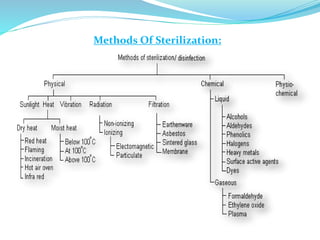
Methods Of Sterilization:
Sterilization achieved by physical methods are referred to as
Physical Sterilization and the major physical agents or
processes involved are:
HEAT STERILIZATION
RADIATION STERILIZATION
STERILE FILTRATION
LOW TEMPERATURE AND DESICCATION
ULTRASONIC VIBRATIONS
DRY STERILIZATION
HEAT:
Heat is considered to be most reliable method of sterilization
of articles that can withstand heat.
- acts by oxidative effects
Sunlight as the biggest source of heat is the oldest and
cheapest way of achieving partial sterilization of cloths.
- only bactericidal [kills only bacteria] in nature it is not
effective for a complete sterilization process.
- microbial activity of sunlight is due to the presence of UV
rays in it
- responsible for spontaneous sterilization by killing bacteria
suspended in water, provides natural method of disinfection of
water bodies such as tanks and lakes.
Factors affecting sterilization by heat are:
• Nature of heat -moist heat is more effective than dry heat.
• Temperature and time - temperature and time are inversely
proportional. As temperature increase the time taken
decrease.
• Number of microorganism – more the number of
microorganism, higher the temperature or longer the
duration required.
• Nature of microorganism – depends on species and strain of
microorganism, sensitivity to heat may vary.
Spores are highly resistant to heat.
• Types of material- articles that are heavily contaminated
require higher temperature or prolonged exposure. Certain
heat sensitive articles must be sterilized at lower temperature.
• Presence of organic material- organic materials such as
protein, sugars, oils, and fats increase the time required.
High temperature and Low temperature methods are the
widely employed techniques used for achieving complete
sterilization.
• Here the sterilization is achieved by artificial heat production
and maintaining it at a specific temperature for a desired time
period.
MODE OF ACTION:
High temperature combined with high moisture is one of the
most effective methods of killing microorganism.
Moist heat kills microorganism by coagulating their proteins
and is much more rapid and effective than dry heat, which
destroys microorganism by oxidizing their chemical
constituents.
Vegetative cells are much more sensitive to heat than spores;
the higher level of ‘water activity’ in the vegetative cells
accounts for this.
Bacterial spores are much more resistant to high temperature
Depending on the type of heat employed, the heat
sterilization is of two types –
•DRY HEAT sterilization
• MOIST HEAT sterilization
• It’s the most commonly used sterilization method mainly
employed to laboratories and hospitals to sterilize utensils
glasswares and other materials.
• Dry heat is artificially produced and temperature is
maintained for a desired time to achieve sterility.
Dry heat acts by
•protein denaturation,
•oxidative damage and
•toxic effects of elevated levels of electrolytes on cells.
Commonly involved dry heat sterilization techniques are:
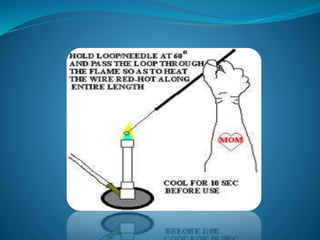
Red heat:
Articles such as bacteriological loops, straight wires, tips of
forceps and searing spatulas are sterilized by holding them in
Bunsen flame till they become red hot.
This is a simple method for effective sterilization of such
articles, but is limited to those articles that can be heated to
redness in flame
Flaming:
This is a method of passing the articles over a Bunsen flame,
but not heating it to redness.
-Articles such as mouth of test tubes, flasks, glass slides and
cover slips are passed through the flame a few times.
-Even though vegetative cells are killed, there is no guarantee
that spores too would die on such short exposure.
- limited to those articles that can be exposed to flame.
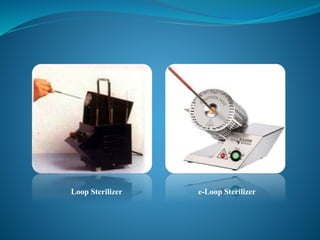
Loop Sterilizer e-Loop Sterilizer
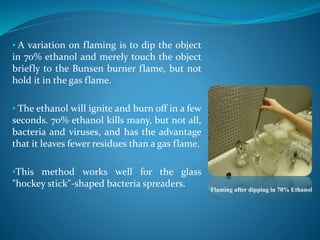
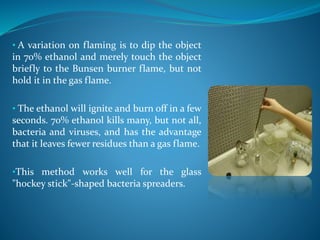
• A variation on flaming is to dip the object
in 70% ethanol and merely touch the object
briefly to the Bunsen burner flame, but not
hold it in the gas flame.
• The ethanol will ignite and burn off in a few
seconds. 70% ethanol kills many, but not all,
bacteria and viruses, and has the advantage
that it leaves fewer residues than a gas flame.
•This method works well for the glass
"hockey stick"-shaped bacteria spreaders.
Flaming after dipping in 70% Ethanol
• A variation on flaming is to dip the object
in 70% ethanol and merely touch the object
briefly to the Bunsen burner flame, but not
hold it in the gas flame.
• The ethanol will ignite and burn off in a few
seconds. 70% ethanol kills many, but not all,
bacteria and viruses, and has the advantage
that it leaves fewer residues than a gas flame.
•This method works well for the glass
"hockey stick"-shaped bacteria spreaders.
Incineration:
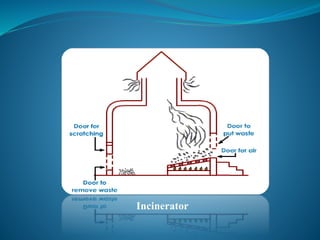
• This is a method of destroying contaminated materials by
burning them in incinerator.
• Articles such as soiled dressings, animal carcasses,
pathological materials and beddings etc should be subjected
to incineration.
• This technique results in the loss of the article, hence is
suitable only for those articles that have to be disposed.
Burning of polystyrene materials emits dense smoke, and
hence should not be incinerated.
Incinerator
Infra Red Rays:
• IF-rays bring about sterilization by generation of heat.
• Articles to be sterilized are placed in a moving conveyer belt
and passed through a tunnel that is heated by infrared
radiators to a temperature of 180°c - exposed for a period of
7.5minutes.
•Articles sterilized include metallic instruments and
glasswares.
•It requires special equipments, hence is not applicable in
diagnostic laboratory.
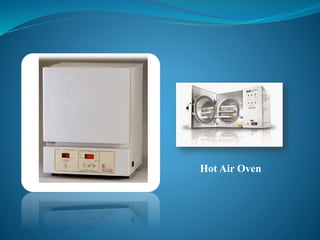
Hot Air Oven:
•This method was introduced by Louis Pasture.
•Articles to be sterilized are exposed to high temperature
[160°c] for duration of 1-2 hour in an electrically heated oven.
•Since air is poor conductor of heat, even distribution of heat
throughout the chamber is achieved by a fan.
•The heat is transferred to the article by radiation,
conduction and convection.
• Consist of three walls and a door made of gun metal that
insulate and keep the heat in and conserves energy, the inner
layer being a poor conductor and outer layer being metallic.
-air filled space in between to aid insulation.
• An air circulating fan helps in uniform distribution of the heat.
• These are fitted with the adjustable wire mesh plated trays or
aluminum trays and may have an on/off rocker switch, as well as
indicators [thermostat] and controls for temperature and
holding time
Hot Air Oven
MODE OF ACTION:
• Dry heat inside the cabin is uniformly distributed and
gets penetrated in to the bacterial cell wall causing
oxidation of cell constituents and toxic electrolytes
get deposited inside the cell causing the death.
• At high temperature denaturation of proteins and
enzymes also occurs resulting in ceasing of cellular
functions.
Sterilization Process:
•Articles to be sterilized must be perfectly dry before placing
them to avoid breakage.
•
•Articles must be placed at sufficient distance so as to allow free
circulation of air in between.
•Mouth of flasks, test tubes and both ends of pipettes must be
plugged with cotton wool.
• Articles such as Petri dishes and pipettes may be arranged
inside metal canisters and then placed. Individual glass articles
must be wrapped in Kraft paper or aluminum foils.
Sterilization Control:
• Three methods exist to check the efficacy of sterilization
process, namely physical chemical and biological.
Physical – Temperature chart recorder and thermocouple.
Chemical – Browne’s tube No.3 [green spot, color changes
from red to green]
Biological – 10^6 spores of Bacillus subtilis or Clostridium
tetani on paper strips are placed inside the hot air oven.
After sterilization cycle, the strips are inoculated into
thioglycollate broth or cooked meat medium and incubated at
37°c for 3-5 days.
Proper sterilization NO GROWTH
Advantages:
• Effective method of sterilization of heat stable articles
• The articles remain dry after sterilization
• only method of sterilizing oils and powders.
Disadvantages:
• Since air is poor conductor of heat, hot air has poor
penetration.
• Cotton wool and paper may get slightly chared and
Glasses may become smoky
• Takes longer time compared to autoclave.
Usage:
A complete cycle involves heating the oven to the required
temperature, maintaining that temperature for the proper time
interval for that temperature, turning the machine off and
cooling the articles in the closed oven till they reach room
temperature.
The standard settings for a hot air oven are:
1.5 to 2 hours at 160 °C
10 to 15 minutes at 180 °C
....plus the time required to preheat the chamber before
beginning the sterilization cycle.
If the door is opened before time, heat escapes and the process
becomes incomplete.
At temperature below 100°c:
Pasteurization:
•This process was originally employed by Louis Pasteur.
•Currently this procedure is employed in food and dairy
industry.
• There are two methods of pasteurization,
holder method [heated at 63°c for 30 minutes]
flash method [heated at 72°c for 15sec.] followed by quickly
cooling to 13°c.
• Other pasteurization method include Ultra-High
temperature [UHT], 140°c for 15sec and 149°c for .5sec.
•This method is suitable to destroy most milk borne
pathogens like Salmonella, Mycobacteria, and
Streptococoi.
Efficacy is tested by phosphatase test and methylene
blue test.
Vaccine bath:
The contaminating bacteria in a vaccine preparation can
be inactivated by heating in a water bath at 60°c for one
hour.
Only vegetative bacteria are killed and spores survive.
Serum bath:
The contaminating bacteria in a serum preparation can be
inactivated by heating in a water bath at 56°c for 1 hr on
several successive days. Proteins in the serum will
coagulate at higher temperature but spores survive.
Inspissations:
• This is a technique to solidify as well as disinfect egg and
serum containing media.
• The medium containing serum or egg are placed in the
slopes of an inspissator and heated at 80-85°cfor 30 mnts
on three successive days.
• On the 1st day the vegetative bacteria would die and those
spores that germinate by next day are then killed the
following days.
At temperature above 100°c:
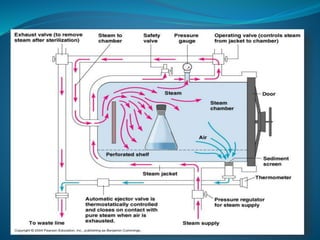
Autoclave:
• Sterilization can be effectively achieved at a temperature
above 100°c using an autoclave.
• Water boils at 100°c at atmospheric pressure, but if
pressure is raised the temperature at which the water boils
also increases.
• At a pressure of 15lbs inside the autoclave, the temperature
is said to be 121°c. Exposure of articles to the temperature for
15mnts sterilizes them.
Advantage of Steam:
• more penetrative power than dry air
• moistens the spores [moister is essential for
coagulation of proteins],
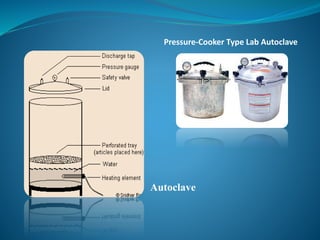
Construction and operation of Autoclave:
A simple autoclave has vertical or horizontal cylindrical
body with
•a heating element,
•a perforated try to keep the articles,
•a lid that can be fastened by screw clamps,
•a pressure gauge,
•a safety valve and a discharge tap.
The articles to be sterilized must not be tightly packed.
The lid is closed but the discharge tap is kept open and the
water is heated.
Pressure-Cooker Type Lab Autoclave
Autoclave
• As the water starts boiling, the steam drives air out of the
discharge tap.
• The pressure inside is allowed to rise up to 15 lbs per square
inch.
• At this pressure the articles are held for 15 minutes, after
which the heating is stooped and the autoclave is allowed to
cool.
• When pressure gauge shows the pressure equals to
atmospheric pressure, the discharge tap is opened to let the
air in. The lid is then opened and articles removed.
Precautions:
• Articles should not be tightly packed and must be
wrapped in paper to prevent drenching,
• The autoclave must not be overloaded,
• air discharge must be complete and there should not be
any residual air trapped inside,
• caps of bottles and flasks should not be tight,
• autoclave must not be opened until the pressure has
fallen or else the contents will boil over,
Advantage:
• Very effective way of sterilization against both vegetative
cells and spores
• Quicker than hot air oven.
Disadvantages:
• Drenching and wetting or articles may occur
• Trapped air may reduce the efficacy and it takes long
time to cool.
Sterilization control:
 Physical method includes automatic process control,
thermocouple and temperature chart recorder.
 Chemical method includes Browne’s tube No.1 (black spot)
and succinic acid (who’s melting point is 121c) and Bowie Dick
tape.
Bowie Dick tape is applied to articles being autoclaved. If the
process has been satisfactory, dark brown stripes will appear
across the tape.
 Biological method includes a paper strip containing 106
spores of Geobacillus stearothermophilus.
At temperature 100°c:
Boiling: 100°c
• kills most vegetative bacteria and viruses immediately.
Some bacterial spores are resistant to boiling and survive;
hence it’s not a substitute for sterilization.
• The killing activity can be enhanced by addition of 2%
sodium bicarbonate.
•When absolute sterility is not required, certain metal articles
and glasswares can be disinfected by placing them in boiling
water for 10-20 mnts.
•The lid of the boiler must not be opened during the period.
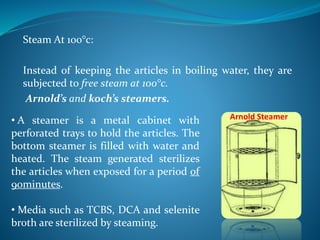
Steam At 100°c:
Instead of keeping the articles in boiling water, they are
subjected to free steam at 100°c.
Arnold’s and koch’s steamers.
• A steamer is a metal cabinet with
perforated trays to hold the articles. The
bottom steamer is filled with water and
heated. The steam generated sterilizes
the articles when exposed for a period of
90minutes.
• Media such as TCBS, DCA and selenite
broth are sterilized by steaming.
Arnold Steamer
• Sugar and gelatin in medium may get decomposed on
autoclaving; hence they are exposed to free steaming for
20mnts for three successive days.
•This process is called as Tyndalization or Fractional
sterilization or Intermittent sterilization.
•The vegetative bacteria are killed in the 1st exposure and
the spores that germinate by next day are killed in
subsequent days.
• The success of process depends on the germination of
spores.
• Energy transmitted through space in a variety of forms is generally
called Radiation.
•Electromagnetic radiation can interact with matter in one of 2
general ways:
IONIZING RADIATIONS [X-ray and Y-rays]
NON-IONIZING RADIATION [UV light]
MODE OF ACTION:
• Gamma rays and X rays which have energies of more than
about 10ev is passes through a cell they create free hydrogen
radicals and some peroxides which in turn can cause
different kinds of intracellular damage.
• Less energetic radiations like UV light does not ionize, it is
absorbed quite specifically by different compounds and cause
Mutation by forming DIMERS or engages in a variety of
chemical reactions not possible for unexcited molecules.
Ionizing radiation:
Ionizing rays are of two types,
particulate and
 electromagnetic rays.
Gamma rays are very penetrating and are commonly
used for sterilization of disposable medical equipment,
such as syringes, needles etc.
X-rays are a form of ionizing energy allowing irradiating
large packages and pallet loads of medical devices. Their
penetration is sufficient to treat multiple pallet loads of
low-density packages.
• Ionizing radiation produce relatively little heat in the
materials being irradiated, thus it is possible to sterilize heat-
sensitive substances in food and pharmaceutical industries
and the process is called Cold sterilization
•Disadvantage:
GAMMA radiation requires bulky shielding for the safety of
the operators; they also require storage of a radioisotope
(usually Cobalt-60), which continuously emits gamma rays (it
cannot be turned off, and therefore always presents a hazard
in the area of the facility).
Non ionizing radiation:
Electron beam processing is also commonly used for
medical device sterilization.
• Electron beams use an on-off technology and provide a
much higher dosing rate than gamma or x-rays.
• Due to the higher dose rate, less exposure time is needed
and thereby any potential degradation to polymers is
reduced.
• A limitation is that electron beams are less
penetrating than either gamma or x-rays.
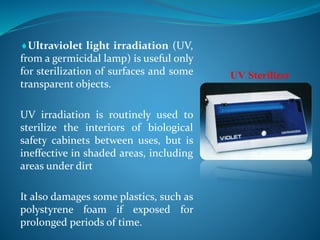
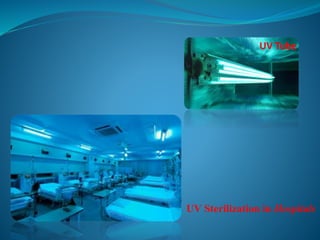
Ultraviolet light irradiation (UV,
from a germicidal lamp) is useful only
for sterilization of surfaces and some
transparent objects.
UV irradiation is routinely used to
sterilize the interiors of biological
safety cabinets between uses, but is
ineffective in shaded areas, including
areas under dirt
It also damages some plastics, such as
polystyrene foam if exposed for
prolonged periods of time.
UV Sterilizer
 Subatomic particles may be more or less penetrating,
and may be generated by a radioisotope or a device,
depending upon the type of particle.
Irradiation with X-rays or gamma rays does not make
materials radioactive.
Irradiation with particles may make materials radioactive,
depending upon the type of particles and their energy, and
the type of target material:
neutrons and very high-energy particles can make
materials radioactive, but have good penetration, whereas
lower energy particles (other than neutrons) cannot make
materials radioactive, but have poorer penetration.
UV Tube
UV Sterilization in Hospitals
When ingredients of a culture medium are thermolabile. i.e.,
destroyed by heat, the use of heat sterilization is not
practicable.
In such cases, however, the process of filtration is used.
[biological fluids such as solutions of antibiotics, vitamins,
tissue extracts, animal serum, etc.]
Filtration does not kill microbes, it separates them out.
Various applications of filtration include
• removing bacteria from ingredients of culture media,
• preparing suspensions of viruses and phages free of
bacteria
• measuring sizes of viruses,
• separating toxins from culture filtrates,
• counting bacteria,
•clarifying fluids and purifying hydatid fluid.
Filtration is aided by using either positive or negative
pressure using vacuum pumps.
Different types of filters are:
1. Earthenware filters:
These filters are made up of diatomaceous earth or porcelain.
They are usually baked into the shape of candle.
Pasteur- Chamberland filter:
These candle filters are from France and are made up of
porcelain (sand and kaolin).
Berkefeld filter:
These are made of Kieselguhr, a fossilized diatomaceous earth.
• available in three grades depending on their porosity (pore
size); they are :V (veil), N(normal) and W (wenig).
Asbestos filters:
• These filters are made from chrysotile type of asbestos,
chemically composed of Magnesium silicate.
They are pressed to form disc, which are to be used only
once.
The disc is held inside a metal mount, which is sterilized
by autoclaving.
•They are available in following grades;
HP/PYR (for removal of pyrogens),
HP/EKS (for absolute sterility) and
HP/EK (for claryfying).
Membrane filters:
These filters are made from a variety of polymeric
materials such as cellulose nitrate, cellulose diacetate,
polycarbonate and polyester.
These membranes have a pore diameter ranging from 0.015
μm to 12 μm. These filters are sterilized by autoclaving.
The advantages of membrane filters are
•known porosity
•no retention of fluids
•reusable after autoclaving and compatible with many
chemicals.
However, membrane filters have little loading capacity and
are fragile.
The disadvantages of depth
filters are
•migration of filter material into
the filtrate
•absorption or retention of
certain volume of liquid by the
filters
• pore sizes are not definite and
viruses and mycoplasma could
pass through.
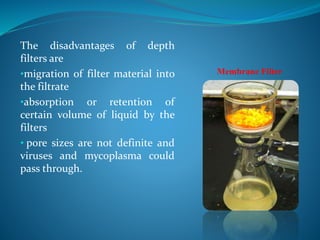
Membrane Filter
Air Filters:
Air can be filtered using HEPA (High Efficiency Particle
Air) filters.
• usually used in biological safety cabinets.
HEPA filters are at least 99.97% efficient for removing
particles >0.3 μm in diameter.
Examples of areas where HEPA filters are used include
rooms housing severely neutropenic patients and those
operating rooms designated for orthopedic implant
procedures.
HEPA filter efficiency is monitored with the
dioctylphthalate (DOP) particle test using particles that
are 0.3 μm in diameter.
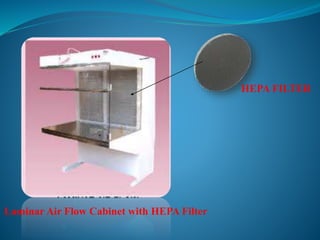
HEPA Filter:
High- Efficiency Particulate Air [HEPA]
Filter has made it possible to deliver clean air
to an enclosure such as a cubicle or a room.
This type of air filtration together with a
system of Laminar Airflow is now extensively
used to produce dust and bacteria free air
Laminar Air Flow Cabinet with HEPA Filter
HEPA FILTER
Temperature below the optimum for growth depresses the rate
of metabolism, and if the temperature is sufficiently low, growth
and metabolism ceases.
Low temperature is useful for preservation of cultures, since
microorganism have a unique capacity for surviving extreme
cold. [-20 -70°c]
Liquid Nitrogen at a temperature of -196°c is used for
preserving cultures
In all these procedures, the initial freezing kills a fraction of
population, but the survivors may remain viable for long
periods.
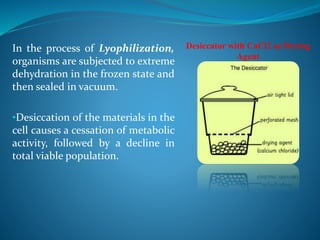
In the process of Lyophilization,
organisms are subjected to extreme
dehydration in the frozen state and
then sealed in vacuum.
•Desiccation of the materials in the
cell causes a cessation of metabolic
activity, followed by a decline in
total viable population.
Desiccator with CaCl2 as Drying
Agent
•Sound waves of frequency >20,000 cycle/second kills
bacteria and some viruses on exposing for one hour.
• Microwaves are not particularly antimicrobial in
themselves, rather the killing effect of microwaves are
largely due to the heat that they generate.
• High frequency sound waves disrupt cells. They are used
to clean and disinfect instruments as well as to reduce
microbial load.
Dry sterilization process (DSP) uses hydrogen peroxide at a
concentration of 30-35% under low pressure conditions.
• This process achieves bacterial reduction of 10−6...10−8.
• The complete process cycle time is just 6 seconds, and the
surface temperature is increased only 10-15 °C (18 to 27 °F).
• Originally designed for the sterilization of plastic bottles in
the beverage industry, because of the high germ reduction
ANY questioNs…………..
Physical sterlization

Physical sterlization

  • 2.
    STERILIZATION - any processthat eliminate or kills all forms of life including transmissible agents ( fungi bacteria virus and spore forms) present on a surface, contained in a fluid, in medication, or in a compound such as biological culture media. It includes all the processes involved in the disabling or destruction of microorganism whose presence can cause serious harm.
  • 3.
    The principle reasonsfor controlling microorganism are : • to prevent transmission of diseases and infection • to prevent contamination by growth of undesirable microorganism and • to prevent deterioration and spoilage of materials. Sterilization as a means of controlling microorganism is mainly achieved by 2 methods: <>CHEMICAL sterilization – chemicals as sterilizing agent. <>PHYSICAL sterilization – physical methods like heat, irradiation, high pressure, filtration etc..,
  • 4.
  • 5.
    Sterilization achieved byphysical methods are referred to as Physical Sterilization and the major physical agents or processes involved are: HEAT STERILIZATION RADIATION STERILIZATION STERILE FILTRATION LOW TEMPERATURE AND DESICCATION ULTRASONIC VIBRATIONS DRY STERILIZATION
  • 6.
    HEAT: Heat is consideredto be most reliable method of sterilization of articles that can withstand heat. - acts by oxidative effects Sunlight as the biggest source of heat is the oldest and cheapest way of achieving partial sterilization of cloths. - only bactericidal [kills only bacteria] in nature it is not effective for a complete sterilization process. - microbial activity of sunlight is due to the presence of UV rays in it - responsible for spontaneous sterilization by killing bacteria suspended in water, provides natural method of disinfection of water bodies such as tanks and lakes.
  • 7.
    Factors affecting sterilizationby heat are: • Nature of heat -moist heat is more effective than dry heat. • Temperature and time - temperature and time are inversely proportional. As temperature increase the time taken decrease. • Number of microorganism – more the number of microorganism, higher the temperature or longer the duration required.
  • 8.
    • Nature ofmicroorganism – depends on species and strain of microorganism, sensitivity to heat may vary. Spores are highly resistant to heat. • Types of material- articles that are heavily contaminated require higher temperature or prolonged exposure. Certain heat sensitive articles must be sterilized at lower temperature. • Presence of organic material- organic materials such as protein, sugars, oils, and fats increase the time required.
  • 9.
    High temperature andLow temperature methods are the widely employed techniques used for achieving complete sterilization. • Here the sterilization is achieved by artificial heat production and maintaining it at a specific temperature for a desired time period.
  • 10.
    MODE OF ACTION: Hightemperature combined with high moisture is one of the most effective methods of killing microorganism. Moist heat kills microorganism by coagulating their proteins and is much more rapid and effective than dry heat, which destroys microorganism by oxidizing their chemical constituents. Vegetative cells are much more sensitive to heat than spores; the higher level of ‘water activity’ in the vegetative cells accounts for this. Bacterial spores are much more resistant to high temperature
  • 11.
    Depending on thetype of heat employed, the heat sterilization is of two types – •DRY HEAT sterilization • MOIST HEAT sterilization
  • 12.
    • It’s themost commonly used sterilization method mainly employed to laboratories and hospitals to sterilize utensils glasswares and other materials. • Dry heat is artificially produced and temperature is maintained for a desired time to achieve sterility. Dry heat acts by •protein denaturation, •oxidative damage and •toxic effects of elevated levels of electrolytes on cells.
  • 13.
    Commonly involved dryheat sterilization techniques are: Red heat: Articles such as bacteriological loops, straight wires, tips of forceps and searing spatulas are sterilized by holding them in Bunsen flame till they become red hot. This is a simple method for effective sterilization of such articles, but is limited to those articles that can be heated to redness in flame
  • 15.
    Flaming: This is amethod of passing the articles over a Bunsen flame, but not heating it to redness. -Articles such as mouth of test tubes, flasks, glass slides and cover slips are passed through the flame a few times. -Even though vegetative cells are killed, there is no guarantee that spores too would die on such short exposure. - limited to those articles that can be exposed to flame.
  • 16.
  • 17.
    • A variationon flaming is to dip the object in 70% ethanol and merely touch the object briefly to the Bunsen burner flame, but not hold it in the gas flame. • The ethanol will ignite and burn off in a few seconds. 70% ethanol kills many, but not all, bacteria and viruses, and has the advantage that it leaves fewer residues than a gas flame. •This method works well for the glass "hockey stick"-shaped bacteria spreaders. Flaming after dipping in 70% Ethanol
  • 18.
    • A variationon flaming is to dip the object in 70% ethanol and merely touch the object briefly to the Bunsen burner flame, but not hold it in the gas flame. • The ethanol will ignite and burn off in a few seconds. 70% ethanol kills many, but not all, bacteria and viruses, and has the advantage that it leaves fewer residues than a gas flame. •This method works well for the glass "hockey stick"-shaped bacteria spreaders.
  • 19.
    Incineration: • This isa method of destroying contaminated materials by burning them in incinerator. • Articles such as soiled dressings, animal carcasses, pathological materials and beddings etc should be subjected to incineration. • This technique results in the loss of the article, hence is suitable only for those articles that have to be disposed. Burning of polystyrene materials emits dense smoke, and hence should not be incinerated.
  • 20.
  • 21.
    Infra Red Rays: •IF-rays bring about sterilization by generation of heat. • Articles to be sterilized are placed in a moving conveyer belt and passed through a tunnel that is heated by infrared radiators to a temperature of 180°c - exposed for a period of 7.5minutes. •Articles sterilized include metallic instruments and glasswares. •It requires special equipments, hence is not applicable in diagnostic laboratory.
  • 22.
    Hot Air Oven: •Thismethod was introduced by Louis Pasture. •Articles to be sterilized are exposed to high temperature [160°c] for duration of 1-2 hour in an electrically heated oven. •Since air is poor conductor of heat, even distribution of heat throughout the chamber is achieved by a fan. •The heat is transferred to the article by radiation, conduction and convection.
  • 23.
    • Consist ofthree walls and a door made of gun metal that insulate and keep the heat in and conserves energy, the inner layer being a poor conductor and outer layer being metallic. -air filled space in between to aid insulation. • An air circulating fan helps in uniform distribution of the heat. • These are fitted with the adjustable wire mesh plated trays or aluminum trays and may have an on/off rocker switch, as well as indicators [thermostat] and controls for temperature and holding time
  • 24.
  • 25.
    MODE OF ACTION: •Dry heat inside the cabin is uniformly distributed and gets penetrated in to the bacterial cell wall causing oxidation of cell constituents and toxic electrolytes get deposited inside the cell causing the death. • At high temperature denaturation of proteins and enzymes also occurs resulting in ceasing of cellular functions.
  • 26.
    Sterilization Process: •Articles tobe sterilized must be perfectly dry before placing them to avoid breakage. • •Articles must be placed at sufficient distance so as to allow free circulation of air in between. •Mouth of flasks, test tubes and both ends of pipettes must be plugged with cotton wool. • Articles such as Petri dishes and pipettes may be arranged inside metal canisters and then placed. Individual glass articles must be wrapped in Kraft paper or aluminum foils.
  • 27.
    Sterilization Control: • Threemethods exist to check the efficacy of sterilization process, namely physical chemical and biological. Physical – Temperature chart recorder and thermocouple. Chemical – Browne’s tube No.3 [green spot, color changes from red to green] Biological – 10^6 spores of Bacillus subtilis or Clostridium tetani on paper strips are placed inside the hot air oven. After sterilization cycle, the strips are inoculated into thioglycollate broth or cooked meat medium and incubated at 37°c for 3-5 days. Proper sterilization NO GROWTH
  • 28.
    Advantages: • Effective methodof sterilization of heat stable articles • The articles remain dry after sterilization • only method of sterilizing oils and powders. Disadvantages: • Since air is poor conductor of heat, hot air has poor penetration. • Cotton wool and paper may get slightly chared and Glasses may become smoky • Takes longer time compared to autoclave.
  • 29.
    Usage: A complete cycleinvolves heating the oven to the required temperature, maintaining that temperature for the proper time interval for that temperature, turning the machine off and cooling the articles in the closed oven till they reach room temperature. The standard settings for a hot air oven are: 1.5 to 2 hours at 160 °C 10 to 15 minutes at 180 °C ....plus the time required to preheat the chamber before beginning the sterilization cycle. If the door is opened before time, heat escapes and the process becomes incomplete.
  • 30.
    At temperature below100°c: Pasteurization: •This process was originally employed by Louis Pasteur. •Currently this procedure is employed in food and dairy industry. • There are two methods of pasteurization, holder method [heated at 63°c for 30 minutes] flash method [heated at 72°c for 15sec.] followed by quickly cooling to 13°c.
  • 31.
    • Other pasteurizationmethod include Ultra-High temperature [UHT], 140°c for 15sec and 149°c for .5sec. •This method is suitable to destroy most milk borne pathogens like Salmonella, Mycobacteria, and Streptococoi. Efficacy is tested by phosphatase test and methylene blue test.
  • 32.
    Vaccine bath: The contaminatingbacteria in a vaccine preparation can be inactivated by heating in a water bath at 60°c for one hour. Only vegetative bacteria are killed and spores survive. Serum bath: The contaminating bacteria in a serum preparation can be inactivated by heating in a water bath at 56°c for 1 hr on several successive days. Proteins in the serum will coagulate at higher temperature but spores survive.
  • 33.
    Inspissations: • This isa technique to solidify as well as disinfect egg and serum containing media. • The medium containing serum or egg are placed in the slopes of an inspissator and heated at 80-85°cfor 30 mnts on three successive days. • On the 1st day the vegetative bacteria would die and those spores that germinate by next day are then killed the following days.
  • 34.
    At temperature above100°c: Autoclave: • Sterilization can be effectively achieved at a temperature above 100°c using an autoclave. • Water boils at 100°c at atmospheric pressure, but if pressure is raised the temperature at which the water boils also increases. • At a pressure of 15lbs inside the autoclave, the temperature is said to be 121°c. Exposure of articles to the temperature for 15mnts sterilizes them.
  • 35.
    Advantage of Steam: •more penetrative power than dry air • moistens the spores [moister is essential for coagulation of proteins],
  • 36.
    Construction and operationof Autoclave: A simple autoclave has vertical or horizontal cylindrical body with •a heating element, •a perforated try to keep the articles, •a lid that can be fastened by screw clamps, •a pressure gauge, •a safety valve and a discharge tap. The articles to be sterilized must not be tightly packed. The lid is closed but the discharge tap is kept open and the water is heated.
  • 37.
    Pressure-Cooker Type LabAutoclave Autoclave
  • 38.
    • As thewater starts boiling, the steam drives air out of the discharge tap. • The pressure inside is allowed to rise up to 15 lbs per square inch. • At this pressure the articles are held for 15 minutes, after which the heating is stooped and the autoclave is allowed to cool. • When pressure gauge shows the pressure equals to atmospheric pressure, the discharge tap is opened to let the air in. The lid is then opened and articles removed.
  • 40.
    Precautions: • Articles shouldnot be tightly packed and must be wrapped in paper to prevent drenching, • The autoclave must not be overloaded, • air discharge must be complete and there should not be any residual air trapped inside, • caps of bottles and flasks should not be tight, • autoclave must not be opened until the pressure has fallen or else the contents will boil over,
  • 41.
    Advantage: • Very effectiveway of sterilization against both vegetative cells and spores • Quicker than hot air oven. Disadvantages: • Drenching and wetting or articles may occur • Trapped air may reduce the efficacy and it takes long time to cool.
  • 42.
    Sterilization control:  Physicalmethod includes automatic process control, thermocouple and temperature chart recorder.  Chemical method includes Browne’s tube No.1 (black spot) and succinic acid (who’s melting point is 121c) and Bowie Dick tape. Bowie Dick tape is applied to articles being autoclaved. If the process has been satisfactory, dark brown stripes will appear across the tape.  Biological method includes a paper strip containing 106 spores of Geobacillus stearothermophilus.
  • 43.
    At temperature 100°c: Boiling:100°c • kills most vegetative bacteria and viruses immediately. Some bacterial spores are resistant to boiling and survive; hence it’s not a substitute for sterilization. • The killing activity can be enhanced by addition of 2% sodium bicarbonate. •When absolute sterility is not required, certain metal articles and glasswares can be disinfected by placing them in boiling water for 10-20 mnts. •The lid of the boiler must not be opened during the period.
  • 44.
    Steam At 100°c: Insteadof keeping the articles in boiling water, they are subjected to free steam at 100°c. Arnold’s and koch’s steamers. • A steamer is a metal cabinet with perforated trays to hold the articles. The bottom steamer is filled with water and heated. The steam generated sterilizes the articles when exposed for a period of 90minutes. • Media such as TCBS, DCA and selenite broth are sterilized by steaming. Arnold Steamer
  • 45.
    • Sugar andgelatin in medium may get decomposed on autoclaving; hence they are exposed to free steaming for 20mnts for three successive days. •This process is called as Tyndalization or Fractional sterilization or Intermittent sterilization. •The vegetative bacteria are killed in the 1st exposure and the spores that germinate by next day are killed in subsequent days. • The success of process depends on the germination of spores.
  • 46.
    • Energy transmittedthrough space in a variety of forms is generally called Radiation. •Electromagnetic radiation can interact with matter in one of 2 general ways: IONIZING RADIATIONS [X-ray and Y-rays] NON-IONIZING RADIATION [UV light]
  • 47.
    MODE OF ACTION: •Gamma rays and X rays which have energies of more than about 10ev is passes through a cell they create free hydrogen radicals and some peroxides which in turn can cause different kinds of intracellular damage. • Less energetic radiations like UV light does not ionize, it is absorbed quite specifically by different compounds and cause Mutation by forming DIMERS or engages in a variety of chemical reactions not possible for unexcited molecules.
  • 48.
    Ionizing radiation: Ionizing raysare of two types, particulate and  electromagnetic rays. Gamma rays are very penetrating and are commonly used for sterilization of disposable medical equipment, such as syringes, needles etc. X-rays are a form of ionizing energy allowing irradiating large packages and pallet loads of medical devices. Their penetration is sufficient to treat multiple pallet loads of low-density packages.
  • 49.
    • Ionizing radiationproduce relatively little heat in the materials being irradiated, thus it is possible to sterilize heat- sensitive substances in food and pharmaceutical industries and the process is called Cold sterilization •Disadvantage: GAMMA radiation requires bulky shielding for the safety of the operators; they also require storage of a radioisotope (usually Cobalt-60), which continuously emits gamma rays (it cannot be turned off, and therefore always presents a hazard in the area of the facility).
  • 50.
    Non ionizing radiation: Electronbeam processing is also commonly used for medical device sterilization. • Electron beams use an on-off technology and provide a much higher dosing rate than gamma or x-rays. • Due to the higher dose rate, less exposure time is needed and thereby any potential degradation to polymers is reduced. • A limitation is that electron beams are less penetrating than either gamma or x-rays.
  • 51.
    Ultraviolet light irradiation(UV, from a germicidal lamp) is useful only for sterilization of surfaces and some transparent objects. UV irradiation is routinely used to sterilize the interiors of biological safety cabinets between uses, but is ineffective in shaded areas, including areas under dirt It also damages some plastics, such as polystyrene foam if exposed for prolonged periods of time. UV Sterilizer
  • 52.
     Subatomic particlesmay be more or less penetrating, and may be generated by a radioisotope or a device, depending upon the type of particle. Irradiation with X-rays or gamma rays does not make materials radioactive. Irradiation with particles may make materials radioactive, depending upon the type of particles and their energy, and the type of target material: neutrons and very high-energy particles can make materials radioactive, but have good penetration, whereas lower energy particles (other than neutrons) cannot make materials radioactive, but have poorer penetration.
  • 53.
  • 54.
    When ingredients ofa culture medium are thermolabile. i.e., destroyed by heat, the use of heat sterilization is not practicable. In such cases, however, the process of filtration is used. [biological fluids such as solutions of antibiotics, vitamins, tissue extracts, animal serum, etc.]
  • 55.
    Filtration does notkill microbes, it separates them out. Various applications of filtration include • removing bacteria from ingredients of culture media, • preparing suspensions of viruses and phages free of bacteria • measuring sizes of viruses, • separating toxins from culture filtrates, • counting bacteria, •clarifying fluids and purifying hydatid fluid. Filtration is aided by using either positive or negative pressure using vacuum pumps.
  • 56.
    Different types offilters are: 1. Earthenware filters: These filters are made up of diatomaceous earth or porcelain. They are usually baked into the shape of candle. Pasteur- Chamberland filter: These candle filters are from France and are made up of porcelain (sand and kaolin). Berkefeld filter: These are made of Kieselguhr, a fossilized diatomaceous earth. • available in three grades depending on their porosity (pore size); they are :V (veil), N(normal) and W (wenig).
  • 57.
    Asbestos filters: • Thesefilters are made from chrysotile type of asbestos, chemically composed of Magnesium silicate. They are pressed to form disc, which are to be used only once. The disc is held inside a metal mount, which is sterilized by autoclaving. •They are available in following grades; HP/PYR (for removal of pyrogens), HP/EKS (for absolute sterility) and HP/EK (for claryfying).
  • 58.
    Membrane filters: These filtersare made from a variety of polymeric materials such as cellulose nitrate, cellulose diacetate, polycarbonate and polyester. These membranes have a pore diameter ranging from 0.015 μm to 12 μm. These filters are sterilized by autoclaving. The advantages of membrane filters are •known porosity •no retention of fluids •reusable after autoclaving and compatible with many chemicals. However, membrane filters have little loading capacity and are fragile.
  • 59.
    The disadvantages ofdepth filters are •migration of filter material into the filtrate •absorption or retention of certain volume of liquid by the filters • pore sizes are not definite and viruses and mycoplasma could pass through. Membrane Filter
  • 60.
    Air Filters: Air canbe filtered using HEPA (High Efficiency Particle Air) filters. • usually used in biological safety cabinets. HEPA filters are at least 99.97% efficient for removing particles >0.3 μm in diameter. Examples of areas where HEPA filters are used include rooms housing severely neutropenic patients and those operating rooms designated for orthopedic implant procedures. HEPA filter efficiency is monitored with the dioctylphthalate (DOP) particle test using particles that are 0.3 μm in diameter.
  • 61.
    HEPA Filter: High- EfficiencyParticulate Air [HEPA] Filter has made it possible to deliver clean air to an enclosure such as a cubicle or a room. This type of air filtration together with a system of Laminar Airflow is now extensively used to produce dust and bacteria free air
  • 62.
    Laminar Air FlowCabinet with HEPA Filter HEPA FILTER
  • 63.
    Temperature below theoptimum for growth depresses the rate of metabolism, and if the temperature is sufficiently low, growth and metabolism ceases. Low temperature is useful for preservation of cultures, since microorganism have a unique capacity for surviving extreme cold. [-20 -70°c] Liquid Nitrogen at a temperature of -196°c is used for preserving cultures In all these procedures, the initial freezing kills a fraction of population, but the survivors may remain viable for long periods.
  • 64.
    In the processof Lyophilization, organisms are subjected to extreme dehydration in the frozen state and then sealed in vacuum. •Desiccation of the materials in the cell causes a cessation of metabolic activity, followed by a decline in total viable population. Desiccator with CaCl2 as Drying Agent
  • 65.
    •Sound waves offrequency >20,000 cycle/second kills bacteria and some viruses on exposing for one hour. • Microwaves are not particularly antimicrobial in themselves, rather the killing effect of microwaves are largely due to the heat that they generate. • High frequency sound waves disrupt cells. They are used to clean and disinfect instruments as well as to reduce microbial load.
  • 66.
    Dry sterilization process(DSP) uses hydrogen peroxide at a concentration of 30-35% under low pressure conditions. • This process achieves bacterial reduction of 10−6...10−8. • The complete process cycle time is just 6 seconds, and the surface temperature is increased only 10-15 °C (18 to 27 °F). • Originally designed for the sterilization of plastic bottles in the beverage industry, because of the high germ reduction
  • 67.