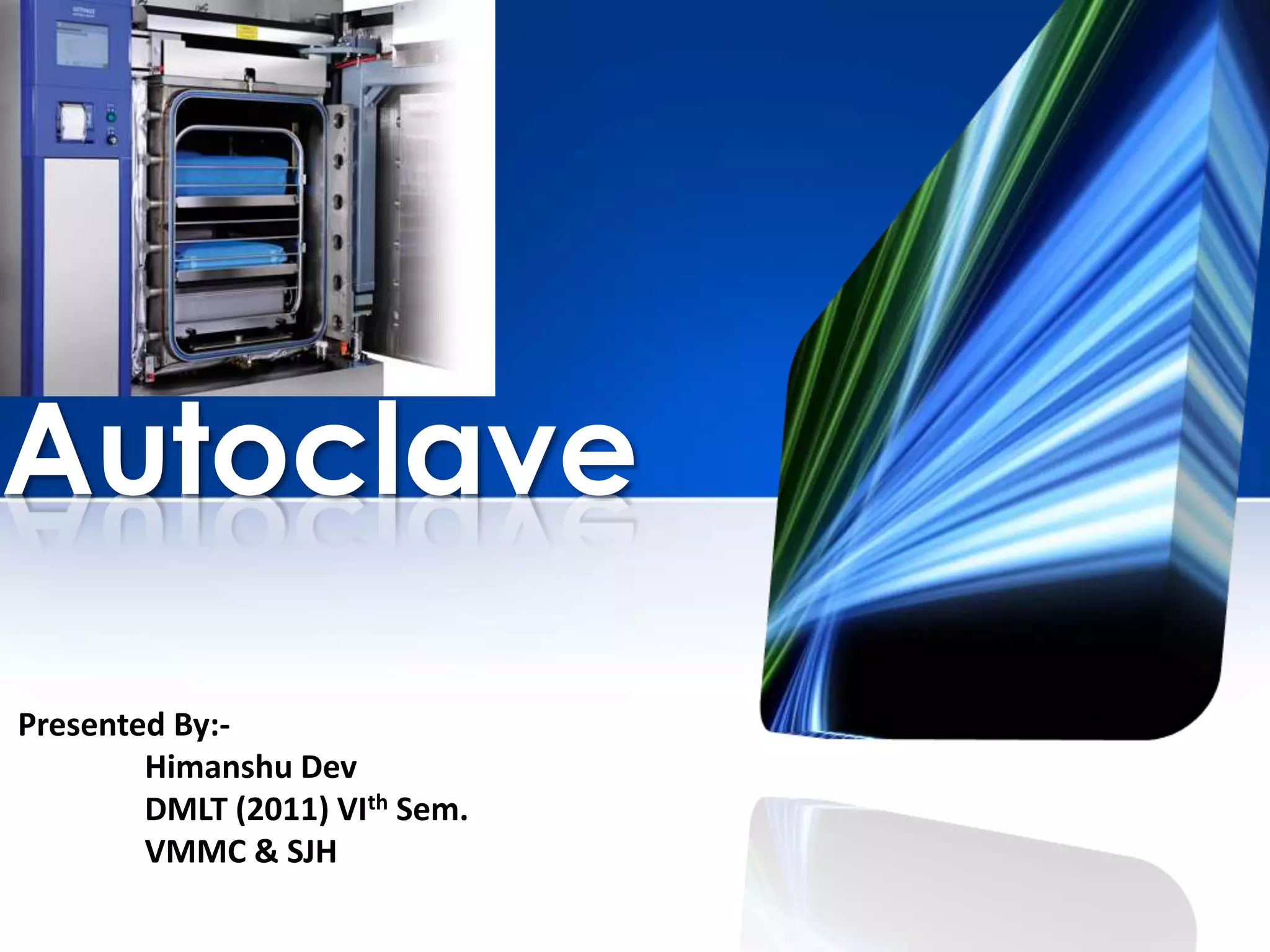
Autoclave
Presented By:-
Himanshu Dev
DMLT (2011) VIth Sem.
VMMC & SJH
 The autoclave is a piece of equipment used for
sterilizing various requirements in the lab by wet
sterilization method.
 The name comes from Greek auto-, ultimately
meaning self, and Latin clavis meaning key—a
self-locking device.
 The word sterilizing means the destruction of
elimination of all forms of life (microbial,
including spores) present in inanimate objects
by means of physical, chemical or gaseous
procedures.
Autoclave
Operation Principle
 When water is heated in a closed container, saturated steam is
produced under pressure.
 According to Boyle’s Law, when volume of the steam, is kept
constant, the temperature is directly proportional to pressure.
 If the pressure is reduced it boils at a lower temperature. If the
pressure rises, it boils at a greater temperature.
 At 15 lbs pressure 1210 C temperature can be obtained.
 Moist heat coagulates cell proteins of the microorganisms and
thus kills all the living entities (including spores) in 15 to 20
minutes.
 Hot saturated steam is efficient means of destroying micro-
organisms, since it penetrates rapidly and gives up its latent heat
as it condenses on the cooler objects.
The process associated in achieving sterile
conditions of inanimate objects are the following :
• Cleaning
• Decontamination
• Inspection
• Preparation and packing
• Sterilization
• Storage
• Delivery of materials
Purpose of the Autoclave
In the laboratory, materials and objects are
sterilized for the following purposes:
1. To prepare materials for bacteriological cell
cultures (test tubes, pipettes, Petridishes,
etc.) in order to avoid their contamination.
2. Prepare elements used for taking samples.
(All must be in sterile conditions: needles,
tubes, containers).
3. Sterilize contaminated material.
Two Type of Autoclave
1. Horizontal or downward displacement
autoclave.
2. Vacuum assisted autoclave.
Horizontal or downward
displacement autoclave
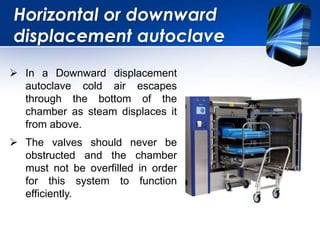
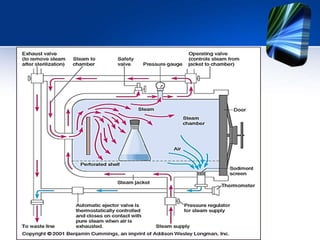
 In a Downward displacement
autoclave cold air escapes
through the bottom of the
chamber as steam displaces it
from above.
 The valves should never be
obstructed and the chamber
must not be overfilled in order
for this system to function
efficiently.
Horizontal or downward
displacement autoclave contd..
 This type of autoclave is electrically operated and can be
fully or semiautomatic.
 The downward displacement autoclave sterilizer is also
known as a gravity displacement unit.
 It uses a heating element to heat up the water and
produce steam.
 The steam, which is lighter than air, forces the air inside
the sterilization chamber to move downward.
 Eventually the air moves out through the drain hole of
the sterilization chamber.
 Once the temperature in the chamber is sufficient, the
hole is automatically closed and the sterilization process
is started.
Vaccum Assisted Autoclave
ClosedClosed
OpenOpen
SteamSteam
SteamSteam
ClosedClosed
OpenOpen
SteamSteam
SteamSteam
OpenOpen
SteamSteam
SteamSteam
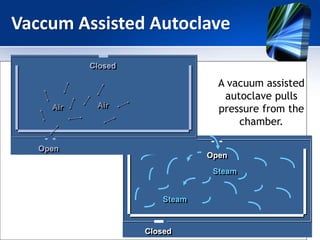
A vacuum assisted
autoclave pulls
pressure from the
chamber.
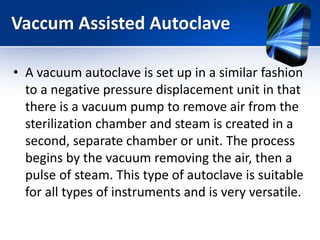
• A vacuum autoclave is set up in a similar fashion
to a negative pressure displacement unit in that
there is a vacuum pump to remove air from the
sterilization chamber and steam is created in a
second, separate chamber or unit. The process
begins by the vacuum removing the air, then a
pulse of steam. This type of autoclave is suitable
for all types of instruments and is very versatile.
Vaccum Assisted Autoclave
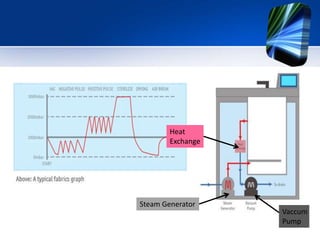
Heat
Exchange
Steam Generator
Vaccum
Pump
MAIN COMPONENTS
1. Heating Elements
2. Temperature Controller
3. Pressure Sensor
4. Chamber
5. Door gasket
6. Solenoid valve
7. Water level Sensor
8. Steam generator
9. Vaccum pump
Vacuum assisted or pre-vacuum
autoclave
• Air is evacuated rapidly from the sterilising chamber
at the beginning of the cycle creating a vacuum, so
steam penetration and sterilising occurs very rapidly.
• A second vacuum cycle withdraws moisture after
sterilisation , facilitating drying of the load.
• Often, this autoclave is connected to a central boiler
of steam. They have a large capacity and are fully
automated and failsafe.
• Modern, computerised autoclaves will abort the
cycle if there is a malfunction.
Vertical Pressure
Cooker(Autoclave)
• This cooker operates similarly to a household pressure
cooker. It is commonly used in practice. The vertical
pressure cooker has an air vent at the top which is
manually closed after all the air has been evacuated.
• This is a possible disadvantage as some air may remain
trapped under the steam and therefore cause a lower
temperature to be reached in this area.
• As this is a manually operated steriliser, human error can
influence the effectiveness of sterilisation.
• There is also no automatic drying cycle, so items may be
slightly damp at the end of the cycle. Ensure packs are fully
dried before storing.
Classification of Autoclaves
• Type "N" & Type "B“ Each
• Type "N" units do not use a vacuum to remove
air from the sterilization chamber. Type "N"
autoclaves are suitable for a specific type of
load--for solid.
• Type "B" units use a vacuum pump. Type "B"
autoclaves can be used on wrapped and hollow
instruments, which means a piece of equipment
can be sterilized now for use later.
MAIN COMPONENTS
1. Heating Elements
2. Temperature Controller
3. Pressure Sensor
4. Chamber
5. Door gasket
6. Solenoid valve
7. Water level Sensor
Preparation of Material
1. Syringes and needles
 Syringes are wrapped in gauze and needles are placed
separately in small test tubes that are plugged.
 A pad of nonabsorbent cotton is placed at the bottom of
each tube to protect the tip of the needle. Syringes and
needles are then placed in a metal tray, which is placed
uncovered in the autoclave.
2. Glassware
 Glassware such as specimen tubes, petri dishes,
specimen collection bottles are wrapped in brown paper
and are tied with string.
 The Pasteur pipettes are placed in large tubes, which are
then plugged.
What can be Autoclaved?
Surgical Instruments
Glassware
Plastic tubes and pipette tips
Culture and stocks of infectious material
Discarded Live and attenuated vaccine
Media and solutions
Waste
Preventive Maintenances
1. Clean all the filters.(Water, Air )
2. Fill the water level of feed tank up to maximum limit
3. Check that the manometers function as expected.
4. Check the accuracy of temperature reading.
5. Activate the safety valves manually to verify that they are operating
well.
6. Conduct a general sterilization process write down pressure,
temperature, required times for completing each phase of the cycle,
put it on registration system.
7. Verify that it is functioning within tolerances defined by manufacturer
8. Check any abnormal sound in solenoids.
9. Clean the chamber and remove limescale if any, advice to use only
distilled water.
10. Check the earth leakage current, protective earth.
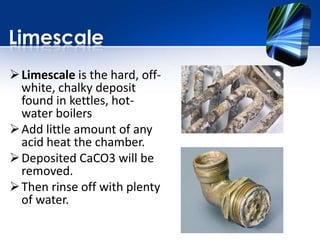
Limescale
Limescale is the hard, off-
white, chalky deposit
found in kettles, hot-
water boilers
Add little amount of any
acid heat the chamber.
Deposited CaCO3 will be
removed.
Then rinse off with plenty
of water.
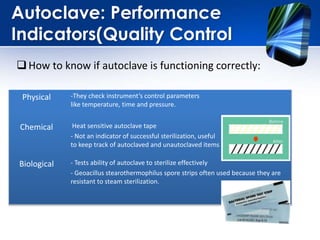
Autoclave: Performance
Indicators(Quality Control
How to know if autoclave is functioning correctly:
Physical -They check instrument’s control parameters
like temperature, time and pressure.
Chemical -Heat sensitive autoclave tape
- Not an indicator of successful sterilization, useful
to keep track of autoclaved and unautoclaved items
Biological - Tests ability of autoclave to sterilize effectively
- Geoacillus stearothermophilus spore strips often used because they are
resistant to steam sterilization.
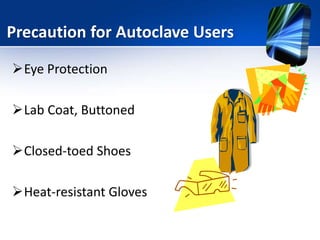
Precaution for Autoclave Users
Eye Protection
Lab Coat, Buttoned
Closed-toed Shoes
Heat-resistant Gloves
Autoclave

Autoclave

  • 1.
    Autoclave Presented By:- Himanshu Dev DMLT(2011) VIth Sem. VMMC & SJH
  • 2.
     The autoclaveis a piece of equipment used for sterilizing various requirements in the lab by wet sterilization method.  The name comes from Greek auto-, ultimately meaning self, and Latin clavis meaning key—a self-locking device.  The word sterilizing means the destruction of elimination of all forms of life (microbial, including spores) present in inanimate objects by means of physical, chemical or gaseous procedures. Autoclave
  • 3.
    Operation Principle  Whenwater is heated in a closed container, saturated steam is produced under pressure.  According to Boyle’s Law, when volume of the steam, is kept constant, the temperature is directly proportional to pressure.  If the pressure is reduced it boils at a lower temperature. If the pressure rises, it boils at a greater temperature.  At 15 lbs pressure 1210 C temperature can be obtained.  Moist heat coagulates cell proteins of the microorganisms and thus kills all the living entities (including spores) in 15 to 20 minutes.  Hot saturated steam is efficient means of destroying micro- organisms, since it penetrates rapidly and gives up its latent heat as it condenses on the cooler objects.
  • 4.
    The process associatedin achieving sterile conditions of inanimate objects are the following : • Cleaning • Decontamination • Inspection • Preparation and packing • Sterilization • Storage • Delivery of materials
  • 5.
    Purpose of theAutoclave In the laboratory, materials and objects are sterilized for the following purposes: 1. To prepare materials for bacteriological cell cultures (test tubes, pipettes, Petridishes, etc.) in order to avoid their contamination. 2. Prepare elements used for taking samples. (All must be in sterile conditions: needles, tubes, containers). 3. Sterilize contaminated material.
  • 6.
    Two Type ofAutoclave 1. Horizontal or downward displacement autoclave. 2. Vacuum assisted autoclave.
  • 7.
    Horizontal or downward displacementautoclave  In a Downward displacement autoclave cold air escapes through the bottom of the chamber as steam displaces it from above.  The valves should never be obstructed and the chamber must not be overfilled in order for this system to function efficiently.
  • 8.
    Horizontal or downward displacementautoclave contd..  This type of autoclave is electrically operated and can be fully or semiautomatic.  The downward displacement autoclave sterilizer is also known as a gravity displacement unit.  It uses a heating element to heat up the water and produce steam.  The steam, which is lighter than air, forces the air inside the sterilization chamber to move downward.  Eventually the air moves out through the drain hole of the sterilization chamber.  Once the temperature in the chamber is sufficient, the hole is automatically closed and the sterilization process is started.
  • 10.
  • 11.
    • A vacuumautoclave is set up in a similar fashion to a negative pressure displacement unit in that there is a vacuum pump to remove air from the sterilization chamber and steam is created in a second, separate chamber or unit. The process begins by the vacuum removing the air, then a pulse of steam. This type of autoclave is suitable for all types of instruments and is very versatile. Vaccum Assisted Autoclave
  • 12.
  • 13.
    MAIN COMPONENTS 1. HeatingElements 2. Temperature Controller 3. Pressure Sensor 4. Chamber 5. Door gasket 6. Solenoid valve 7. Water level Sensor 8. Steam generator 9. Vaccum pump
  • 14.
    Vacuum assisted orpre-vacuum autoclave • Air is evacuated rapidly from the sterilising chamber at the beginning of the cycle creating a vacuum, so steam penetration and sterilising occurs very rapidly. • A second vacuum cycle withdraws moisture after sterilisation , facilitating drying of the load. • Often, this autoclave is connected to a central boiler of steam. They have a large capacity and are fully automated and failsafe. • Modern, computerised autoclaves will abort the cycle if there is a malfunction.
  • 15.
    Vertical Pressure Cooker(Autoclave) • Thiscooker operates similarly to a household pressure cooker. It is commonly used in practice. The vertical pressure cooker has an air vent at the top which is manually closed after all the air has been evacuated. • This is a possible disadvantage as some air may remain trapped under the steam and therefore cause a lower temperature to be reached in this area. • As this is a manually operated steriliser, human error can influence the effectiveness of sterilisation. • There is also no automatic drying cycle, so items may be slightly damp at the end of the cycle. Ensure packs are fully dried before storing.
  • 16.
    Classification of Autoclaves •Type "N" & Type "B“ Each • Type "N" units do not use a vacuum to remove air from the sterilization chamber. Type "N" autoclaves are suitable for a specific type of load--for solid. • Type "B" units use a vacuum pump. Type "B" autoclaves can be used on wrapped and hollow instruments, which means a piece of equipment can be sterilized now for use later.
  • 17.
    MAIN COMPONENTS 1. HeatingElements 2. Temperature Controller 3. Pressure Sensor 4. Chamber 5. Door gasket 6. Solenoid valve 7. Water level Sensor
  • 18.
    Preparation of Material 1.Syringes and needles  Syringes are wrapped in gauze and needles are placed separately in small test tubes that are plugged.  A pad of nonabsorbent cotton is placed at the bottom of each tube to protect the tip of the needle. Syringes and needles are then placed in a metal tray, which is placed uncovered in the autoclave. 2. Glassware  Glassware such as specimen tubes, petri dishes, specimen collection bottles are wrapped in brown paper and are tied with string.  The Pasteur pipettes are placed in large tubes, which are then plugged.
  • 19.
    What can beAutoclaved? Surgical Instruments Glassware Plastic tubes and pipette tips Culture and stocks of infectious material Discarded Live and attenuated vaccine Media and solutions Waste
  • 20.
    Preventive Maintenances 1. Cleanall the filters.(Water, Air ) 2. Fill the water level of feed tank up to maximum limit 3. Check that the manometers function as expected. 4. Check the accuracy of temperature reading. 5. Activate the safety valves manually to verify that they are operating well. 6. Conduct a general sterilization process write down pressure, temperature, required times for completing each phase of the cycle, put it on registration system. 7. Verify that it is functioning within tolerances defined by manufacturer 8. Check any abnormal sound in solenoids. 9. Clean the chamber and remove limescale if any, advice to use only distilled water. 10. Check the earth leakage current, protective earth.
  • 21.
    Limescale Limescale is thehard, off- white, chalky deposit found in kettles, hot- water boilers Add little amount of any acid heat the chamber. Deposited CaCO3 will be removed. Then rinse off with plenty of water.
  • 22.
    Autoclave: Performance Indicators(Quality Control Howto know if autoclave is functioning correctly: Physical -They check instrument’s control parameters like temperature, time and pressure. Chemical -Heat sensitive autoclave tape - Not an indicator of successful sterilization, useful to keep track of autoclaved and unautoclaved items Biological - Tests ability of autoclave to sterilize effectively - Geoacillus stearothermophilus spore strips often used because they are resistant to steam sterilization.
  • 23.
    Precaution for AutoclaveUsers Eye Protection Lab Coat, Buttoned Closed-toed Shoes Heat-resistant Gloves