 Sterilization
 process by which an article, surface, or medium is freed of all living microorganisms
either in the vegetative or in the spore state
 DESTROYS SPORES
 refers to the use of a chemical agent that destroys or removes all pathogenic
organisms or organisms capable of giving rise to infection
 NOT SPORICIDAL
 CHEMICAL DISINFECTANTS WHICH CAN BE SAFELY APPLIED TO SKIN
OR MUCUS MEMBRANE
 BEST & MOST COMMONLY USED  BETADINE
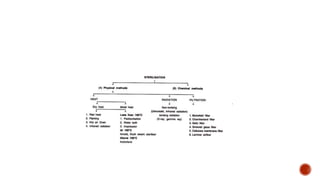
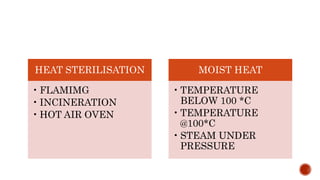
HEAT STERILISATION
• FLAMIMG
• INCINERATION
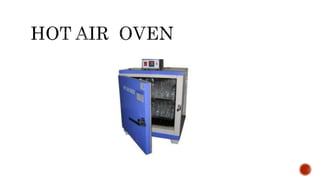
• HOT AIR OVEN
MOIST HEAT
• TEMPERATURE
BELOW 100 *C
• TEMPERATURE
@100*C
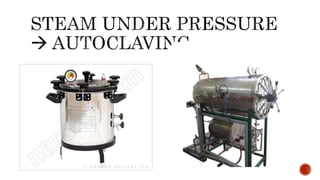
• STEAM UNDER
PRESSURE
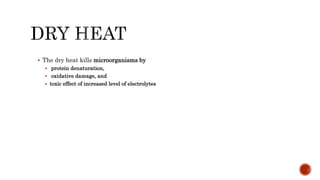
 The dry heat kills microorganisms by
 protein denaturation,
 oxidative damage, and
 toxic effect of increased level of electrolytes
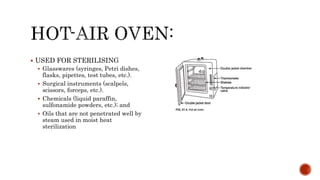
 USED FOR STERILISING
 Glasswares (syringes, Petri dishes,
flasks, pipettes, test tubes, etc.).
 Surgical instruments (scalpels,
scissors, forceps, etc.).
 Chemicals (liquid paraffin,
sulfonamide powders, etc.); and
 Oils that are not penetrated well by
steam used in moist heat
sterilization
 160 for 45 minutes
 170 degree for 18 minutes
 180 degree for 7.5 minutes
 190 degree for 1.5 minutes
 Thermocouples, chemical indicators, and bacteriological spores of Bacillus subtilis
& clostridium tetani are used as sterilization controls to determine the efficacy of
sterilization by hot-air oven.
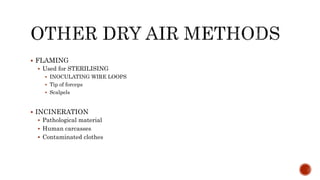
 FLAMING
 Used for STERILISING
 INOCULATING WIRE LOOPS
 Tip of forceps
 Scalpels
 INCINERATION
 Pathological material
 Human carcasses
 Contaminated clothes
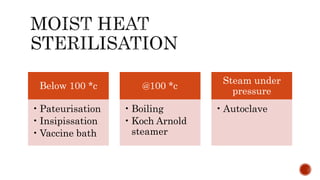
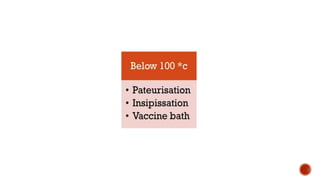
Below 100 *c
• Pateurisation
• Insipissation
• Vaccine bath
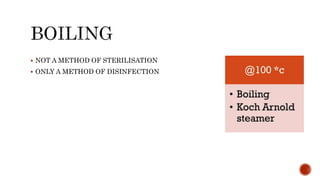
@100 *c
• Boiling
• Koch Arnold
steamer
Steam under
pressure
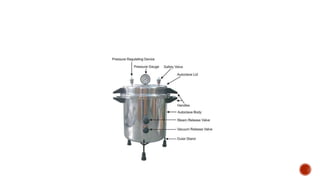
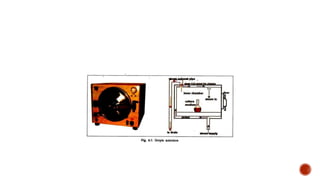
• Autoclave
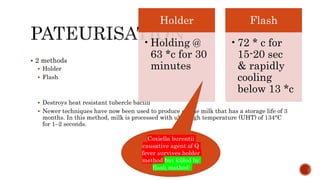
 2 methods
 Holder
 Flash
 Destroys heat resistant tubercle bacilli
 Newer techniques have now been used to produce sterile milk that has a storage life of 3
months. In this method, milk is processed with ultrahigh temperature (UHT) of 134°C
for 1–2 seconds.
Holder
•Holding @
63 *c for 30
minutes
Flash
•72 * c for
15-20 sec
& rapidly
cooling
below 13 *c
Coxiella burentii
causative agent of Q
fever survives holder
method but killed by
flash method
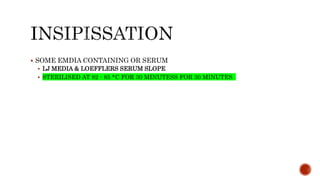
 SOME EMDIA CONTAINING OR SERUM
 LJ MEDIA & LOEFFLERS SERUM SLOPE
 STERILISED AT 82 - 85 *C FOR 30 MINUTESS FOR 30 MINUTES
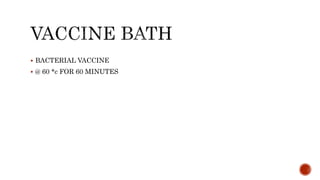
 BACTERIAL VACCINE
 @ 60 *c FOR 60 MINUTES
 NOT A METHOD OF STERILISATION
 ONLY A METHOD OF DISINFECTION
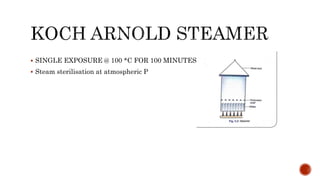
 SINGLE EXPOSURE @ 100 *C FOR 100 MINUTES
 Steam sterilisation at atmospheric P
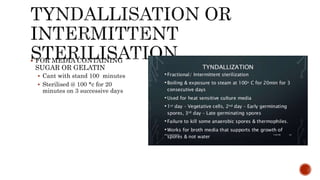
 FOR MEDIA CONTAINING
SUGAR OR GELATIN
 Cant with stand 100 minutes
 Sterilised @ 100 *c for 20
minutes on 3 successive days
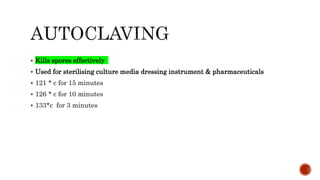
 Kills spores effectively
 Used for sterilising culture media dressing instrument & pharmaceuticals
 121 * c for 15 minutes
 126 * c for 10 minutes
 133*c for 3 minutes
 Thermocouples
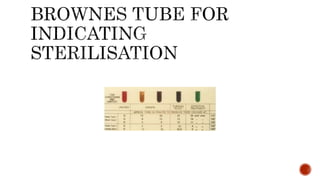
 Brown’s tube is the most commonly used chemical indicator of moist heat
sterilization in the autoclave. It contains red solution that turns green when
exposed to temperature of 121°C for 15 minutes in an autoclave
 Spores of bacillus steatothermophilus
 Water purification & analysis
 Sterilisation & sterility testing
 MEMBRANE FILTER  MC USED
 CONSTITUENTS LIKE SERUM TRYPSIN GROWTH FACTORS PROTEINS AMINOACIDS
VITAMINS HORMONES
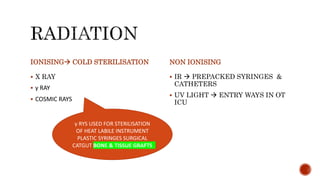
IONISING COLD STERILISATION
 X RAY
 γ RAY
 COSMIC RAYS
NON IONISING
 IR  PREPACKED SYRINGES &
CATHETERS
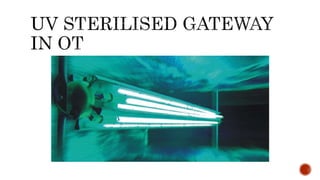
 UV LIGHT  ENTRY WAYS IN OT
ICU
γ RYS USED FOR STERILISATION
OF HEAT LABILE INSTRUMENT
PLASTIC SYRINGES SURGICAL
CATGUT BONE & TISSUE GRAFTS
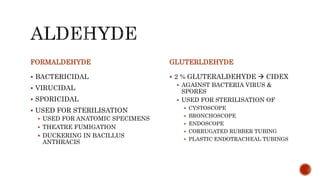
FORMALDEHYDE
 BACTERICIDAL
 VIRUCIDAL
 SPORICIDAL
 USED FOR STERILISATION
 USED FOR ANATOMIC SPECIMENS
 THEATRE FUMIGATION
 DUCKERING IN BACILLUS
ANTHRACIS
GLUTERLDEHYDE
 2 % GLUTERALDEHYDE  CIDEX
 AGAINST BACTERIA VIRUS &
SPORES
 USED FOR STERILISATION OF
 CYSTOSCOPE
 BRONCHOSCOPE
 ENDOSCOPE
 CORRUGATED RUBBER TUBING
 PLASTIC ENDOTRACHEAL TUBINGS
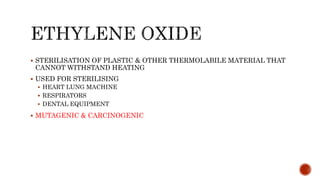
 STERILISATION OF PLASTIC & OTHER THERMOLABILE MATERIAL THAT
CANNOT WITHSTAND HEATING
 USED FOR STERILISING
 HEART LUNG MACHINE
 RESPIRATORS
 DENTAL EQUIPMENT
 MUTAGENIC & CARCINOGENIC
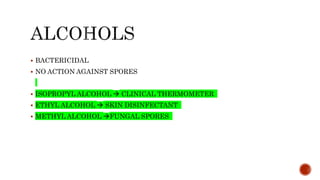
 BACTERICIDAL
 NO ACTION AGAINST SPORES
 ISOPROPYL ALCOHOL  CLINICAL THERMOMETER
 ETHYL ALCOHOL  SKIN DISINFECTANT
 METHYL ALCOHOL FUNGAL SPORES
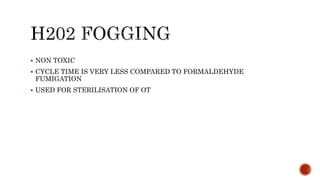
 NON TOXIC
 CYCLE TIME IS VERY LESS COMPARED TO FORMALDEHYDE
FUMIGATION
 USED FOR STERILISATION OF OT
 BACTERICIDAL VIRUCIDAL & SPORICIDAL
 DISINFECTION OF WATER
 HYPOCHLORITE
 WATER TREATMENT
 HIV BLOOD SPILLS  5000 RPM
 HepB BLOOD SPILLS  10000 RPM
 MORE SPORICIDAL THAN CHLORINE
 IODOPHORES  ORGANIC COMPOUNDS THAT SLOW RELEASING OF
IODINE
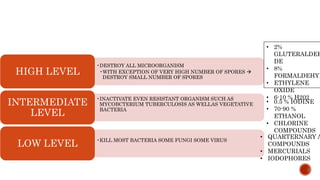
•DESTROY ALL MICROORGANISM
•WITH EXCEPTION OF VERY HIGH NUMBER OF SPORES 
DESTROY SMALL NUMBER OF SPORES
HIGH LEVEL
•INACTIVATE EVEN RESISTANT ORGANISM SUCH AS
MYCOBCTERIUM TUBERCULOSIS AS WELLAS VEGETATIVE
BACTERIA
INTERMEDIATE
LEVEL
•KILL MOST BACTERIA SOME FUNGI SOME VIRUS
LOW LEVEL
• QUARTERNARY A
COMPOUNDS
• MERCURIALS
• IODOPHORES
• 2%
GLUTERALDEH
DE
• 8%
FORMALDEHYD
• ETHYLENE
OXIDE
• 6-10 % H202
• 0.5 % IODINE
• 70-90 %
ETHANOL
• CHLORINE
COMPOUNDS
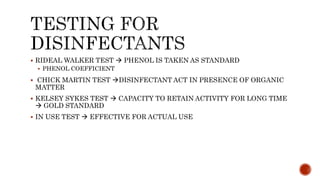
 RIDEAL WALKER TEST  PHENOL IS TAKEN AS STANDARD
 PHENOL COEFFICIENT
 CHICK MARTIN TEST DISINFECTANT ACT IN PRESENCE OF ORGANIC
MATTER
 KELSEY SYKES TEST  CAPACITY TO RETAIN ACTIVITY FOR LONG TIME
 GOLD STANDARD
 IN USE TEST  EFFECTIVE FOR ACTUAL USE
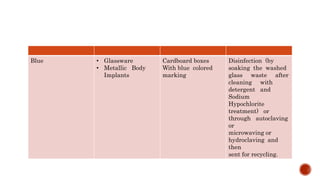
Blue • Glassware
• Metallic Body
Implants
Cardboard boxes
With blue colored
marking
Disinfection (by
soaking the washed
glass waste after
cleaning with
detergent and
Sodium
Hypochlorite
treatment) or
through autoclaving
or
microwaving or
hydroclaving and
then
sent for recycling.
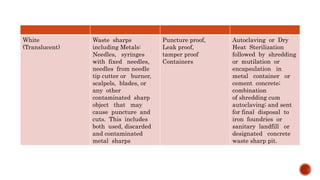
White
(Translucent)
Waste sharps
including Metals:
Needles, syringes
with fixed needles,
needles from needle
tip cutter or burner,
scalpels, blades, or
any other
contaminated sharp
object that may
cause puncture and
cuts. This includes
both used, discarded
and contaminated
metal sharps
Puncture proof,
Leak proof,
tamper proof
Containers
Autoclaving or Dry
Heat Sterilization
followed by shredding
or mutilation or
encapsulation in
metal container or
cement concrete;
combination
of shredding cum
autoclaving; and sent
for final disposal to
iron foundries or
sanitary landfill or
designated concrete
waste sharp pit.
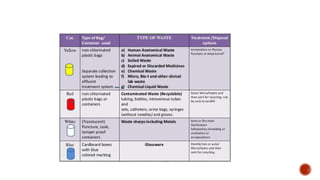
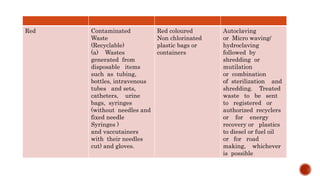
Red Contaminated
Waste
(Recyclable)
(a) Wastes
generated from
disposable items
such as tubing,
bottles, intravenous
tubes and sets,
catheters, urine
bags, syringes
(without needles and
fixed needle
Syringes )
and vaccutainers
with their needles
cut) and gloves.
Red coloured
Non chlorinated
plastic bags or
containers
Autoclaving
or Micro waving/
hydroclaving
followed by
shredding or
mutilation
or combination
of sterilization and
shredding. Treated
waste to be sent
to registered or
authorized recyclers
or for energy
recovery or plastics
to diesel or fuel oil
or for road
making, whichever
is possible
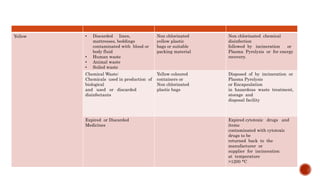
Yellow • Discarded linen,
mattresses, beddings
contaminated with blood or
body fluid
• Human waste
• Animal waste
• Soiled waste
Non chlorinated
yellow plastic
bags or suitable
packing material
Non chlorinated chemical
disinfection
followed by incineration or
Plasma Pyrolysis or for energy
recovery.
Chemical Waste:
Chemicals used in production of
biological
and used or discarded
disinfectants
Yellow coloured
containers or
Non chlorinated
plastic bags
Disposed of by incineration or
Plasma Pyrolysis
or Encapsulation
in hazardous waste treatment,
storage and
disposal facility
Expired or Discarded
Medicines
Expired cytotoxic drugs and
items
contaminated with cytotoxic
drugs to be
returned back to the
manufacturer or
supplier for incineration
at temperature
>1200 *C

Sterilisation &disinfection microbiology revision notes

  • 2.
     Sterilization  processby which an article, surface, or medium is freed of all living microorganisms either in the vegetative or in the spore state  DESTROYS SPORES
  • 3.
     refers tothe use of a chemical agent that destroys or removes all pathogenic organisms or organisms capable of giving rise to infection  NOT SPORICIDAL
  • 4.
     CHEMICAL DISINFECTANTSWHICH CAN BE SAFELY APPLIED TO SKIN OR MUCUS MEMBRANE  BEST & MOST COMMONLY USED  BETADINE
  • 7.
    HEAT STERILISATION • FLAMIMG •INCINERATION • HOT AIR OVEN MOIST HEAT • TEMPERATURE BELOW 100 *C • TEMPERATURE @100*C • STEAM UNDER PRESSURE
  • 8.
     The dryheat kills microorganisms by  protein denaturation,  oxidative damage, and  toxic effect of increased level of electrolytes
  • 9.
     USED FORSTERILISING  Glasswares (syringes, Petri dishes, flasks, pipettes, test tubes, etc.).  Surgical instruments (scalpels, scissors, forceps, etc.).  Chemicals (liquid paraffin, sulfonamide powders, etc.); and  Oils that are not penetrated well by steam used in moist heat sterilization
  • 10.
     160 for45 minutes  170 degree for 18 minutes  180 degree for 7.5 minutes  190 degree for 1.5 minutes
  • 12.
     Thermocouples, chemicalindicators, and bacteriological spores of Bacillus subtilis & clostridium tetani are used as sterilization controls to determine the efficacy of sterilization by hot-air oven.
  • 13.
     FLAMING  Usedfor STERILISING  INOCULATING WIRE LOOPS  Tip of forceps  Scalpels  INCINERATION  Pathological material  Human carcasses  Contaminated clothes
  • 14.
    Below 100 *c •Pateurisation • Insipissation • Vaccine bath @100 *c • Boiling • Koch Arnold steamer Steam under pressure • Autoclave
  • 17.
     2 methods Holder  Flash  Destroys heat resistant tubercle bacilli  Newer techniques have now been used to produce sterile milk that has a storage life of 3 months. In this method, milk is processed with ultrahigh temperature (UHT) of 134°C for 1–2 seconds. Holder •Holding @ 63 *c for 30 minutes Flash •72 * c for 15-20 sec & rapidly cooling below 13 *c Coxiella burentii causative agent of Q fever survives holder method but killed by flash method
  • 18.
     SOME EMDIACONTAINING OR SERUM  LJ MEDIA & LOEFFLERS SERUM SLOPE  STERILISED AT 82 - 85 *C FOR 30 MINUTESS FOR 30 MINUTES
  • 19.
     BACTERIAL VACCINE @ 60 *c FOR 60 MINUTES
  • 21.
     NOT AMETHOD OF STERILISATION  ONLY A METHOD OF DISINFECTION
  • 22.
     SINGLE EXPOSURE@ 100 *C FOR 100 MINUTES  Steam sterilisation at atmospheric P
  • 23.
     FOR MEDIACONTAINING SUGAR OR GELATIN  Cant with stand 100 minutes  Sterilised @ 100 *c for 20 minutes on 3 successive days
  • 28.
     Kills sporeseffectively  Used for sterilising culture media dressing instrument & pharmaceuticals  121 * c for 15 minutes  126 * c for 10 minutes  133*c for 3 minutes
  • 29.
     Thermocouples  Brown’stube is the most commonly used chemical indicator of moist heat sterilization in the autoclave. It contains red solution that turns green when exposed to temperature of 121°C for 15 minutes in an autoclave  Spores of bacillus steatothermophilus
  • 32.
     Water purification& analysis  Sterilisation & sterility testing  MEMBRANE FILTER  MC USED  CONSTITUENTS LIKE SERUM TRYPSIN GROWTH FACTORS PROTEINS AMINOACIDS VITAMINS HORMONES
  • 34.
    IONISING COLD STERILISATION X RAY  γ RAY  COSMIC RAYS NON IONISING  IR  PREPACKED SYRINGES & CATHETERS  UV LIGHT  ENTRY WAYS IN OT ICU γ RYS USED FOR STERILISATION OF HEAT LABILE INSTRUMENT PLASTIC SYRINGES SURGICAL CATGUT BONE & TISSUE GRAFTS
  • 37.
    FORMALDEHYDE  BACTERICIDAL  VIRUCIDAL SPORICIDAL  USED FOR STERILISATION  USED FOR ANATOMIC SPECIMENS  THEATRE FUMIGATION  DUCKERING IN BACILLUS ANTHRACIS GLUTERLDEHYDE  2 % GLUTERALDEHYDE  CIDEX  AGAINST BACTERIA VIRUS & SPORES  USED FOR STERILISATION OF  CYSTOSCOPE  BRONCHOSCOPE  ENDOSCOPE  CORRUGATED RUBBER TUBING  PLASTIC ENDOTRACHEAL TUBINGS
  • 38.
     STERILISATION OFPLASTIC & OTHER THERMOLABILE MATERIAL THAT CANNOT WITHSTAND HEATING  USED FOR STERILISING  HEART LUNG MACHINE  RESPIRATORS  DENTAL EQUIPMENT  MUTAGENIC & CARCINOGENIC
  • 39.
     BACTERICIDAL  NOACTION AGAINST SPORES  ISOPROPYL ALCOHOL  CLINICAL THERMOMETER  ETHYL ALCOHOL  SKIN DISINFECTANT  METHYL ALCOHOL FUNGAL SPORES
  • 40.
     NON TOXIC CYCLE TIME IS VERY LESS COMPARED TO FORMALDEHYDE FUMIGATION  USED FOR STERILISATION OF OT
  • 41.
  • 42.
     DISINFECTION OFWATER  HYPOCHLORITE  WATER TREATMENT  HIV BLOOD SPILLS  5000 RPM  HepB BLOOD SPILLS  10000 RPM
  • 43.
     MORE SPORICIDALTHAN CHLORINE  IODOPHORES  ORGANIC COMPOUNDS THAT SLOW RELEASING OF IODINE
  • 45.
    •DESTROY ALL MICROORGANISM •WITHEXCEPTION OF VERY HIGH NUMBER OF SPORES  DESTROY SMALL NUMBER OF SPORES HIGH LEVEL •INACTIVATE EVEN RESISTANT ORGANISM SUCH AS MYCOBCTERIUM TUBERCULOSIS AS WELLAS VEGETATIVE BACTERIA INTERMEDIATE LEVEL •KILL MOST BACTERIA SOME FUNGI SOME VIRUS LOW LEVEL • QUARTERNARY A COMPOUNDS • MERCURIALS • IODOPHORES • 2% GLUTERALDEH DE • 8% FORMALDEHYD • ETHYLENE OXIDE • 6-10 % H202 • 0.5 % IODINE • 70-90 % ETHANOL • CHLORINE COMPOUNDS
  • 47.
     RIDEAL WALKERTEST  PHENOL IS TAKEN AS STANDARD  PHENOL COEFFICIENT  CHICK MARTIN TEST DISINFECTANT ACT IN PRESENCE OF ORGANIC MATTER  KELSEY SYKES TEST  CAPACITY TO RETAIN ACTIVITY FOR LONG TIME  GOLD STANDARD  IN USE TEST  EFFECTIVE FOR ACTUAL USE
  • 51.
    Blue • Glassware •Metallic Body Implants Cardboard boxes With blue colored marking Disinfection (by soaking the washed glass waste after cleaning with detergent and Sodium Hypochlorite treatment) or through autoclaving or microwaving or hydroclaving and then sent for recycling.
  • 52.
    White (Translucent) Waste sharps including Metals: Needles,syringes with fixed needles, needles from needle tip cutter or burner, scalpels, blades, or any other contaminated sharp object that may cause puncture and cuts. This includes both used, discarded and contaminated metal sharps Puncture proof, Leak proof, tamper proof Containers Autoclaving or Dry Heat Sterilization followed by shredding or mutilation or encapsulation in metal container or cement concrete; combination of shredding cum autoclaving; and sent for final disposal to iron foundries or sanitary landfill or designated concrete waste sharp pit.
  • 53.
    Red Contaminated Waste (Recyclable) (a) Wastes generatedfrom disposable items such as tubing, bottles, intravenous tubes and sets, catheters, urine bags, syringes (without needles and fixed needle Syringes ) and vaccutainers with their needles cut) and gloves. Red coloured Non chlorinated plastic bags or containers Autoclaving or Micro waving/ hydroclaving followed by shredding or mutilation or combination of sterilization and shredding. Treated waste to be sent to registered or authorized recyclers or for energy recovery or plastics to diesel or fuel oil or for road making, whichever is possible
  • 54.
    Yellow • Discardedlinen, mattresses, beddings contaminated with blood or body fluid • Human waste • Animal waste • Soiled waste Non chlorinated yellow plastic bags or suitable packing material Non chlorinated chemical disinfection followed by incineration or Plasma Pyrolysis or for energy recovery. Chemical Waste: Chemicals used in production of biological and used or discarded disinfectants Yellow coloured containers or Non chlorinated plastic bags Disposed of by incineration or Plasma Pyrolysis or Encapsulation in hazardous waste treatment, storage and disposal facility Expired or Discarded Medicines Expired cytotoxic drugs and items contaminated with cytotoxic drugs to be returned back to the manufacturer or supplier for incineration at temperature >1200 *C