MOIST HEAT STERILIZATION
6/11/2013
Principle-Denaturation & coagulation of
proteins due to the latent heat present in
steam
Advantages of steam –Latent heat liberated
on condensing on a cooler surface increases
the temprature of that surface
What is Moist heat Sterilization?
6/11/2013
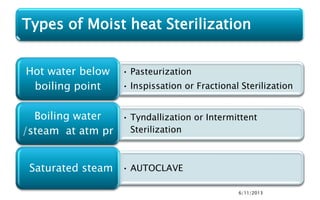
Types of Moist heat Sterilization
• Pasteurization
• Inspissation or Fractional Sterilization
Hot water below
boiling point
• Tyndallization or Intermittent
Sterilization
Boiling water
/steam at atm pr
• AUTOCLAVESaturated steam
6/11/2013
Pasteurization
6/11/2013
• 63 C for 30
minutes
Holder
Method
•72 C for 15-
20 seconds
Flash
Process
Heat labile fluids may be disinfected
It is the process of
thickening by dehydration
6/11/2013
Inspissation
 Media such as
Lowenstein –Jensen
media and Loeffler’s
serum are rendered
sterile by heating at
80-85 C for half an
hour on three
consecutive days
6/11/2013
Tyndallisation
Principle: The first exposure kills all
vegetative bacteria and the spores
since they are in a favourable
medium will germinate and be killed
on subsequent occasions
Though generally adequate this
method may fail with spores of
certain anaerobes and thermophiles
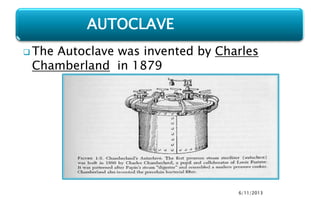
 The Autoclave was invented by Charles
Chamberland in 1879
AUTOCLAVE
6/11/2013
Definition
Autoclave is a pressurized
device designed to heat
aqueous solutions above
their boiling point at
normal atmospheric
pressure to achieve
sterilization
6/11/2013
Reliable sterilization with moist heat requires
temperatures above that of boiling water.
These high temperatures are most commonly achieved
by steam under pressure in an autoclave. .
Need for autoclaving:
6/11/2013
Autoclaving is the preferred method of
sterilization unless the material to be
sterilized can be damaged by heat or
moisture
6/11/2013
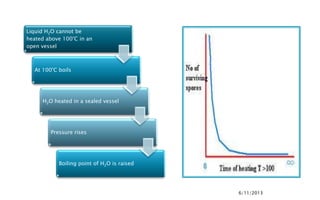
Liquid H2O cannot be
heated above 100°C in an
open vessel
At 100°C boils
H2O heated in a sealed vessel
Pressure rises
Boiling point of H2O is raised
6/11/2013
Air removal
Downward displacement
Steam pulsing
Vacuum pumps
Superatmospheric
Subatmospheric
Process
6/11/2013
Biological indicators are the only process indicators that directly monitor the lethality of a
given sterilization process. Spores used to monitor a sterilization process have
demonstrated resistance to the sterilizing agent and are more resistant than the
bioburden found on medical devices.
Bacillus stearothermophilus
Thermophilus aquaticus
Spore Test
6/11/2013
If the autoclave does not reach the
right temperature the spores
will germinate when incubated and
their metabolism will change the
color of a pH –sensitive chemical.
6/11/2013
Any Questions???
6/11/2013

Moist heat sterilization

  • 1.
  • 2.
    Principle-Denaturation & coagulationof proteins due to the latent heat present in steam Advantages of steam –Latent heat liberated on condensing on a cooler surface increases the temprature of that surface What is Moist heat Sterilization? 6/11/2013
  • 3.
    Types of Moistheat Sterilization • Pasteurization • Inspissation or Fractional Sterilization Hot water below boiling point • Tyndallization or Intermittent Sterilization Boiling water /steam at atm pr • AUTOCLAVESaturated steam 6/11/2013
  • 4.
    Pasteurization 6/11/2013 • 63 Cfor 30 minutes Holder Method •72 C for 15- 20 seconds Flash Process Heat labile fluids may be disinfected
  • 5.
    It is theprocess of thickening by dehydration 6/11/2013 Inspissation  Media such as Lowenstein –Jensen media and Loeffler’s serum are rendered sterile by heating at 80-85 C for half an hour on three consecutive days
  • 6.
    6/11/2013 Tyndallisation Principle: The firstexposure kills all vegetative bacteria and the spores since they are in a favourable medium will germinate and be killed on subsequent occasions Though generally adequate this method may fail with spores of certain anaerobes and thermophiles
  • 7.
     The Autoclavewas invented by Charles Chamberland in 1879 AUTOCLAVE 6/11/2013
  • 8.
    Definition Autoclave is apressurized device designed to heat aqueous solutions above their boiling point at normal atmospheric pressure to achieve sterilization 6/11/2013
  • 9.
    Reliable sterilization withmoist heat requires temperatures above that of boiling water. These high temperatures are most commonly achieved by steam under pressure in an autoclave. . Need for autoclaving: 6/11/2013 Autoclaving is the preferred method of sterilization unless the material to be sterilized can be damaged by heat or moisture
  • 10.
    6/11/2013 Liquid H2O cannotbe heated above 100°C in an open vessel At 100°C boils H2O heated in a sealed vessel Pressure rises Boiling point of H2O is raised
  • 11.
    6/11/2013 Air removal Downward displacement Steampulsing Vacuum pumps Superatmospheric Subatmospheric Process
  • 12.
  • 13.
    Biological indicators arethe only process indicators that directly monitor the lethality of a given sterilization process. Spores used to monitor a sterilization process have demonstrated resistance to the sterilizing agent and are more resistant than the bioburden found on medical devices. Bacillus stearothermophilus Thermophilus aquaticus Spore Test 6/11/2013 If the autoclave does not reach the right temperature the spores will germinate when incubated and their metabolism will change the color of a pH –sensitive chemical.
  • 14.
  • 15.