Y.Bavaneethan.
Lecturer
Department of Food Technology
SLGTI. Sri Lanka.11/27/2017 Y.BAVANEETHAN 1
Heat sterilisation
 Unit operation; foods are heated sufficiently at high
temperature & for long time to destroy microbial & enzyme
activity.
• a shelf life > 6 month at ambient temperatures.
 Severe heat treatment during the older process of in- container
sterilisation (canning);
• produce substantial changes in nutritional and sensory qualities
 More recent developments, introduced advanced technology
• Ohmic heating is to reduce the damage of nutrients &
sensory components.
 Two main procedure methods:
• Part 1: in-container heat sterilisation
• Part 2: UHT processes.11/27/2017 Y.BAVANEETHAN 2
In-container sterilization
physical state of
food
container
size
pH of the food
rate of heat penetration
into the food.
heat resistance of
micro-organisms or enzymes
How long to
sterilise a food?
The length of time required to sterilise a food. That is
influenced by:
11/27/2017 Y.BAVANEETHAN 3
Heat resistance of micro-organisms
 The heat resistant, spore forming micro-organism –
Clostridium botulinum
•most dangerous pathogen.
•Under anaerobic conditions inside a sealed container
•This produce a powerful exotoxin- “botulin”.
Minimum requirement of heat sterilisation.
1. In low-acid foods(pH > 4.5)
• Destruction of C. botulinum is a minimum requirement of heat
sterilisation.
• Normally, Destruction of C. botulinum in low acid foods ensure,
• Destroyed all other heat resistant spoilage micro organism.
11/27/2017 Y.BAVANEETHAN 4
2. In acidic foods (pH 4.5–3.7),
– yeasts and fungi or heat-resistant enzymes are
used to establish Minimum requirement of
processing times and temperatures for
sterilization.
3. In more acidic foods (pH< 3.7),
– Destruction of enzyme inactivation is the
Minimum requirement of processing time and
temperature. (sometimes referred to as
pasteurisation).
11/27/2017 Y.BAVANEETHAN 5
11/27/2017 Y.BAVANEETHAN 6
Thermal Destruction of Microorganisms
 Heat is lethal to microorganisms, but each species has
own particular heat tolerance.
 The process is dependent both on the temperature of
exposure and the time required at this temperature to
destruction.
 Thermal destruction of micro-organisms simply
explained by D value.
 D values differ for different microbial species
– higher D value indicates greater heat resistance.
– 12 D value - Clostridium botulinum
11/27/2017 Y.BAVANEETHAN 7
Decimal reduction time (D-value)
 Definition of D-value, which denotes the decimal
reduction time, this is the time required at a specific
temperature and under specified conditions to reduce
a microbial population by one decimal.
 The decimal reduction time is dependent on;
– the temperature
– the type of microorganism
– the composition of the medium containing the
microorganism.
 For example, a D value at 72°C of 1 minute means;
– that for each minute of processing at 72°C, the bacteria
population of the target microorganism will be reduced by 90%.
11/27/2017 Y.BAVANEETHAN 8
• Here D value is 14 minutes (40-26) and would be representative of a process at 120°C.
[Specific temperature (120OC) and under specified conditions]
11/27/2017 Y.BAVANEETHAN 9
The Z-value.
• The Z-value is the increase in temperature required to reduce
the decimal reduction time by one decimal. It is a measure of
the change in death rate with a change in temperature.
30/3
=10
(one decimal)
11/27/2017 Y.BAVANEETHAN 10
The 12-D Process
 Canned foods are susceptible to the spores of the
organism Clostridium botulinum.
– causes botulism.
 These bacterial spores can survive many heat
treatment processes.
 Modern food production, canned foods are subjected
to a time/temperature process,
– That reduce the survival of most heat-resistant C.
botulinum spores
– by 12 logs or 12-D at 250℉ (121.1 OC)
 12 D values means 12 log cycle reduction of micro
organism. (10-12 reduction)
11/27/2017 Y.BAVANEETHAN 11
• For example if there were 10,000 spores of a
species of spore in a can of food and a 12 D process
was given, the initial 10,000 spores (10 4 spores)
would be reduced to a theoretical 10-8 living spores
per can. ( 104 /1012 = 10-8)
11/27/2017 Y.BAVANEETHAN 12
11/27/2017 Y.BAVANEETHAN 13
D-value is 1 minute at 121°C
11/27/2017 Y.BAVANEETHAN 14
Example of how to use D and Z values in
Heat treatment Calculations
Raw milk at the processing plant has bacterial
population of 4x10⁵/mL. It is to be processed
at 72°C for 210 seconds. The average D value
at 65°C for the mixed population is 7 min. The
Z value is 7°C. How many organisms will be
left after pasteurization?
11/27/2017 Y.BAVANEETHAN 15
Types of Microorganisms Important in
Retorted Foods
11/27/2017 Y.BAVANEETHAN 16
Rate of heat penetration
 The following factors are influences on the rate of heat
penetration:
1. Type of product:
– Liquid foods(peas in brine) convection heat transfer faster
than solid foods (by conduction).
2. Size of the container:
3. Agitation of the container:“control the cold point effect”
– Increases the rate of heat penetration in viscous or semi-
solid foods.
4. Temperature of the retort:
– higher temperature difference between food and heating
medium causes faster heat penetration
5. Type of container:
– Heat penetration is faster through metal than glass.11/27/2017 Y.BAVANEETHAN 17
11/27/2017 Y.BAVANEETHAN 18
Why is this important?????
11/27/2017 Y.BAVANEETHAN 19
Sterilization Process and Equipment
• The sterilization process in the canned product can be
subdivided into three phases.
– Phase 1 = (heating phase) the product temperature
is increased from ambient to the required
sterilization temperature.
– Phase 2 = (holding phase) This temperature is
maintained for a defined time.
– Phase 3 = (cooling phase) the temperature in the
can is decreased by introduction of cold water.
11/27/2017 Y.BAVANEETHAN 20
Batch or Continuous type Autoclaves or
Retorts
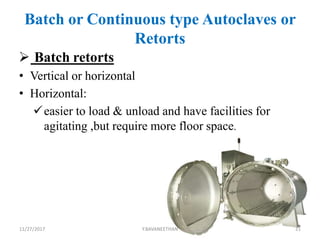
 Batch retorts
• Vertical or horizontal
• Horizontal:
easier to load & unload and have facilities for
agitating ,but require more floor space.
11/27/2017 Y.BAVANEETHAN 21
Continuous retorts
• Permit close control over processing conditions
• Produce more uniform products.
• Produce gradual changes in pressure inside cans
• less strain on can seams compared with batch equipment.
 Main disadvantages
• High in-process stock lost if a breakdown occurred
• Problems with metal corrosion & contamination by
thermophilic bacteria – due to inadequate preventative
measures.
11/27/2017 Y.BAVANEETHAN 22
Continuous Hydrostatic Sterilizer
11/27/2017 Y.BAVANEETHAN 23
Ultra high-temperature (UHT)/Aseptic
processes
Higher processing temperatures at shorter time are
possible. (132OC at 2 sec)
– into pre-sterilised containers in a sterile
atmosphere.
Liquid foods: milk, fruit juices and concentrates,
cream, yoghurt, wine, salad dressing, egg & ice cream
mix.
Foods with small discrete particles: cottage cheese, baby
foods, tomato products, fruit & vegetables, soups & rice
desserts.
High quality of UHT foods - Specially Chilled & frozen
foods
Shelf life at least 6 month without refrigeration.11/27/2017 Y.BAVANEETHAN 24
UHT Processing Characteristics
 Operation above 132ºC
 Heat transfer exposure for relatively small volume of
product to a large surface area product.
 Maintenance of turbulence in the product when, passes
over the heating surface
 Use of pumps to give constant delivery of product in
the heat exchanger
 Constant cleaning of heating surfaces to maintain high
rates of heat transfer
– reduce burning-on of the product.
11/27/2017 Y.BAVANEETHAN 25
 UHT Equipment is classified according to the method
of heating:
Direct systems - steam injection
 Indirect systems - plate heat exchangers, tubular
heat exchangers
 Other systems - microwave, dielectric, ohmic
heating
• Main limitations of UHT
– High processing cost and complexity of the plant,
– Necessary to sterilize packaging materials and
associated pipe work and tanks.
– Need maintenance of sterile air and surfaces in
filling machines.
– The higher skill levels required to operation.
11/27/2017 Y.BAVANEETHAN 26
Autoclave HeatStetilization
11/27/2017 Y.BAVANEETHAN 27
Types of packaging for thermally processed
foods
• Retort(able) pouches
• Tetrapak
• Glass jars or bottles
• Plastic
• Cans (2-3 piece)
11/27/2017 Y.BAVANEETHAN 28
Retortable pouch
3 layers ( laminate)
A. mylar or polypropylene
=> outside surface
B. aluminum –
=> barrier to gases and water vapor;
Hermatic container
C. polypropylene-
=>in contact with the food;
=>inert (prevent contact of food with aluminum)
=>heat resistant surface
11/27/2017 Y.BAVANEETHAN 29
Heat Sterilization Effect on Food
• Purpose of heat sterilization:
– extend the shelf life of foods at ambient
temperatures
– minimizing the changes in nutritional value and
sensorial characteristics
• But compare with pasteurization, higher nutritional
and sensorial losses in heat commercial sterilization.
1. Colour
 Time–temperature combinations of sterilization effect
the pigments in foods.
– meats the red oxymyoglobin pigment is converted
to brown metmyoglobin.
– purplish myoglobin is converted to red–brown
myohaemichromogen11/27/2017 Y.BAVANEETHAN 30
 Sodium nitrite and sodium nitrate are added to meat
– reduce the risk of C. botulinum.
– Maintain red–pink coloration is due to nitric oxide
myoglobin and metmyoglobin nitrite.
 In fruits and vegetables Canning process,
– chlorophyll is converted to pheophytin.
– iron or tin react with anthocyanins to form a purple
pigment, AND
– colourless leucoanthocyanins form pink anthocyanin
complexes.
 Sterilized milk slight colour changes due to
caramelization and maillard browning.
11/27/2017 Y.BAVANEETHAN 31
2. Flavor and aroma
 In canned meats, Interactions between following
components produce more than 600 flavor.
– pyrolysis
– decarboxylation of amino acids
– Maillard reactions
– caramelisation of carbohydrates to furfural
– oxidation and decarboxylation of lipids.
 In fruits and vegetables form complex reactions;
– degradation, recombination and volatilization of
aldehydes, ketones, sugars, amino acids and organic acids.
 In milk - development of a cooked flavor.
– due to denaturation of whey proteins to form hydrogen
sulphide.11/27/2017 Y.BAVANEETHAN 32
3. Texture or viscosity
 In canned meats, changes in texture;
– caused by coagulation and loss of water holding
capacity of proteins.
• which produces shrinkage and stiffening of
muscle tissues.
– Softening is caused by hydrolysis of collagen
– melting and dispersion of fats through the product.
 Polyphosphates added to canned meat,
– to bind water
– increases the tenderness of the product
– reduces shrinkage.
11/27/2017 Y.BAVANEETHAN 33
 In fruits and vegetables, softening is caused by;
– hydrolysis of pectic materials, and
– gelatinization of starches and partial solubilisation of
hemicelluloses
 Calcium salts added to blancher water of fruits and
vegetable.
– to form insoluble calcium pectate that Increase the
firmness of the canned product
 Small changes in the viscosity of milk due to;
– modification of K-casein and,
– Increase the sensitivity to calcium precipitation and
coagulation.
11/27/2017 Y.BAVANEETHAN 34
4. Nutritional value
 Proteins are coagulated in canned meats and losses of
amino acids are 10–20%.
– Reductions in lysine and tryptophan
– reduces the biological value of the proteins by 6–9%.
– loss of thiamin (50–75%) and pantothenic acid (20–
35%).
 In canned fruits and vegetables,
– significant loss of water soluble vitamins, particularly
ascorbic acid.
 Sterilized soya–meat products may show increase
in nutritional value, due to decrease the stability
of the trypsin inhibitor in soy beans.
11/27/2017 Y.BAVANEETHAN 35
Thank you
11/27/2017 Y.BAVANEETHAN 36

Sterilization.

  • 1.
    Y.Bavaneethan. Lecturer Department of FoodTechnology SLGTI. Sri Lanka.11/27/2017 Y.BAVANEETHAN 1
  • 2.
    Heat sterilisation  Unitoperation; foods are heated sufficiently at high temperature & for long time to destroy microbial & enzyme activity. • a shelf life > 6 month at ambient temperatures.  Severe heat treatment during the older process of in- container sterilisation (canning); • produce substantial changes in nutritional and sensory qualities  More recent developments, introduced advanced technology • Ohmic heating is to reduce the damage of nutrients & sensory components.  Two main procedure methods: • Part 1: in-container heat sterilisation • Part 2: UHT processes.11/27/2017 Y.BAVANEETHAN 2
  • 3.
    In-container sterilization physical stateof food container size pH of the food rate of heat penetration into the food. heat resistance of micro-organisms or enzymes How long to sterilise a food? The length of time required to sterilise a food. That is influenced by: 11/27/2017 Y.BAVANEETHAN 3
  • 4.
    Heat resistance ofmicro-organisms  The heat resistant, spore forming micro-organism – Clostridium botulinum •most dangerous pathogen. •Under anaerobic conditions inside a sealed container •This produce a powerful exotoxin- “botulin”. Minimum requirement of heat sterilisation. 1. In low-acid foods(pH > 4.5) • Destruction of C. botulinum is a minimum requirement of heat sterilisation. • Normally, Destruction of C. botulinum in low acid foods ensure, • Destroyed all other heat resistant spoilage micro organism. 11/27/2017 Y.BAVANEETHAN 4
  • 5.
    2. In acidicfoods (pH 4.5–3.7), – yeasts and fungi or heat-resistant enzymes are used to establish Minimum requirement of processing times and temperatures for sterilization. 3. In more acidic foods (pH< 3.7), – Destruction of enzyme inactivation is the Minimum requirement of processing time and temperature. (sometimes referred to as pasteurisation). 11/27/2017 Y.BAVANEETHAN 5
  • 6.
  • 7.
    Thermal Destruction ofMicroorganisms  Heat is lethal to microorganisms, but each species has own particular heat tolerance.  The process is dependent both on the temperature of exposure and the time required at this temperature to destruction.  Thermal destruction of micro-organisms simply explained by D value.  D values differ for different microbial species – higher D value indicates greater heat resistance. – 12 D value - Clostridium botulinum 11/27/2017 Y.BAVANEETHAN 7
  • 8.
    Decimal reduction time(D-value)  Definition of D-value, which denotes the decimal reduction time, this is the time required at a specific temperature and under specified conditions to reduce a microbial population by one decimal.  The decimal reduction time is dependent on; – the temperature – the type of microorganism – the composition of the medium containing the microorganism.  For example, a D value at 72°C of 1 minute means; – that for each minute of processing at 72°C, the bacteria population of the target microorganism will be reduced by 90%. 11/27/2017 Y.BAVANEETHAN 8
  • 9.
    • Here Dvalue is 14 minutes (40-26) and would be representative of a process at 120°C. [Specific temperature (120OC) and under specified conditions] 11/27/2017 Y.BAVANEETHAN 9
  • 10.
    The Z-value. • TheZ-value is the increase in temperature required to reduce the decimal reduction time by one decimal. It is a measure of the change in death rate with a change in temperature. 30/3 =10 (one decimal) 11/27/2017 Y.BAVANEETHAN 10
  • 11.
    The 12-D Process Canned foods are susceptible to the spores of the organism Clostridium botulinum. – causes botulism.  These bacterial spores can survive many heat treatment processes.  Modern food production, canned foods are subjected to a time/temperature process, – That reduce the survival of most heat-resistant C. botulinum spores – by 12 logs or 12-D at 250℉ (121.1 OC)  12 D values means 12 log cycle reduction of micro organism. (10-12 reduction) 11/27/2017 Y.BAVANEETHAN 11
  • 12.
    • For exampleif there were 10,000 spores of a species of spore in a can of food and a 12 D process was given, the initial 10,000 spores (10 4 spores) would be reduced to a theoretical 10-8 living spores per can. ( 104 /1012 = 10-8) 11/27/2017 Y.BAVANEETHAN 12
  • 13.
  • 14.
    D-value is 1minute at 121°C 11/27/2017 Y.BAVANEETHAN 14
  • 15.
    Example of howto use D and Z values in Heat treatment Calculations Raw milk at the processing plant has bacterial population of 4x10⁵/mL. It is to be processed at 72°C for 210 seconds. The average D value at 65°C for the mixed population is 7 min. The Z value is 7°C. How many organisms will be left after pasteurization? 11/27/2017 Y.BAVANEETHAN 15
  • 16.
    Types of MicroorganismsImportant in Retorted Foods 11/27/2017 Y.BAVANEETHAN 16
  • 17.
    Rate of heatpenetration  The following factors are influences on the rate of heat penetration: 1. Type of product: – Liquid foods(peas in brine) convection heat transfer faster than solid foods (by conduction). 2. Size of the container: 3. Agitation of the container:“control the cold point effect” – Increases the rate of heat penetration in viscous or semi- solid foods. 4. Temperature of the retort: – higher temperature difference between food and heating medium causes faster heat penetration 5. Type of container: – Heat penetration is faster through metal than glass.11/27/2017 Y.BAVANEETHAN 17
  • 18.
  • 19.
    Why is thisimportant????? 11/27/2017 Y.BAVANEETHAN 19
  • 20.
    Sterilization Process andEquipment • The sterilization process in the canned product can be subdivided into three phases. – Phase 1 = (heating phase) the product temperature is increased from ambient to the required sterilization temperature. – Phase 2 = (holding phase) This temperature is maintained for a defined time. – Phase 3 = (cooling phase) the temperature in the can is decreased by introduction of cold water. 11/27/2017 Y.BAVANEETHAN 20
  • 21.
    Batch or Continuoustype Autoclaves or Retorts  Batch retorts • Vertical or horizontal • Horizontal: easier to load & unload and have facilities for agitating ,but require more floor space. 11/27/2017 Y.BAVANEETHAN 21
  • 22.
    Continuous retorts • Permitclose control over processing conditions • Produce more uniform products. • Produce gradual changes in pressure inside cans • less strain on can seams compared with batch equipment.  Main disadvantages • High in-process stock lost if a breakdown occurred • Problems with metal corrosion & contamination by thermophilic bacteria – due to inadequate preventative measures. 11/27/2017 Y.BAVANEETHAN 22
  • 23.
  • 24.
    Ultra high-temperature (UHT)/Aseptic processes Higherprocessing temperatures at shorter time are possible. (132OC at 2 sec) – into pre-sterilised containers in a sterile atmosphere. Liquid foods: milk, fruit juices and concentrates, cream, yoghurt, wine, salad dressing, egg & ice cream mix. Foods with small discrete particles: cottage cheese, baby foods, tomato products, fruit & vegetables, soups & rice desserts. High quality of UHT foods - Specially Chilled & frozen foods Shelf life at least 6 month without refrigeration.11/27/2017 Y.BAVANEETHAN 24
  • 25.
    UHT Processing Characteristics Operation above 132ºC  Heat transfer exposure for relatively small volume of product to a large surface area product.  Maintenance of turbulence in the product when, passes over the heating surface  Use of pumps to give constant delivery of product in the heat exchanger  Constant cleaning of heating surfaces to maintain high rates of heat transfer – reduce burning-on of the product. 11/27/2017 Y.BAVANEETHAN 25
  • 26.
     UHT Equipmentis classified according to the method of heating: Direct systems - steam injection  Indirect systems - plate heat exchangers, tubular heat exchangers  Other systems - microwave, dielectric, ohmic heating • Main limitations of UHT – High processing cost and complexity of the plant, – Necessary to sterilize packaging materials and associated pipe work and tanks. – Need maintenance of sterile air and surfaces in filling machines. – The higher skill levels required to operation. 11/27/2017 Y.BAVANEETHAN 26
  • 27.
  • 28.
    Types of packagingfor thermally processed foods • Retort(able) pouches • Tetrapak • Glass jars or bottles • Plastic • Cans (2-3 piece) 11/27/2017 Y.BAVANEETHAN 28
  • 29.
    Retortable pouch 3 layers( laminate) A. mylar or polypropylene => outside surface B. aluminum – => barrier to gases and water vapor; Hermatic container C. polypropylene- =>in contact with the food; =>inert (prevent contact of food with aluminum) =>heat resistant surface 11/27/2017 Y.BAVANEETHAN 29
  • 30.
    Heat Sterilization Effecton Food • Purpose of heat sterilization: – extend the shelf life of foods at ambient temperatures – minimizing the changes in nutritional value and sensorial characteristics • But compare with pasteurization, higher nutritional and sensorial losses in heat commercial sterilization. 1. Colour  Time–temperature combinations of sterilization effect the pigments in foods. – meats the red oxymyoglobin pigment is converted to brown metmyoglobin. – purplish myoglobin is converted to red–brown myohaemichromogen11/27/2017 Y.BAVANEETHAN 30
  • 31.
     Sodium nitriteand sodium nitrate are added to meat – reduce the risk of C. botulinum. – Maintain red–pink coloration is due to nitric oxide myoglobin and metmyoglobin nitrite.  In fruits and vegetables Canning process, – chlorophyll is converted to pheophytin. – iron or tin react with anthocyanins to form a purple pigment, AND – colourless leucoanthocyanins form pink anthocyanin complexes.  Sterilized milk slight colour changes due to caramelization and maillard browning. 11/27/2017 Y.BAVANEETHAN 31
  • 32.
    2. Flavor andaroma  In canned meats, Interactions between following components produce more than 600 flavor. – pyrolysis – decarboxylation of amino acids – Maillard reactions – caramelisation of carbohydrates to furfural – oxidation and decarboxylation of lipids.  In fruits and vegetables form complex reactions; – degradation, recombination and volatilization of aldehydes, ketones, sugars, amino acids and organic acids.  In milk - development of a cooked flavor. – due to denaturation of whey proteins to form hydrogen sulphide.11/27/2017 Y.BAVANEETHAN 32
  • 33.
    3. Texture orviscosity  In canned meats, changes in texture; – caused by coagulation and loss of water holding capacity of proteins. • which produces shrinkage and stiffening of muscle tissues. – Softening is caused by hydrolysis of collagen – melting and dispersion of fats through the product.  Polyphosphates added to canned meat, – to bind water – increases the tenderness of the product – reduces shrinkage. 11/27/2017 Y.BAVANEETHAN 33
  • 34.
     In fruitsand vegetables, softening is caused by; – hydrolysis of pectic materials, and – gelatinization of starches and partial solubilisation of hemicelluloses  Calcium salts added to blancher water of fruits and vegetable. – to form insoluble calcium pectate that Increase the firmness of the canned product  Small changes in the viscosity of milk due to; – modification of K-casein and, – Increase the sensitivity to calcium precipitation and coagulation. 11/27/2017 Y.BAVANEETHAN 34
  • 35.
    4. Nutritional value Proteins are coagulated in canned meats and losses of amino acids are 10–20%. – Reductions in lysine and tryptophan – reduces the biological value of the proteins by 6–9%. – loss of thiamin (50–75%) and pantothenic acid (20– 35%).  In canned fruits and vegetables, – significant loss of water soluble vitamins, particularly ascorbic acid.  Sterilized soya–meat products may show increase in nutritional value, due to decrease the stability of the trypsin inhibitor in soy beans. 11/27/2017 Y.BAVANEETHAN 35
  • 36.