Y.Bavaneethan.
Lecturer
Department of Food Technology
SLGTI.12/4/2017 Y.BAVANEETHAN. 1
What is freezing ?
2
A method of food preservation whereby:
• The heat is removed (heat of fusion)
• Temperature of the food is reduced below its
freezing point (T<Tf)
• a portion of water in food undergoes a
change in state to form ice crystals (aw
lowered)
12/4/2017 Y.BAVANEETHAN. 2
Preservation by Freezing
3
Preservation achieved by:
• Low temperature
• Reduced water activity due to ice formation
& high concentration of solutes in unfrozen
water
• Blanching of some foods
12/4/2017 Y.BAVANEETHAN. 3
Goal of Freezing
4
• To prevent growth of microorganisms by
– Killing some bacteria (little effect)
– Reducing water activity
– Mechanical formation of ice crystals
– Osmotic changes in cell fluids
– Tying up some free water( reduce the amount
of free water)
• To lower temperature enough to slow down
chemical reactions
– (every 10OC decrease in temperature that
lead to half the reaction rate)12/4/2017 Y.BAVANEETHAN. 4
Physical, biochemical and microbiological
degradation of food controlled by heat removing process.
Best preservation:
The zone of maximal ice formation (normally
between -1 and -5°C) then move as quickly as possible
to the equilibrium temperature of at least -18°C
Temperature always less than -18°C
12/4/2017 Y.BAVANEETHAN. 5
Principles of freezing
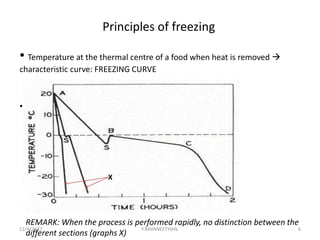
• Temperature at the thermal centre of a food when heat is removed 
characteristic curve: FREEZING CURVE
• 4 sections !
REMARK: When the process is performed rapidly, no distinction between the
different sections (graphs X)
X
12/4/2017 Y.BAVANEETHAN. 6
Freezing curve
• Section AS
• The food is cooled to below its freezing point (=sensible heat)
• At point S the water remains liquid, although the temperature is below
the freezing point
• Phenomenon is called supercooling and partly determines the crystal
size
• Section SB
• The temperature rises rapidly to the freezing point as ice crystals begin
to form and latent heat of crystallization is released
• Section BC
• Heat is removed from the food at the same rate as before
• Latent heat is removed and ice forms, but temperature almost constant
• The freezing point is depressed by the increase in solute concentrations
in the unfrozen liquor
• Major part of the ice is formed
• Section CD
• The temperature of the ice-water mixture decreases to the temperature
of the freezer12/4/2017 Y.BAVANEETHAN. 7
• Specific heat
– Is the quantity of heat that is gained or lost by a unit mass
of products to a accomplish a unit change in temperature
without the change in state (kJ/kg C)
• Sensible heat
– When an object is heated, its temperature rises as heat is
added. The increase in heat is called sensible heat.
Similarly, when heat is removed from an object and its
temperature falls, the heat removed is also called sensible
heat. (No change their state)
• latent heat
– Pure substances in nature able to change their state. Solids
can become liquids (ice to water) and liquids can become
gases (water to vapor). These require the addition or
removal of heat. The heat changes with state changes is
called latent heat.12/4/2017 Y.BAVANEETHAN. 8
12/4/2017 Y.BAVANEETHAN. 9
Supercooling
10
• Going below freezing point without the formation of
ice crystals ( crystallization)
• It yields better quality food than if not present
• This shows that the undesirable effects of
freezing are due to ice formation rather than
reduction of temperature
12/4/2017 Y.BAVANEETHAN. 10
The freezing point varies in function of the composition of the
food, but is almost never lower than -5°C
Examples:
Product °C
Milk, eggs -0.5
Meat -1.7  -2.2
Fish -0.6  -2.0
Vegetables -0.8  -2.8
Fruit -0.9  -2.7
1 M sachralose
solution
-2.65
1 M NaCl solution -3.45
Y.BAVANEETHAN.
Crystallization
 Crystallization occurs
–at point B of the freezing curve
–consists of nucleation and crystal growth
 Nucleation: occurs by combining molecules into an
ordered particle of a size sufficient to survive and
serve as a rate for crystal growth
• Homogeneous nucleation: in pure systems
• Heterogeneous nucleation: nucleus formation
around suspended particle or at a cell wall, in
food systems, takes place during supercooling.
12/4/2017 Y.BAVANEETHAN. 12
Crystallization
 Crystallization occurs
–at point B of the freezing curve
–consists of nucleation and crystal growth
 Nucleation Temperature (NT):
– Nucleation temperature is the temperature at which
the first ice crystals appear in a solution. It is also
referred to as supercooling point (SCP) or
crystallization temperature.
12/4/2017 Y.BAVANEETHAN. 13
Homogenous/Heterogeneous Nucleation
 There are two types of nucleation: homogeneous and
heterogeneous.
 Nucleation caused by electrostatic attraction between
water polar molecules is referred to as homogenous
nucleation.
 Since such attractions are weak,
– A large number of molecules need to be initiate
nucleation.
– If nucleation happens with adding of extrinsic
nucleator, it is referred to as heterogeneous nucleation
– An example of an extrinsic nucleator is frost or ice.
– If ice is dropped into supercooled water, nucleation
occurs instantly.
12/4/2017 Y.BAVANEETHAN. 14
(a) Water nucleation forced by pouring frost
(b) seconds after nucleation
(C) & (d) Crystal growth
12/4/2017 Y.BAVANEETHAN. 15
 Crystal growth: enlargement of nucleus by the orderly
addition of molecules
• The length of the supercooling period depends on,
 type of food
 rate of heat removal
12/4/2017 Y.BAVANEETHAN. 16
Effect of Supercooling in Food Industry
 Supercooling phenomenon is of particular interest in
food industry.
 fruits and vegetables storage and transport require cold
environment where the temperature is several degrees
below freezing point.
 However, freezing the food lead reduce the quality by
damaging food cells and changing color and sensory.
 But, food can store in supercooling or subfreezing
temperature without freezing,
– There no loss of quality.
–Eg => unpeeled garlic was stored in −6˚C for a week,
without freezing
12/4/2017 Y.BAVANEETHAN. 17
Ice formation at different freezing
temperatures
Leniger and Beverloo (1995).)
12/4/2017 Y.BAVANEETHAN. 18
Slow freezing
 Ice crystals grow in intercellular spaces
– deform and rupture adjacent cell walls
 Ice crystals have a lower water vapor pressure than
regions within the cells
– water moves from the cell to growing crystals
– cells: dehydrated and permanently damaged
• by increased solute concentration
 On thawing,
– cells do not regain their original shape & turgidity
– food is softened and the cellular material leaks out
from ruptured cells (drip loss)12/4/2017 Y.BAVANEETHAN. 19
Fast freezing
Smaller ice crystals form within both cells and
intercellular spaces
– little physical damage to cells, and water vapor
pressure gradients are not formed
– minimal dehydration of the cells
– texture of the food is retained to a greater extent
12/4/2017 Y.BAVANEETHAN. 20
Temperature changes
of food through the critical zone.
Leniger and Beverloo (1995).)
12/4/2017 Y.BAVANEETHAN. 21
Effect of freezing on plant
tissues
a) slow freezing
b) fast freezing
The localization of the crystals is determined
by the freezing rate, the cellular structure and
the temperature
a
b
12/4/2017 Y.BAVANEETHAN. 22
12/4/2017 Y.BAVANEETHAN. 23
12/4/2017 Y.BAVANEETHAN. 24
12/4/2017 Y.BAVANEETHAN. 25
12/4/2017 Y.BAVANEETHAN. 26
Thawing
 Freeze food in normal atmosphere, surface ice melts to form a
layer of water.
– Water has a lower thermal conductivity and a lower thermal
diffusivity than ice.
 Therefore, reduces the rate of heat is conducted to the frozen
food interior.
– Called “Insulating effect”.
 Foods are heated immediately to specific temperature which is
sufficient to destroy pathogenic micro-organisms.
 Improper thawing,
– Cold point effect- drip loss
– contamination by spoilage and pathogenic micro-organisms
– To overcome this problem,
• food is thawed by microwave or dielectric heaters
• heat is generated within the food.12/4/2017 Y.BAVANEETHAN. 27
Volume changes
 Volume of ice is 9 % higher than that of pure water
– expansion of foods after freezing
– the degree of expansion varies depend on
following factors:
1. Moisture content:
– higher moisture contents  greater changes in
volume
2. Cell arrangement:
– plant materials have intracellular air spaces
– absorb internal increases in volume without large
changes in overall size
12/4/2017 Y.BAVANEETHAN. 28
Volume changes
• Example:
– whole strawberries increase in volume by 3.0 %
– coarsely ground strawberries increase by 8.2 %
– both are frozen to -20°C
3. The concentrations of solutes:
• High concentrations reduce the freezing point
– No freeze or Expand
– Commercial use freezing technology
4. Freezer temperature:
– determines the amount of unfrozen water and
degree of expansion
12/4/2017 Y.BAVANEETHAN. 29
Volume changes
5. Crystallized components:
– ice, fats and solutes - when they cooled
– reduces the volume of food
 The volume changes leads
– internal tensions mechanical damage
 Firm vegetables tissues damage easier than flexible
membranes of muscle tissues.
Volume change and Solute concentration,
– main causes of damage of frozen food
12/4/2017 Y.BAVANEETHAN. 30
Freezing rate
•Um = 0.1 – 1 cm/h slow freezing
• = 1 – 5 cm/h medium rate
• = 5 – 10 cm/h fast freezing
• = 10 – 100 cm/h very fast freezing
• Mostly fast freezing leads to better quality depending on the type
of food
12/4/2017 Y.BAVANEETHAN. 31
Freezing equipments
1. Mechanical freezer – which evaporate & compress a
refrigerant in a continuous cycle
a. Cool air freezers
b. Cool liquid freezers
c. Cool surface freezers
2. Cryogenic freezers – cryogen- liquid CO2
liquid N2
liquid freon
12/4/2017 Y.BAVANEETHAN. 32
Freezing equipments
 Factors considered for selection:
a. Rate of freezing required
b. Size, shape & packaging requirement of the
food
c. Batch or continuous operation –
depends on - Scale of production &
No. of product types
12/4/2017 Y.BAVANEETHAN. 33
3.Fluidized bed freezers
• Modified form of blast freezer
• Air at (-25)- (-35)°C is passed at high velocity
(2-5m/s).
– through 2-13 cm bed of food
–vibrating tray support to uniform freezing.
• Shape & size of the pieces of food determine,
– thickness of the fluidized bed &
– air velocity needed for fluidization
12/4/2017 Y.BAVANEETHAN. 34
Fluidized bed freezers
Advantages
• Foods greater contact with the air & all surfaces are
frozen uniformly & simultaneously
• This produces
a. higher heat transfer coefficients
b. Shorter freezing times
c. Higher production rates
d. Less dehydration of unpacked foods
Disadvantages
 Restricted to particulate foods - peas, shrimp,
french fries
12/4/2017 Y.BAVANEETHAN. 35
Fluidization freezers
Fluidization freezer Immersion freezing
12/4/2017 Y.BAVANEETHAN. 36
Cryogenic freezers
 Characterized by a change of state in the refrigerant (or
cryogen) as heat is absorbed from freezing food
 The cryogen is,
– in intimate contact with the food
– rapidly removes energy from food
• to provide latent heat of vaporization or sublimation
– produce high heat transfer coefficient & rapid
freezing.
12/4/2017 Y.BAVANEETHAN. 37
Cryogenic freezers
 Most common refrigerants
– Liquid N₂
– solid or liquid CO₂,
– dichlorodiflouromethane (freon 12)
 liquid N₂ & CO₂- colorless, odorless & inert
 2 types
–Batch type-
immersed in liquid N₂ for few sec.
–Continuous type-
use liquid N₂ tunnel- can decrease temp. in 15 sec.
12/4/2017 Y.BAVANEETHAN. 38
Cryogenic freezers
Advantages
–Fixed rate of heat extraction
– low capital cost for equipment
–Smaller weight loss from dehydration
–Rapid freezing
–Exclusion of O2 during freezing
–Rapid startup & no defrost time
–Low power consumption
Disadvantages
–High cost of refrigerant12/4/2017 Y.BAVANEETHAN. 39
Cryogenic freezers
Cryogenic freezer (N₂)
12/4/2017 Y.BAVANEETHAN. 40
Overview
application distance
cooling
medium
temperature
difference cooling
medium- product
advantage
disadvantage
Air blast freezer universal large small dehydration
Fluidization
freezer
specific rather large small dehydration,
individually
freezing, short
freezing time
Plate freezer limited small small high freezing rate,
limited in scale
Scraped wall
freezer
specific small small only liquids and
pastes
cryogenic freezer universal small large high freezing
rates
Immersion
freezer
limited small small contact cooling
mediumY.BAVANEETHAN.
Effect of freezing
•Causes of quality loss:
– Chemical causes
– Biochemical causes
– Microbiological causes
– Physical causes
– Specific problems
12/4/2017 Y.BAVANEETHAN. 42
Quality loss: chemical causes
 Denaturation of proteins 
– modified water bonding capacity and structure
– fish gets a stringy structure, red meat and poultry
become firmer
 Lipids:
– taste rancid because of oxidation
 Color changes in meat:
– oxymyoglobine (red) is converted to metmyoglobine
(brown)
12/4/2017 Y.BAVANEETHAN. 43
Quality loss: chemical causes
 Color changes in vegetables:
–conversion of chlorophyl and phenol
Loss of vitamins:
–vit C & pandothonic acid lost at subfreezing TO
Other vitamin lost due to drip losses in meat & fish
12/4/2017 Y.BAVANEETHAN. 44
Microbiological causes
 During freezing:
– Growth of microorganisms is temperature dependent.
– No pathogens can grow around ≈5ºC.
– No microorganisms growth <-5º.
– limited amount of micro-organisms are destroyed
– Lethal damage (cold shock) possible
• depends on the type of organism but generally sublethal
damage
 After thawing: micro-organisms recover (resuscitation)
– total plate count (TPC) of a deep frozen product is
normally lower compared with TPC after the
resuscitation period.
12/4/2017 Y.BAVANEETHAN. 45
Microbiological causes
During storage:
 Generally G+ bacteria more resistant for freezing
than G- bacteria.
• Bacillus, Clostridium, Lactobacillus,
Staphylococcus, Micrococcus, Streptococcus
 G- bacteria,
• Echerichia, Pseudomonas, Alcaligenes, Vibrio,
Salmonella
 Pathogenic parasites are killed
12/4/2017 Y.BAVANEETHAN. 46
28
■ loss of moisture from food to storage
environment
■ characterized by: lighter colour (microscopic
cavity previously occupied by ice can change the
wavelength of reflected light)
■ foods with large surface area/volume ratio
e.g. IQF
■ minimized by special packaging methods.
Physical causes: Freezer burn
12/4/2017 Y.BAVANEETHAN. 47
2929
Freezer Burn of Red Meat
12/4/2017 Y.BAVANEETHAN. 48

Freezing

  • 1.
    Y.Bavaneethan. Lecturer Department of FoodTechnology SLGTI.12/4/2017 Y.BAVANEETHAN. 1
  • 2.
    What is freezing? 2 A method of food preservation whereby: • The heat is removed (heat of fusion) • Temperature of the food is reduced below its freezing point (T<Tf) • a portion of water in food undergoes a change in state to form ice crystals (aw lowered) 12/4/2017 Y.BAVANEETHAN. 2
  • 3.
    Preservation by Freezing 3 Preservationachieved by: • Low temperature • Reduced water activity due to ice formation & high concentration of solutes in unfrozen water • Blanching of some foods 12/4/2017 Y.BAVANEETHAN. 3
  • 4.
    Goal of Freezing 4 •To prevent growth of microorganisms by – Killing some bacteria (little effect) – Reducing water activity – Mechanical formation of ice crystals – Osmotic changes in cell fluids – Tying up some free water( reduce the amount of free water) • To lower temperature enough to slow down chemical reactions – (every 10OC decrease in temperature that lead to half the reaction rate)12/4/2017 Y.BAVANEETHAN. 4
  • 5.
    Physical, biochemical andmicrobiological degradation of food controlled by heat removing process. Best preservation: The zone of maximal ice formation (normally between -1 and -5°C) then move as quickly as possible to the equilibrium temperature of at least -18°C Temperature always less than -18°C 12/4/2017 Y.BAVANEETHAN. 5
  • 6.
    Principles of freezing •Temperature at the thermal centre of a food when heat is removed  characteristic curve: FREEZING CURVE • 4 sections ! REMARK: When the process is performed rapidly, no distinction between the different sections (graphs X) X 12/4/2017 Y.BAVANEETHAN. 6
  • 7.
    Freezing curve • SectionAS • The food is cooled to below its freezing point (=sensible heat) • At point S the water remains liquid, although the temperature is below the freezing point • Phenomenon is called supercooling and partly determines the crystal size • Section SB • The temperature rises rapidly to the freezing point as ice crystals begin to form and latent heat of crystallization is released • Section BC • Heat is removed from the food at the same rate as before • Latent heat is removed and ice forms, but temperature almost constant • The freezing point is depressed by the increase in solute concentrations in the unfrozen liquor • Major part of the ice is formed • Section CD • The temperature of the ice-water mixture decreases to the temperature of the freezer12/4/2017 Y.BAVANEETHAN. 7
  • 8.
    • Specific heat –Is the quantity of heat that is gained or lost by a unit mass of products to a accomplish a unit change in temperature without the change in state (kJ/kg C) • Sensible heat – When an object is heated, its temperature rises as heat is added. The increase in heat is called sensible heat. Similarly, when heat is removed from an object and its temperature falls, the heat removed is also called sensible heat. (No change their state) • latent heat – Pure substances in nature able to change their state. Solids can become liquids (ice to water) and liquids can become gases (water to vapor). These require the addition or removal of heat. The heat changes with state changes is called latent heat.12/4/2017 Y.BAVANEETHAN. 8
  • 9.
  • 10.
    Supercooling 10 • Going belowfreezing point without the formation of ice crystals ( crystallization) • It yields better quality food than if not present • This shows that the undesirable effects of freezing are due to ice formation rather than reduction of temperature 12/4/2017 Y.BAVANEETHAN. 10
  • 11.
    The freezing pointvaries in function of the composition of the food, but is almost never lower than -5°C Examples: Product °C Milk, eggs -0.5 Meat -1.7  -2.2 Fish -0.6  -2.0 Vegetables -0.8  -2.8 Fruit -0.9  -2.7 1 M sachralose solution -2.65 1 M NaCl solution -3.45 Y.BAVANEETHAN.
  • 12.
    Crystallization  Crystallization occurs –atpoint B of the freezing curve –consists of nucleation and crystal growth  Nucleation: occurs by combining molecules into an ordered particle of a size sufficient to survive and serve as a rate for crystal growth • Homogeneous nucleation: in pure systems • Heterogeneous nucleation: nucleus formation around suspended particle or at a cell wall, in food systems, takes place during supercooling. 12/4/2017 Y.BAVANEETHAN. 12
  • 13.
    Crystallization  Crystallization occurs –atpoint B of the freezing curve –consists of nucleation and crystal growth  Nucleation Temperature (NT): – Nucleation temperature is the temperature at which the first ice crystals appear in a solution. It is also referred to as supercooling point (SCP) or crystallization temperature. 12/4/2017 Y.BAVANEETHAN. 13
  • 14.
    Homogenous/Heterogeneous Nucleation  Thereare two types of nucleation: homogeneous and heterogeneous.  Nucleation caused by electrostatic attraction between water polar molecules is referred to as homogenous nucleation.  Since such attractions are weak, – A large number of molecules need to be initiate nucleation. – If nucleation happens with adding of extrinsic nucleator, it is referred to as heterogeneous nucleation – An example of an extrinsic nucleator is frost or ice. – If ice is dropped into supercooled water, nucleation occurs instantly. 12/4/2017 Y.BAVANEETHAN. 14
  • 15.
    (a) Water nucleationforced by pouring frost (b) seconds after nucleation (C) & (d) Crystal growth 12/4/2017 Y.BAVANEETHAN. 15
  • 16.
     Crystal growth:enlargement of nucleus by the orderly addition of molecules • The length of the supercooling period depends on,  type of food  rate of heat removal 12/4/2017 Y.BAVANEETHAN. 16
  • 17.
    Effect of Supercoolingin Food Industry  Supercooling phenomenon is of particular interest in food industry.  fruits and vegetables storage and transport require cold environment where the temperature is several degrees below freezing point.  However, freezing the food lead reduce the quality by damaging food cells and changing color and sensory.  But, food can store in supercooling or subfreezing temperature without freezing, – There no loss of quality. –Eg => unpeeled garlic was stored in −6˚C for a week, without freezing 12/4/2017 Y.BAVANEETHAN. 17
  • 18.
    Ice formation atdifferent freezing temperatures Leniger and Beverloo (1995).) 12/4/2017 Y.BAVANEETHAN. 18
  • 19.
    Slow freezing  Icecrystals grow in intercellular spaces – deform and rupture adjacent cell walls  Ice crystals have a lower water vapor pressure than regions within the cells – water moves from the cell to growing crystals – cells: dehydrated and permanently damaged • by increased solute concentration  On thawing, – cells do not regain their original shape & turgidity – food is softened and the cellular material leaks out from ruptured cells (drip loss)12/4/2017 Y.BAVANEETHAN. 19
  • 20.
    Fast freezing Smaller icecrystals form within both cells and intercellular spaces – little physical damage to cells, and water vapor pressure gradients are not formed – minimal dehydration of the cells – texture of the food is retained to a greater extent 12/4/2017 Y.BAVANEETHAN. 20
  • 21.
    Temperature changes of foodthrough the critical zone. Leniger and Beverloo (1995).) 12/4/2017 Y.BAVANEETHAN. 21
  • 22.
    Effect of freezingon plant tissues a) slow freezing b) fast freezing The localization of the crystals is determined by the freezing rate, the cellular structure and the temperature a b 12/4/2017 Y.BAVANEETHAN. 22
  • 23.
  • 24.
  • 25.
  • 26.
  • 27.
    Thawing  Freeze foodin normal atmosphere, surface ice melts to form a layer of water. – Water has a lower thermal conductivity and a lower thermal diffusivity than ice.  Therefore, reduces the rate of heat is conducted to the frozen food interior. – Called “Insulating effect”.  Foods are heated immediately to specific temperature which is sufficient to destroy pathogenic micro-organisms.  Improper thawing, – Cold point effect- drip loss – contamination by spoilage and pathogenic micro-organisms – To overcome this problem, • food is thawed by microwave or dielectric heaters • heat is generated within the food.12/4/2017 Y.BAVANEETHAN. 27
  • 28.
    Volume changes  Volumeof ice is 9 % higher than that of pure water – expansion of foods after freezing – the degree of expansion varies depend on following factors: 1. Moisture content: – higher moisture contents  greater changes in volume 2. Cell arrangement: – plant materials have intracellular air spaces – absorb internal increases in volume without large changes in overall size 12/4/2017 Y.BAVANEETHAN. 28
  • 29.
    Volume changes • Example: –whole strawberries increase in volume by 3.0 % – coarsely ground strawberries increase by 8.2 % – both are frozen to -20°C 3. The concentrations of solutes: • High concentrations reduce the freezing point – No freeze or Expand – Commercial use freezing technology 4. Freezer temperature: – determines the amount of unfrozen water and degree of expansion 12/4/2017 Y.BAVANEETHAN. 29
  • 30.
    Volume changes 5. Crystallizedcomponents: – ice, fats and solutes - when they cooled – reduces the volume of food  The volume changes leads – internal tensions mechanical damage  Firm vegetables tissues damage easier than flexible membranes of muscle tissues. Volume change and Solute concentration, – main causes of damage of frozen food 12/4/2017 Y.BAVANEETHAN. 30
  • 31.
    Freezing rate •Um =0.1 – 1 cm/h slow freezing • = 1 – 5 cm/h medium rate • = 5 – 10 cm/h fast freezing • = 10 – 100 cm/h very fast freezing • Mostly fast freezing leads to better quality depending on the type of food 12/4/2017 Y.BAVANEETHAN. 31
  • 32.
    Freezing equipments 1. Mechanicalfreezer – which evaporate & compress a refrigerant in a continuous cycle a. Cool air freezers b. Cool liquid freezers c. Cool surface freezers 2. Cryogenic freezers – cryogen- liquid CO2 liquid N2 liquid freon 12/4/2017 Y.BAVANEETHAN. 32
  • 33.
    Freezing equipments  Factorsconsidered for selection: a. Rate of freezing required b. Size, shape & packaging requirement of the food c. Batch or continuous operation – depends on - Scale of production & No. of product types 12/4/2017 Y.BAVANEETHAN. 33
  • 34.
    3.Fluidized bed freezers •Modified form of blast freezer • Air at (-25)- (-35)°C is passed at high velocity (2-5m/s). – through 2-13 cm bed of food –vibrating tray support to uniform freezing. • Shape & size of the pieces of food determine, – thickness of the fluidized bed & – air velocity needed for fluidization 12/4/2017 Y.BAVANEETHAN. 34
  • 35.
    Fluidized bed freezers Advantages •Foods greater contact with the air & all surfaces are frozen uniformly & simultaneously • This produces a. higher heat transfer coefficients b. Shorter freezing times c. Higher production rates d. Less dehydration of unpacked foods Disadvantages  Restricted to particulate foods - peas, shrimp, french fries 12/4/2017 Y.BAVANEETHAN. 35
  • 36.
    Fluidization freezers Fluidization freezerImmersion freezing 12/4/2017 Y.BAVANEETHAN. 36
  • 37.
    Cryogenic freezers  Characterizedby a change of state in the refrigerant (or cryogen) as heat is absorbed from freezing food  The cryogen is, – in intimate contact with the food – rapidly removes energy from food • to provide latent heat of vaporization or sublimation – produce high heat transfer coefficient & rapid freezing. 12/4/2017 Y.BAVANEETHAN. 37
  • 38.
    Cryogenic freezers  Mostcommon refrigerants – Liquid N₂ – solid or liquid CO₂, – dichlorodiflouromethane (freon 12)  liquid N₂ & CO₂- colorless, odorless & inert  2 types –Batch type- immersed in liquid N₂ for few sec. –Continuous type- use liquid N₂ tunnel- can decrease temp. in 15 sec. 12/4/2017 Y.BAVANEETHAN. 38
  • 39.
    Cryogenic freezers Advantages –Fixed rateof heat extraction – low capital cost for equipment –Smaller weight loss from dehydration –Rapid freezing –Exclusion of O2 during freezing –Rapid startup & no defrost time –Low power consumption Disadvantages –High cost of refrigerant12/4/2017 Y.BAVANEETHAN. 39
  • 40.
    Cryogenic freezers Cryogenic freezer(N₂) 12/4/2017 Y.BAVANEETHAN. 40
  • 41.
    Overview application distance cooling medium temperature difference cooling medium-product advantage disadvantage Air blast freezer universal large small dehydration Fluidization freezer specific rather large small dehydration, individually freezing, short freezing time Plate freezer limited small small high freezing rate, limited in scale Scraped wall freezer specific small small only liquids and pastes cryogenic freezer universal small large high freezing rates Immersion freezer limited small small contact cooling mediumY.BAVANEETHAN.
  • 42.
    Effect of freezing •Causesof quality loss: – Chemical causes – Biochemical causes – Microbiological causes – Physical causes – Specific problems 12/4/2017 Y.BAVANEETHAN. 42
  • 43.
    Quality loss: chemicalcauses  Denaturation of proteins  – modified water bonding capacity and structure – fish gets a stringy structure, red meat and poultry become firmer  Lipids: – taste rancid because of oxidation  Color changes in meat: – oxymyoglobine (red) is converted to metmyoglobine (brown) 12/4/2017 Y.BAVANEETHAN. 43
  • 44.
    Quality loss: chemicalcauses  Color changes in vegetables: –conversion of chlorophyl and phenol Loss of vitamins: –vit C & pandothonic acid lost at subfreezing TO Other vitamin lost due to drip losses in meat & fish 12/4/2017 Y.BAVANEETHAN. 44
  • 45.
    Microbiological causes  Duringfreezing: – Growth of microorganisms is temperature dependent. – No pathogens can grow around ≈5ºC. – No microorganisms growth <-5º. – limited amount of micro-organisms are destroyed – Lethal damage (cold shock) possible • depends on the type of organism but generally sublethal damage  After thawing: micro-organisms recover (resuscitation) – total plate count (TPC) of a deep frozen product is normally lower compared with TPC after the resuscitation period. 12/4/2017 Y.BAVANEETHAN. 45
  • 46.
    Microbiological causes During storage: Generally G+ bacteria more resistant for freezing than G- bacteria. • Bacillus, Clostridium, Lactobacillus, Staphylococcus, Micrococcus, Streptococcus  G- bacteria, • Echerichia, Pseudomonas, Alcaligenes, Vibrio, Salmonella  Pathogenic parasites are killed 12/4/2017 Y.BAVANEETHAN. 46
  • 47.
    28 ■ loss ofmoisture from food to storage environment ■ characterized by: lighter colour (microscopic cavity previously occupied by ice can change the wavelength of reflected light) ■ foods with large surface area/volume ratio e.g. IQF ■ minimized by special packaging methods. Physical causes: Freezer burn 12/4/2017 Y.BAVANEETHAN. 47
  • 48.
    2929 Freezer Burn ofRed Meat 12/4/2017 Y.BAVANEETHAN. 48