
1
Y.Bavaneethan.
Lecturer
Department of Food Technology
SLGTI. SriLanka.
12/8/2017 Y.BAVANEETHAN
Dehydration
Dehydration (or drying) is defined as ‘the application of
heat under controlled conditions to remove the majority of
the water normally present in a food by evaporation.
The main purpose of dehydration is to extend the shelf life
of foods by a reduction in water activity.
This is inhibits microbial growth and enzyme activity, but;
• The processing temperature is usually insufficient to cause
their inactivation.
• Therefore any increase in moisture content during storage,
result in rapid spoilage.
Drying causes deterioration of both the eating quality and
the nutritional value of the food.
• The design and operation of dehydration equipment aim to
minimize these changes.
12/8/2017 Y.BAVANEETHAN 2
Preservation effect
• Dehyrated foods have lower water activity (aw=0.2-0.6)
• This aw not enough (free water) for :
• Microorganism Growth (needs aw > 0.93, Specially
bacteria)
• Staphylococcus aureus (aw > 0.85)
• Mold ( need aw >0.6)
• Enzymatic reactions
• Chemical reactions (eg) Mailllard browning) (need
aw>0.3)
• Microorganisms are not killed,
• Keep Mos in-active stage.
• MO will resume growth after food is rehydrated (suitable
environment)12/8/2017 Y.BAVANEETHAN 3
Controlling Factors for Dehydration
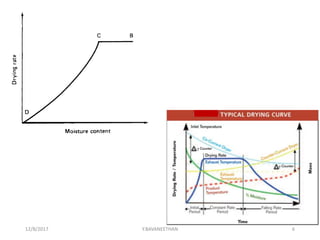
• Two separate phenomena are involved in
dehydration.
 First, moisture must move from the interior to surface of
the material. This is occur two ways:
capillary action or diffusion.
 Movement by capillary action occur during early
stages of drying.
• Second, the surface water must be evaporated into
air.
• Evaporation rate depend on;
• condition of drying air, and
• concentration of water at the surface.
12/8/2017 Y.BAVANEETHAN 4
Factors affecting dehydration
• Surface area
• Smaller food piece, more rapid the rate of moisture loss
• Temperature
• Increase in temperature will increase the dehydration rate
• Air velocity
• Maximize velocity of heated air moving around the food particles
• Humidity of drying air
• The drier the air, the moisture it can absorb
• % RH (relative humidity) of the drying air determines the final
moisture content of food
• Atmospheric pressure and vacuum
• Water boils at 100oC ( at a pressure of 1 atm= 760Hg)
• At lower pressure the boiling temperature will decrease
• Eg. Under vacuum, water will boil at 32oC
• Important for heat sensitive food products
• MOSTLY USED FOR FREEZE DRYING
12/8/2017 Y.BAVANEETHAN 5
12/8/2017 Y.BAVANEETHAN 6
Aw for some dried foods
Product aW
Skim milk powder
Dehydrated soups
0.03
noodles 0.5
Fruit: berries, apples, apricots, raisins ( grapes) 0.6
Fruit juice concentrates, condensed milk 0.8
12/8/2017 Y.BAVANEETHAN 7
Changes during dehydration
1. Cell/ tissue shrinkage
2. Case hardening
3. Chemical changes
1. Shrinkage
• Shrinkage water migrates- interior of the food surface
• Evaporates by the drying medium
• Water carries with it water soluble substances dissolved in it
12/8/2017 Y.BAVANEETHAN 8
2. Case hardening
• Rapid drying- compounds (such as sugar) form a
hard, impermeable “case” around the food piece.
• Can slow down the dehydration
• Common in high sugar products
• Tropical and temperate fruit products
12/8/2017 Y.BAVANEETHAN 9
3. Chemical changes
• Browning and flavor changes due to reactions
 Maillard browning = from increased solution concentration
• Denaturation of proteins, aggregation of polysaccharides
 Loss of water soluble binding capacity
• Loss of water soluble components
• Concentration on the surface of the food ( case hardening)
• Loss of volatiles ( especially flavor compounds)
12/8/2017 Y.BAVANEETHAN 10
Dehydration Equipments
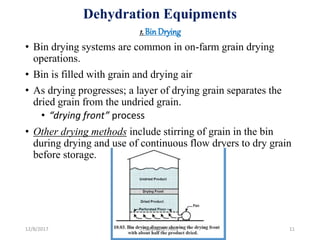
1. Bin Drying
• Bin drying systems are common in on-farm grain drying
operations.
• Bin is filled with grain and drying air
• As drying progresses; a layer of drying grain separates the
dried grain from the undried grain.
• “drying front” process
• Other drying methods include stirring of grain in the bin
during drying and use of continuous flow dryers to dry grain
before storage.
12/8/2017 Y.BAVANEETHAN 11
2. Cabinet Drying
• Cabinet dryers are usually small, insulated units with;
• A heater, circulating fan, and shelves to hold the product to
be dried.
• General procedure is to force heated air over multiple trays.
• However, greater energy efficiencies can be obtained if some
of the heated air is recirculated.
• Basic operation of a cabinet dryer with recirculation.
• Energy savings of 50% or more can be achieved with
recirculation.
12/8/2017 Y.BAVANEETHAN 12
3. Tunnel Drying
• Tunnel dryers are a large-scale modification of the cabinet
dryer concept.
• The drying chamber is a tunnel with multiple carts
containing trays.
• New carts of undried product are loaded at one end of the
tunnel.
• product are removed from the other end.
• Air flow in these dryers may be Parallel or Counter to the
movement of carts in the tunnel.
Tunnel dryer sketches showing (a) parallel and (b) counter flow operation
12/8/2017 Y.BAVANEETHAN 13
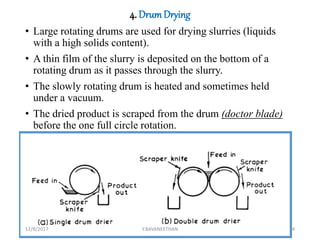
4. DrumDrying
• Large rotating drums are used for drying slurries (liquids
with a high solids content).
• A thin film of the slurry is deposited on the bottom of a
rotating drum as it passes through the slurry.
• The slowly rotating drum is heated and sometimes held
under a vacuum.
• The dried product is scraped from the drum (doctor blade)
before the one full circle rotation.
12/8/2017 Y.BAVANEETHAN 14
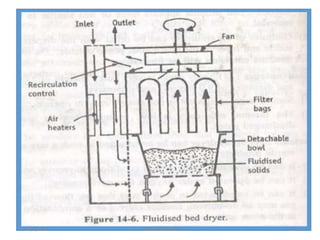
5. Fluidised-beddriers
• The main features of a fluidised-bed drier;
 evenly distribute the air at a uniform velocity around the bed
of material.
• Produce an homogenous region of air and prevent localised high
velocities,
 disengagement or ‘freeboard’ region above the bed to allow
disentrainment of particles.
• Hot air is blown through the bed, causing;
 the food to become suspended ( Problem)
To overcome this;
vigorously agitated (fluidised), exposing the maximum
surface area of food for drying.
12/8/2017 Y.BAVANEETHAN 15
12/8/2017 Y.BAVANEETHAN 16
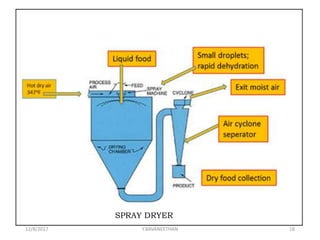
6. SprayDrying
• Spray drying is used to dry liquid products. The product to be
dried is sprayed into a stream of heated air.
• The two major operations of concern in spray drying are;
• Droplet atomization and
• Powder collection.
• To optimize drying, droplets should be small and uniform in
size.
• Special procedures must be used to insure that atomization
is satisfactory.
• Collection of the dried powder also requires special
techniques.
• The powder particles are small and move easily within an
air stream.
12/8/2017 Y.BAVANEETHAN 17
SPRAY DRYER
12/8/2017 Y.BAVANEETHAN 18
7. Freeze Drying
• Freeze drying involves the removal of moisture from a frozen
product .
• The temperature must be below freezing for that product (insure
that product remains frozen)
• And the vapor pressure must be maintained at a very low
level to permit moisture removal by sublimation.
• Because of the low temperature, low pressure, and low
drying rate, freeze drying is quite expensive compared
other drying methods.
• However, freeze drying produce high quality dried
products.
• “Freezer burn,” sometimes seen in frozen foods,
• undesirable of freeze drying. (very slow type freeze).
12/8/2017 Y.BAVANEETHAN 19
12/8/2017 Y.BAVANEETHAN 20
Effect on Foods
Products undergo changes during drying that reduce their
quality compared to the fresh material.
1. Texture
Rupture, crack, compress and permanently distort the relatively
rigid cells,
• Change texture apperance
• To give the food a shrunken shriveled appearance.
Re-hydrated product absorbs water more slowly and does not
regain the firm texture of the fresh material.
Drying pieces of meat - severe changes in texture.
• Caused by aggregation and denaturation of proteins and loss
of water-holding capacity.
Case hardening effect.
• reduces the rate of drying to produce a food with a dry
surface and a moist interior.12/8/2017 Y.BAVANEETHAN 21
2. Flavor and Aroma
Heat not only vaporises water during drying but also causes
loss of volatile components.
Volatile loss depends on;
• Temperature and moisture content of the food
• And the vapour pressure of the volatiles and their solubility in
water.
The open porous structure of dried food allows access of
oxygen,
• which is a second important cause of aroma loss due to
oxidation of volatile components and lipids during storage.
These changes are can reduced by:
• vacuum or gas packing
• low storage temperatures
• maintenance of low moisture contents
• addition of synthetic antioxidants
• preservation of natural anti-oxidants.12/8/2017 Y.BAVANEETHAN 22
3. Colour
Causes of colour loss or change in dried foods;
• drying changes the surface characteristics of a food and
alter the reflectivity of surface.
Fruits and vegetables,
• Chemical changes to carotenoid and chlorophyl
pigments.
• Caused by heat and oxidation during drying
• Residual polyphenoloxidase enzyme activity causes
browning.
Prevented by treatment of fruits with ascorbic acid or
sulphur dioxide.
• However, sulphur dioxide bleaches anthocyanins, and
residual sulphur dioxide is also health problem.
12/8/2017 Y.BAVANEETHAN 23
Calculation
12/8/2017 Y.BAVANEETHAN 24
12/8/2017 Y.BAVANEETHAN 25

Dehydration

  • 1.
    1 Y.Bavaneethan. Lecturer Department of FoodTechnology SLGTI. SriLanka. 12/8/2017 Y.BAVANEETHAN
  • 2.
    Dehydration Dehydration (or drying)is defined as ‘the application of heat under controlled conditions to remove the majority of the water normally present in a food by evaporation. The main purpose of dehydration is to extend the shelf life of foods by a reduction in water activity. This is inhibits microbial growth and enzyme activity, but; • The processing temperature is usually insufficient to cause their inactivation. • Therefore any increase in moisture content during storage, result in rapid spoilage. Drying causes deterioration of both the eating quality and the nutritional value of the food. • The design and operation of dehydration equipment aim to minimize these changes. 12/8/2017 Y.BAVANEETHAN 2
  • 3.
    Preservation effect • Dehyratedfoods have lower water activity (aw=0.2-0.6) • This aw not enough (free water) for : • Microorganism Growth (needs aw > 0.93, Specially bacteria) • Staphylococcus aureus (aw > 0.85) • Mold ( need aw >0.6) • Enzymatic reactions • Chemical reactions (eg) Mailllard browning) (need aw>0.3) • Microorganisms are not killed, • Keep Mos in-active stage. • MO will resume growth after food is rehydrated (suitable environment)12/8/2017 Y.BAVANEETHAN 3
  • 4.
    Controlling Factors forDehydration • Two separate phenomena are involved in dehydration.  First, moisture must move from the interior to surface of the material. This is occur two ways: capillary action or diffusion.  Movement by capillary action occur during early stages of drying. • Second, the surface water must be evaporated into air. • Evaporation rate depend on; • condition of drying air, and • concentration of water at the surface. 12/8/2017 Y.BAVANEETHAN 4
  • 5.
    Factors affecting dehydration •Surface area • Smaller food piece, more rapid the rate of moisture loss • Temperature • Increase in temperature will increase the dehydration rate • Air velocity • Maximize velocity of heated air moving around the food particles • Humidity of drying air • The drier the air, the moisture it can absorb • % RH (relative humidity) of the drying air determines the final moisture content of food • Atmospheric pressure and vacuum • Water boils at 100oC ( at a pressure of 1 atm= 760Hg) • At lower pressure the boiling temperature will decrease • Eg. Under vacuum, water will boil at 32oC • Important for heat sensitive food products • MOSTLY USED FOR FREEZE DRYING 12/8/2017 Y.BAVANEETHAN 5
  • 6.
  • 7.
    Aw for somedried foods Product aW Skim milk powder Dehydrated soups 0.03 noodles 0.5 Fruit: berries, apples, apricots, raisins ( grapes) 0.6 Fruit juice concentrates, condensed milk 0.8 12/8/2017 Y.BAVANEETHAN 7
  • 8.
    Changes during dehydration 1.Cell/ tissue shrinkage 2. Case hardening 3. Chemical changes 1. Shrinkage • Shrinkage water migrates- interior of the food surface • Evaporates by the drying medium • Water carries with it water soluble substances dissolved in it 12/8/2017 Y.BAVANEETHAN 8
  • 9.
    2. Case hardening •Rapid drying- compounds (such as sugar) form a hard, impermeable “case” around the food piece. • Can slow down the dehydration • Common in high sugar products • Tropical and temperate fruit products 12/8/2017 Y.BAVANEETHAN 9
  • 10.
    3. Chemical changes •Browning and flavor changes due to reactions  Maillard browning = from increased solution concentration • Denaturation of proteins, aggregation of polysaccharides  Loss of water soluble binding capacity • Loss of water soluble components • Concentration on the surface of the food ( case hardening) • Loss of volatiles ( especially flavor compounds) 12/8/2017 Y.BAVANEETHAN 10
  • 11.
    Dehydration Equipments 1. BinDrying • Bin drying systems are common in on-farm grain drying operations. • Bin is filled with grain and drying air • As drying progresses; a layer of drying grain separates the dried grain from the undried grain. • “drying front” process • Other drying methods include stirring of grain in the bin during drying and use of continuous flow dryers to dry grain before storage. 12/8/2017 Y.BAVANEETHAN 11
  • 12.
    2. Cabinet Drying •Cabinet dryers are usually small, insulated units with; • A heater, circulating fan, and shelves to hold the product to be dried. • General procedure is to force heated air over multiple trays. • However, greater energy efficiencies can be obtained if some of the heated air is recirculated. • Basic operation of a cabinet dryer with recirculation. • Energy savings of 50% or more can be achieved with recirculation. 12/8/2017 Y.BAVANEETHAN 12
  • 13.
    3. Tunnel Drying •Tunnel dryers are a large-scale modification of the cabinet dryer concept. • The drying chamber is a tunnel with multiple carts containing trays. • New carts of undried product are loaded at one end of the tunnel. • product are removed from the other end. • Air flow in these dryers may be Parallel or Counter to the movement of carts in the tunnel. Tunnel dryer sketches showing (a) parallel and (b) counter flow operation 12/8/2017 Y.BAVANEETHAN 13
  • 14.
    4. DrumDrying • Largerotating drums are used for drying slurries (liquids with a high solids content). • A thin film of the slurry is deposited on the bottom of a rotating drum as it passes through the slurry. • The slowly rotating drum is heated and sometimes held under a vacuum. • The dried product is scraped from the drum (doctor blade) before the one full circle rotation. 12/8/2017 Y.BAVANEETHAN 14
  • 15.
    5. Fluidised-beddriers • Themain features of a fluidised-bed drier;  evenly distribute the air at a uniform velocity around the bed of material. • Produce an homogenous region of air and prevent localised high velocities,  disengagement or ‘freeboard’ region above the bed to allow disentrainment of particles. • Hot air is blown through the bed, causing;  the food to become suspended ( Problem) To overcome this; vigorously agitated (fluidised), exposing the maximum surface area of food for drying. 12/8/2017 Y.BAVANEETHAN 15
  • 16.
  • 17.
    6. SprayDrying • Spraydrying is used to dry liquid products. The product to be dried is sprayed into a stream of heated air. • The two major operations of concern in spray drying are; • Droplet atomization and • Powder collection. • To optimize drying, droplets should be small and uniform in size. • Special procedures must be used to insure that atomization is satisfactory. • Collection of the dried powder also requires special techniques. • The powder particles are small and move easily within an air stream. 12/8/2017 Y.BAVANEETHAN 17
  • 18.
  • 19.
    7. Freeze Drying •Freeze drying involves the removal of moisture from a frozen product . • The temperature must be below freezing for that product (insure that product remains frozen) • And the vapor pressure must be maintained at a very low level to permit moisture removal by sublimation. • Because of the low temperature, low pressure, and low drying rate, freeze drying is quite expensive compared other drying methods. • However, freeze drying produce high quality dried products. • “Freezer burn,” sometimes seen in frozen foods, • undesirable of freeze drying. (very slow type freeze). 12/8/2017 Y.BAVANEETHAN 19
  • 20.
  • 21.
    Effect on Foods Productsundergo changes during drying that reduce their quality compared to the fresh material. 1. Texture Rupture, crack, compress and permanently distort the relatively rigid cells, • Change texture apperance • To give the food a shrunken shriveled appearance. Re-hydrated product absorbs water more slowly and does not regain the firm texture of the fresh material. Drying pieces of meat - severe changes in texture. • Caused by aggregation and denaturation of proteins and loss of water-holding capacity. Case hardening effect. • reduces the rate of drying to produce a food with a dry surface and a moist interior.12/8/2017 Y.BAVANEETHAN 21
  • 22.
    2. Flavor andAroma Heat not only vaporises water during drying but also causes loss of volatile components. Volatile loss depends on; • Temperature and moisture content of the food • And the vapour pressure of the volatiles and their solubility in water. The open porous structure of dried food allows access of oxygen, • which is a second important cause of aroma loss due to oxidation of volatile components and lipids during storage. These changes are can reduced by: • vacuum or gas packing • low storage temperatures • maintenance of low moisture contents • addition of synthetic antioxidants • preservation of natural anti-oxidants.12/8/2017 Y.BAVANEETHAN 22
  • 23.
    3. Colour Causes ofcolour loss or change in dried foods; • drying changes the surface characteristics of a food and alter the reflectivity of surface. Fruits and vegetables, • Chemical changes to carotenoid and chlorophyl pigments. • Caused by heat and oxidation during drying • Residual polyphenoloxidase enzyme activity causes browning. Prevented by treatment of fruits with ascorbic acid or sulphur dioxide. • However, sulphur dioxide bleaches anthocyanins, and residual sulphur dioxide is also health problem. 12/8/2017 Y.BAVANEETHAN 23
  • 24.
  • 25.