BLANCHING
Submitted by
Muneeb
18msfood07
Central University of Punjab
Blanching
• Blanching is a mild heat treatment prior to freezing,
canning or drying for fruit and vegetable
• Hot water or steam are mainly used heating media
in industry.
• Not a final method of preservation it is a pre
treatment
• Blanching is the scalding of fruit or vegetables in
boiling water or steam
• It is combined with cleaning and/ or peeling
Blanching
• Blanching is a unit operation prior to freezing,
canning, or drying in which fruits or vegetables are
heated for the purpose of inactivating enzymes
To achieve adequate enzyme inactivation, food is
heated rapidly to a pre-set temperature, held for a pre-
set time and then cooled rapidly to near ambient
temperatures.
Objective
• Inactivating enzyme
• Modifying texture
• Preserving colour, flavour and nutritional value
• Removing trapped air
• Cleaning
• Reduction of microbial load
Factors Influence blanching time
• Type of product
• Size of the pieces of food
• Blanching temperature
• Method of heating.
Theory
• Unsteady state heat transfer by conduction and
convection
• The maximum processing temperature in freezing
and dehydration is insufficient to inactivate
enzymes
• In canning, the time taken to reach sterilizing
temperatures, particularly in large cans, may be
sufficient to allow enzyme activity to take place
• Under-blanching may cause more damage to food
than the absence of blanching does
• Enzymes are
• Lipoxygenase
• Polyphenoloxidase
• Polygalacturonase
• Chlorophyllase
• Heat resistant enzyme present in most vegetable
are Catalases and peroxidase – used for
determining success of blanching.
• Adequate blanching also reduces number of
contaminating micro organism on surface of food
• Blanching can soften tissue
Food processing and preservation by
Dhir Singh , Dheer Singh
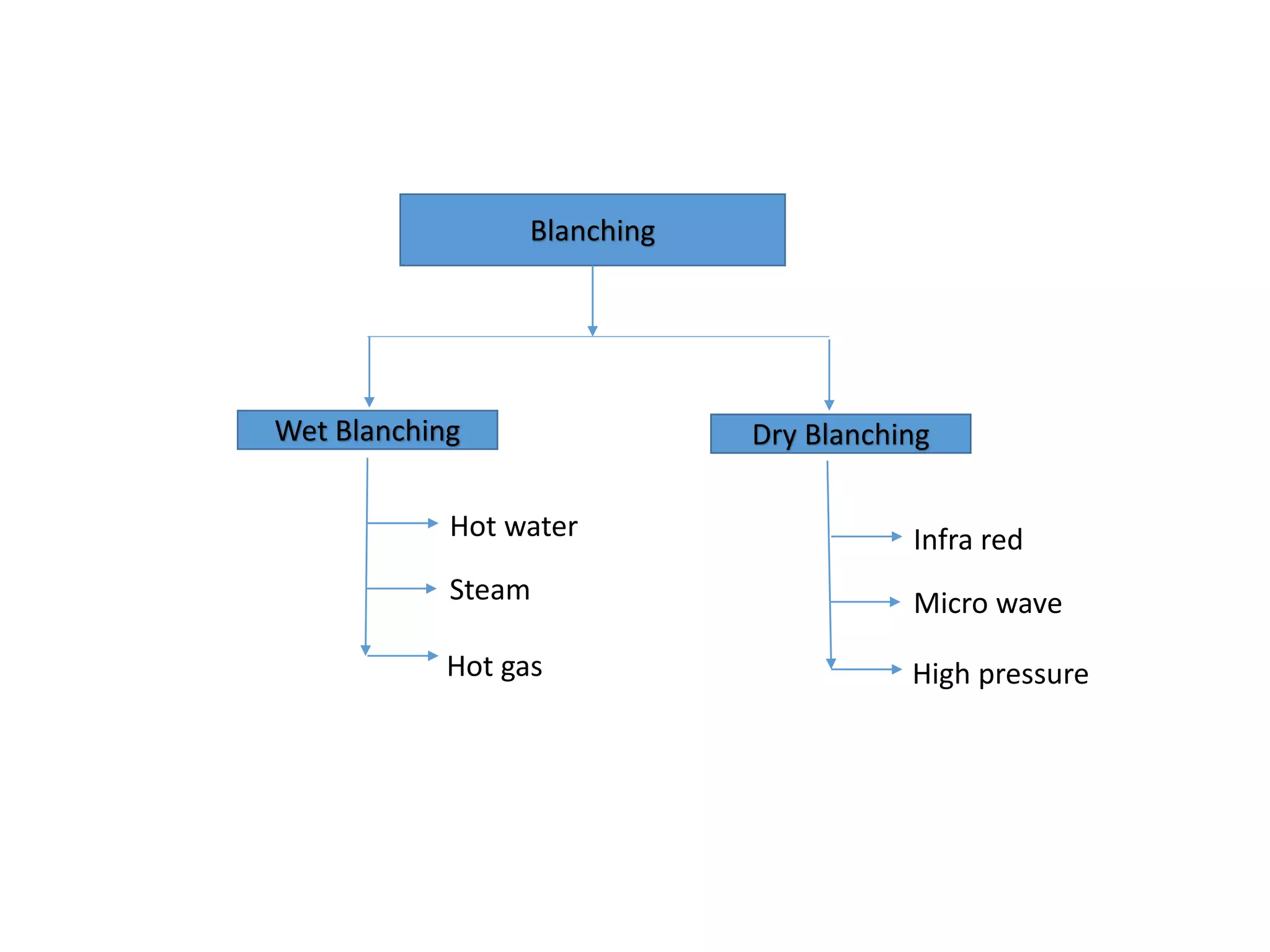
Blanching
Wet Blanching Dry Blanching
Hot water
Steam
Hot gas
Infra red
Micro wave
High pressure
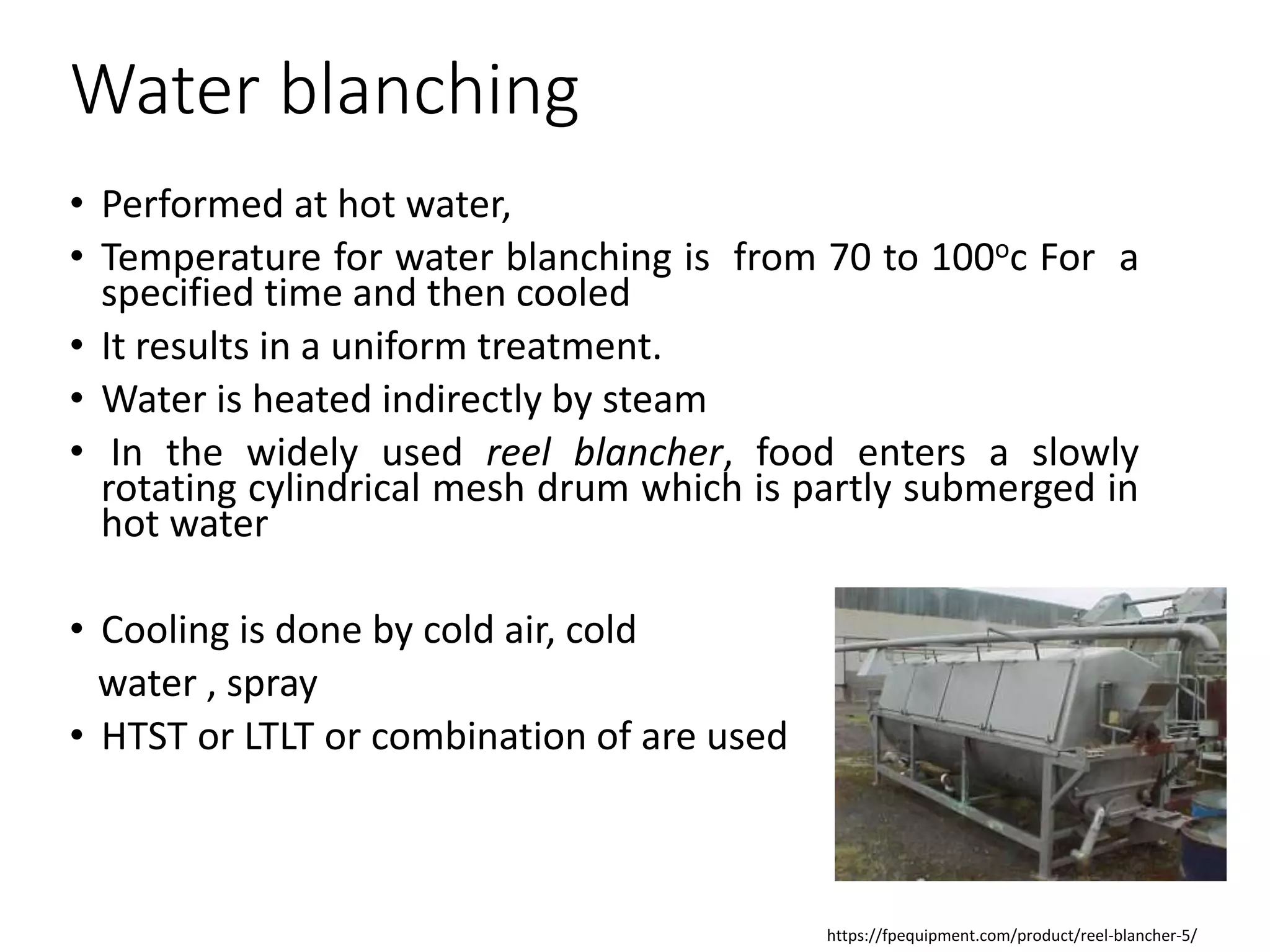
Water blanching
• Performed at hot water,
• Temperature for water blanching is from 70 to 100oc For a
specified time and then cooled
• It results in a uniform treatment.
• Water is heated indirectly by steam
• In the widely used reel blancher, food enters a slowly
rotating cylindrical mesh drum which is partly submerged in
hot water
• Cooling is done by cold air, cold
water , spray
• HTST or LTLT or combination of are used
https://fpequipment.com/product/reel-blancher-5/
Advantages
• Lower capital cost
• Better energy efficiency
• Uniform treatment.
Disadvantages
• Leaching of minerals and nutrients such as vitamins
• Produce effluents with large biological oxygen demand
• Risk of contaminating by thermophilic bacteria
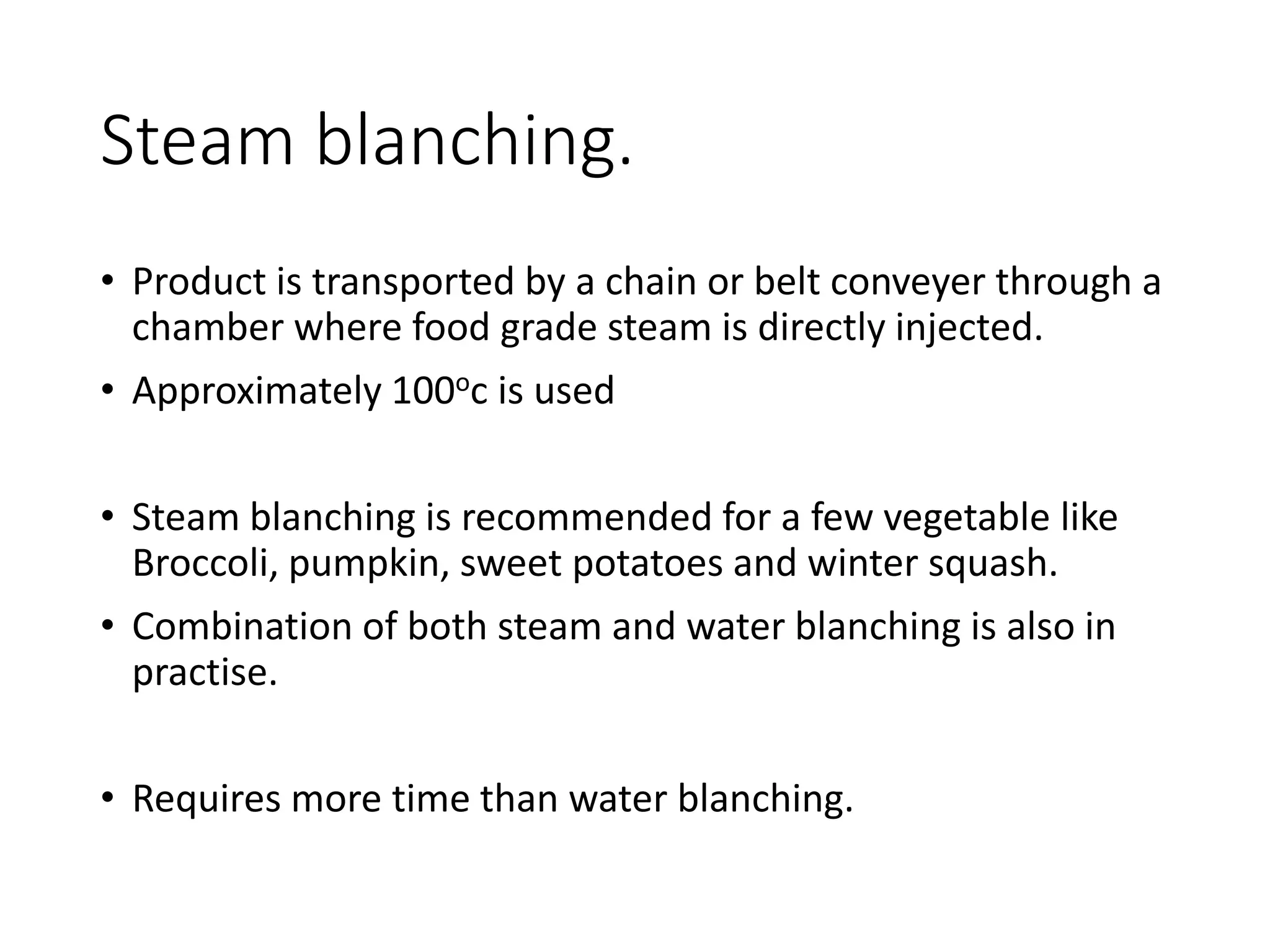
Steam blanching.
• Product is transported by a chain or belt conveyer through a
chamber where food grade steam is directly injected.
• Approximately 100oc is used
• Steam blanching is recommended for a few vegetable like
Broccoli, pumpkin, sweet potatoes and winter squash.
• Combination of both steam and water blanching is also in
practise.
• Requires more time than water blanching.
https://www.slideshare.net/bavaneethan/blanching-83286088
• Advantages
Small loss of water soluble components
Smaller volume of waste
Lower disposal charge
Easy to clean and sterilise
• Disadvantages
Uneven blanching if the food is piled too
Some Loss of mass in the food
Blancher-cooler
1. Pre-heating, blanching, cooling sections.
2. Food on a single conveyer belt throughout each stage, not
to suffer from physical damage due to turbulence of
conventional hot water blanchers.
3. Food is pre heated with water
4. After blanching, 2nd recirculation system cools the food.
5. A recirculated water steam mixture to blanch food and final
cooling is done cold air.
Food processing and preservation by Dhir Singh ,
Dheer Singh
IQB
It occurs in 2 stages
• Food is heated in a single layer to a sufficient temperature
to inactivate enzymes.
• Adiabatic holding- a deep bed of food is held for sufficient
time to allow temperature at centre of each piece to
increase to that needed for enzyme inactivation
• Cooling stage
• 25s for heating and 50s for holding 1cm diced carrot
compared with 3 min for conventional blanching.
Food processing technology principle and practise by P J
Fellows.
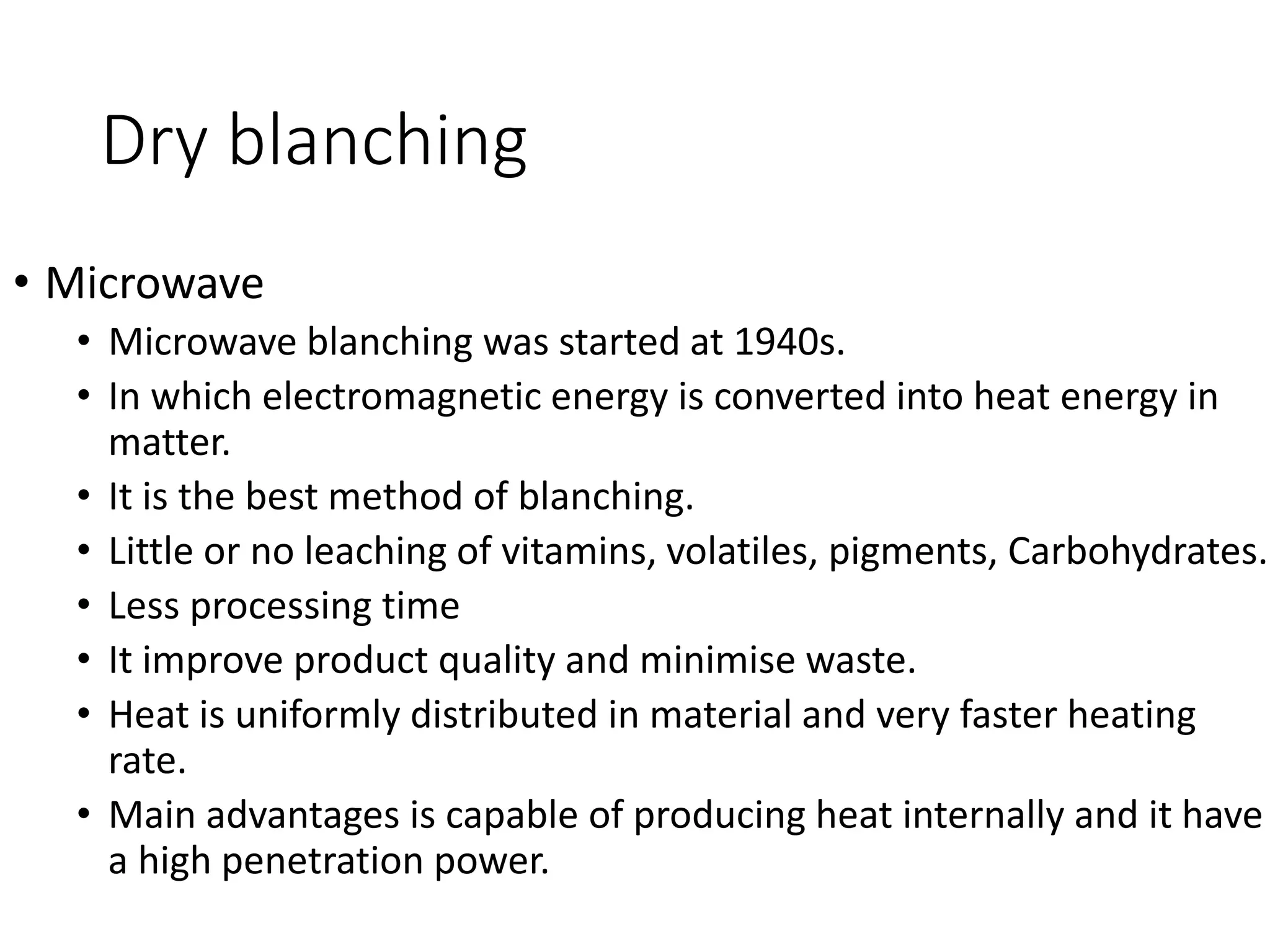
Dry blanching
• Microwave
• Microwave blanching was started at 1940s.
• In which electromagnetic energy is converted into heat energy in
matter.
• It is the best method of blanching.
• Little or no leaching of vitamins, volatiles, pigments, Carbohydrates.
• Less processing time
• It improve product quality and minimise waste.
• Heat is uniformly distributed in material and very faster heating
rate.
• Main advantages is capable of producing heat internally and it have
a high penetration power.
Infrared
• Infrared radiation penetrates in to the food and directly
heats the food
• Water in food absorb heat energy efficiently in the range
of medium and far infrared wavelength with peak wave
length at 3,4,7 and 6μm
• Useful range of wave length for IR in range of 0.7 to 10
μm
• Main disadvantage of IR is cell wall rupture, blackening
and undesired structural changes.
High pressure
• The pressure ranges between 50 and 700 MPa.
• Generally between 100 and 200 MPa is recommended
• The product is generally contained in heat sealed
container.
• It reduce drying time and increases rate of drying.
• Inactivation of peach polyphenoloxidase enzyme in
peaches.
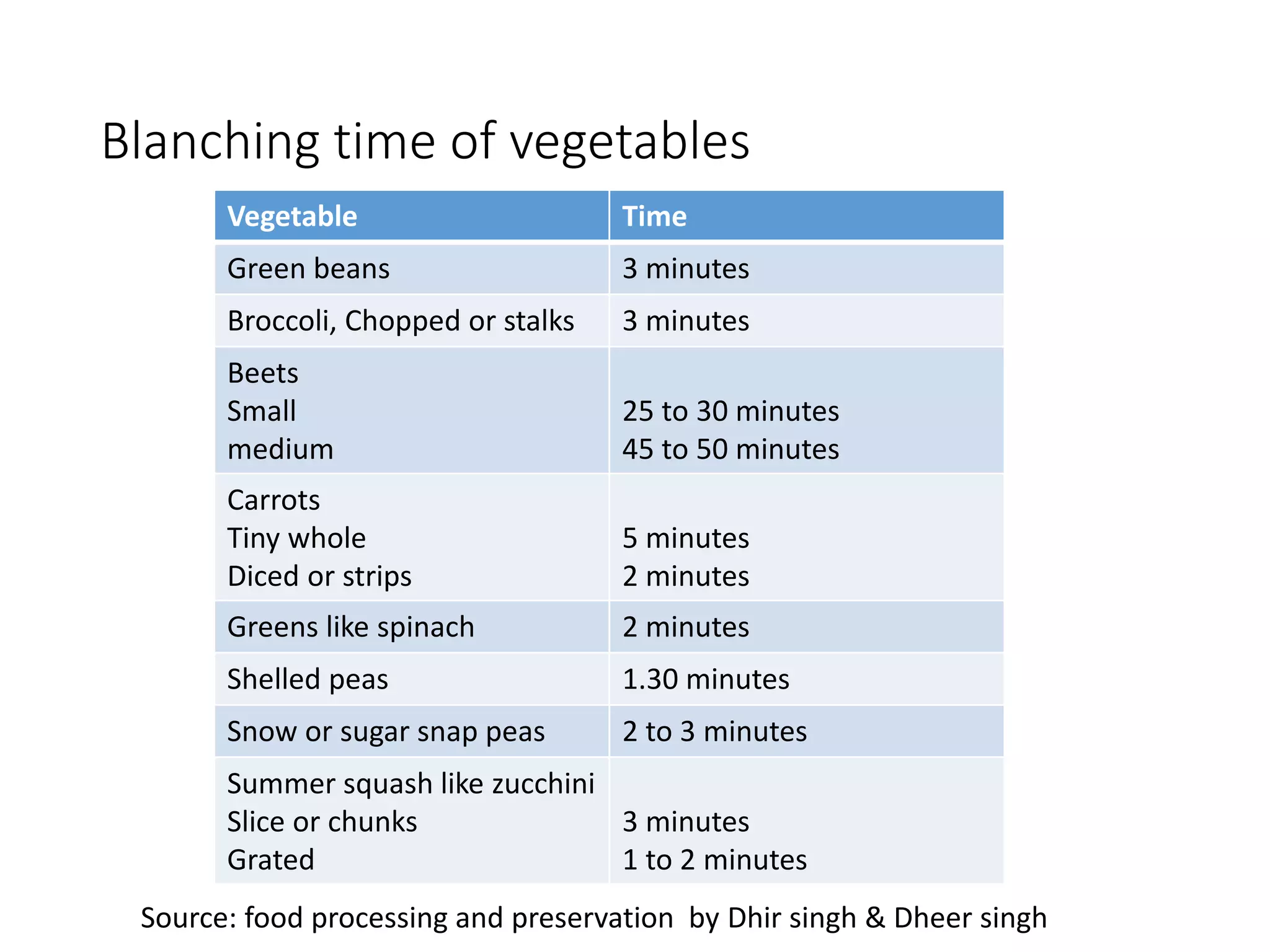
Blanching time of vegetables
Vegetable Time
Green beans 3 minutes
Broccoli, Chopped or stalks 3 minutes
Beets
Small
medium
25 to 30 minutes
45 to 50 minutes
Carrots
Tiny whole
Diced or strips
5 minutes
2 minutes
Greens like spinach 2 minutes
Shelled peas 1.30 minutes
Snow or sugar snap peas 2 to 3 minutes
Summer squash like zucchini
Slice or chunks
Grated
3 minutes
1 to 2 minutes
Source: food processing and preservation by Dhir singh & Dheer singh
Processing time & temperature
Type Radiation or temperature Time
Infrared
Medium IR (peak) 3,4,7 μm
Far IR (peak) 6μm
3000 – 4000 W/m2 20 min
Microwave
2450 – 50 MHz 85- 87oc
10 – 11 minute
High pressure blanching
100 and 200 MPa
22 to 24 (100 MPa)
24 to 26 (200 MPa)
10 minute
20 minute
Hot water 70oc and 80oc
90oc
1 minute
2.5 minute
Steam blanching 100oc 15-20 seconds
Source: microwave blanching an emerging trend in food engineering and its
effects on capsicum by Shivendu Ranjan
Effects of blanching on food quality
Undesirable texture changes during wet blanching.
Some times Undesirable color change occurs.
• Nutritional Quality
• Blanching reduces the nutritional value of food.
• Nutrients leach out from the product especially during water
blanching.
• Water soluble vitamins are lost during wet blanching.
Loss (%) of ascorbic acid
Treatment Peas Broccoli Green beans
Water blanch water
cool
29.1 38.7 15.1
Water blanch air cool 25.0 30.6 19.5
Steam blanch water
cool
24.2 22.2 17.7
Steam blanch air cool 14.0 9.0 18.6
Source: food processing and preservation by Dhir singh & Dheer singh
Thank you.
Reference
• https://www.slideshare.net/bavaneethan/blanching-
83286088
• Food processing and preservation by Dhir singh & Dheer
singh
• Food processing technology principle and practise by P J
Fellows.
• https://en.wikipedia.org/wiki/Blanching_(cooking)
• Journal of food processing engineering
microwave blanching : an emerging trend in food engineering and its
effects on capsicum
Shivendu Rajan, Nandita Dasgupta, Niharika Walia, Thara chand and
Chidambaram Ramalingam

Blanching

  • 1.
  • 2.
    Blanching • Blanching isa mild heat treatment prior to freezing, canning or drying for fruit and vegetable • Hot water or steam are mainly used heating media in industry. • Not a final method of preservation it is a pre treatment • Blanching is the scalding of fruit or vegetables in boiling water or steam • It is combined with cleaning and/ or peeling
  • 3.
    Blanching • Blanching isa unit operation prior to freezing, canning, or drying in which fruits or vegetables are heated for the purpose of inactivating enzymes To achieve adequate enzyme inactivation, food is heated rapidly to a pre-set temperature, held for a pre- set time and then cooled rapidly to near ambient temperatures.
  • 4.
    Objective • Inactivating enzyme •Modifying texture • Preserving colour, flavour and nutritional value • Removing trapped air • Cleaning • Reduction of microbial load
  • 5.
    Factors Influence blanchingtime • Type of product • Size of the pieces of food • Blanching temperature • Method of heating.
  • 6.
    Theory • Unsteady stateheat transfer by conduction and convection • The maximum processing temperature in freezing and dehydration is insufficient to inactivate enzymes • In canning, the time taken to reach sterilizing temperatures, particularly in large cans, may be sufficient to allow enzyme activity to take place • Under-blanching may cause more damage to food than the absence of blanching does
  • 7.
    • Enzymes are •Lipoxygenase • Polyphenoloxidase • Polygalacturonase • Chlorophyllase • Heat resistant enzyme present in most vegetable are Catalases and peroxidase – used for determining success of blanching. • Adequate blanching also reduces number of contaminating micro organism on surface of food • Blanching can soften tissue Food processing and preservation by Dhir Singh , Dheer Singh
  • 8.
    Blanching Wet Blanching DryBlanching Hot water Steam Hot gas Infra red Micro wave High pressure
  • 9.
    Water blanching • Performedat hot water, • Temperature for water blanching is from 70 to 100oc For a specified time and then cooled • It results in a uniform treatment. • Water is heated indirectly by steam • In the widely used reel blancher, food enters a slowly rotating cylindrical mesh drum which is partly submerged in hot water • Cooling is done by cold air, cold water , spray • HTST or LTLT or combination of are used https://fpequipment.com/product/reel-blancher-5/
  • 10.
    Advantages • Lower capitalcost • Better energy efficiency • Uniform treatment. Disadvantages • Leaching of minerals and nutrients such as vitamins • Produce effluents with large biological oxygen demand • Risk of contaminating by thermophilic bacteria
  • 11.
    Steam blanching. • Productis transported by a chain or belt conveyer through a chamber where food grade steam is directly injected. • Approximately 100oc is used • Steam blanching is recommended for a few vegetable like Broccoli, pumpkin, sweet potatoes and winter squash. • Combination of both steam and water blanching is also in practise. • Requires more time than water blanching.
  • 12.
  • 13.
    • Advantages Small lossof water soluble components Smaller volume of waste Lower disposal charge Easy to clean and sterilise • Disadvantages Uneven blanching if the food is piled too Some Loss of mass in the food
  • 14.
    Blancher-cooler 1. Pre-heating, blanching,cooling sections. 2. Food on a single conveyer belt throughout each stage, not to suffer from physical damage due to turbulence of conventional hot water blanchers. 3. Food is pre heated with water 4. After blanching, 2nd recirculation system cools the food. 5. A recirculated water steam mixture to blanch food and final cooling is done cold air.
  • 15.
    Food processing andpreservation by Dhir Singh , Dheer Singh
  • 16.
    IQB It occurs in2 stages • Food is heated in a single layer to a sufficient temperature to inactivate enzymes. • Adiabatic holding- a deep bed of food is held for sufficient time to allow temperature at centre of each piece to increase to that needed for enzyme inactivation • Cooling stage • 25s for heating and 50s for holding 1cm diced carrot compared with 3 min for conventional blanching.
  • 17.
    Food processing technologyprinciple and practise by P J Fellows.
  • 18.
    Dry blanching • Microwave •Microwave blanching was started at 1940s. • In which electromagnetic energy is converted into heat energy in matter. • It is the best method of blanching. • Little or no leaching of vitamins, volatiles, pigments, Carbohydrates. • Less processing time • It improve product quality and minimise waste. • Heat is uniformly distributed in material and very faster heating rate. • Main advantages is capable of producing heat internally and it have a high penetration power.
  • 19.
    Infrared • Infrared radiationpenetrates in to the food and directly heats the food • Water in food absorb heat energy efficiently in the range of medium and far infrared wavelength with peak wave length at 3,4,7 and 6μm • Useful range of wave length for IR in range of 0.7 to 10 μm • Main disadvantage of IR is cell wall rupture, blackening and undesired structural changes.
  • 20.
    High pressure • Thepressure ranges between 50 and 700 MPa. • Generally between 100 and 200 MPa is recommended • The product is generally contained in heat sealed container. • It reduce drying time and increases rate of drying. • Inactivation of peach polyphenoloxidase enzyme in peaches.
  • 21.
    Blanching time ofvegetables Vegetable Time Green beans 3 minutes Broccoli, Chopped or stalks 3 minutes Beets Small medium 25 to 30 minutes 45 to 50 minutes Carrots Tiny whole Diced or strips 5 minutes 2 minutes Greens like spinach 2 minutes Shelled peas 1.30 minutes Snow or sugar snap peas 2 to 3 minutes Summer squash like zucchini Slice or chunks Grated 3 minutes 1 to 2 minutes Source: food processing and preservation by Dhir singh & Dheer singh
  • 22.
    Processing time &temperature Type Radiation or temperature Time Infrared Medium IR (peak) 3,4,7 μm Far IR (peak) 6μm 3000 – 4000 W/m2 20 min Microwave 2450 – 50 MHz 85- 87oc 10 – 11 minute High pressure blanching 100 and 200 MPa 22 to 24 (100 MPa) 24 to 26 (200 MPa) 10 minute 20 minute Hot water 70oc and 80oc 90oc 1 minute 2.5 minute Steam blanching 100oc 15-20 seconds Source: microwave blanching an emerging trend in food engineering and its effects on capsicum by Shivendu Ranjan
  • 23.
    Effects of blanchingon food quality Undesirable texture changes during wet blanching. Some times Undesirable color change occurs. • Nutritional Quality • Blanching reduces the nutritional value of food. • Nutrients leach out from the product especially during water blanching. • Water soluble vitamins are lost during wet blanching. Loss (%) of ascorbic acid Treatment Peas Broccoli Green beans Water blanch water cool 29.1 38.7 15.1 Water blanch air cool 25.0 30.6 19.5 Steam blanch water cool 24.2 22.2 17.7 Steam blanch air cool 14.0 9.0 18.6 Source: food processing and preservation by Dhir singh & Dheer singh
  • 24.
  • 25.
    Reference • https://www.slideshare.net/bavaneethan/blanching- 83286088 • Foodprocessing and preservation by Dhir singh & Dheer singh • Food processing technology principle and practise by P J Fellows. • https://en.wikipedia.org/wiki/Blanching_(cooking) • Journal of food processing engineering microwave blanching : an emerging trend in food engineering and its effects on capsicum Shivendu Rajan, Nandita Dasgupta, Niharika Walia, Thara chand and Chidambaram Ramalingam