MICROWAVE AND
THERMAL HEATING
PRESENTED BY:
KULSUMSHERWANI
ENROLLMENTNUMBER:GN0965
M.TECH INPROCESSING ANDFOODENGINEERING
DEPARTMENT OF POSTHARVEST ENGINEERING ANDTECHNOLOGY , A.M.U,ALIGARH
2
THERMAL HEATING
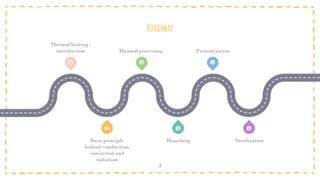
Roadmap
3
1 3 5
6
4
2
Thermal heating :
introduction Thermal processing Pasteurization
Basic principle
behind: conduction,
convection and
radiation
Blanching Sterilization
4
THERMAL HEATING: INTRODUCTION
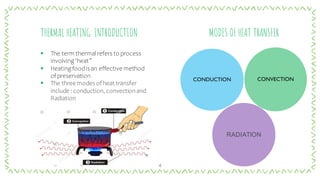
▪ The term thermal refers to process
involving ‘heat”
▪ Heating foodis an effective method
of preservation
▪ The three modes of heat transfer
include : conduction, convectionand
Radiation
MODES OFHEAT TRANSFER
RADIATION
BASIC PRINCIPLE BEHIND:
CONDUCTION
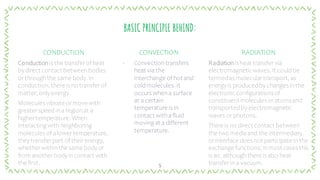
Conduction is the transferof heat
bydirect contact betweenbodies
orthroughthe same body. In
conduction, there is no transferof
matter, onlyenergy.
Molecules vibrate ormovewith
greaterspeed ina regionat a
highertemperature. When
interacting withneighboring
molecules of alowertemperature,
theytransfer part of theirenergy,
whetherwithinthe same bodyor
from anotherbodyincontact with
the first.
CONVECTION
‐ Convectiontransfers
heat via the
interchange of hot and
coldmolecules. It
occurs whena surface
at a certain
temperature is in
contact withafluid
moving at a different
temperature.
RADIATION
Radiation is heat transfervia
electromagneticwaves. It couldbe
termedas moleculartransport, as
energyis producedby changes inthe
electronic configurationsof
constituent molecules oratomsand
transportedby electromagnetic
waves or photons.
There is no direct contact between
the two mediaand the intermediary
orinterface does not participate inthe
exchange functions; inmost cases this
is air, althoughthere is also heat
transferin a vacuum.
5
THERMAL PROCESSSING
6
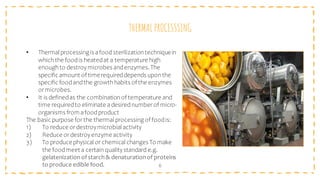
• Thermal processing is afood sterilizationtechniquein
whichthe foodis heatedat a temperature high
enoughto destroymicrobes andenzymes. The
specific amount of timerequireddepends uponthe
specific foodandthe growthhabits of the enzymes
ormicrobes.
• It is definedas the combinationof temperature and
time requiredto eliminate adesirednumberof micro-
organisms from afoodproduct
The basic purpose for the thermal processing of foodis:
1) To reduce ordestroymicrobial activity
2) Reduce ordestroyenzyme activity
3) To produce physical or chemical changes To make
the foodmeet a certainqualitystandard e.g.
gelatenization ofstarch& denaturationof proteins
to produce edible food.
METHODS OF THERMAL PROCESSING
7
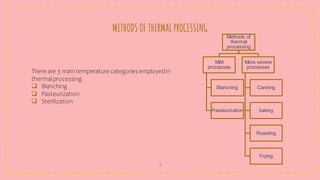
There are 3 maintemperature categories employedin
thermal processing
❑ Blanching
❑ Pasteurization
❑ Sterilization
Methods of
thermal
processing
Mild
processes
Blanching
Pasteurization
More severe
processes
Canning
baking
Roasting
Frying
Blanching
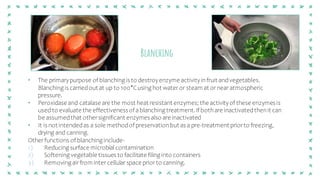
• The primarypurpose of blanching is to destroyenzyme activityinfruit andvegetables.
Blanching is carriedout at up to 100°Cusing hot wateror steam at ornear atmospheric
pressure.
• Peroxidase and catalase are the most heat resistant enzymes; the activityof these enzymes is
used to evaluate the effectivenessof ablanching treatment.If bothare inactivatedthenit can
be assumedthat othersignificant enzymes also are inactivated
• It is not intendedas a sole methodof preservationbut as a pre-treatment priorto freezing,
drying and canning.
Otherfunctions of blanching include-
1) Reducing surface microbial contamination
2) Softening vegetable tissues to facilitate filing into containers
3) Removing airfrom intercellularspace priorto canning.
METHODS OF BLANCHING
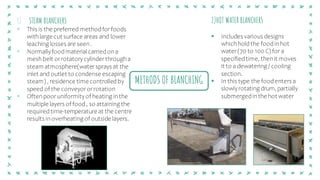
1) STEAM BLANCHERS
▪ This is the preferred methodfor foods
withlarge cut surface areas and lower
leaching losses are seen .
▪ Normallyfoodmaterial carriedon a
mesh belt or rotatorycylinder througha
steam atmosphere(watersprays at the
inlet and outlet to condense escaping
steam) , residence time controlledby
speed of the conveyor or rotation
▪ Often poor uniformityof heating in the
multiple layers of food, so attaining the
requiredtime-temperature at the centre
results in overheating of outside layers.
2)HOT WATER BLANCHERS
▪ Includes various designs
whichholdthe foodinhot
water(70 to 100 C) for a
specifiedtime, thenit moves
it to a dewatering / cooling
section.
▪ In this type the foodenters a
slowlyrotating drum, partially
submergedinthe hot water
Pasteurization
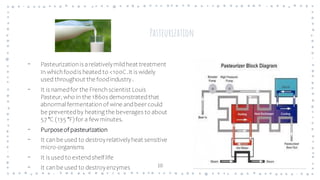
‐ Pasteurization is arelativelymildheat treatment
In which foodis heated to <100C.It is widely
used throughout the foodindustry.
‐ It is namedfor the French scientist Louis
Pasteur, who in the 1860s demonstratedthat
abnormal fermentation of wine andbeer could
be preventedby heating the beverages to about
57 °C (135 °F) for a fewminutes.
‐ Purposeof pasteurization
‐ It can be used to destroyrelativelyheat sensitive
micro-organisms
‐ It is used to extendshelf life
‐ It can be used to destroyenzymes 10
11
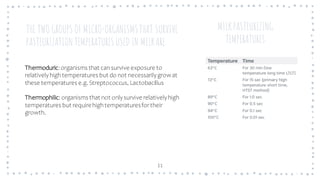
MILK PASTEURIZING
TEMPERATURES
Thermoduric:organisms that cansurvive exposure to
relativelyhightemperatures but do not necessarilygrowat
these temperatures e.g. Streptococcus, Lactobacillus
Thermophilic: organisms that not onlysurvive relativelyhigh
temperatures but requirehightemperaturesfortheir
growth.
THE TWO GROUPS OF MICRO-ORGANISMSTHAT SURVIVE
PASTEURIZATION TEMPERATURES USED IN MILKARE:
12
METHODS OF PASTEURIZATION
There are a numberof methods of pasteurizationbut the 2
basic ones are:
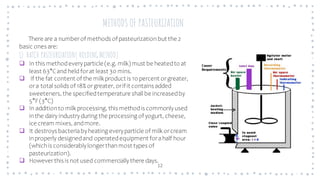
1) BATCH PASTEURIZATION( HOLDING METHOD)
❑ In this methodeveryparticle (e.g. milk) must be heatedto at
least 63°Cand held forat least 30 mins.
❑ If the fat content of the milk product is 10 percent orgreater,
ora total solids of 18% orgreater, orif it contains added
sweeteners, the specifiedtemperature shall be increasedby
5°F(3°C)
❑ In additionto milk processing, this methodis commonlyused
inthe dairy industryduring the processing of yogurt, cheese,
ice cream mixes, andmore.
❑ It destroys bacteriabyheating everyparticle of milk orcream
inproperly designedand operatedequipment forahalf hour
(whichis considerablylongerthanmost types of
pasteurization).
❑ Howeverthis is not used commerciallythere days.
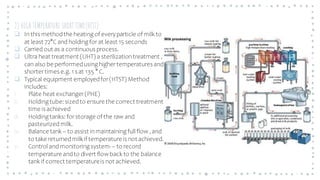
2) HIGH TEMPERATURE SHORT TIME(HTST)
❑ In this methodthe heating of everyparticle of milk to
at least 72°C and holding for at least 15 seconds
❑ Carried out as a continuous process.
❑ Ultra heat treatment (UHT) a sterilizationtreatment ,
can also be performedusing highertemperatures and
shortertimes e.g. 1 s at 135 ° C.
❑ Typical equipment employedfor(HTST) Method
includes:
i. Plate heat exchanger(PHE)
ii. Holding tube: sizedto ensure the correct treatment
time is achieved
iii. Holding tanks: forstorage of the raw and
pasteurizedmilk.
iv. Balance tank – to assist inmaintaining full flow, and
to take returnedmilk if temperature is not achieved.
v. Control and monitoring system- – to record
temperature andto divert flowback to the balance
tank if correct temperatureis not achieved.
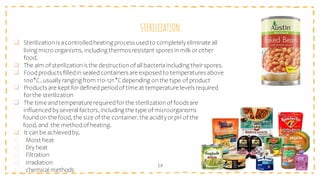
STERILIZATION
14
❑ Sterilizationis acontrolledheating process usedto completelyeliminate all
living micro organisms, including thermos resistant spores inmilk orother
food.
❑ The aim of sterilizationis the destructionof all bacteriaincluding theirspores.
❑ Foodproducts filledin sealedcontainers are exposed to temperatures above
100°C, usually ranging from 110-121 °Cdepending onthe type of product
❑ Products are kept fordefined periodof time at temperature levels required
forthe sterilization
❑ The time andtemperature requiredforthe sterilizationof foods are
influencedbyseveral factors, including the type of microorganisms
foundon the food, the size of the container, the acidityorpH of the
food, and the methodof heating.
❑ It canbe achievedby,
1) Moist heat
2) Dry heat
3) Filtration
4) Irradiation
5) chemical methods
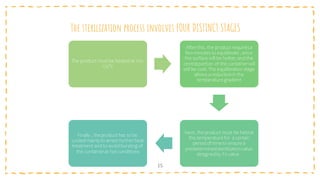
The sterilization process involves FOUR DISTINCT STAGES
15
The product must be heated at 110-
125°C
Afterthis, the product requiresa
fewminutes to equilibrate ,since
the surfacewill be hotter,and the
centralportion of the containerwill
still be cool. The equilibration stage
allows a reductionin the
temperature gradient
Next, theproduct must be heldat
this temperature for a certain
period of timeto ensure a
predeterminedsterilizationvalue
designedby F0 value .
Finally , theproduct has to be
cooled mainly to arrest furtherheat
treatment and to avoid bursting of
the containerat hot conditions
16
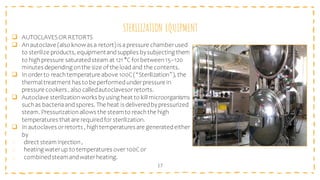
STERILIZATION EQUIPMENT
17
❑ AUTOCLAVESOR RETORTS
❑ An autoclave (also knowas a retort) is apressure chamber used
to sterilize products, equipmentandsupplies bysubjecting them
to highpressure saturatedsteam at 121 °C forbetween15–120
minutes depending on the size of the load and the contents.
❑ In order to reach temperature above 100C(“Sterilization”), the
thermal treatment has to be performedunderpressure in
pressure cookers , also calledautoclavesor retorts.
❑ Autoclave sterilization works byusing heat to kill microorganisms
such as bacteriaand spores. The heat is deliveredbypressurized
steam. Pressurization allows the steamto reach the high
temperatures that are requiredfor sterilization.
❑ In autoclaves or retorts , hightemperatures are generatedeither
by
1. direct steam injection,
2. heating waterup to temperatures over100Cor
3. combinedsteamandwaterheating.
MICROWAVE HEATING
18
Roadmap
19
1 3 5
6
4
2
Microwave heating:
Introduction
Components of a
microwave
Is microwave
safe???
Working principle Mechanism Advantages and
disadvantages
7
Applications
“
20
MICROWAVE HEATING: INTRODUCTION
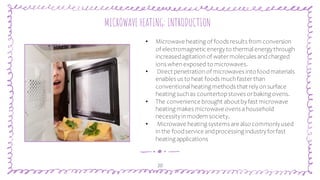
• Microwave heating of foods results from conversion
of electromagnetic energyto thermal energythrough
increasedagitationof watermolecules andcharged
ions whenexposed to microwaves.
• Direct penetrationof microwaves intofoodmaterials
enables us to heat foods muchfasterthan
conventional heating methods that relyonsurface
heating suchas countertopstoves orbaking ovens.
• The convenience brought aboutbyfast microwave
heating makes microwaveovens ahousehold
necessityinmodernsociety.
• Microwave heating systems are also commonlyused
inthe foodservice andprocessing industryforfast
heating applications
WORKING PRINCIPLE
21
‐ Microwave ovens work onthe principle of conversionof electromagneticenergyinto
thermal energy. Electromagnetic (EM) energyrefers to the radiation(waves) comprising
an electrical fieldandmagnetic fieldoscillating perpendicularto eachother.
‐ When a polar molecule,i.e.,amolecule containing opposite charges,falls inthe path of
these EM radiations, it oscillates to alignwiththem. This causes the energyto be lost from
the dipole by molecularfrictionandcollision, resulting inheating.
‐ The watermolecules present inside ourfoodproducts go undera similarphenomenon
whenthey come incontact withmicrowaveradiations, heating the foodfrom inside out.
22
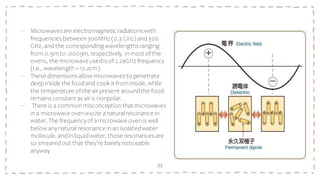
– Microwaves are electromagnetic radiationswith
frequencies between 300MHz (0.3 GHz) and300
GHz, and the corresponding wavelengths ranging
from 0.9m to .0009m, respectively. In most of the
ovens, the microwave usedis of 2.24GHz frequency
(i.e., wavelength = 12.2cm).
– These dimensions allowmicrowaves to penetrate
deep inside the foodand cook it from inside, while
the temperature of the air present aroundthe food
remains constant as air is nonpolar.
– There is a common misconception that microwaves
in a microwave oven excite anatural resonance in
water. The frequencyof amicrowave ovenis well
belowanynatural resonance in an isolatedwater
molecule, andin liquidwater, those resonances are
so smearedout that they’re barelynoticeable
anyway
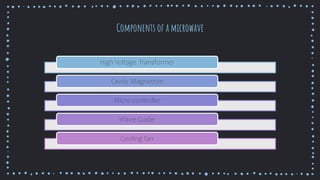
Components of a microwave
High Voltage Transformer
Cavity Magnetron
Micro controller
Wave Guide
Cooling fan
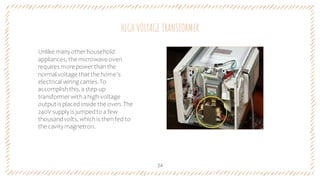
Unlike manyotherhousehold
appliances, the microwave oven
requires more powerthanthe
normal voltage that the home’s
electrical wiring carries.To
accomplish this, astep-up
transformerwithahigh-voltage
output is placed inside the oven. The
240V supply is jumpedto a few
thousandvolts, whichis thenfed to
the cavitymagnetron.
HIGH VOLTAGE TRANSFORMER
24
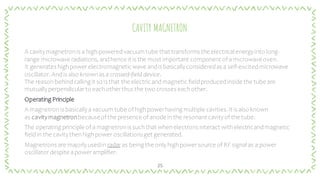
CAVITY MAGNETRON
A cavitymagnetron is a high-poweredvacuum tube that transforms the electrical energyinto long-
range microwave radiations, andhence it is the most important component of amicrowaveoven.
It generates highpowerelectromagneticwave andis basicallyconsideredas a self-excitedmicrowave
oscillator. Andis also known as a crossed-field device.
The reason behindcalling it so is that the electric andmagnetic fieldproducedinside the tube are
mutuallyperpendicularto each otherthus the two crosses each other.
Operating Principle
A magnetron is basicallyavacuum tube of highpowerhaving multiple cavities.It is also known
as cavitymagnetronbecauseof the presence of anode in the resonant cavityof the tube.
The operating principle of a magnetron is such that when electrons interact with electricandmagnetic
fieldin the cavitythen highpower oscillationsget generated.
Magnetrons are majorlyusedin radar as being the only highpowersource of RF signal as a power
oscillatordespite apoweramplifier.
25
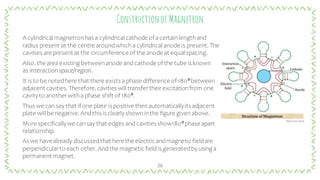
Constructionof Magnetron
A cylindrical magnetronhas a cylindrical cathode of acertainlengthand
radius present at the centre aroundwhich a cylindrical anode is present. The
cavities are present at the circumference of the anode at equal spacing.
Also, the areaexisting betweenanode and cathode of the tube is known
as interaction space/region.
It is to be notedhere that there exists a phase difference of 180⁰between
adjacent cavities. Therefore,cavities will transfertheirexcitationfrom one
cavityto anotherwitha phase shift of 180⁰.
Thus we can say that if one plate is positive thenautomaticallyits adjacent
plate will be negative. Andthis is clearlyshowninthe figure givenabove.
More specificallywe cansay that edges and cavities show180⁰phase apart
relationship.
As we have already discussedthat here the electric andmagnetic fieldare
perpendicularto each other. Andthe magnetic fieldis generatedbyusing a
permanent magnet.
26
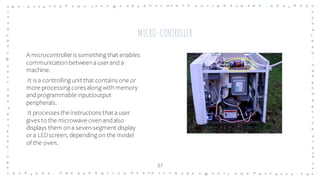
27
A microcontroller is something that enables
communication between auser and a
machine.
It is a controlling unit that contains one or
more processing cores along with memory
and programmable input/output
peripherals.
It processes the instructions that auser
gives to the microwave ovenandalso
displays them on a seven-segment display
or a LEDscreen, depending on the model
of the oven.
MICRO-CONTROLLER
WAVE GUIDE
28
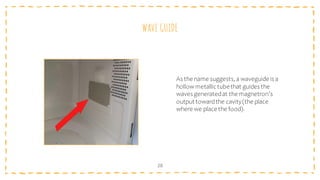
As the name suggests, a waveguide is a
hollowmetallic tubethat guides the
waves generatedat the magnetron’s
output towardthe cavity(the place
where we place the food).
COOLING FANS
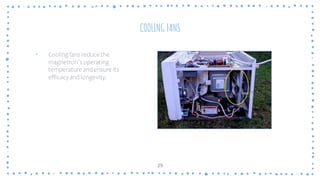
‐ Cooling fans reduce the
magnetron’s operating
temperature andensure its
efficacyand longevity.
29
MECHANISM
30
31
After the generation of microwaves at the magnetron, they are guided by the waveguide
towards the food inside the cavity.
The microwaves penetrate through the surface of the food and reach the water molecules
present inside it. As the orientation of the electric field changes over time, the polar
molecules of water attempt to follow the field by changing their orientation inside the
material to line up along the field lines in an energetically favorable configuration (namely,
with the positive side pointing in the same direction as the field lines).
As these molecules change direction rapidly (millions of times per second at least), they gain
energy, which increases the temperature of the material. This process is called dielectric
heating.
The microwave energy diminishes according to the inverse square law, and therefore, the
cavity chamber, where we place food, is designed in such a way that it carries out the
maximum efficiency of the heating effect of microwaves.
IS MICROWAVE HEATING SAFE???
32
– Misconceptions: To dispel some misconceptions, it is important to realize that foodcookedina
microwave ovendoes not become"radioactive". Nordoes anymicrowaveenergyremaininthe
cavityorthe foodafterthe microwave ovenis switchedoff. Inthis respect, microwavesact just
like light; whenthe light bulb is turnedoff, no light remains.
– When usedaccording to manufacturers'instructions,microwaveovens are safe and convenient
forheating and cooking avarietyof foods. However, several precautions needto be taken,
specificallywithregards to potential exposure to microwaves, thermal burns andfoodhandling.
33
Microwavesafety:
• designof microwave ovens ensures that the microwaves are containedwithinthe ovenandcanonly
be present when the ovenis switchedonand the dooris shut. Leakage around and throughthe glass
dooris limitedbydesignto alevel well belowthat recommendedbyinternational standards.
However, microwaveleakage couldstill occurarounddamaged, dirtyor modifiedmicrowave ovens.It
is therefore important that the ovenis maintainedingoodcondition.
• Users should check that the doorcloses properlyand that the safetyinterlock devices,fittedto the
doorto prevent microwaves frombeinggeneratedwhile it is open, work correctly.The doorseals
shouldbe kept cleanand there should be no visible signs of damage to the seals or the outercasing
of the oven. If any faults are found orparts of the ovenare damaged, it should not be used until it has
beenrepairedby an appropriately qualifiedservice engineer.
• Microwave energycanbe absorbedbythe bodyand produce heat in exposedtissues. Organs witha
poorbloodsupply and temperature control, suchas the eye, ortemperature-sensitivetissue likethe
testes, have a higherrisk of heat damage. However, thermal damage wouldonlyoccurfrom long
exposures to very highpowerlevels, well inexcess of those measuredaroundmicrowave ovens.
34
Thermal safety:
• Burninjuries canresult from handling hot items heatedina microwave oven, inthe same wayas items
heatedusing conventional ovens orcookingsurfaces. However, heating foodinamicrowave oven
presents some peculiarities. Boiling wateronaconventional stoveallows steam to escape through
bubbling actionas the waterbegins to boil. Inamicrowave oventhere maybe no bubbles onthe walls
of the containerandthe water will super-heat and may suddenly boil. This suddenboiling maybe
triggeredbya single bubble inthe liquidorbythe introductionof aforeignelement suchas aspoon.
People have beenseverelyburnedbysuper-heatedwater.
• Anotherpeculiarityof microwave cooking relates to the thermal response of specific foods. Certain
items withnon-porous surfaces (e.g. hotdogs)orcomposedof materials that heat at different rates
(e.g. yolk and white of eggs) heat unevenlyand mayexplode. This can happen if eggs orchestnuts are
cookedintheirshells.
ADVANATGES
• The volumetricheating process of microwaves is theirmostprominentcharacteristic. Inthe
conventional cooking method, the heat must spreadinwards from the surface of the fooditem,
whereas the spread of heat inthe case of microwave ovenis done ina controlledmannerwith
the help of the microwaves.
• It’s a quick and convenient methodof heating foodandleftovers.
• Since microwaves canonlyinteract withpolarsubstances likewater, theycannot affect the
nutritional value of those ingredients that are non-polar. Otherconventional cooking methods,
however, maydestroysome polaras well as non-polaringredients during the process.
• The userinterface and micro-controllerfacilitate precisecontroloverthe cooking temperature.
• The ease of the cooking process inamicrowave ovenalso results ineasiercleaning of the
equipment afteruse
35
DISADVANTAGES
36
• The cost of equipment is highin comparison to other conventional cooking methods.
• Microwave leakage mayleadto electromagnetic interference withotherelectrical equipment
present in the surrounding vicinity. The pacemakers installedin some patients are particularly
vulnerable to such radiation leakage.
• Microwave radiation can heat bodytissue the same way it heats food. Exposure to high levels of
microwaves can cause apainful burn. In particular, the eyes and the testes are vulnerable to
microwave heating because there is relativelylittle bloodflowin them to carryaway excess heat.
• Another disadvantage of microwaves is that theyhave limitedcapacityandbecause of this, they
are not the best option for large families.
APPLICATIONS
37
1)
COOKING
Continuousmicrowavecooking
systems are used to cook meats
commercially. Bacon precooking
and crisping is one of the most
common applications of industrial
microwave processing. Many fast
food restaurantsare commercial
users of this technology.
Microwave cooking is also used as
a booster prior to an impingement
oven for fully cooked, bone-in
chicken. Conventionalcooking can
leave blood spotsor cause
overcooking on the exterior of
meat, whereas microwaves
penetrate to begin internal
cooking more quickly, reducing
cooking time by as much as 50%
and increasing throughputby as
much as 30%.
2)
DRYING
Microwave drying is very efficient
and is commercially used in
applicationsfor snacks, as well as
spices and other ingredients. It is
also used to finish dry pastaand
instantnoodles.Industrial
Microwave Systems estimates that
microwave use as a pre-dryer or
post-dryer can increase overall
production capacities by 25%–33%
and can produce a return on
capital investmentwithin as little
as 12–24 months.
38
3)
TEMPERING
The most popular application of
microwaves in food processing
is for tempering. Microwaves
rapidly generate heat
volumetrically, and defrosting is
achieved in minutes rather than
hours/days, even for large
product blocks. Tempering can
also be performed directly
inside the package. This process
results in a significant reduction
in drip loss while minimizing
product deterioration due to
bacterial growth, making it ideal
for many defrosting processes.
Microwave heating is commonly
used to temper deep-frozen
beef, pork, poultry, and fish.
4)
STERILIZATION
Conventional sterilization
processes, like retorting, are
generally carried out by treating
products with drastic heat
treatments, resulting in loss of
product quality. Microwave
sterilization offers the potential
for shorter process times and
improved quality
39
THANKS!

THERMAL AND MICROWAVE HEATING .pdf

  • 1.
    MICROWAVE AND THERMAL HEATING PRESENTEDBY: KULSUMSHERWANI ENROLLMENTNUMBER:GN0965 M.TECH INPROCESSING ANDFOODENGINEERING DEPARTMENT OF POSTHARVEST ENGINEERING ANDTECHNOLOGY , A.M.U,ALIGARH
  • 2.
  • 3.
    Roadmap 3 1 3 5 6 4 2 Thermalheating : introduction Thermal processing Pasteurization Basic principle behind: conduction, convection and radiation Blanching Sterilization
  • 4.
    4 THERMAL HEATING: INTRODUCTION ▪The term thermal refers to process involving ‘heat” ▪ Heating foodis an effective method of preservation ▪ The three modes of heat transfer include : conduction, convectionand Radiation MODES OFHEAT TRANSFER RADIATION
  • 5.
    BASIC PRINCIPLE BEHIND: CONDUCTION Conductionis the transferof heat bydirect contact betweenbodies orthroughthe same body. In conduction, there is no transferof matter, onlyenergy. Molecules vibrate ormovewith greaterspeed ina regionat a highertemperature. When interacting withneighboring molecules of alowertemperature, theytransfer part of theirenergy, whetherwithinthe same bodyor from anotherbodyincontact with the first. CONVECTION ‐ Convectiontransfers heat via the interchange of hot and coldmolecules. It occurs whena surface at a certain temperature is in contact withafluid moving at a different temperature. RADIATION Radiation is heat transfervia electromagneticwaves. It couldbe termedas moleculartransport, as energyis producedby changes inthe electronic configurationsof constituent molecules oratomsand transportedby electromagnetic waves or photons. There is no direct contact between the two mediaand the intermediary orinterface does not participate inthe exchange functions; inmost cases this is air, althoughthere is also heat transferin a vacuum. 5
  • 6.
    THERMAL PROCESSSING 6 • Thermalprocessing is afood sterilizationtechniquein whichthe foodis heatedat a temperature high enoughto destroymicrobes andenzymes. The specific amount of timerequireddepends uponthe specific foodandthe growthhabits of the enzymes ormicrobes. • It is definedas the combinationof temperature and time requiredto eliminate adesirednumberof micro- organisms from afoodproduct The basic purpose for the thermal processing of foodis: 1) To reduce ordestroymicrobial activity 2) Reduce ordestroyenzyme activity 3) To produce physical or chemical changes To make the foodmeet a certainqualitystandard e.g. gelatenization ofstarch& denaturationof proteins to produce edible food.
  • 7.
    METHODS OF THERMALPROCESSING 7 There are 3 maintemperature categories employedin thermal processing ❑ Blanching ❑ Pasteurization ❑ Sterilization Methods of thermal processing Mild processes Blanching Pasteurization More severe processes Canning baking Roasting Frying
  • 8.
    Blanching • The primarypurposeof blanching is to destroyenzyme activityinfruit andvegetables. Blanching is carriedout at up to 100°Cusing hot wateror steam at ornear atmospheric pressure. • Peroxidase and catalase are the most heat resistant enzymes; the activityof these enzymes is used to evaluate the effectivenessof ablanching treatment.If bothare inactivatedthenit can be assumedthat othersignificant enzymes also are inactivated • It is not intendedas a sole methodof preservationbut as a pre-treatment priorto freezing, drying and canning. Otherfunctions of blanching include- 1) Reducing surface microbial contamination 2) Softening vegetable tissues to facilitate filing into containers 3) Removing airfrom intercellularspace priorto canning.
  • 9.
    METHODS OF BLANCHING 1)STEAM BLANCHERS ▪ This is the preferred methodfor foods withlarge cut surface areas and lower leaching losses are seen . ▪ Normallyfoodmaterial carriedon a mesh belt or rotatorycylinder througha steam atmosphere(watersprays at the inlet and outlet to condense escaping steam) , residence time controlledby speed of the conveyor or rotation ▪ Often poor uniformityof heating in the multiple layers of food, so attaining the requiredtime-temperature at the centre results in overheating of outside layers. 2)HOT WATER BLANCHERS ▪ Includes various designs whichholdthe foodinhot water(70 to 100 C) for a specifiedtime, thenit moves it to a dewatering / cooling section. ▪ In this type the foodenters a slowlyrotating drum, partially submergedinthe hot water
  • 10.
    Pasteurization ‐ Pasteurization isarelativelymildheat treatment In which foodis heated to <100C.It is widely used throughout the foodindustry. ‐ It is namedfor the French scientist Louis Pasteur, who in the 1860s demonstratedthat abnormal fermentation of wine andbeer could be preventedby heating the beverages to about 57 °C (135 °F) for a fewminutes. ‐ Purposeof pasteurization ‐ It can be used to destroyrelativelyheat sensitive micro-organisms ‐ It is used to extendshelf life ‐ It can be used to destroyenzymes 10
  • 11.
    11 MILK PASTEURIZING TEMPERATURES Thermoduric:organisms thatcansurvive exposure to relativelyhightemperatures but do not necessarilygrowat these temperatures e.g. Streptococcus, Lactobacillus Thermophilic: organisms that not onlysurvive relativelyhigh temperatures but requirehightemperaturesfortheir growth. THE TWO GROUPS OF MICRO-ORGANISMSTHAT SURVIVE PASTEURIZATION TEMPERATURES USED IN MILKARE:
  • 12.
    12 METHODS OF PASTEURIZATION Thereare a numberof methods of pasteurizationbut the 2 basic ones are: 1) BATCH PASTEURIZATION( HOLDING METHOD) ❑ In this methodeveryparticle (e.g. milk) must be heatedto at least 63°Cand held forat least 30 mins. ❑ If the fat content of the milk product is 10 percent orgreater, ora total solids of 18% orgreater, orif it contains added sweeteners, the specifiedtemperature shall be increasedby 5°F(3°C) ❑ In additionto milk processing, this methodis commonlyused inthe dairy industryduring the processing of yogurt, cheese, ice cream mixes, andmore. ❑ It destroys bacteriabyheating everyparticle of milk orcream inproperly designedand operatedequipment forahalf hour (whichis considerablylongerthanmost types of pasteurization). ❑ Howeverthis is not used commerciallythere days.
  • 13.
    2) HIGH TEMPERATURESHORT TIME(HTST) ❑ In this methodthe heating of everyparticle of milk to at least 72°C and holding for at least 15 seconds ❑ Carried out as a continuous process. ❑ Ultra heat treatment (UHT) a sterilizationtreatment , can also be performedusing highertemperatures and shortertimes e.g. 1 s at 135 ° C. ❑ Typical equipment employedfor(HTST) Method includes: i. Plate heat exchanger(PHE) ii. Holding tube: sizedto ensure the correct treatment time is achieved iii. Holding tanks: forstorage of the raw and pasteurizedmilk. iv. Balance tank – to assist inmaintaining full flow, and to take returnedmilk if temperature is not achieved. v. Control and monitoring system- – to record temperature andto divert flowback to the balance tank if correct temperatureis not achieved.
  • 14.
    STERILIZATION 14 ❑ Sterilizationis acontrolledheatingprocess usedto completelyeliminate all living micro organisms, including thermos resistant spores inmilk orother food. ❑ The aim of sterilizationis the destructionof all bacteriaincluding theirspores. ❑ Foodproducts filledin sealedcontainers are exposed to temperatures above 100°C, usually ranging from 110-121 °Cdepending onthe type of product ❑ Products are kept fordefined periodof time at temperature levels required forthe sterilization ❑ The time andtemperature requiredforthe sterilizationof foods are influencedbyseveral factors, including the type of microorganisms foundon the food, the size of the container, the acidityorpH of the food, and the methodof heating. ❑ It canbe achievedby, 1) Moist heat 2) Dry heat 3) Filtration 4) Irradiation 5) chemical methods
  • 15.
    The sterilization processinvolves FOUR DISTINCT STAGES 15 The product must be heated at 110- 125°C Afterthis, the product requiresa fewminutes to equilibrate ,since the surfacewill be hotter,and the centralportion of the containerwill still be cool. The equilibration stage allows a reductionin the temperature gradient Next, theproduct must be heldat this temperature for a certain period of timeto ensure a predeterminedsterilizationvalue designedby F0 value . Finally , theproduct has to be cooled mainly to arrest furtherheat treatment and to avoid bursting of the containerat hot conditions
  • 16.
  • 17.
    STERILIZATION EQUIPMENT 17 ❑ AUTOCLAVESORRETORTS ❑ An autoclave (also knowas a retort) is apressure chamber used to sterilize products, equipmentandsupplies bysubjecting them to highpressure saturatedsteam at 121 °C forbetween15–120 minutes depending on the size of the load and the contents. ❑ In order to reach temperature above 100C(“Sterilization”), the thermal treatment has to be performedunderpressure in pressure cookers , also calledautoclavesor retorts. ❑ Autoclave sterilization works byusing heat to kill microorganisms such as bacteriaand spores. The heat is deliveredbypressurized steam. Pressurization allows the steamto reach the high temperatures that are requiredfor sterilization. ❑ In autoclaves or retorts , hightemperatures are generatedeither by 1. direct steam injection, 2. heating waterup to temperatures over100Cor 3. combinedsteamandwaterheating.
  • 18.
  • 19.
    Roadmap 19 1 3 5 6 4 2 Microwaveheating: Introduction Components of a microwave Is microwave safe??? Working principle Mechanism Advantages and disadvantages 7 Applications
  • 20.
    “ 20 MICROWAVE HEATING: INTRODUCTION •Microwave heating of foods results from conversion of electromagnetic energyto thermal energythrough increasedagitationof watermolecules andcharged ions whenexposed to microwaves. • Direct penetrationof microwaves intofoodmaterials enables us to heat foods muchfasterthan conventional heating methods that relyonsurface heating suchas countertopstoves orbaking ovens. • The convenience brought aboutbyfast microwave heating makes microwaveovens ahousehold necessityinmodernsociety. • Microwave heating systems are also commonlyused inthe foodservice andprocessing industryforfast heating applications
  • 21.
    WORKING PRINCIPLE 21 ‐ Microwaveovens work onthe principle of conversionof electromagneticenergyinto thermal energy. Electromagnetic (EM) energyrefers to the radiation(waves) comprising an electrical fieldandmagnetic fieldoscillating perpendicularto eachother. ‐ When a polar molecule,i.e.,amolecule containing opposite charges,falls inthe path of these EM radiations, it oscillates to alignwiththem. This causes the energyto be lost from the dipole by molecularfrictionandcollision, resulting inheating. ‐ The watermolecules present inside ourfoodproducts go undera similarphenomenon whenthey come incontact withmicrowaveradiations, heating the foodfrom inside out.
  • 22.
    22 – Microwaves areelectromagnetic radiationswith frequencies between 300MHz (0.3 GHz) and300 GHz, and the corresponding wavelengths ranging from 0.9m to .0009m, respectively. In most of the ovens, the microwave usedis of 2.24GHz frequency (i.e., wavelength = 12.2cm). – These dimensions allowmicrowaves to penetrate deep inside the foodand cook it from inside, while the temperature of the air present aroundthe food remains constant as air is nonpolar. – There is a common misconception that microwaves in a microwave oven excite anatural resonance in water. The frequencyof amicrowave ovenis well belowanynatural resonance in an isolatedwater molecule, andin liquidwater, those resonances are so smearedout that they’re barelynoticeable anyway
  • 23.
    Components of amicrowave High Voltage Transformer Cavity Magnetron Micro controller Wave Guide Cooling fan
  • 24.
    Unlike manyotherhousehold appliances, themicrowave oven requires more powerthanthe normal voltage that the home’s electrical wiring carries.To accomplish this, astep-up transformerwithahigh-voltage output is placed inside the oven. The 240V supply is jumpedto a few thousandvolts, whichis thenfed to the cavitymagnetron. HIGH VOLTAGE TRANSFORMER 24
  • 25.
    CAVITY MAGNETRON A cavitymagnetronis a high-poweredvacuum tube that transforms the electrical energyinto long- range microwave radiations, andhence it is the most important component of amicrowaveoven. It generates highpowerelectromagneticwave andis basicallyconsideredas a self-excitedmicrowave oscillator. Andis also known as a crossed-field device. The reason behindcalling it so is that the electric andmagnetic fieldproducedinside the tube are mutuallyperpendicularto each otherthus the two crosses each other. Operating Principle A magnetron is basicallyavacuum tube of highpowerhaving multiple cavities.It is also known as cavitymagnetronbecauseof the presence of anode in the resonant cavityof the tube. The operating principle of a magnetron is such that when electrons interact with electricandmagnetic fieldin the cavitythen highpower oscillationsget generated. Magnetrons are majorlyusedin radar as being the only highpowersource of RF signal as a power oscillatordespite apoweramplifier. 25
  • 26.
    Constructionof Magnetron A cylindricalmagnetronhas a cylindrical cathode of acertainlengthand radius present at the centre aroundwhich a cylindrical anode is present. The cavities are present at the circumference of the anode at equal spacing. Also, the areaexisting betweenanode and cathode of the tube is known as interaction space/region. It is to be notedhere that there exists a phase difference of 180⁰between adjacent cavities. Therefore,cavities will transfertheirexcitationfrom one cavityto anotherwitha phase shift of 180⁰. Thus we can say that if one plate is positive thenautomaticallyits adjacent plate will be negative. Andthis is clearlyshowninthe figure givenabove. More specificallywe cansay that edges and cavities show180⁰phase apart relationship. As we have already discussedthat here the electric andmagnetic fieldare perpendicularto each other. Andthe magnetic fieldis generatedbyusing a permanent magnet. 26
  • 27.
    27 A microcontroller issomething that enables communication between auser and a machine. It is a controlling unit that contains one or more processing cores along with memory and programmable input/output peripherals. It processes the instructions that auser gives to the microwave ovenandalso displays them on a seven-segment display or a LEDscreen, depending on the model of the oven. MICRO-CONTROLLER
  • 28.
    WAVE GUIDE 28 As thename suggests, a waveguide is a hollowmetallic tubethat guides the waves generatedat the magnetron’s output towardthe cavity(the place where we place the food).
  • 29.
    COOLING FANS ‐ Coolingfans reduce the magnetron’s operating temperature andensure its efficacyand longevity. 29
  • 30.
  • 31.
    31 After the generationof microwaves at the magnetron, they are guided by the waveguide towards the food inside the cavity. The microwaves penetrate through the surface of the food and reach the water molecules present inside it. As the orientation of the electric field changes over time, the polar molecules of water attempt to follow the field by changing their orientation inside the material to line up along the field lines in an energetically favorable configuration (namely, with the positive side pointing in the same direction as the field lines). As these molecules change direction rapidly (millions of times per second at least), they gain energy, which increases the temperature of the material. This process is called dielectric heating. The microwave energy diminishes according to the inverse square law, and therefore, the cavity chamber, where we place food, is designed in such a way that it carries out the maximum efficiency of the heating effect of microwaves.
  • 32.
    IS MICROWAVE HEATINGSAFE??? 32 – Misconceptions: To dispel some misconceptions, it is important to realize that foodcookedina microwave ovendoes not become"radioactive". Nordoes anymicrowaveenergyremaininthe cavityorthe foodafterthe microwave ovenis switchedoff. Inthis respect, microwavesact just like light; whenthe light bulb is turnedoff, no light remains. – When usedaccording to manufacturers'instructions,microwaveovens are safe and convenient forheating and cooking avarietyof foods. However, several precautions needto be taken, specificallywithregards to potential exposure to microwaves, thermal burns andfoodhandling.
  • 33.
    33 Microwavesafety: • designof microwaveovens ensures that the microwaves are containedwithinthe ovenandcanonly be present when the ovenis switchedonand the dooris shut. Leakage around and throughthe glass dooris limitedbydesignto alevel well belowthat recommendedbyinternational standards. However, microwaveleakage couldstill occurarounddamaged, dirtyor modifiedmicrowave ovens.It is therefore important that the ovenis maintainedingoodcondition. • Users should check that the doorcloses properlyand that the safetyinterlock devices,fittedto the doorto prevent microwaves frombeinggeneratedwhile it is open, work correctly.The doorseals shouldbe kept cleanand there should be no visible signs of damage to the seals or the outercasing of the oven. If any faults are found orparts of the ovenare damaged, it should not be used until it has beenrepairedby an appropriately qualifiedservice engineer. • Microwave energycanbe absorbedbythe bodyand produce heat in exposedtissues. Organs witha poorbloodsupply and temperature control, suchas the eye, ortemperature-sensitivetissue likethe testes, have a higherrisk of heat damage. However, thermal damage wouldonlyoccurfrom long exposures to very highpowerlevels, well inexcess of those measuredaroundmicrowave ovens.
  • 34.
    34 Thermal safety: • Burninjuriescanresult from handling hot items heatedina microwave oven, inthe same wayas items heatedusing conventional ovens orcookingsurfaces. However, heating foodinamicrowave oven presents some peculiarities. Boiling wateronaconventional stoveallows steam to escape through bubbling actionas the waterbegins to boil. Inamicrowave oventhere maybe no bubbles onthe walls of the containerandthe water will super-heat and may suddenly boil. This suddenboiling maybe triggeredbya single bubble inthe liquidorbythe introductionof aforeignelement suchas aspoon. People have beenseverelyburnedbysuper-heatedwater. • Anotherpeculiarityof microwave cooking relates to the thermal response of specific foods. Certain items withnon-porous surfaces (e.g. hotdogs)orcomposedof materials that heat at different rates (e.g. yolk and white of eggs) heat unevenlyand mayexplode. This can happen if eggs orchestnuts are cookedintheirshells.
  • 35.
    ADVANATGES • The volumetricheatingprocess of microwaves is theirmostprominentcharacteristic. Inthe conventional cooking method, the heat must spreadinwards from the surface of the fooditem, whereas the spread of heat inthe case of microwave ovenis done ina controlledmannerwith the help of the microwaves. • It’s a quick and convenient methodof heating foodandleftovers. • Since microwaves canonlyinteract withpolarsubstances likewater, theycannot affect the nutritional value of those ingredients that are non-polar. Otherconventional cooking methods, however, maydestroysome polaras well as non-polaringredients during the process. • The userinterface and micro-controllerfacilitate precisecontroloverthe cooking temperature. • The ease of the cooking process inamicrowave ovenalso results ineasiercleaning of the equipment afteruse 35
  • 36.
    DISADVANTAGES 36 • The costof equipment is highin comparison to other conventional cooking methods. • Microwave leakage mayleadto electromagnetic interference withotherelectrical equipment present in the surrounding vicinity. The pacemakers installedin some patients are particularly vulnerable to such radiation leakage. • Microwave radiation can heat bodytissue the same way it heats food. Exposure to high levels of microwaves can cause apainful burn. In particular, the eyes and the testes are vulnerable to microwave heating because there is relativelylittle bloodflowin them to carryaway excess heat. • Another disadvantage of microwaves is that theyhave limitedcapacityandbecause of this, they are not the best option for large families.
  • 37.

    APPLICATIONS 37 1) COOKING Continuousmicrowavecooking systems are usedto cook meats commercially. Bacon precooking and crisping is one of the most common applications of industrial microwave processing. Many fast food restaurantsare commercial users of this technology. Microwave cooking is also used as a booster prior to an impingement oven for fully cooked, bone-in chicken. Conventionalcooking can leave blood spotsor cause overcooking on the exterior of meat, whereas microwaves penetrate to begin internal cooking more quickly, reducing cooking time by as much as 50% and increasing throughputby as much as 30%. 2) DRYING Microwave drying is very efficient and is commercially used in applicationsfor snacks, as well as spices and other ingredients. It is also used to finish dry pastaand instantnoodles.Industrial Microwave Systems estimates that microwave use as a pre-dryer or post-dryer can increase overall production capacities by 25%–33% and can produce a return on capital investmentwithin as little as 12–24 months.
  • 38.
    38 3) TEMPERING The most popularapplication of microwaves in food processing is for tempering. Microwaves rapidly generate heat volumetrically, and defrosting is achieved in minutes rather than hours/days, even for large product blocks. Tempering can also be performed directly inside the package. This process results in a significant reduction in drip loss while minimizing product deterioration due to bacterial growth, making it ideal for many defrosting processes. Microwave heating is commonly used to temper deep-frozen beef, pork, poultry, and fish. 4) STERILIZATION Conventional sterilization processes, like retorting, are generally carried out by treating products with drastic heat treatments, resulting in loss of product quality. Microwave sterilization offers the potential for shorter process times and improved quality
  • 39.