PALLVI DHOTRA
                ROLL No. 06
FOOD SCIENCE & TECHNOLOGY
Hurdle technology is the combined use of several
                                         shelf-
preservation methods to make a product shelf-stable,
to improve quality and to provide additional safety.
Also known as “combined method technology”.
Leistner in 1976, introduced the term “hurdle effect”.


NEED FOR HURDLE TECHNOLOGY
Consumers are demanding for fresh, natural and
minimally processed food products.
Ongoing trend has been eat out and to consume ready
to eat foods.
New ecology routes for microbial growth have emerged.
                                             emerged.
Preservative factors or hurdles disturb the
homeostasis of microorganisms.

Microorganisms should not be able to “jump over”
all the hurdles present in the food product.

Preservative factors prevents microorganisms from
multiplying and causing them to remain inactive or
even die.

The hurdle concept illustrates that complex
interactions of temperature, water activity, pH etc
are significant to the microbial stability.
High Temperature
i. Pasteurization
    mild heat treatment (e.g., 63oC for 30 min; 100oC for 12
    sec)
    high product quality
    destroys vegetative pathogens (disease-causing microbes)
                                  (disease-
                                            shelf-
    reduces total microbial load, increases shelf-life
    does not destroy spores (dormant stage of some bacteria)
    usually combined with other hurdles (e.g., refrigeration)
ii. Sterilization

 complete destruction of microorganisms

 severe heat treatment (equivalent to several
 min at 121.1oC)

 destroys spores

 gives "shelf-stable" product
       "shelf-

 some nutrient, quality destruction (colour,
 flavour, texture)
iii. Blanching

 blanching is a kind of pasteurization
 generally applied to fruits and vegetables

 primarily applied to inactivate natural
 enzymes

 commonly practiced when food is to be
 frozen

 depending on its severity, also destroys
 microorganisms
Vegetative cells, as well as, viruses are
                            60°     80°
destroyed at temperature 60°C to 80°C

Higher temperature may be needed for
killing of thermophilic microorganisms

Vegetative cells are killed in 10 minutes at
100°
100°C and many spores in 30 minutes at
100°C
100°
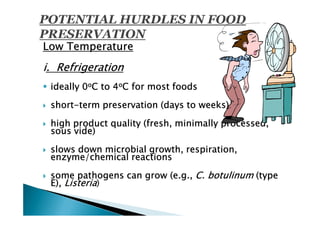
Low Temperature
i. Refrigeration
 ideally 0oC to 4oC for most foods

 short-
 short-term preservation (days to weeks)

 high product quality (fresh, minimally processed,
 sous vide)

 slows down microbial growth, respiration,
 enzyme/chemical reactions

 some pathogens can grow (e.g., C. botulinum (type
 E), Listeria)
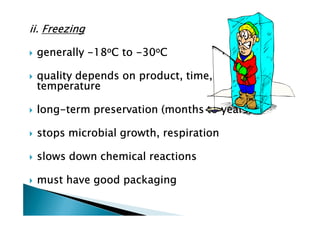
ii. Freezing

 generally -18oC to -30oC

 quality depends on product, time,
 temperature

 long-
 long-term preservation (months to years)

 stops microbial growth, respiration

 slows down chemical reactions

 must have good packaging
Reduced Water Activity (aw)
 aw is water "availability"

 water is required for microbial growth,
 enzyme/chemical reactions

 pathogenic microorganisms cannot grow at aw <
 0.86

 yeast & moulds cannot grow at aw <0.62

 free water can be removed by concentration,
 dehydration and freeze drying

 in general, the lower the aw, the longer the storage
 life
Glucose

Fructose

Sucrose

Sodium chloride

Potassium chloride
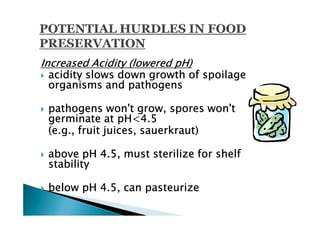
Increased Acidity (lowered pH)
  acidity slows down growth of spoilage
  organisms and pathogens

 pathogens won't grow, spores won't
 germinate at pH<4.5
 (e.g., fruit juices, sauerkraut)

 above pH 4.5, must sterilize for shelf
 stability

 below pH 4.5, can pasteurize
Organic acids
 citric acid
 malic acid
 tartaric acid
 benzoic acid
 lactic acid
 propionic acid

Inorganic acids

             by-
Fermentation by- products
Controlling Oxygen
 low oxygen inhibits growth of many
 spoilage organisms
but:
 anaerobic conditions required by some pathogens
 (e.g., C. botulinum)

Preservatives
 inhibit bacteria, yeasts, moulds
 used at low levels (mg/kg) for specific applications
 e.g., benzoate (soft drinks), propionate (baked
 goods),
 nitrites (meats), sulfites (wine), ascorbate (juices)
Sulphur dioxide and Sulphites
Nitrites and Nitrates
Sorbates
Propionates
Sodium benzoate
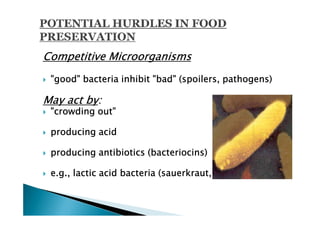
Competitive Microorganisms
 "good" bacteria inhibit "bad" (spoilers, pathogens)

May act by:
        by:
 "crowding out"

 producing acid

 producing antibiotics (bacteriocins)

 e.g., lactic acid bacteria (sauerkraut, yogurt)
Sequence of hurdles ensures stability at each
stage. All hurdles decline with time except aw.

Nitrite inhibits pathogens

growth of other bacteria depletes oxygen

                   acid-
Low oxygen favours acid-producing
competitive flora

Acid decreases pH

Aw hurdle gradually increases due to drying.
These products have pH > 4.5 and aw > 0.85.

Should have to comply with the low-acid
                                 low-
canned food regulations (i.e., commercial
sterilization).

However, for quality reasons, these products
cannot be given a sterilization process.

Instead, the spreads are stabilized by moderate
levels of salt, decreased pH and moisture.
Improves product quality and microbial safety.

Save Money, Energy & Several other Resources.

Foods remains stable & safe, high in sensory &
nutritive value due to gentle process applied.

Doesn't effects the integrity of food pieces (fruits).

Applicable in both Large & Small Industries.

Manufacture of new products according to the need
of processors and consumers.
BOOKS-
BOOKS-
 A text book of food preservation - BY
 NEELAM KHETARPAL.
 Food microbiology - BY
 Food science – BY
WEBSITES-
WEBSITES-
<http://www.ifrn.bbsrc.ac.uk/safety/comicro
 /Culture_25.pdf>
<http://ars.usda.gov/Services/docs.htm?doci
 d=6786
Hurdle technology

Hurdle technology

  • 1.
    PALLVI DHOTRA ROLL No. 06 FOOD SCIENCE & TECHNOLOGY
  • 2.
    Hurdle technology isthe combined use of several shelf- preservation methods to make a product shelf-stable, to improve quality and to provide additional safety. Also known as “combined method technology”. Leistner in 1976, introduced the term “hurdle effect”. NEED FOR HURDLE TECHNOLOGY Consumers are demanding for fresh, natural and minimally processed food products. Ongoing trend has been eat out and to consume ready to eat foods. New ecology routes for microbial growth have emerged. emerged.
  • 3.
    Preservative factors orhurdles disturb the homeostasis of microorganisms. Microorganisms should not be able to “jump over” all the hurdles present in the food product. Preservative factors prevents microorganisms from multiplying and causing them to remain inactive or even die. The hurdle concept illustrates that complex interactions of temperature, water activity, pH etc are significant to the microbial stability.
  • 4.
    High Temperature i. Pasteurization mild heat treatment (e.g., 63oC for 30 min; 100oC for 12 sec) high product quality destroys vegetative pathogens (disease-causing microbes) (disease- shelf- reduces total microbial load, increases shelf-life does not destroy spores (dormant stage of some bacteria) usually combined with other hurdles (e.g., refrigeration)
  • 5.
    ii. Sterilization completedestruction of microorganisms severe heat treatment (equivalent to several min at 121.1oC) destroys spores gives "shelf-stable" product "shelf- some nutrient, quality destruction (colour, flavour, texture)
  • 6.
    iii. Blanching blanchingis a kind of pasteurization generally applied to fruits and vegetables primarily applied to inactivate natural enzymes commonly practiced when food is to be frozen depending on its severity, also destroys microorganisms
  • 7.
    Vegetative cells, aswell as, viruses are 60° 80° destroyed at temperature 60°C to 80°C Higher temperature may be needed for killing of thermophilic microorganisms Vegetative cells are killed in 10 minutes at 100° 100°C and many spores in 30 minutes at 100°C 100°
  • 8.
    Low Temperature i. Refrigeration ideally 0oC to 4oC for most foods short- short-term preservation (days to weeks) high product quality (fresh, minimally processed, sous vide) slows down microbial growth, respiration, enzyme/chemical reactions some pathogens can grow (e.g., C. botulinum (type E), Listeria)
  • 9.
    ii. Freezing generally-18oC to -30oC quality depends on product, time, temperature long- long-term preservation (months to years) stops microbial growth, respiration slows down chemical reactions must have good packaging
  • 10.
    Reduced Water Activity(aw) aw is water "availability" water is required for microbial growth, enzyme/chemical reactions pathogenic microorganisms cannot grow at aw < 0.86 yeast & moulds cannot grow at aw <0.62 free water can be removed by concentration, dehydration and freeze drying in general, the lower the aw, the longer the storage life
  • 11.
  • 12.
    Increased Acidity (loweredpH) acidity slows down growth of spoilage organisms and pathogens pathogens won't grow, spores won't germinate at pH<4.5 (e.g., fruit juices, sauerkraut) above pH 4.5, must sterilize for shelf stability below pH 4.5, can pasteurize
  • 13.
    Organic acids citricacid malic acid tartaric acid benzoic acid lactic acid propionic acid Inorganic acids by- Fermentation by- products
  • 14.
    Controlling Oxygen lowoxygen inhibits growth of many spoilage organisms but: anaerobic conditions required by some pathogens (e.g., C. botulinum) Preservatives inhibit bacteria, yeasts, moulds used at low levels (mg/kg) for specific applications e.g., benzoate (soft drinks), propionate (baked goods), nitrites (meats), sulfites (wine), ascorbate (juices)
  • 15.
    Sulphur dioxide andSulphites Nitrites and Nitrates Sorbates Propionates Sodium benzoate
  • 16.
    Competitive Microorganisms "good"bacteria inhibit "bad" (spoilers, pathogens) May act by: by: "crowding out" producing acid producing antibiotics (bacteriocins) e.g., lactic acid bacteria (sauerkraut, yogurt)
  • 17.
    Sequence of hurdlesensures stability at each stage. All hurdles decline with time except aw. Nitrite inhibits pathogens growth of other bacteria depletes oxygen acid- Low oxygen favours acid-producing competitive flora Acid decreases pH Aw hurdle gradually increases due to drying.
  • 18.
    These products havepH > 4.5 and aw > 0.85. Should have to comply with the low-acid low- canned food regulations (i.e., commercial sterilization). However, for quality reasons, these products cannot be given a sterilization process. Instead, the spreads are stabilized by moderate levels of salt, decreased pH and moisture.
  • 19.
    Improves product qualityand microbial safety. Save Money, Energy & Several other Resources. Foods remains stable & safe, high in sensory & nutritive value due to gentle process applied. Doesn't effects the integrity of food pieces (fruits). Applicable in both Large & Small Industries. Manufacture of new products according to the need of processors and consumers.
  • 20.
    BOOKS- BOOKS- A textbook of food preservation - BY NEELAM KHETARPAL. Food microbiology - BY Food science – BY WEBSITES- WEBSITES- <http://www.ifrn.bbsrc.ac.uk/safety/comicro /Culture_25.pdf> <http://ars.usda.gov/Services/docs.htm?doci d=6786