Food processing Technology
Thermal Death Time
M. Ragadeepa
Assistant Professor
Department of Food and DairyTechnology
Mannar Thirumalai Naicker College
Content
■ Introduction
■ Definition
■ TDT curve
■ End point curve
■ What's an example of
thermal death time?
■ Conclusion
Introduction :
It is defined as number of minutes of
heating required to destroy a specified number of
organisms at a given temperature. The thermal death
time follows a logarithimic relationship with the
temperature of heating.
Definition :
This means as
we increase or decrease the
temperature of heating, the thermal
death time for bacteria will increase
or decrease in a logarithmic scale.
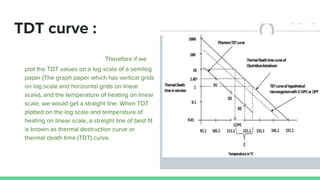
TDT curve :
Therefore if we
plot the TDT values on a log scale of a semilog
paper (The graph paper which has vertical grids
on log scale and horizontal grids on linear
scale), and the temperature of heating on linear
scale, we would get a straight line. When TDT
plotted on the log scale and temperature of
heating on linear scale, a straight line of best fit
is known as thermal destruction curve or
thermal death time (TDT) curve.
End point curve :
15
● The TDT curve constructed in this
manner is called end point curve.
● This curve can be used for finding out
the thermal death time for a fixed
number of organisms at an unknown
temperature.
● TDT values obtained in this manner
are valid only for the number and type
of organisms used in that particular
experiment.
What is an example of thermal death time?
The thermal death time of microorganisms
can vary, depending on the thermal tolerance of the microbes.
For example, thermophilic bacteria such as Thermophilus
aquaticus that can tolerate high temperatures will have a
thermal death time that is longer than the more heat-sensitive
bacterium Escherichia coli.
Conclusion :
Thermal death time is
how long it takes to kill a specific
bacterium at a specific temperature. It
was originally developed for food
canning and has found applications in
cosmetics, producing salmonella-free
feeds for animals (e.g. poultry) and
pharmaceuticals.

Thermal Death Time

  • 1.
    Food processing Technology ThermalDeath Time M. Ragadeepa Assistant Professor Department of Food and DairyTechnology Mannar Thirumalai Naicker College
  • 2.
    Content ■ Introduction ■ Definition ■TDT curve ■ End point curve ■ What's an example of thermal death time? ■ Conclusion
  • 3.
    Introduction : It isdefined as number of minutes of heating required to destroy a specified number of organisms at a given temperature. The thermal death time follows a logarithimic relationship with the temperature of heating.
  • 4.
    Definition : This meansas we increase or decrease the temperature of heating, the thermal death time for bacteria will increase or decrease in a logarithmic scale.
  • 5.
    TDT curve : Thereforeif we plot the TDT values on a log scale of a semilog paper (The graph paper which has vertical grids on log scale and horizontal grids on linear scale), and the temperature of heating on linear scale, we would get a straight line. When TDT plotted on the log scale and temperature of heating on linear scale, a straight line of best fit is known as thermal destruction curve or thermal death time (TDT) curve.
  • 6.
    End point curve: 15 ● The TDT curve constructed in this manner is called end point curve. ● This curve can be used for finding out the thermal death time for a fixed number of organisms at an unknown temperature. ● TDT values obtained in this manner are valid only for the number and type of organisms used in that particular experiment.
  • 7.
    What is anexample of thermal death time? The thermal death time of microorganisms can vary, depending on the thermal tolerance of the microbes. For example, thermophilic bacteria such as Thermophilus aquaticus that can tolerate high temperatures will have a thermal death time that is longer than the more heat-sensitive bacterium Escherichia coli.
  • 8.
    Conclusion : Thermal deathtime is how long it takes to kill a specific bacterium at a specific temperature. It was originally developed for food canning and has found applications in cosmetics, producing salmonella-free feeds for animals (e.g. poultry) and pharmaceuticals.