Thermal Food Processing Technologies
Er. P.C.Vengaiah
Scientist(Food Science &Technology)
Dr.Y.S.R. Horticultural University
Horticultural Research Station
Pandirimamidi-533288
Andhra Pradesh
COOKING
•Baking
•Broiling
•Roasting
•Boiling
•Stewing
•Frying
•To make food more palatable,
improve taste:
– Alteration of color, flavor,
texture
– Improved digestibility
•Not a preservation technique
but:
–Destroy or reduce m.o.
–Inactivation of enzymes
–Destruction of toxins
Limitations
• Loss of heat sensitive vitamins
• Leaching of nutrients
• Reduces quality of proteins
• Leaching of colouring pigments and flavonoids
HEAT/THERMAL PROCESSİNG
•Applying heat to foods to
decrease the concentration of the viable
microorganisms to such a level that would
only allow growth of microorganisms and
spores in the food under defined storage
conditions to an acceptable level
(commercial sterility).
Heat/thermal processing
• The use of high temperature to produce safe food products
dates to the 1790s in France.
• Napoleon Bonaparte offered a prize to scientists to develop
preserved foods for the armies of France.
• This offer lead to the research of commercial sterilization of
foods by Nicholas Appert .
• In the 1860s, Louis Pasteur, while working with beer and wine,
developed the process of pasteurization.
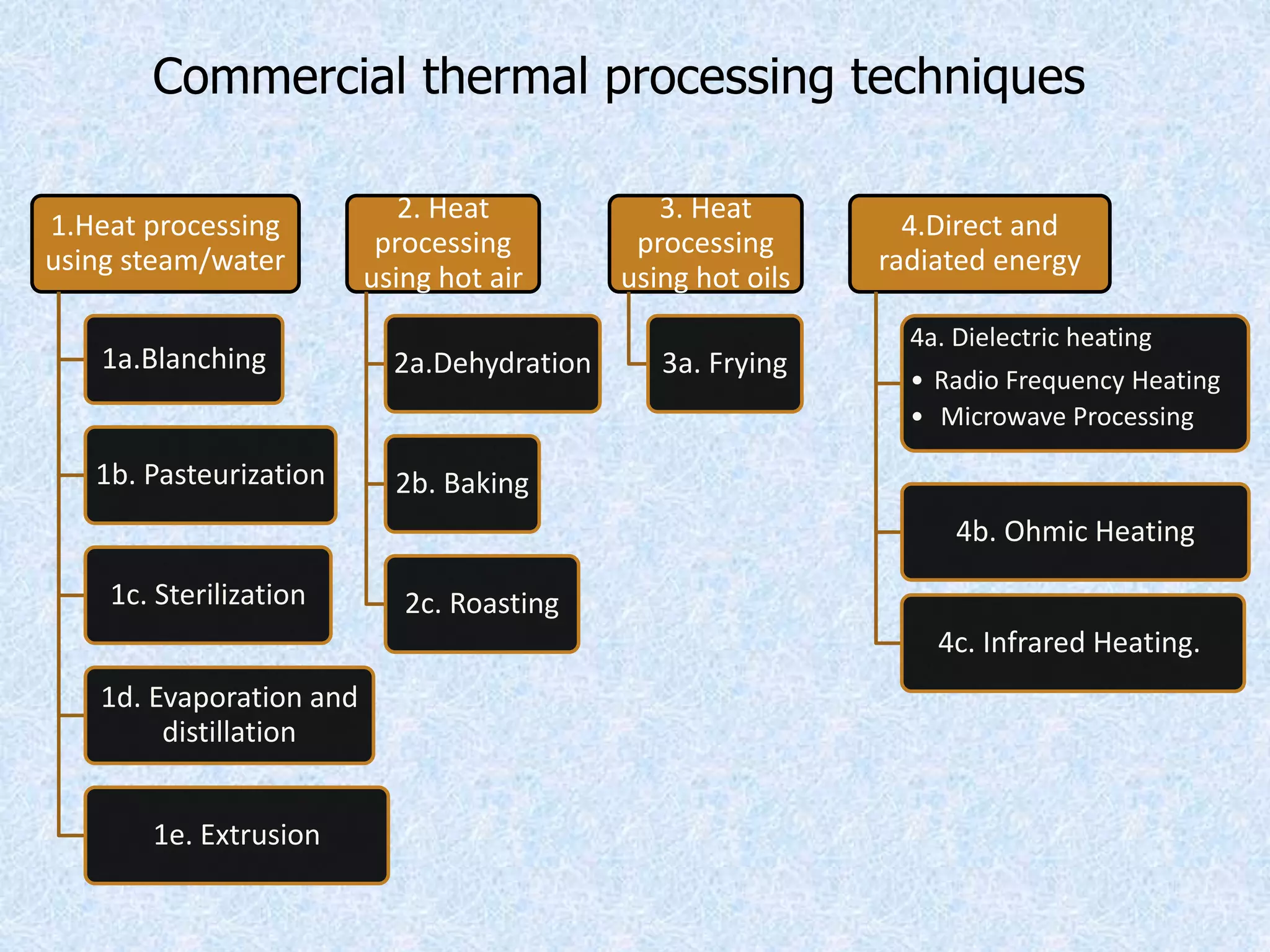
Commercial thermal processing techniques
1.Heat processing
using steam/water
1a.Blanching
1b. Pasteurization
1c. Sterilization
1d. Evaporation and
distillation
1e. Extrusion
2. Heat
processing
using hot air
2a.Dehydration
2b. Baking
2c. Roasting
3. Heat
processing
using hot oils
3a. Frying
4.Direct and
radiated energy
4a. Dielectric heating
• Radio Frequency Heating
• Microwave Processing
4b. Ohmic Heating
4c. Infrared Heating.
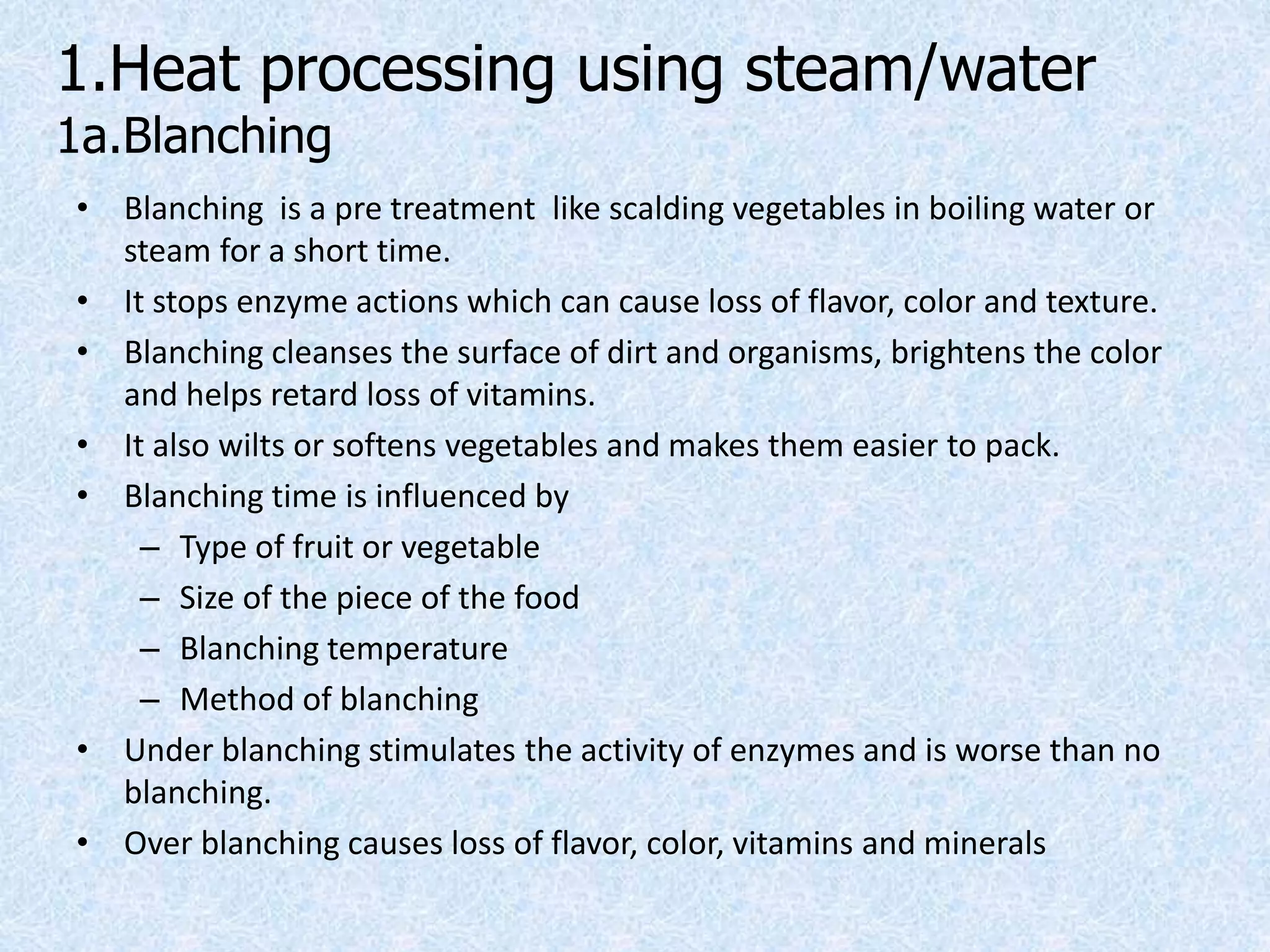
1.Heat processing using steam/water
1a.Blanching
• Blanching is a pre treatment like scalding vegetables in boiling water or
steam for a short time.
• It stops enzyme actions which can cause loss of flavor, color and texture.
• Blanching cleanses the surface of dirt and organisms, brightens the color
and helps retard loss of vitamins.
• It also wilts or softens vegetables and makes them easier to pack.
• Blanching time is influenced by
– Type of fruit or vegetable
– Size of the piece of the food
– Blanching temperature
– Method of blanching
• Under blanching stimulates the activity of enzymes and is worse than no
blanching.
• Over blanching causes loss of flavor, color, vitamins and minerals
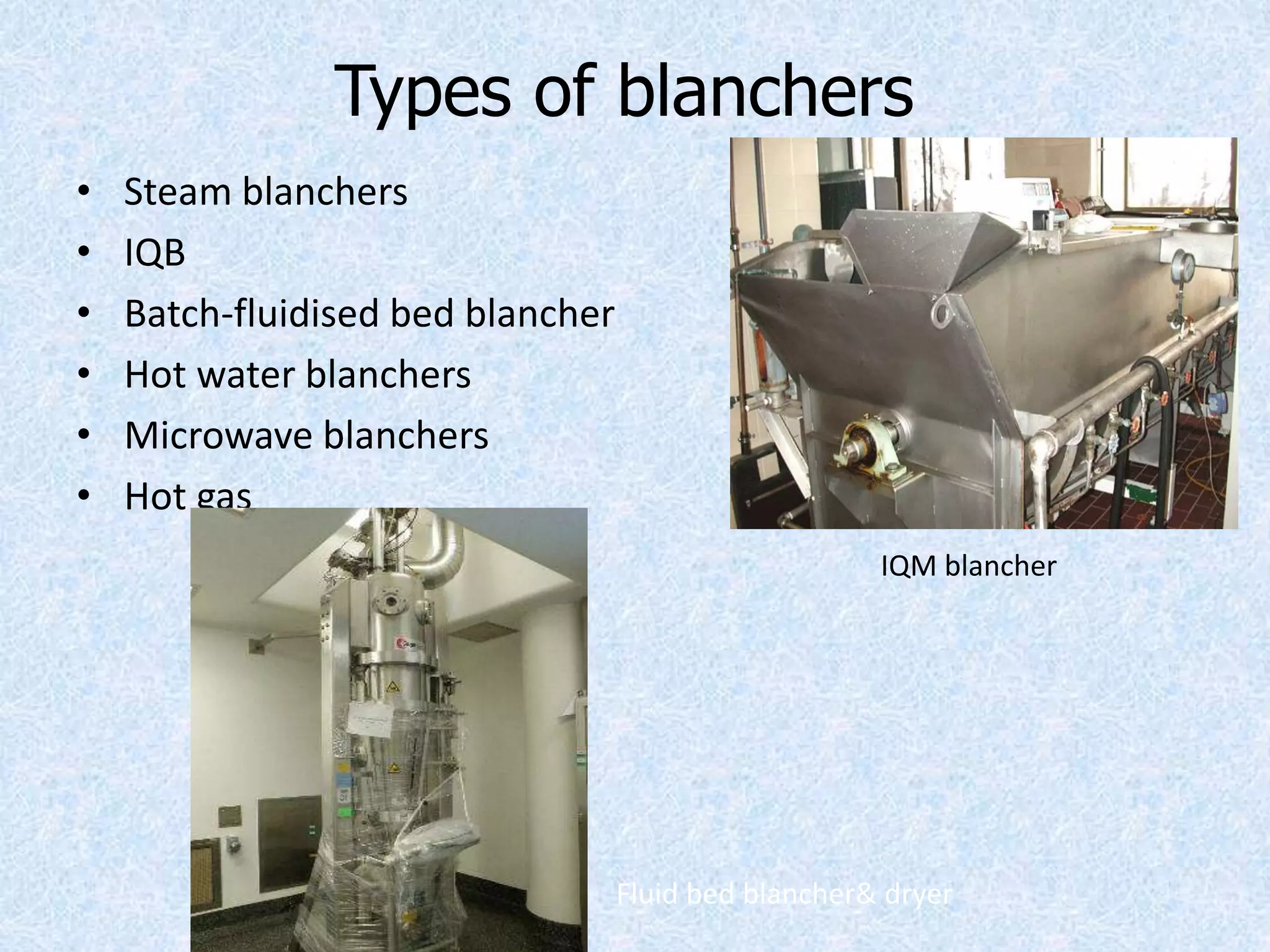
Types of blanchers
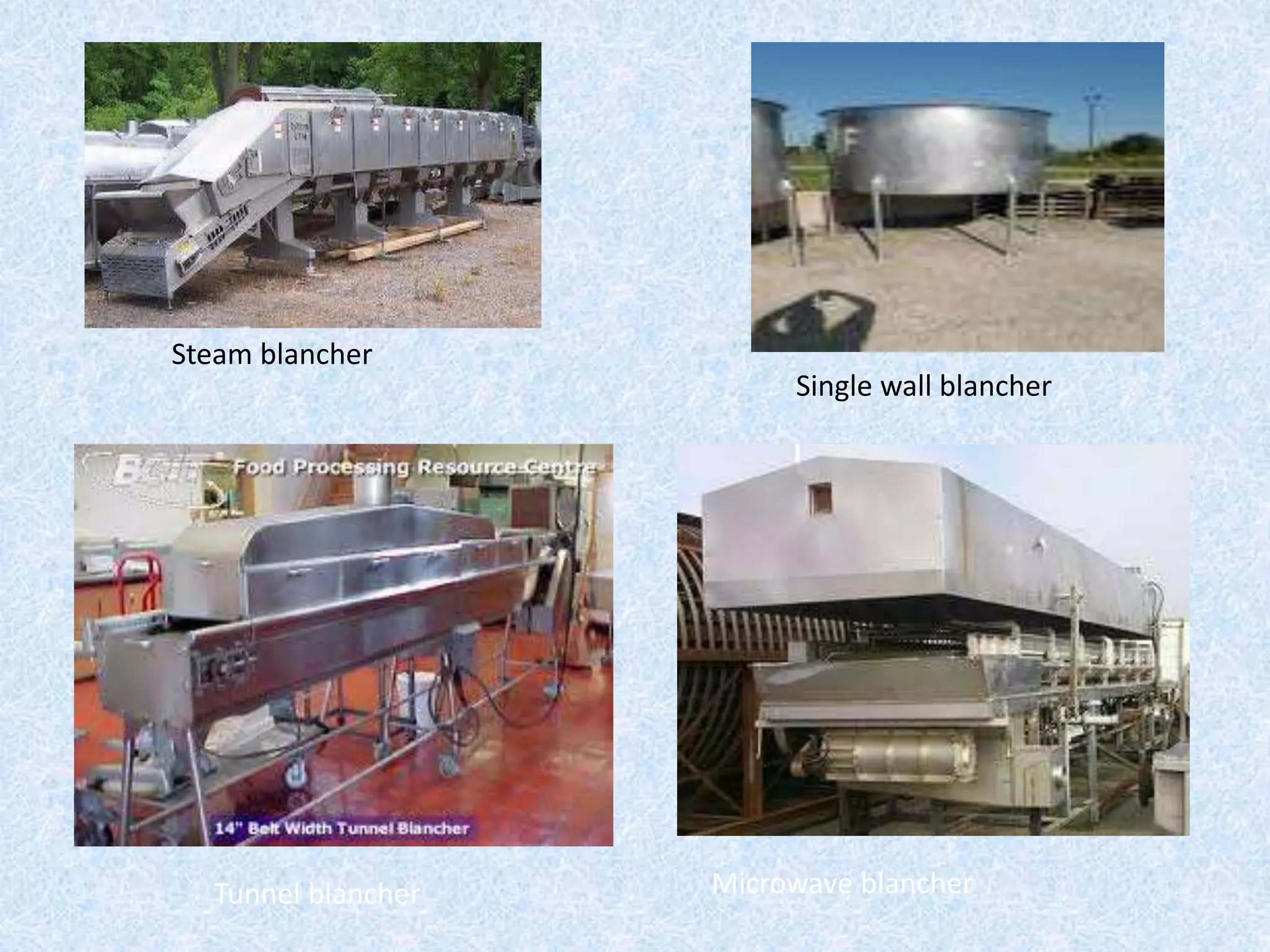
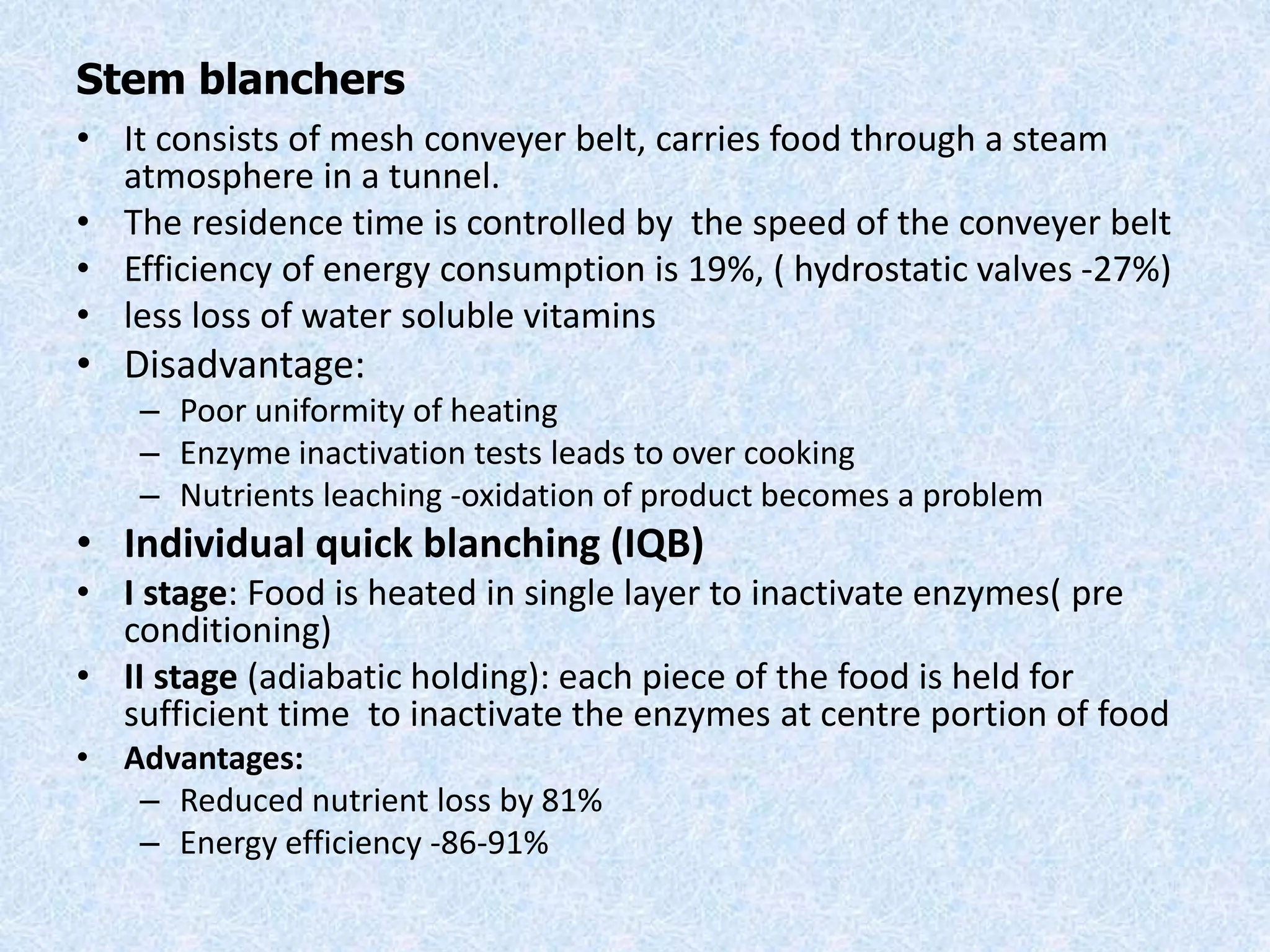
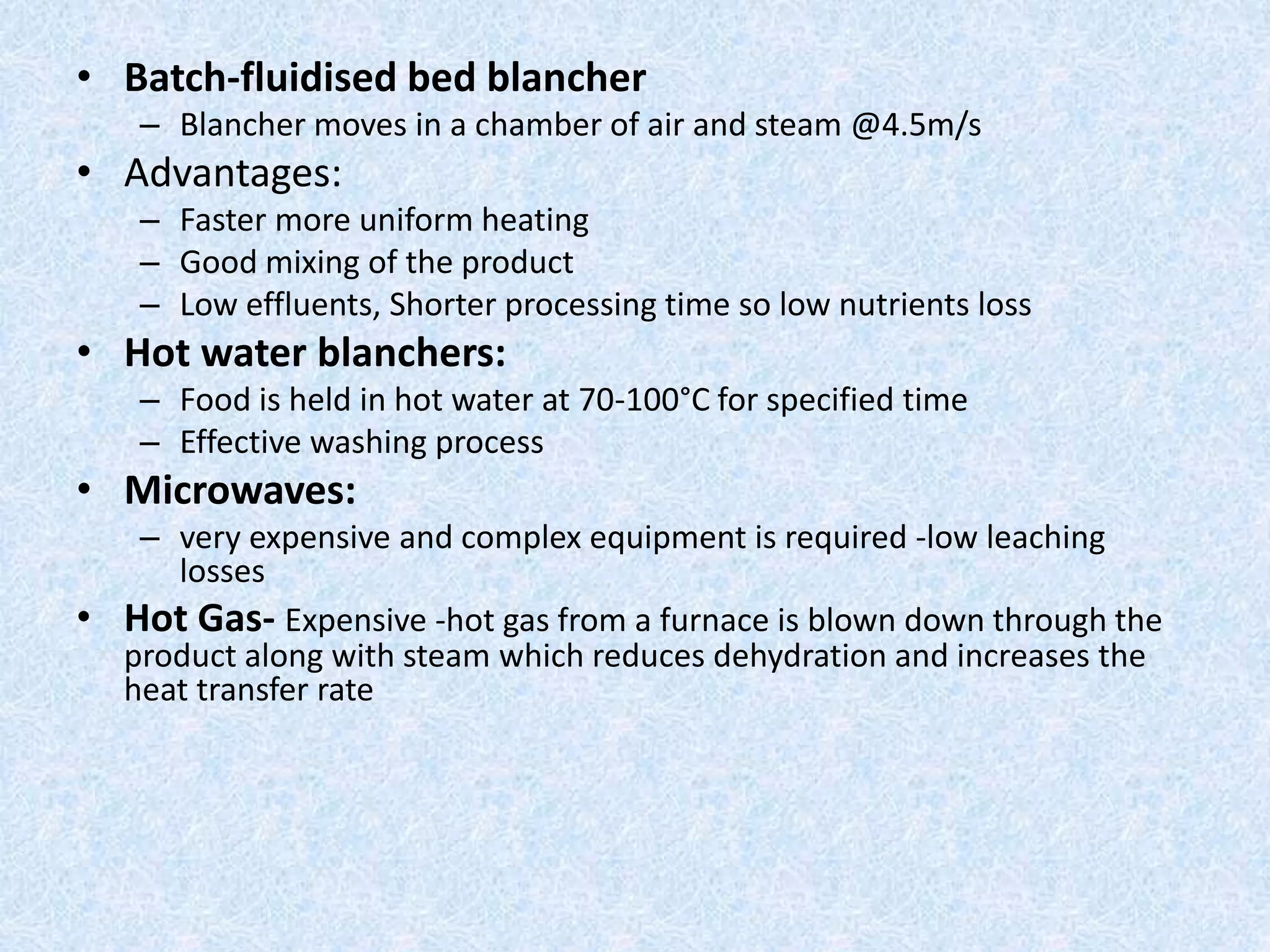
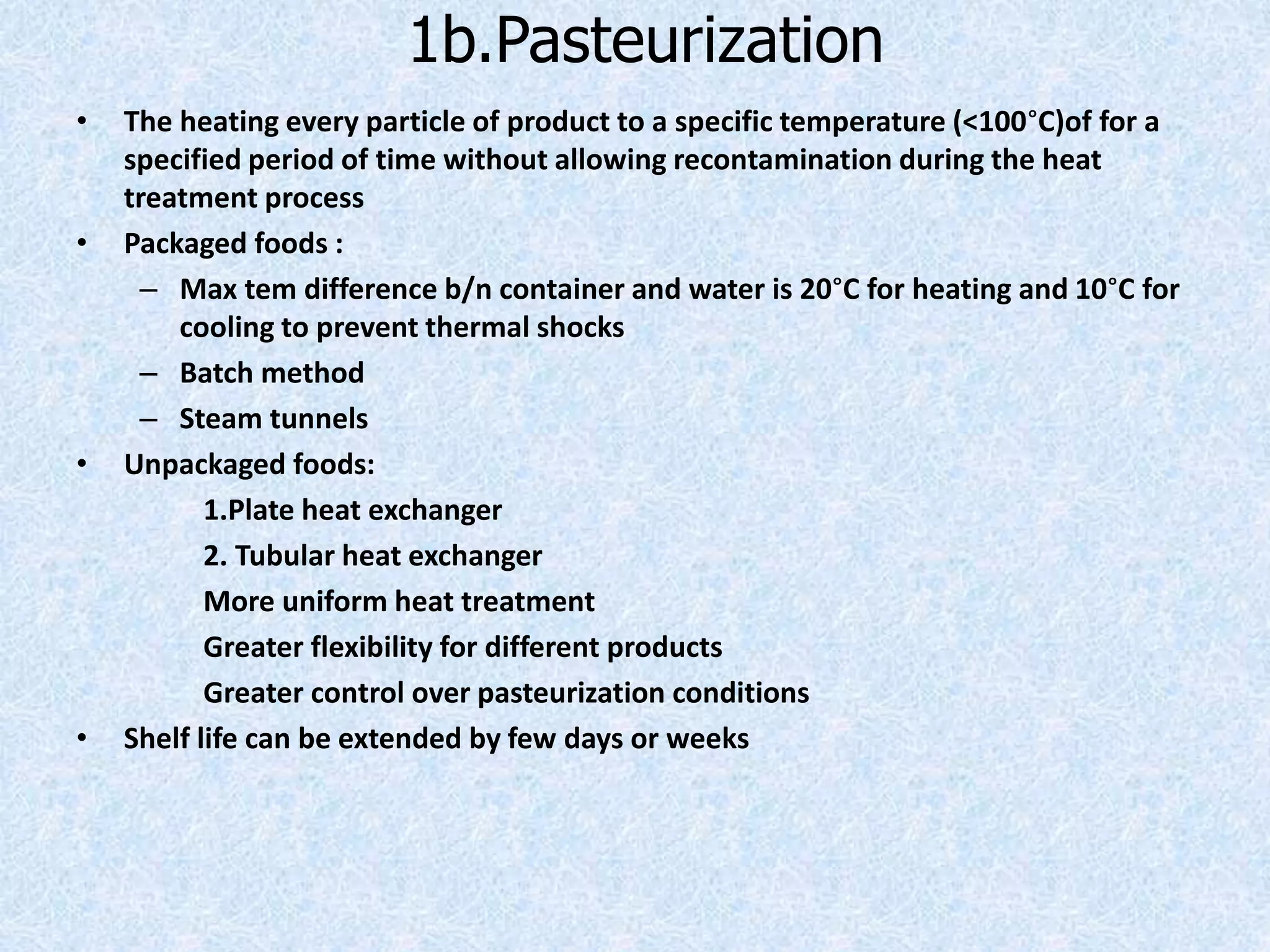
• Steam blanchers
• IQB
• Batch-fluidised bed blancher
• Hot water blanchers
• Microwave blanchers
• Hot gas
IQM blancher
Microwave blancher Fluid bed blancher& dryer
Tunnel blancher
Steam blancher
Single wall blancher
Microwave blancher
Stem blanchers
• It consists of mesh conveyer belt, carries food through a steam
atmosphere in a tunnel.
• The residence time is controlled by the speed of the conveyer belt
• Efficiency of energy consumption is 19%, ( hydrostatic valves -27%)
• less loss of water soluble vitamins
• Disadvantage:
– Poor uniformity of heating
– Enzyme inactivation tests leads to over cooking
– Nutrients leaching -oxidation of product becomes a problem
• Individual quick blanching (IQB)
• I stage: Food is heated in single layer to inactivate enzymes( pre
conditioning)
• II stage (adiabatic holding): each piece of the food is held for
sufficient time to inactivate the enzymes at centre portion of food
• Advantages:
– Reduced nutrient loss by 81%
– Energy efficiency -86-91%
• Batch-fluidised bed blancher
– Blancher moves in a chamber of air and steam @4.5m/s
• Advantages:
– Faster more uniform heating
– Good mixing of the product
– Low effluents, Shorter processing time so low nutrients loss
• Hot water blanchers:
– Food is held in hot water at 70-100°C for specified time
– Effective washing process
• Microwaves:
– very expensive and complex equipment is required -low leaching
losses
• Hot Gas- Expensive -hot gas from a furnace is blown down through the
product along with steam which reduces dehydration and increases the
heat transfer rate
1b.Pasteurization
• The heating every particle of product to a specific temperature (<100°C)of for a
specified period of time without allowing recontamination during the heat
treatment process
• Packaged foods :
– Max tem difference b/n container and water is 20°C for heating and 10°C for
cooling to prevent thermal shocks
– Batch method
– Steam tunnels
• Unpackaged foods:
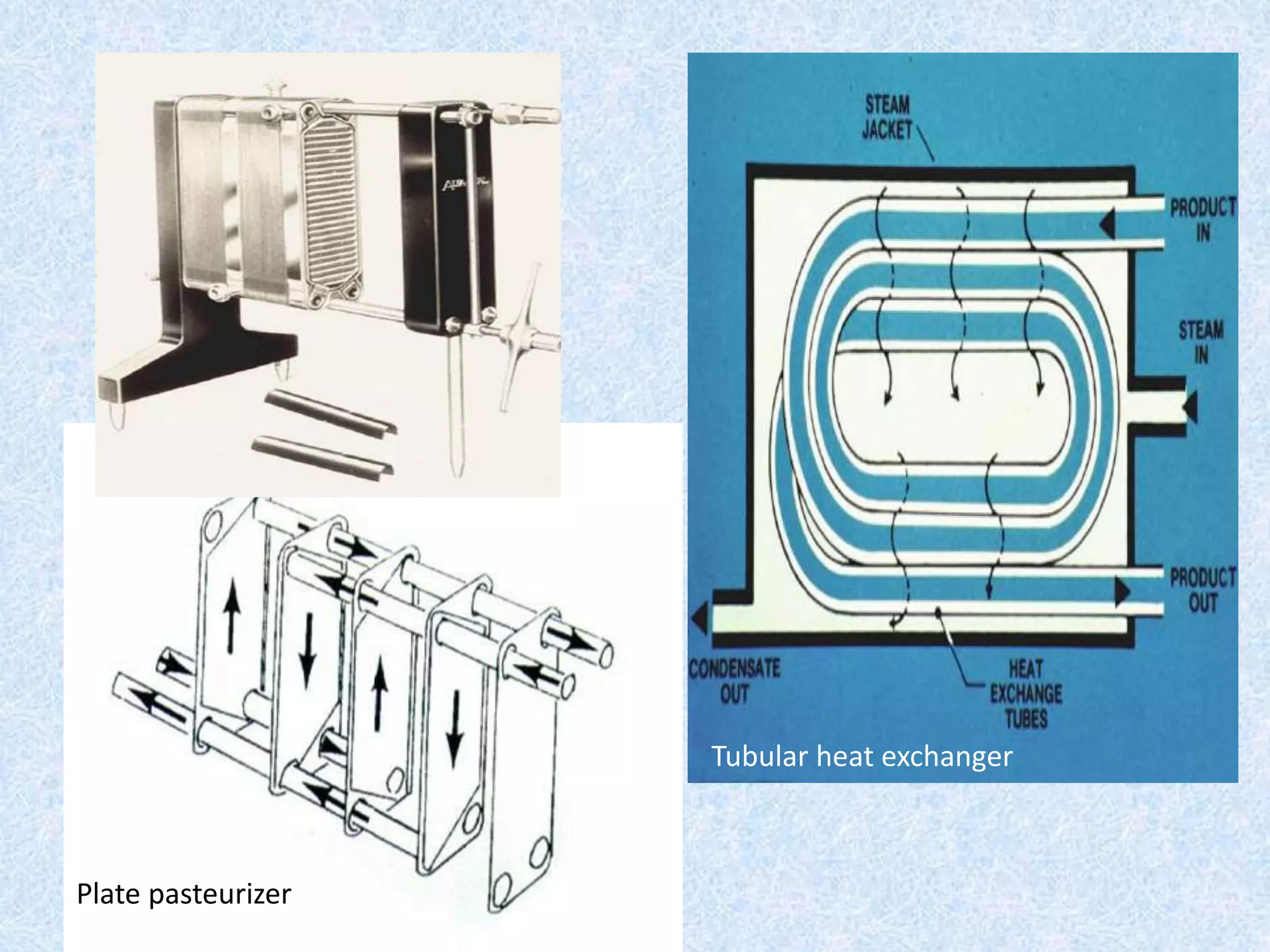
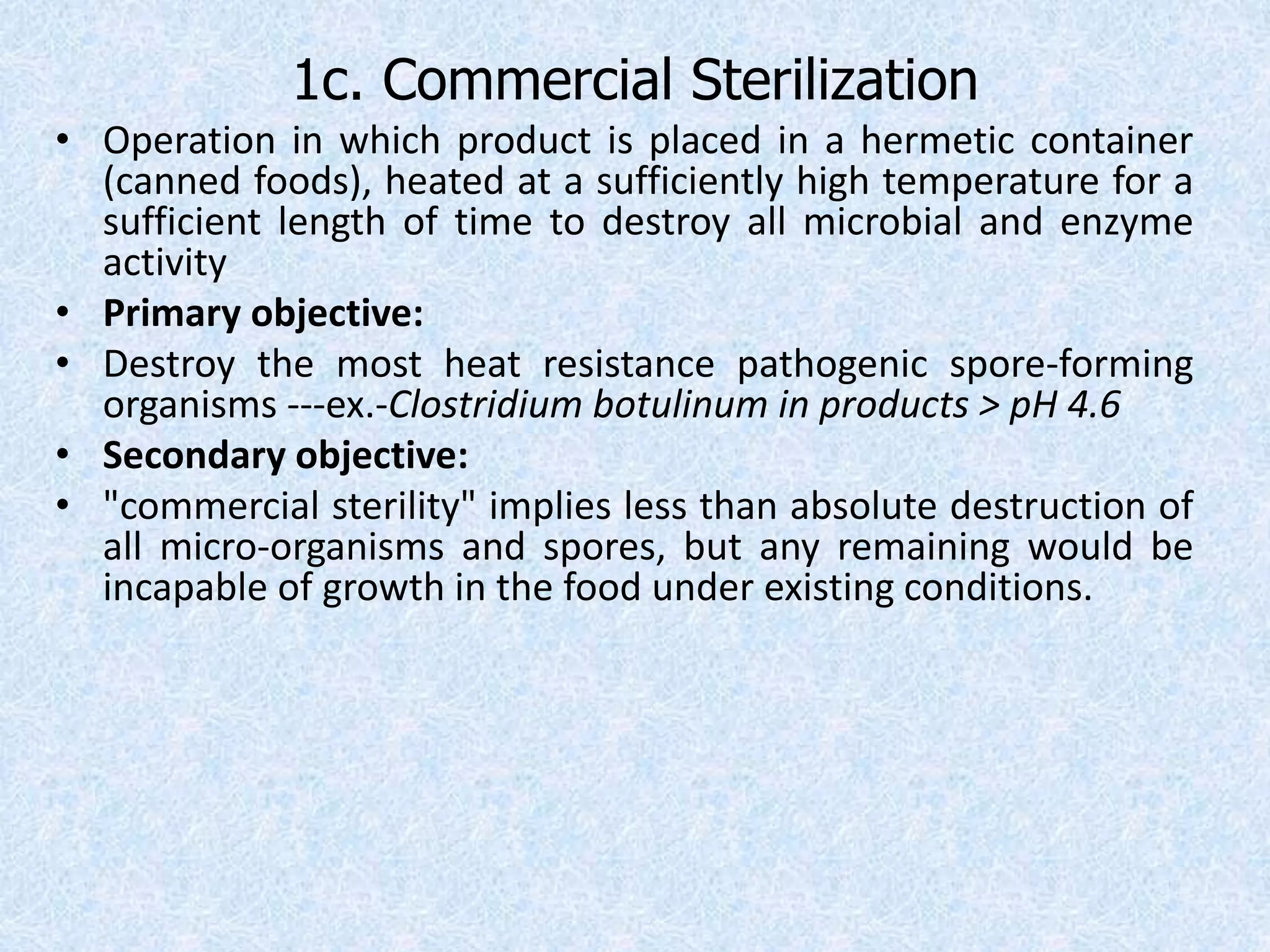
1.Plate heat exchanger
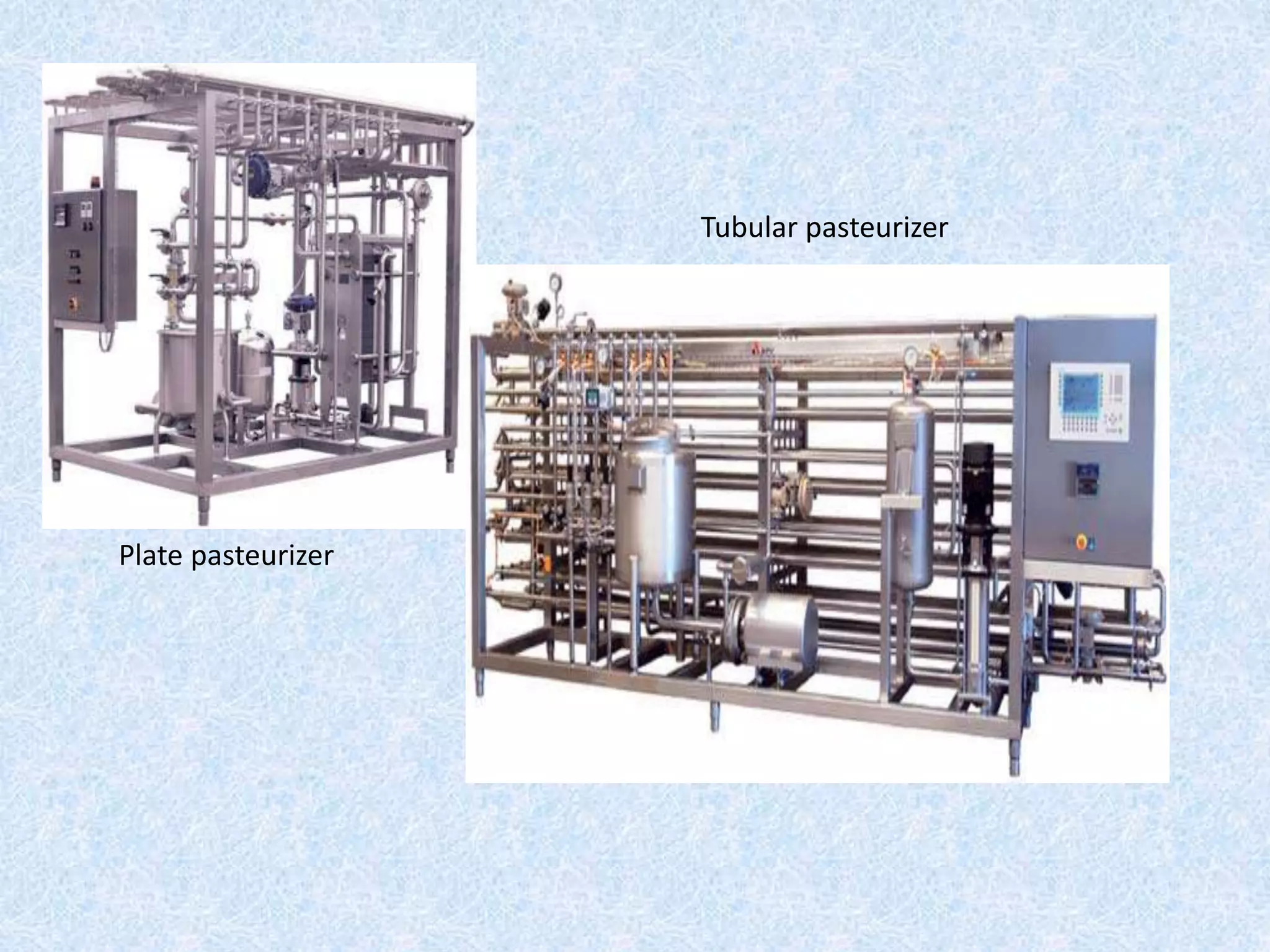
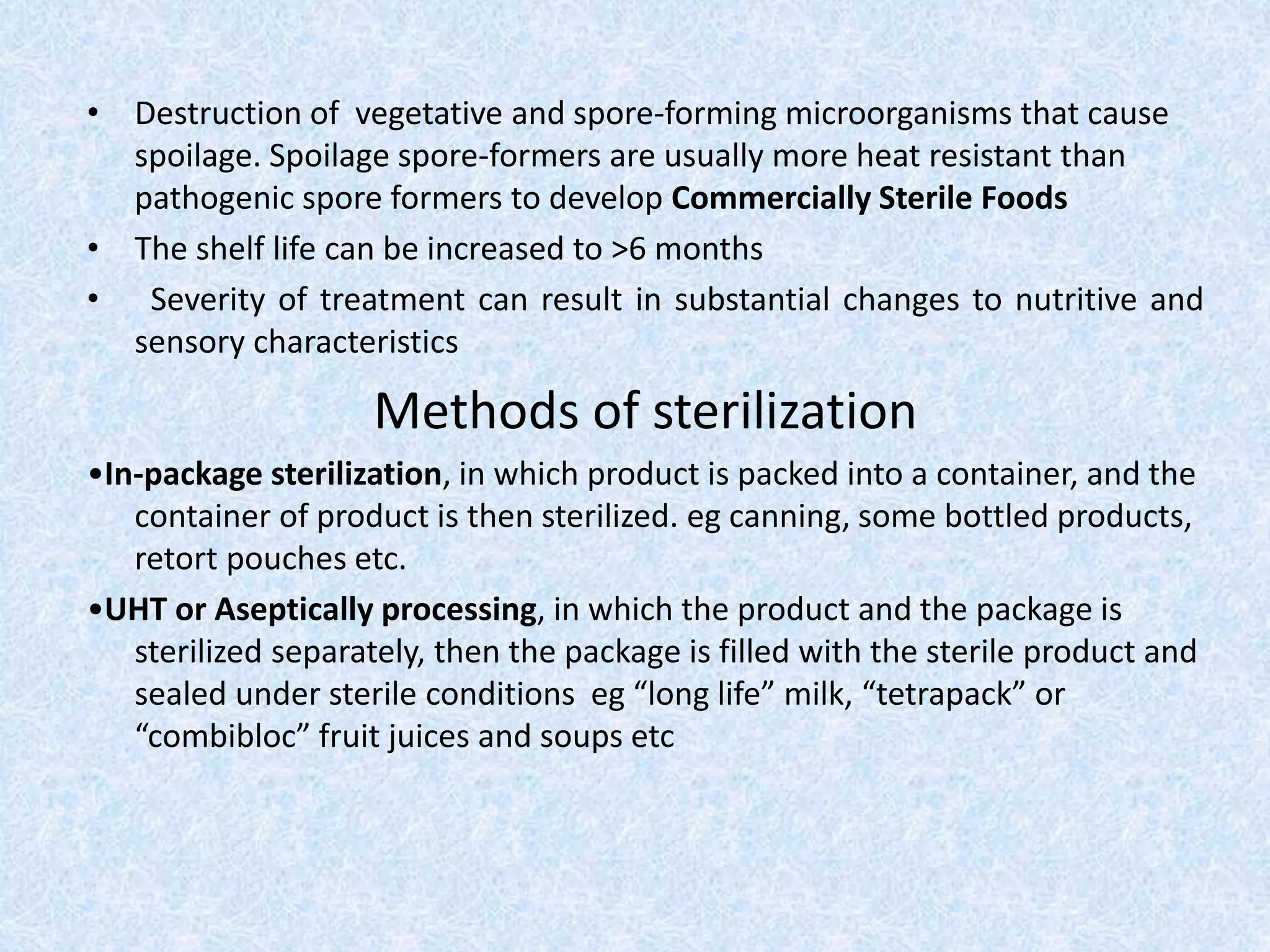
2. Tubular heat exchanger
More uniform heat treatment
Greater flexibility for different products
Greater control over pasteurization conditions
• Shelf life can be extended by few days or weeks
Plate pasteurizer
Tubular heat exchanger
Plate pasteurizer
Tubular pasteurizer
1c. Commercial Sterilization
• Operation in which product is placed in a hermetic container
(canned foods), heated at a sufficiently high temperature for a
sufficient length of time to destroy all microbial and enzyme
activity
• Primary objective:
• Destroy the most heat resistance pathogenic spore-forming
organisms ---ex.-Clostridium botulinum in products > pH 4.6
• Secondary objective:
• "commercial sterility" implies less than absolute destruction of
all micro-organisms and spores, but any remaining would be
incapable of growth in the food under existing conditions.
• Destruction of vegetative and spore-forming microorganisms that cause
spoilage. Spoilage spore-formers are usually more heat resistant than
pathogenic spore formers to develop Commercially Sterile Foods
• The shelf life can be increased to >6 months
• Severity of treatment can result in substantial changes to nutritive and
sensory characteristics
Methods of sterilization
•In-package sterilization, in which product is packed into a container, and the
container of product is then sterilized. eg canning, some bottled products,
retort pouches etc.
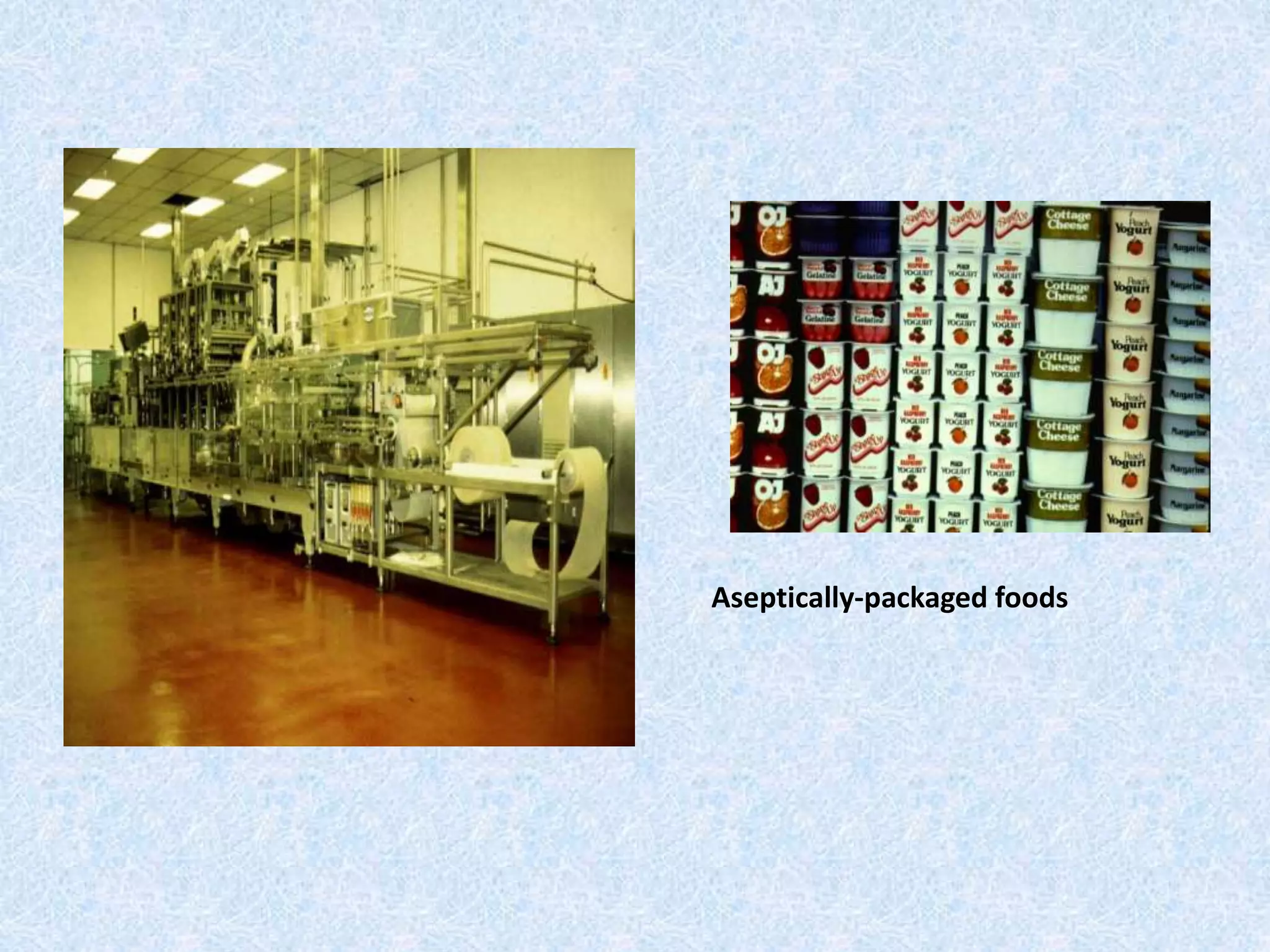
•UHT or Aseptically processing, in which the product and the package is
sterilized separately, then the package is filled with the sterile product and
sealed under sterile conditions eg “long life” milk, “tetrapack” or
“combibloc” fruit juices and soups etc
Length of time for sterilization depends on
•Heat resistance of m.o.
•pH and composition of food
•Size of the container
•Physical state of food material
• Sensory/quality of product
• Rate of heat penetration
• Type of processor/retort
High vs. Low Acid Foods
• Foods can be classified on the basis of pH
– > pH 4.6 are low acid, foods< pH 4.6 are acid foods
– If the Aw of food is <0.85, it can be classified as acid at
ph>4.6.
– Processing times and temperatures are lower for acid
foods because…. -microorganisms are more easily
destroyed in an acid environment -C. botulinum spores
cannot germinate below pH 4.6.
Rate of heat penetration
•Type of product
•Agitation of container
•Retort temperature
•Size of container
•Shape of container
•Type of container
Retorting(Heat processing)
•Product processed in the
package
– Can
– Flexible pouch
– Glass
– Rigid trays
• The usual heat transfer
fluids are:
–saturated steam
–water
–steam -air mixture
•Processing time depends on
heating the most slowly
heating part of the product.
•Retorts (Pressure processors)
Still
–Vertical
–Horizontal
–Agitating
–Batch
–Continuous
Rotary
Hydrostatic cooker (pressure
provided by a 40 –50 feet of
head pressure)
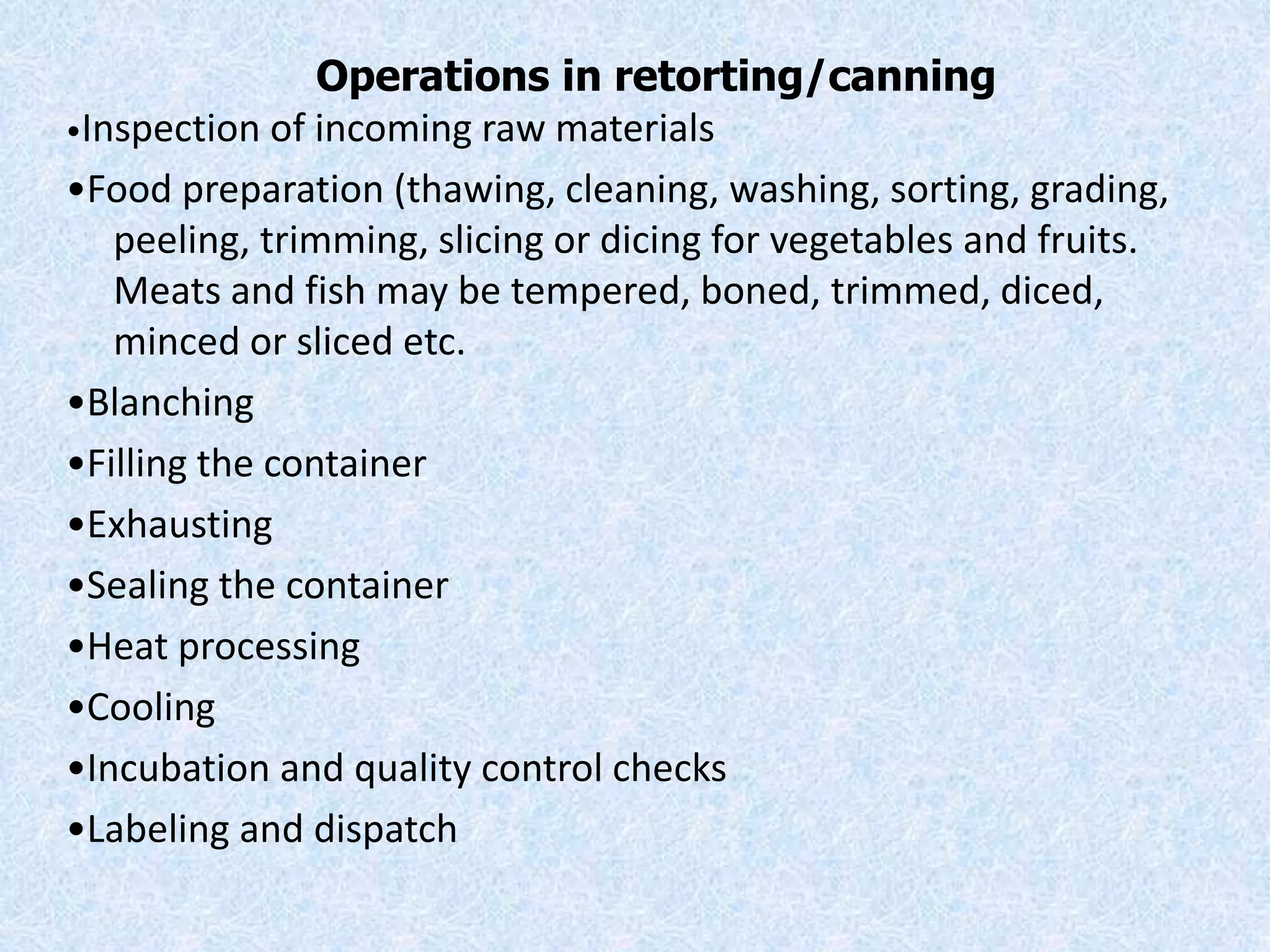
Operations in retorting/canning
•Inspection of incoming raw materials
•Food preparation (thawing, cleaning, washing, sorting, grading,
peeling, trimming, slicing or dicing for vegetables and fruits.
Meats and fish may be tempered, boned, trimmed, diced,
minced or sliced etc.
•Blanching
•Filling the container
•Exhausting
•Sealing the container
•Heat processing
•Cooling
•Incubation and quality control checks
•Labeling and dispatch
Filling
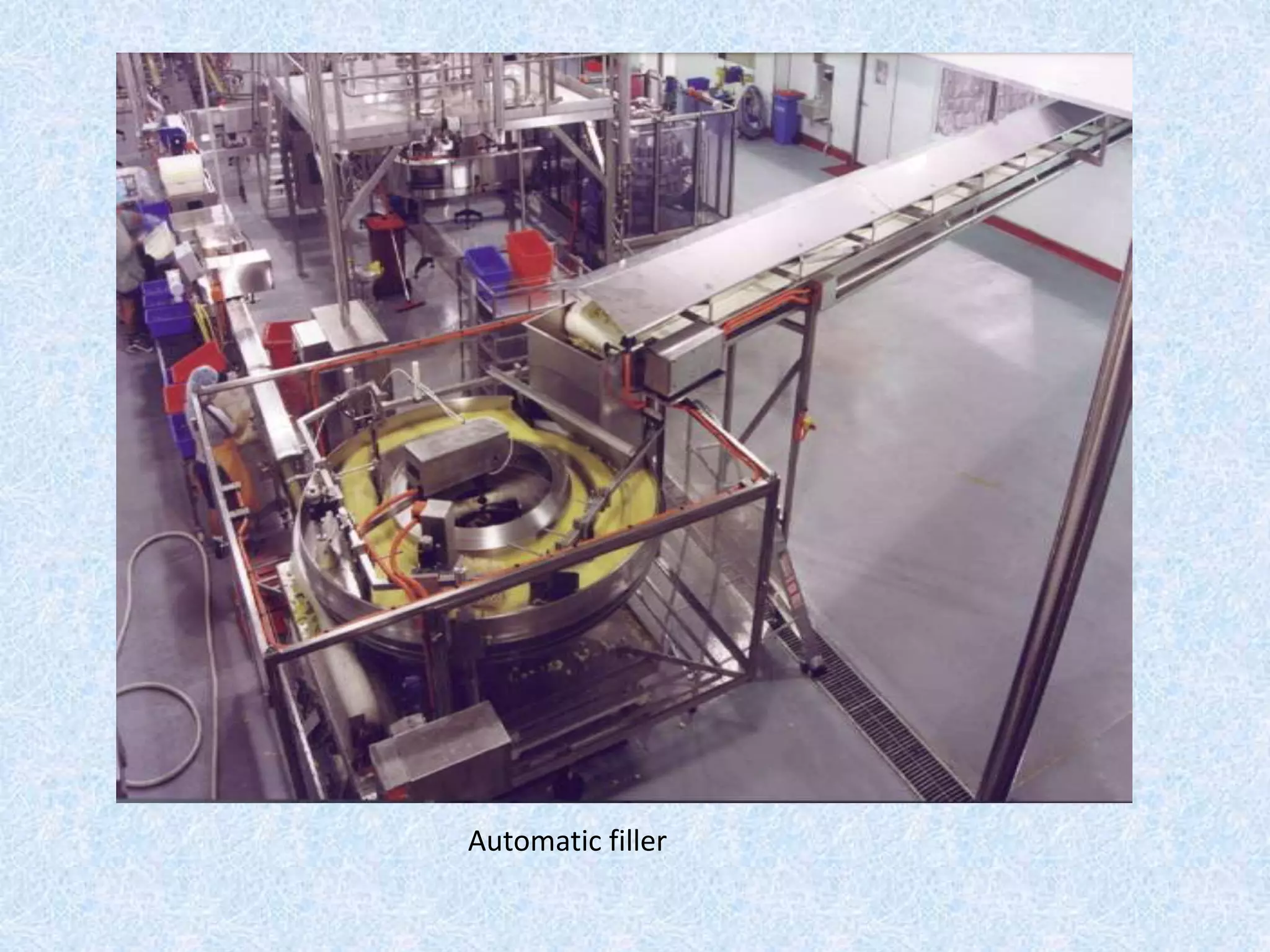
•At this stage the food is placed into the container.
• Under filling gives a large headspace.
Large headspaces result in
–Low vacuum if heat exhaust is used.
–Mushiness of the contents due to excessive movement inside the can.
–Contravening the Pure Food Act Regulations due to under filling.
•Overfilling produces excessively small headspaces, resulting in
–Low vacuum if steam flow closure is relied on for vacuum.
–Swelling of can due to hydrogen production.
–Under processing if the process depends on agitation to mix the contents during
processing.
–Springiness or distortion of can.
–Increased chance that food may be trapped between the can lid and body with
the production of a faulty seam.
•The cans are periodically weighed on line, headspaces, drained and net
weights are determined on the finished products in order to check the
adequacy of the filling process.
Automatic filler
Exhausting
•Exhausting aims to remove air from the package before closure.
Correct exhausting will:
–Remove all gases from the headspace which will minimise
strains on seams during retorting.
–Remove oxygen, otherwise corrosion, oxidation and dis
colouration will result.
–Forms vacuum on cooling to give space for the gases which
are formed on storage.
•There are three exhausting methods available:
•HEAT EXHAUST
•STEAM INJECTION
•MECHANICAL EXHAUST
Exhausting
•HEAT EXHAUST
•Contents are heated before sealing.
•This is ideal for products containing lots of trapped air.
•Final temperature depends on closing temperature and headspace.
•STEAM INJECTION
•Also referred to as STEAM FLOW CLOSURE
•This flushes the headspace out with a jet of steam just before closing.
•This method is more effective where products are packed in hot brines and
syrups where ever a large headspace exists.
•MECHANICAL EXHAUST
•Uses a vacuum pump to remove air from the package.
•Food is filled at low temperatures.
•This method is useful for foods which trap a great deal of air.
•A vacuum gauge is used on a cooled can to determine the vacuum of a can.
•The minimum acceptable pressure is about -23kPa.
•Desirable vacuum will vary for different products
Retort Operation
• -Containers are loaded into baskets.
• -The retort lid is sealed.
Venting stage -Air trapped inside the retort is removed prior processing.
• If air is present at a given pressure the temperature inside the retort will
be lower than that attained by steam alone.
• A mixture of air and steam may stratify leading to cool spots where there is
air.
• This mixture is a less efficient heat transfer medium than steam alone.
• Air in the retort cuts down the heat penetration of steam by insulating the
cans and can accelerate external corrosion.
When venting is completed the venting valve closes
• Pressure begins to build up in the retort.
• When process temperature is reached the thermometer and pressure gauge
readings must agree.
• High acid foods (pH <4.5) are usually processed at low pressures of 34kpa.
• Low acid foods (pH > 4.5) are processed at 73 or 103kpa.
RETORT OPERATION
•The time from when the steam is turned on to when the process temperature is
reached is the come-up time. Once this has finished the process begins.
•Process time is from the end of the come-up time to the commencement of cooling.
•During cooling the steam is turned off and water is added to the retort immediately to
prevent overcooking.
Methods of cooling:
• For small cans at temperatures <116°C atmospheric cooling may be used.
• For cans with a diameter greater than 6cm or processed at temperatures >116°C
pressure cooling is used.
In pressure cooling the pressure around the containers is maintained by
– compressed air during the addition of water.
– The water addition causes the steam to condense and the pressure outside the
package drops suddenly.
– As the internal pressure inside the container does not drop seam distortion may
occur if the external pressure is not kept high.
– At this stage can seams are very fragile and cans must be handled very carefully.
– All water used for cooling heat processed foods must be chlorinated to disinfect
it in case water is sucked into the can during cooling.
Loading a vertical
retort
Typical thermal processing unit
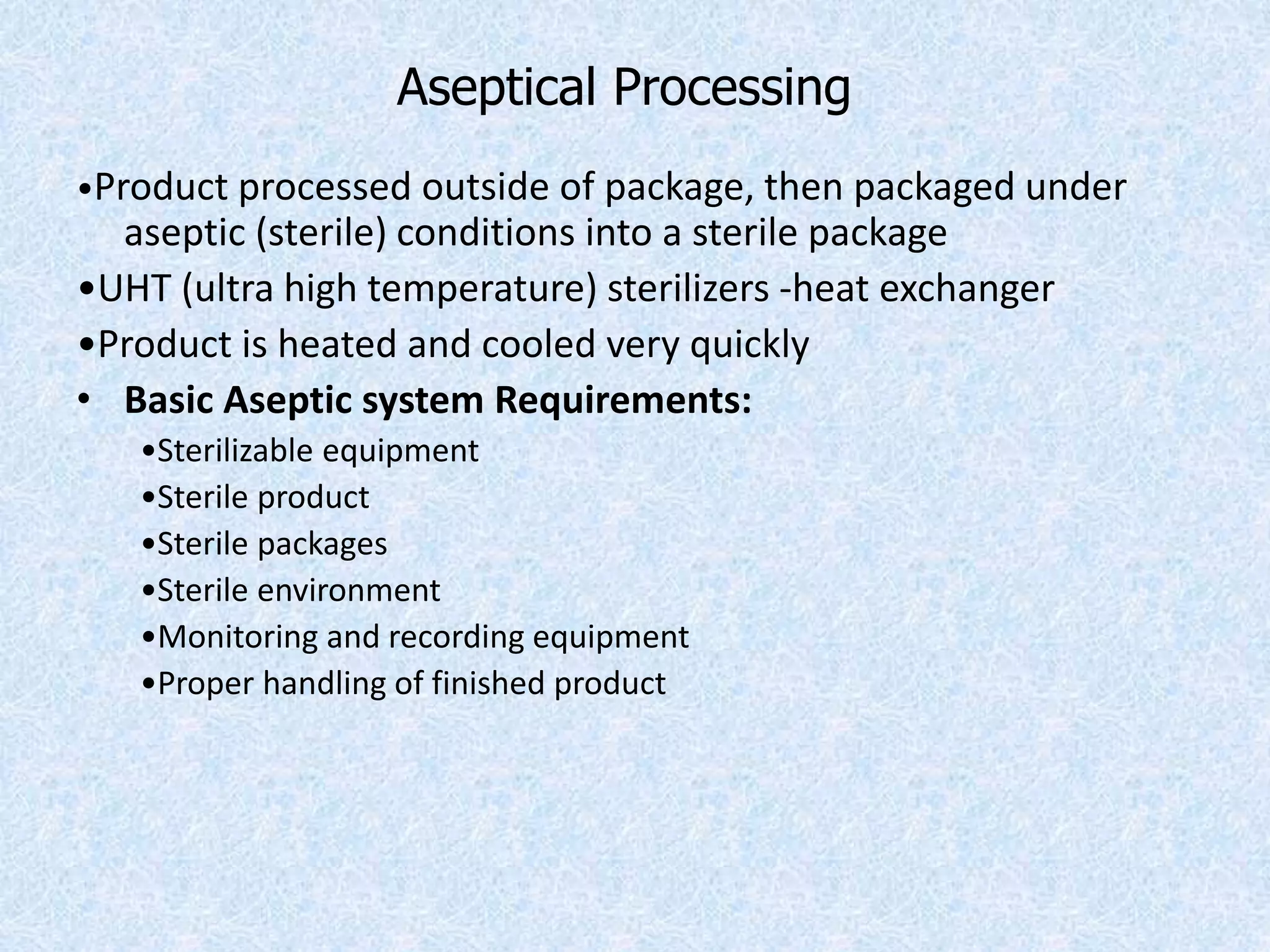
Aseptical Processing
•Product processed outside of package, then packaged under
aseptic (sterile) conditions into a sterile package
•UHT (ultra high temperature) sterilizers -heat exchanger
•Product is heated and cooled very quickly
• Basic Aseptic system Requirements:
•Sterilizable equipment
•Sterile product
•Sterile packages
•Sterile environment
•Monitoring and recording equipment
•Proper handling of finished product
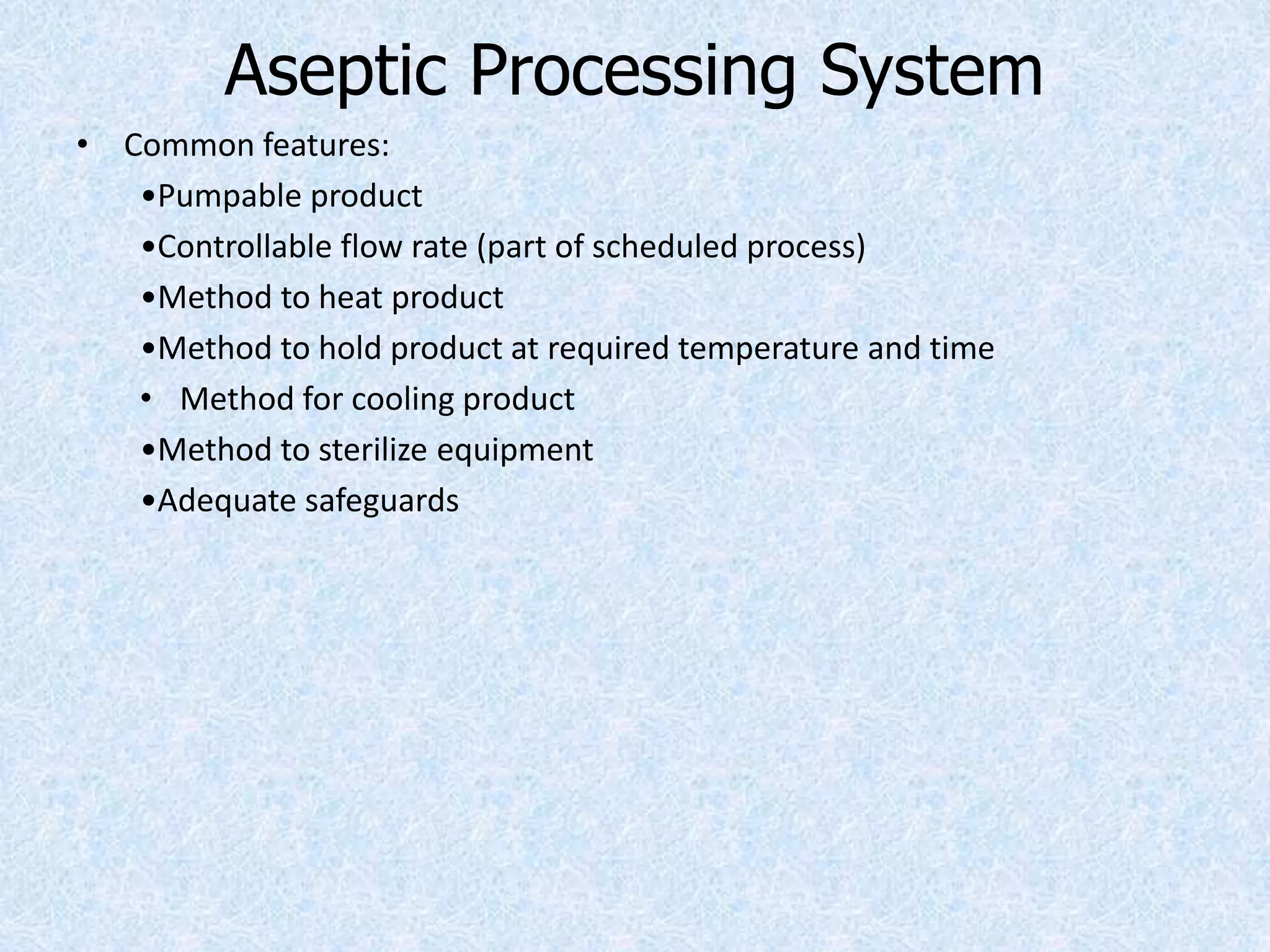
Aseptic Processing System
• Common features:
•Pumpable product
•Controllable flow rate (part of scheduled process)
•Method to heat product
•Method to hold product at required temperature and time
• Method for cooling product
•Method to sterilize equipment
•Adequate safeguards
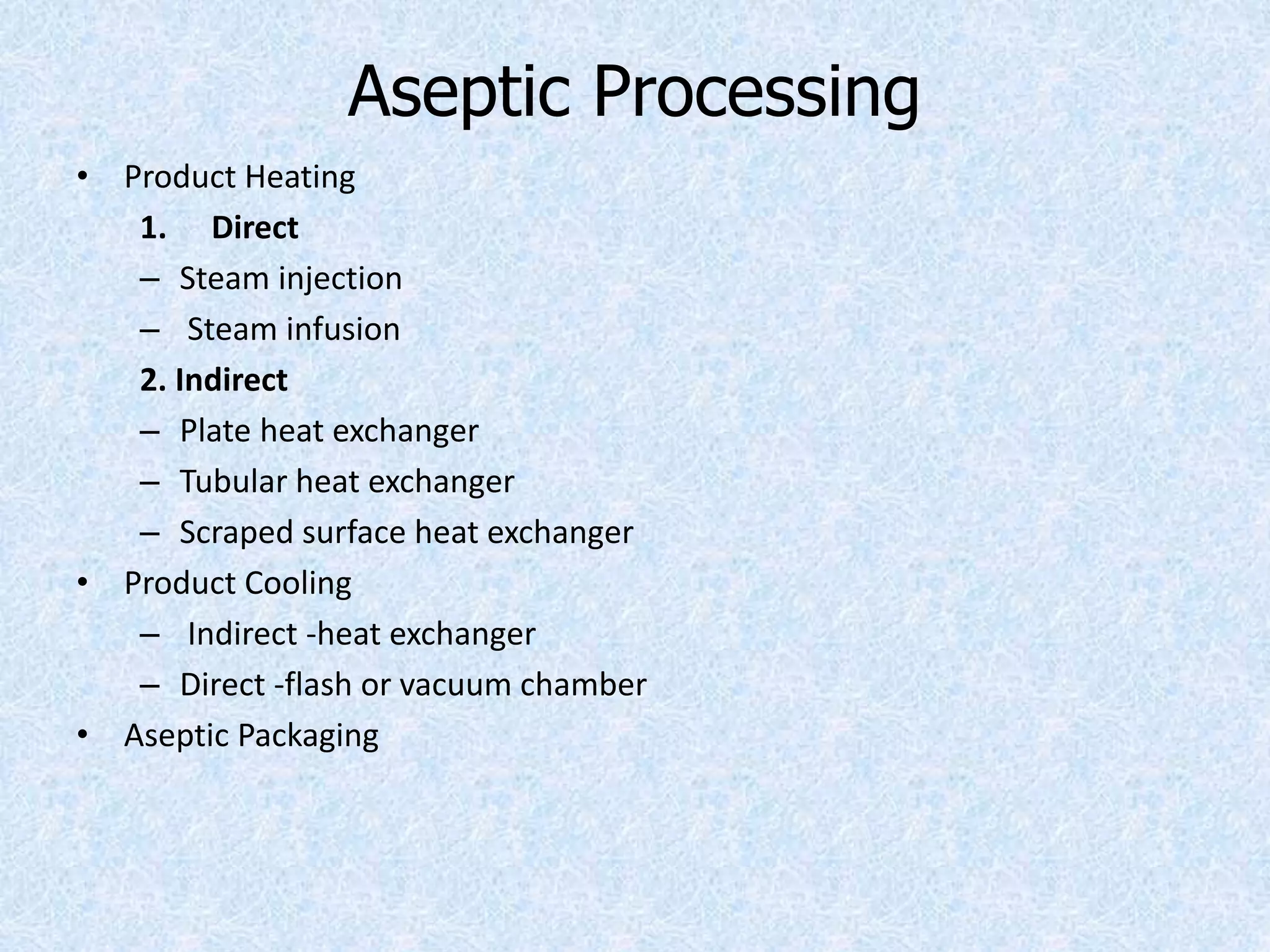
Aseptic Processing
• Product Heating
1. Direct
– Steam injection
– Steam infusion
2. Indirect
– Plate heat exchanger
– Tubular heat exchanger
– Scraped surface heat exchanger
• Product Cooling
– Indirect -heat exchanger
– Direct -flash or vacuum chamber
• Aseptic Packaging
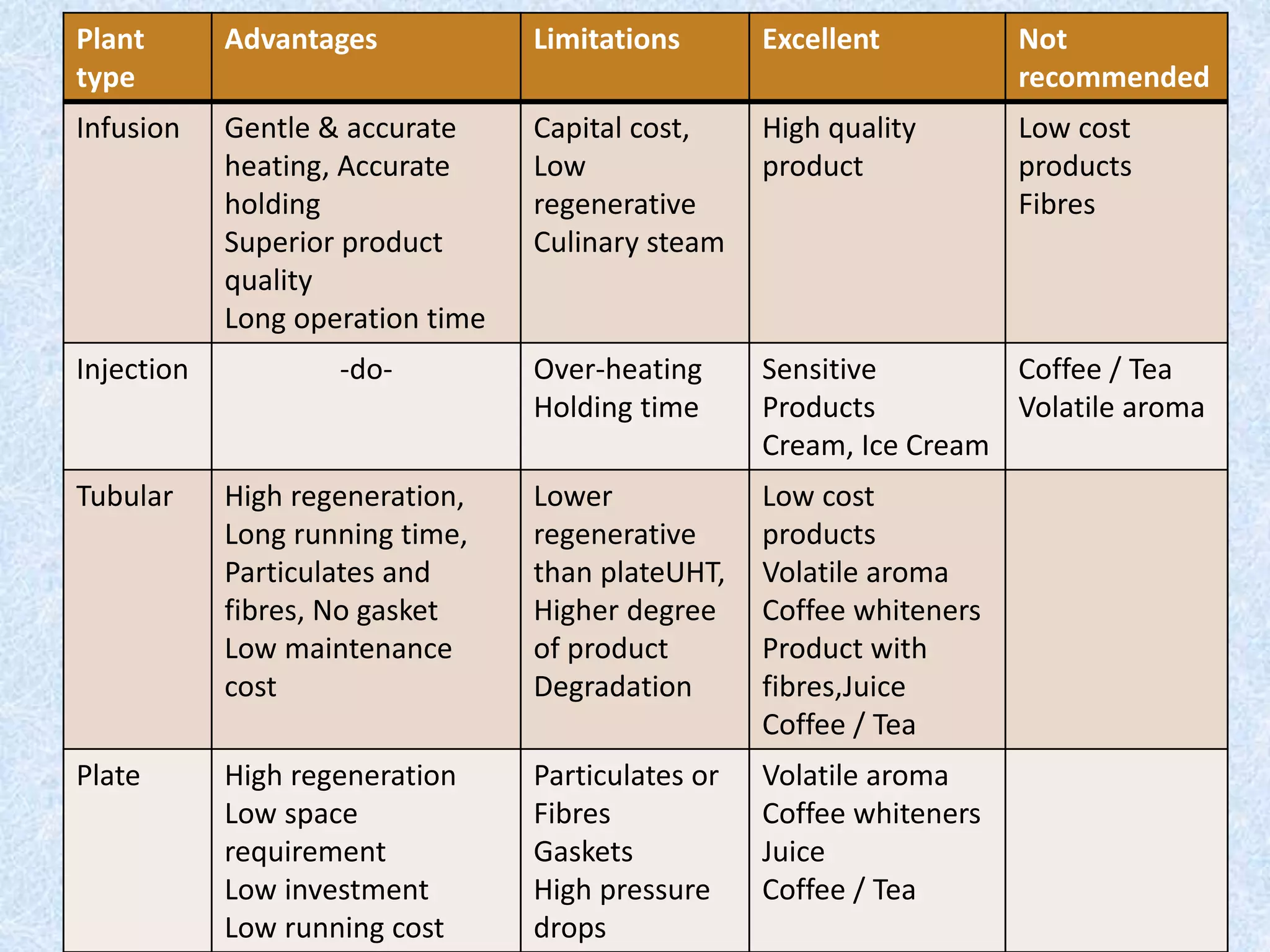
Plant
type
Advantages Limitations Excellent Not
recommended
Infusion Gentle & accurate
heating, Accurate
holding
Superior product
quality
Long operation time
Capital cost,
Low
regenerative
Culinary steam
High quality
product
Low cost
products
Fibres
Injection -do- Over-heating
Holding time
Sensitive
Products
Cream, Ice Cream
Coffee / Tea
Volatile aroma
Tubular High regeneration,
Long running time,
Particulates and
fibres, No gasket
Low maintenance
cost
Lower
regenerative
than plateUHT,
Higher degree
of product
Degradation
Low cost
products
Volatile aroma
Coffee whiteners
Product with
fibres,Juice
Coffee / Tea
Plate High regeneration
Low space
requirement
Low investment
Low running cost
Particulates or
Fibres
Gaskets
High pressure
drops
Volatile aroma
Coffee whiteners
Juice
Coffee / Tea
Aseptically-packaged foods
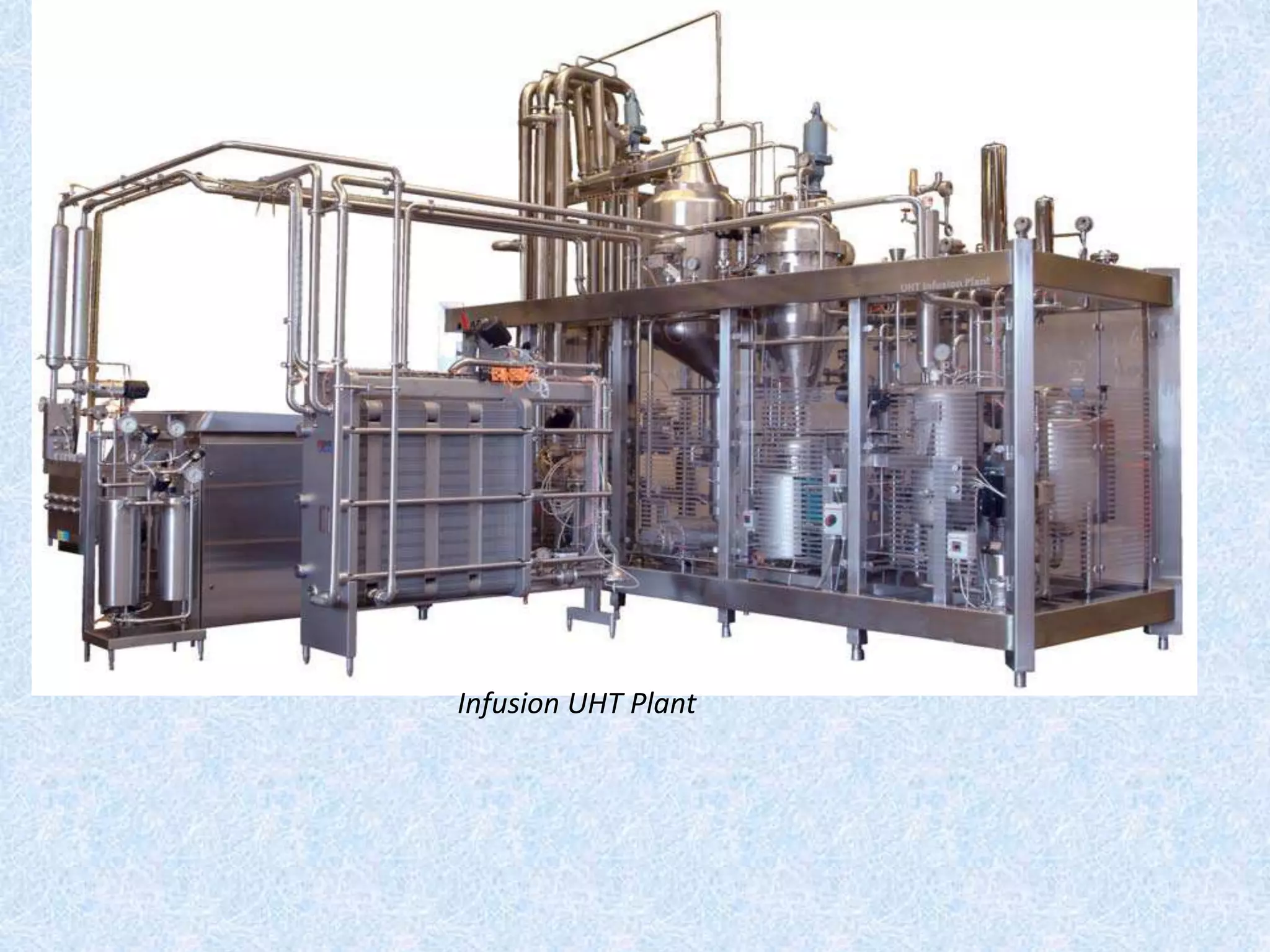
• Infusion UHT Plant
Infusion UHT Plant
1d.Evaporation/concentration
• Evaporator consists of
– Heat exchanger
– Means of separation of water produced
– Mechanical or steam ejector pump
• Types of evaporators
– Natural circulation evaporators
• Open/closed pan/kettle evaporator
• External calandria evaporator
• Short tube evaporator
• Long tube evaporator
– Forced circulation evaporators
• Plate evaporator
• Expanding flow evaporator
– Mechanical/agitated thin film evaporators
• Scraped or wiped surface evaporator
• RO system
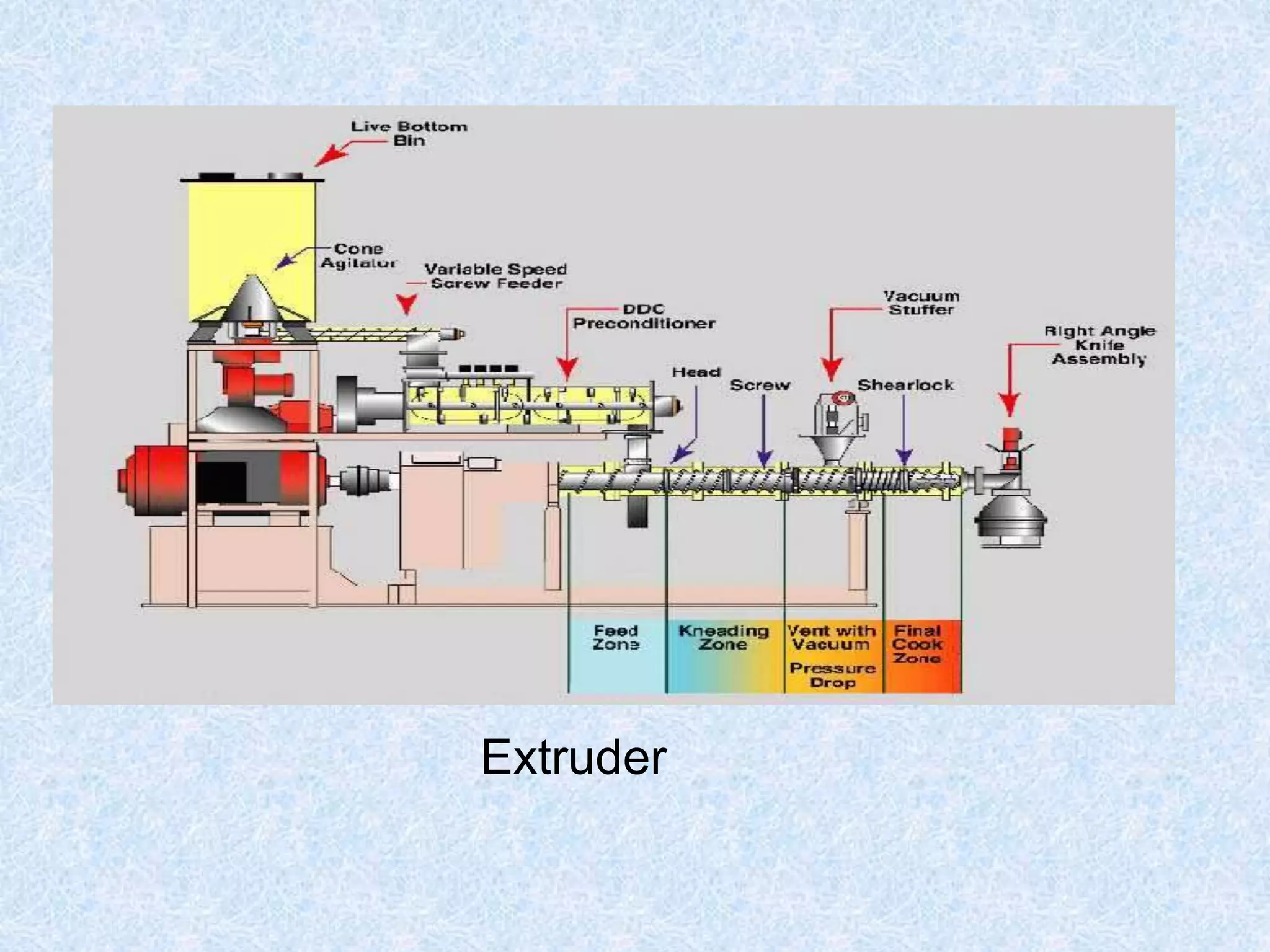
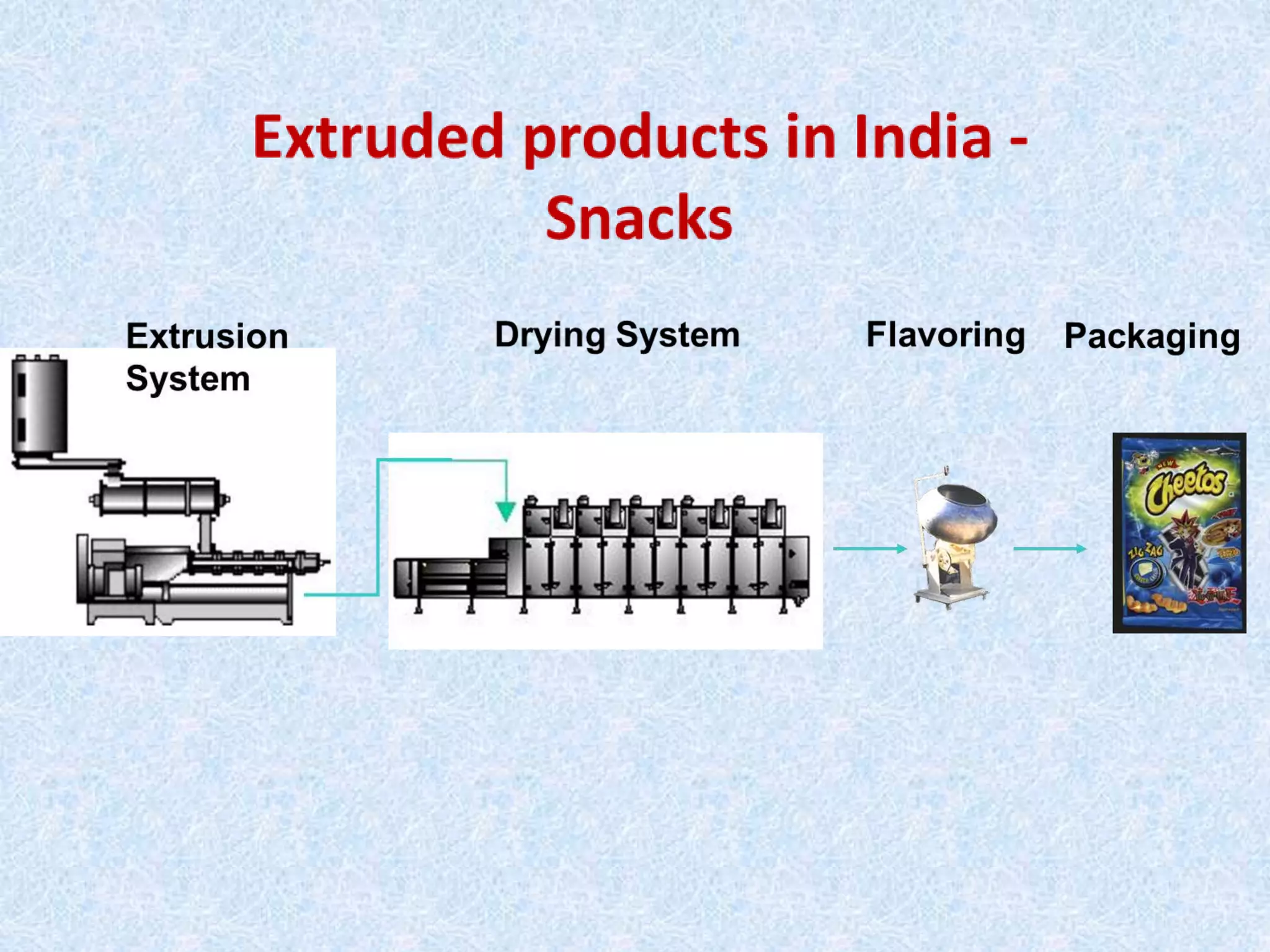
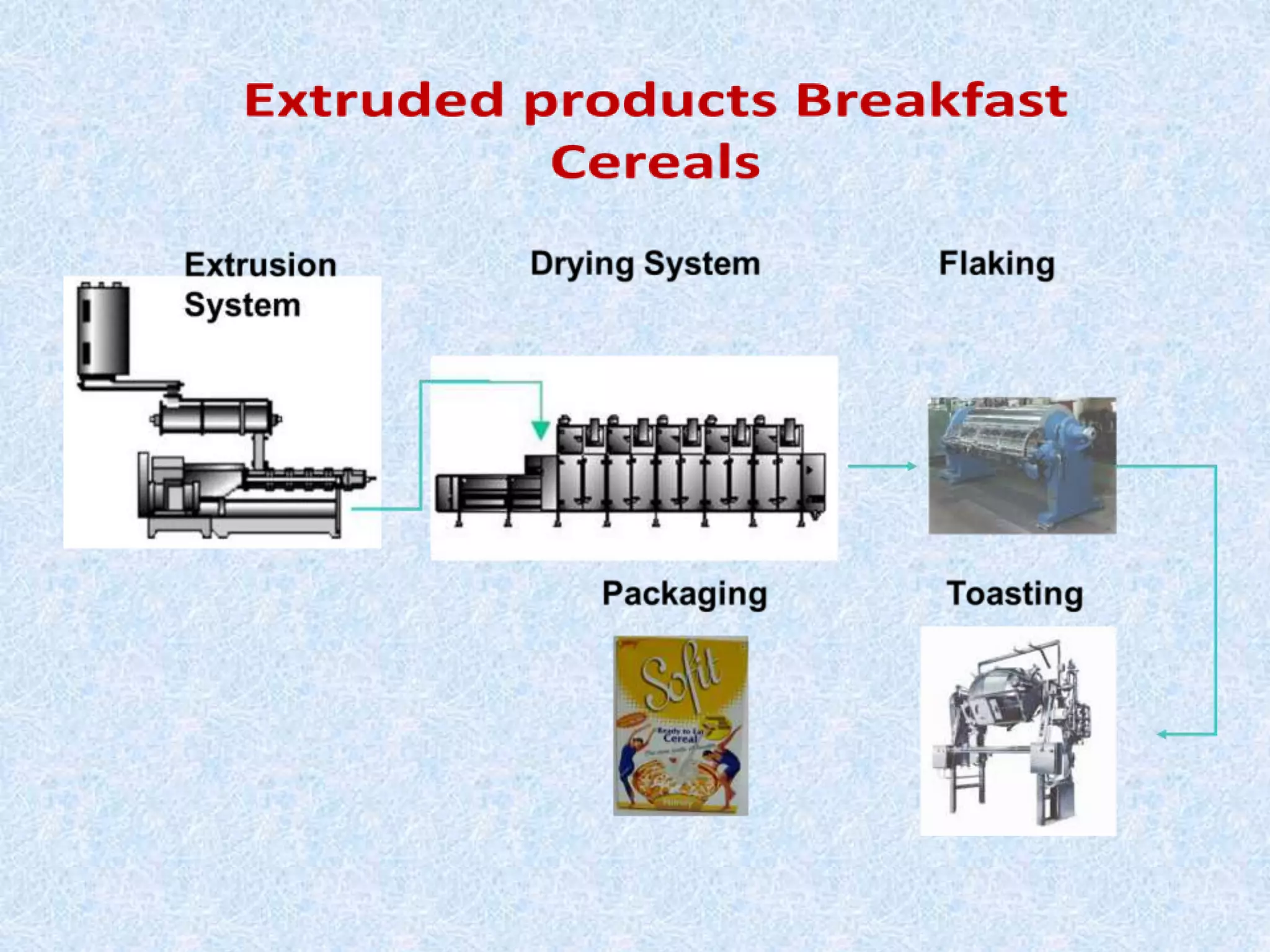
1e.Extrusion
• It is a process of mixing, kneading , shaping, shearing, cooking and forming
• According to the method of operation
– Cold extruders
– Extruder cookers
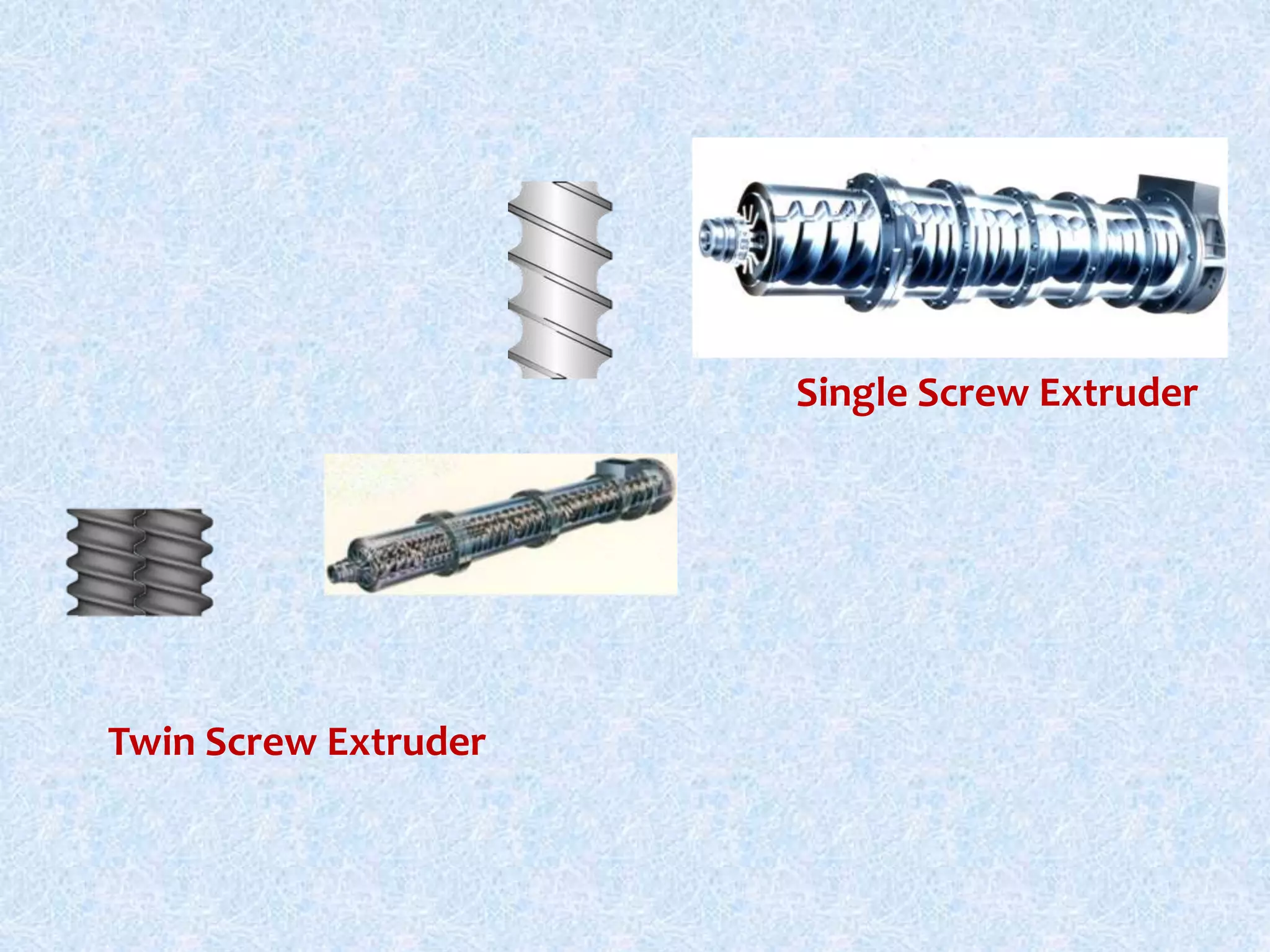
• Method of construction
– Single screw
– Double screw
• Extrusion cooking is HTST process
Extruder
Twin Screw Extruder
Single Screw Extruder
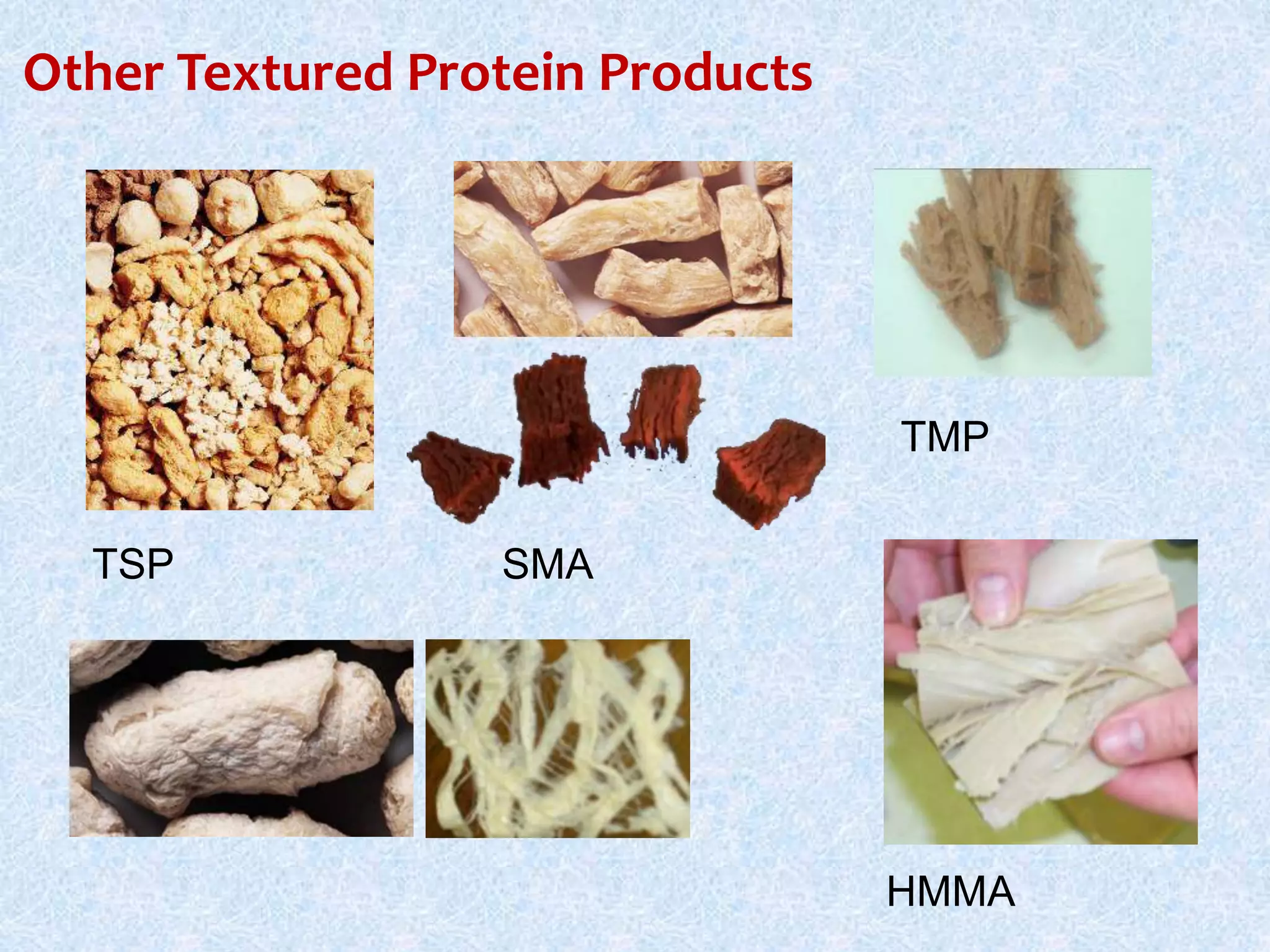
Other Textured Protein Products
HMMA
TSP SMA
TMP
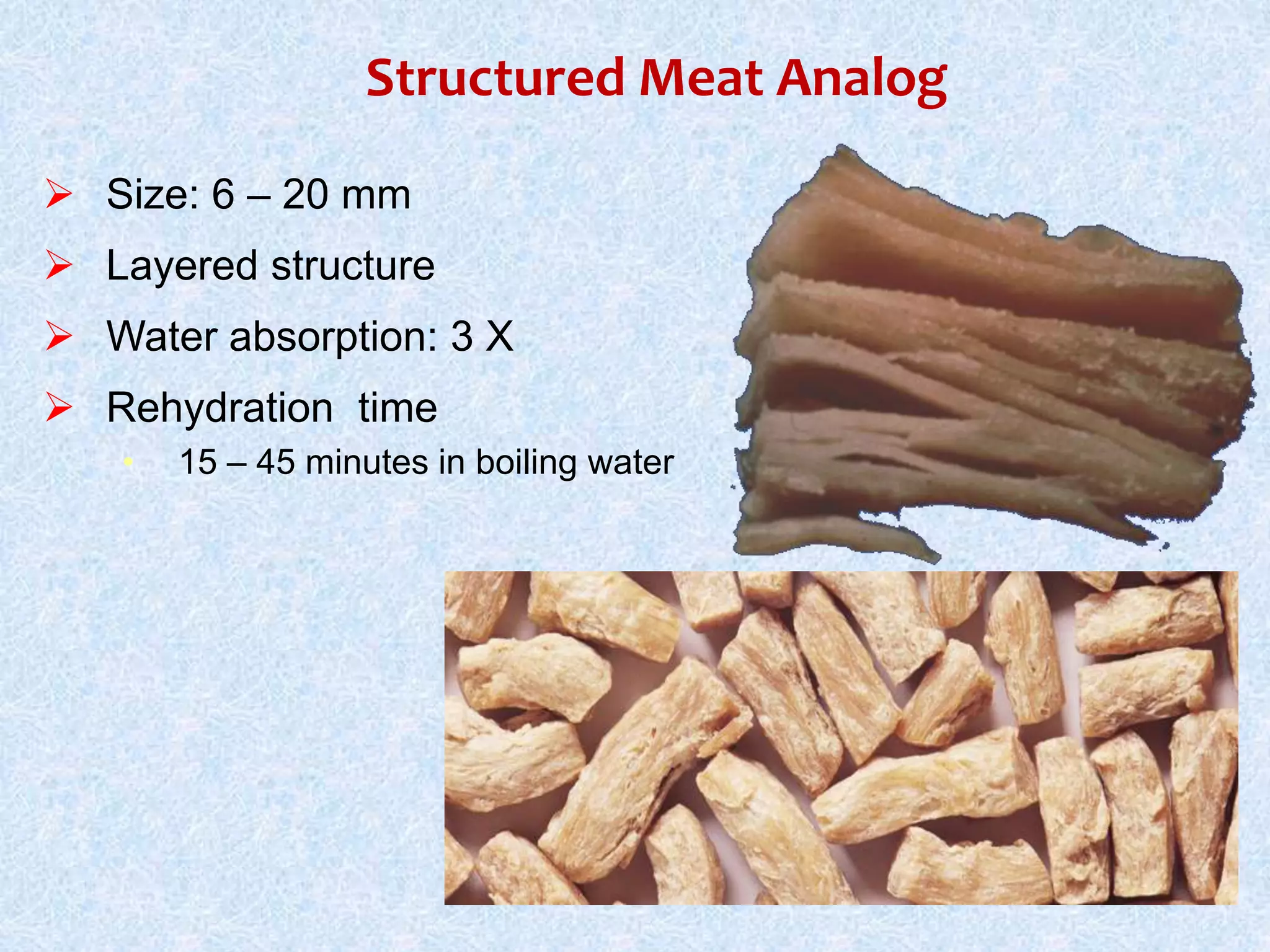
 Size: 6 – 20 mm
 Layered structure
 Water absorption: 3 X
 Rehydration time
• 15 – 45 minutes in boiling water
Structured Meat Analog
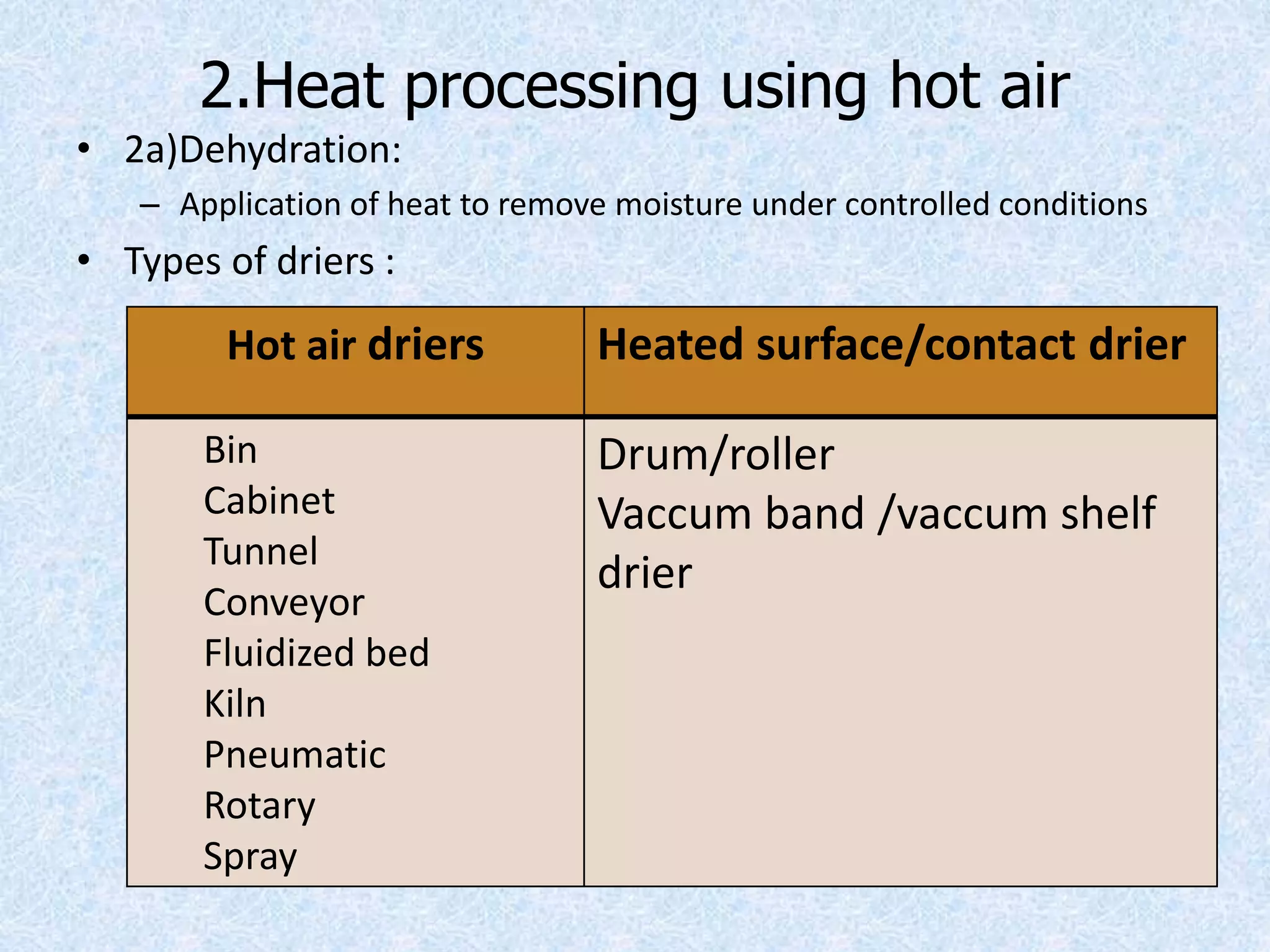
2.Heat processing using hot air
• 2a)Dehydration:
– Application of heat to remove moisture under controlled conditions
• Types of driers :
Hot air driers Heated surface/contact drier
Bin
Cabinet
Tunnel
Conveyor
Fluidized bed
Kiln
Pneumatic
Rotary
Spray
Drum/roller
Vaccum band /vaccum shelf
drier
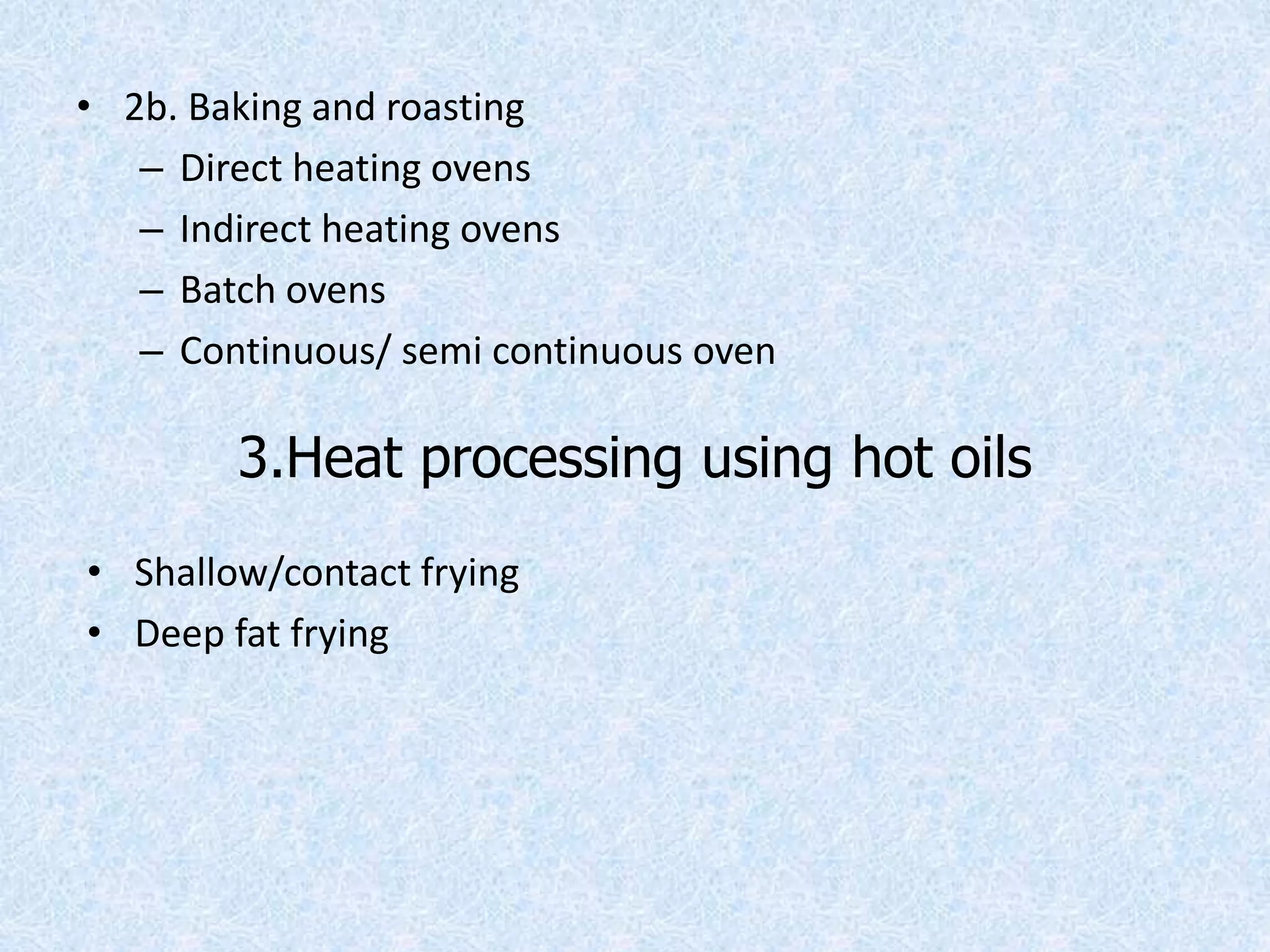
• 2b. Baking and roasting
– Direct heating ovens
– Indirect heating ovens
– Batch ovens
– Continuous/ semi continuous oven
3.Heat processing using hot oils
• Shallow/contact frying
• Deep fat frying
4.Heat processing by direct and radiated energy
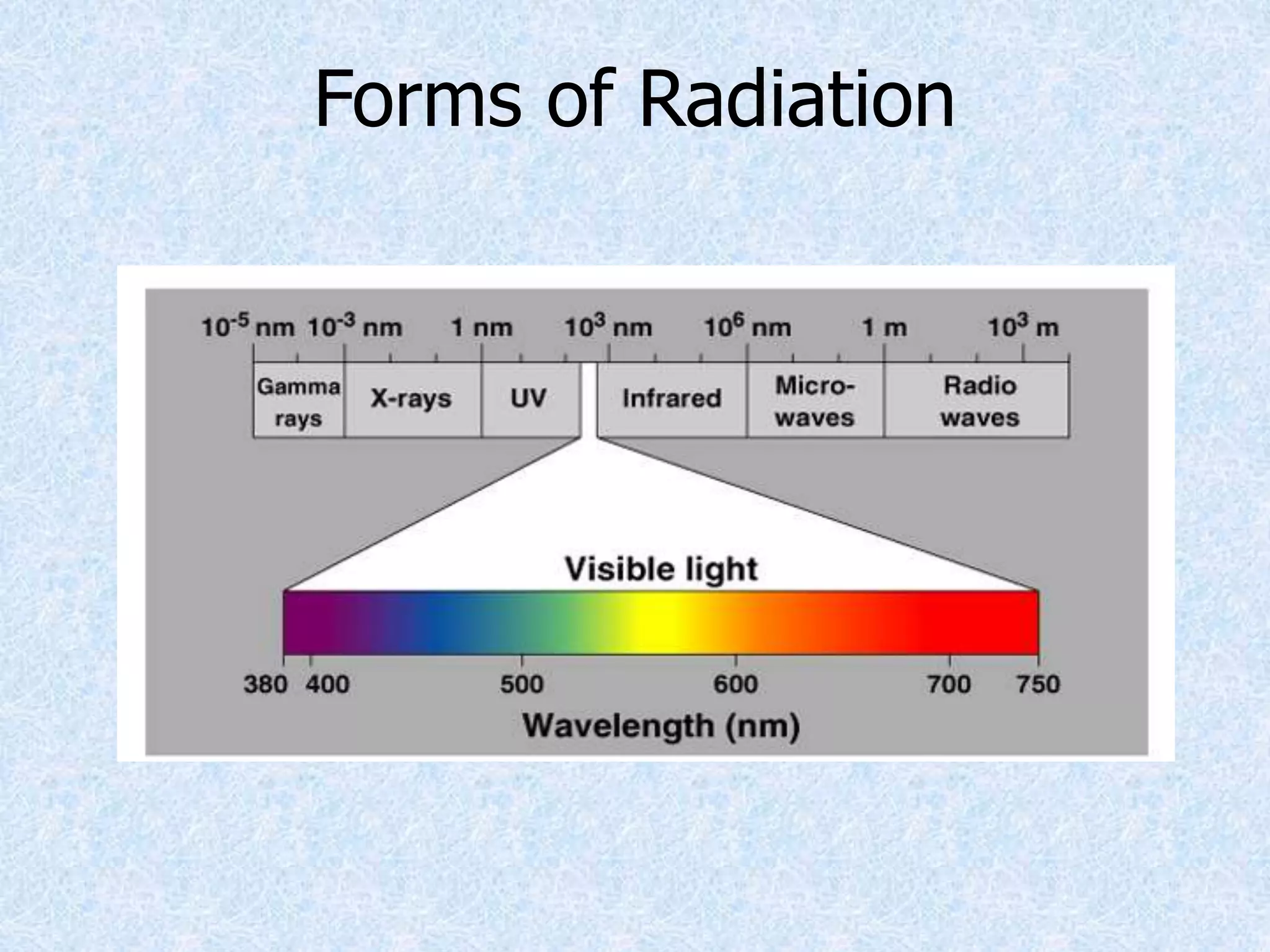
Dielectric and radiant energy are two forms of electromagnetic energy
4a Dielectric heating/Direct method
1.Microwave
2.Radio frequency heating
Microwave:
– Electromagnetic waves from power source magnetron are absorbed
by the water dipole molecule
– Water molecule vibrates rapidly in the food 2,450 million times/sec
– Vibration produces friction that generates heat
– Magnetic waves reflected by metals and absorbed by food
Used in blanching, pasteurization and sterilization
4.Heat processing by direct and radiated energy
Dielectric and radiant energy are two forms of electromagnetic energy
4a Dielectric heating/Direct method
1.Microwave
2.Radio frequency heating
Microwave:
– Electromagnetic waves from power source magnetron are absorbed
by the water dipole molecule
– Water molecule vibrates rapidly in the food 2,450 million times/sec
– Vibration produces friction that generates heat
– Magnetic waves reflected by metals and absorbed by food
Used in blanching, pasteurization and sterilization
Forms of Radiation
• Radio frequency heating: (Similar as microwave )
• The food is passed between electrodes and radio frequency is applied across
the electrodes. Change in orientation of water in the food yields high
temperature.
• Major application in thawing, tempering, dehydration and baking
• Advantage: (Microwave & Radio frequency)
• Heating is rapid
• No surface browning
• Limited/ no contamination
• Easy operation
Ohmic heating/resistance heating(Direct method)
• An alternate electric current is passed through food the electrical
resistance of the food causes the power to be translated directly into heat
• Can be used for UHT sterilization of foods
• No risk of burning /fouling, as there is no hot surface
• No risk of damage for heat sensitive foods
• Energy conversion efficiency is >90%
• Suitable for viscous liquid
• Suitable for continuous processing
• Lowe capital cost than microwave.
Infrared heating
• It is electromagnetic radiation emitted by hot objects when it is absorbed
the radiation gives up its energy to heat materials.
• Heat transfer depends upon
• Surface temperature of heating and receiving material
• Surface properties of two materials
• Shape of the emitting and receiving bodies.
• Types of radiant heaters
– Flat metal heaters
– Tubular
– Ceramic
– Quartz
– Halogen tubes
Radiation; (Cold sterilization)
1. Ionizing Radiation: Gamma rays, X rays, electron
beams, or higher energy rays. Have short wavelengths
(less than 1 nanometer).
• Dislodge electrons from atoms and form ions.
• Cause mutations in DNA and produce peroxides.
• Usage in food industry is increasing
Disadvantages: Penetrates human tissues. May cause
genetic mutations in humans.
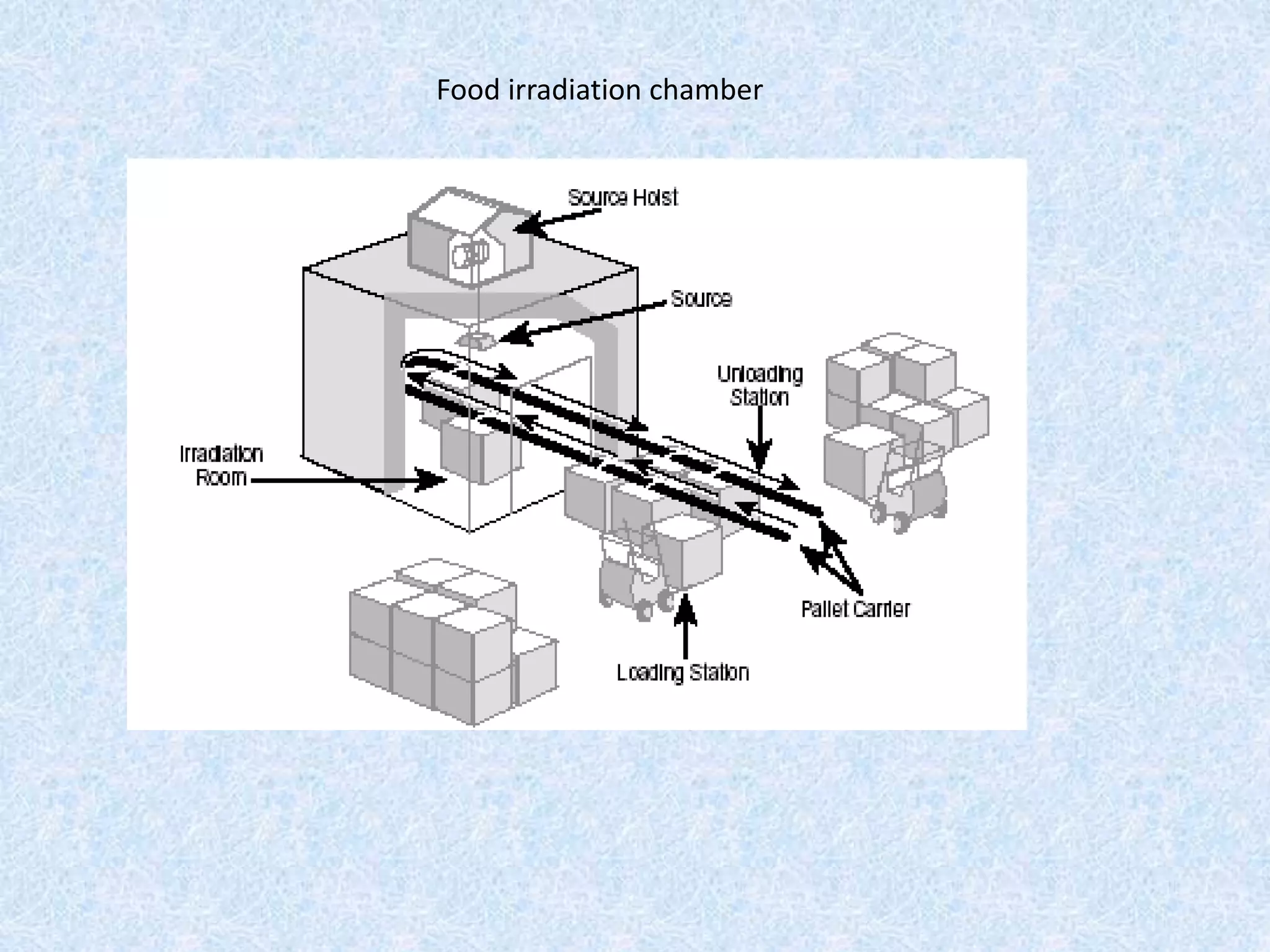
Benefits of Food Irradiation
• 􀁺 Low Dose (<1kGy):
• – Insect disinfections
• – Sprout inhibition
• – Maturation delay
• – Extend shelf life
• 􀁺 Medium Dose (1-10 kGy):
• – Reduction in food-borne diseases
• – Reduction of spoilage microorganisms
• 􀁺 High Dose (10-50 kGy):
• – Sterilization
Food irradiation chamber
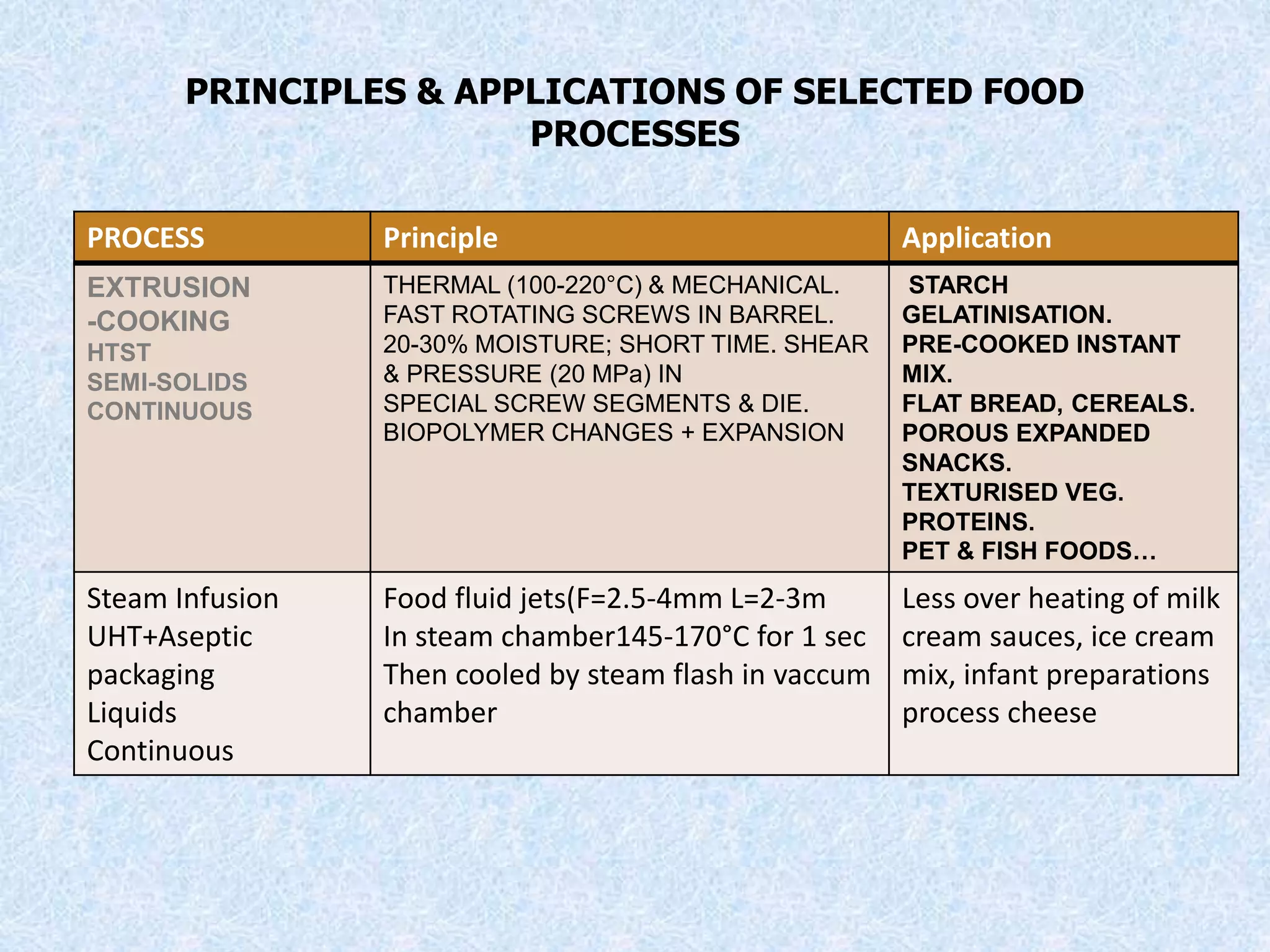
PRINCIPLES & APPLICATIONS OF SELECTED FOOD
PROCESSES
PROCESS Principle Application
EXTRUSION
-COOKING
HTST
SEMI-SOLIDS
CONTINUOUS
THERMAL (100-220°C) & MECHANICAL.
FAST ROTATING SCREWS IN BARREL.
20-30% MOISTURE; SHORT TIME. SHEAR
& PRESSURE (20 MPa) IN
SPECIAL SCREW SEGMENTS & DIE.
BIOPOLYMER CHANGES + EXPANSION
STARCH
GELATINISATION.
PRE-COOKED INSTANT
MIX.
FLAT BREAD, CEREALS.
POROUS EXPANDED
SNACKS.
TEXTURISED VEG.
PROTEINS.
PET & FISH FOODS…
Steam Infusion
UHT+Aseptic
packaging
Liquids
Continuous
Food fluid jets(F=2.5-4mm L=2-3m
In steam chamber145-170°C for 1 sec
Then cooled by steam flash in vaccum
chamber
Less over heating of milk
cream sauces, ice cream
mix, infant preparations
process cheese
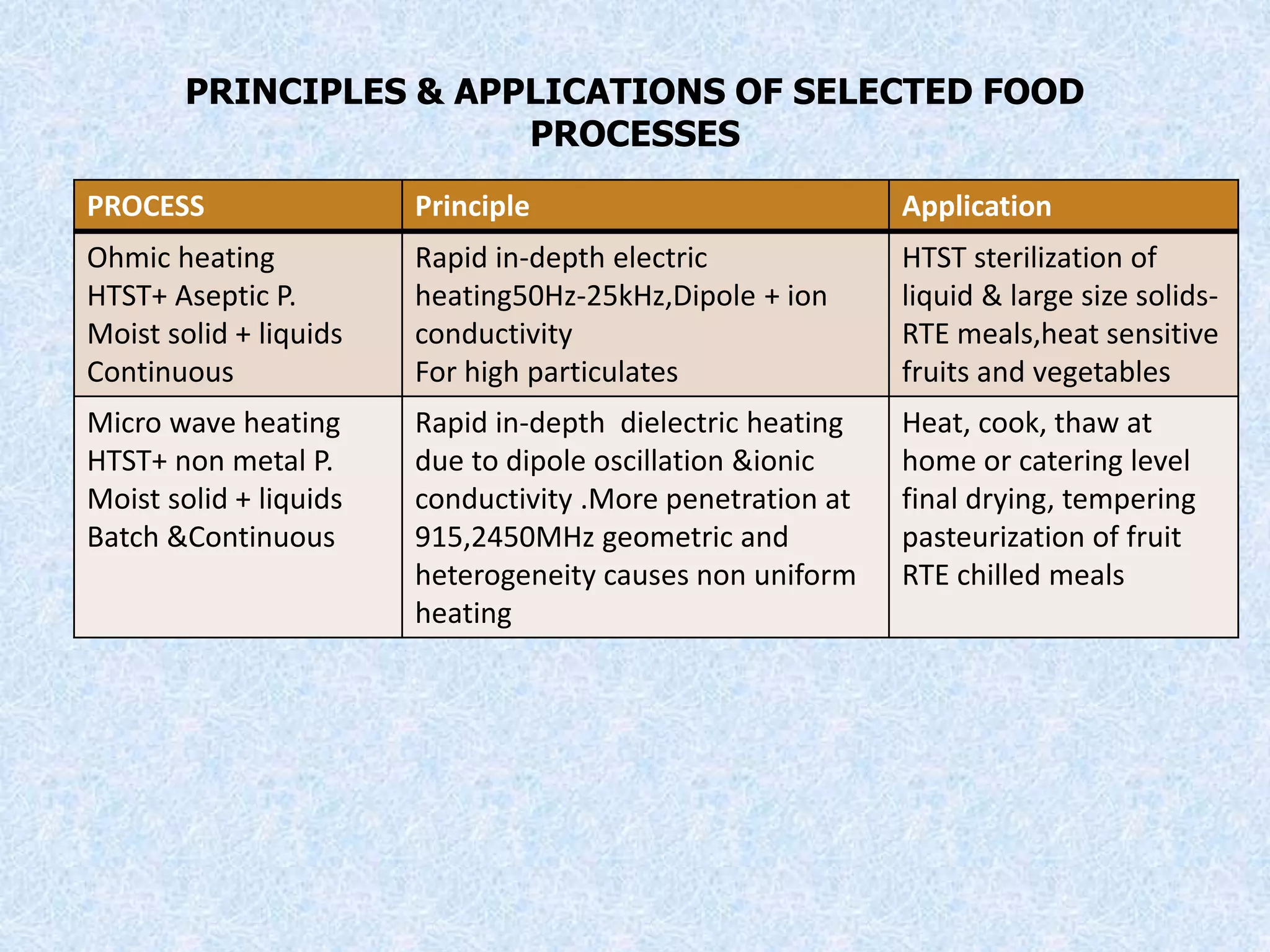
PRINCIPLES & APPLICATIONS OF SELECTED FOOD
PROCESSES
PROCESS Principle Application
Ohmic heating
HTST+ Aseptic P.
Moist solid + liquids
Continuous
Rapid in-depth electric
heating50Hz-25kHz,Dipole + ion
conductivity
For high particulates
HTST sterilization of
liquid & large size solids-
RTE meals,heat sensitive
fruits and vegetables
Micro wave heating
HTST+ non metal P.
Moist solid + liquids
Batch &Continuous
Rapid in-depth dielectric heating
due to dipole oscillation &ionic
conductivity .More penetration at
915,2450MHz geometric and
heterogeneity causes non uniform
heating
Heat, cook, thaw at
home or catering level
final drying, tempering
pasteurization of fruit
RTE chilled meals
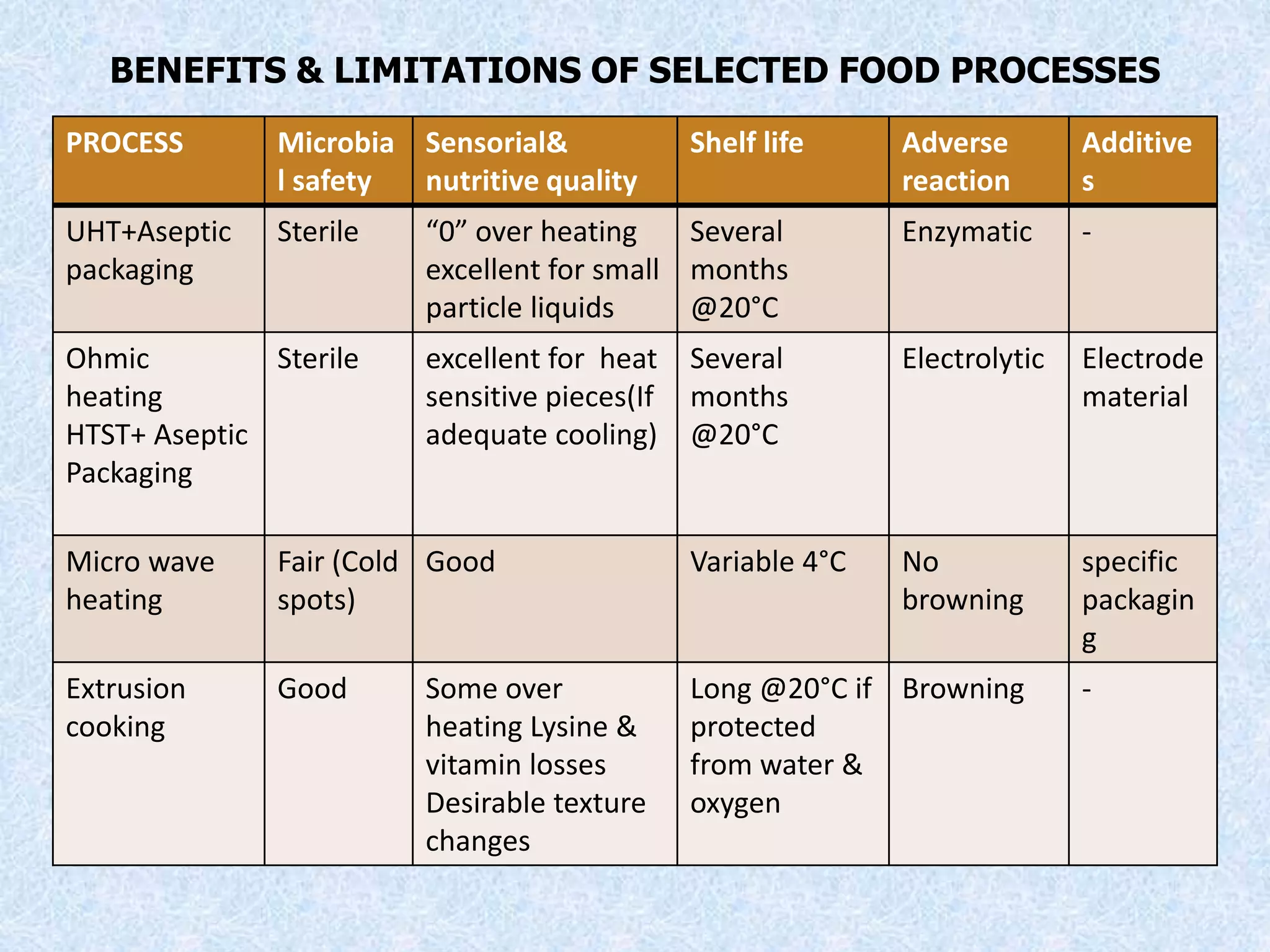
BENEFITS & LIMITATIONS OF SELECTED FOOD PROCESSES
PROCESS Microbia
l safety
Sensorial&
nutritive quality
Shelf life Adverse
reaction
Additive
s
UHT+Aseptic
packaging
Sterile “0” over heating
excellent for small
particle liquids
Several
months
@20°C
Enzymatic -
Ohmic
heating
HTST+ Aseptic
Packaging
Sterile excellent for heat
sensitive pieces(If
adequate cooling)
Several
months
@20°C
Electrolytic Electrode
material
Micro wave
heating
Fair (Cold
spots)
Good Variable 4°C No
browning
specific
packagin
g
Extrusion
cooking
Good Some over
heating Lysine &
vitamin losses
Desirable texture
changes
Long @20°C if
protected
from water &
oxygen
Browning -
Thermal processing technologies

Thermal processing technologies

  • 1.
    Thermal Food ProcessingTechnologies Er. P.C.Vengaiah Scientist(Food Science &Technology) Dr.Y.S.R. Horticultural University Horticultural Research Station Pandirimamidi-533288 Andhra Pradesh
  • 2.
    COOKING •Baking •Broiling •Roasting •Boiling •Stewing •Frying •To make foodmore palatable, improve taste: – Alteration of color, flavor, texture – Improved digestibility •Not a preservation technique but: –Destroy or reduce m.o. –Inactivation of enzymes –Destruction of toxins
  • 3.
    Limitations • Loss ofheat sensitive vitamins • Leaching of nutrients • Reduces quality of proteins • Leaching of colouring pigments and flavonoids
  • 4.
    HEAT/THERMAL PROCESSİNG •Applying heatto foods to decrease the concentration of the viable microorganisms to such a level that would only allow growth of microorganisms and spores in the food under defined storage conditions to an acceptable level (commercial sterility).
  • 5.
    Heat/thermal processing • Theuse of high temperature to produce safe food products dates to the 1790s in France. • Napoleon Bonaparte offered a prize to scientists to develop preserved foods for the armies of France. • This offer lead to the research of commercial sterilization of foods by Nicholas Appert . • In the 1860s, Louis Pasteur, while working with beer and wine, developed the process of pasteurization.
  • 6.
    Commercial thermal processingtechniques 1.Heat processing using steam/water 1a.Blanching 1b. Pasteurization 1c. Sterilization 1d. Evaporation and distillation 1e. Extrusion 2. Heat processing using hot air 2a.Dehydration 2b. Baking 2c. Roasting 3. Heat processing using hot oils 3a. Frying 4.Direct and radiated energy 4a. Dielectric heating • Radio Frequency Heating • Microwave Processing 4b. Ohmic Heating 4c. Infrared Heating.
  • 7.
    1.Heat processing usingsteam/water 1a.Blanching • Blanching is a pre treatment like scalding vegetables in boiling water or steam for a short time. • It stops enzyme actions which can cause loss of flavor, color and texture. • Blanching cleanses the surface of dirt and organisms, brightens the color and helps retard loss of vitamins. • It also wilts or softens vegetables and makes them easier to pack. • Blanching time is influenced by – Type of fruit or vegetable – Size of the piece of the food – Blanching temperature – Method of blanching • Under blanching stimulates the activity of enzymes and is worse than no blanching. • Over blanching causes loss of flavor, color, vitamins and minerals
  • 8.
    Types of blanchers •Steam blanchers • IQB • Batch-fluidised bed blancher • Hot water blanchers • Microwave blanchers • Hot gas IQM blancher Microwave blancher Fluid bed blancher& dryer
  • 9.
    Tunnel blancher Steam blancher Singlewall blancher Microwave blancher
  • 10.
    Stem blanchers • Itconsists of mesh conveyer belt, carries food through a steam atmosphere in a tunnel. • The residence time is controlled by the speed of the conveyer belt • Efficiency of energy consumption is 19%, ( hydrostatic valves -27%) • less loss of water soluble vitamins • Disadvantage: – Poor uniformity of heating – Enzyme inactivation tests leads to over cooking – Nutrients leaching -oxidation of product becomes a problem • Individual quick blanching (IQB) • I stage: Food is heated in single layer to inactivate enzymes( pre conditioning) • II stage (adiabatic holding): each piece of the food is held for sufficient time to inactivate the enzymes at centre portion of food • Advantages: – Reduced nutrient loss by 81% – Energy efficiency -86-91%
  • 11.
    • Batch-fluidised bedblancher – Blancher moves in a chamber of air and steam @4.5m/s • Advantages: – Faster more uniform heating – Good mixing of the product – Low effluents, Shorter processing time so low nutrients loss • Hot water blanchers: – Food is held in hot water at 70-100°C for specified time – Effective washing process • Microwaves: – very expensive and complex equipment is required -low leaching losses • Hot Gas- Expensive -hot gas from a furnace is blown down through the product along with steam which reduces dehydration and increases the heat transfer rate
  • 12.
    1b.Pasteurization • The heatingevery particle of product to a specific temperature (<100°C)of for a specified period of time without allowing recontamination during the heat treatment process • Packaged foods : – Max tem difference b/n container and water is 20°C for heating and 10°C for cooling to prevent thermal shocks – Batch method – Steam tunnels • Unpackaged foods: 1.Plate heat exchanger 2. Tubular heat exchanger More uniform heat treatment Greater flexibility for different products Greater control over pasteurization conditions • Shelf life can be extended by few days or weeks
  • 13.
  • 14.
  • 15.
    1c. Commercial Sterilization •Operation in which product is placed in a hermetic container (canned foods), heated at a sufficiently high temperature for a sufficient length of time to destroy all microbial and enzyme activity • Primary objective: • Destroy the most heat resistance pathogenic spore-forming organisms ---ex.-Clostridium botulinum in products > pH 4.6 • Secondary objective: • "commercial sterility" implies less than absolute destruction of all micro-organisms and spores, but any remaining would be incapable of growth in the food under existing conditions.
  • 16.
    • Destruction ofvegetative and spore-forming microorganisms that cause spoilage. Spoilage spore-formers are usually more heat resistant than pathogenic spore formers to develop Commercially Sterile Foods • The shelf life can be increased to >6 months • Severity of treatment can result in substantial changes to nutritive and sensory characteristics Methods of sterilization •In-package sterilization, in which product is packed into a container, and the container of product is then sterilized. eg canning, some bottled products, retort pouches etc. •UHT or Aseptically processing, in which the product and the package is sterilized separately, then the package is filled with the sterile product and sealed under sterile conditions eg “long life” milk, “tetrapack” or “combibloc” fruit juices and soups etc
  • 17.
    Length of timefor sterilization depends on •Heat resistance of m.o. •pH and composition of food •Size of the container •Physical state of food material • Sensory/quality of product • Rate of heat penetration • Type of processor/retort
  • 18.
    High vs. LowAcid Foods • Foods can be classified on the basis of pH – > pH 4.6 are low acid, foods< pH 4.6 are acid foods – If the Aw of food is <0.85, it can be classified as acid at ph>4.6. – Processing times and temperatures are lower for acid foods because…. -microorganisms are more easily destroyed in an acid environment -C. botulinum spores cannot germinate below pH 4.6.
  • 19.
    Rate of heatpenetration •Type of product •Agitation of container •Retort temperature •Size of container •Shape of container •Type of container
  • 20.
    Retorting(Heat processing) •Product processedin the package – Can – Flexible pouch – Glass – Rigid trays • The usual heat transfer fluids are: –saturated steam –water –steam -air mixture •Processing time depends on heating the most slowly heating part of the product. •Retorts (Pressure processors) Still –Vertical –Horizontal –Agitating –Batch –Continuous Rotary Hydrostatic cooker (pressure provided by a 40 –50 feet of head pressure)
  • 21.
    Operations in retorting/canning •Inspectionof incoming raw materials •Food preparation (thawing, cleaning, washing, sorting, grading, peeling, trimming, slicing or dicing for vegetables and fruits. Meats and fish may be tempered, boned, trimmed, diced, minced or sliced etc. •Blanching •Filling the container •Exhausting •Sealing the container •Heat processing •Cooling •Incubation and quality control checks •Labeling and dispatch
  • 22.
    Filling •At this stagethe food is placed into the container. • Under filling gives a large headspace. Large headspaces result in –Low vacuum if heat exhaust is used. –Mushiness of the contents due to excessive movement inside the can. –Contravening the Pure Food Act Regulations due to under filling. •Overfilling produces excessively small headspaces, resulting in –Low vacuum if steam flow closure is relied on for vacuum. –Swelling of can due to hydrogen production. –Under processing if the process depends on agitation to mix the contents during processing. –Springiness or distortion of can. –Increased chance that food may be trapped between the can lid and body with the production of a faulty seam. •The cans are periodically weighed on line, headspaces, drained and net weights are determined on the finished products in order to check the adequacy of the filling process.
  • 23.
  • 24.
    Exhausting •Exhausting aims toremove air from the package before closure. Correct exhausting will: –Remove all gases from the headspace which will minimise strains on seams during retorting. –Remove oxygen, otherwise corrosion, oxidation and dis colouration will result. –Forms vacuum on cooling to give space for the gases which are formed on storage. •There are three exhausting methods available: •HEAT EXHAUST •STEAM INJECTION •MECHANICAL EXHAUST
  • 25.
    Exhausting •HEAT EXHAUST •Contents areheated before sealing. •This is ideal for products containing lots of trapped air. •Final temperature depends on closing temperature and headspace. •STEAM INJECTION •Also referred to as STEAM FLOW CLOSURE •This flushes the headspace out with a jet of steam just before closing. •This method is more effective where products are packed in hot brines and syrups where ever a large headspace exists. •MECHANICAL EXHAUST •Uses a vacuum pump to remove air from the package. •Food is filled at low temperatures. •This method is useful for foods which trap a great deal of air. •A vacuum gauge is used on a cooled can to determine the vacuum of a can. •The minimum acceptable pressure is about -23kPa. •Desirable vacuum will vary for different products
  • 26.
    Retort Operation • -Containersare loaded into baskets. • -The retort lid is sealed. Venting stage -Air trapped inside the retort is removed prior processing. • If air is present at a given pressure the temperature inside the retort will be lower than that attained by steam alone. • A mixture of air and steam may stratify leading to cool spots where there is air. • This mixture is a less efficient heat transfer medium than steam alone. • Air in the retort cuts down the heat penetration of steam by insulating the cans and can accelerate external corrosion. When venting is completed the venting valve closes • Pressure begins to build up in the retort. • When process temperature is reached the thermometer and pressure gauge readings must agree. • High acid foods (pH <4.5) are usually processed at low pressures of 34kpa. • Low acid foods (pH > 4.5) are processed at 73 or 103kpa.
  • 27.
    RETORT OPERATION •The timefrom when the steam is turned on to when the process temperature is reached is the come-up time. Once this has finished the process begins. •Process time is from the end of the come-up time to the commencement of cooling. •During cooling the steam is turned off and water is added to the retort immediately to prevent overcooking. Methods of cooling: • For small cans at temperatures <116°C atmospheric cooling may be used. • For cans with a diameter greater than 6cm or processed at temperatures >116°C pressure cooling is used. In pressure cooling the pressure around the containers is maintained by – compressed air during the addition of water. – The water addition causes the steam to condense and the pressure outside the package drops suddenly. – As the internal pressure inside the container does not drop seam distortion may occur if the external pressure is not kept high. – At this stage can seams are very fragile and cans must be handled very carefully. – All water used for cooling heat processed foods must be chlorinated to disinfect it in case water is sucked into the can during cooling.
  • 28.
    Loading a vertical retort Typicalthermal processing unit
  • 29.
    Aseptical Processing •Product processedoutside of package, then packaged under aseptic (sterile) conditions into a sterile package •UHT (ultra high temperature) sterilizers -heat exchanger •Product is heated and cooled very quickly • Basic Aseptic system Requirements: •Sterilizable equipment •Sterile product •Sterile packages •Sterile environment •Monitoring and recording equipment •Proper handling of finished product
  • 30.
    Aseptic Processing System •Common features: •Pumpable product •Controllable flow rate (part of scheduled process) •Method to heat product •Method to hold product at required temperature and time • Method for cooling product •Method to sterilize equipment •Adequate safeguards
  • 31.
    Aseptic Processing • ProductHeating 1. Direct – Steam injection – Steam infusion 2. Indirect – Plate heat exchanger – Tubular heat exchanger – Scraped surface heat exchanger • Product Cooling – Indirect -heat exchanger – Direct -flash or vacuum chamber • Aseptic Packaging
  • 32.
    Plant type Advantages Limitations ExcellentNot recommended Infusion Gentle & accurate heating, Accurate holding Superior product quality Long operation time Capital cost, Low regenerative Culinary steam High quality product Low cost products Fibres Injection -do- Over-heating Holding time Sensitive Products Cream, Ice Cream Coffee / Tea Volatile aroma Tubular High regeneration, Long running time, Particulates and fibres, No gasket Low maintenance cost Lower regenerative than plateUHT, Higher degree of product Degradation Low cost products Volatile aroma Coffee whiteners Product with fibres,Juice Coffee / Tea Plate High regeneration Low space requirement Low investment Low running cost Particulates or Fibres Gaskets High pressure drops Volatile aroma Coffee whiteners Juice Coffee / Tea
  • 33.
  • 34.
    • Infusion UHTPlant Infusion UHT Plant
  • 35.
    1d.Evaporation/concentration • Evaporator consistsof – Heat exchanger – Means of separation of water produced – Mechanical or steam ejector pump • Types of evaporators – Natural circulation evaporators • Open/closed pan/kettle evaporator • External calandria evaporator • Short tube evaporator • Long tube evaporator – Forced circulation evaporators • Plate evaporator • Expanding flow evaporator – Mechanical/agitated thin film evaporators • Scraped or wiped surface evaporator • RO system
  • 36.
    1e.Extrusion • It isa process of mixing, kneading , shaping, shearing, cooking and forming • According to the method of operation – Cold extruders – Extruder cookers • Method of construction – Single screw – Double screw • Extrusion cooking is HTST process
  • 37.
  • 38.
  • 41.
    Other Textured ProteinProducts HMMA TSP SMA TMP
  • 42.
     Size: 6– 20 mm  Layered structure  Water absorption: 3 X  Rehydration time • 15 – 45 minutes in boiling water Structured Meat Analog
  • 43.
    2.Heat processing usinghot air • 2a)Dehydration: – Application of heat to remove moisture under controlled conditions • Types of driers : Hot air driers Heated surface/contact drier Bin Cabinet Tunnel Conveyor Fluidized bed Kiln Pneumatic Rotary Spray Drum/roller Vaccum band /vaccum shelf drier
  • 44.
    • 2b. Bakingand roasting – Direct heating ovens – Indirect heating ovens – Batch ovens – Continuous/ semi continuous oven 3.Heat processing using hot oils • Shallow/contact frying • Deep fat frying
  • 45.
    4.Heat processing bydirect and radiated energy Dielectric and radiant energy are two forms of electromagnetic energy 4a Dielectric heating/Direct method 1.Microwave 2.Radio frequency heating Microwave: – Electromagnetic waves from power source magnetron are absorbed by the water dipole molecule – Water molecule vibrates rapidly in the food 2,450 million times/sec – Vibration produces friction that generates heat – Magnetic waves reflected by metals and absorbed by food Used in blanching, pasteurization and sterilization
  • 46.
    4.Heat processing bydirect and radiated energy Dielectric and radiant energy are two forms of electromagnetic energy 4a Dielectric heating/Direct method 1.Microwave 2.Radio frequency heating Microwave: – Electromagnetic waves from power source magnetron are absorbed by the water dipole molecule – Water molecule vibrates rapidly in the food 2,450 million times/sec – Vibration produces friction that generates heat – Magnetic waves reflected by metals and absorbed by food Used in blanching, pasteurization and sterilization
  • 47.
  • 48.
    • Radio frequencyheating: (Similar as microwave ) • The food is passed between electrodes and radio frequency is applied across the electrodes. Change in orientation of water in the food yields high temperature. • Major application in thawing, tempering, dehydration and baking • Advantage: (Microwave & Radio frequency) • Heating is rapid • No surface browning • Limited/ no contamination • Easy operation
  • 49.
    Ohmic heating/resistance heating(Directmethod) • An alternate electric current is passed through food the electrical resistance of the food causes the power to be translated directly into heat • Can be used for UHT sterilization of foods • No risk of burning /fouling, as there is no hot surface • No risk of damage for heat sensitive foods • Energy conversion efficiency is >90% • Suitable for viscous liquid • Suitable for continuous processing • Lowe capital cost than microwave.
  • 50.
    Infrared heating • Itis electromagnetic radiation emitted by hot objects when it is absorbed the radiation gives up its energy to heat materials. • Heat transfer depends upon • Surface temperature of heating and receiving material • Surface properties of two materials • Shape of the emitting and receiving bodies. • Types of radiant heaters – Flat metal heaters – Tubular – Ceramic – Quartz – Halogen tubes
  • 51.
    Radiation; (Cold sterilization) 1.Ionizing Radiation: Gamma rays, X rays, electron beams, or higher energy rays. Have short wavelengths (less than 1 nanometer). • Dislodge electrons from atoms and form ions. • Cause mutations in DNA and produce peroxides. • Usage in food industry is increasing Disadvantages: Penetrates human tissues. May cause genetic mutations in humans.
  • 52.
    Benefits of FoodIrradiation • 􀁺 Low Dose (<1kGy): • – Insect disinfections • – Sprout inhibition • – Maturation delay • – Extend shelf life • 􀁺 Medium Dose (1-10 kGy): • – Reduction in food-borne diseases • – Reduction of spoilage microorganisms • 􀁺 High Dose (10-50 kGy): • – Sterilization
  • 53.
  • 54.
    PRINCIPLES & APPLICATIONSOF SELECTED FOOD PROCESSES PROCESS Principle Application EXTRUSION -COOKING HTST SEMI-SOLIDS CONTINUOUS THERMAL (100-220°C) & MECHANICAL. FAST ROTATING SCREWS IN BARREL. 20-30% MOISTURE; SHORT TIME. SHEAR & PRESSURE (20 MPa) IN SPECIAL SCREW SEGMENTS & DIE. BIOPOLYMER CHANGES + EXPANSION STARCH GELATINISATION. PRE-COOKED INSTANT MIX. FLAT BREAD, CEREALS. POROUS EXPANDED SNACKS. TEXTURISED VEG. PROTEINS. PET & FISH FOODS… Steam Infusion UHT+Aseptic packaging Liquids Continuous Food fluid jets(F=2.5-4mm L=2-3m In steam chamber145-170°C for 1 sec Then cooled by steam flash in vaccum chamber Less over heating of milk cream sauces, ice cream mix, infant preparations process cheese
  • 55.
    PRINCIPLES & APPLICATIONSOF SELECTED FOOD PROCESSES PROCESS Principle Application Ohmic heating HTST+ Aseptic P. Moist solid + liquids Continuous Rapid in-depth electric heating50Hz-25kHz,Dipole + ion conductivity For high particulates HTST sterilization of liquid & large size solids- RTE meals,heat sensitive fruits and vegetables Micro wave heating HTST+ non metal P. Moist solid + liquids Batch &Continuous Rapid in-depth dielectric heating due to dipole oscillation &ionic conductivity .More penetration at 915,2450MHz geometric and heterogeneity causes non uniform heating Heat, cook, thaw at home or catering level final drying, tempering pasteurization of fruit RTE chilled meals
  • 56.
    BENEFITS & LIMITATIONSOF SELECTED FOOD PROCESSES PROCESS Microbia l safety Sensorial& nutritive quality Shelf life Adverse reaction Additive s UHT+Aseptic packaging Sterile “0” over heating excellent for small particle liquids Several months @20°C Enzymatic - Ohmic heating HTST+ Aseptic Packaging Sterile excellent for heat sensitive pieces(If adequate cooling) Several months @20°C Electrolytic Electrode material Micro wave heating Fair (Cold spots) Good Variable 4°C No browning specific packagin g Extrusion cooking Good Some over heating Lysine & vitamin losses Desirable texture changes Long @20°C if protected from water & oxygen Browning -