FOOD SCIENCE AND NUTRITION
ASSIGNMENT
TOPIC:PRESERVATION BY HEAT
TREATMENT-CANNING,PASTEURISATION,
STERILISATION
INTRODUCTION:
• Heat is one of the most important methods of food
preservation and it finds very wide application
amongst various other means of preserving foods.
• Heat treatment kills both pathogenic and spoilage
microorganisms of suppresses their growth and
inactivates enzymes.
• Heat can be applied in different forms such as
1.CANNING
2.PASTEURIZATION
3.STERILISATION
CANNING:
• Canning is the process of applying heat to food
that sealed hermetically in a jar to destroy any
microorganism that can cause food spoilage.
• In canning the food is placed in containers,
heated, and then sealed, usually under vacuum.
• Canning process is advantageous in retaining the
stable vitamins and colour and flavour of food
items.
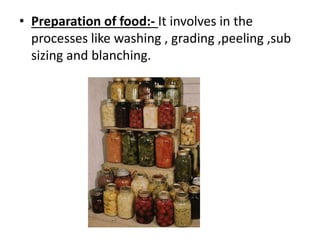
• Preparation of food:- It involves in the
processes like washing , grading ,peeling ,sub
sizing and blanching.
• Filling of cans:- The hot food is then filled into
pre-heated cans .
• Cans are also kept hot in order to expand the
food, remove air or gas trapped with in.
• Containers are not completely filled with food.
• Headspace of not more than 10 per vent of
the total container volume is maintained for
exapansion of food during heating
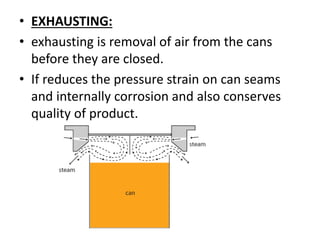
• EXHAUSTING:
• exhausting is removal of air from the cans
before they are closed.
• If reduces the pressure strain on can seams
and internally corrosion and also conserves
quality of product.
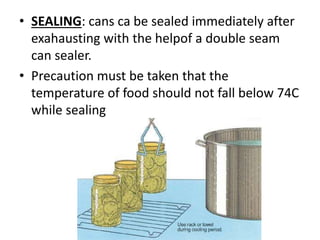
• SEALING: cans ca be sealed immediately after
exahausting with the helpof a double seam
can sealer.
• Precaution must be taken that the
temperature of food should not fall below 74C
while sealing
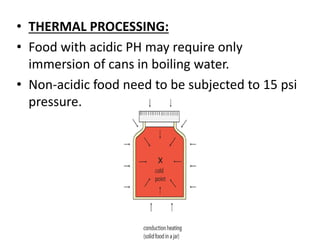
• THERMAL PROCESSING:
• Food with acidic PH may require only
immersion of cans in boiling water.
• Non-acidic food need to be subjected to 15 psi
pressure.
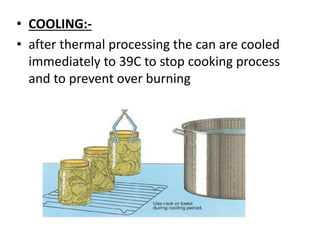
• COOLING:-
• after thermal processing the can are cooled
immediately to 39C to stop cooking process
and to prevent over burning
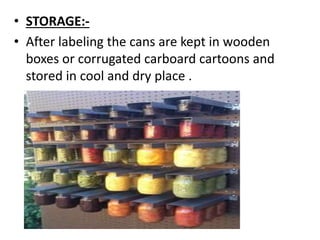
• STORAGE:-
• After labeling the cans are kept in wooden
boxes or corrugated carboard cartoons and
stored in cool and dry place .
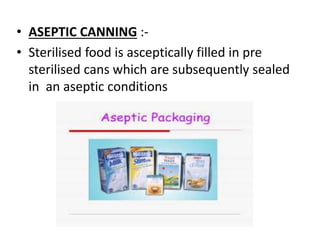
• ASEPTIC CANNING :-
• Sterilised food is asceptically filled in pre
sterilised cans which are subsequently sealed
in an aseptic conditions
• HOT PACK:-
• It involves in filling of pre—pasteurised food
while still in clean containers but not
essentially sterile containers under clean but
not necessarily aseptic conditions .
PASTERIZATION
• It is an mild heat treatment for relatively brief
duration to kill apart of one organisms and to
eliminate human pathogens present in the
body.
• The main purpose of pasteurisation is
destruction micro organisms along with
enzyme inactivation.
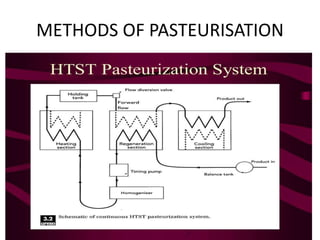
METHODS OF PASTEURISATION
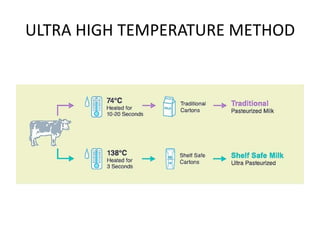
ULTRA HIGH TEMPERATURE METHOD
LOW TEMPERATURE LONG TIME
METHOD
• In LTLT pasteurization the pasteurisation is in
the order of minutes and related to the
temperature use , the minimal heat treatment
for market milk is 62.8C for 30 min holding
method and for grape juice is 76.7C for 30
min.
STERILIZATION
• Sterilization refers to complete destruction of
microorganisms .
• Heat treatment-121C
• Temperature at sea level is 100C at
atmospheric pressure but with 15psi
temperature of 121.5C can be achieved .

Preservation by canning,sterilisation

  • 1.
    FOOD SCIENCE ANDNUTRITION ASSIGNMENT TOPIC:PRESERVATION BY HEAT TREATMENT-CANNING,PASTEURISATION, STERILISATION
  • 2.
    INTRODUCTION: • Heat isone of the most important methods of food preservation and it finds very wide application amongst various other means of preserving foods. • Heat treatment kills both pathogenic and spoilage microorganisms of suppresses their growth and inactivates enzymes.
  • 3.
    • Heat canbe applied in different forms such as 1.CANNING 2.PASTEURIZATION 3.STERILISATION
  • 4.
    CANNING: • Canning isthe process of applying heat to food that sealed hermetically in a jar to destroy any microorganism that can cause food spoilage. • In canning the food is placed in containers, heated, and then sealed, usually under vacuum. • Canning process is advantageous in retaining the stable vitamins and colour and flavour of food items.
  • 5.
    • Preparation offood:- It involves in the processes like washing , grading ,peeling ,sub sizing and blanching.
  • 6.
    • Filling ofcans:- The hot food is then filled into pre-heated cans . • Cans are also kept hot in order to expand the food, remove air or gas trapped with in. • Containers are not completely filled with food. • Headspace of not more than 10 per vent of the total container volume is maintained for exapansion of food during heating
  • 7.
    • EXHAUSTING: • exhaustingis removal of air from the cans before they are closed. • If reduces the pressure strain on can seams and internally corrosion and also conserves quality of product.
  • 8.
    • SEALING: cansca be sealed immediately after exahausting with the helpof a double seam can sealer. • Precaution must be taken that the temperature of food should not fall below 74C while sealing
  • 9.
    • THERMAL PROCESSING: •Food with acidic PH may require only immersion of cans in boiling water. • Non-acidic food need to be subjected to 15 psi pressure.
  • 10.
    • COOLING:- • afterthermal processing the can are cooled immediately to 39C to stop cooking process and to prevent over burning
  • 11.
    • STORAGE:- • Afterlabeling the cans are kept in wooden boxes or corrugated carboard cartoons and stored in cool and dry place .
  • 12.
    • ASEPTIC CANNING:- • Sterilised food is asceptically filled in pre sterilised cans which are subsequently sealed in an aseptic conditions
  • 13.
    • HOT PACK:- •It involves in filling of pre—pasteurised food while still in clean containers but not essentially sterile containers under clean but not necessarily aseptic conditions .
  • 14.
    PASTERIZATION • It isan mild heat treatment for relatively brief duration to kill apart of one organisms and to eliminate human pathogens present in the body. • The main purpose of pasteurisation is destruction micro organisms along with enzyme inactivation.
  • 15.
  • 16.
  • 17.
    LOW TEMPERATURE LONGTIME METHOD • In LTLT pasteurization the pasteurisation is in the order of minutes and related to the temperature use , the minimal heat treatment for market milk is 62.8C for 30 min holding method and for grape juice is 76.7C for 30 min.
  • 18.
    STERILIZATION • Sterilization refersto complete destruction of microorganisms . • Heat treatment-121C • Temperature at sea level is 100C at atmospheric pressure but with 15psi temperature of 121.5C can be achieved .